Zoltan Kochan
c068720dec
Zoltan Kochan
c068720dec
* fix(pacquet): shorten long virtual store dirnames to avoid ENAMETOOLONG

Peer-heavy snapshot keys (e.g. vitest with a dozen browser / coverage /
DOM peers) produced flat-name directories that overflowed macOS's 255-
byte filename limit, so `install` aborted with errno 63 before unpacking
any tarballs. Port the trailing length / case-shortening branch of
upstream's `depPathToFilename` (deps/path/src/index.ts:169) so the name
becomes `<prefix>_<32-hex-sha256>` capped at `virtualStoreDirMaxLength`
bytes (default 120).

Extract `create_short_hash` and `shorten_virtual_store_name` into a new
`pacquet-crypto-hash` crate mirroring upstream `@pnpm/crypto.hash`;
`pacquet-lockfile`, `pacquet-registry`, and `pacquet-store-dir` all
consume it instead of duplicating the sha2 + truncate logic.

Reported via pnpm/pacquet issue triage (vitest@4.1.6 peer suffix).

* fix(pacquet): taplo format and remove broken intra-doc link

Format `pacquet/crates/crypto-hash/Cargo.toml` per the workspace
`.taplo.toml` (aligns the `[package]` keys) and downgrade the
`pacquet_modules_yaml::DEFAULT_VIRTUAL_STORE_DIR_MAX_LENGTH` reference
in `PkgNameVerPeer::to_virtual_store_name` to plain text, since
`pacquet-lockfile` deliberately does not depend on
`pacquet-modules-yaml` and `RUSTDOCFLAGS=-D warnings` rejected the
unresolved intra-doc link.

* feat(pacquet/config): expose virtualStoreDirMaxLength

Add `virtual_store_dir_max_length: u64` to `Config` with default 120
(matching `pacquet_modules_yaml::DEFAULT_VIRTUAL_STORE_DIR_MAX_LENGTH`).
Wire it through `WorkspaceSettings.virtualStoreDirMaxLength` and the
`PNPM_CONFIG_VIRTUAL_STORE_DIR_MAX_LENGTH` env-overlay so users can
override the threshold via `pnpm-workspace.yaml`, global `config.yaml`,
or environment variables — mirroring upstream
`Config.virtualStoreDirMaxLength`.

The three flat-name call sites (`install_without_lockfile.rs`,
`install_package_from_registry.rs`, `virtual_store_layout.rs`) and the
`.modules.yaml` writer now read the configured value instead of the
hardcoded constant. `VirtualStoreLayout::legacy` takes the value as an
explicit second arg so test fixtures don't silently inherit a default.
简体中文 | 日本語 | 한국어 | Italiano | Português Brasileiro

Fast, disk space efficient package manager:
- Fast. Up to 2x faster than the alternatives (see benchmark).
- Efficient. Files inside
node_modulesare linked from a single content-addressable storage. - Great for monorepos.
- Strict. A package can access only dependencies that are specified in its
package.json. - Deterministic. Has a lockfile called
pnpm-lock.yaml. - Works as a Node.js version manager. See pnpm runtime.
- Works everywhere. Supports Windows, Linux, and macOS.
- Battle-tested. Used in production by teams of all sizes since 2016.
- See the full feature comparison with npm and Yarn.
To quote the Rush team:
Microsoft uses pnpm in Rush repos with hundreds of projects and hundreds of PRs per day, and we’ve found it to be very fast and reliable.



Platinum Sponsors

|
Gold Sponsors

|

|

|

|

|

|

|

|
Silver Sponsors

|

|

|

|

|

|

|
⏱️ Time.now |
Support this project by becoming a sponsor.
Background
pnpm uses a content-addressable filesystem to store all files from all module directories on a disk. When using npm, if you have 100 projects using lodash, you will have 100 copies of lodash on disk. With pnpm, lodash will be stored in a content-addressable storage, so:
- If you depend on different versions of lodash, only the files that differ are added to the store.
If lodash has 100 files, and a new version has a change only in one of those files,
pnpm updatewill only add 1 new file to the storage. - All the files are saved in a single place on the disk. When packages are installed, their files are linked from that single place consuming no additional disk space. Linking is performed using either hard-links or reflinks (copy-on-write).
As a result, you save gigabytes of space on your disk and you have a lot faster installations!
If you'd like more details about the unique node_modules structure that pnpm creates and
why it works fine with the Node.js ecosystem, read this small article: Flat node_modules is not the only way.
💖 Like this project? Let people know with a tweet
Getting Started
Benchmark
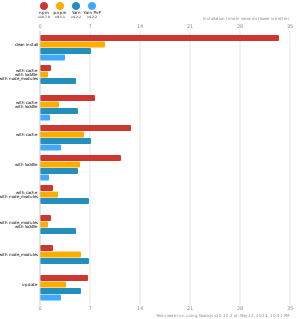
pnpm is up to 2x faster than npm and Yarn classic. See all benchmarks here.
Benchmarks on an app with lots of dependencies: