Zoltan Kochan
cc4ff817aa
Zoltan Kochan
cc4ff817aa
`PackageVersion` (the per-version registry manifest the npm resolver parses) was missing the `optionalDependencies` and `peerDependenciesMeta` fields. The resolver builds `ResolveResult.manifest` via `serde_json::to_value(picked)` and downstream walks it with [`extract_children`](https://github.com/pnpm/pnpm/blob/1fb8a2d5d8/pacquet/crates/resolving-deps-resolver/src/resolve_dependency_tree.rs#L752-L759) (reads `optionalDependencies`) and [`extract_peer_dependencies`](https://github.com/pnpm/pnpm/blob/1fb8a2d5d8/pacquet/crates/resolving-deps-resolver/src/resolve_dependency_tree.rs#L776-L824) (reads `peerDependenciesMeta`). Without those fields on the struct, both reads always saw nothing — so `optionalDependencies` edges were silently dropped, and every optional peer was treated as required, then auto-installed via the `autoInstallPeers` fallback in [`hoist_peers`](https://github.com/pnpm/pnpm/blob/1fb8a2d5d8/pacquet/crates/resolving-deps-resolver/src/hoist_peers.rs#L134-L136).

## Astro cascade

On the vlt [`astro`](https://github.com/vltpkg/benchmarks/tree/main/fixtures/astro) fixture, `unstorage` (a transitive of astro) declares 19 optional peers via `peerDependenciesMeta` (`@azure/*`, `@vercel/*`, `@netlify/blobs`, `@upstash/redis`, `@deno/kv`, `ioredis`, `uploadthing`, …). Pacquet's resolver auto-installed every one of them and walked their transitive trees; astro's own `optionalDependencies` (`sharp`) went missing entirely.

The supposed "5.5× astro deep-tree slowdown" tracked in #11902 was almost all wasted work, not a real perf bug. None of the candidate hypotheses listed there (`async_recursion` Box-pinning, per-node `lock_recoverable` mutex acquires, manifest `serde_json::to_value` cost, tarball extraction) were the bottleneck.

## Before / after on vlt astro

| Metric | Before | After | pnpm 11.3.0 |
|---|---:|---:|---:|
| `pacquet install` wall time (warm store) | 39.6 s | 8.5 s | 7.0 s |
| Lockfile lines | 13,364 | 3,037 | 3,444 |
| `resolution:` entries | 1,535 | 377 | 377 |
| Astro root peer suffixes | 30 (`@azure/...`, `@vercel/...`, ...) | `(rollup@4.60.4)(typescript@5.9.3)` | `(rollup@4.60.4)(typescript@5.9.3)` |
| `sharp` (`optionalDependencies`) refs in lockfile | 0 | 110 | 85 |

Warm-cache hyperfine (3 runs, fresh `node_modules` + lockfile each time):

```
pacquet (patched):   670 ms ± 72 ms
pnpm 11.3.0:        1270 ms ±  7 ms
pacquet is 1.89 ± 0.20 times faster than pnpm
```

Closes the astro column in #11902.

## Implementation

- Add `optional_dependencies: Option<HashMap<String, String>>` and `peer_dependencies_meta: Option<HashMap<String, PeerDependencyMeta>>` to `PackageVersion`. The existing `#[serde(rename_all = "camelCase")]` handles wire format.
- Add a `PeerDependencyMeta` newtype with just the `optional` field (the only field the resolver consumes).
- Fix up the four struct-literal construction sites in tests + the trust-evidence projection.
- Add a regression test that deserializes a fixture with both fields populated and asserts they round-trip through `serde_json::to_value` — which is what the resolver consumes.
简体中文 | 日本語 | 한국어 | Italiano | Português Brasileiro

Fast, disk space efficient package manager:
- Fast. Up to 2x faster than the alternatives (see benchmark).
- Efficient. Files inside
node_modulesare linked from a single content-addressable storage. - Great for monorepos.
- Strict. A package can access only dependencies that are specified in its
package.json. - Deterministic. Has a lockfile called
pnpm-lock.yaml. - Works as a Node.js version manager. See pnpm runtime.
- Works everywhere. Supports Windows, Linux, and macOS.
- Battle-tested. Used in production by teams of all sizes since 2016.
- See the full feature comparison with npm and Yarn.
To quote the Rush team:
Microsoft uses pnpm in Rush repos with hundreds of projects and hundreds of PRs per day, and we’ve found it to be very fast and reliable.



Platinum Sponsors

|
Gold Sponsors

|

|

|

|

|

|

|

|
Silver Sponsors

|

|

|

|

|

|

|
⏱️ Time.now |
Support this project by becoming a sponsor.
Background
pnpm uses a content-addressable filesystem to store all files from all module directories on a disk. When using npm, if you have 100 projects using lodash, you will have 100 copies of lodash on disk. With pnpm, lodash will be stored in a content-addressable storage, so:
- If you depend on different versions of lodash, only the files that differ are added to the store.
If lodash has 100 files, and a new version has a change only in one of those files,
pnpm updatewill only add 1 new file to the storage. - All the files are saved in a single place on the disk. When packages are installed, their files are linked from that single place consuming no additional disk space. Linking is performed using either hard-links or reflinks (copy-on-write).
As a result, you save gigabytes of space on your disk and you have a lot faster installations!
If you'd like more details about the unique node_modules structure that pnpm creates and
why it works fine with the Node.js ecosystem, read this small article: Flat node_modules is not the only way.
💖 Like this project? Let people know with a tweet
Getting Started
Benchmark
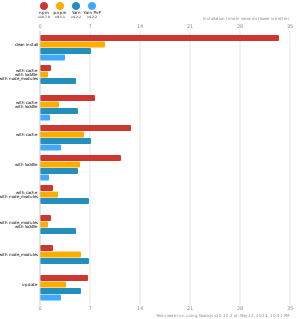
pnpm is up to 2x faster than npm and Yarn classic. See all benchmarks here.
Benchmarks on an app with lots of dependencies: