 Zoltan Kochan
d2b42c2dfc
Zoltan Kochan
d2b42c2dfc
## Summary

Two parity changes for pacquet's resolver, continuing https://github.com/pnpm/pnpm/issues/12266. Measured on the monorepo (fresh state, `install --lockfile-only`, back-to-back vs **pnpm 11.6.0**), the real-lockfile document diff drops from **128 to 5 changed lines** (re-measured after rebasing over #12361/#12362: **132 → 11**, where 8 of the 11 are a divergence the pacquet side of #12362 itself introduced — see the analysis on pnpm/pnpm#12266 — and 3 are the known cycle-closing-edge gap).

### 1. Per-level preferred-version fold

pnpm extends the preferred-versions map per resolution level: after a package's direct dependencies settle, their `(name, version)` pairs join the map the *children's* subtree resolutions pick against ([resolveDependencies.ts#L717-L746](https://github.com/pnpm/pnpm/blob/ce9c096e8e/installing/deps-resolver/src/resolveDependencies.ts#L717-L746)). So `signed-varint`'s `varint@~5.0.0` dedupes to the `varint@5.0.0` its parent pinned as a sibling instead of drifting to `5.0.2`. pacquet picked against a static seed only; besides `varint`/`es-abstract`, this turned out to drive the remaining `jest`/`@types/node` duplicate variants too.

- The walk resolves a whole sibling level before any child subtree starts (upstream's postponed-resolution barrier): `resolve_node` splits into `resolve_node_seed` + `walk_node_children`.
- Each level layers its versions onto a new `PreferredVersionsOverlay` (O(1) `Arc`-chained layers in `resolver-base`); the npm picker folds the per-name view in as plain `version` selectors at both registry seams.
- The overlay's per-name view joins the per-wanted dedup cache key; lockfile-reuse subtrees keep the no-overlay path (exact pins).

### 2. Hoist rounds across all importers (deterministic barrier, same logic as pnpm)

pnpm resolves **every importer's initial wave before any peer hoist**, then repeats global hoist rounds (per round: each importer's required-peer loop to a fixpoint, then one optional-peer hoist) until no importer hoists ([resolveDependencies.ts#L335-L445](https://github.com/pnpm/pnpm/blob/ce9c096e8e/installing/deps-resolver/src/resolveDependencies.ts#L335-L445)). pacquet ran each importer's whole hoist loop before the next importer's initial wave, so an early importer's optional-peer pick couldn't see versions a later importer resolves — `@cyclonedx`'s `spdx-expression-parse` hoisted `3.0.1` where pnpm's barrier-visible map picks `4.0.0`. `resolve_importer_with_workspace` is now an `ImporterHoistState` (`init` / `run_required_round` / `hoist_optional_round`) driven by `resolve_workspace` in upstream's exact phase order. Both implementations are deterministic here; the rule is identical.

## Verification

- New regression test `child_resolution_prefers_parent_level_sibling_versions` (fails with the fold disabled) + full `resolving-*`, `package-manager`, `cli` suites: 1,242 tests pass; clippy `--deny warnings`, rustfmt, typos clean.
- Whole-monorepo diff vs fresh pnpm 11.6.0: 128 → 5 changed lines; consecutive pacquet runs byte-identical.
简体中文 | 日本語 | 한국어 | Italiano | Português Brasileiro

Fast, disk space efficient package manager:
- Fast. Up to 2x faster than the alternatives (see benchmark).
- Efficient. Files inside
node_modulesare linked from a single content-addressable storage. - Great for monorepos.
- Strict. A package can access only dependencies that are specified in its
package.json. - Deterministic. Has a lockfile called
pnpm-lock.yaml. - Works as a Node.js version manager. See pnpm runtime.
- Works everywhere. Supports Windows, Linux, and macOS.
- Battle-tested. Used in production by teams of all sizes since 2016.
- See the full feature comparison with npm and Yarn.
To quote the Rush team:
Microsoft uses pnpm in Rush repos with hundreds of projects and hundreds of PRs per day, and we’ve found it to be very fast and reliable.



Platinum Sponsors

|

|
Gold Sponsors

|

|

|

|

|

|

|

|
Silver Sponsors

|

|

|

|

|

|

|

|
⏱️ Time.now |
Support this project by becoming a sponsor.
Background
pnpm uses a content-addressable filesystem to store all files from all module directories on a disk. When using npm, if you have 100 projects using lodash, you will have 100 copies of lodash on disk. With pnpm, lodash will be stored in a content-addressable storage, so:
- If you depend on different versions of lodash, only the files that differ are added to the store.
If lodash has 100 files, and a new version has a change only in one of those files,
pnpm updatewill only add 1 new file to the storage. - All the files are saved in a single place on the disk. When packages are installed, their files are linked from that single place consuming no additional disk space. Linking is performed using either hard-links or reflinks (copy-on-write).
As a result, you save gigabytes of space on your disk and you have a lot faster installations!
If you'd like more details about the unique node_modules structure that pnpm creates and
why it works fine with the Node.js ecosystem, read this small article: Flat node_modules is not the only way.
💖 Like this project? Let people know with a tweet
Getting Started
Benchmark
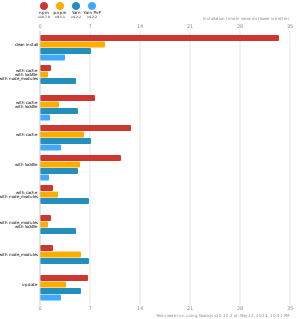
pnpm is up to 2x faster than npm and Yarn classic. See all benchmarks here.
Benchmarks on an app with lots of dependencies:
License
MIT, except the pnpr/ directory, which is source-available under the PolyForm Shield License 1.0.0.