 Zoltan KochanandClaude Fable 5
d2ed60afba
Zoltan KochanandClaude Fable 5
d2ed60afba
The git-resolver unit tests hit live github.com by default: the mocks for
fetchWithDispatcher and graceful-git existed, but beforeEach restored the
real implementations. When GitHub throttles the shared CI runner IPs, the
HEAD probe in isRepoPublic() fails (it has zero retries and treats any
error as "private"), and resolution silently degrades from the hosted
tarball to a git clone, changing the resolved id and failing the
assertions. This broke the main branch build at
https://github.com/pnpm/pnpm/actions/runs/29026897310/job/86153736091

The mocks are now the default: fetch reports every repository as public
and graceful-git serves ls-remote output from a fixture table captured
from the real repositories, with the same commit hashes the assertions
already expected. The private-repo-over-HTTPS test now calls
mockFetchAsPrivate() explicitly instead of relying on a real 404 for the
nonexistent github.com/foo/bar. The one live-network case in
parsePref.test.ts got the same treatment. The suite drops from ~40s to
under half a second and runs offline.

The dlx e2e test stays a genuine end-to-end test against GitHub, but its
allowBuild list now approves both resolution shapes of the same commit
(codeload tarball and git+https clone), so the resolver's
rate-limit-induced fallback no longer trips the
GIT_DEP_PREPARE_NOT_ALLOWED gate, as seen in
https://github.com/pnpm/pnpm/actions/runs/29029971938/job/86170695840

Co-authored-by: Claude Fable 5 <noreply@anthropic.com>
简体中文 | 日本語 | 한국어 | Italiano | Português Brasileiro

Fast, disk space efficient package manager:
- Fast. Up to 2x faster than the alternatives (see benchmark).
- Efficient. Files inside
node_modulesare linked from a single content-addressable storage. - Great for monorepos.
- Strict. A package can access only dependencies that are specified in its
package.json. - Deterministic. Has a lockfile called
pnpm-lock.yaml. - Works as a Node.js version manager. See pnpm runtime.
- Works everywhere. Supports Windows, Linux, and macOS.
- Battle-tested. Used in production by teams of all sizes since 2016.
- Experimental Rust port. Includes pacquet, an experimental port of the CLI written in Rust.
- See the full feature comparison with npm and Yarn.
To quote the Rush team:
Microsoft uses pnpm in Rush repos with hundreds of projects and hundreds of PRs per day, and we’ve found it to be very fast and reliable.



Platinum Sponsors

|

|
Gold Sponsors

|

|

|

|

|

|

|

|
Silver Sponsors

|

|

|

|

|

|

|

|
|
| ⏱️ Time.now |
Support this project by becoming a sponsor.
Background
pnpm uses a content-addressable filesystem to store all files from all module directories on a disk. When using npm, if you have 100 projects using lodash, you will have 100 copies of lodash on disk. With pnpm, lodash will be stored in a content-addressable storage, so:
- If you depend on different versions of lodash, only the files that differ are added to the store.
If lodash has 100 files, and a new version has a change only in one of those files,
pnpm updatewill only add 1 new file to the storage. - All the files are saved in a single place on the disk. When packages are installed, their files are linked from that single place consuming no additional disk space. Linking is performed using either hard-links or reflinks (copy-on-write).
As a result, you save gigabytes of space on your disk and you have a lot faster installations!
If you'd like more details about the unique node_modules structure that pnpm creates and
why it works fine with the Node.js ecosystem, read this small article: Flat node_modules is not the only way.
💖 Like this project? Let people know with a tweet
Getting Started
Benchmark
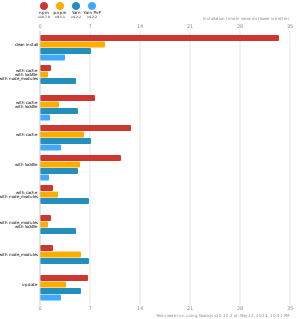
pnpm is up to 2x faster than npm and Yarn classic. See all benchmarks here.
Benchmarks on an app with lots of dependencies:
License
MIT, except the pnpr/ directory, which is source-available under the PolyForm Shield License 1.0.0.