 d3f68e2aa4
`pnpm audit` enumerates the install paths to every vulnerable package. The
reachability-based pruning added in 11.5.1 (pnpm/pnpm#12087) lets the walker
skip subtrees that reach no unsaturated finding by precomputing, per node, the
set of vulnerabilities reachable from it.

That getter only memoised acyclic subtrees: a node whose subtree contained a
cycle was `complete === false`, and so was every ancestor up to the importer
roots. None of them were cached, so their reachable set was recomputed on every
query. Real dependency graphs commonly contain cycles, and a single cycle high
in the graph makes a large fraction of nodes non-memoisable, yielding an O(N^2)
walk. This matched the report in pnpm/pnpm#12212 exactly (CPU-bound, identical
audit output across versions).

Reachability is now computed with Tarjan's strongly-connected-components
algorithm. Every node is scanned once; all members of an SCC reach the same set
of vulnerabilities and share one set, finalised in reverse-topological order.
Cyclic graphs are handled in O(N + E).

The reachable set is used only to prune, so it must never under-approximate
(that would hide a real finding). Tarjan yields the exact set for every node,
so no finding can be dropped, and the path-recording logic is unchanged. The
getter returns ReadonlySet<string> so the shared sets cannot be mutated by
callers, and a missing memo entry (an impossible-by-construction state) throws
rather than silently returning an empty set.

A regression test asserts the read-count growth ratio between two cycle sizes
(L=200 and L=400) is sub-quadratic: the fix scales ~2x (linear), the previous
code ~4x (quadratic). Asserting the ratio cancels the per-node constant, so the
test is not brittle to constant-factor changes.

Closes pnpm/pnpm#12212.

---------

Co-authored-by: Claude Opus 4.8 (1M context) <noreply@anthropic.com>
Co-authored-by: Zoltan Kochan <z@kochan.io>
简体中文 | 日本語 | 한국어 | Italiano | Português Brasileiro

Fast, disk space efficient package manager:
- Fast. Up to 2x faster than the alternatives (see benchmark).
- Efficient. Files inside
node_modulesare linked from a single content-addressable storage. - Great for monorepos.
- Strict. A package can access only dependencies that are specified in its
package.json. - Deterministic. Has a lockfile called
pnpm-lock.yaml. - Works as a Node.js version manager. See pnpm runtime.
- Works everywhere. Supports Windows, Linux, and macOS.
- Battle-tested. Used in production by teams of all sizes since 2016.
- See the full feature comparison with npm and Yarn.
To quote the Rush team:
Microsoft uses pnpm in Rush repos with hundreds of projects and hundreds of PRs per day, and we’ve found it to be very fast and reliable.



Platinum Sponsors

|

|
Gold Sponsors

|

|

|

|

|

|

|

|
Silver Sponsors

|

|

|

|

|

|

|

|

|
| ⏱️ Time.now |
Support this project by becoming a sponsor.
Background
pnpm uses a content-addressable filesystem to store all files from all module directories on a disk. When using npm, if you have 100 projects using lodash, you will have 100 copies of lodash on disk. With pnpm, lodash will be stored in a content-addressable storage, so:
- If you depend on different versions of lodash, only the files that differ are added to the store.
If lodash has 100 files, and a new version has a change only in one of those files,
pnpm updatewill only add 1 new file to the storage. - All the files are saved in a single place on the disk. When packages are installed, their files are linked from that single place consuming no additional disk space. Linking is performed using either hard-links or reflinks (copy-on-write).
As a result, you save gigabytes of space on your disk and you have a lot faster installations!
If you'd like more details about the unique node_modules structure that pnpm creates and
why it works fine with the Node.js ecosystem, read this small article: Flat node_modules is not the only way.
💖 Like this project? Let people know with a tweet
Getting Started
Benchmark
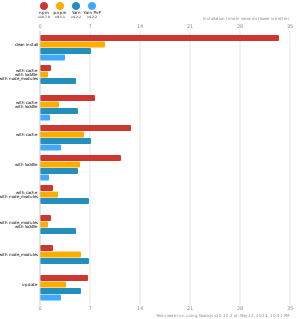
pnpm is up to 2x faster than npm and Yarn classic. See all benchmarks here.
Benchmarks on an app with lots of dependencies:
License
MIT, except the pnpr/ directory, which is source-available under the PolyForm Shield License 1.0.0.