Zoltan Kochan
d8a79a9c30
Zoltan Kochan
d8a79a9c30
Lands the pieces of the npm registry protocol that pnpm-registry was missing, and switches the TypeScript test harness off verdaccio onto pnpm-registry. `@pnpm/registry-mock` (the npm package) is untouched.

### Server-side additions (`registry/crates/pnpm-registry`)

- `PUT /-/user/org.couchdb.user:<name>` — adduser / login, returns a Bearer token. In-memory user + token stores.
- `PUT /:pkg` — publish (scoped + unscoped). Base64-decodes `_attachments`, merges into the existing packument, writes manifest + tarball atomically. 100 MiB body limit.
- `GET /-/package/:pkg/dist-tags` + `PUT/DELETE /-/package/:pkg/dist-tags/:tag` — rewrites the on-disk packument so tag changes survive a restart.
- `Authorization: Bearer` and `Authorization: Basic` both identify the caller.
- Per-package access policy (wax glob patterns). Defaults mirror `@pnpm/registry-mock`'s `config.yaml`: `@private/*` and `@pnpm.e2e/needs-auth` require auth; everything else is anonymous read, authenticated write. Enforced on every packument / version-manifest / tarball GET and every write endpoint.

### TypeScript-test migration

- `__utils__/jest-config/with-registry/globalSetup.js` keeps `prepare()` from `@pnpm/registry-mock` (still needed for the tempy storage path written into the runtime-config yaml — `getIntegrity` reads it from there) but spawns `pnpm-registry` instead of verdaccio. `addUser`, `addDistTag`, `getIntegrity`, `REGISTRY_MOCK_*` from registry-mock work as-is — they're plain npm-wire-protocol HTTP calls.
- Binary lookup follows pacquet's pattern: `PNPM_REGISTRY_BIN` env override, then `target/release/pnpm-registry`, then `target/debug/pnpm-registry`.
- CI test job (`.github/workflows/test.yml`) installs the Rust toolchain via the existing `./.github/actions/rustup` composite action and builds `pnpm-registry --release` before tests run. Per-platform — Linux and Windows in the matrix each build their own.
简体中文 | 日本語 | 한국어 | Italiano | Português Brasileiro

Fast, disk space efficient package manager:
- Fast. Up to 2x faster than the alternatives (see benchmark).
- Efficient. Files inside
node_modulesare linked from a single content-addressable storage. - Great for monorepos.
- Strict. A package can access only dependencies that are specified in its
package.json. - Deterministic. Has a lockfile called
pnpm-lock.yaml. - Works as a Node.js version manager. See pnpm runtime.
- Works everywhere. Supports Windows, Linux, and macOS.
- Battle-tested. Used in production by teams of all sizes since 2016.
- See the full feature comparison with npm and Yarn.
To quote the Rush team:
Microsoft uses pnpm in Rush repos with hundreds of projects and hundreds of PRs per day, and we’ve found it to be very fast and reliable.



Platinum Sponsors

|
Gold Sponsors

|

|

|

|

|

|

|

|
Silver Sponsors

|

|

|

|

|

|

|
⏱️ Time.now |
Support this project by becoming a sponsor.
Background
pnpm uses a content-addressable filesystem to store all files from all module directories on a disk. When using npm, if you have 100 projects using lodash, you will have 100 copies of lodash on disk. With pnpm, lodash will be stored in a content-addressable storage, so:
- If you depend on different versions of lodash, only the files that differ are added to the store.
If lodash has 100 files, and a new version has a change only in one of those files,
pnpm updatewill only add 1 new file to the storage. - All the files are saved in a single place on the disk. When packages are installed, their files are linked from that single place consuming no additional disk space. Linking is performed using either hard-links or reflinks (copy-on-write).
As a result, you save gigabytes of space on your disk and you have a lot faster installations!
If you'd like more details about the unique node_modules structure that pnpm creates and
why it works fine with the Node.js ecosystem, read this small article: Flat node_modules is not the only way.
💖 Like this project? Let people know with a tweet
Getting Started
Benchmark
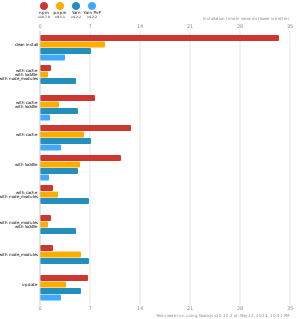
pnpm is up to 2x faster than npm and Yarn classic. See all benchmarks here.
Benchmarks on an app with lots of dependencies: