 Trevor BurnhamandZoltan Kochan
d8be2b85d1
Trevor BurnhamandZoltan Kochan
d8be2b85d1
`pnpm cache list-registries` printed the mirror directory name where `pnpm
cache view` printed a decoded registry URL, so the two disagreed about what a
registry is called and the listing gave no way to tell a live entry from a
stale one. Both stacks already exported the decoder beside the encoder; only
the listing never called it. Fixed in v11 and v12, since the inconsistency is
in both.

Keying the mirror on the scheme and path stranded every directory written
before it: the registry now resolves to a different name, and `list`, `view`
and `delete` all scope their glob to the configured registry's current key, so
nothing reads the leftover and nothing could remove it. `pnpm cache prune`
removes the directories this version can no longer read, across all three
metadata roots. New command, so v12 only.

`is_unreadable_registry_key` decides what goes. A name carrying no scheme
separator predates the current shape, with one exception it must not confuse
for staleness: `get_registry_name` collapses a key over 255 bytes to a bare
sha256, which carries no separator either. Those are spared, so one
unreachable directory can survive rather than a live mirror being deleted.

`--dry-run` lists what would go without removing it. The cache directory is
shared machine-wide and the scheme-in-key change shipped in v11.27.0 as well as
v12.4.0, so a pnpm at 11.26 or earlier still reads the host-only names this
removes; a user on both versions can check before paying that CLI a refetch.

The ephemeral-port directories the issue also mentions are in the current key
shape, so reclaiming them needs a retention policy rather than a mechanism,
and are left out. The descriptor-scoped roots under `v11/metadata-private`
accumulate equally unreadable directories and are also skipped, as `delete`,
`list` and `view` skip them.

Also stops `cacheList` and `cacheDelete` from asserting an exact cache
listing while the update check resolves `pnpm@latest` through the same cache
dir. That check is off under CI, so the stray `pnpm.jsonl` entry only failed
these tests locally.

Closes pnpm/pnpm#15046.

---------

Co-authored-by: Zoltan Kochan <z@kochan.io>
简体中文 | 日本語 | 한국어 | Italiano | Português Brasileiro

Fast, disk space efficient package manager:
- Fast. Up to 2x faster than the alternatives (see benchmark).
- Efficient. Files inside
node_modulesare linked from a single content-addressable storage. - Great for monorepos.
- Strict. A package can access only dependencies that are specified in its
package.json. - Deterministic. Has a lockfile called
pnpm-lock.yaml. - Works as a Node.js version manager. See pnpm runtime.
- Works everywhere. Supports Windows, Linux, and macOS.
- Battle-tested. Used in production by teams of all sizes since 2016.
- Experimental Rust port. Includes pacquet, an experimental port of the CLI written in Rust.
- See the full feature comparison with npm and Yarn.
To quote the Rush team:
Microsoft uses pnpm in Rush repos with hundreds of projects and hundreds of PRs per day, and we’ve found it to be very fast and reliable.



Platinum Sponsors

|

|

|

|
Gold Sponsors

|

|

|

|

|

|

|

|
Silver Sponsors

|

|

|

|

|

|

|

|

|
| ⏱️ Time.now |
Support this project by becoming a sponsor.
Background
pnpm uses a content-addressable filesystem to store all files from all module directories on a disk. When using npm, if you have 100 projects using lodash, you will have 100 copies of lodash on disk. With pnpm, lodash will be stored in a content-addressable storage, so:
- If you depend on different versions of lodash, only the files that differ are added to the store.
If lodash has 100 files, and a new version has a change only in one of those files,
pnpm updatewill only add 1 new file to the storage. - All the files are saved in a single place on the disk. When packages are installed, their files are linked from that single place consuming no additional disk space. Linking is performed using either hard-links or reflinks (copy-on-write).
As a result, you save gigabytes of space on your disk and you have a lot faster installations!
If you'd like more details about the unique node_modules structure that pnpm creates and
why it works fine with the Node.js ecosystem, read this small article: Flat node_modules is not the only way.
💖 Like this project? Let people know with a tweet
Getting Started
Benchmark
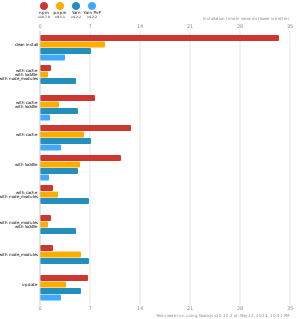
pnpm is up to 2x faster than npm and Yarn classic. See all benchmarks here.
Benchmarks on an app with lots of dependencies:
License
MIT, except the pnpr/ directory, which is source-available under the PolyForm Shield License 1.0.0.