 Zoltan Kochan
daecf8765f
Zoltan Kochan
daecf8765f
Bun materializes the same warm-store `node_modules` in roughly a third of pacquet's wall time on btrfs. Profiling the gap showed it was never syscall mechanics — it was the tier `Auto` picks: pacquet reflinks there, and a reflink is a new inode plus extent bookkeeping inside the filesystem's metadata trees, where a hardlink is one directory entry and an nlink bump.

## Measurements

alotta-files fixture (39k files), warm store + lockfile, cold `node_modules`, btrfs, interleaved A/B:

| | clone-first (before) | hardlink-first (after) |
|---|---|---|
| 32 threads | 0.91s wall / 5.4s sys | **0.53s / 2.9s** |
| 4 threads | 1.14s / 1.5s | **0.66s / 0.9s** |

Hardlink-first is also the default Bun ships (`--backend=hardlink`).

## Scope: pnpm 12 only

This changes what the default materializes on disk, so it ships behind the v12 major. **pnpm 11's TypeScript importer deliberately keeps clone-first** — the two `Auto` implementations intentionally diverge on this until pnpm 11 is retired. The ladder's rustdoc and the changeset record the decision, and the changeset bumps only `pacquet`.

## What doesn't change

- **pnpm 11**, entirely.
- **ext4** (GitHub CI, the published benchmark): `FICLONE` is unsupported there, so `Auto` always ended up hardlinking after one failed reflink. Nothing moves.
- **macOS** keeps clone-first — APFS `clonefile` is the platform's cheap primitive.
- Explicit `packageImportMethod: clone` / `clone-or-copy` / `hardlink` / `copy` are untouched.

## The trade

Clone-first bought store isolation on Linux CoW filesystems: a clone can't be corrupted by a package that mutates its own files at runtime. But every ext4 and Windows install already runs without that isolation, and the store's real guard is `verify-store-integrity`. v12 makes Linux stop paying extra for a protection the other platforms never had; users who want the isolation keep it with `packageImportMethod: clone`.

## What was tried and rejected

Bun's other structural difference — `linkat` from open directory fds (a 256-entry store-prefix fd table plus a per-package dirfd) instead of absolute-path resolution — was implemented and benchmarked too. Every link was confirmed on the fd path (counted: 35k+ hits, 0 fallbacks), kernel time fell ~15%, and wall **regressed** (link phase 335ms → 531ms at 4 cores). Linux resolves hot cached paths through the lock-free RCU dcache walk; the fd anchoring saves nothing that was expensive. Making the per-package file loop sequential also regressed (straggler tail on thousand-file packages). Both reverted; noting it here so nobody re-walks that path without new evidence.

## Implementation

The downgrade cache moves from `fetch_max` (which encoded the ladder in the constants' numeric order) to a compare-exchange step along a per-platform ladder (`next_auto_tier`), so racing rayon workers still converge without a lock. `pnpm:progress imported` telemetry reports the platform's ladder head instead of unconditionally claiming clone (a review catch). Tests pin the ladder order, the fresh-state hardlink, the telemetry mapping, and that a stale compare-exchange can neither skip nor regress a tier.
简体中文 | 日本語 | 한국어 | Italiano | Português Brasileiro

Fast, disk space efficient package manager:
- Fast. Up to 2x faster than the alternatives (see benchmark).
- Efficient. Files inside
node_modulesare linked from a single content-addressable storage. - Great for monorepos.
- Strict. A package can access only dependencies that are specified in its
package.json. - Deterministic. Has a lockfile called
pnpm-lock.yaml. - Works as a Node.js version manager. See pnpm runtime.
- Works everywhere. Supports Windows, Linux, and macOS.
- Battle-tested. Used in production by teams of all sizes since 2016.
- Experimental Rust port. Includes pacquet, an experimental port of the CLI written in Rust.
- See the full feature comparison with npm and Yarn.
To quote the Rush team:
Microsoft uses pnpm in Rush repos with hundreds of projects and hundreds of PRs per day, and we’ve found it to be very fast and reliable.



Platinum Sponsors

|

|
Gold Sponsors

|

|

|

|

|

|

|

|
Silver Sponsors

|

|

|

|

|

|

|

|
|
| ⏱️ Time.now |
Support this project by becoming a sponsor.
Background
pnpm uses a content-addressable filesystem to store all files from all module directories on a disk. When using npm, if you have 100 projects using lodash, you will have 100 copies of lodash on disk. With pnpm, lodash will be stored in a content-addressable storage, so:
- If you depend on different versions of lodash, only the files that differ are added to the store.
If lodash has 100 files, and a new version has a change only in one of those files,
pnpm updatewill only add 1 new file to the storage. - All the files are saved in a single place on the disk. When packages are installed, their files are linked from that single place consuming no additional disk space. Linking is performed using either hard-links or reflinks (copy-on-write).
As a result, you save gigabytes of space on your disk and you have a lot faster installations!
If you'd like more details about the unique node_modules structure that pnpm creates and
why it works fine with the Node.js ecosystem, read this small article: Flat node_modules is not the only way.
💖 Like this project? Let people know with a tweet
Getting Started
Benchmark
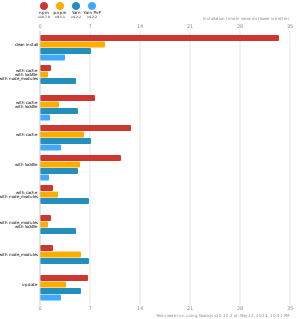
pnpm is up to 2x faster than npm and Yarn classic. See all benchmarks here.
Benchmarks on an app with lots of dependencies:
License
MIT, except the pnpr/ directory, which is source-available under the PolyForm Shield License 1.0.0.