Zoltan Kochan
ddf4ec4612
Zoltan Kochan
ddf4ec4612
Ports pnpm's [`dedupeInjectedDeps`](https://github.com/pnpm/pnpm/blob/39101f5e37/installing/deps-resolver/src/dedupeInjectedDeps.ts) to pacquet end-to-end, and restructures the resolver to match pnpm's multi-importer shape so the dedupe lives where pnpm puts it.

- **Config plumbing** — `dedupe_injected_deps: bool` on `Config` (default `true`), read from `pnpm-workspace.yaml`'s `dedupeInjectedDeps` key, overridable via `PNPM_CONFIG_DEDUPE_INJECTED_DEPS`. Cleared as a workspace-only field in `WorkspaceSettings::clear_workspace_only_fields`.
- **`dependenciesMeta.injected` plumbing** — pacquet's deps-resolver previously constructed `WantedDependency` with `..Default::default()`, so the per-package `dependenciesMeta[<alias>].injected: true` flag never reached the npm/local resolvers and no install path produced a `file:<workspace>` direct dep. Reading `dependenciesMeta` at the importer-level wanted-dep collection unlocks the `file:` workspace-pick branch the dedupe consumer is designed to collapse.
- **Multi-importer resolver refactor** — new `resolve_workspace` orchestrator (`pacquet/crates/resolving-deps-resolver/src/resolve_workspace.rs`) mirrors pnpm's [`resolveDependencies(importers, opts)`](https://github.com/pnpm/pnpm/blob/39101f5e37/installing/deps-resolver/src/index.ts#L128). It constructs one shared `WorkspaceTreeCtx` (resolved-pkgs dedup, children-spec cache, resolver-call memo, peer-walker seed sets), hands `Arc::clone` to every per-importer `resolve_importer_with_workspace`, then runs a single `resolve_peers_workspace` pass that shares `peersCache` + `purePkgs` across importers. Importer N's tree walk now reuses importer M's resolver hits instead of re-running the chain.
- **`dedupeInjectedDeps` lives in `resolve_peers_workspace`** (`pacquet/crates/resolving-deps-resolver/src/dedupe_injected_deps.rs`), matching pnpm's `resolvePeers` integration. The install layer no longer carries any dedupe wiring; it just hands importers + a per-importer `ResolveOptions` closure to `resolve_workspace`. After dedupe, unreachable `file:<workspace>` snapshots are pruned from the graph so they don't leak into `pnpm-lock.yaml`.
- **`ImporterDepVersion::File` arm** — when `dedupeInjectedDeps: false` leaves an injected workspace dep as `file:packages/<name>` at the importer level, the lockfile writer used to panic at `importer_dep_version` (the `parse::<PkgNameVerPeer>().expect(...)` arm). Adds a `File(String)` variant to `ImporterDepVersion`, wires it through `dependencies_graph_to_lockfile` and `symlink_direct_dependencies`, and the new e2e test `injected_workspace_dep_with_dedupe_off_writes_file_arm` exercises that path end-to-end.
- **Workspace state** — surfaces `dedupe_injected_deps` in `current_settings` and adds it to the `settings_match` comparison in `optimistic_repeat_install`; drops it from the "deliberately not compared" list so settings drift now triggers a reinstall.

Tracked under pnpm/pnpm#12009 (one item; the rest are separate PRs).
简体中文 | 日本語 | 한국어 | Italiano | Português Brasileiro

Fast, disk space efficient package manager:
- Fast. Up to 2x faster than the alternatives (see benchmark).
- Efficient. Files inside
node_modulesare linked from a single content-addressable storage. - Great for monorepos.
- Strict. A package can access only dependencies that are specified in its
package.json. - Deterministic. Has a lockfile called
pnpm-lock.yaml. - Works as a Node.js version manager. See pnpm runtime.
- Works everywhere. Supports Windows, Linux, and macOS.
- Battle-tested. Used in production by teams of all sizes since 2016.
- See the full feature comparison with npm and Yarn.
To quote the Rush team:
Microsoft uses pnpm in Rush repos with hundreds of projects and hundreds of PRs per day, and we’ve found it to be very fast and reliable.



Platinum Sponsors

|
Gold Sponsors

|

|

|

|

|

|

|

|
Silver Sponsors

|

|

|

|

|

|

|
⏱️ Time.now |
Support this project by becoming a sponsor.
Background
pnpm uses a content-addressable filesystem to store all files from all module directories on a disk. When using npm, if you have 100 projects using lodash, you will have 100 copies of lodash on disk. With pnpm, lodash will be stored in a content-addressable storage, so:
- If you depend on different versions of lodash, only the files that differ are added to the store.
If lodash has 100 files, and a new version has a change only in one of those files,
pnpm updatewill only add 1 new file to the storage. - All the files are saved in a single place on the disk. When packages are installed, their files are linked from that single place consuming no additional disk space. Linking is performed using either hard-links or reflinks (copy-on-write).
As a result, you save gigabytes of space on your disk and you have a lot faster installations!
If you'd like more details about the unique node_modules structure that pnpm creates and
why it works fine with the Node.js ecosystem, read this small article: Flat node_modules is not the only way.
💖 Like this project? Let people know with a tweet
Getting Started
Benchmark
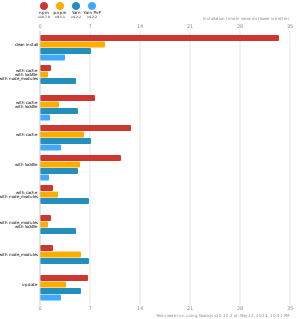
pnpm is up to 2x faster than npm and Yarn classic. See all benchmarks here.
Benchmarks on an app with lots of dependencies: