Zoltan Kochan
e01d2bc0a1
Zoltan Kochan
e01d2bc0a1
* fix(pacquet/fs): fall back to absolute target across Windows drives

`pathdiff::diff_paths` does not return `None` when the two paths sit on
different Windows drive roots; it produces a path that climbs out with
`..` and then re-anchors with the target's drive letter (for example,
`..\..\C:\Users\...`). Windows rejects such a symlink target with
`ERROR_INVALID_PARAMETER` (os error 87), which is the failure mode CI
on Windows hits when the workspace lives on `D:` and the global store
installed by `setup-pnpm` lives on `C:`.

Node.js's `path.win32.relative` returns the absolute `to` argument
when the two paths share no common root, which is the behavior
upstream `symlink-dir` relies on. Mirror that by detecting unequal
`Component::Prefix` values up front and returning the absolute target
unchanged. Drive-letter comparison is case-insensitive to match
NTFS and Node.js semantics.

* fix(pacquet/fs): normalize verbatim Windows paths before relative diff

`Prefix::Disk('C')` and `Prefix::VerbatimDisk('C')` name the same
physical drive, but compare unequal as `Component::Prefix` values, so
the cross-root guard added in the previous commit would unnecessarily
fall back to an absolute target whenever one input was a verbatim
`\\?\C:\...` path. Worse, `pathdiff::diff_paths` itself would emit a
re-anchored garbage path on the variant-mismatched case if the guard
ever let it through.

Run both inputs through `dunce::simplified` on Windows, which strips
the `\\?\` prefix when the non-verbatim form is still valid, so
mixed verbatim and non-verbatim views of the same drive collapse
onto a common `Prefix::Disk` before the comparison and the diff.
Tighten `case_normalize` to map `VerbatimDisk` onto `Disk` for the
residual long-path case that `dunce` declines to simplify.

* style(pacquet/fs): split relative_target_inner per platform

`clippy::needless_return` rejects the explicit `return` in the
Windows `{ ... }` block because the block itself is the function's
tail expression on Windows. The block-with-cfg-attribute layout
also obscured that the function body shrinks to a single tail
expression on non-Windows. Extracting two `#[cfg]`-gated
`relative_target_inner` helpers makes both targets read as a
straight tail expression and drops the clippy violation.

* fix(pacquet/fs): make same_path_root variant-strict

Collapsing `Disk` and `VerbatimDisk` (and the UNC analogues) onto a
common variant in `same_path_root` is unsafe when one input is a
verbatim path that `dunce::simplified` declined to strip (e.g., a
path long enough that the non-verbatim form would exceed the legacy
limit). `same_path_root` would declare the two paths same-root, but
`pathdiff::diff_paths` would still walk `Component::Prefix` for
equality and emit a re-anchored garbage path on the variant
mismatch — the same `..\\..\\C:\\Users\\...` shape that triggers
`ERROR_INVALID_PARAMETER` (os error 87) on Windows.

Restore the variant-strict comparison so mismatched variants fall
back to an absolute target, which is the correct outcome on the
edge case. The common short-path mixed-form case (`\\?\C:\foo`
paired with `C:\bar`) still produces a relative target because
`dunce::simplified` normalizes the variants upstream of this check.

* docs(pacquet): tests are documentation; do not narrate them in code

Add an explicit rule to AGENTS.md: when a behavioral scenario or
edge case is already captured by a test (name, setup, assertions),
do not re-narrate it in a doc comment on the implementation. The
doc comment should state the contract; the test demonstrates the
behavior.

Apply the rule to the recently added Windows symlink fix. The doc
comments on `relative_target_for` and `same_path_root` had grown
into mini essays restating the `ERROR_INVALID_PARAMETER` failure
mode, the CI scenario, and the `dunce::simplified` rationale,
all of which is covered by the three Windows tests. Trim both to
the contract plus one short note on the only non-obvious invariant
(why `same_path_root` is variant-strict). The tests in turn shed
their multi-paragraph preambles in favor of self-explanatory names
and direct assertions, keeping only a one-line regression pointer
on the CI-failure test.

* docs(pacquet/fs): describe same_path_root match shape accurately

The previous doc claimed "same UNC share" as a match condition, but
the implementation requires identical `Prefix` after `dunce::simplified`
with only drive-letter case folding. UNC server/share differences in
case or `UNC`/`VerbatimUNC` variant fall back to absolute.
简体中文 | 日本語 | 한국어 | Italiano | Português Brasileiro

Fast, disk space efficient package manager:
- Fast. Up to 2x faster than the alternatives (see benchmark).
- Efficient. Files inside
node_modulesare linked from a single content-addressable storage. - Great for monorepos.
- Strict. A package can access only dependencies that are specified in its
package.json. - Deterministic. Has a lockfile called
pnpm-lock.yaml. - Works as a Node.js version manager. See pnpm runtime.
- Works everywhere. Supports Windows, Linux, and macOS.
- Battle-tested. Used in production by teams of all sizes since 2016.
- See the full feature comparison with npm and Yarn.
To quote the Rush team:
Microsoft uses pnpm in Rush repos with hundreds of projects and hundreds of PRs per day, and we’ve found it to be very fast and reliable.



Platinum Sponsors

|
Gold Sponsors

|

|

|

|

|

|

|

|
Silver Sponsors

|

|

|

|

|

|
|
⏱️ Time.now |
Support this project by becoming a sponsor.
Background
pnpm uses a content-addressable filesystem to store all files from all module directories on a disk. When using npm, if you have 100 projects using lodash, you will have 100 copies of lodash on disk. With pnpm, lodash will be stored in a content-addressable storage, so:
- If you depend on different versions of lodash, only the files that differ are added to the store.
If lodash has 100 files, and a new version has a change only in one of those files,
pnpm updatewill only add 1 new file to the storage. - All the files are saved in a single place on the disk. When packages are installed, their files are linked from that single place consuming no additional disk space. Linking is performed using either hard-links or reflinks (copy-on-write).
As a result, you save gigabytes of space on your disk and you have a lot faster installations!
If you'd like more details about the unique node_modules structure that pnpm creates and
why it works fine with the Node.js ecosystem, read this small article: Flat node_modules is not the only way.
💖 Like this project? Let people know with a tweet
Getting Started
Benchmark
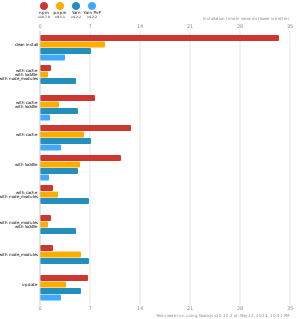
pnpm is up to 2x faster than npm and Yarn classic. See all benchmarks here.
Benchmarks on an app with lots of dependencies: