 Zoltan Kochan
e1b573d31d
Zoltan Kochan
e1b573d31d
Three papercuts that together make a lint cost a full pre-push sweep.

`test-affected` took its diff against the local `main`, which is only as
current as the last time someone checked it out — and `main` usually lives
in another worktree here, so it lags. Every commit it lagged by read as a
change of the current branch: crates someone else touched got tested, and
a file every crate compiles against, landing upstream, made the whole run
refuse to scope and send you to `just ready`. Six commits of lag was
enough to attribute an unrelated `Cargo.lock` to a branch that had not
touched it. A `--base` that names a branch now diffs against that
branch's remote-tracking ref. A tag, a revision expression, a qualified
ref and `HEAD` are taken as given, since each already names one commit.

The pre-commit hook formats the Rust files being committed, with the
pinned rustfmt. Formatting is the one Rust check that needs no compile, so
it is the one that can run per commit; clippy and dylint stay in pre-push
where their cost is paid once. A file with unstaged changes as well is
left alone and named, since formatting the working tree and staging the
result would commit the part of it the author held back. The pathnames are
handled in Node, one argument per file, so a path holding a space, a glob
character, or a leading `-` reaches rustfmt intact, and only a regular
file is formatted: rustfmt writes through a symlink.

Both lint failures in pre-push named the command that reports the
findings rather than the one that applies them. `just fix` and the new
`just dylint-fix` fix most of what either finds, which is the difference
between one more sweep and several.
简体中文 | 日本語 | 한국어 | Italiano | Português Brasileiro

Fast, disk space efficient package manager:
- Fast. Up to 2x faster than the alternatives (see benchmark).
- Efficient. Files inside
node_modulesare linked from a single content-addressable storage. - Great for monorepos.
- Strict. A package can access only dependencies that are specified in its
package.json. - Deterministic. Has a lockfile called
pnpm-lock.yaml. - Works as a Node.js version manager. See pnpm runtime.
- Works everywhere. Supports Windows, Linux, and macOS.
- Battle-tested. Used in production by teams of all sizes since 2016.
- Experimental Rust port. Includes pacquet, an experimental port of the CLI written in Rust.
- See the full feature comparison with npm and Yarn.
To quote the Rush team:
Microsoft uses pnpm in Rush repos with hundreds of projects and hundreds of PRs per day, and we’ve found it to be very fast and reliable.



Platinum Sponsors

|

|

|

|
Gold Sponsors

|

|

|

|

|

|

|

|
Silver Sponsors

|

|

|

|

|

|

|

|
|
| ⏱️ Time.now |
Support this project by becoming a sponsor.
Background
pnpm uses a content-addressable filesystem to store all files from all module directories on a disk. When using npm, if you have 100 projects using lodash, you will have 100 copies of lodash on disk. With pnpm, lodash will be stored in a content-addressable storage, so:
- If you depend on different versions of lodash, only the files that differ are added to the store.
If lodash has 100 files, and a new version has a change only in one of those files,
pnpm updatewill only add 1 new file to the storage. - All the files are saved in a single place on the disk. When packages are installed, their files are linked from that single place consuming no additional disk space. Linking is performed using either hard-links or reflinks (copy-on-write).
As a result, you save gigabytes of space on your disk and you have a lot faster installations!
If you'd like more details about the unique node_modules structure that pnpm creates and
why it works fine with the Node.js ecosystem, read this small article: Flat node_modules is not the only way.
💖 Like this project? Let people know with a tweet
Getting Started
Benchmark
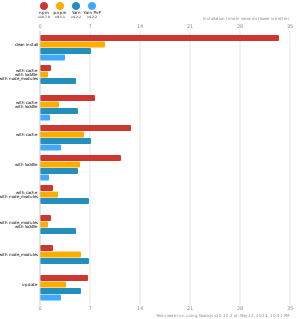
pnpm is up to 2x faster than npm and Yarn classic. See all benchmarks here.
Benchmarks on an app with lots of dependencies:
License
MIT, except the pnpr/ directory, which is source-available under the PolyForm Shield License 1.0.0.