e2791ab6fe
* feat(pacquet): port named registries to the install chain

Adds the user-facing `<alias>:` resolver surface so a manifest entry
like `"@acme/private": "gh:^1.0.0"` resolves against GitHub Packages
(or any other registry the user configures under
`namedRegistries:` in `pnpm-workspace.yaml`).

Mirrors upstream pnpm/pnpm@b61e268d57:

- `parse_named_registry_specifier_to_registry_package_spec` parses
  `<alias>:[@<owner>/]<name>[@<version>]` and `<alias>:<version>`
  bodies. Rejects scope-without-name with
  `ERR_PNPM_INVALID_NAMED_REGISTRY_PACKAGE_NAME`.
- `merge_named_registries` folds the user map onto pacquet's
  built-in aliases (`gh:` -> GitHub Packages) and validates URLs at
  resolver construction (`ERR_PNPM_INVALID_NAMED_REGISTRY_URL`).
- `NamedRegistryResolver` is a third `Resolver` alongside the npm /
  jsr paths, emitting `resolved_via: "named-registry"`. Auth headers
  flow through the existing per-URL `.npmrc` lookup.
- `Config::named_registries` reads `namedRegistries:` from
  `pnpm-workspace.yaml`, with `${VAR}` substitution on the values
  (matches upstream's `replaceEnvInStringValues`).
- `install_without_lockfile` constructs the merged map once and
  threads it through both the resolver chain (after npm/git, so
  configured aliases cannot hijack built-in schemes) and
  `build_resolution_verifiers` (so tarball-URL prefix routing
  honours user aliases).

* fix(pacquet): rustdoc broken links + spell-check typo

- `resolving-local-resolver/src/chain.rs`: drop the redundant
  explicit `(crate::...)` target on `[resolve_latest_from_local]`
  (clippy's `redundant_explicit_links` lint flagged it under
  `RUSTDOCFLAGS=-D warnings`) and demote the `[contains_path_sep]`
  intra-doc reference to backticks since the helper is private.
- `resolving-npm-resolver/src/parse_bare_specifier.rs`: rename
  `unparseable` to `unparsable` in a doc comment so the workspace
  typos check passes.

* test(pacquet): cover the remaining named-registry test cases

Ports upstream's
[`resolving/default-resolver/test/namedRegistry.ts`](https://github.com/pnpm/pnpm/blob/b61e268d57/resolving/default-resolver/test/namedRegistry.ts)
and the two `resolveNamedRegistry.test.ts` cases the previous
commit hadn't covered.

- New `tests/chain.rs` integration tests assert that the explicit
  `link:` / `workspace:` / `file:` schemes win over a colliding
  named-registry alias. These pin the local-scheme / local-path
  split: with combined `LocalResolver`, named-registry would slot
  *after* both halves and a `link` alias could hijack `link:./pkg`.
- `resolves_via_builtin_gh_alias` covers the `gh:` happy path that
  was previously only exercised via a user-supplied `work:` alias.
- `preserves_scoped_pkg_name_when_alias_differs` verifies that the
  resolver records the dependency under the registry's name, not
  the local manifest alias.
- `user_config_overrides_builtin_gh_alias` covers the GHES override
  scenario where a user points `gh` at their enterprise host.

11 resolver tests pass (5 unit + 3 chain integration + 3 happy-path
scenarios) plus the 12 parser cases already in place.
简体中文 | 日本語 | 한국어 | Italiano | Português Brasileiro

Fast, disk space efficient package manager:
- Fast. Up to 2x faster than the alternatives (see benchmark).
- Efficient. Files inside
node_modulesare linked from a single content-addressable storage. - Great for monorepos.
- Strict. A package can access only dependencies that are specified in its
package.json. - Deterministic. Has a lockfile called
pnpm-lock.yaml. - Works as a Node.js version manager. See pnpm runtime.
- Works everywhere. Supports Windows, Linux, and macOS.
- Battle-tested. Used in production by teams of all sizes since 2016.
- See the full feature comparison with npm and Yarn.
To quote the Rush team:
Microsoft uses pnpm in Rush repos with hundreds of projects and hundreds of PRs per day, and we’ve found it to be very fast and reliable.



Platinum Sponsors

|
Gold Sponsors

|

|

|

|

|

|

|

|
Silver Sponsors

|

|

|

|

|

|

|
⏱️ Time.now |
Support this project by becoming a sponsor.
Background
pnpm uses a content-addressable filesystem to store all files from all module directories on a disk. When using npm, if you have 100 projects using lodash, you will have 100 copies of lodash on disk. With pnpm, lodash will be stored in a content-addressable storage, so:
- If you depend on different versions of lodash, only the files that differ are added to the store.
If lodash has 100 files, and a new version has a change only in one of those files,
pnpm updatewill only add 1 new file to the storage. - All the files are saved in a single place on the disk. When packages are installed, their files are linked from that single place consuming no additional disk space. Linking is performed using either hard-links or reflinks (copy-on-write).
As a result, you save gigabytes of space on your disk and you have a lot faster installations!
If you'd like more details about the unique node_modules structure that pnpm creates and
why it works fine with the Node.js ecosystem, read this small article: Flat node_modules is not the only way.
💖 Like this project? Let people know with a tweet
Getting Started
Benchmark
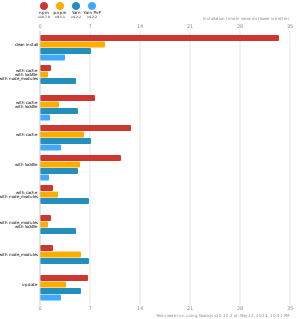
pnpm is up to 2x faster than npm and Yarn classic. See all benchmarks here.
Benchmarks on an app with lots of dependencies: