 Zoltan Kochan
e322d08690
Zoltan Kochan
e322d08690
Ambiguous object-store failures can commit a shared-artifact blob while returning an error. Conservatively retaining the reserved quota prevents limit bypasses, but can permanently charge storage that no committed envelope references.

Register each publication in the conditionally written quota document before it reads or creates immutable objects. When an ambiguous failure marks reclamation as necessary, let one replica acquire a token after all active publications drain. The token blocks new publications while the collector derives reachability from stored envelopes, removes unreferenced blobs, rescans physical usage, and atomically replaces the quota state. Preserve the retry marker when collection fails, retry transient cleanup failures from live requests, jitter conditional-write backoff, and retain the documented quiesced quota-reset procedure for registrations or tokens left by terminated processes.

Also synchronize the recursive-run bail summary regression with bounded marker waits so it deterministically exercises recording a task that was in flight when another task failed without risking a hung test.

On Windows, a competing `create_dir` can report `AccessDenied` while the prior lock directory is delete-pending. Retry that platform-specific transient error within the caller's wait and a one-second release budget, while continuing to report persistent permission failures.

Related to pnpm/pnpm#14220.
简体中文 | 日本語 | 한국어 | Italiano | Português Brasileiro

Fast, disk space efficient package manager:
- Fast. Up to 2x faster than the alternatives (see benchmark).
- Efficient. Files inside
node_modulesare linked from a single content-addressable storage. - Great for monorepos.
- Strict. A package can access only dependencies that are specified in its
package.json. - Deterministic. Has a lockfile called
pnpm-lock.yaml. - Works as a Node.js version manager. See pnpm runtime.
- Works everywhere. Supports Windows, Linux, and macOS.
- Battle-tested. Used in production by teams of all sizes since 2016.
- Experimental Rust port. Includes pacquet, an experimental port of the CLI written in Rust.
- See the full feature comparison with npm and Yarn.
To quote the Rush team:
Microsoft uses pnpm in Rush repos with hundreds of projects and hundreds of PRs per day, and we’ve found it to be very fast and reliable.



Platinum Sponsors

|

|

|
Gold Sponsors

|

|

|

|

|

|

|

|

|
Silver Sponsors

|

|

|

|

|

|

|

|
|
| ⏱️ Time.now |
Support this project by becoming a sponsor.
Background
pnpm uses a content-addressable filesystem to store all files from all module directories on a disk. When using npm, if you have 100 projects using lodash, you will have 100 copies of lodash on disk. With pnpm, lodash will be stored in a content-addressable storage, so:
- If you depend on different versions of lodash, only the files that differ are added to the store.
If lodash has 100 files, and a new version has a change only in one of those files,
pnpm updatewill only add 1 new file to the storage. - All the files are saved in a single place on the disk. When packages are installed, their files are linked from that single place consuming no additional disk space. Linking is performed using either hard-links or reflinks (copy-on-write).
As a result, you save gigabytes of space on your disk and you have a lot faster installations!
If you'd like more details about the unique node_modules structure that pnpm creates and
why it works fine with the Node.js ecosystem, read this small article: Flat node_modules is not the only way.
💖 Like this project? Let people know with a tweet
Getting Started
Benchmark
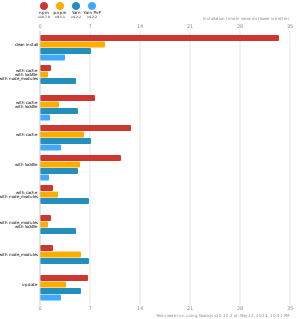
pnpm is up to 2x faster than npm and Yarn classic. See all benchmarks here.
Benchmarks on an app with lots of dependencies:
License
MIT, except the pnpr/ directory, which is source-available under the PolyForm Shield License 1.0.0.