Zoltan Kochan
e5e7b7241d
Zoltan Kochan
e5e7b7241d
* fix(env-installer): only print "Installing config dependencies..." when work is actually being done

Previously the message was emitted unconditionally for every config
dependency, before any of the "do we need to fetch / re-symlink?"
checks. As a result the banner printed on every install even when
everything was already cached and correctly linked.

Emit the started event lazily — at most once per install, and only
when an orphan is being removed, a parent or subdep needs fetching,
a parent symlink needs (re)creating, or orphan subdep siblings are
being pruned.

---
Written by an agent (Claude Code, claude-opus-4-7).

* test(env-installer): assert installing-config-deps events fire only when work happens

Captures `streamParser` events around `resolveAndInstallConfigDeps`
to verify the lazy emission introduced in the previous commit:
- fresh install emits both `started` and `done`,
- a follow-up no-op install emits neither,
- removing a config dep still emits `started` (orphan cleanup work).

---
Written by an agent (Claude Code, claude-opus-4-7).

* test(env-installer): subscribe to streamParser once at module load

`streamParser` is a `split2` Transform stream that buffers writes until
the first 'data' listener attaches and then drains the whole buffer into
it. Subscribing per-test made the new install-config-deps test capture
events from every earlier test in the file. Move the subscription to
module load and have each test drain the accumulated events around its
own call.

Also drop the "removal" assertion: `resolveAndInstallConfigDeps` does
not prune entries that disappear from the configDeps argument (lockfile
pruning happens at a higher layer), so the scenario it claimed to test
never actually fired the orphan-cleanup path.

---
Written by an agent (Claude Code, claude-opus-4-7).

* fix(env-installer): emit started when only the sibling symlink needs relinking

If a config dep's optional subdep is already cached in the global
virtual store but the sibling symlink under the parent's node_modules
is missing or points at a stale target, symlinkDir() does real work
without reportStarted ever firing. Check whether the link already
points at the expected target and only fire reportStarted + symlinkDir
when it doesn't, mirroring the parentSymlinkAlreadyCorrect path.

Also clean up the test-level streamParser listener in afterAll so the
subscription doesn't outlive the test file.

---
Written by an agent (Claude Code, claude-opus-4-7).
简体中文 | 日本語 | 한국어 | Italiano | Português Brasileiro

Fast, disk space efficient package manager:
- Fast. Up to 2x faster than the alternatives (see benchmark).
- Efficient. Files inside
node_modulesare linked from a single content-addressable storage. - Great for monorepos.
- Strict. A package can access only dependencies that are specified in its
package.json. - Deterministic. Has a lockfile called
pnpm-lock.yaml. - Works as a Node.js version manager. See pnpm runtime.
- Works everywhere. Supports Windows, Linux, and macOS.
- Battle-tested. Used in production by teams of all sizes since 2016.
- See the full feature comparison with npm and Yarn.
To quote the Rush team:
Microsoft uses pnpm in Rush repos with hundreds of projects and hundreds of PRs per day, and we’ve found it to be very fast and reliable.



Platinum Sponsors

|
Gold Sponsors

|

|

|

|

|

|

|

|
Silver Sponsors

|

|

|

|

|

|

|
⏱️ Time.now |
Support this project by becoming a sponsor.
Background
pnpm uses a content-addressable filesystem to store all files from all module directories on a disk. When using npm, if you have 100 projects using lodash, you will have 100 copies of lodash on disk. With pnpm, lodash will be stored in a content-addressable storage, so:
- If you depend on different versions of lodash, only the files that differ are added to the store.
If lodash has 100 files, and a new version has a change only in one of those files,
pnpm updatewill only add 1 new file to the storage. - All the files are saved in a single place on the disk. When packages are installed, their files are linked from that single place consuming no additional disk space. Linking is performed using either hard-links or reflinks (copy-on-write).
As a result, you save gigabytes of space on your disk and you have a lot faster installations!
If you'd like more details about the unique node_modules structure that pnpm creates and
why it works fine with the Node.js ecosystem, read this small article: Flat node_modules is not the only way.
💖 Like this project? Let people know with a tweet
Getting Started
Benchmark
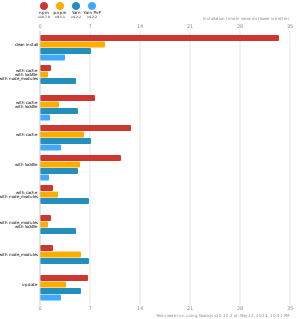
pnpm is up to 2x faster than npm and Yarn classic. See all benchmarks here.
Benchmarks on an app with lots of dependencies: