 Zoltan Kochan
ea10c041a5
Zoltan Kochan
ea10c041a5
`pnpm stage approve` accepted exactly one stage id and wrapped each request in
its own `withOtpHandling`, so releasing a workspace meant one invocation and one
proof of presence per package, in an order the releaser had to work out by hand.

It now takes a list of stage ids, and with none it lists the staged versions and
offers them in a checkbox prompt (the non-interactive case keeps failing with
STAGE_ID_REQUIRED, now with a hint).

The batch runs through a new `OtpSession` in the web-auth package: it keeps the
one-time password a challenge yielded and passes it to every later request,
re-prompting only once the registry stops accepting it — a classic TOTP expires
within a minute, which is exactly the case a whole-workspace approval hits.
`withOtpHandling` is now the single-operation form of that session, so publish
and reject behave as before.

Inside a workspace the selection is sorted through the workspace dependency
graph (the same sequencer the recursive commands use), keyed on the name each
project publishes under, since that is the only name a staged version carries. A
package whose workspace dependency could not be approved is skipped rather than
published against a dependency that never reached the registry. A registry
verdict on one version leaves the rest of the batch running and ends with a
non-zero exit; an authentication failure or a broken connection aborts it.

The registry's description of a staged version decides what a maintainer
publishes, so its id and package name are validated as they came — a hidden
character can neither be stripped into a valid value nor keep a name from
matching a workspace package — and the display-only fields are stripped of the
control characters that could redraw the picker around a selection. The shared
`@pnpm/text.sanitize` package holds that character set for both the staged
picker and `update --interactive`, mirroring the `pnpm-text-sanitize` crate.

Both stacks implement this, down to the partial-batch summary and exit code —
pacquet has no output-with-exit-code channel, so it prints the summary the way
the dispatcher prints command output and exits 1.
简体中文 | 日本語 | 한국어 | Italiano | Português Brasileiro

Fast, disk space efficient package manager:
- Fast. Up to 2x faster than the alternatives (see benchmark).
- Efficient. Files inside
node_modulesare linked from a single content-addressable storage. - Great for monorepos.
- Strict. A package can access only dependencies that are specified in its
package.json. - Deterministic. Has a lockfile called
pnpm-lock.yaml. - Works as a Node.js version manager. See pnpm runtime.
- Works everywhere. Supports Windows, Linux, and macOS.
- Battle-tested. Used in production by teams of all sizes since 2016.
- Experimental Rust port. Includes pacquet, an experimental port of the CLI written in Rust.
- See the full feature comparison with npm and Yarn.
To quote the Rush team:
Microsoft uses pnpm in Rush repos with hundreds of projects and hundreds of PRs per day, and we’ve found it to be very fast and reliable.



Platinum Sponsors

|

|

|
Gold Sponsors

|

|

|

|

|

|

|

|

|
Silver Sponsors

|

|

|

|

|

|

|

|

|
| ⏱️ Time.now |
Support this project by becoming a sponsor.
Background
pnpm uses a content-addressable filesystem to store all files from all module directories on a disk. When using npm, if you have 100 projects using lodash, you will have 100 copies of lodash on disk. With pnpm, lodash will be stored in a content-addressable storage, so:
- If you depend on different versions of lodash, only the files that differ are added to the store.
If lodash has 100 files, and a new version has a change only in one of those files,
pnpm updatewill only add 1 new file to the storage. - All the files are saved in a single place on the disk. When packages are installed, their files are linked from that single place consuming no additional disk space. Linking is performed using either hard-links or reflinks (copy-on-write).
As a result, you save gigabytes of space on your disk and you have a lot faster installations!
If you'd like more details about the unique node_modules structure that pnpm creates and
why it works fine with the Node.js ecosystem, read this small article: Flat node_modules is not the only way.
💖 Like this project? Let people know with a tweet
Getting Started
Benchmark
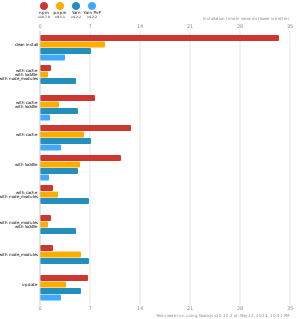
pnpm is up to 2x faster than npm and Yarn classic. See all benchmarks here.
Benchmarks on an app with lots of dependencies:
License
MIT, except the pnpr/ directory, which is source-available under the PolyForm Shield License 1.0.0.