Zoltan Kochan
eb7e6ae8ab
Zoltan Kochan
eb7e6ae8ab
## Summary

`@pnpm/exe@11.0.0-rc.4` aborts on every invocation with:

```
node::sea::(anonymous namespace)::SeaDeserializer::Read() at ../src/node_sea.cc:174
Assertion failed: (format_value) <= (static_cast<uint8_t>(ModuleFormat::kModule))
```

Two independent Node.js v25.7+ SEA regressions are responsible, both surfaced by the rc.4 bump of the embedded runtime from 25.6.1 to 25.9.0. This PR fixes both and adds a prepublish smoke test so a broken binary can't reach npm again.

## Root cause

**1. SEA blob format changed in Node.js v25.7.0** ([nodejs/node#61813](https://github.com/nodejs/node/pull/61813) added ESM-entry-point support and inserted a new `ModuleFormat` byte into the blob header). SEA blobs carry no version marker, so a blob written by one Node.js version can only be deserialized by a matching one. In rc.4, the CI host Node.js (25.6.1, pre-change) wrote the blob and it was embedded in a 25.9.0 runtime (post-change) — the deserializer reads a misaligned byte as `format_value`, exceeds `kModule`, `CHECK_LE` fires, `SIGABRT`. `resolveBuilderBinary()` was preferring `process.execPath` whenever the running Node supported `--build-sea`, never checking that its version matched the embedded runtime.

**2. Node.js v25.7+ replaces the ambient `require` and `import()` inside a CJS SEA entry with embedder hooks** that only resolve built-in module names. The `pnpm.cjs` shim loaded `dist/pnpm.mjs` via `await import(pathToFileURL(...).href)`, which after the fix to (1) reached the CJS entry and then blew up with:

```
ERR_UNKNOWN_BUILTIN_MODULE: No such built-in module: file:///.../dist/pnpm.mjs
    at loadBuiltinModuleForEmbedder
    at importModuleDynamicallyForEmbedder
```

## Changes

- **`releasing/commands/src/pack-app/packApp.ts`** — `resolveBuilderBinary` now takes the resolved target runtime version and only reuses `process.execPath` when `process.version` exactly matches; otherwise it downloads a host-arch Node of the target version via the existing `ensureNodeRuntime` path. Added `PACK_APP_RUNTIME_TOO_OLD` for runtimes older than v25.5 (no `--build-sea`). Removed the now-unused `DEFAULT_BUILDER_SPEC` and the stale `fetch`/`nodeDownloadMirrors` args on the builder resolver. Help text / examples refreshed to drop `node@22` / `node@lts` references that would now be rejected.
- **`pnpm/pnpm.cjs`** — loads `dist/pnpm.mjs` through `Module.createRequire(process.execPath)` instead of `await import(fileURL)`. `createRequire` returns a regular CJS loader that bypasses the SEA embedder hooks, and the pnpm bundle has no top-level await so synchronous `require` of ESM (Node 22+) loads it cleanly. No build-time paths are baked in — `process.execPath` is evaluated at runtime, verified by relocation-testing the darwin-arm64 SEA under `/tmp/`.
- **`pnpm/artifacts/verify-binary.mjs`** (new) + `prepublishOnly` on every platform artifact — replaces the existence-only `test -f pnpm` gate with:
  1. A **relocation-sensitivity check**: run the binary without `dist/` staged and confirm the failure mentions a path derived from `process.execPath`, not a build-time constant. Catches any future regression of (2).
  2. A **smoke test**: stage a `dist → ../exe/dist` symlink (using `symlink-dir` so Windows junctions are handled transparently), exec `./pnpm -v`, assert the output is a SemVer 2 string.
  - Cross-platform targets (darwin/win32 artifacts on a Linux CI, or a libc mismatch) skip the exec with a log line and fall back to existence-only, so a musl artifact published from a glibc host still goes through.
  - Real `dist/` dirs (developer layout) are preserved; stale symlinks from aborted runs are replaced; created symlinks are cleaned up on exit.
- **`pnpm/artifacts/exe/test/setup.test.ts`** — new `pnpm -v` execution test gated on both the platform binary and the staged bundle being present, so ordinary `pn compile` test runs skip cleanly instead of failing on a missing `dist/`.
简体中文 | 日本語 | 한국어 | Italiano | Português Brasileiro

Fast, disk space efficient package manager:
- Fast. Up to 2x faster than the alternatives (see benchmark).
- Efficient. Files inside
node_modulesare linked from a single content-addressable storage. - Great for monorepos.
- Strict. A package can access only dependencies that are specified in its
package.json. - Deterministic. Has a lockfile called
pnpm-lock.yaml. - Works as a Node.js version manager. See pnpm runtime.
- Works everywhere. Supports Windows, Linux, and macOS.
- Battle-tested. Used in production by teams of all sizes since 2016.
- See the full feature comparison with npm and Yarn.
To quote the Rush team:
Microsoft uses pnpm in Rush repos with hundreds of projects and hundreds of PRs per day, and we’ve found it to be very fast and reliable.



Platinum Sponsors

|
Gold Sponsors

|

|

|

|

|

|

|

|
Silver Sponsors

|

|

|

|

|

|

|
⏱️ Time.now |
Support this project by becoming a sponsor.
Background
pnpm uses a content-addressable filesystem to store all files from all module directories on a disk. When using npm, if you have 100 projects using lodash, you will have 100 copies of lodash on disk. With pnpm, lodash will be stored in a content-addressable storage, so:
- If you depend on different versions of lodash, only the files that differ are added to the store.
If lodash has 100 files, and a new version has a change only in one of those files,
pnpm updatewill only add 1 new file to the storage. - All the files are saved in a single place on the disk. When packages are installed, their files are linked from that single place consuming no additional disk space. Linking is performed using either hard-links or reflinks (copy-on-write).
As a result, you save gigabytes of space on your disk and you have a lot faster installations!
If you'd like more details about the unique node_modules structure that pnpm creates and
why it works fine with the Node.js ecosystem, read this small article: Flat node_modules is not the only way.
💖 Like this project? Let people know with a tweet
Getting Started
Benchmark
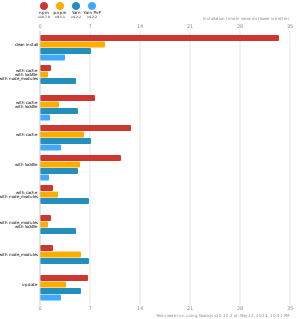
pnpm is up to 2x faster than npm and Yarn classic. See all benchmarks here.
Benchmarks on an app with lots of dependencies: