 Zoltan Kochan
f41c306cc8
Zoltan Kochan
f41c306cc8
pnpm downloads a Node.js runtime, a Bun runtime, a Deno runtime, a Yarn
release and, since this week, a Python interpreter. Two of those could be
pointed at a mirror, through two settings that shared neither a name nor a
shape: `node-mirror:<channel>` and `python.downloadUrl`. Bun and Deno had
none at all.

`tools` names them, keyed by the tool, with `mirror` saying where its
builds come from:

    tools:
      node:
        mirror: https://mirror.example.com/node/download
      bun:
        mirror: https://mirror.example.com/bun
      python:
        mirror: https://mirror.example.com/python-build-standalone/releases

The key is the tool itself, with no category above it. Every taxonomy
this could have used breaks on its next entry: Node.js is a runtime, Yarn
is not, a Python interpreter arguably is, a Rust toolchain would not be,
and a cargo subcommand certainly is not. `tools` inherits no such split
and needs no rename when the next one arrives. It is also the word both
tools that manage many runtimes use, in proto's `[tools.*]` and mise's
tool-namespaced settings.

A mirror carries the project's own layout below it, so only the host
above it differs. That is what lets one string serve tools whose trees
are otherwise nothing alike, and why `tools.node.mirror` is the base its
release channels hang off, exactly as nodejs.org lays them out.

This is the tool an ecosystem runs on, not where its packages come from.
`registry`, `python.indexUrl` and `cargo.indexUrl` keep answering that,
which is why `tools.python` and the `python` section can mean different
things without competing.

`python.downloadUrl` has not been released, so it is gone rather than
deprecated, and its pending changeset now names the setting that replaces
it. `node-mirror:<channel>` has shipped and stays: it names one release
channel where the base names them all, so it decides the channel it names
and leaves the rest to the base.

Deno and Yarn are left out. Both read the GitHub API for release metadata
and take asset URLs out of the response, which a base URL cannot stand in
for. pnpm/pnpm#15042 covers the URL rewriting that would reach them.

`pnpm pack-app` also downloads the Node.js it embeds through `tools.node`
now. It passed no mirror at all, under a comment saying pacquet had no
such setting, which stopped being true when `nodeDownloadMirrors`
landed. It reads only `tools.node`: that runtime runs as the builder and
is kept in the shared pack-app cache, so a repository naming
`node-mirror:<channel>` would be choosing the program that packs
everyone's app.

Related to pnpm/pnpm#14945
简体中文 | 日本語 | 한국어 | Italiano | Português Brasileiro

Fast, disk space efficient package manager:
- Fast. Up to 2x faster than the alternatives (see benchmark).
- Efficient. Files inside
node_modulesare linked from a single content-addressable storage. - Great for monorepos.
- Strict. A package can access only dependencies that are specified in its
package.json. - Deterministic. Has a lockfile called
pnpm-lock.yaml. - Works as a Node.js version manager. See pnpm runtime.
- Works everywhere. Supports Windows, Linux, and macOS.
- Battle-tested. Used in production by teams of all sizes since 2016.
- Experimental Rust port. Includes pacquet, an experimental port of the CLI written in Rust.
- See the full feature comparison with npm and Yarn.
To quote the Rush team:
Microsoft uses pnpm in Rush repos with hundreds of projects and hundreds of PRs per day, and we’ve found it to be very fast and reliable.



Platinum Sponsors

|

|

|

|
Gold Sponsors

|

|

|

|

|

|

|

|
Silver Sponsors

|

|

|

|

|

|

|

|
|
| ⏱️ Time.now |
Support this project by becoming a sponsor.
Background
pnpm uses a content-addressable filesystem to store all files from all module directories on a disk. When using npm, if you have 100 projects using lodash, you will have 100 copies of lodash on disk. With pnpm, lodash will be stored in a content-addressable storage, so:
- If you depend on different versions of lodash, only the files that differ are added to the store.
If lodash has 100 files, and a new version has a change only in one of those files,
pnpm updatewill only add 1 new file to the storage. - All the files are saved in a single place on the disk. When packages are installed, their files are linked from that single place consuming no additional disk space. Linking is performed using either hard-links or reflinks (copy-on-write).
As a result, you save gigabytes of space on your disk and you have a lot faster installations!
If you'd like more details about the unique node_modules structure that pnpm creates and
why it works fine with the Node.js ecosystem, read this small article: Flat node_modules is not the only way.
💖 Like this project? Let people know with a tweet
Getting Started
Benchmark
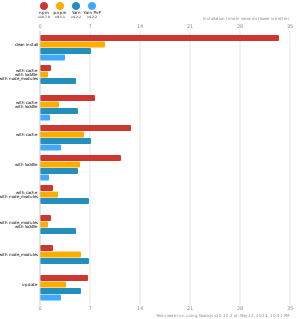
pnpm is up to 2x faster than npm and Yarn classic. See all benchmarks here.
Benchmarks on an app with lots of dependencies:
License
MIT, except the pnpr/ directory, which is source-available under the PolyForm Shield License 1.0.0.