 99a3a79b3b
The old screen was one 425-line component with correctness bugs, not just a
weak layout.

Fixed defects:
- Empty recipients were sent. handleSendBulkSMS mapped every parsed row into
  the payload, so a blank phone cell produced a message addressed to "".
  There was no filtering, no phone validation and no dedupe, so the same
  number listed twice was texted twice.
- User-facing copy printed raw bytes: "max 1048576 bytes".
- The row limit could be wrong. maxRows fell back to 50 while the
  subscription query was still loading, so an unlimited-plan user could be
  told their file was too big. The cap is now only enforced once the real
  limit is known.
- Steps were gated with opacity-50 + pointer-events-none, which leaves
  controls in the tab order and unannounced. Locked steps now use `inert`.
- Data came from raw useQuery(['devices']) + devices?.data instead of the
  typed useDevices(), the same shared-cache-key shape hazard that caused the
  devices?.filter crash in round 1.

The new flow: upload (with parse summary and a preview table of the first 5
rows), map (auto-detected phone column plus live valid/invalid/duplicate
counts), compose (clickable variable chips, SMS segment counter, preview that
cycles through real recipients) and review (explicit count, an itemised list
of skipped rows and why, nothing sent until confirmed).

bulk-csv.ts holds the rules that decide who receives a message, as pure
functions with 24 unit tests. Those tests caught a real bug during
development: the short "to" hint substring-matched a column named "total",
which would have silently auto-selected the wrong column. Short hints are now
exact-match only.

Sample CSV at /samples/bulk-sms-sample.csv using 555 reserved-for-fiction US
and Canada numbers, so an unedited upload cannot text a real person, with an
order-confirmation template that demonstrates multi-variable interpolation.

E2e asserts the actual request payload contains exactly the two valid
recipients from a file seeded with a blank, an invalid and a duplicate row,
and that the parsed-CSV table does not reintroduce sideways scroll at 375px.

Co-Authored-By: Claude Fable 5 <noreply@anthropic.com>



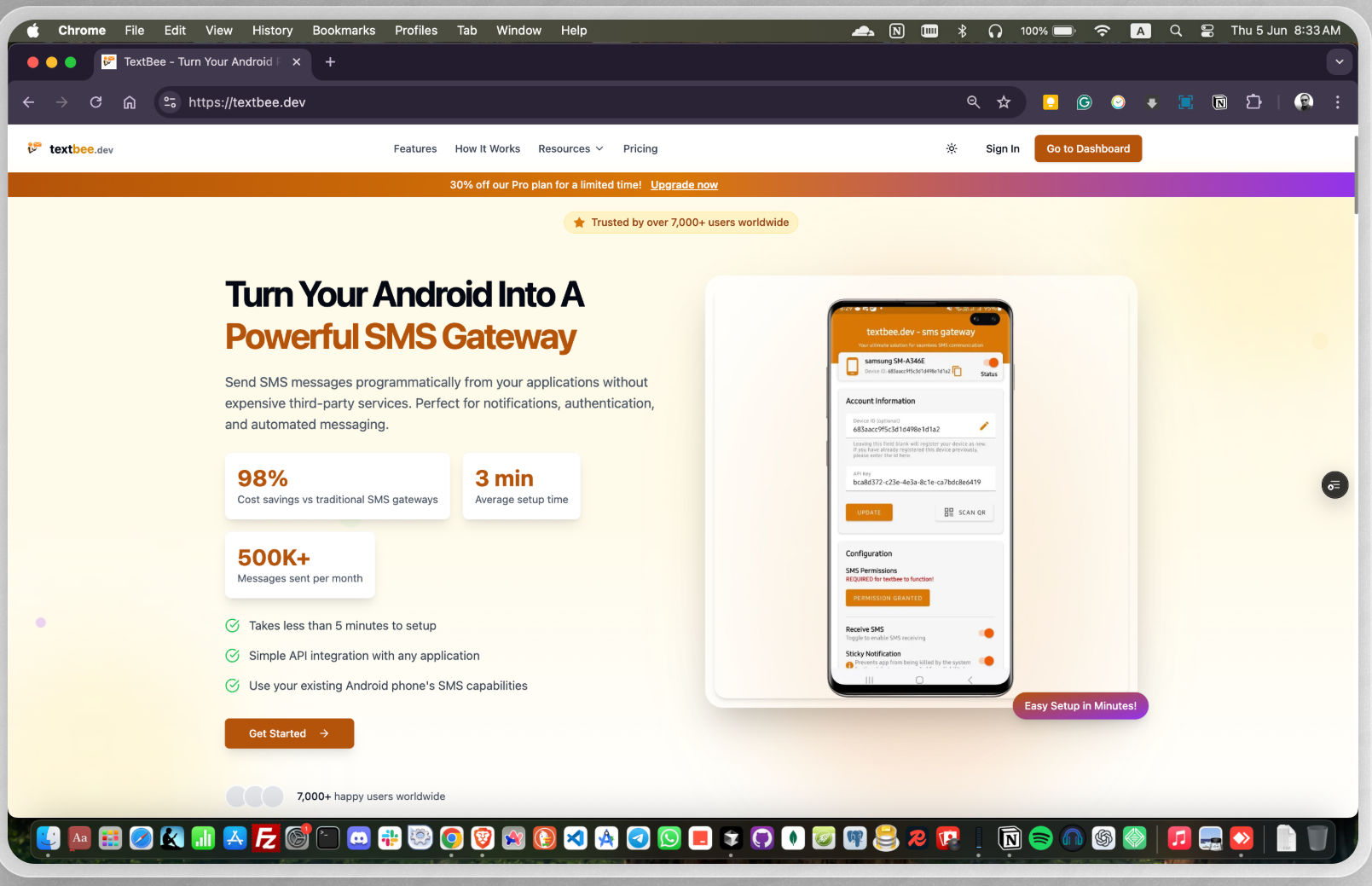
textbee.dev - android sms gateway
Send and receive SMS messages using your own Android phone - no Twilio, no per-message fees. Free, open-source, and self-hostable.
Manage SMS messages through a web dashboard or a REST API. textbee is ideal for businesses, developers, and hobbyists looking for a reliable and cost-effective solution to automate SMS messaging.
Website: https://textbee.dev
Why textbee?
| textbee | Twilio & similar APIs | |
|---|---|---|
| Cost per SMS | Your carrier plan (often free/unlimited) | ~$0.008+ per message |
| Phone number | Your own SIM | Rented number |
| Self-hostable | ✅ Full control over your data | ❌ |
| Open source | ✅ | ❌ |
| Setup time | ~2 minutes | Account approval, compliance forms |
Features
- Send & receive SMS messages via API & dashboard
- Use your own Android phone as an SMS gateway
- REST API for easy integration with apps & services
- Send bulk SMS with CSV file
- Multi-device support for higher SMS throughput
- Secure API authentication with API keys
- Webhook support for incoming messages
- Self-hosting support for full control over your data
Getting Started
- Go to textbee.dev and register or login with your account
- Install the app on your Android phone from textbee.dev/download
- Open the app and grant the permissions for SMS
- Go to textbee.dev/dashboard and click register device / generate API key
- Scan the QR code with the app or enter the API key manually
- You're ready to send SMS from the dashboard or from your application via the REST API
Sending an SMS
const API_KEY = 'YOUR_API_KEY';
const DEVICE_ID = 'YOUR_DEVICE_ID';

await axios.post(`https://api.textbee.dev/api/v1/gateway/devices/${DEVICE_ID}/send-sms`, {
  recipients: [ '+251912345678' ],
  message: 'Hello World!',
}, {
  headers: { 'x-api-key': API_KEY },
});
Python
```python import requestsAPI_KEY = 'YOUR_API_KEY' DEVICE_ID = 'YOUR_DEVICE_ID'
requests.post( f'https://api.textbee.dev/api/v1/gateway/devices/{DEVICE_ID}/send-sms', json={ 'recipients': ['+251912345678'], 'message': 'Hello World!', }, headers={'x-api-key': API_KEY}, )
</details>
<details>
<summary><b>curl</b></summary>
```bash
curl -X POST "https://api.textbee.dev/api/v1/gateway/devices/YOUR_DEVICE_ID/send-sms" \
  -H 'x-api-key: YOUR_API_KEY' \
  -H 'Content-Type: application/json' \
  -d '{
    "recipients": [ "+251912345678" ],
    "message": "Hello World!"
  }'
Enable SMS receiving in the mobile app, then access incoming messages via the REST API, the dashboard, or webhook notifications delivered to your preferred URL.
const API_KEY = 'YOUR_API_KEY';
const DEVICE_ID = 'YOUR_DEVICE_ID';

await axios.get(`https://api.textbee.dev/api/v1/gateway/devices/${DEVICE_ID}/get-received-sms`, {
  headers: { 'x-api-key': API_KEY },
});
curl
```bash curl -X GET "https://api.textbee.dev/api/v1/gateway/devices/YOUR_DEVICE_ID/get-received-sms" \ -H "x-api-key: YOUR_API_KEY" ```- OTP / 2FA delivery for your app
- Order and appointment notifications
- Alerts from servers, cron jobs, and home automation
- Form-to-SMS and lead follow-ups
- Bulk announcements to a contact list (CSV upload)
FAQ
Will my carrier block my number for sending too many messages?
Carriers apply their own rate limits and anti-spam policies, which vary by country and plan. For personal and low-volume use this is rarely an issue. For higher throughput, use multiple devices/SIMs and keep sending rates reasonable. You are responsible for staying within your carrier's terms.Is it legal to send marketing SMS this way?
SMS marketing is regulated in most countries (e.g., TCPA in the US, GDPR/ePrivacy in the EU). textbee is a tool — you are responsible for obtaining consent and complying with the laws that apply to you and your recipients.Does my phone need to stay on?
Yes — messages are sent through your phone, so it needs to be powered on with the app running and connected to the internet. A spare Android phone plugged into a charger works great as a dedicated gateway.Is there a limit on the cloud-hosted version?
See [textbee.dev](https://textbee.dev) for current plans and limits. You can always self-host for full control.Self-Hosting
Technology stack: React, Next.js, Node.js, NestJS, MongoDB, Android, Kotlin, Jetpack Compose, Java (legacy)
Setting Up Database
- Install MongoDB on Your Server: Follow the official MongoDB installation guide for your operating system.
- Using MongoDB Atlas: Alternatively, you can create a free database on MongoDB Atlas. Sign up at MongoDB Atlas and follow the instructions to set up your database.
Firebase Setup
- Create a Firebase project.
- Enable Firebase Cloud Messaging (FCM) in your Firebase project.
- Obtain the Firebase credentials for backend use and the Android app.
Building the Android App
- Clone the repository and navigate to the Android project directory.
- Update the
google-services.jsonfile with your Firebase project configuration. - Update every occurrence of
textbee.devwith your own domain in the project. - Build the app using Android Studio or the command line:
./gradlew assembleRelease
Building the Web
- Navigate to the
webdirectory. - Copy the
.env.examplefile to.env:cp .env.example .env - Update the
.envfile with your own credentials. - Install dependencies:
pnpm install - Build the web application:
pnpm build
Building the API
- Navigate to the
apidirectory. - Copy the
.env.examplefile to.env:cp .env.example .env - Update the
.envfile with your own credentials. - Install dependencies:
pnpm install - Build the API:
pnpm build
Hosting on a VPS
- Install
pnpm,pm2, andCaddyon your VPS. - Use
pm2to manage your Node.js processes:pm2 start dist/main.js --name textbee-api - Configure
Caddyto serve your web application and API. Example Caddyfile:textbee.dev { reverse_proxy /api/* localhost:3000 reverse_proxy /* localhost:3001 } - Ensure your domain points to your VPS and Caddy is configured properly.
Dockerized env
Requirements:
- Docker installed
- After setting up Firebase, update your
.envinweb&&apifolder.cd web && cp .env.example .env \ && cd ../api && cp .env.example .env - Navigate to root folder and execute docker-compose.yml file.
This will spin upwebcontainer,apicontainer alongside withMongoDBandMongoExpress.TextBeedatabase will be automatically created.To stop the containers simply typedocker compose up -ddocker compose down
Contributing
Contributions are welcome!
- Fork the project.
- Create a feature or bugfix branch from
mainbranch. - Make sure your commit messages and PR comment summaries are descriptive.
- Create a pull request to the
mainbranch.
Bug Reporting and Feature Requests
Please feel free to create an issue in the repository for any bug reports or feature requests. Make sure to provide a detailed description of the issue or feature you are requesting and properly label whether it is a bug or a feature request.
Please note that if you discover any vulnerability or security issue, we kindly request that you refrain from creating a public issue. Instead, send an email detailing the vulnerability to contact@textbee.dev.
For support, feedback, and questions
Feel free to reach out to us at contact@textbee.dev or Join our Discord server