 d4cd649b6b
useConnections went from 661 lines down to 264 by extracting three
single-responsibility helpers under packages/web/src/core/connections/.
The hook is now pure orchestration; transport / heartbeat / SDK-client
/ status-probe concerns live in their own files.

New modules:
- core/connections/heartbeat.ts (45 LOC): startConfigHeartbeat (5s),
  startMaintenanceHeartbeat (5min), stopHeartbeat. Owns the heartbeats
  Map; replaces the inline interval bookkeeping. Both helpers stop the
  prior heartbeat first so callers don't have to.
- core/connections/sdkClient.ts (61 LOC): buildMeshDevice(connId,
  deviceId, transport) opens the OPFS DB, builds the four sqlocal
  repositories (chat / draft / nodes / telemetry), and constructs the
  MeshDevice with the canonical retention defaults (chat 90d / 1k per
  bucket; telemetry 30d / 500 per node). Falls back to in-memory when
  sqlocal is unavailable.
- core/connections/transports.ts (236 LOC): per-transport openTransport
  factory (HTTP reachability check, BT permission re-acquisition with
  optional prompt, Serial port lookup with close-then-reopen),
  probeConnection for refreshStatuses, closeTransport for cleanup.
  Discriminates over conn.type so useConnections doesn't carry the
  switch logic.

useConnections (now 264 LOC):
- Owns the cachedTransports + configSubscriptions maps and the
  Zustand selectors.
- teardown(id, conn) consolidates the heartbeat + config-sub +
  meshDevice.disconnect + transport-close cleanup that used to be
  duplicated across removeConnection / disconnect.
- connect calls openTransport and forwards the resulting transport +
  cached BT/Serial handle into setupMeshDevice. The BT
  gattserverdisconnected listener is wired here (it needs the connId).
- refreshStatuses simplifies to a filter + Promise.all over
  probeConnection.
- syncConnectionStatuses unchanged.

Behavior is unchanged. No new tests — the existing web suite (236)
still passes; build clean.
Meshtastic Web Monorepo




Overview
This monorepo consolidates the official Meshtastic web interface, the domain-driven JavaScript SDK that drives it, and a set of runtime-specific transport packages. Everything you need to read state from or send commands to a Meshtastic device lives here.
Note
You can find the main Meshtastic documentation at https://meshtastic.org/docs/introduction/.
Packages
All projects live under packages/.
| Package | Purpose |
|---|---|
packages/sdk |
Framework-agnostic TypeScript SDK. Domain-driven feature slices (device, chat, nodes, channels, config, telemetry, position, traceroute, files) built around a MeshClient orchestrator with @preact/signals-core reactive state. |
packages/sdk-react |
React hooks + MeshProvider on top of @meshtastic/sdk. Wraps signals in useSyncExternalStore for concurrent-safe renders. |
packages/web |
Reference React web client. Hosted at client.meshtastic.org. |
packages/ui |
Shared Radix + Tailwind component library. |
packages/protobufs |
Generated TypeScript stubs from meshtastic/protobufs, produced via buf generate. Source of truth for every wire-level type. |
packages/transport-http |
HTTP transport for devices exposing a network interface. |
packages/transport-web-bluetooth |
Web Bluetooth transport for BLE-capable devices (browsers). |
packages/transport-web-serial |
Web Serial transport for USB-serial devices (browsers). |
packages/transport-node |
TCP transport for Node.js. |
packages/transport-node-serial |
Serial transport for Node.js. |
packages/transport-deno |
TCP transport for Deno. |
packages/transport-mock |
In-memory transport for tests. |
packages/core |
Legacy SDK — superseded by @meshtastic/sdk and slated for removal after the slice-by-slice migration completes. |
All publishable packages ship to both JSR and NPM.
Architecture
@meshtastic/sdk organises its source by feature slice. Each slice follows the
same DDD layout:
features/<slice>/
  domain/          # entities & value objects — pure TypeScript types
  application/     # use-cases (SendTextUseCase, FavoriteNodeUseCase, …)
  infrastructure/  # protobuf ↔ domain mappers, admin-message adapters
  state/           # signals-backed reactive stores
  <Slice>Client.ts # public facade exposing readable signals + command methods
  index.ts
The shared kernel under packages/sdk/src/core/ owns:
client/—MeshClient, the thin orchestrator that owns the transport, queue, event bus, and one instance of every slice client.transport/— theTransportinterface everytransport-*package implements.event-bus/— typed pub/sub channels populated by the packet codec.packet-codec/— frame parser (0x94 0xC3),FromRadiodecoder, portnum router.queue/,xmodem/— packet ack/timeout pipeline and file-transfer protocol.signals/— signal and keyed-collection helpers consumed by every slice.logging/—tslogfactory used consistently by every class.identifiers/,errors/— small primitives shared across slices.
The protobuf boundary is strict: wire messages enter through the packet codec,
get mapped into domain entities inside features/*/infrastructure/*Mapper.ts,
and signals only ever expose the domain shape.
 Transport   ─▶   Packet codec   ─▶   EventBus   ─▶   Slice infrastructure
                                                            │
                                                            ▼
                                                    Signals (state)  ─▶  sdk-react hooks  ─▶  UI
                                                            ▲
                                                            │
 Slice application (use-cases)  ─▶   MeshClient.sendPacket  ─▶   Queue   ─▶   Transport
Expected domain errors are returned as Result<T, E> via better-result; exceptions are reserved for programmer errors and truly exceptional conditions.
Getting Started
Prerequisites
You need pnpm installed. If you plan to regenerate protobufs, also install the Buf CLI.
Setup
git clone https://github.com/meshtastic/web.git
cd web
pnpm install
Run the web client
pnpm --filter @meshtastic/web dev
Build everything
pnpm -r build
Run tests
pnpm -r test
Lint + format
pnpm check
pnpm check:fix
Developing
Adding a new feature slice to @meshtastic/sdk
- Create
packages/sdk/src/features/<slice>/withdomain/,application/,infrastructure/,state/subdirectories plus anindex.tsbarrel. - Implement a signals-backed store in
state/. - Subscribe to the relevant
EventBuschannel(s) inside a<Slice>Client.tsclass and write mapped domain entities to the store. - Wire the new client into
MeshClientand re-export types frompackages/sdk/mod.ts. - Add vitest coverage: domain invariants, use-cases against
createFakeTransport(), and round-trip mapper fixtures. - If the slice has React callers, add a matching hook under
packages/sdk-react/src/hooks/.
Adding a new transport
Implement the Transport interface exported from @meshtastic/sdk/transport:
interface Transport {
  toDevice: WritableStream<Uint8Array>;
  fromDevice: ReadableStream<DeviceOutput>;
  disconnect(): Promise<void>;
}
The SDK does the framing and decoding — transports only supply raw bytes.
Testing
Vitest is wired at the repo root and picks up packages/* projects. The SDK
ships @meshtastic/sdk/testing with createFakeTransport() for wiring tests
without real hardware.
Publishing
Each publishable package has build:npm / publish:npm / prepare:jsr /
publish:jsr scripts. See each package's package.json for details.
Repository activity
| Project | Repobeats |
|---|---|
| Meshtastic Web | 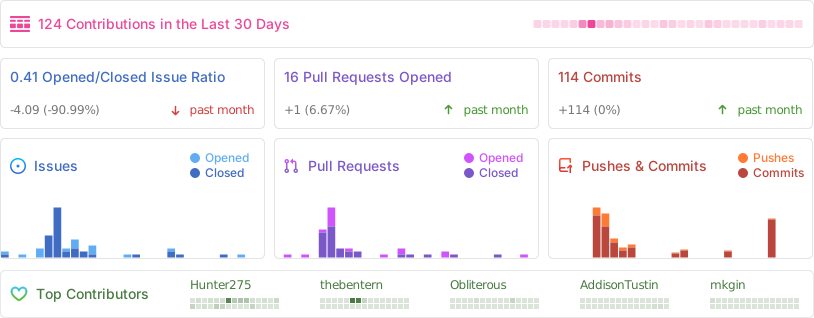 |
Feedback
If you encounter any issues, please report them in our issues tracker. Your feedback helps improve the stability of future releases.
Star history
Contributors
License
GPL-3.0-only. See LICENSE.