## Summary
- Adds a **Keep downloaded models (~/.exo/models)** checkbox to the
macOS uninstall confirmation dialog (Settings → Advanced → Danger Zone).
The full `~/.exo` directory is now removed on uninstall by default; if
the checkbox is checked, `~/.exo/models` is preserved.
- The standalone `app/EXO/uninstall-exo.sh` gains a matching
`--keep-models` flag and the same `~/.exo` cleanup so GUI and CLI flows
stay in sync. Resolves the user home via `$SUDO_USER` since the script
runs under `sudo`.
Previously, "Uninstall EXO" only cleaned up system-level components
(LaunchDaemon, network location, logs, app bundle) and left the entire
`~/.exo` directory behind. Now uninstalling actually removes EXO's user
data, with a one-click opt-out for the (potentially many GB) of
downloaded models.
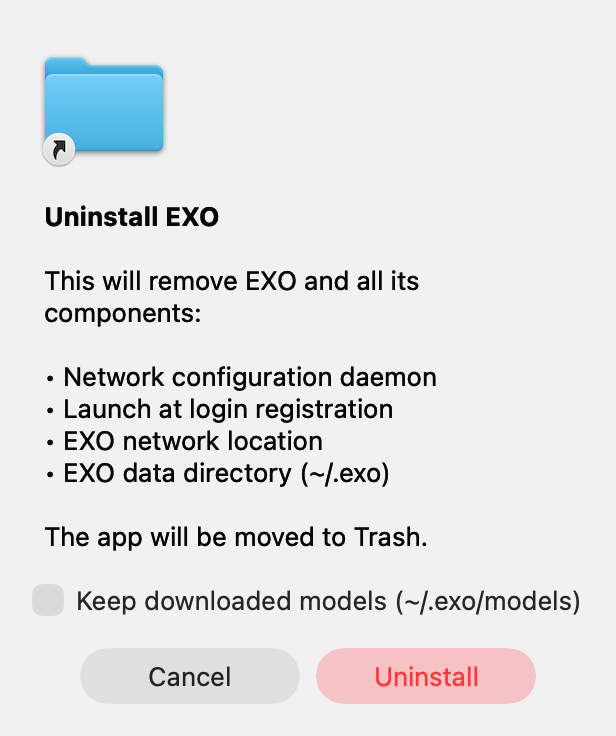
> Note: the rendered icon in the screenshot above is the generic system
folder icon because it was captured from a small standalone Swift binary
(no app bundle / icon resource). When triggered from the actual EXO.app,
the EXO app icon is shown.
## Test plan
- [ ] Build EXO.app locally; open Settings → Advanced → Danger Zone →
Uninstall EXO; confirm the new "Keep downloaded models (~/.exo/models)"
checkbox is present and unchecked by default.
- [ ] Uninstall with the checkbox **checked** → `~/.exo/models/`
survives, all other entries under `~/.exo` are gone, system components
removed, app moved to Trash.
- [ ] Uninstall with the checkbox **unchecked** → `~/.exo` is fully
removed.
- [ ] `sudo app/EXO/uninstall-exo.sh --keep-models` → `~/.exo/models/`
is preserved, the rest of `~/.exo` is removed.
- [ ] `sudo app/EXO/uninstall-exo.sh` (no flag) → `~/.exo` is fully
removed.
- [ ] `app/EXO/uninstall-exo.sh --help` prints usage and exits 0;
unknown args exit 2 with a usage hint.
🤖 Generated with [Claude Code](https://claude.com/claude-code)
---------
Co-authored-by: Claude Opus 4.7 (1M context) <noreply@anthropic.com>
Co-authored-by: Evan <evanev7@gmail.com>
## Summary

The standalone `app/EXO/uninstall-exo.sh` only knew about the legacy
filename `disable_bridge_enable_dhcp.sh`. On machines installed with
newer EXO versions, the current `/Library/Application
Support/EXO/disable_bridge.sh` was left behind, and the script then
reported `EXO support directory not empty, leaving in place`.

This PR makes the script try both filenames, removing whichever ones
exist. Tolerates **either**, **both**, or **neither** being present
without erroring.

The Swift `NetworkSetupHelper.makeUninstallScript()` already handles
both paths correctly, so the GUI uninstall flow is unaffected — this is
a script-only fix.

Caught while running an end-to-end uninstall on a real machine for
#1997.

## Test plan

Verified the new block in isolation against all four states:

- [x] both `disable_bridge.sh` and `disable_bridge_enable_dhcp.sh`
present → both removed
- [x] only `disable_bridge.sh` present → removed cleanly
- [x] only `disable_bridge_enable_dhcp.sh` present → removed cleanly
(legacy install)
- [x] neither present → prints the existing "already removed?" warning,
exits 0

🤖 Generated with [Claude Code](https://claude.com/claude-code)

Co-authored-by: Claude Opus 4.7 (1M context) <noreply@anthropic.com>
The load balancer counted ALL tasks (Complete, Cancelled, TimedOut,
Failed) instead of only Pending/Running ones. With 138 accumulated tasks
and only 7 active, routing decisions were based on historical
distribution, causing one node to appear permanently 'busier' and
starving the other of work.

Co-authored-by: Adam Durham <adam@example.com>
Co-authored-by: Claude Opus 4.6 (1M context) <noreply@anthropic.com>
## Motivation

Extend bench/eval tooling with robustness features, streaming support,
and align model configs with vllm eval for reproducible comparisons.

## Changes

- **exo_eval**: Checkpoint/resume (JSONL), instance health monitoring +
early abort, `top_k`/`min_p`/`enable_thinking` params, LCB
`--release-version`/`--offset`
- **exo_bench**: Streaming SSE (`--stream`), Kimi tokenizer fix for
transformers 5.x
- **Both tools**: Auto-detect running instances instead of requiring
`--skip-instance-setup`; `--fresh-instance` to override
- **harness**: SSE streaming client, `find_existing_instance()` shared
helper, removed download timeout, settle-timeout default 0→7200s
- **models.toml**: Added `enable_thinking`, aligned `max_tokens`/temps
with vllm, added new models
- **API**: Streaming SSE for `/bench/chat/completions`

## Why It Works

- Checkpoint/resume uses append-only JSONL + skip-on-load so interrupted
evals resume without re-running completed questions
- Health monitoring races an `asyncio.Event` against API calls for fast
abort when the instance dies
- Auto-detection queries `/state` for existing instances matching the
model ID before attempting placement
- Streaming reuses the existing `generate_chat_stream` infrastructure
from the regular chat endpoint
Upstream PR #1947 added `presence_penalty` and `frequency_penalty` to
`TextGenerationTaskParams` and the mlx-lm generator call sites, but
missed wiring them up in the API adapter so they were silently dropped
from incoming requests. This fixes the API mapping.

Co-authored-by: Adam Durham <adam@example.com>
## Motivation

The bug-report presigned-URL endpoint
(`https://reports.exolabs.net/presigned-urls`) was injected at build
time from the `EXO_BUG_REPORT_PRESIGNED_URL_ENDPOINT` GitHub Actions
secret into `Info.plist`, then read at runtime by `BugReportService`. It
isn't actually a secret — the POST body is just `{"keys":[...]}` with no
credential (see `app/EXO/EXO/Services/BugReportService.swift:136-142`),
abuse prevention lives server-side on the lambda, and the URL is already
visible in every publicly-distributed DMG's `Info.plist`. Treating it as
a repo secret added plumbing with no security benefit and broke local
dev builds — hitting **Send Bug Report** on an uncustomised `just
build-app` raised "Bug report endpoint is invalid".

## Changes

- `app/EXO/EXO/Info.plist`: replace
`$(EXO_BUG_REPORT_PRESIGNED_URL_ENDPOINT)` with the literal URL.
- `.github/workflows/build-app.yml`: drop the
`EXO_BUG_REPORT_PRESIGNED_URL_ENDPOINT` job-level env var and the
xcodebuild build-setting passthrough. No other workflow changes.

Swift code is unchanged — `BugReportService` still reads from
`Info.plist`, which leaves an escape hatch if anyone ever needs to
override via `xcodebuild EXOBugReportPresignedUrlEndpoint=...` without
recompiling.

Follow-up: the `EXO_BUG_REPORT_PRESIGNED_URL_ENDPOINT` repo secret can
now be deleted in the GitHub Actions settings UI.

## Why It Works

`Info.plist` variable substitution turns `$(FOO)` into whatever build
setting `FOO` resolves to. CI was setting `FOO` via xcodebuild; local
dev wasn't, so the key resolved to an empty string, which
`BugReportService.fetchPresignedUploadUrls` rejects via the
`!trimmedEndpointString.isEmpty` guard at `BugReportService.swift:131`.
Hardcoding the literal string removes the substitution entirely, so
every build — local or CI — gets the right value.

## Test Plan

### Manual Testing
<!-- Hardware: MacBook Pro (macOS app build via Xcode) -->
- `just build-app` with no extra env vars (reproduces the failure path
on `main`).
- `/usr/libexec/PlistBuddy -c "Print :EXOBugReportPresignedUrlEndpoint"
app/EXO/build/Build/Products/Debug/EXO.app/Contents/Info.plist` →
returns `https://reports.exolabs.net/presigned-urls` (was empty before
this change).
- `open app/EXO/build/Build/Products/Debug/EXO.app` → menubar → **Debug
Info** → **Send Bug Report** → type a description → **Send** → upload
succeeds and the **Create GitHub Issue** button appears (was failing
with "Bug report endpoint is invalid" before).
- Cross-check on the Slack side that the uploaded `report.json` lands
under `reports/YYYY/MM/DD/<ts>/` as before.

### Automated Testing
<!-- Describe changes to automated tests, or how existing tests cover
this change -->
- No new tests. This is a single-string change to `Info.plist` plus a
workflow cleanup. `nix flake check` in CI verifies formatting/lint for
the rest of the tree.

🤖 Generated with [Claude Code](https://claude.com/claude-code)

Co-authored-by: Claude Opus 4.7 (1M context) <noreply@anthropic.com>
## Motivation

When a new node joins, it might not have the cache.


Caveat:
This is potentially fallible if a new node joins and updates real
topology, but the API topology hasn't caught up with this fact and the
user queues up a new text generation. In practice, there is only a split
second where this is the case, and this is only for users of the
dashboard interface. We should fix this properly after the release.
## Motivation

When a user clicks **Send Bug Report** in the macOS app, we already give
them the option to add more context via an optional text field. But the
current prompt is just a terse label — `"What's the issue? (optional)"`
— which doesn't tell the user why bothering to fill it in matters. A
friendly one-line explanation increases the chance they'll describe what
went wrong, which is the single most useful signal when we triage the
resulting diagnostic bundle.

## Changes

- `app/EXO/EXO/ContentView.swift`: In the `.prompting` phase of
`sendBugReportButton`, replace the single label with a two-line
hierarchy:
  - Primary: `Tell us what went wrong (optional)`
- Helper: `A quick description of what you were doing and what happened
helps us track down the bug for you.`
- The helper uses `.caption2` + `.secondary` + `.opacity(0.8)` +
`.fixedSize(horizontal: false, vertical: true)` so it stays visually
subordinate and wraps cleanly inside the 340pt popover.

No changes to `BugReportService`, the `user_description` payload, or any
other flow.

## Why It Works

The optional description is already plumbed end-to-end (text editor →
`bugReportUserDescription` state → `BugReportService.sendReport(...,
userDescription:)` → `report.json`'s `user_description` field → GitHub
issue pre-fill). The only gap was user-facing motivation, so this is
purely a copy/layout tweak inside the existing `.prompting` case — no
new state, bindings, or service changes.

## Test Plan

### Manual Testing
<!-- Hardware: MacBook Pro (macOS app build via Xcode) -->
- Build the macOS app in Xcode (`app/EXO/EXO.xcodeproj`) and launch it.
- Open the menubar popover → expand **Debug Info** → click **Send Bug
Report**.
- Verify the new primary label and helper sentence both appear above the
text editor and wrap cleanly within the popover width.
- Leave the field empty → click **Send** → upload should succeed (no
`user_description` in payload, same as before).
- Fill in a description → click **Send** → upload succeeds and the
success card with **Create GitHub Issue** appears; clicking it opens
GitHub with the description pre-filled.
- Click **Cancel** from the prompting state → returns to idle.

### Automated Testing
<!-- Describe changes to automated tests, or how existing tests cover
this change -->
- No new automated tests. This is a SwiftUI copy/layout change; existing
`EXOTests` are smoke-level and don't cover `ContentView` view bodies,
and UI snapshot tests aren't worth adding for a two-line copy tweak.
- `nix fmt` reports 0 files changed after the edit; `nix flake check` in
CI will verify formatting/lint for the rest of the tree.

🤖 Generated with [Claude Code](https://claude.com/claude-code)

Co-authored-by: Claude Opus 4.7 (1M context) <noreply@anthropic.com>
## Summary
Adds a new **Pi** tab to the Integrations page (`/#/integrations`)
alongside the existing Claude Code, OpenCode, Codex, OpenClaw, Open
WebUI, n8n, and Firefox tabs.

[pi](https://pi.dev) (`@mariozechner/pi-coding-agent`) is a terminal
coding agent that supports custom OpenAI-compatible providers via
`~/.pi/agent/models.json`.
This tab gives users a copy-pasteable config to wire pi up to their exo
cluster.

## What's in the tab
- **Model selector** (shown when multiple models are running) — picks
the default model for the generated shell command.
- **Models Config card** — generates `~/.pi/agent/models.json`
registering `exo` as a custom provider:
     - `baseUrl` → `<apiUrl>/v1`
     - `api` → `openai-completions`
     - `apiKey` → `"exo"` (placeholder; exo ignores it)
- `compat.supportsDeveloperRole: false` and
`compat.supportsReasoningEffort: false`, per pi docs recommendation for
local OpenAI-compatible servers
- Auto-populates every running model with `id`, `contextWindow` (from
`/v1/models`), and `input: ["text", "image"]` for vision-capable models
- **Shell Command card** — `pi --provider exo --model <model>` for quick
launch.

The tab gracefully falls back to `your-model-id` when no models are
running, matching the behavior of the other tabs.

   ## Usage

   1. `npm install -g @mariozechner/pi-coding-agent`
   2. Paste the generated config into `~/.pi/agent/models.json`
3. Run `pi` and pick an exo model via `/model` — or run the shell
command directly

   ## Changes

- `dashboard/src/routes/integrations/+page.svelte` — adds `"Pi"` to the
`tabs` tuple, `piModel` state, `piModelsJson` + `piShellCommand`
derivations, and the tab content block.

   Single-file, scoped change — no backend or type changes.

   ## Testing

   - `cd dashboard && npm run build` — ✅ builds cleanly
   - `svelte-check` on the edited file — no new errors
- Manually verified the tab renders, the model selector updates the
generated JSON, and the config reflects `/v1/models` capabilities
(vision → `input: ["text","image"]`,
 `context_length` → `contextWindow`).

   ## Screenshots

<img width="1545" height="1236" alt="pi-tab"
src="https://github.com/user-attachments/assets/38aa179f-4ed9-4a1e-9783-d3baa7738263"
/>
## Motivation

This fixes a bunch of observed model quality issues introduced upstream
in JACCL, as well as API issues and prefix cache calculation.


## Test Plan

### Manual Testing
Tested a bunch

### Automated Testing
Added a test, automated eval tool calls on Kimi K2.6, Minimax M2.7, GPT
OSS and Qwen3.6 models.

---------

Co-authored-by: Evan <evanev7@gmail.com>
## Motivation
Fixes#1918. Downloaded model status reverts from "completed" to
"pending" during each download scan. Reproduced with `zai-org/GLM-5.1`.
## Changes
- `coordinator.py`: In the periodic rescan, don't downgrade
already-completed models; fall back to `resolve_existing_model()`
(safetensors weight check) when per-file size check reports incomplete
- New `test_download_status_not_lost.py`: 3 regression tests
## Why It Works
The rescan compares local file sizes against HF's `main` revision. When
HF updates text files (README, jinja, etc.), remote sizes change but
local files still match the old revision — causing a false "incomplete".
The fix uses the safetensors weight check as ground truth instead.
Long-term: pin the downloaded revision SHA rather than always checking
against `main`.
## Test Plan
### Manual Testing
- Mac Studio M3 Ultra with GLM-5.1 downloaded (natural reproduction of
the issue)
- Confirmed GLM-5.1 stays `DownloadCompleted` through multiple rescan
cycles
### Automated Testing
- 3 new tests: completed-not-downgraded, fallback-to-resolve,
genuinely-incomplete-stays-pending
## Motivation

Image models fail to load after a mid-download instance deletion and
recreation. The system skips the download and crashes with
`FileNotFoundError: No safetensors files found in .../vae`.

## Changes

- Make `ModelSafetensorsIndexMetadata.total_size` optional (`PositiveInt
| None = None`)
- Add null guard in `fetch_safetensors_size`
- Add regression test

## Why It Works

Exolabs quantized image models have safetensors index files with mflux
metadata (`quantization_level`, `mflux_version`) but no `total_size`.
The required `PositiveInt` field caused Pydantic validation to fail,
which was silently swallowed by `except Exception: continue` in
`_scan_model_directory`. This skipped all weight map checks, making
incomplete models appear complete.

## Test Plan

### Manual Testing

- Hardware: Mac Studio
- Before: `CreateRunner → LoadModel` (crash). After: `CreateRunner →
DownloadModel` (correct).

### Automated Testing

- `test_safetensors_index.py`: 3 cases covering missing, valid, and null
metadata
## Motivation

<!-- Why is this change needed? What problem does it solve? -->
<!-- If it fixes an open issue, please link to the issue here -->

## Changes

<!-- Describe what you changed in detail -->

## Why It Works

<!-- Explain why your approach solves the problem -->

## Test Plan

### Manual Testing
<!-- Hardware: (e.g., MacBook Pro M1 Max 32GB, Mac Mini M2 16GB,
connected via Thunderbolt 4) -->
<!-- What you did: -->
<!-- - -->

### Automated Testing
<!-- Describe changes to automated tests, or how existing tests cover
this change -->
<!-- - -->
## Motivation

Vision models don't understand images on M5 series MacBooks. The
upstream NAX addmm fix (https://github.com/ml-explore/mlx/pull/3422)
fixes this.

## Why It Works
Same conclusion I came to when I was debugging the issue on an M5 Max.
It works after this fix.

## Test Plan

### Manual Testing
Works for Qwen3.5 27B
## Motivation

<!-- Why is this change needed? What problem does it solve? -->
<!-- If it fixes an open issue, please link to the issue here -->

## Changes

<!-- Describe what you changed in detail -->

## Why It Works

<!-- Explain why your approach solves the problem -->

## Test Plan

### Manual Testing
<!-- Hardware: (e.g., MacBook Pro M1 Max 32GB, Mac Mini M2 16GB,
connected via Thunderbolt 4) -->
<!-- What you did: -->
<!-- - -->

### Automated Testing
<!-- Describe changes to automated tests, or how existing tests cover
this change -->
<!-- - -->
## Summary
- After `KVPrefixCache` evicts LRU entries, the MLX Metal buffers stay
allocated until Python's GC runs
- This leaks ~3-4 GB between long-context requests, reducing the
effective context ceiling for back-to-back requests
- Adding `gc.collect()` + `mx.clear_cache()` after eviction frees Metal
buffers promptly

## Test plan
- [x] Measured on 2-node PP cluster with Qwen3.5-397B-A17B-4bit at 63K
context
- [x] Before: 108.88 GB retained after eviction (3.78 GB above baseline)
- [x] After: 105.48 GB retained after eviction (0.38 GB above baseline —
draft model KV + minor overhead)
- [x] `gc.collect()` adds ~2-3ms latency, runs once per eviction cycle
(not per token)
- [ ] Verify with `uv run pytest`

🤖 Generated with [Claude Code](https://claude.com/claude-code)

---------

Co-authored-by: Adam Durham <adam@example.com>
Co-authored-by: Claude Opus 4.6 (1M context) <noreply@anthropic.com>
Co-authored-by: rltakashige <rl.takashige@gmail.com>
Adds the 8bit variant missing from #1907 — the safetensors index is now
live on HF.

- `mlx-community/Qwen3.6-35B-A3B-8bit` (~35 GB)

Architectural fields match the existing 4bit/5bit/bf16 cards.
`storage_size.in_bytes` is taken from `metadata.total_size` of the
upstream `model.safetensors.index.json`.
## Motivation
`mlx-community` has just published the new **Qwen3.6-35B-A3B**
multimodal MoE family on HuggingFace. Without static model cards exo
doesn't surface these models in the dashboard picker or match its
placement / prefill logic, so users can't one-click launch them. This PR
adds cards for the three quants whose safetensors indexes are already
live on HF (4bit / 5bit / bf16).
## Changes
Three new TOML files in `resources/inference_model_cards/`:
- `mlx-community--Qwen3.6-35B-A3B-4bit.toml` (~19 GB)
- `mlx-community--Qwen3.6-35B-A3B-5bit.toml` (~23 GB)
- `mlx-community--Qwen3.6-35B-A3B-bf16.toml` (~65 GB)
All three share the same architectural fields (`n_layers = 40`,
`hidden_size = 2048`, `num_key_value_heads = 2`, `context_length =
262144`, capabilities `text, thinking, thinking_toggle, vision`,
`base_model = "Qwen3.6 35B A3B"`) — only `model_id`, `quantization`, and
`storage_size.in_bytes` differ between variants.
## Why It Works
- Qwen3.6-35B-A3B reuses the `qwen3_5_moe` architecture
(`Qwen3_5MoeForConditionalGeneration`) — the same one already wired into
exo's MLX runner at `src/exo/worker/engines/mlx/auto_parallel.py:47` via
`Qwen3_5MoeModel`. The architectural fields are taken verbatim from the
HF `config.json.text_config` and match the existing `Qwen3.5-35B-A3B-*`
cards.
- Storage sizes are the exact `metadata.total_size` read from each
variant's `model.safetensors.index.json` on HF, so download progress and
cluster-memory-fit checks are accurate.
- Vision support is flagged in `capabilities`; the `[vision]` block is
auto-detected by `ModelCard._autodetect_vision` from the upstream
`config.json`, so no hand-written vision config is required.
- The card loader (`_refresh_card_cache` in
`src/exo/shared/models/model_cards.py`) globs every `.toml` in
`resources/inference_model_cards/` on startup, so nothing else needs to
change — the `/models` endpoint and the dashboard picker pick them up
automatically.
The `mxfp4` / `mxfp8` / `nvfp4` variants are still uploading upstream
(index JSONs currently 404) and can be added in a follow-up PR once HF
completes.
## Test Plan
### Manual Testing
Hardware: MacBook Pro M4 Max, 48 GB unified memory.
- Built the dashboard, ran `uv run exo`, waited for the API to come up
on `http://localhost:52415`.
- `curl -s http://localhost:52415/models` returns the three new model
ids (`mlx-community/Qwen3.6-35B-A3B-{4bit,5bit,bf16}`) alongside
existing models.
- Opened the dashboard, clicked SELECT MODEL, typed "Qwen3.6" into the
search box. A single **"Qwen3.6 35B A3B"** group appears showing `3
variants (19GB-65GB)`. Expanding it lists the `4bit` / `5bit` / `bf16`
quants with sizes `19GB` / `23GB` / `65GB`, exactly as expected:

- Programmatically loaded each TOML via `ModelCard.load_from_path(...)`
and confirmed the parsed fields (layers / hidden / KV heads / context /
quant / base_model / caps / bytes) match what's written in the files.
### Automated Testing
No code paths were touched — these are pure TOML data files that plug
into the existing model-card loader. The existing pytest suite covers
TOML parsing and card serving; adding new TOMLs doesn't require new test
scaffolding. `uv run ruff check` and `nix fmt` are clean.
---------
Co-authored-by: Claude Opus 4.6 (1M context) <noreply@anthropic.com>
Co-authored-by: Ryuichi Leo Takashige <rl.takashige@gmail.com>
## Motivation

<!-- Why is this change needed? What problem does it solve? -->
<!-- If it fixes an open issue, please link to the issue here -->

## Changes

<!-- Describe what you changed in detail -->

## Why It Works

<!-- Explain why your approach solves the problem -->

## Test Plan

### Manual Testing
<!-- Hardware: (e.g., MacBook Pro M1 Max 32GB, Mac Mini M2 16GB,
connected via Thunderbolt 4) -->
<!-- What you did: -->
<!-- - -->

### Automated Testing
<!-- Describe changes to automated tests, or how existing tests cover
this change -->
<!-- - -->
## Motivation
Closes#1858
## Changes
<!-- Describe what you changed in detail -->
## Why It Works
<!-- Explain why your approach solves the problem -->
## Test Plan
### Manual Testing
<!-- Hardware: (e.g., MacBook Pro M1 Max 32GB, Mac Mini M2 16GB,
connected via Thunderbolt 4) -->
<!-- What you did: -->
<!-- - -->
### Automated Testing
<!-- Describe changes to automated tests, or how existing tests cover
this change -->
<!-- - -->
## Motivation

<img width="828" height="373" alt="Screenshot 2026-04-14 at 22 56 52"
src="https://github.com/user-attachments/assets/f8f48c1d-68c5-4acc-a6de-9d180672da9d"
/>

if is_new_master=True, _elect_loop creates a new EventRouter before the
worker has receivers. Then, event router runs _run_ext_in and
buf.drain_indexed() will pick off events, even though
self.internal_outbound is not populated fully.

Finally, when the worker does try requesting events, the next event it
receives is not the first event, meaning the worker crashes.

## Changes

Start the event router after all the receivers are registered

## Why It Works

self.internal_outbound is populated before the loop begins.

## Test Plan

### Manual Testing
No more crashes observed in testing (it's actually quite easy to
reproduce the issue if you have one node with this fix but the other
node on main).

I'm convinced this is a fix, at least.
## Motivation

Model loading is actually quite reliable now. No need to kill if you
have a slow SSD or it's a massive model; the user can shut the instance
down if necessary.

This was a major cause of signal=9 issues although not the only one (can
happen during inference too?).
The reason signal=9 is so bad is that RDMA will no longer work until
restart if this ever happens.

## Changes

- no more model load timeout
- no more crazy sigkills
- try harder to clean up processes on model shutdown

## Test Plan

### Manual Testing
Tested with some RDMA instances
## Motivation
For using Exo-Bench extensively, there are many cases that we could use
prefix caching to speed up the benchmarks, especially when the focus is
on the token generation.

At the same time, it's very clear that prefix caching decode tokens is
not very useful in most current scenarios. Surprisingly, even for
non-thinking models, the chat template means that a continued
conversation will be formatted such that the existing cache is not
effective.

We already (slightly accidentally) do this for the batch generator - we
should do it for the sequential generator too.

## Changes

We can now speed up exo bench by having a use prefix caching flag. Of
course, for most accurate pp results, it is better to not have it, but
this speeds up tg and large benchmarking significantly.
Updated methodology to match

## Test Plan

### Manual Testing
Tested on many configurations that the difference in results is
negligible, even with multiple --pp options.
## Motivation

The Responses API usage response was missing `input_tokens_details` and
`output_tokens_details`. The chat completions API already reports these.

## Changes

- Added `InputTokensDetails` (`cached_tokens`) and `OutputTokensDetails`
(`reasoning_tokens`) to `ResponseUsage`
- Extracted shared `_build_response_usage()` helper for both streaming
and non-streaming paths

## Test Plan

### Manual Testing

4-node cluster, `Qwen3-30B-A3B-4bit` — verified both detail objects
present with correct values in streaming and non-streaming responses.

### Automated Testing

13 tests in `test_openai_responses_api.py`.
## Motivation

Part 1 of many memory improvements.

## Changes
As written in the title

## Test Plan

### Manual Testing
Gemma 4 26B cache reduced from 54GB -> 10GB per 100k tokens, Qwen3.5 35B
A3B cache reduced from 21GB every 100000 tokens to 7GB.
2026-04-13 18:32:17 +01:00
611 changed files with 9681 additions and 17445 deletions
Loaded 100 of 611 files, more files were not shown because too many files have changed in this diff.
Show more
Reference in new issue
Block a user
Blocking a user prevents them from interacting with repositories, such as opening or commenting on pull requests or issues. Learn more about blocking a user.
 Ryuichi Leo Takashige

