mirror of
https://github.com/fastapi/fastapi.git
synced 2025-12-25 23:29:34 -05:00
Compare commits
100 Commits
| Author | SHA1 | Date | |
|---|---|---|---|

|
717a1ec409 | ||
|
|
eba2c66532 | ||
|
|
3788ca4640 | ||
|
|
97fa743ecb | ||
|
|
e726b7b771 | ||
|
|
6a22b75afd | ||
|
|
4093d9b22a | ||
|
|
18daf8f301 | ||
|
|
962578bec2 | ||
|
|
85cff59109 | ||
|
|
b869c7c872 | ||
|
|
016c3f0d5b | ||
|
|
4eb9c60652 | ||
|
|
8879757a88 | ||
|
|
fadfcfda4a | ||
|
|
b8c4149e89 | ||
|
|
836bb97a2d | ||
|
|
7db359182d | ||
|
|
4eada92883 | ||
|
|
6a74f3a0c1 | ||
|
|
daa0765653 | ||
|
|
27e26b5939 | ||
|
|
6f45f43709 | ||
|
|
6c80e9a8e0 | ||
|
|
3b2e891917 | ||
|
|
9121fccf55 | ||
|
|
fa2c750443 | ||
|
|
29e7b31ee6 | ||
|
|
bb6c6ed5d1 | ||
|
|
1a5273773e | ||
|
|
3f40c37905 | ||
|
|
996dfd05bd | ||
|
|
0a1dd7894c | ||
|
|
dbfd3f7e18 | ||
|
|
a0209a0d2c | ||
|
|
099aab79e6 | ||
|
|
7dc5b94d45 | ||
|
|
684c0077cc | ||
|
|
75d8a6b5c2 | ||
|
|
96fdfc53cc | ||
|
|
49517d3310 | ||
|
|
9355cc4eaa | ||
|
|
1ce59152e7 | ||
|
|
1241f7f0b7 | ||
|
|
fd74c0f6a4 | ||
|
|
e4eac12c34 | ||
|
|
b235653a6c | ||
|
|
4cb4bdb984 | ||
|
|
ba596152d9 | ||
|
|
a1227624c8 | ||
|
|
9ce1ae771c | ||
|
|
b9fed9b485 | ||
|
|
0d97e1f97d | ||
|
|
1ce7258a01 | ||
|
|
bcd06fdfdf | ||
|
|
fc35b7d18d | ||
|
|
8c12ab0d5b | ||
|
|
38194a29bc | ||
|
|
6b65de6033 | ||
|
|
f80230d654 | ||
|
|
f6cc418d79 | ||
|
|
3ce9407093 | ||
|
|
ef1716c39e | ||
|
|
9ab7da6562 | ||
|
|
fcfff5e8e5 | ||
|
|
67ef62a4dd | ||
|
|
7741635b3b | ||
|
|
3d81bc638b | ||
|
|
c1801738b0 | ||
|
|
ba84f167f5 | ||
|
|
0a38c51b9e | ||
|
|
db5b2bdf56 | ||
|
|
5ac84120b3 | ||
|
|
2d296c5d07 | ||
|
|
71c96d9eb9 | ||
|
|
5342a0a00f | ||
|
|
163b086f21 | ||
|
|
0876d3df1d | ||
|
|
50baf5e804 | ||
|
|
3d6da2c32d | ||
|
|
e721d04350 | ||
|
|
8cc6f9baac | ||
|
|
dfd453e001 | ||
|
|
7e9d5aacf8 | ||
|
|
d27a218bc3 | ||
|
|
0c4ded88fe | ||
|
|
0e0931d308 | ||
|
|
dcfa9eb8fe | ||
|
|
6ebf60b175 | ||
|
|
a4d0724a97 | ||
|
|
c235e9b78c | ||
|
|
5fa3e239db | ||
|
|
3d1b107d70 | ||
|
|
18e0828daf | ||
|
|
f16c7729bd | ||
|
|
9f3c8cd139 | ||
|
|
a7a35aee61 | ||
|
|
dc5a966548 | ||
|
|
ea8d7f689e | ||
|
|
0ed6c92341 |
3
.github/ISSUE_TEMPLATE/config.yml
vendored
3
.github/ISSUE_TEMPLATE/config.yml
vendored
@@ -1 +1,4 @@
|
||||
blank_issues_enabled: false
|
||||
contact_links:
|
||||
- name: Security Contact
|
||||
about: Please report security vulnerabilities to security@tiangolo.com
|
||||
|
||||
181
.github/ISSUE_TEMPLATE/feature-request.yml
vendored
Normal file
181
.github/ISSUE_TEMPLATE/feature-request.yml
vendored
Normal file
@@ -0,0 +1,181 @@
|
||||
name: Feature Request
|
||||
description: Suggest an idea or ask for a feature that you would like to have in FastAPI
|
||||
labels: [enhancement]
|
||||
body:
|
||||
- type: markdown
|
||||
attributes:
|
||||
value: |
|
||||
Thanks for your interest in FastAPI! 🚀
|
||||
|
||||
Please follow these instructions, fill every question, and do every step. 🙏
|
||||
|
||||
I'm asking this because answering questions and solving problems in GitHub issues is what consumes most of the time.
|
||||
|
||||
I end up not being able to add new features, fix bugs, review pull requests, etc. as fast as I wish because I have to spend too much time handling issues.
|
||||
|
||||
All that, on top of all the incredible help provided by a bunch of community members, the [FastAPI Experts](https://fastapi.tiangolo.com/fastapi-people/#experts), that give a lot of their time to come here and help others.
|
||||
|
||||
That's a lot of work they are doing, but if more FastAPI users came to help others like them just a little bit more, it would be much less effort for them (and you and me 😅).
|
||||
|
||||
By asking questions in a structured way (following this) it will be much easier to help you.
|
||||
|
||||
And there's a high chance that you will find the solution along the way and you won't even have to submit it and wait for an answer. 😎
|
||||
|
||||
As there are too many issues with questions, I'll have to close the incomplete ones. That will allow me (and others) to focus on helping people like you that follow the whole process and help us help you. 🤓
|
||||
- type: checkboxes
|
||||
id: checks
|
||||
attributes:
|
||||
label: First Check
|
||||
description: Please confirm and check all the following options.
|
||||
options:
|
||||
- label: I added a very descriptive title to this issue.
|
||||
required: true
|
||||
- label: I used the GitHub search to find a similar issue and didn't find it.
|
||||
required: true
|
||||
- label: I searched the FastAPI documentation, with the integrated search.
|
||||
required: true
|
||||
- label: I already searched in Google "How to X in FastAPI" and didn't find any information.
|
||||
required: true
|
||||
- label: I already read and followed all the tutorial in the docs and didn't find an answer.
|
||||
required: true
|
||||
- label: I already checked if it is not related to FastAPI but to [Pydantic](https://github.com/samuelcolvin/pydantic).
|
||||
required: true
|
||||
- label: I already checked if it is not related to FastAPI but to [Swagger UI](https://github.com/swagger-api/swagger-ui).
|
||||
required: true
|
||||
- label: I already checked if it is not related to FastAPI but to [ReDoc](https://github.com/Redocly/redoc).
|
||||
required: true
|
||||
- type: checkboxes
|
||||
id: help
|
||||
attributes:
|
||||
label: Commit to Help
|
||||
description: |
|
||||
After submitting this, I commit to one of:
|
||||
|
||||
* Read open issues with questions until I find 2 issues where I can help someone and add a comment to help there.
|
||||
* I already hit the "watch" button in this repository to receive notifications and I commit to help at least 2 people that ask questions in the future.
|
||||
* Implement a Pull Request for a confirmed bug.
|
||||
|
||||
options:
|
||||
- label: I commit to help with one of those options 👆
|
||||
required: true
|
||||
- type: textarea
|
||||
id: example
|
||||
attributes:
|
||||
label: Example Code
|
||||
description: |
|
||||
Please add a self-contained, [minimal, reproducible, example](https://stackoverflow.com/help/minimal-reproducible-example) with your use case.
|
||||
|
||||
If I (or someone) can copy it, run it, and see it right away, there's a much higher chance I (or someone) will be able to help you.
|
||||
|
||||
placeholder: |
|
||||
from fastapi import FastAPI
|
||||
|
||||
app = FastAPI()
|
||||
|
||||
|
||||
@app.get("/")
|
||||
def read_root():
|
||||
return {"Hello": "World"}
|
||||
render: python
|
||||
validations:
|
||||
required: true
|
||||
- type: textarea
|
||||
id: description
|
||||
attributes:
|
||||
label: Description
|
||||
description: |
|
||||
What is your feature request?
|
||||
|
||||
Write a short description telling me what you are trying to solve and what you are currently doing.
|
||||
placeholder: |
|
||||
* Open the browser and call the endpoint `/`.
|
||||
* It returns a JSON with `{"Hello": "World"}`.
|
||||
* I would like it to have an extra parameter to teleport me to the moon and back.
|
||||
validations:
|
||||
required: true
|
||||
- type: textarea
|
||||
id: wanted-solution
|
||||
attributes:
|
||||
label: Wanted Solution
|
||||
description: |
|
||||
Tell me what's the solution you would like.
|
||||
placeholder: |
|
||||
I would like it to have a `teleport_to_moon` parameter that defaults to `False`, and can be set to `True` to teleport me.
|
||||
validations:
|
||||
required: true
|
||||
- type: textarea
|
||||
id: wanted-code
|
||||
attributes:
|
||||
label: Wanted Code
|
||||
description: Show me an example of how you would want the code to look like.
|
||||
placeholder: |
|
||||
from fastapi import FastAPI
|
||||
|
||||
app = FastAPI()
|
||||
|
||||
|
||||
@app.get("/", teleport_to_moon=True)
|
||||
def read_root():
|
||||
return {"Hello": "World"}
|
||||
render: python
|
||||
validations:
|
||||
required: true
|
||||
- type: textarea
|
||||
id: alternatives
|
||||
attributes:
|
||||
label: Alternatives
|
||||
description: |
|
||||
Tell me about alternatives you've considered.
|
||||
placeholder: |
|
||||
To wait for Space X moon travel plans to drop down long after they release them. But I would rather teleport.
|
||||
- type: dropdown
|
||||
id: os
|
||||
attributes:
|
||||
label: Operating System
|
||||
description: What operating system are you on?
|
||||
multiple: true
|
||||
options:
|
||||
- Linux
|
||||
- Windows
|
||||
- macOS
|
||||
- Other
|
||||
validations:
|
||||
required: true
|
||||
- type: textarea
|
||||
id: os-details
|
||||
attributes:
|
||||
label: Operating System Details
|
||||
description: You can add more details about your operating system here, in particular if you chose "Other".
|
||||
- type: input
|
||||
id: fastapi-version
|
||||
attributes:
|
||||
label: FastAPI Version
|
||||
description: |
|
||||
What FastAPI version are you using?
|
||||
|
||||
You can find the FastAPI version with:
|
||||
|
||||
```bash
|
||||
python -c "import fastapi; print(fastapi.__version__)"
|
||||
```
|
||||
validations:
|
||||
required: true
|
||||
- type: input
|
||||
id: python-version
|
||||
attributes:
|
||||
label: Python Version
|
||||
description: |
|
||||
What Python version are you using?
|
||||
|
||||
You can find the Python version with:
|
||||
|
||||
```bash
|
||||
python --version
|
||||
```
|
||||
validations:
|
||||
required: true
|
||||
- type: textarea
|
||||
id: context
|
||||
attributes:
|
||||
label: Additional Context
|
||||
description: Add any additional context information or screenshots you think are useful.
|
||||
104
.github/ISSUE_TEMPLATE/feature_request.md
vendored
104
.github/ISSUE_TEMPLATE/feature_request.md
vendored
@@ -1,104 +0,0 @@
|
||||
---
|
||||
name: Feature request
|
||||
about: Suggest an idea for this project
|
||||
title: ""
|
||||
labels: enhancement
|
||||
assignees: ''
|
||||
|
||||
---
|
||||
|
||||
### First check
|
||||
|
||||
* [ ] I added a very descriptive title to this issue.
|
||||
* [ ] I used the GitHub search to find a similar issue and didn't find it.
|
||||
* [ ] I searched the FastAPI documentation, with the integrated search.
|
||||
* [ ] I already searched in Google "How to X in FastAPI" and didn't find any information.
|
||||
* [ ] I already read and followed all the tutorial in the docs and didn't find an answer.
|
||||
* [ ] I already checked if it is not related to FastAPI but to [Pydantic](https://github.com/samuelcolvin/pydantic).
|
||||
* [ ] I already checked if it is not related to FastAPI but to [Swagger UI](https://github.com/swagger-api/swagger-ui).
|
||||
* [ ] I already checked if it is not related to FastAPI but to [ReDoc](https://github.com/Redocly/redoc).
|
||||
* [ ] After submitting this, I commit to:
|
||||
* Read open issues with questions until I find 2 issues where I can help someone and add a comment to help there.
|
||||
* Or, I already hit the "watch" button in this repository to receive notifications and I commit to help at least 2 people that ask questions in the future.
|
||||
* Implement a Pull Request for a confirmed bug.
|
||||
|
||||
<!--
|
||||
|
||||
I'm asking all this because answering questions and solving problems in GitHub issues consumes a lot of time. I end up not being able to add new features, fix bugs, review Pull Requests, etc. as fast as I wish because I have to spend too much time handling issues.
|
||||
|
||||
All that, on top of all the incredible help provided by a bunch of community members that give a lot of their time to come here and help others.
|
||||
|
||||
That's a lot of work they are doing, but if more FastAPI users came to help others like them just a little bit more, it would be much less effort for them (and you and me 😅).
|
||||
|
||||
-->
|
||||
|
||||
### Example
|
||||
|
||||
Here's a self-contained [minimal, reproducible, example](https://stackoverflow.com/help/minimal-reproducible-example) with my use case:
|
||||
|
||||
<!-- Replace the code below with your own self-contained, minimal, reproducible, example -->
|
||||
|
||||
```Python
|
||||
from fastapi import FastAPI
|
||||
|
||||
app = FastAPI()
|
||||
|
||||
|
||||
@app.get("/")
|
||||
def read_root():
|
||||
return {"Hello": "World"}
|
||||
```
|
||||
|
||||
### Description
|
||||
|
||||
<!-- Replace the content below with your own feature request -->
|
||||
|
||||
* Open the browser and call the endpoint `/`.
|
||||
* It returns a JSON with `{"Hello": "World"}`.
|
||||
* I would like it to have an extra parameter to teleport me to the moon and back.
|
||||
|
||||
### The solution you would like
|
||||
|
||||
<!-- Replace this with your own content -->
|
||||
|
||||
I would like it to have a `teleport_to_moon` parameter that defaults to `False`, and can be set to `True` to teleport me:
|
||||
|
||||
```Python
|
||||
from fastapi import FastAPI
|
||||
|
||||
app = FastAPI()
|
||||
|
||||
|
||||
@app.get("/", teleport_to_moon=True)
|
||||
def read_root():
|
||||
return {"Hello": "World"}
|
||||
```
|
||||
|
||||
### Describe alternatives you've considered
|
||||
|
||||
<!-- Replace this with your own ideas -->
|
||||
|
||||
To wait for Space X moon travel plans to drop down long after they release them. But I would rather teleport.
|
||||
|
||||
### Environment
|
||||
|
||||
* OS: [e.g. Linux / Windows / macOS]:
|
||||
* FastAPI Version [e.g. 0.3.0]:
|
||||
|
||||
To know the FastAPI version use:
|
||||
|
||||
```bash
|
||||
python -c "import fastapi; print(fastapi.__version__)"
|
||||
```
|
||||
|
||||
* Python version:
|
||||
|
||||
To know the Python version use:
|
||||
|
||||
```bash
|
||||
python --version
|
||||
```
|
||||
|
||||
### Additional context
|
||||
|
||||
<!-- Add any other context or screenshots about the question here. -->
|
||||
81
.github/ISSUE_TEMPLATE/question.md
vendored
81
.github/ISSUE_TEMPLATE/question.md
vendored
@@ -1,81 +0,0 @@
|
||||
---
|
||||
name: Question or Problem
|
||||
about: Ask a question or ask about a problem
|
||||
title: ""
|
||||
labels: question
|
||||
assignees: ""
|
||||
|
||||
---
|
||||
|
||||
### First check
|
||||
|
||||
* [ ] I added a very descriptive title to this issue.
|
||||
* [ ] I used the GitHub search to find a similar issue and didn't find it.
|
||||
* [ ] I searched the FastAPI documentation, with the integrated search.
|
||||
* [ ] I already searched in Google "How to X in FastAPI" and didn't find any information.
|
||||
* [ ] I already read and followed all the tutorial in the docs and didn't find an answer.
|
||||
* [ ] I already checked if it is not related to FastAPI but to [Pydantic](https://github.com/samuelcolvin/pydantic).
|
||||
* [ ] I already checked if it is not related to FastAPI but to [Swagger UI](https://github.com/swagger-api/swagger-ui).
|
||||
* [ ] I already checked if it is not related to FastAPI but to [ReDoc](https://github.com/Redocly/redoc).
|
||||
* [ ] After submitting this, I commit to one of:
|
||||
* Read open issues with questions until I find 2 issues where I can help someone and add a comment to help there.
|
||||
* I already hit the "watch" button in this repository to receive notifications and I commit to help at least 2 people that ask questions in the future.
|
||||
* Implement a Pull Request for a confirmed bug.
|
||||
|
||||
<!--
|
||||
|
||||
I'm asking all this because answering questions and solving problems in GitHub issues consumes a lot of time. I end up not being able to add new features, fix bugs, review Pull Requests, etc. as fast as I wish because I have to spend too much time handling issues.
|
||||
|
||||
All that, on top of all the incredible help provided by a bunch of community members that give a lot of their time to come here and help others.
|
||||
|
||||
That's a lot of work they are doing, but if more FastAPI users came to help others like them just a little bit more, it would be much less effort for them (and you and me 😅).
|
||||
|
||||
-->
|
||||
|
||||
### Example
|
||||
|
||||
Here's a self-contained, [minimal, reproducible, example](https://stackoverflow.com/help/minimal-reproducible-example) with my use case:
|
||||
|
||||
<!-- Replace the code below with your own self-contained, minimal, reproducible, example, if I (or someone) can copy it, run it, and see it right away, there's a much higher chance I (or someone) will be able to help you -->
|
||||
|
||||
```Python
|
||||
from fastapi import FastAPI
|
||||
|
||||
app = FastAPI()
|
||||
|
||||
|
||||
@app.get("/")
|
||||
def read_root():
|
||||
return {"Hello": "World"}
|
||||
```
|
||||
|
||||
### Description
|
||||
|
||||
<!-- Replace the content below with your own problem, question, or error -->
|
||||
|
||||
* Open the browser and call the endpoint `/`.
|
||||
* It returns a JSON with `{"Hello": "World"}`.
|
||||
* But I expected it to return `{"Hello": "Sara"}`.
|
||||
|
||||
### Environment
|
||||
|
||||
* OS: [e.g. Linux / Windows / macOS]:
|
||||
* FastAPI Version [e.g. 0.3.0]:
|
||||
|
||||
To know the FastAPI version use:
|
||||
|
||||
```bash
|
||||
python -c "import fastapi; print(fastapi.__version__)"
|
||||
```
|
||||
|
||||
* Python version:
|
||||
|
||||
To know the Python version use:
|
||||
|
||||
```bash
|
||||
python --version
|
||||
```
|
||||
|
||||
### Additional context
|
||||
|
||||
<!-- Add any other context or screenshots about the question here. -->
|
||||
146
.github/ISSUE_TEMPLATE/question.yml
vendored
Normal file
146
.github/ISSUE_TEMPLATE/question.yml
vendored
Normal file
@@ -0,0 +1,146 @@
|
||||
name: Question or Problem
|
||||
description: Ask a question or ask about a problem
|
||||
labels: [question]
|
||||
body:
|
||||
- type: markdown
|
||||
attributes:
|
||||
value: |
|
||||
Thanks for your interest in FastAPI! 🚀
|
||||
|
||||
Please follow these instructions, fill every question, and do every step. 🙏
|
||||
|
||||
I'm asking this because answering questions and solving problems in GitHub issues is what consumes most of the time.
|
||||
|
||||
I end up not being able to add new features, fix bugs, review pull requests, etc. as fast as I wish because I have to spend too much time handling issues.
|
||||
|
||||
All that, on top of all the incredible help provided by a bunch of community members, the [FastAPI Experts](https://fastapi.tiangolo.com/fastapi-people/#experts), that give a lot of their time to come here and help others.
|
||||
|
||||
That's a lot of work they are doing, but if more FastAPI users came to help others like them just a little bit more, it would be much less effort for them (and you and me 😅).
|
||||
|
||||
By asking questions in a structured way (following this) it will be much easier to help you.
|
||||
|
||||
And there's a high chance that you will find the solution along the way and you won't even have to submit it and wait for an answer. 😎
|
||||
|
||||
As there are too many issues with questions, I'll have to close the incomplete ones. That will allow me (and others) to focus on helping people like you that follow the whole process and help us help you. 🤓
|
||||
- type: checkboxes
|
||||
id: checks
|
||||
attributes:
|
||||
label: First Check
|
||||
description: Please confirm and check all the following options.
|
||||
options:
|
||||
- label: I added a very descriptive title to this issue.
|
||||
required: true
|
||||
- label: I used the GitHub search to find a similar issue and didn't find it.
|
||||
required: true
|
||||
- label: I searched the FastAPI documentation, with the integrated search.
|
||||
required: true
|
||||
- label: I already searched in Google "How to X in FastAPI" and didn't find any information.
|
||||
required: true
|
||||
- label: I already read and followed all the tutorial in the docs and didn't find an answer.
|
||||
required: true
|
||||
- label: I already checked if it is not related to FastAPI but to [Pydantic](https://github.com/samuelcolvin/pydantic).
|
||||
required: true
|
||||
- label: I already checked if it is not related to FastAPI but to [Swagger UI](https://github.com/swagger-api/swagger-ui).
|
||||
required: true
|
||||
- label: I already checked if it is not related to FastAPI but to [ReDoc](https://github.com/Redocly/redoc).
|
||||
required: true
|
||||
- type: checkboxes
|
||||
id: help
|
||||
attributes:
|
||||
label: Commit to Help
|
||||
description: |
|
||||
After submitting this, I commit to one of:
|
||||
|
||||
* Read open issues with questions until I find 2 issues where I can help someone and add a comment to help there.
|
||||
* I already hit the "watch" button in this repository to receive notifications and I commit to help at least 2 people that ask questions in the future.
|
||||
* Implement a Pull Request for a confirmed bug.
|
||||
|
||||
options:
|
||||
- label: I commit to help with one of those options 👆
|
||||
required: true
|
||||
- type: textarea
|
||||
id: example
|
||||
attributes:
|
||||
label: Example Code
|
||||
description: |
|
||||
Please add a self-contained, [minimal, reproducible, example](https://stackoverflow.com/help/minimal-reproducible-example) with your use case.
|
||||
|
||||
If I (or someone) can copy it, run it, and see it right away, there's a much higher chance I (or someone) will be able to help you.
|
||||
|
||||
placeholder: |
|
||||
from fastapi import FastAPI
|
||||
|
||||
app = FastAPI()
|
||||
|
||||
|
||||
@app.get("/")
|
||||
def read_root():
|
||||
return {"Hello": "World"}
|
||||
render: python
|
||||
validations:
|
||||
required: true
|
||||
- type: textarea
|
||||
id: description
|
||||
attributes:
|
||||
label: Description
|
||||
description: |
|
||||
What is the problem, question, or error?
|
||||
|
||||
Write a short description telling me what you are doing, what you expect to happen, and what is currently happening.
|
||||
placeholder: |
|
||||
* Open the browser and call the endpoint `/`.
|
||||
* It returns a JSON with `{"Hello": "World"}`.
|
||||
* But I expected it to return `{"Hello": "Sara"}`.
|
||||
validations:
|
||||
required: true
|
||||
- type: dropdown
|
||||
id: os
|
||||
attributes:
|
||||
label: Operating System
|
||||
description: What operating system are you on?
|
||||
multiple: true
|
||||
options:
|
||||
- Linux
|
||||
- Windows
|
||||
- macOS
|
||||
- Other
|
||||
validations:
|
||||
required: true
|
||||
- type: textarea
|
||||
id: os-details
|
||||
attributes:
|
||||
label: Operating System Details
|
||||
description: You can add more details about your operating system here, in particular if you chose "Other".
|
||||
- type: input
|
||||
id: fastapi-version
|
||||
attributes:
|
||||
label: FastAPI Version
|
||||
description: |
|
||||
What FastAPI version are you using?
|
||||
|
||||
You can find the FastAPI version with:
|
||||
|
||||
```bash
|
||||
python -c "import fastapi; print(fastapi.__version__)"
|
||||
```
|
||||
validations:
|
||||
required: true
|
||||
- type: input
|
||||
id: python-version
|
||||
attributes:
|
||||
label: Python Version
|
||||
description: |
|
||||
What Python version are you using?
|
||||
|
||||
You can find the Python version with:
|
||||
|
||||
```bash
|
||||
python --version
|
||||
```
|
||||
validations:
|
||||
required: true
|
||||
- type: textarea
|
||||
id: context
|
||||
attributes:
|
||||
label: Additional Context
|
||||
description: Add any additional context information or screenshots you think are useful.
|
||||
2
.github/workflows/build-docs.yml
vendored
2
.github/workflows/build-docs.yml
vendored
@@ -4,7 +4,7 @@ on:
|
||||
pull_request:
|
||||
types: [opened, synchronize]
|
||||
jobs:
|
||||
build:
|
||||
build-docs:
|
||||
runs-on: ubuntu-18.04
|
||||
steps:
|
||||
- name: Dump GitHub context
|
||||
|
||||
15
.github/workflows/latest-changes.yml
vendored
15
.github/workflows/latest-changes.yml
vendored
@@ -11,12 +11,27 @@ on:
|
||||
number:
|
||||
description: PR number
|
||||
required: true
|
||||
debug_enabled:
|
||||
description: 'Run the build with tmate debugging enabled (https://github.com/marketplace/actions/debugging-with-tmate)'
|
||||
required: false
|
||||
default: false
|
||||
|
||||
jobs:
|
||||
latest-changes:
|
||||
runs-on: ubuntu-latest
|
||||
steps:
|
||||
- uses: actions/checkout@v2
|
||||
with:
|
||||
# To allow latest-changes to commit to master
|
||||
token: ${{ secrets.ACTIONS_TOKEN }}
|
||||
# Allow debugging with tmate
|
||||
- name: Setup tmate session
|
||||
uses: mxschmitt/action-tmate@v3
|
||||
if: ${{ github.event_name == 'workflow_dispatch' && github.event.inputs.debug_enabled }}
|
||||
with:
|
||||
limit-access-to-actor: true
|
||||
token: ${{ secrets.ACTIONS_TOKEN }}
|
||||
standard_token: ${{ secrets.GITHUB_TOKEN }}
|
||||
- uses: docker://tiangolo/latest-changes:0.0.3
|
||||
with:
|
||||
token: ${{ secrets.GITHUB_TOKEN }}
|
||||
|
||||
2
.github/workflows/preview-docs.yml
vendored
2
.github/workflows/preview-docs.yml
vendored
@@ -7,7 +7,7 @@ on:
|
||||
- completed
|
||||
|
||||
jobs:
|
||||
deploy:
|
||||
preview-docs:
|
||||
runs-on: ubuntu-latest
|
||||
steps:
|
||||
- uses: actions/checkout@v2
|
||||
|
||||
467
docs/de/docs/index.md
Normal file
467
docs/de/docs/index.md
Normal file
@@ -0,0 +1,467 @@
|
||||
|
||||
{!../../../docs/missing-translation.md!}
|
||||
|
||||
|
||||
<p align="center">
|
||||
<a href="https://fastapi.tiangolo.com"><img src="https://fastapi.tiangolo.com/img/logo-margin/logo-teal.png" alt="FastAPI"></a>
|
||||
</p>
|
||||
<p align="center">
|
||||
<em>FastAPI framework, high performance, easy to learn, fast to code, ready for production</em>
|
||||
</p>
|
||||
<p align="center">
|
||||
<a href="https://github.com/tiangolo/fastapi/actions?query=workflow%3ATest" target="_blank">
|
||||
<img src="https://github.com/tiangolo/fastapi/workflows/Test/badge.svg" alt="Test">
|
||||
</a>
|
||||
<a href="https://codecov.io/gh/tiangolo/fastapi" target="_blank">
|
||||
<img src="https://img.shields.io/codecov/c/github/tiangolo/fastapi?color=%2334D058" alt="Coverage">
|
||||
</a>
|
||||
<a href="https://pypi.org/project/fastapi" target="_blank">
|
||||
<img src="https://img.shields.io/pypi/v/fastapi?color=%2334D058&label=pypi%20package" alt="Package version">
|
||||
</a>
|
||||
</p>
|
||||
|
||||
---
|
||||
|
||||
**Documentation**: <a href="https://fastapi.tiangolo.com" target="_blank">https://fastapi.tiangolo.com</a>
|
||||
|
||||
**Source Code**: <a href="https://github.com/tiangolo/fastapi" target="_blank">https://github.com/tiangolo/fastapi</a>
|
||||
|
||||
---
|
||||
|
||||
FastAPI is a modern, fast (high-performance), web framework for building APIs with Python 3.6+ based on standard Python type hints.
|
||||
|
||||
The key features are:
|
||||
|
||||
* **Fast**: Very high performance, on par with **NodeJS** and **Go** (thanks to Starlette and Pydantic). [One of the fastest Python frameworks available](#performance).
|
||||
|
||||
* **Fast to code**: Increase the speed to develop features by about 200% to 300%. *
|
||||
* **Fewer bugs**: Reduce about 40% of human (developer) induced errors. *
|
||||
* **Intuitive**: Great editor support. <abbr title="also known as auto-complete, autocompletion, IntelliSense">Completion</abbr> everywhere. Less time debugging.
|
||||
* **Easy**: Designed to be easy to use and learn. Less time reading docs.
|
||||
* **Short**: Minimize code duplication. Multiple features from each parameter declaration. Fewer bugs.
|
||||
* **Robust**: Get production-ready code. With automatic interactive documentation.
|
||||
* **Standards-based**: Based on (and fully compatible with) the open standards for APIs: <a href="https://github.com/OAI/OpenAPI-Specification" class="external-link" target="_blank">OpenAPI</a> (previously known as Swagger) and <a href="https://json-schema.org/" class="external-link" target="_blank">JSON Schema</a>.
|
||||
|
||||
<small>* estimation based on tests on an internal development team, building production applications.</small>
|
||||
|
||||
## Sponsors
|
||||
|
||||
<!-- sponsors -->
|
||||
|
||||
{% if sponsors %}
|
||||
{% for sponsor in sponsors.gold -%}
|
||||
<a href="{{ sponsor.url }}" target="_blank" title="{{ sponsor.title }}"><img src="{{ sponsor.img }}" style="border-radius:15px"></a>
|
||||
{% endfor -%}
|
||||
{%- for sponsor in sponsors.silver -%}
|
||||
<a href="{{ sponsor.url }}" target="_blank" title="{{ sponsor.title }}"><img src="{{ sponsor.img }}" style="border-radius:15px"></a>
|
||||
{% endfor %}
|
||||
{% endif %}
|
||||
|
||||
<!-- /sponsors -->
|
||||
|
||||
<a href="https://fastapi.tiangolo.com/fastapi-people/#sponsors" class="external-link" target="_blank">Other sponsors</a>
|
||||
|
||||
## Opinions
|
||||
|
||||
"_[...] I'm using **FastAPI** a ton these days. [...] I'm actually planning to use it for all of my team's **ML services at Microsoft**. Some of them are getting integrated into the core **Windows** product and some **Office** products._"
|
||||
|
||||
<div style="text-align: right; margin-right: 10%;">Kabir Khan - <strong>Microsoft</strong> <a href="https://github.com/tiangolo/fastapi/pull/26" target="_blank"><small>(ref)</small></a></div>
|
||||
|
||||
---
|
||||
|
||||
"_We adopted the **FastAPI** library to spawn a **REST** server that can be queried to obtain **predictions**. [for Ludwig]_"
|
||||
|
||||
<div style="text-align: right; margin-right: 10%;">Piero Molino, Yaroslav Dudin, and Sai Sumanth Miryala - <strong>Uber</strong> <a href="https://eng.uber.com/ludwig-v0-2/" target="_blank"><small>(ref)</small></a></div>
|
||||
|
||||
---
|
||||
|
||||
"_**Netflix** is pleased to announce the open-source release of our **crisis management** orchestration framework: **Dispatch**! [built with **FastAPI**]_"
|
||||
|
||||
<div style="text-align: right; margin-right: 10%;">Kevin Glisson, Marc Vilanova, Forest Monsen - <strong>Netflix</strong> <a href="https://netflixtechblog.com/introducing-dispatch-da4b8a2a8072" target="_blank"><small>(ref)</small></a></div>
|
||||
|
||||
---
|
||||
|
||||
"_I’m over the moon excited about **FastAPI**. It’s so fun!_"
|
||||
|
||||
<div style="text-align: right; margin-right: 10%;">Brian Okken - <strong><a href="https://pythonbytes.fm/episodes/show/123/time-to-right-the-py-wrongs?time_in_sec=855" target="_blank">Python Bytes</a> podcast host</strong> <a href="https://twitter.com/brianokken/status/1112220079972728832" target="_blank"><small>(ref)</small></a></div>
|
||||
|
||||
---
|
||||
|
||||
"_Honestly, what you've built looks super solid and polished. In many ways, it's what I wanted **Hug** to be - it's really inspiring to see someone build that._"
|
||||
|
||||
<div style="text-align: right; margin-right: 10%;">Timothy Crosley - <strong><a href="https://www.hug.rest/" target="_blank">Hug</a> creator</strong> <a href="https://news.ycombinator.com/item?id=19455465" target="_blank"><small>(ref)</small></a></div>
|
||||
|
||||
---
|
||||
|
||||
"_If you're looking to learn one **modern framework** for building REST APIs, check out **FastAPI** [...] It's fast, easy to use and easy to learn [...]_"
|
||||
|
||||
"_We've switched over to **FastAPI** for our **APIs** [...] I think you'll like it [...]_"
|
||||
|
||||
<div style="text-align: right; margin-right: 10%;">Ines Montani - Matthew Honnibal - <strong><a href="https://explosion.ai" target="_blank">Explosion AI</a> founders - <a href="https://spacy.io" target="_blank">spaCy</a> creators</strong> <a href="https://twitter.com/_inesmontani/status/1144173225322143744" target="_blank"><small>(ref)</small></a> - <a href="https://twitter.com/honnibal/status/1144031421859655680" target="_blank"><small>(ref)</small></a></div>
|
||||
|
||||
---
|
||||
|
||||
## **Typer**, the FastAPI of CLIs
|
||||
|
||||
<a href="https://typer.tiangolo.com" target="_blank"><img src="https://typer.tiangolo.com/img/logo-margin/logo-margin-vector.svg" style="width: 20%;"></a>
|
||||
|
||||
If you are building a <abbr title="Command Line Interface">CLI</abbr> app to be used in the terminal instead of a web API, check out <a href="https://typer.tiangolo.com/" class="external-link" target="_blank">**Typer**</a>.
|
||||
|
||||
**Typer** is FastAPI's little sibling. And it's intended to be the **FastAPI of CLIs**. ⌨️ 🚀
|
||||
|
||||
## Requirements
|
||||
|
||||
Python 3.6+
|
||||
|
||||
FastAPI stands on the shoulders of giants:
|
||||
|
||||
* <a href="https://www.starlette.io/" class="external-link" target="_blank">Starlette</a> for the web parts.
|
||||
* <a href="https://pydantic-docs.helpmanual.io/" class="external-link" target="_blank">Pydantic</a> for the data parts.
|
||||
|
||||
## Installation
|
||||
|
||||
<div class="termy">
|
||||
|
||||
```console
|
||||
$ pip install fastapi
|
||||
|
||||
---> 100%
|
||||
```
|
||||
|
||||
</div>
|
||||
|
||||
You will also need an ASGI server, for production such as <a href="https://www.uvicorn.org" class="external-link" target="_blank">Uvicorn</a> or <a href="https://gitlab.com/pgjones/hypercorn" class="external-link" target="_blank">Hypercorn</a>.
|
||||
|
||||
<div class="termy">
|
||||
|
||||
```console
|
||||
$ pip install uvicorn[standard]
|
||||
|
||||
---> 100%
|
||||
```
|
||||
|
||||
</div>
|
||||
|
||||
## Example
|
||||
|
||||
### Create it
|
||||
|
||||
* Create a file `main.py` with:
|
||||
|
||||
```Python
|
||||
from typing import Optional
|
||||
|
||||
from fastapi import FastAPI
|
||||
|
||||
app = FastAPI()
|
||||
|
||||
|
||||
@app.get("/")
|
||||
def read_root():
|
||||
return {"Hello": "World"}
|
||||
|
||||
|
||||
@app.get("/items/{item_id}")
|
||||
def read_item(item_id: int, q: Optional[str] = None):
|
||||
return {"item_id": item_id, "q": q}
|
||||
```
|
||||
|
||||
<details markdown="1">
|
||||
<summary>Or use <code>async def</code>...</summary>
|
||||
|
||||
If your code uses `async` / `await`, use `async def`:
|
||||
|
||||
```Python hl_lines="9 14"
|
||||
from typing import Optional
|
||||
|
||||
from fastapi import FastAPI
|
||||
|
||||
app = FastAPI()
|
||||
|
||||
|
||||
@app.get("/")
|
||||
async def read_root():
|
||||
return {"Hello": "World"}
|
||||
|
||||
|
||||
@app.get("/items/{item_id}")
|
||||
async def read_item(item_id: int, q: Optional[str] = None):
|
||||
return {"item_id": item_id, "q": q}
|
||||
```
|
||||
|
||||
**Note**:
|
||||
|
||||
If you don't know, check the _"In a hurry?"_ section about <a href="https://fastapi.tiangolo.com/async/#in-a-hurry" target="_blank">`async` and `await` in the docs</a>.
|
||||
|
||||
</details>
|
||||
|
||||
### Run it
|
||||
|
||||
Run the server with:
|
||||
|
||||
<div class="termy">
|
||||
|
||||
```console
|
||||
$ uvicorn main:app --reload
|
||||
|
||||
INFO: Uvicorn running on http://127.0.0.1:8000 (Press CTRL+C to quit)
|
||||
INFO: Started reloader process [28720]
|
||||
INFO: Started server process [28722]
|
||||
INFO: Waiting for application startup.
|
||||
INFO: Application startup complete.
|
||||
```
|
||||
|
||||
</div>
|
||||
|
||||
<details markdown="1">
|
||||
<summary>About the command <code>uvicorn main:app --reload</code>...</summary>
|
||||
|
||||
The command `uvicorn main:app` refers to:
|
||||
|
||||
* `main`: the file `main.py` (the Python "module").
|
||||
* `app`: the object created inside of `main.py` with the line `app = FastAPI()`.
|
||||
* `--reload`: make the server restart after code changes. Only do this for development.
|
||||
|
||||
</details>
|
||||
|
||||
### Check it
|
||||
|
||||
Open your browser at <a href="http://127.0.0.1:8000/items/5?q=somequery" class="external-link" target="_blank">http://127.0.0.1:8000/items/5?q=somequery</a>.
|
||||
|
||||
You will see the JSON response as:
|
||||
|
||||
```JSON
|
||||
{"item_id": 5, "q": "somequery"}
|
||||
```
|
||||
|
||||
You already created an API that:
|
||||
|
||||
* Receives HTTP requests in the _paths_ `/` and `/items/{item_id}`.
|
||||
* Both _paths_ take `GET` <em>operations</em> (also known as HTTP _methods_).
|
||||
* The _path_ `/items/{item_id}` has a _path parameter_ `item_id` that should be an `int`.
|
||||
* The _path_ `/items/{item_id}` has an optional `str` _query parameter_ `q`.
|
||||
|
||||
### Interactive API docs
|
||||
|
||||
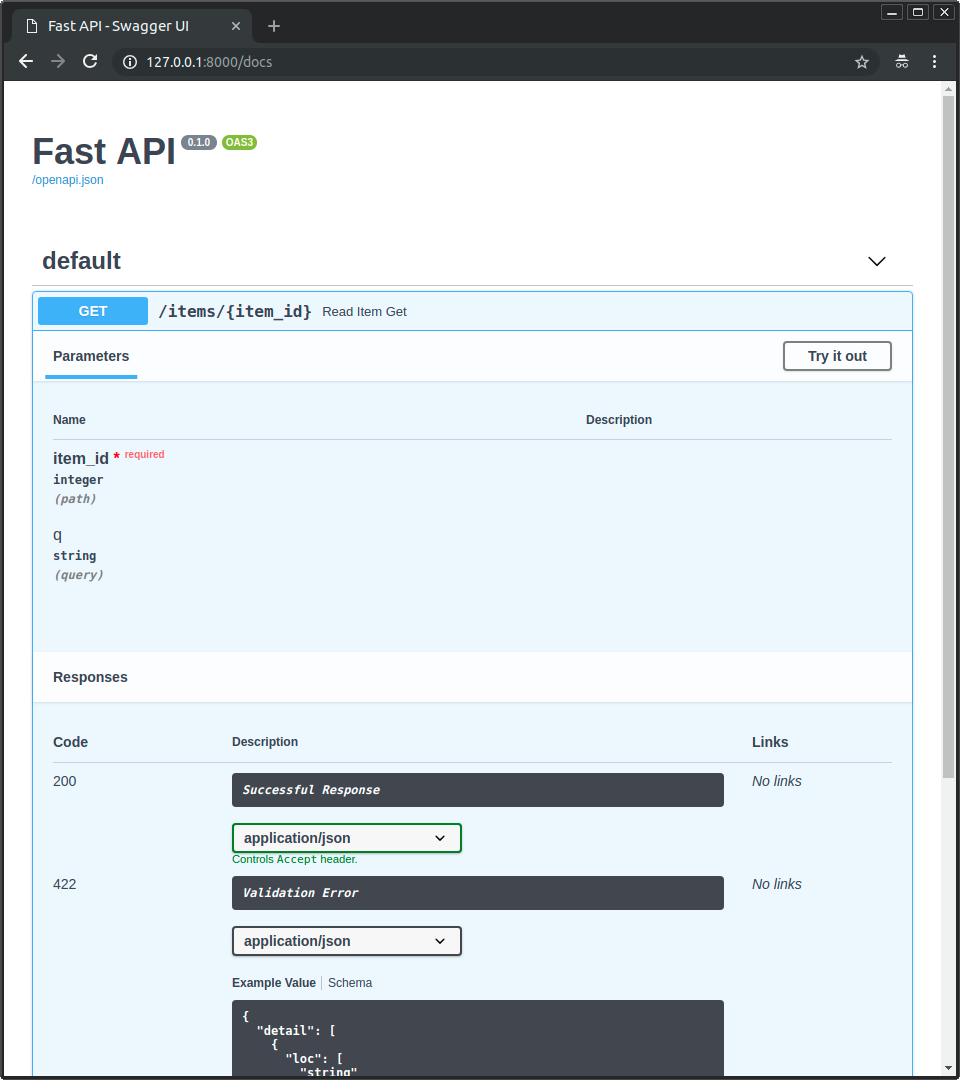
Now go to <a href="http://127.0.0.1:8000/docs" class="external-link" target="_blank">http://127.0.0.1:8000/docs</a>.
|
||||
|
||||
You will see the automatic interactive API documentation (provided by <a href="https://github.com/swagger-api/swagger-ui" class="external-link" target="_blank">Swagger UI</a>):
|
||||
|
||||
|
||||
|
||||
### Alternative API docs
|
||||
|
||||
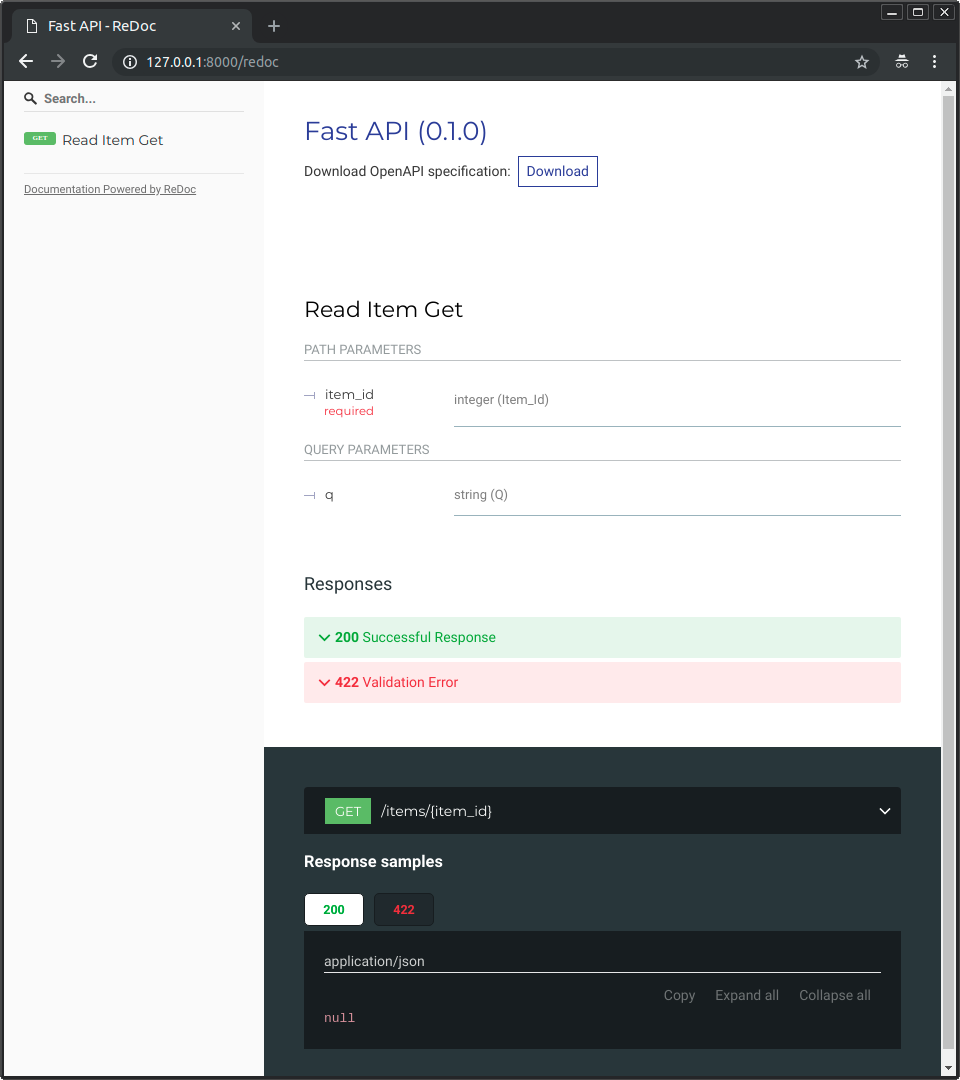
And now, go to <a href="http://127.0.0.1:8000/redoc" class="external-link" target="_blank">http://127.0.0.1:8000/redoc</a>.
|
||||
|
||||
You will see the alternative automatic documentation (provided by <a href="https://github.com/Rebilly/ReDoc" class="external-link" target="_blank">ReDoc</a>):
|
||||
|
||||
|
||||
|
||||
## Example upgrade
|
||||
|
||||
Now modify the file `main.py` to receive a body from a `PUT` request.
|
||||
|
||||
Declare the body using standard Python types, thanks to Pydantic.
|
||||
|
||||
```Python hl_lines="4 9-12 25-27"
|
||||
from typing import Optional
|
||||
|
||||
from fastapi import FastAPI
|
||||
from pydantic import BaseModel
|
||||
|
||||
app = FastAPI()
|
||||
|
||||
|
||||
class Item(BaseModel):
|
||||
name: str
|
||||
price: float
|
||||
is_offer: Optional[bool] = None
|
||||
|
||||
|
||||
@app.get("/")
|
||||
def read_root():
|
||||
return {"Hello": "World"}
|
||||
|
||||
|
||||
@app.get("/items/{item_id}")
|
||||
def read_item(item_id: int, q: Optional[str] = None):
|
||||
return {"item_id": item_id, "q": q}
|
||||
|
||||
|
||||
@app.put("/items/{item_id}")
|
||||
def update_item(item_id: int, item: Item):
|
||||
return {"item_name": item.name, "item_id": item_id}
|
||||
```
|
||||
|
||||
The server should reload automatically (because you added `--reload` to the `uvicorn` command above).
|
||||
|
||||
### Interactive API docs upgrade
|
||||
|
||||
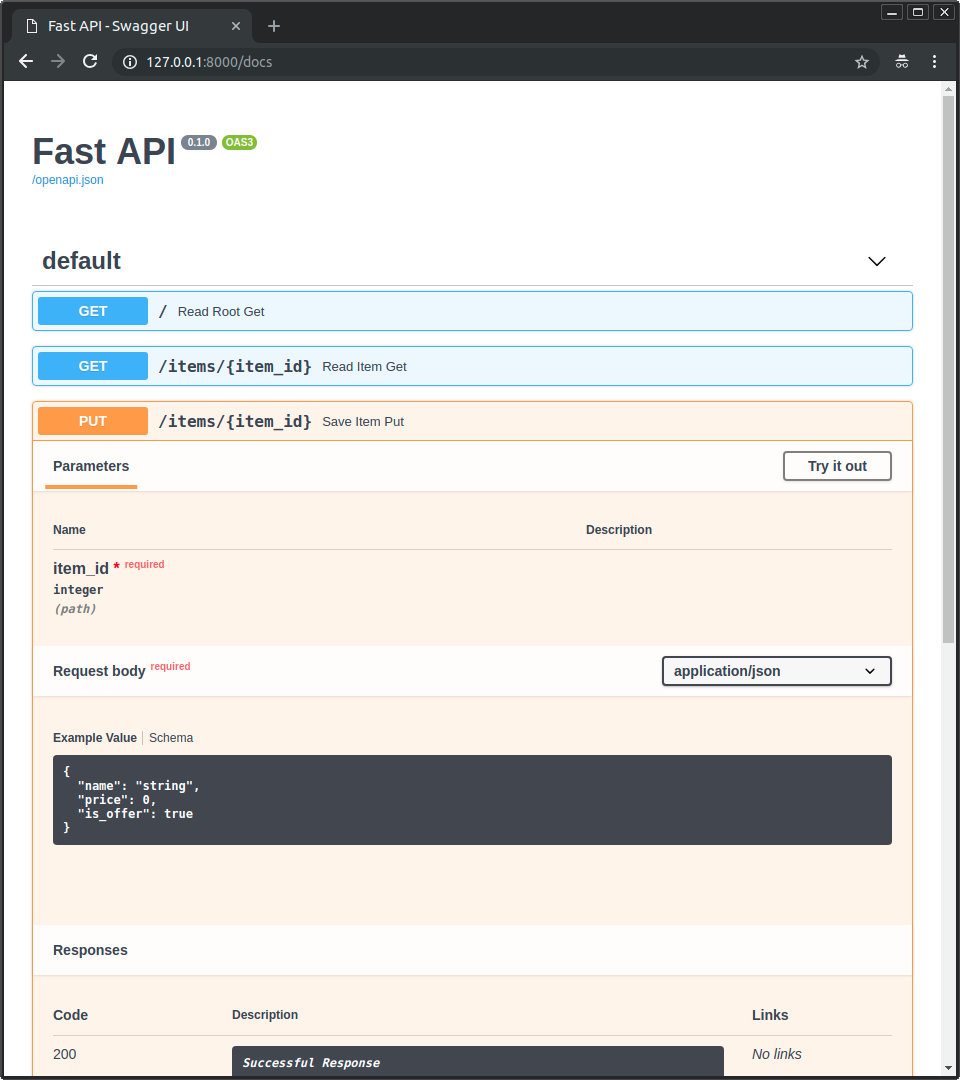
Now go to <a href="http://127.0.0.1:8000/docs" class="external-link" target="_blank">http://127.0.0.1:8000/docs</a>.
|
||||
|
||||
* The interactive API documentation will be automatically updated, including the new body:
|
||||
|
||||
|
||||
|
||||
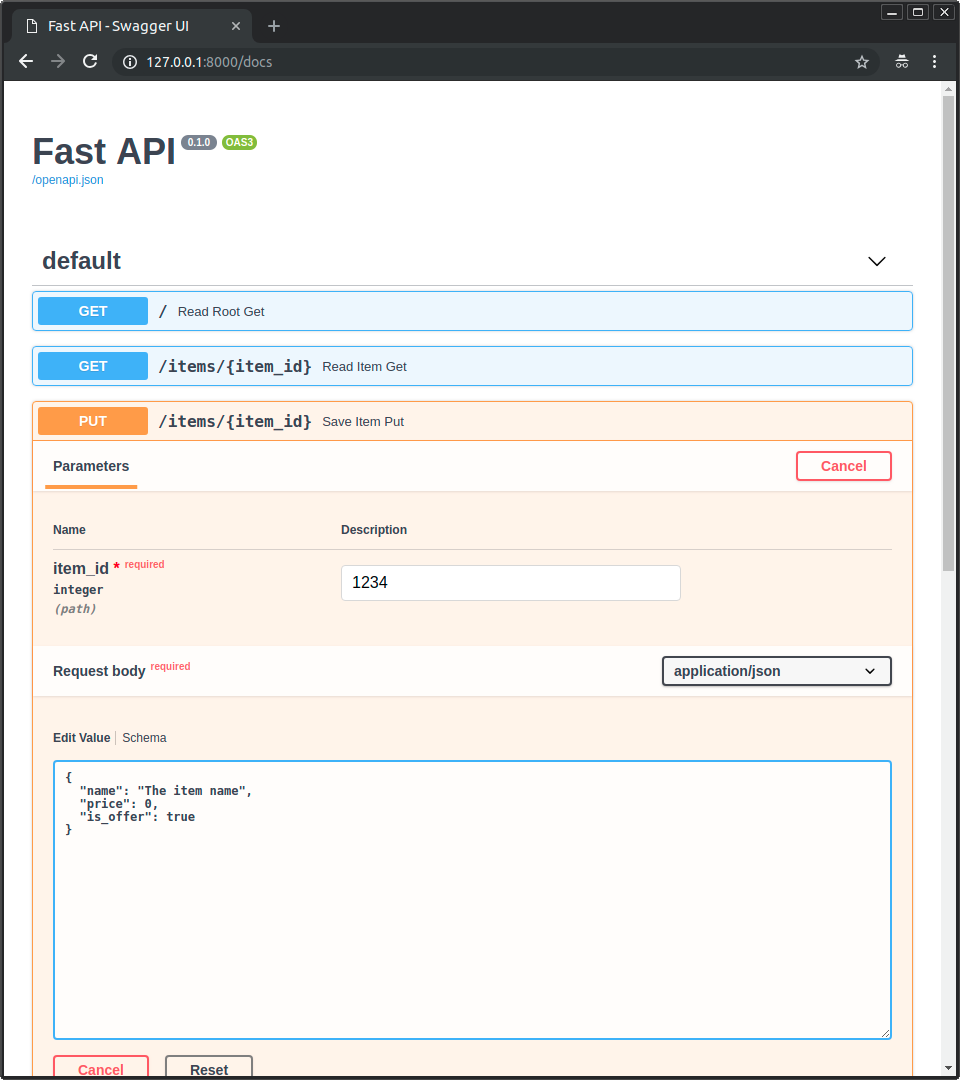
* Click on the button "Try it out", it allows you to fill the parameters and directly interact with the API:
|
||||
|
||||
|
||||
|
||||
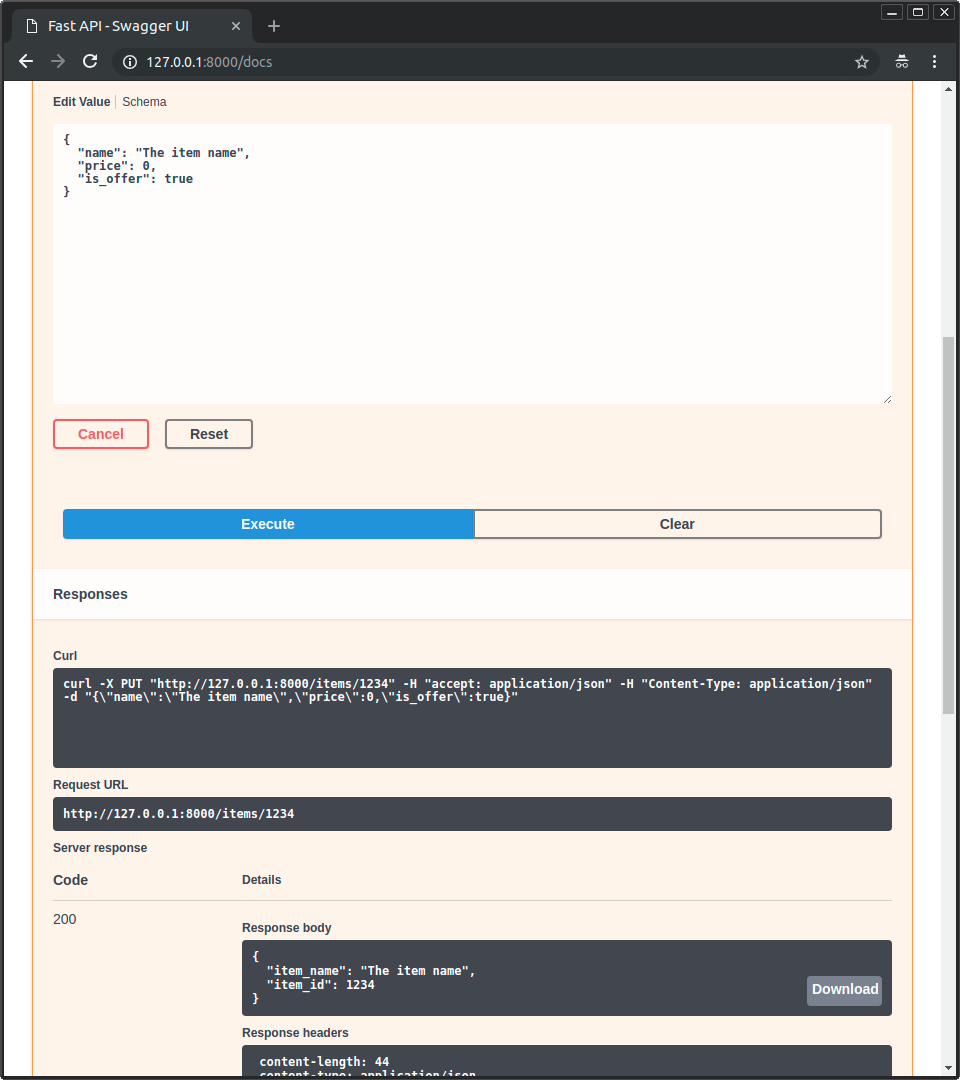
* Then click on the "Execute" button, the user interface will communicate with your API, send the parameters, get the results and show them on the screen:
|
||||
|
||||
|
||||
|
||||
### Alternative API docs upgrade
|
||||
|
||||
And now, go to <a href="http://127.0.0.1:8000/redoc" class="external-link" target="_blank">http://127.0.0.1:8000/redoc</a>.
|
||||
|
||||
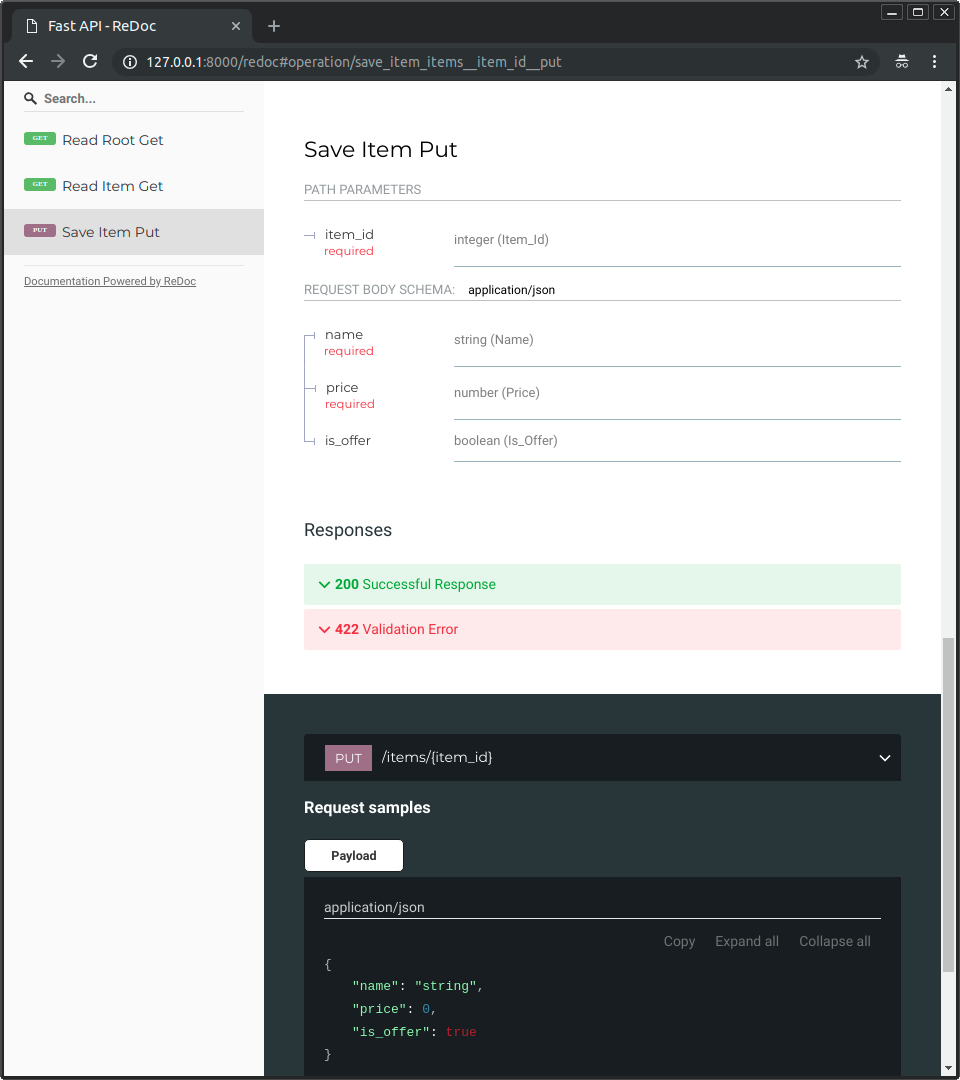
* The alternative documentation will also reflect the new query parameter and body:
|
||||
|
||||
|
||||
|
||||
### Recap
|
||||
|
||||
In summary, you declare **once** the types of parameters, body, etc. as function parameters.
|
||||
|
||||
You do that with standard modern Python types.
|
||||
|
||||
You don't have to learn a new syntax, the methods or classes of a specific library, etc.
|
||||
|
||||
Just standard **Python 3.6+**.
|
||||
|
||||
For example, for an `int`:
|
||||
|
||||
```Python
|
||||
item_id: int
|
||||
```
|
||||
|
||||
or for a more complex `Item` model:
|
||||
|
||||
```Python
|
||||
item: Item
|
||||
```
|
||||
|
||||
...and with that single declaration you get:
|
||||
|
||||
* Editor support, including:
|
||||
* Completion.
|
||||
* Type checks.
|
||||
* Validation of data:
|
||||
* Automatic and clear errors when the data is invalid.
|
||||
* Validation even for deeply nested JSON objects.
|
||||
* <abbr title="also known as: serialization, parsing, marshalling">Conversion</abbr> of input data: coming from the network to Python data and types. Reading from:
|
||||
* JSON.
|
||||
* Path parameters.
|
||||
* Query parameters.
|
||||
* Cookies.
|
||||
* Headers.
|
||||
* Forms.
|
||||
* Files.
|
||||
* <abbr title="also known as: serialization, parsing, marshalling">Conversion</abbr> of output data: converting from Python data and types to network data (as JSON):
|
||||
* Convert Python types (`str`, `int`, `float`, `bool`, `list`, etc).
|
||||
* `datetime` objects.
|
||||
* `UUID` objects.
|
||||
* Database models.
|
||||
* ...and many more.
|
||||
* Automatic interactive API documentation, including 2 alternative user interfaces:
|
||||
* Swagger UI.
|
||||
* ReDoc.
|
||||
|
||||
---
|
||||
|
||||
Coming back to the previous code example, **FastAPI** will:
|
||||
|
||||
* Validate that there is an `item_id` in the path for `GET` and `PUT` requests.
|
||||
* Validate that the `item_id` is of type `int` for `GET` and `PUT` requests.
|
||||
* If it is not, the client will see a useful, clear error.
|
||||
* Check if there is an optional query parameter named `q` (as in `http://127.0.0.1:8000/items/foo?q=somequery`) for `GET` requests.
|
||||
* As the `q` parameter is declared with `= None`, it is optional.
|
||||
* Without the `None` it would be required (as is the body in the case with `PUT`).
|
||||
* For `PUT` requests to `/items/{item_id}`, Read the body as JSON:
|
||||
* Check that it has a required attribute `name` that should be a `str`.
|
||||
* Check that it has a required attribute `price` that has to be a `float`.
|
||||
* Check that it has an optional attribute `is_offer`, that should be a `bool`, if present.
|
||||
* All this would also work for deeply nested JSON objects.
|
||||
* Convert from and to JSON automatically.
|
||||
* Document everything with OpenAPI, that can be used by:
|
||||
* Interactive documentation systems.
|
||||
* Automatic client code generation systems, for many languages.
|
||||
* Provide 2 interactive documentation web interfaces directly.
|
||||
|
||||
---
|
||||
|
||||
We just scratched the surface, but you already get the idea of how it all works.
|
||||
|
||||
Try changing the line with:
|
||||
|
||||
```Python
|
||||
return {"item_name": item.name, "item_id": item_id}
|
||||
```
|
||||
|
||||
...from:
|
||||
|
||||
```Python
|
||||
... "item_name": item.name ...
|
||||
```
|
||||
|
||||
...to:
|
||||
|
||||
```Python
|
||||
... "item_price": item.price ...
|
||||
```
|
||||
|
||||
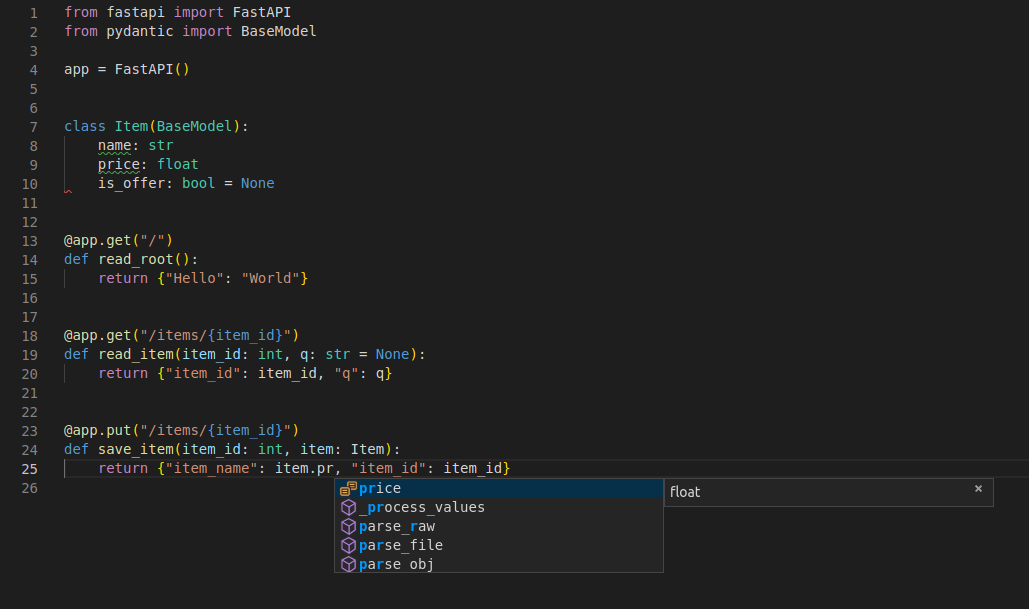
...and see how your editor will auto-complete the attributes and know their types:
|
||||
|
||||
|
||||
|
||||
For a more complete example including more features, see the <a href="https://fastapi.tiangolo.com/tutorial/">Tutorial - User Guide</a>.
|
||||
|
||||
**Spoiler alert**: the tutorial - user guide includes:
|
||||
|
||||
* Declaration of **parameters** from other different places as: **headers**, **cookies**, **form fields** and **files**.
|
||||
* How to set **validation constraints** as `maximum_length` or `regex`.
|
||||
* A very powerful and easy to use **<abbr title="also known as components, resources, providers, services, injectables">Dependency Injection</abbr>** system.
|
||||
* Security and authentication, including support for **OAuth2** with **JWT tokens** and **HTTP Basic** auth.
|
||||
* More advanced (but equally easy) techniques for declaring **deeply nested JSON models** (thanks to Pydantic).
|
||||
* Many extra features (thanks to Starlette) as:
|
||||
* **WebSockets**
|
||||
* **GraphQL**
|
||||
* extremely easy tests based on `requests` and `pytest`
|
||||
* **CORS**
|
||||
* **Cookie Sessions**
|
||||
* ...and more.
|
||||
|
||||
## Performance
|
||||
|
||||
Independent TechEmpower benchmarks show **FastAPI** applications running under Uvicorn as <a href="https://www.techempower.com/benchmarks/#section=test&runid=7464e520-0dc2-473d-bd34-dbdfd7e85911&hw=ph&test=query&l=zijzen-7" class="external-link" target="_blank">one of the fastest Python frameworks available</a>, only below Starlette and Uvicorn themselves (used internally by FastAPI). (*)
|
||||
|
||||
To understand more about it, see the section <a href="https://fastapi.tiangolo.com/benchmarks/" class="internal-link" target="_blank">Benchmarks</a>.
|
||||
|
||||
## Optional Dependencies
|
||||
|
||||
Used by Pydantic:
|
||||
|
||||
* <a href="https://github.com/esnme/ultrajson" target="_blank"><code>ujson</code></a> - for faster JSON <abbr title="converting the string that comes from an HTTP request into Python data">"parsing"</abbr>.
|
||||
* <a href="https://github.com/JoshData/python-email-validator" target="_blank"><code>email_validator</code></a> - for email validation.
|
||||
|
||||
Used by Starlette:
|
||||
|
||||
* <a href="https://requests.readthedocs.io" target="_blank"><code>requests</code></a> - Required if you want to use the `TestClient`.
|
||||
* <a href="https://github.com/Tinche/aiofiles" target="_blank"><code>aiofiles</code></a> - Required if you want to use `FileResponse` or `StaticFiles`.
|
||||
* <a href="https://jinja.palletsprojects.com" target="_blank"><code>jinja2</code></a> - Required if you want to use the default template configuration.
|
||||
* <a href="https://andrew-d.github.io/python-multipart/" target="_blank"><code>python-multipart</code></a> - Required if you want to support form <abbr title="converting the string that comes from an HTTP request into Python data">"parsing"</abbr>, with `request.form()`.
|
||||
* <a href="https://pythonhosted.org/itsdangerous/" target="_blank"><code>itsdangerous</code></a> - Required for `SessionMiddleware` support.
|
||||
* <a href="https://pyyaml.org/wiki/PyYAMLDocumentation" target="_blank"><code>pyyaml</code></a> - Required for Starlette's `SchemaGenerator` support (you probably don't need it with FastAPI).
|
||||
* <a href="https://graphene-python.org/" target="_blank"><code>graphene</code></a> - Required for `GraphQLApp` support.
|
||||
* <a href="https://github.com/esnme/ultrajson" target="_blank"><code>ujson</code></a> - Required if you want to use `UJSONResponse`.
|
||||
|
||||
Used by FastAPI / Starlette:
|
||||
|
||||
* <a href="https://www.uvicorn.org" target="_blank"><code>uvicorn</code></a> - for the server that loads and serves your application.
|
||||
* <a href="https://github.com/ijl/orjson" target="_blank"><code>orjson</code></a> - Required if you want to use `ORJSONResponse`.
|
||||
|
||||
You can install all of these with `pip install fastapi[all]`.
|
||||
|
||||
## License
|
||||
|
||||
This project is licensed under the terms of the MIT license.
|
||||
125
docs/de/mkdocs.yml
Normal file
125
docs/de/mkdocs.yml
Normal file
@@ -0,0 +1,125 @@
|
||||
site_name: FastAPI
|
||||
site_description: FastAPI framework, high performance, easy to learn, fast to code, ready for production
|
||||
site_url: https://fastapi.tiangolo.com/de/
|
||||
theme:
|
||||
name: material
|
||||
custom_dir: overrides
|
||||
palette:
|
||||
- scheme: default
|
||||
primary: teal
|
||||
accent: amber
|
||||
toggle:
|
||||
icon: material/lightbulb-outline
|
||||
name: Switch to light mode
|
||||
- scheme: slate
|
||||
primary: teal
|
||||
accent: amber
|
||||
toggle:
|
||||
icon: material/lightbulb
|
||||
name: Switch to dark mode
|
||||
features:
|
||||
- search.suggest
|
||||
- search.highlight
|
||||
icon:
|
||||
repo: fontawesome/brands/github-alt
|
||||
logo: https://fastapi.tiangolo.com/img/icon-white.svg
|
||||
favicon: https://fastapi.tiangolo.com/img/favicon.png
|
||||
language: de
|
||||
repo_name: tiangolo/fastapi
|
||||
repo_url: https://github.com/tiangolo/fastapi
|
||||
edit_uri: ''
|
||||
google_analytics:
|
||||
- UA-133183413-1
|
||||
- auto
|
||||
plugins:
|
||||
- search
|
||||
- markdownextradata:
|
||||
data: data
|
||||
nav:
|
||||
- FastAPI: index.md
|
||||
- Languages:
|
||||
- en: /
|
||||
- de: /de/
|
||||
- es: /es/
|
||||
- fr: /fr/
|
||||
- id: /id/
|
||||
- it: /it/
|
||||
- ja: /ja/
|
||||
- ko: /ko/
|
||||
- pl: /pl/
|
||||
- pt: /pt/
|
||||
- ru: /ru/
|
||||
- sq: /sq/
|
||||
- tr: /tr/
|
||||
- uk: /uk/
|
||||
- zh: /zh/
|
||||
markdown_extensions:
|
||||
- toc:
|
||||
permalink: true
|
||||
- markdown.extensions.codehilite:
|
||||
guess_lang: false
|
||||
- markdown_include.include:
|
||||
base_path: docs
|
||||
- admonition
|
||||
- codehilite
|
||||
- extra
|
||||
- pymdownx.superfences:
|
||||
custom_fences:
|
||||
- name: mermaid
|
||||
class: mermaid
|
||||
format: !!python/name:pymdownx.superfences.fence_div_format ''
|
||||
- pymdownx.tabbed
|
||||
extra:
|
||||
social:
|
||||
- icon: fontawesome/brands/github-alt
|
||||
link: https://github.com/tiangolo/fastapi
|
||||
- icon: fontawesome/brands/discord
|
||||
link: https://discord.gg/VQjSZaeJmf
|
||||
- icon: fontawesome/brands/twitter
|
||||
link: https://twitter.com/fastapi
|
||||
- icon: fontawesome/brands/linkedin
|
||||
link: https://www.linkedin.com/in/tiangolo
|
||||
- icon: fontawesome/brands/dev
|
||||
link: https://dev.to/tiangolo
|
||||
- icon: fontawesome/brands/medium
|
||||
link: https://medium.com/@tiangolo
|
||||
- icon: fontawesome/solid/globe
|
||||
link: https://tiangolo.com
|
||||
alternate:
|
||||
- link: /
|
||||
name: en - English
|
||||
- link: /de/
|
||||
name: de
|
||||
- link: /es/
|
||||
name: es - español
|
||||
- link: /fr/
|
||||
name: fr - français
|
||||
- link: /id/
|
||||
name: id
|
||||
- link: /it/
|
||||
name: it - italiano
|
||||
- link: /ja/
|
||||
name: ja - 日本語
|
||||
- link: /ko/
|
||||
name: ko - 한국어
|
||||
- link: /pl/
|
||||
name: pl
|
||||
- link: /pt/
|
||||
name: pt - português
|
||||
- link: /ru/
|
||||
name: ru - русский язык
|
||||
- link: /sq/
|
||||
name: sq - shqip
|
||||
- link: /tr/
|
||||
name: tr - Türkçe
|
||||
- link: /uk/
|
||||
name: uk - українська мова
|
||||
- link: /zh/
|
||||
name: zh - 汉语
|
||||
extra_css:
|
||||
- https://fastapi.tiangolo.com/css/termynal.css
|
||||
- https://fastapi.tiangolo.com/css/custom.css
|
||||
extra_javascript:
|
||||
- https://unpkg.com/mermaid@8.4.6/dist/mermaid.min.js
|
||||
- https://fastapi.tiangolo.com/js/termynal.js
|
||||
- https://fastapi.tiangolo.com/js/custom.js
|
||||
0
docs/de/overrides/.gitignore
vendored
Normal file
0
docs/de/overrides/.gitignore
vendored
Normal file
@@ -1,258 +1,278 @@
|
||||
articles:
|
||||
english:
|
||||
- link: https://medium.com/@williamhayes/fastapi-starlette-debug-vs-prod-5f7561db3a59
|
||||
title: FastAPI/Starlette debug vs prod
|
||||
author_link: https://medium.com/@williamhayes
|
||||
author: William Hayes
|
||||
- link: https://medium.com/data-rebels/fastapi-google-as-an-external-authentication-provider-3a527672cf33
|
||||
title: FastAPI — Google as an external authentication provider
|
||||
author_link: https://medium.com/@nilsdebruin
|
||||
author: Nils de Bruin
|
||||
- link: https://medium.com/data-rebels/fastapi-how-to-add-basic-and-cookie-authentication-a45c85ef47d3
|
||||
title: FastAPI — How to add basic and cookie authentication
|
||||
author_link: https://medium.com/@nilsdebruin
|
||||
author: Nils de Bruin
|
||||
- link: https://dev.to/errietta/introduction-to-the-fastapi-python-framework-2n10
|
||||
title: Introduction to the fastapi python framework
|
||||
author_link: https://dev.to/errietta
|
||||
author: Errieta Kostala
|
||||
- link: https://nickc1.github.io/api,/scikit-learn/2019/01/10/scikit-fastapi.html
|
||||
title: "FastAPI and Scikit-Learn: Easily Deploy Models"
|
||||
author_link: https://nickc1.github.io/
|
||||
author: Nick Cortale
|
||||
- link: https://medium.com/data-rebels/fastapi-authentication-revisited-enabling-api-key-authentication-122dc5975680
|
||||
title: "FastAPI authentication revisited: Enabling API key authentication"
|
||||
author_link: https://medium.com/@nilsdebruin
|
||||
author: Nils de Bruin
|
||||
- link: https://medium.com/@nico.axtmann95/deploying-a-scikit-learn-model-with-onnx-und-fastapi-1af398268915
|
||||
title: Deploying a scikit-learn model with ONNX and FastAPI
|
||||
author_link: https://www.linkedin.com/in/nico-axtmann
|
||||
author: Nico Axtmann
|
||||
- link: https://geekflare.com/python-asynchronous-web-frameworks/
|
||||
title: Top 5 Asynchronous Web Frameworks for Python
|
||||
author_link: https://geekflare.com/author/ankush/
|
||||
author: Ankush Thakur
|
||||
- link: https://medium.com/@gntrm/jwt-authentication-with-fastapi-and-aws-cognito-1333f7f2729e
|
||||
title: JWT Authentication with FastAPI and AWS Cognito
|
||||
author_link: https://twitter.com/gntrm
|
||||
author: Johannes Gontrum
|
||||
- link: https://towardsdatascience.com/how-to-deploy-a-machine-learning-model-dc51200fe8cf
|
||||
title: How to Deploy a Machine Learning Model
|
||||
author_link: https://www.linkedin.com/in/mgrootendorst/
|
||||
author: Maarten Grootendorst
|
||||
- link: https://eng.uber.com/ludwig-v0-2/
|
||||
title: "Uber: Ludwig v0.2 Adds New Features and Other Improvements to its Deep Learning Toolbox [including a FastAPI server]"
|
||||
author_link: https://eng.uber.com
|
||||
author: Uber Engineering
|
||||
- link: https://gitlab.com/euri10/fastapi_cheatsheet
|
||||
title: A FastAPI and Swagger UI visual cheatsheet
|
||||
author_link: https://gitlab.com/euri10
|
||||
author: "@euri10"
|
||||
- link: https://medium.com/@mike.p.moritz/using-docker-compose-to-deploy-a-lightweight-python-rest-api-with-a-job-queue-37e6072a209b
|
||||
title: Using Docker Compose to deploy a lightweight Python REST API with a job queue
|
||||
author_link: https://medium.com/@mike.p.moritz
|
||||
author: Mike Moritz
|
||||
- link: https://robwagner.dev/tortoise-fastapi-setup/
|
||||
title: Setting up Tortoise ORM with FastAPI
|
||||
author_link: https://robwagner.dev/
|
||||
author: Rob Wagner
|
||||
- link: https://dev.to/dbanty/why-i-m-leaving-flask-3ki6
|
||||
title: Why I'm Leaving Flask
|
||||
author_link: https://dev.to/dbanty
|
||||
author: Dylan Anthony
|
||||
- link: https://medium.com/python-data/how-to-deploy-tensorflow-2-0-models-as-an-api-service-with-fastapi-docker-128b177e81f3
|
||||
title: How To Deploy Tensorflow 2.0 Models As An API Service With FastAPI & Docker
|
||||
author_link: https://medium.com/@bbrenyah
|
||||
author: Bernard Brenyah
|
||||
- link: https://testdriven.io/blog/fastapi-crud/
|
||||
title: "TestDriven.io: Developing and Testing an Asynchronous API with FastAPI and Pytest"
|
||||
author_link: https://testdriven.io/authors/herman
|
||||
author: Michael Herman
|
||||
- link: https://towardsdatascience.com/deploying-iris-classifications-with-fastapi-and-docker-7c9b83fdec3a
|
||||
title: "Towards Data Science: Deploying Iris Classifications with FastAPI and Docker"
|
||||
author_link: https://towardsdatascience.com/@mandygu
|
||||
author: Mandy Gu
|
||||
- link: https://medium.com/analytics-vidhya/deploy-machine-learning-models-with-keras-fastapi-redis-and-docker-4940df614ece
|
||||
title: Deploy Machine Learning Models with Keras, FastAPI, Redis and Docker
|
||||
author_link: https://medium.com/@shane.soh
|
||||
author: Shane Soh
|
||||
- link: https://medium.com/@arthur393/another-boilerplate-to-fastapi-azure-pipeline-ci-pytest-3c8d9a4be0bb
|
||||
title: "Another Boilerplate to FastAPI: Azure Pipeline CI + Pytest"
|
||||
author_link: https://twitter.com/arthurheinrique
|
||||
author: Arthur Henrique
|
||||
- link: https://iwpnd.pw/articles/2020-01/deploy-fastapi-to-aws-lambda
|
||||
title: How to continuously deploy a FastAPI to AWS Lambda with AWS SAM
|
||||
author_link: https://iwpnd.pw
|
||||
author: Benjamin Ramser
|
||||
- link: https://www.tutlinks.com/create-and-deploy-fastapi-app-to-heroku/
|
||||
title: Create and Deploy FastAPI app to Heroku without using Docker
|
||||
author_link: https://www.linkedin.com/in/navule/
|
||||
author: Navule Pavan Kumar Rao
|
||||
- link: https://iwpnd.pw/articles/2020-03/apache-kafka-fastapi-geostream
|
||||
title: Apache Kafka producer and consumer with FastAPI and aiokafka
|
||||
author_link: https://iwpnd.pw
|
||||
author: Benjamin Ramser
|
||||
- link: https://wuilly.com/2019/10/real-time-notifications-with-python-and-postgres/
|
||||
title: Real-time Notifications with Python and Postgres
|
||||
author_link: https://wuilly.com/
|
||||
author: Guillermo Cruz
|
||||
- link: https://dev.to/paurakhsharma/microservice-in-python-using-fastapi-24cc
|
||||
title: Microservice in Python using FastAPI
|
||||
author_link: https://twitter.com/PaurakhSharma
|
||||
author: Paurakh Sharma Humagain
|
||||
- link: https://dev.to/cuongld2/build-simple-api-service-with-python-fastapi-part-1-581o
|
||||
title: Build simple API service with Python FastAPI — Part 1
|
||||
author_link: https://dev.to/cuongld2
|
||||
author: cuongld2
|
||||
- link: https://paulsec.github.io/posts/fastapi_plus_zeit_serverless_fu/
|
||||
title: FastAPI + Zeit.co = 🚀
|
||||
author_link: https://twitter.com/PaulWebSec
|
||||
author: Paul Sec
|
||||
- link: https://dev.to/tiangolo/build-a-web-api-from-scratch-with-fastapi-the-workshop-2ehe
|
||||
title: Build a web API from scratch with FastAPI - the workshop
|
||||
author_link: https://twitter.com/tiangolo
|
||||
author: Sebastián Ramírez (tiangolo)
|
||||
- link: https://www.twilio.com/blog/build-secure-twilio-webhook-python-fastapi
|
||||
title: Build a Secure Twilio Webhook with Python and FastAPI
|
||||
author_link: https://www.twilio.com
|
||||
author: Twilio
|
||||
- link: https://www.stavros.io/posts/fastapi-with-django/
|
||||
title: Using FastAPI with Django
|
||||
author_link: https://twitter.com/Stavros
|
||||
author: Stavros Korokithakis
|
||||
- link: https://netflixtechblog.com/introducing-dispatch-da4b8a2a8072
|
||||
title: Introducing Dispatch
|
||||
author_link: https://netflixtechblog.com/
|
||||
author: Netflix
|
||||
- link: https://davidefiocco.github.io/streamlit-fastapi-ml-serving/
|
||||
title: Machine learning model serving in Python using FastAPI and streamlit
|
||||
author_link: https://github.com/davidefiocco
|
||||
author: Davide Fiocco
|
||||
- link: https://www.tutlinks.com/deploy-fastapi-on-azure/
|
||||
title: Deploy FastAPI on Azure App Service
|
||||
author_link: https://www.linkedin.com/in/navule/
|
||||
author: Navule Pavan Kumar Rao
|
||||
- link: https://towardsdatascience.com/build-and-host-fast-data-science-applications-using-fastapi-823be8a1d6a0
|
||||
title: Build And Host Fast Data Science Applications Using FastAPI
|
||||
author_link: https://medium.com/@farhadmalik
|
||||
author: Farhad Malik
|
||||
- link: https://medium.com/@gabbyprecious2000/creating-a-crud-app-with-fastapi-part-one-7c049292ad37
|
||||
title: Creating a CRUD App with FastAPI (Part one)
|
||||
author_link: https://medium.com/@gabbyprecious2000
|
||||
author: Precious Ndubueze
|
||||
- link: https://julienharbulot.com/notification-server.html
|
||||
title: HTTP server to display desktop notifications
|
||||
author_link: https://julienharbulot.com/
|
||||
author: Julien Harbulot
|
||||
- link: https://guitton.co/posts/fastapi-monitoring/
|
||||
title: How to monitor your FastAPI service
|
||||
author_link: https://twitter.com/louis_guitton
|
||||
author: Louis Guitton
|
||||
- link: https://amitness.com/2020/06/fastapi-vs-flask/
|
||||
title: FastAPI for Flask Users
|
||||
author_link: https://twitter.com/amitness
|
||||
author: Amit Chaudhary
|
||||
- link: https://valonjanuzaj.medium.com/deploy-a-dockerized-fastapi-application-to-aws-cc757830ba1b
|
||||
title: Deploy a dockerized FastAPI application to AWS
|
||||
author_link: https://www.linkedin.com/in/valon-januzaj-b02692187/
|
||||
author: Valon Januzaj
|
||||
- link: https://dompatmore.com/blog/authenticate-your-fastapi-app-with-auth0
|
||||
title: Authenticate Your FastAPI App with auth0
|
||||
author_link: https://twitter.com/dompatmore
|
||||
author: Dom Patmore
|
||||
japanese:
|
||||
- link: https://qiita.com/mtitg/items/47770e9a562dd150631d
|
||||
title: FastAPI|DB接続してCRUDするPython製APIサーバーを構築
|
||||
author_link: https://qiita.com/mtitg
|
||||
author: "@mtitg"
|
||||
- link: https://qiita.com/ryoryomaru/items/59958ed385b3571d50de
|
||||
title: python製の最新APIフレームワーク FastAPI を触ってみた
|
||||
author_link: https://qiita.com/ryoryomaru
|
||||
author: "@ryoryomaru"
|
||||
- link: https://qiita.com/angel_katayoku/items/0e1f5dbbe62efc612a78
|
||||
title: FastAPIでCORSを回避
|
||||
author_link: https://qiita.com/angel_katayoku
|
||||
author: "@angel_katayoku"
|
||||
- link: https://qiita.com/angel_katayoku/items/4fbc1a4e2b33fa2237d2
|
||||
title: FastAPIをMySQLと接続してDockerで管理してみる
|
||||
author_link: https://qiita.com/angel_katayoku
|
||||
author: "@angel_katayoku"
|
||||
- link: https://qiita.com/angel_katayoku/items/8a458a8952f50b73f420
|
||||
title: FastAPIでPOSTされたJSONのレスポンスbodyを受け取る
|
||||
author_link: https://qiita.com/angel_katayoku
|
||||
author: "@angel_katayoku"
|
||||
- link: https://qiita.com/hikarut/items/b178af2e2440c67c6ac4
|
||||
title: フロントエンド開発者向けのDockerによるPython開発環境構築
|
||||
author_link: https://qiita.com/hikarut
|
||||
author: Hikaru Takahashi
|
||||
- link: https://rightcode.co.jp/blog/information-technology/fastapi-tutorial-todo-apps-environment
|
||||
title: "【第1回】FastAPIチュートリアル: ToDoアプリを作ってみよう【環境構築編】"
|
||||
author_link: https://rightcode.co.jp/author/jun
|
||||
author: ライトコードメディア編集部
|
||||
- link: https://rightcode.co.jp/blog/information-technology/fastapi-tutorial-todo-apps-model-building
|
||||
title: "【第2回】FastAPIチュートリアル: ToDoアプリを作ってみよう【モデル構築編】"
|
||||
author_link: https://rightcode.co.jp/author/jun
|
||||
author: ライトコードメディア編集部
|
||||
- link: https://rightcode.co.jp/blog/information-technology/fastapi-tutorial-todo-apps-authentication-user-registration
|
||||
title: "【第3回】FastAPIチュートリアル: toDoアプリを作ってみよう【認証・ユーザ登録編】"
|
||||
author_link: https://rightcode.co.jp/author/jun
|
||||
author: ライトコードメディア編集部
|
||||
- link: https://rightcode.co.jp/blog/information-technology/fastapi-tutorial-todo-apps-admin-page-improvement
|
||||
title: "【第4回】FastAPIチュートリアル: toDoアプリを作ってみよう【管理者ページ改良編】"
|
||||
author_link: https://rightcode.co.jp/author/jun
|
||||
author: ライトコードメディア編集部
|
||||
- link: https://qiita.com/bee2/items/0ad260ab9835a2087dae
|
||||
title: PythonのWeb frameworkのパフォーマンス比較 (Django, Flask, responder, FastAPI, japronto)
|
||||
author_link: https://qiita.com/bee2
|
||||
author: "@bee2"
|
||||
- link: https://qiita.com/bee2/items/75d9c0d7ba20e7a4a0e9
|
||||
title: "[FastAPI] Python製のASGI Web フレームワーク FastAPIに入門する"
|
||||
author_link: https://qiita.com/bee2
|
||||
author: "@bee2"
|
||||
vietnamese:
|
||||
- link: https://fullstackstation.com/fastapi-trien-khai-bang-docker/
|
||||
title: "FASTAPI: TRIỂN KHAI BẰNG DOCKER"
|
||||
author_link: https://fullstackstation.com/author/figonking/
|
||||
author: Nguyễn Nhân
|
||||
russian:
|
||||
- link: https://habr.com/ru/post/454440/
|
||||
title: "Мелкая питонячая радость #2: Starlette - Солидная примочка – FastAPI"
|
||||
author_link: https://habr.com/ru/users/57uff3r/
|
||||
author: Andrey Korchak
|
||||
- link: https://habr.com/ru/post/478620/
|
||||
title: Почему Вы должны попробовать FastAPI?
|
||||
author_link: https://github.com/prostomarkeloff
|
||||
author: prostomarkeloff
|
||||
- link: https://trkohler.com/fast-api-introduction-to-framework
|
||||
title: "FastAPI: знакомимся с фреймворком"
|
||||
author_link: https://www.linkedin.com/in/trkohler/
|
||||
author: Troy Köhler
|
||||
- author: "@pystar"
|
||||
author_link: https://pystar.substack.com/
|
||||
link: https://pystar.substack.com/p/how-to-create-a-fake-certificate
|
||||
title: How to Create A Fake Certificate Authority And Generate TLS Certs for FastAPI
|
||||
- author: Shahriyar(Shako) Rzayev
|
||||
author_link: https://www.linkedin.com/in/shahriyar-rzayev/
|
||||
link: https://www.azepug.az/posts/fastapi/#building-simple-e-commerce-with-nuxtjs-and-fastapi-series
|
||||
title: Building simple E-Commerce with NuxtJS and FastAPI
|
||||
- author: Rodrigo Arenas
|
||||
author_link: https://rodrigo-arenas.medium.com/
|
||||
link: https://medium.com/analytics-vidhya/serve-a-machine-learning-model-using-sklearn-fastapi-and-docker-85aabf96729b
|
||||
title: "Serve a machine learning model using Sklearn, FastAPI and Docker"
|
||||
- author: Navule Pavan Kumar Rao
|
||||
author_link: https://www.linkedin.com/in/navule/
|
||||
link: https://www.tutlinks.com/deploy-fastapi-on-ubuntu-gunicorn-caddy-2/
|
||||
title: Deploy FastAPI on Ubuntu and Serve using Caddy 2 Web Server
|
||||
- author: Patrick Ladon
|
||||
author_link: https://dev.to/factorlive
|
||||
link: https://dev.to/factorlive/python-facebook-messenger-webhook-with-fastapi-on-glitch-4n90
|
||||
title: Python Facebook messenger webhook with FastAPI on Glitch
|
||||
- author: Dom Patmore
|
||||
author_link: https://twitter.com/dompatmore
|
||||
link: https://dompatmore.com/blog/authenticate-your-fastapi-app-with-auth0
|
||||
title: Authenticate Your FastAPI App with auth0
|
||||
- author: Valon Januzaj
|
||||
author_link: https://www.linkedin.com/in/valon-januzaj-b02692187/
|
||||
link: https://valonjanuzaj.medium.com/deploy-a-dockerized-fastapi-application-to-aws-cc757830ba1b
|
||||
title: Deploy a dockerized FastAPI application to AWS
|
||||
- author: Amit Chaudhary
|
||||
author_link: https://twitter.com/amitness
|
||||
link: https://amitness.com/2020/06/fastapi-vs-flask/
|
||||
title: FastAPI for Flask Users
|
||||
- author: Louis Guitton
|
||||
author_link: https://twitter.com/louis_guitton
|
||||
link: https://guitton.co/posts/fastapi-monitoring/
|
||||
title: How to monitor your FastAPI service
|
||||
- author: Julien Harbulot
|
||||
author_link: https://julienharbulot.com/
|
||||
link: https://julienharbulot.com/notification-server.html
|
||||
title: HTTP server to display desktop notifications
|
||||
- author: Precious Ndubueze
|
||||
author_link: https://medium.com/@gabbyprecious2000
|
||||
link: https://medium.com/@gabbyprecious2000/creating-a-crud-app-with-fastapi-part-one-7c049292ad37
|
||||
title: Creating a CRUD App with FastAPI (Part one)
|
||||
- author: Farhad Malik
|
||||
author_link: https://medium.com/@farhadmalik
|
||||
link: https://towardsdatascience.com/build-and-host-fast-data-science-applications-using-fastapi-823be8a1d6a0
|
||||
title: Build And Host Fast Data Science Applications Using FastAPI
|
||||
- author: Navule Pavan Kumar Rao
|
||||
author_link: https://www.linkedin.com/in/navule/
|
||||
link: https://www.tutlinks.com/deploy-fastapi-on-azure/
|
||||
title: Deploy FastAPI on Azure App Service
|
||||
- author: Davide Fiocco
|
||||
author_link: https://github.com/davidefiocco
|
||||
link: https://davidefiocco.github.io/streamlit-fastapi-ml-serving/
|
||||
title: Machine learning model serving in Python using FastAPI and streamlit
|
||||
- author: Netflix
|
||||
author_link: https://netflixtechblog.com/
|
||||
link: https://netflixtechblog.com/introducing-dispatch-da4b8a2a8072
|
||||
title: Introducing Dispatch
|
||||
- author: Stavros Korokithakis
|
||||
author_link: https://twitter.com/Stavros
|
||||
link: https://www.stavros.io/posts/fastapi-with-django/
|
||||
title: Using FastAPI with Django
|
||||
- author: Twilio
|
||||
author_link: https://www.twilio.com
|
||||
link: https://www.twilio.com/blog/build-secure-twilio-webhook-python-fastapi
|
||||
title: Build a Secure Twilio Webhook with Python and FastAPI
|
||||
- author: Sebastián Ramírez (tiangolo)
|
||||
author_link: https://twitter.com/tiangolo
|
||||
link: https://dev.to/tiangolo/build-a-web-api-from-scratch-with-fastapi-the-workshop-2ehe
|
||||
title: Build a web API from scratch with FastAPI - the workshop
|
||||
- author: Paul Sec
|
||||
author_link: https://twitter.com/PaulWebSec
|
||||
link: https://paulsec.github.io/posts/fastapi_plus_zeit_serverless_fu/
|
||||
title: FastAPI + Zeit.co = 🚀
|
||||
- author: cuongld2
|
||||
author_link: https://dev.to/cuongld2
|
||||
link: https://dev.to/cuongld2/build-simple-api-service-with-python-fastapi-part-1-581o
|
||||
title: Build simple API service with Python FastAPI — Part 1
|
||||
- author: Paurakh Sharma Humagain
|
||||
author_link: https://twitter.com/PaurakhSharma
|
||||
link: https://dev.to/paurakhsharma/microservice-in-python-using-fastapi-24cc
|
||||
title: Microservice in Python using FastAPI
|
||||
- author: Guillermo Cruz
|
||||
author_link: https://wuilly.com/
|
||||
link: https://wuilly.com/2019/10/real-time-notifications-with-python-and-postgres/
|
||||
title: Real-time Notifications with Python and Postgres
|
||||
- author: Benjamin Ramser
|
||||
author_link: https://iwpnd.pw
|
||||
link: https://iwpnd.pw/articles/2020-03/apache-kafka-fastapi-geostream
|
||||
title: Apache Kafka producer and consumer with FastAPI and aiokafka
|
||||
- author: Navule Pavan Kumar Rao
|
||||
author_link: https://www.linkedin.com/in/navule/
|
||||
link: https://www.tutlinks.com/create-and-deploy-fastapi-app-to-heroku/
|
||||
title: Create and Deploy FastAPI app to Heroku without using Docker
|
||||
- author: Benjamin Ramser
|
||||
author_link: https://iwpnd.pw
|
||||
link: https://iwpnd.pw/articles/2020-01/deploy-fastapi-to-aws-lambda
|
||||
title: How to continuously deploy a FastAPI to AWS Lambda with AWS SAM
|
||||
- author: Arthur Henrique
|
||||
author_link: https://twitter.com/arthurheinrique
|
||||
link: https://medium.com/@arthur393/another-boilerplate-to-fastapi-azure-pipeline-ci-pytest-3c8d9a4be0bb
|
||||
title: 'Another Boilerplate to FastAPI: Azure Pipeline CI + Pytest'
|
||||
- author: Shane Soh
|
||||
author_link: https://medium.com/@shane.soh
|
||||
link: https://medium.com/analytics-vidhya/deploy-machine-learning-models-with-keras-fastapi-redis-and-docker-4940df614ece
|
||||
title: Deploy Machine Learning Models with Keras, FastAPI, Redis and Docker
|
||||
- author: Mandy Gu
|
||||
author_link: https://towardsdatascience.com/@mandygu
|
||||
link: https://towardsdatascience.com/deploying-iris-classifications-with-fastapi-and-docker-7c9b83fdec3a
|
||||
title: 'Towards Data Science: Deploying Iris Classifications with FastAPI and Docker'
|
||||
- author: Michael Herman
|
||||
author_link: https://testdriven.io/authors/herman
|
||||
link: https://testdriven.io/blog/fastapi-crud/
|
||||
title: 'TestDriven.io: Developing and Testing an Asynchronous API with FastAPI and Pytest'
|
||||
- author: Bernard Brenyah
|
||||
author_link: https://medium.com/@bbrenyah
|
||||
link: https://medium.com/python-data/how-to-deploy-tensorflow-2-0-models-as-an-api-service-with-fastapi-docker-128b177e81f3
|
||||
title: How To Deploy Tensorflow 2.0 Models As An API Service With FastAPI & Docker
|
||||
- author: Dylan Anthony
|
||||
author_link: https://dev.to/dbanty
|
||||
link: https://dev.to/dbanty/why-i-m-leaving-flask-3ki6
|
||||
title: Why I'm Leaving Flask
|
||||
- author: Rob Wagner
|
||||
author_link: https://robwagner.dev/
|
||||
link: https://robwagner.dev/tortoise-fastapi-setup/
|
||||
title: Setting up Tortoise ORM with FastAPI
|
||||
- author: Mike Moritz
|
||||
author_link: https://medium.com/@mike.p.moritz
|
||||
link: https://medium.com/@mike.p.moritz/using-docker-compose-to-deploy-a-lightweight-python-rest-api-with-a-job-queue-37e6072a209b
|
||||
title: Using Docker Compose to deploy a lightweight Python REST API with a job queue
|
||||
- author: '@euri10'
|
||||
author_link: https://gitlab.com/euri10
|
||||
link: https://gitlab.com/euri10/fastapi_cheatsheet
|
||||
title: A FastAPI and Swagger UI visual cheatsheet
|
||||
- author: Uber Engineering
|
||||
author_link: https://eng.uber.com
|
||||
link: https://eng.uber.com/ludwig-v0-2/
|
||||
title: 'Uber: Ludwig v0.2 Adds New Features and Other Improvements to its Deep Learning Toolbox [including a FastAPI server]'
|
||||
- author: Maarten Grootendorst
|
||||
author_link: https://www.linkedin.com/in/mgrootendorst/
|
||||
link: https://towardsdatascience.com/how-to-deploy-a-machine-learning-model-dc51200fe8cf
|
||||
title: How to Deploy a Machine Learning Model
|
||||
- author: Johannes Gontrum
|
||||
author_link: https://twitter.com/gntrm
|
||||
link: https://medium.com/@gntrm/jwt-authentication-with-fastapi-and-aws-cognito-1333f7f2729e
|
||||
title: JWT Authentication with FastAPI and AWS Cognito
|
||||
- author: Ankush Thakur
|
||||
author_link: https://geekflare.com/author/ankush/
|
||||
link: https://geekflare.com/python-asynchronous-web-frameworks/
|
||||
title: Top 5 Asynchronous Web Frameworks for Python
|
||||
- author: Nico Axtmann
|
||||
author_link: https://www.linkedin.com/in/nico-axtmann
|
||||
link: https://medium.com/@nico.axtmann95/deploying-a-scikit-learn-model-with-onnx-und-fastapi-1af398268915
|
||||
title: Deploying a scikit-learn model with ONNX and FastAPI
|
||||
- author: Nils de Bruin
|
||||
author_link: https://medium.com/@nilsdebruin
|
||||
link: https://medium.com/data-rebels/fastapi-authentication-revisited-enabling-api-key-authentication-122dc5975680
|
||||
title: 'FastAPI authentication revisited: Enabling API key authentication'
|
||||
- author: Nick Cortale
|
||||
author_link: https://nickc1.github.io/
|
||||
link: https://nickc1.github.io/api,/scikit-learn/2019/01/10/scikit-fastapi.html
|
||||
title: 'FastAPI and Scikit-Learn: Easily Deploy Models'
|
||||
- author: Errieta Kostala
|
||||
author_link: https://dev.to/errietta
|
||||
link: https://dev.to/errietta/introduction-to-the-fastapi-python-framework-2n10
|
||||
title: Introduction to the fastapi python framework
|
||||
- author: Nils de Bruin
|
||||
author_link: https://medium.com/@nilsdebruin
|
||||
link: https://medium.com/data-rebels/fastapi-how-to-add-basic-and-cookie-authentication-a45c85ef47d3
|
||||
title: FastAPI — How to add basic and cookie authentication
|
||||
- author: Nils de Bruin
|
||||
author_link: https://medium.com/@nilsdebruin
|
||||
link: https://medium.com/data-rebels/fastapi-google-as-an-external-authentication-provider-3a527672cf33
|
||||
title: FastAPI — Google as an external authentication provider
|
||||
- author: William Hayes
|
||||
author_link: https://medium.com/@williamhayes
|
||||
link: https://medium.com/@williamhayes/fastapi-starlette-debug-vs-prod-5f7561db3a59
|
||||
title: FastAPI/Starlette debug vs prod
|
||||
german:
|
||||
- link: https://blog.codecentric.de/2019/08/inbetriebnahme-eines-scikit-learn-modells-mit-onnx-und-fastapi/
|
||||
title: Inbetriebnahme eines scikit-learn-Modells mit ONNX und FastAPI
|
||||
author_link: https://twitter.com/_nicoax
|
||||
author: Nico Axtmann
|
||||
- author: Nico Axtmann
|
||||
author_link: https://twitter.com/_nicoax
|
||||
link: https://blog.codecentric.de/2019/08/inbetriebnahme-eines-scikit-learn-modells-mit-onnx-und-fastapi/
|
||||
title: Inbetriebnahme eines scikit-learn-Modells mit ONNX und FastAPI
|
||||
japanese:
|
||||
- author: '@bee2'
|
||||
author_link: https://qiita.com/bee2
|
||||
link: https://qiita.com/bee2/items/75d9c0d7ba20e7a4a0e9
|
||||
title: '[FastAPI] Python製のASGI Web フレームワーク FastAPIに入門する'
|
||||
- author: '@bee2'
|
||||
author_link: https://qiita.com/bee2
|
||||
link: https://qiita.com/bee2/items/0ad260ab9835a2087dae
|
||||
title: PythonのWeb frameworkのパフォーマンス比較 (Django, Flask, responder, FastAPI, japronto)
|
||||
- author: ライトコードメディア編集部
|
||||
author_link: https://rightcode.co.jp/author/jun
|
||||
link: https://rightcode.co.jp/blog/information-technology/fastapi-tutorial-todo-apps-admin-page-improvement
|
||||
title: '【第4回】FastAPIチュートリアル: toDoアプリを作ってみよう【管理者ページ改良編】'
|
||||
- author: ライトコードメディア編集部
|
||||
author_link: https://rightcode.co.jp/author/jun
|
||||
link: https://rightcode.co.jp/blog/information-technology/fastapi-tutorial-todo-apps-authentication-user-registration
|
||||
title: '【第3回】FastAPIチュートリアル: toDoアプリを作ってみよう【認証・ユーザ登録編】'
|
||||
- author: ライトコードメディア編集部
|
||||
author_link: https://rightcode.co.jp/author/jun
|
||||
link: https://rightcode.co.jp/blog/information-technology/fastapi-tutorial-todo-apps-model-building
|
||||
title: '【第2回】FastAPIチュートリアル: ToDoアプリを作ってみよう【モデル構築編】'
|
||||
- author: ライトコードメディア編集部
|
||||
author_link: https://rightcode.co.jp/author/jun
|
||||
link: https://rightcode.co.jp/blog/information-technology/fastapi-tutorial-todo-apps-environment
|
||||
title: '【第1回】FastAPIチュートリアル: ToDoアプリを作ってみよう【環境構築編】'
|
||||
- author: Hikaru Takahashi
|
||||
author_link: https://qiita.com/hikarut
|
||||
link: https://qiita.com/hikarut/items/b178af2e2440c67c6ac4
|
||||
title: フロントエンド開発者向けのDockerによるPython開発環境構築
|
||||
- author: '@angel_katayoku'
|
||||
author_link: https://qiita.com/angel_katayoku
|
||||
link: https://qiita.com/angel_katayoku/items/8a458a8952f50b73f420
|
||||
title: FastAPIでPOSTされたJSONのレスポンスbodyを受け取る
|
||||
- author: '@angel_katayoku'
|
||||
author_link: https://qiita.com/angel_katayoku
|
||||
link: https://qiita.com/angel_katayoku/items/4fbc1a4e2b33fa2237d2
|
||||
title: FastAPIをMySQLと接続してDockerで管理してみる
|
||||
- author: '@angel_katayoku'
|
||||
author_link: https://qiita.com/angel_katayoku
|
||||
link: https://qiita.com/angel_katayoku/items/0e1f5dbbe62efc612a78
|
||||
title: FastAPIでCORSを回避
|
||||
- author: '@ryoryomaru'
|
||||
author_link: https://qiita.com/ryoryomaru
|
||||
link: https://qiita.com/ryoryomaru/items/59958ed385b3571d50de
|
||||
title: python製の最新APIフレームワーク FastAPI を触ってみた
|
||||
- author: '@mtitg'
|
||||
author_link: https://qiita.com/mtitg
|
||||
link: https://qiita.com/mtitg/items/47770e9a562dd150631d
|
||||
title: FastAPI|DB接続してCRUDするPython製APIサーバーを構築
|
||||
russian:
|
||||
- author: Troy Köhler
|
||||
author_link: https://www.linkedin.com/in/trkohler/
|
||||
link: https://trkohler.com/fast-api-introduction-to-framework
|
||||
title: 'FastAPI: знакомимся с фреймворком'
|
||||
- author: prostomarkeloff
|
||||
author_link: https://github.com/prostomarkeloff
|
||||
link: https://habr.com/ru/post/478620/
|
||||
title: Почему Вы должны попробовать FastAPI?
|
||||
- author: Andrey Korchak
|
||||
author_link: https://habr.com/ru/users/57uff3r/
|
||||
link: https://habr.com/ru/post/454440/
|
||||
title: 'Мелкая питонячая радость #2: Starlette - Солидная примочка – FastAPI'
|
||||
vietnamese:
|
||||
- author: Nguyễn Nhân
|
||||
author_link: https://fullstackstation.com/author/figonking/
|
||||
link: https://fullstackstation.com/fastapi-trien-khai-bang-docker/
|
||||
title: 'FASTAPI: TRIỂN KHAI BẰNG DOCKER'
|
||||
podcasts:
|
||||
english:
|
||||
- link: https://pythonbytes.fm/episodes/show/123/time-to-right-the-py-wrongs?time_in_sec=855
|
||||
title: FastAPI on PythonBytes
|
||||
author_link: https://pythonbytes.fm/
|
||||
author: Python Bytes FM
|
||||
- link: https://www.pythonpodcast.com/fastapi-web-application-framework-episode-259/
|
||||
title: "Build The Next Generation Of Python Web Applications With FastAPI - Episode 259 - interview to Sebastían Ramírez (tiangolo)"
|
||||
author_link: https://www.pythonpodcast.com/
|
||||
author: Podcast.`__init__`
|
||||
- author: Podcast.`__init__`
|
||||
author_link: https://www.pythonpodcast.com/
|
||||
link: https://www.pythonpodcast.com/fastapi-web-application-framework-episode-259/
|
||||
title: Build The Next Generation Of Python Web Applications With FastAPI - Episode 259 - interview to Sebastían Ramírez (tiangolo)
|
||||
- author: Python Bytes FM
|
||||
author_link: https://pythonbytes.fm/
|
||||
link: https://pythonbytes.fm/episodes/show/123/time-to-right-the-py-wrongs?time_in_sec=855
|
||||
title: FastAPI on PythonBytes
|
||||
talks:
|
||||
english:
|
||||
- link: https://www.youtube.com/watch?v=3DLwPcrE5mA
|
||||
title: "PyCon UK 2019: FastAPI from the ground up"
|
||||
author_link: https://twitter.com/chriswithers13
|
||||
author: Chris Withers
|
||||
- link: https://www.youtube.com/watch?v=z9K5pwb0rt8
|
||||
title: "PyConBY 2020: Serve ML models easily with FastAPI"
|
||||
author_link: https://twitter.com/tiangolo
|
||||
author: "Sebastián Ramírez (tiangolo)"
|
||||
- link: https://www.youtube.com/watch?v=PnpTY1f4k2U
|
||||
title: "[VIRTUAL] Py.Amsterdam's flying Software Circus: Intro to FastAPI"
|
||||
author_link: https://twitter.com/tiangolo
|
||||
author: "Sebastián Ramírez (tiangolo)"
|
||||
- author: Sebastián Ramírez (tiangolo)
|
||||
author_link: https://twitter.com/tiangolo
|
||||
link: https://www.youtube.com/watch?v=PnpTY1f4k2U
|
||||
title: '[VIRTUAL] Py.Amsterdam''s flying Software Circus: Intro to FastAPI'
|
||||
- author: Sebastián Ramírez (tiangolo)
|
||||
author_link: https://twitter.com/tiangolo
|
||||
link: https://www.youtube.com/watch?v=z9K5pwb0rt8
|
||||
title: 'PyConBY 2020: Serve ML models easily with FastAPI'
|
||||
- author: Chris Withers
|
||||
author_link: https://twitter.com/chriswithers13
|
||||
link: https://www.youtube.com/watch?v=3DLwPcrE5mA
|
||||
title: 'PyCon UK 2019: FastAPI from the ground up'
|
||||
|
||||
@@ -161,10 +161,33 @@ An alternative JSON response using <a href="https://github.com/ultrajson/ultrajs
|
||||
|
||||
Returns an HTTP redirect. Uses a 307 status code (Temporary Redirect) by default.
|
||||
|
||||
You can return a `RedirectResponse` directly:
|
||||
|
||||
```Python hl_lines="2 9"
|
||||
{!../../../docs_src/custom_response/tutorial006.py!}
|
||||
```
|
||||
|
||||
---
|
||||
|
||||
Or you can use it in the `response_class` parameter:
|
||||
|
||||
|
||||
```Python hl_lines="2 7 9"
|
||||
{!../../../docs_src/custom_response/tutorial006b.py!}
|
||||
```
|
||||
|
||||
If you do that, then you can return the URL directly from your *path operation* function.
|
||||
|
||||
In this case, the `status_code` used will be the default one for the `RedirectResponse`, which is `307`.
|
||||
|
||||
---
|
||||
|
||||
You can also use the `status_code` parameter combined with the `response_class` parameter:
|
||||
|
||||
```Python hl_lines="2 7 9"
|
||||
{!../../../docs_src/custom_response/tutorial006c.py!}
|
||||
```
|
||||
|
||||
### `StreamingResponse`
|
||||
|
||||
Takes an async generator or a normal generator/iterator and streams the response body.
|
||||
@@ -175,14 +198,24 @@ Takes an async generator or a normal generator/iterator and streams the response
|
||||
|
||||
#### Using `StreamingResponse` with file-like objects
|
||||
|
||||
If you have a file-like object (e.g. the object returned by `open()`), you can return it in a `StreamingResponse`.
|
||||
If you have a file-like object (e.g. the object returned by `open()`), you can create a generator function to iterate over that file-like object.
|
||||
|
||||
That way, you don't have to read it all first in memory, and you can pass that generator function to the `StreamingResponse`, and return it.
|
||||
|
||||
This includes many libraries to interact with cloud storage, video processing, and others.
|
||||
|
||||
```Python hl_lines="2 10-11"
|
||||
```{ .python .annotate hl_lines="2 10-12 14" }
|
||||
{!../../../docs_src/custom_response/tutorial008.py!}
|
||||
```
|
||||
|
||||
1. This is the generator function. It's a "generator function" because it contains `yield` statements inside.
|
||||
2. By using a `with` block, we make sure that the file-like object is closed after the generator function is done. So, after it finishes sending the response.
|
||||
3. This `yield from` tells the function to iterate over that thing named `file_like`. And then, for each part iterated, yield that part as coming from this generator function.
|
||||
|
||||
So, it is a generator function that transfers the "generating" work to something else internally.
|
||||
|
||||
By doing it this way, we can put it in a `with` block, and that way, ensure that it is closed after finishing.
|
||||
|
||||
!!! tip
|
||||
Notice that here as we are using standard `open()` that doesn't support `async` and `await`, we declare the path operation with normal `def`.
|
||||
|
||||
@@ -203,6 +236,14 @@ File responses will include appropriate `Content-Length`, `Last-Modified` and `E
|
||||
{!../../../docs_src/custom_response/tutorial009.py!}
|
||||
```
|
||||
|
||||
You can also use the `response_class` parameter:
|
||||
|
||||
```Python hl_lines="2 8 10"
|
||||
{!../../../docs_src/custom_response/tutorial009b.py!}
|
||||
```
|
||||
|
||||
In this case, you can return the file path directly from your *path operation* function.
|
||||
|
||||
## Default response class
|
||||
|
||||
When creating a **FastAPI** class instance or an `APIRouter` you can specify which response class to use by default.
|
||||
|
||||
98
docs/en/docs/advanced/dataclasses.md
Normal file
98
docs/en/docs/advanced/dataclasses.md
Normal file
@@ -0,0 +1,98 @@
|
||||
# Using Dataclasses
|
||||
|
||||
FastAPI is built on top of **Pydantic**, and I have been showing you how to use Pydantic models to declare requests and responses.
|
||||
|
||||
But FastAPI also supports using <a href="https://docs.python.org/3/library/dataclasses.html" class="external-link" target="_blank">`dataclasses`</a> the same way:
|
||||
|
||||
```Python hl_lines="1 7-12 19-20"
|
||||
{!../../../docs_src/dataclasses/tutorial001.py!}
|
||||
```
|
||||
|
||||
This is still thanks to **Pydantic**, as it has <a href="https://pydantic-docs.helpmanual.io/usage/dataclasses/#use-of-stdlib-dataclasses-with-basemodel" class="external-link" target="_blank">internal support for `dataclasses`</a>.
|
||||
|
||||
So, even with the code above that doesn't use Pydantic explicitly, FastAPI is using Pydantic to convert those standard dataclasses to Pydantic's own flavor of dataclasses.
|
||||
|
||||
And of course, it supports the same:
|
||||
|
||||
* data validation
|
||||
* data serialization
|
||||
* data documentation, etc.
|
||||
|
||||
This works the same way as with Pydantic models. And it is actually achieved in the same way underneath, using Pydantic.
|
||||
|
||||
!!! info
|
||||
Have in mind that dataclasses can't do everything Pydantic models can do.
|
||||
|
||||
So, you might still need to use Pydantic models.
|
||||
|
||||
But if you have a bunch of dataclasses laying around, this is a nice trick to use them to power a web API using FastAPI. 🤓
|
||||
|
||||
## Dataclasses in `response_model`
|
||||
|
||||
You can also use `dataclasses` in the `response_model` parameter:
|
||||
|
||||
```Python hl_lines="1 7-13 19"
|
||||
{!../../../docs_src/dataclasses/tutorial002.py!}
|
||||
```
|
||||
|
||||
The dataclass will be automatically converted to a Pydantic dataclass.
|
||||
|
||||
This way, its schema will show up in the API docs user interface:
|
||||
|
||||
<img src="/img/tutorial/dataclasses/image01.png">
|
||||
|
||||
## Dataclasses in Nested Data Structures
|
||||
|
||||
You can also combine `dataclasses` with other type annotations to make nested data structures.
|
||||
|
||||
In some cases, you might still have to use Pydantic's version of `dataclasses`. For example, if you have errors with the automatically generated API documentation.
|
||||
|
||||
In that case, you can simply swap the standard `dataclasses` with `pydantic.dataclasses`, which is a drop-in replacement:
|
||||
|
||||
```{ .python .annotate hl_lines="1 5 8-11 14-17 23-25 28" }
|
||||
{!../../../docs_src/dataclasses/tutorial003.py!}
|
||||
```
|
||||
|
||||
1. We still import `field` from standard `dataclasses`.
|
||||
|
||||
2. `pydantic.dataclasses` is a drop-in replacement for `dataclasses`.
|
||||
|
||||
3. The `Author` dataclass includes a list of `Item` dataclasses.
|
||||
|
||||
4. The `Author` dataclass is used as the `response_model` parameter.
|
||||
|
||||
5. You can use other standard type annotations with dataclasses as the request body.
|
||||
|
||||
In this case, it's a list of `Item` dataclasses.
|
||||
|
||||
6. Here we are returning a dictionary that contains `items` which is a list of dataclasses.
|
||||
|
||||
FastAPI is still capable of <abbr title="converting the data to a format that can be transmitted">serializing</abbr> the data to JSON.
|
||||
|
||||
7. Here the `response_model` is using a type annotation of a list of `Author` dataclasses.
|
||||
|
||||
Again, you can combine `dataclasses` with standard type annotations.
|
||||
|
||||
8. Notice that this *path operation function* uses regular `def` instead of `async def`.
|
||||
|
||||
As always, in FastAPI you can combine `def` and `async def` as needed.
|
||||
|
||||
If you need a refresher about when to use which, check out the section _"In a hurry?"_ in the docs about <a href="https://fastapi.tiangolo.com/async/#in-a-hurry" target="_blank" class="internal-link">`async` and `await`</a>.
|
||||
|
||||
9. This *path operation function* is not returning dataclasses (although it could), but a list of dictionaries with internal data.
|
||||
|
||||
FastAPI will use the `response_model` parameter (that includes dataclasses) to convert the response.
|
||||
|
||||
You can combine `dataclasses` with other type annotations in many different combinations to form complex data structures.
|
||||
|
||||
Check the in-code annotation tips above to see more specific details.
|
||||
|
||||
## Learn More
|
||||
|
||||
You can also combine `dataclasses` with other Pydantic models, inherit from them, include them in your own models, etc.
|
||||
|
||||
To learn more, check the <a href="https://pydantic-docs.helpmanual.io/usage/dataclasses/" class="external-link" target="_blank">Pydantic docs about dataclasses</a>.
|
||||
|
||||
## Version
|
||||
|
||||
This is available since FastAPI version `0.67.0`. 🔖
|
||||
@@ -33,7 +33,7 @@ You should do it after adding all your *path operations*.
|
||||
|
||||
## Exclude from OpenAPI
|
||||
|
||||
To exclude a *path operation* from the generated OpenAPI schema (and thus, from the automatic documentation systems), use the parameter `include_in_schema` and set it to `False`;
|
||||
To exclude a *path operation* from the generated OpenAPI schema (and thus, from the automatic documentation systems), use the parameter `include_in_schema` and set it to `False`:
|
||||
|
||||
```Python hl_lines="6"
|
||||
{!../../../docs_src/path_operation_advanced_configuration/tutorial003.py!}
|
||||
@@ -50,3 +50,121 @@ It won't show up in the documentation, but other tools (such as Sphinx) will be
|
||||
```Python hl_lines="19-29"
|
||||
{!../../../docs_src/path_operation_advanced_configuration/tutorial004.py!}
|
||||
```
|
||||
|
||||
## Additional Responses
|
||||
|
||||
You probably have seen how to declare the `response_model` and `status_code` for a *path operation*.
|
||||
|
||||
That defines the metadata about the main response of a *path operation*.
|
||||
|
||||
You can also declare additional responses with their models, status codes, etc.
|
||||
|
||||
There's a whole chapter here in the documentation about it, you can read it at [Additional Responses in OpenAPI](./additional-responses.md){.internal-link target=_blank}.
|
||||
|
||||
## OpenAPI Extra
|
||||
|
||||
When you declare a *path operation* in your application, **FastAPI** automatically generates the relevant metadata about that *path operation* to be included in the OpenAPI schema.
|
||||
|
||||
!!! note "Technical details"
|
||||
In the OpenAPI specification it is called the <a href="https://github.com/OAI/OpenAPI-Specification/blob/main/versions/3.0.3.md#operation-object" class="external-link" target="_blank">Operation Object</a>.
|
||||
|
||||
It has all the information about the *path operation* and is used to generate the automatic documentation.
|
||||
|
||||
It includes the `tags`, `parameters`, `requestBody`, `responses`, etc.
|
||||
|
||||
This *path operation*-specific OpenAPI schema is normally generated automatically by **FastAPI**, but you can also extend it.
|
||||
|
||||
!!! tip
|
||||
This is a low level extension point.
|
||||
|
||||
If you only need to declare additonal responses, a more convenient way to do it is with [Additional Responses in OpenAPI](./additional-responses.md){.internal-link target=_blank}.
|
||||
|
||||
You can extend the OpenAPI schema for a *path operation* using the parameter `openapi_extra`.
|
||||
|
||||
### OpenAPI Extensions
|
||||
|
||||
This `openapi_extra` can be helpful, for example, to declare [OpenAPI Extensions](https://github.com/OAI/OpenAPI-Specification/blob/main/versions/3.0.3.md#specificationExtensions):
|
||||
|
||||
```Python hl_lines="6"
|
||||
{!../../../docs_src/path_operation_advanced_configuration/tutorial005.py!}
|
||||
```
|
||||
|
||||
If you open the automatic API docs, your extension will show up at the bottom of the specific *path operation*.
|
||||
|
||||
<img src="/img/tutorial/path-operation-advanced-configuration/image01.png">
|
||||
|
||||
And if you see the resulting OpenAPI (at `/openapi.json` in your API), you will see your extension as part of the specific *path operation* too:
|
||||
|
||||
```JSON hl_lines="22"
|
||||
{
|
||||
"openapi": "3.0.2",
|
||||
"info": {
|
||||
"title": "FastAPI",
|
||||
"version": "0.1.0"
|
||||
},
|
||||
"paths": {
|
||||
"/items/": {
|
||||
"get": {
|
||||
"summary": "Read Items",
|
||||
"operationId": "read_items_items__get",
|
||||
"responses": {
|
||||
"200": {
|
||||
"description": "Successful Response",
|
||||
"content": {
|
||||
"application/json": {
|
||||
"schema": {}
|
||||
}
|
||||
}
|
||||
}
|
||||
},
|
||||
"x-aperture-labs-portal": "blue"
|
||||
}
|
||||
}
|
||||
}
|
||||
}
|
||||
```
|
||||
|
||||
### Custom OpenAPI *path operation* schema
|
||||
|
||||
The dictionary in `openapi_extra` will be deeply merged with the automatically generated OpenAPI schema for the *path operation*.
|
||||
|
||||
So, you could add additional data to the automatically generated schema.
|
||||
|
||||
For example, you could decide to read and validate the request with your own code, without using the automatic features of FastAPI with Pydantic, but you could still want to define the request in the OpenAPI schema.
|
||||
|
||||
You could do that with `openapi_extra`:
|
||||
|
||||
```Python hl_lines="20-37 39-40"
|
||||
{!../../../docs_src/path_operation_advanced_configuration/tutorial006.py!}
|
||||
```
|
||||
|
||||
In this example, we didn't declare any Pydantic model. In fact, the request body is not even <abbr title="converted from some plain format, like bytes, into Python objects">parsed</abbr> as JSON, it is read directly as `bytes`, and the function `magic_data_reader()` would be in charge of parsing it in some way.
|
||||
|
||||
Nevertheless, we can declare the expected schema for the request body.
|
||||
|
||||
### Custom OpenAPI content type
|
||||
|
||||
Using this same trick, you could use a Pydantic model to define the JSON Schema that is then included in the custom OpenAPI schema section for the *path operation*.
|
||||
|
||||
And you could do this even if the data type in the request is not JSON.
|
||||
|
||||
For example, in this application we don't use FastAPI's integrated functionality to extract the JSON Schema from Pydantic models nor the automatic validation for JSON. In fact, we are declaring the request content type as YAML, not JSON:
|
||||
|
||||
```Python hl_lines="17-22 24"
|
||||
{!../../../docs_src/path_operation_advanced_configuration/tutorial007.py!}
|
||||
```
|
||||
|
||||
Nevertheless, although we are not using the default integrated functionality, we are still using a Pydantic model to manually generate the JSON Schema for the data that we want to receive in YAML.
|
||||
|
||||
Then we use the request directly, and extract the body as `bytes`. This means that FastAPI won't even try to parse the request payload as JSON.
|
||||
|
||||
And then in our code, we parse that YAML content directly, and then we are again using the same Pydantic model to validate the YAML content:
|
||||
|
||||
```Python hl_lines="26-33"
|
||||
{!../../../docs_src/path_operation_advanced_configuration/tutorial007.py!}
|
||||
```
|
||||
|
||||
!!! tip
|
||||
Here we re-use the same Pydantic model.
|
||||
|
||||
But the same way, we could have validated it in some other way.
|
||||
|
||||
@@ -235,7 +235,7 @@ And then we can require it from the *path operation function* as a dependency an
|
||||
|
||||
Then it would be very easy to provide a different settings object during testing by creating a dependency override for `get_settings`:
|
||||
|
||||
```Python hl_lines="8-9 12 21"
|
||||
```Python hl_lines="9-10 13 21"
|
||||
{!../../../docs_src/settings/app02/test_main.py!}
|
||||
```
|
||||
|
||||
@@ -288,7 +288,7 @@ Reading a file from disk is normally a costly (slow) operation, so you probably
|
||||
But every time we do:
|
||||
|
||||
```Python
|
||||
config.Settings()
|
||||
Settings()
|
||||
```
|
||||
|
||||
a new `Settings` object would be created, and at creation it would read the `.env` file again.
|
||||
@@ -297,7 +297,7 @@ If the dependency function was just like:
|
||||
|
||||
```Python
|
||||
def get_settings():
|
||||
return config.Settings()
|
||||
return Settings()
|
||||
```
|
||||
|
||||
we would create that object for each request, and we would be reading the `.env` file for each request. ⚠️
|
||||
|
||||
@@ -102,13 +102,15 @@ To see the difference, imagine the following story about burgers:
|
||||
|
||||
### Concurrent Burgers
|
||||
|
||||
<!-- The gender neutral cook emoji "🧑🍳" does not render well in browsers. In the meantime, I'm using a mix of male "👨🍳" and female "👩🍳" cooks. -->
|
||||
|
||||
You go with your crush 😍 to get fast food 🍔, you stand in line while the cashier 💁 takes the orders from the people in front of you.
|
||||
|
||||
Then it's your turn, you place your order of 2 very fancy burgers 🍔 for your crush 😍 and you.
|
||||
|
||||
You pay 💸.
|
||||
|
||||
The cashier 💁 says something to the guy in the kitchen 👨🍳 so he knows he has to prepare your burgers 🍔 (even though he is currently preparing the ones for the previous clients).
|
||||
The cashier 💁 says something to the cook in the kitchen 👨🍳 so they know they have to prepare your burgers 🍔 (even though they are currently preparing the ones for the previous clients).
|
||||
|
||||
The cashier 💁 gives you the number of your turn.
|
||||
|
||||
@@ -146,9 +148,9 @@ Now let's imagine these aren't "Concurrent Burgers", but "Parallel Burgers".
|
||||
|
||||
You go with your crush 😍 to get parallel fast food 🍔.
|
||||
|
||||
You stand in line while several (let's say 8) cashiers that at the same time are cooks 👨🍳👨🍳👨🍳👨🍳👨🍳👨🍳👨🍳👨🍳 take the orders from the people in front of you.
|
||||
You stand in line while several (let's say 8) cashiers that at the same time are cooks 👩🍳👨🍳👩🍳👨🍳👩🍳👨🍳👩🍳👨🍳 take the orders from the people in front of you.
|
||||
|
||||
Everyone before you is waiting 🕙 for their burgers 🍔 to be ready before leaving the counter because each of the 8 cashiers goes himself and prepares the burger right away before getting the next order.
|
||||
Everyone before you is waiting 🕙 for their burgers 🍔 to be ready before leaving the counter because each of the 8 cashiers goes and prepares the burger right away before getting the next order.
|
||||
|
||||
Then it's finally your turn, you place your order of 2 very fancy burgers 🍔 for your crush 😍 and you.
|
||||
|
||||
@@ -174,7 +176,7 @@ There was not much talk or flirting as most of the time was spent waiting 🕙 i
|
||||
|
||||
In this scenario of the parallel burgers, you are a computer / program 🤖 with two processors (you and your crush 😍), both waiting 🕙 and dedicating their attention ⏯ to be "waiting on the counter" 🕙 for a long time.
|
||||
|
||||
The fast food store has 8 processors (cashiers/cooks) 👨🍳👨🍳👨🍳👨🍳👨🍳👨🍳👨🍳👨🍳. While the concurrent burgers store might have had only 2 (one cashier and one cook) 💁 👨🍳.
|
||||
The fast food store has 8 processors (cashiers/cooks) 👩🍳👨🍳👩🍳👨🍳👩🍳👨🍳👩🍳👨🍳. While the concurrent burgers store might have had only 2 (one cashier and one cook) 💁 👨🍳.
|
||||
|
||||
But still, the final experience is not the best 😞.
|
||||
|
||||
@@ -236,7 +238,7 @@ You could have turns as in the burgers example, first the living room, then the
|
||||
|
||||
It would take the same amount of time to finish with or without turns (concurrency) and you would have done the same amount of work.
|
||||
|
||||
But in this case, if you could bring the 8 ex-cashier/cooks/now-cleaners 👨🍳👨🍳👨🍳👨🍳👨🍳👨🍳👨🍳👨🍳, and each one of them (plus you) could take a zone of the house to clean it, you could do all the work in **parallel**, with the extra help, and finish much sooner.
|
||||
But in this case, if you could bring the 8 ex-cashier/cooks/now-cleaners 👩🍳👨🍳👩🍳👨🍳👩🍳👨🍳👩🍳👨🍳, and each one of them (plus you) could take a zone of the house to clean it, you could do all the work in **parallel**, with the extra help, and finish much sooner.
|
||||
|
||||
In this scenario, each one of the cleaners (including you) would be a processor, doing their part of the job.
|
||||
|
||||
|
||||
@@ -99,3 +99,7 @@ a.announce-link:hover {
|
||||
display: flex;
|
||||
align-items: center;
|
||||
}
|
||||
|
||||
.twitter {
|
||||
color: #00acee;
|
||||
}
|
||||
|
||||
@@ -118,7 +118,7 @@ They are supporting my work with **FastAPI** (and others), mainly through <a hre
|
||||
|
||||
{% if sponsors %}
|
||||
{% for sponsor in sponsors.gold -%}
|
||||
<a href="{{ sponsor.url }}" target="_blank" title="{{ sponsor.title }}"><img src="{{ sponsor.img }}"></a>
|
||||
<a href="{{ sponsor.url }}" target="_blank" title="{{ sponsor.title }}"><img src="{{ sponsor.img }}" style="border-radius:15px"></a>
|
||||
{% endfor %}
|
||||
{% endif %}
|
||||
|
||||
@@ -126,7 +126,7 @@ They are supporting my work with **FastAPI** (and others), mainly through <a hre
|
||||
|
||||
{% if sponsors %}
|
||||
{% for sponsor in sponsors.silver -%}
|
||||
<a href="{{ sponsor.url }}" target="_blank" title="{{ sponsor.title }}"><img src="{{ sponsor.img }}"></a>
|
||||
<a href="{{ sponsor.url }}" target="_blank" title="{{ sponsor.title }}"><img src="{{ sponsor.img }}" style="border-radius:15px"></a>
|
||||
{% endfor %}
|
||||
{% endif %}
|
||||
|
||||
@@ -134,7 +134,7 @@ They are supporting my work with **FastAPI** (and others), mainly through <a hre
|
||||
|
||||
{% if sponsors %}
|
||||
{% for sponsor in sponsors.bronze -%}
|
||||
<a href="{{ sponsor.url }}" target="_blank" title="{{ sponsor.title }}"><img src="{{ sponsor.img }}"></a>
|
||||
<a href="{{ sponsor.url }}" target="_blank" title="{{ sponsor.title }}"><img src="{{ sponsor.img }}" style="border-radius:15px"></a>
|
||||
{% endfor %}
|
||||
{% endif %}
|
||||
|
||||
|
||||
@@ -20,6 +20,10 @@ You can subscribe to the (infrequent) [**FastAPI and friends** newsletter](/news
|
||||
* Breaking changes 🚨
|
||||
* Tips and tricks ✅
|
||||
|
||||
## Follow FastAPI on Twitter
|
||||
|
||||
<a href="https://twitter.com/fastapi" class="external-link" target="_blank">Follow @fastapi on **Twitter**</a> to get the latest news about **FastAPI**. 🐦
|
||||
|
||||
## Star **FastAPI** in GitHub
|
||||
|
||||
You can "star" FastAPI in GitHub (clicking the star button at the top right): <a href="https://github.com/tiangolo/fastapi" class="external-link" target="_blank">https://github.com/tiangolo/fastapi</a>. ⭐️
|
||||
@@ -32,7 +36,7 @@ You can "watch" FastAPI in GitHub (clicking the "watch" button at the top right)
|
||||
|
||||
There you can select "Releases only".
|
||||
|
||||
Doing it, you will receive notifications (in your email) whenever there's a new release (a new version) of **FastAPI** with bug fixes and new features.
|
||||
By doing it, you will receive notifications (in your email) whenever there's a new release (a new version) of **FastAPI** with bug fixes and new features.
|
||||
|
||||
## Connect with the author
|
||||
|
||||
@@ -46,17 +50,18 @@ You can:
|
||||
* <a href="https://twitter.com/tiangolo" class="external-link" target="_blank">Follow me on **Twitter**</a>.
|
||||
* Tell me how you use FastAPI (I love to hear that).
|
||||
* Hear when I make announcements or release new tools.
|
||||
* You can also <a href="https://twitter.com/fastapi" class="external-link" target="_blank">follow @fastapi on Twitter</a> (a separate account).
|
||||
* <a href="https://www.linkedin.com/in/tiangolo/" class="external-link" target="_blank">Connect with me on **Linkedin**</a>.
|
||||
* Hear when I make announcements or release new tools (although I use Twitter more often 🤷♂).
|
||||
* Read what I write (or follow me) on <a href="https://dev.to/tiangolo" class="external-link" target="_blank">**Dev.to**</a> or <a href="https://medium.com/@tiangolo" class="external-link" target="_blank">**Medium**</a>.
|
||||
* Read other ideas, articles, and about tools I have created.
|
||||
* Read other ideas, articles, and read about tools I have created.
|
||||
* Follow me to read when I publish something new.
|
||||
|
||||
## Tweet about **FastAPI**
|
||||
|
||||
<a href="https://twitter.com/compose/tweet?text=I'm loving FastAPI because... https://github.com/tiangolo/fastapi cc @tiangolo" class="external-link" target="_blank">Tweet about **FastAPI**</a> and let me and others know why you like it. 🎉
|
||||
<a href="https://twitter.com/compose/tweet?text=I'm loving @fastapi because... https://github.com/tiangolo/fastapi" class="external-link" target="_blank">Tweet about **FastAPI**</a> and let me and others know why you like it. 🎉
|
||||
|
||||
I love to hear about how **FastAPI** is being used, what have you liked in it, in which project/company are you using it, etc.
|
||||
I love to hear about how **FastAPI** is being used, what you have liked in it, in which project/company are you using it, etc.
|
||||
|
||||
## Vote for FastAPI
|
||||
|
||||
@@ -67,15 +72,15 @@ I love to hear about how **FastAPI** is being used, what have you liked in it, i
|
||||
|
||||
You can see <a href="https://github.com/tiangolo/fastapi/issues" class="external-link" target="_blank">existing issues</a> and try and help others, most of the times they are questions that you might already know the answer for. 🤓
|
||||
|
||||
If you are helping a lot of people on issues you might become an official [FastAPI Expert](fastapi-people.md#experts){.internal-link target=_blank}. 🎉
|
||||
If you are helping a lot of people with issues, you might become an official [FastAPI Expert](fastapi-people.md#experts){.internal-link target=_blank}. 🎉
|
||||
|
||||
## Watch the GitHub repository
|
||||
|
||||
You can "watch" FastAPI in GitHub (clicking the "watch" button at the top right): <a href="https://github.com/tiangolo/fastapi" class="external-link" target="_blank">https://github.com/tiangolo/fastapi</a>. 👀
|
||||
|
||||
If you select "Watching" instead of "Releases only", you will receive notifications when someone creates a new issue.
|
||||
If you select "Watching" instead of "Releases only" you will receive notifications when someone creates a new issue.
|
||||
|
||||
Then you can try and help them solving those issues.
|
||||
Then you can try and help them solve those issues.
|
||||
|
||||
## Create issues
|
||||
|
||||
@@ -84,7 +89,7 @@ You can <a href="https://github.com/tiangolo/fastapi/issues/new/choose" class="e
|
||||
* Ask a **question** or ask about a **problem**.
|
||||
* Suggest a new **feature**.
|
||||
|
||||
**Note**: if you create an issue then I'm going to ask you to also help others. 😉
|
||||
**Note**: if you create an issue, then I'm going to ask you to also help others. 😉
|
||||
|
||||
## Create a Pull Request
|
||||
|
||||
@@ -92,9 +97,9 @@ You can [contribute](contributing.md){.internal-link target=_blank} to the sourc
|
||||
|
||||
* To fix a typo you found on the documentation.
|
||||
* To share an article, video, or podcast you created or found about FastAPI by <a href="https://github.com/tiangolo/fastapi/edit/master/docs/en/data/external_links.yml" class="external-link" target="_blank">editing this file</a>.
|
||||
* Make sure you add your link to the end of the corresponding section.
|
||||
* Make sure you add your link to the start of the corresponding section.
|
||||
* To help [translate the documentation](contributing.md#translations){.internal-link target=_blank} to your language.
|
||||
* You can also help reviewing the translations created by others.
|
||||
* You can also help to review the translations created by others.
|
||||
* To propose new documentation sections.
|
||||
* To fix an existing issue/bug.
|
||||
* To add a new feature.
|
||||
|
||||
BIN
docs/en/docs/img/tutorial/dataclasses/image01.png
Normal file
BIN
docs/en/docs/img/tutorial/dataclasses/image01.png
Normal file

Binary file not shown.
|
After Width: | Height: | Size: 71 KiB |

Binary file not shown.
|
Before Width: | Height: | Size: 37 KiB After Width: | Height: | Size: 88 KiB |

Binary file not shown.
|
After Width: | Height: | Size: 66 KiB |
@@ -46,10 +46,10 @@ The key features are:
|
||||
|
||||
{% if sponsors %}
|
||||
{% for sponsor in sponsors.gold -%}
|
||||
<a href="{{ sponsor.url }}" target="_blank" title="{{ sponsor.title }}"><img src="{{ sponsor.img }}"></a>
|
||||
<a href="{{ sponsor.url }}" target="_blank" title="{{ sponsor.title }}"><img src="{{ sponsor.img }}" style="border-radius:15px"></a>
|
||||
{% endfor -%}
|
||||
{%- for sponsor in sponsors.silver -%}
|
||||
<a href="{{ sponsor.url }}" target="_blank" title="{{ sponsor.title }}"><img src="{{ sponsor.img }}"></a>
|
||||
<a href="{{ sponsor.url }}" target="_blank" title="{{ sponsor.title }}"><img src="{{ sponsor.img }}" style="border-radius:15px"></a>
|
||||
{% endfor %}
|
||||
{% endif %}
|
||||
|
||||
|
||||
@@ -3,6 +3,94 @@
|
||||
## Latest Changes
|
||||
|
||||
|
||||
## 0.68.0
|
||||
|
||||
### Features
|
||||
|
||||
* ✨ Add support for extensions and updates to the OpenAPI schema in each *path operation*. New docs: [FastAPI Path Operation Advanced Configuration - OpenAPI Extra](https://fastapi.tiangolo.com/advanced/path-operation-advanced-configuration/#openapi-extra). Initial PR [#1922](https://github.com/tiangolo/fastapi/pull/1922) by [@edouardlp](https://github.com/edouardlp).
|
||||
* ✨ Add additonal OpenAPI metadata parameters to `FastAPI` class, shown on the automatic API docs UI. New docs: [Metadata and Docs URLs](https://fastapi.tiangolo.com/tutorial/metadata/). Initial PR [#1812](https://github.com/tiangolo/fastapi/pull/1812) by [@dkreeft](https://github.com/dkreeft).
|
||||
* ✨ Add `description` parameter to all the security scheme classes, e.g. `APIKeyQuery(name="key", description="A very cool API key")`. PR [#1757](https://github.com/tiangolo/fastapi/pull/1757) by [@hylkepostma](https://github.com/hylkepostma).
|
||||
* ✨ Update OpenAPI models, supporting recursive models and extensions. PR [#3628](https://github.com/tiangolo/fastapi/pull/3628) by [@tiangolo](https://github.com/tiangolo).
|
||||
* ✨ Import and re-export data structures from Starlette, used by Request properties, on `fastapi.datastructures`. Initial PR [#1872](https://github.com/tiangolo/fastapi/pull/1872) by [@jamescurtin](https://github.com/jamescurtin).
|
||||
|
||||
### Docs
|
||||
|
||||
* 📝 Update docs about async and response-model with more gender neutral language. PR [#1869](https://github.com/tiangolo/fastapi/pull/1869) by [@Edward-Knight](https://github.com/Edward-Knight).
|
||||
|
||||
### Translations
|
||||
|
||||
* 🌐 Add Russian translation for `docs/python-types.md`. PR [#3039](https://github.com/tiangolo/fastapi/pull/3039) by [@dukkee](https://github.com/dukkee).
|
||||
* 🌐 Add Chinese translation for `docs/tutorial/dependencies/index.md`. PR [#3489](https://github.com/tiangolo/fastapi/pull/3489) by [@jaystone776](https://github.com/jaystone776).
|
||||
* 🌐 Add Russian translation for `docs/external-links.md`. PR [#3036](https://github.com/tiangolo/fastapi/pull/3036) by [@dukkee](https://github.com/dukkee).
|
||||
* 🌐 Add Chinese translation for `docs/tutorial/dependencies/global-dependencies.md`. PR [#3493](https://github.com/tiangolo/fastapi/pull/3493) by [@jaystone776](https://github.com/jaystone776).
|
||||
* 🌐 Add Portuguese translation for `docs/deployment/versions.md`. PR [#3618](https://github.com/tiangolo/fastapi/pull/3618) by [@lsglucas](https://github.com/lsglucas).
|
||||
* 🌐 Add Japanese translation for `docs/tutorial/security/oauth2-jwt.md`. PR [#3526](https://github.com/tiangolo/fastapi/pull/3526) by [@sattosan](https://github.com/sattosan).
|
||||
|
||||
### Internal
|
||||
|
||||
* ✅ Add the `docs_src` directory to test coverage and update tests. Initial PR [#1904](https://github.com/tiangolo/fastapi/pull/1904) by [@Kludex](https://github.com/Kludex).
|
||||
* 🔧 Add new GitHub templates with forms for new issues. PR [#3612](https://github.com/tiangolo/fastapi/pull/3612) by [@tiangolo](https://github.com/tiangolo).
|
||||
* 📝 Add official FastAPI Twitter to docs: [@fastapi](https://twitter.com/fastapi). PR [#3578](https://github.com/tiangolo/fastapi/pull/3578) by [@tiangolo](https://github.com/tiangolo).
|
||||
|
||||
## 0.67.0
|
||||
|
||||
### Features
|
||||
|
||||
* ✨ Add support for `dataclasses` in request bodies and `response_model`. New documentation: [Advanced User Guide - Using Dataclasses](https://fastapi.tiangolo.com/advanced/dataclasses/). PR [#3577](https://github.com/tiangolo/fastapi/pull/3577) by [@tiangolo](https://github.com/tiangolo).
|
||||
* ✨ Support `dataclasses` in responses. PR [#3576](https://github.com/tiangolo/fastapi/pull/3576) by [@tiangolo](https://github.com/tiangolo), continuation from initial PR [#2722](https://github.com/tiangolo/fastapi/pull/2722) by [@amitlissack](https://github.com/amitlissack).
|
||||
|
||||
### Docs
|
||||
|
||||
* 📝 Add external link: How to Create A Fake Certificate Authority And Generate TLS Certs for FastAPI. PR [#2839](https://github.com/tiangolo/fastapi/pull/2839) by [@aitoehigie](https://github.com/aitoehigie).
|
||||
* ✏ Fix code highlighted line in: `body-nested-models.md`. PR [#3463](https://github.com/tiangolo/fastapi/pull/3463) by [@jaystone776](https://github.com/jaystone776).
|
||||
* ✏ Fix typo in `body-nested-models.md`. PR [#3462](https://github.com/tiangolo/fastapi/pull/3462) by [@jaystone776](https://github.com/jaystone776).
|
||||
* ✏ Fix typo "might me" -> "might be" in `docs/en/docs/tutorial/schema-extra-example.md`. PR [#3362](https://github.com/tiangolo/fastapi/pull/3362) by [@dbrakman](https://github.com/dbrakman).
|
||||
* 📝 Add external link: Building simple E-Commerce with NuxtJS and FastAPI. PR [#3271](https://github.com/tiangolo/fastapi/pull/3271) by [@ShahriyarR](https://github.com/ShahriyarR).
|
||||
* 📝 Add external link: Serve a machine learning model using Sklearn, FastAPI and Docker. PR [#2974](https://github.com/tiangolo/fastapi/pull/2974) by [@rodrigo-arenas](https://github.com/rodrigo-arenas).
|
||||
* ✏️ Fix typo on docstring in datastructures file. PR [#2887](https://github.com/tiangolo/fastapi/pull/2887) by [@Kludex](https://github.com/Kludex).
|
||||
* 📝 Add External Link: Deploy FastAPI on Ubuntu and Serve using Caddy 2 Web Server. PR [#3572](https://github.com/tiangolo/fastapi/pull/3572) by [@tiangolo](https://github.com/tiangolo).
|
||||
* 📝 Add External Link, replaces #1898. PR [#3571](https://github.com/tiangolo/fastapi/pull/3571) by [@tiangolo](https://github.com/tiangolo).
|
||||
|
||||
### Internal
|
||||
|
||||
* 🎨 Improve style for sponsors, add radius border. PR [#2388](https://github.com/tiangolo/fastapi/pull/2388) by [@Kludex](https://github.com/Kludex).
|
||||
* 👷 Update GitHub Action latest-changes. PR [#3574](https://github.com/tiangolo/fastapi/pull/3574) by [@tiangolo](https://github.com/tiangolo).
|
||||
* 👷 Update GitHub Action latest-changes. PR [#3573](https://github.com/tiangolo/fastapi/pull/3573) by [@tiangolo](https://github.com/tiangolo).
|
||||
* 👷 Rename and clarify CI workflow job names. PR [#3570](https://github.com/tiangolo/fastapi/pull/3570) by [@tiangolo](https://github.com/tiangolo).
|
||||
* 👷 Update GitHub Action latest-changes, strike 2 ⚾. PR [#3575](https://github.com/tiangolo/fastapi/pull/3575) by [@tiangolo](https://github.com/tiangolo).
|
||||
* 🔧 Sort external links in docs to have the most recent at the top. PR [#3568](https://github.com/tiangolo/fastapi/pull/3568) by [@tiangolo](https://github.com/tiangolo).
|
||||
|
||||
## 0.66.1
|
||||
|
||||
### Translations
|
||||
|
||||
* 🌐 Add basic setup for German translations. PR [#3522](https://github.com/tiangolo/fastapi/pull/3522) by [@0x4Dark](https://github.com/0x4Dark).
|
||||
* 🌐 Add Portuguese translation for `docs/tutorial/security/index.md`. PR [#3507](https://github.com/tiangolo/fastapi/pull/3507) by [@oandersonmagalhaes](https://github.com/oandersonmagalhaes).
|
||||
* 🌐 Add Portuguese translation for `docs/deployment/index.md`. PR [#3337](https://github.com/tiangolo/fastapi/pull/3337) by [@lsglucas](https://github.com/lsglucas).
|
||||
|
||||
### Internal
|
||||
|
||||
* 🔧 Configure strict pytest options and update/refactor tests. Upgrade pytest to `>=6.2.4,<7.0.0` and pytest-cov to `>=2.12.0,<3.0.0`. Initial PR [#2790](https://github.com/tiangolo/fastapi/pull/2790) by [@graingert](https://github.com/graingert).
|
||||
* ⬆️ Upgrade python-jose dependency to `>=3.3.0,<4.0.0` for tests. PR [#3468](https://github.com/tiangolo/fastapi/pull/3468) by [@tiangolo](https://github.com/tiangolo).
|
||||
|
||||
## 0.66.0
|
||||
|
||||
### Features
|
||||
|
||||
* ✨ Allow setting the `response_class` to `RedirectResponse` or `FileResponse` and returning the URL from the function. New and updated docs are in the tutorial section **Custom Response - HTML, Stream, File, others**, in [RedirectResponse](https://fastapi.tiangolo.com/advanced/custom-response/#redirectresponse) and in [FileResponse](https://fastapi.tiangolo.com/advanced/custom-response/#fileresponse). PR [#3457](https://github.com/tiangolo/fastapi/pull/3457) by [@tiangolo](https://github.com/tiangolo).
|
||||
|
||||
### Fixes
|
||||
|
||||
* 🐛 Fix include/exclude for dicts in `jsonable_encoder`. PR [#2016](https://github.com/tiangolo/fastapi/pull/2016) by [@Rubikoid](https://github.com/Rubikoid).
|
||||
* 🐛 Support custom OpenAPI / JSON Schema fields in the generated output OpenAPI. PR [#1429](https://github.com/tiangolo/fastapi/pull/1429) by [@jmagnusson](https://github.com/jmagnusson).
|
||||
|
||||
### Translations
|
||||
|
||||
* 🌐 Add Spanish translation for `tutorial/query-params.md`. PR [#2243](https://github.com/tiangolo/fastapi/pull/2243) by [@mariacamilagl](https://github.com/mariacamilagl).
|
||||
* 🌐 Add Spanish translation for `advanced/response-directly.md`. PR [#1253](https://github.com/tiangolo/fastapi/pull/1253) by [@jfunez](https://github.com/jfunez).
|
||||
* 🌐 Add Spanish translation for `advanced/additional-status-codes.md`. PR [#1252](https://github.com/tiangolo/fastapi/pull/1252) by [@jfunez](https://github.com/jfunez).
|
||||
* 🌐 Add Spanish translation for `advanced/path-operation-advanced-configuration.md`. PR [#1251](https://github.com/tiangolo/fastapi/pull/1251) by [@jfunez](https://github.com/jfunez).
|
||||
|
||||
## 0.65.3
|
||||
|
||||
### Fixes
|
||||
|
||||
@@ -198,7 +198,7 @@ Even for items inside of lists:
|
||||
|
||||
<img src="/img/tutorial/body-nested-models/image01.png">
|
||||
|
||||
You couldn't get this kind of editor support if you where working directly with `dict` instead of Pydantic models.
|
||||
You couldn't get this kind of editor support if you were working directly with `dict` instead of Pydantic models.
|
||||
|
||||
But you don't have to worry about them either, incoming dicts are converted automatically and your output is converted automatically to JSON too.
|
||||
|
||||
@@ -218,7 +218,7 @@ That's what we are going to see here.
|
||||
|
||||
In this case, you would accept any `dict` as long as it has `int` keys with `float` values:
|
||||
|
||||
```Python hl_lines="15"
|
||||
```Python hl_lines="9"
|
||||
{!../../../docs_src/body_nested_models/tutorial009.py!}
|
||||
```
|
||||
|
||||
|
||||
@@ -2,21 +2,28 @@
|
||||
|
||||
You can customize several metadata configurations in your **FastAPI** application.
|
||||
|
||||
## Title, description, and version
|
||||
## Metadata for API
|
||||
|
||||
You can set the:
|
||||
You can set the following fields that are used in the OpenAPI specification and the automatic API docs UIs:
|
||||
|
||||
* **Title**: used as your API's title/name, in OpenAPI and the automatic API docs UIs.
|
||||
* **Description**: the description of your API, in OpenAPI and the automatic API docs UIs.
|
||||
* **Version**: the version of your API, e.g. `v2` or `2.5.0`.
|
||||
* Useful for example if you had a previous version of the application, also using OpenAPI.
|
||||
| Parameter | Type | Description |
|
||||
|------------|------|-------------|
|
||||
| `title` | `str` | The title of the API. |
|
||||
| `description` | `str` | A short description of the API. It can use Markdown. |
|
||||
| `version` | `string` | The version of the API. This is the version of your own application, not of OpenAPI. For example `2.5.0`. |
|
||||
| `terms_of_service` | `str` | A URL to the Terms of Service for the API. If provided, this has to be a URL. |
|
||||
| `contact` | `dict` | The contact information for the exposed API. It can contain several fields. <details><summary><code>contact</code> fields</summary><table><thead><tr><th>Parameter</th><th>Type</th><th>Description</th></tr></thead><tbody><tr><td><code>name</code></td><td><code>str</code></td><td>The identifying name of the contact person/organization.</td></tr><tr><td><code>url</code></td><td><code>str</code></td><td>The URL pointing to the contact information. MUST be in the format of a URL.</td></tr><tr><td><code>email</code></td><td><code>str</code></td><td>The email address of the contact person/organization. MUST be in the format of an email address.</td></tr></tbody></table></details> |
|
||||
| `license_info` | `dict` | The license information for the exposed API. It can contain several fields. <details><summary><code>license_info</code> fields</summary><table><thead><tr><th>Parameter</th><th>Type</th><th>Description</th></tr></thead><tbody><tr><td><code>name</code></td><td><code>str</code></td><td><strong>REQUIRED</strong> (if a <code>license_info</code> is set). The license name used for the API.</td></tr><tr><td><code>url</code></td><td><code>str</code></td><td>A URL to the license used for the API. MUST be in the format of a URL.</td></tr></tbody></table></details> |
|
||||
|
||||
To set them, use the parameters `title`, `description`, and `version`:
|
||||
You can set them as follows:
|
||||
|
||||
```Python hl_lines="4-6"
|
||||
```Python hl_lines="3-16 19-31"
|
||||
{!../../../docs_src/metadata/tutorial001.py!}
|
||||
```
|
||||
|
||||
!!! tip
|
||||
You can write Markdown in the `description` field and it will be rendered in the output.
|
||||
|
||||
With this configuration, the automatic API docs would look like:
|
||||
|
||||
<img src="/img/tutorial/metadata/image01.png">
|
||||
|
||||
@@ -47,7 +47,7 @@ And we are using this model to declare our input and the same model to declare o
|
||||
|
||||
Now, whenever a browser is creating a user with a password, the API will return the same password in the response.
|
||||
|
||||
In this case, it might not be a problem, because the user himself is sending the password.
|
||||
In this case, it might not be a problem, because the user themself is sending the password.
|
||||
|
||||
But if we use the same model for another *path operation*, we could be sending our user's passwords to every client.
|
||||
|
||||
|
||||
@@ -88,7 +88,7 @@ With `examples` added to `Body()` the `/docs` would look like:
|
||||
!!! warning
|
||||
These are very technical details about the standards **JSON Schema** and **OpenAPI**.
|
||||
|
||||
If the ideas above already work for you, that might me enough, and you probably don't need these details, feel free to skip them.
|
||||
If the ideas above already work for you, that might be enough, and you probably don't need these details, feel free to skip them.
|
||||
|
||||
When you add an example inside of a Pydantic model, using `schema_extra` or `Field(example="something")` that example is added to the **JSON Schema** for that Pydantic model.
|
||||
|
||||
|
||||
@@ -39,6 +39,7 @@ nav:
|
||||
- FastAPI: index.md
|
||||
- Languages:
|
||||
- en: /
|
||||
- de: /de/
|
||||
- es: /es/
|
||||
- fr: /fr/
|
||||
- id: /id/
|
||||
@@ -118,6 +119,7 @@ nav:
|
||||
- advanced/security/oauth2-scopes.md
|
||||
- advanced/security/http-basic-auth.md
|
||||
- advanced/using-request-directly.md
|
||||
- advanced/dataclasses.md
|
||||
- advanced/middleware.md
|
||||
- advanced/sql-databases-peewee.md
|
||||
- advanced/async-sql-databases.md
|
||||
@@ -178,7 +180,7 @@ extra:
|
||||
- icon: fontawesome/brands/discord
|
||||
link: https://discord.gg/VQjSZaeJmf
|
||||
- icon: fontawesome/brands/twitter
|
||||
link: https://twitter.com/tiangolo
|
||||
link: https://twitter.com/fastapi
|
||||
- icon: fontawesome/brands/linkedin
|
||||
link: https://www.linkedin.com/in/tiangolo
|
||||
- icon: fontawesome/brands/dev
|
||||
@@ -190,6 +192,8 @@ extra:
|
||||
alternate:
|
||||
- link: /
|
||||
name: en - English
|
||||
- link: /de/
|
||||
name: de
|
||||
- link: /es/
|
||||
name: es - español
|
||||
- link: /fr/
|
||||
|
||||
@@ -3,6 +3,13 @@
|
||||
{% block announce %}
|
||||
<div class="announce-wrapper">
|
||||
<div id="announce-left">
|
||||
<div class="item">
|
||||
<a class="announce-link" href="https://twitter.com/fastapi" target="_blank">
|
||||
<span class="twemoji twitter">
|
||||
{% include ".icons/fontawesome/brands/twitter.svg" %}
|
||||
</span> Follow <strong>@fastapi</strong> on <strong>Twitter</strong> to stay updated
|
||||
</a>
|
||||
</div>
|
||||
<div class="item">
|
||||
<a class="announce-link" href="https://fastapi.tiangolo.com/newsletter/">
|
||||
<span class="twemoji">
|
||||
|
||||
37
docs/es/docs/advanced/additional-status-codes.md
Normal file
37
docs/es/docs/advanced/additional-status-codes.md
Normal file
@@ -0,0 +1,37 @@
|
||||
# Códigos de estado adicionales
|
||||
|
||||
Por defecto, **FastAPI** devolverá las respuestas utilizando una `JSONResponse`, poniendo el contenido que devuelves en tu *operación de path* dentro de esa `JSONResponse`.
|
||||
|
||||
Utilizará el código de estado por defecto, o el que hayas asignado en tu *operación de path*.
|
||||
|
||||
## Códigos de estado adicionales
|
||||
|
||||
Si quieres devolver códigos de estado adicionales además del principal, puedes hacerlo devolviendo directamente una `Response`, como una `JSONResponse`, y asignar directamente el código de estado adicional.
|
||||
|
||||
Por ejemplo, digamos que quieres tener una *operación de path* que permita actualizar ítems y devolver códigos de estado HTTP 200 "OK" cuando sea exitosa.
|
||||
|
||||
Pero también quieres que acepte nuevos ítems. Cuando los ítems no existan anteriormente, serán creados y devolverá un código de estado HTTP 201 "Created".
|
||||
|
||||
Para conseguir esto importa `JSONResponse` y devuelve ahí directamente tu contenido, asignando el `status_code` que quieras:
|
||||
|
||||
```Python hl_lines="2 19"
|
||||
{!../../../docs_src/additional_status_codes/tutorial001.py!}
|
||||
```
|
||||
|
||||
!!! warning "Advertencia"
|
||||
Cuando devuelves directamente una `Response`, como en los ejemplos anteriores, será devuelta directamente.
|
||||
|
||||
No será serializado con el modelo, etc.
|
||||
|
||||
Asegurate de que la respuesta tenga los datos que quieras, y que los valores sean JSON válidos (si estás usando `JSONResponse`).
|
||||
|
||||
!!! note "Detalles Técnicos"
|
||||
También podrías utilizar `from starlette.responses import JSONResponse`.
|
||||
|
||||
**FastAPI** provee las mismas `starlette.responses` que `fastapi.responses` simplemente como una convención para ti, el desarrollador. Pero la mayoría de las respuestas disponibles vienen directamente de Starlette. Lo mismo con `status`.
|
||||
|
||||
## OpenAPI y documentación de API
|
||||
|
||||
Si quieres devolver códigos de estado y respuestas adicionales directamente, estas no estarán incluidas en el schema de OpenAPI (documentación de API), porque FastAPI no tiene una manera de conocer de antemano lo que vas a devolver.
|
||||
|
||||
Pero puedes documentar eso en tu código usando [Respuestas Adicionales](additional-responses.md){.internal-link target=_blank}.
|
||||
@@ -0,0 +1,52 @@
|
||||
# Configuración avanzada de las operaciones de path
|
||||
|
||||
## OpenAPI operationId
|
||||
|
||||
!!! warning "Advertencia"
|
||||
Si no eres una persona "experta" en OpenAPI, probablemente no necesitas leer esto.
|
||||
|
||||
Puedes asignar el `operationId` de OpenAPI para ser usado en tu *operación de path* con el parámetro `operation_id`.
|
||||
|
||||
En este caso tendrías que asegurarte de que sea único para cada operación.
|
||||
|
||||
```Python hl_lines="6"
|
||||
{!../../../docs_src/path_operation_advanced_configuration/tutorial001.py!}
|
||||
```
|
||||
|
||||
### Usando el nombre de la *función de la operación de path* en el operationId
|
||||
|
||||
Si quieres usar tus nombres de funciones de API como `operationId`s, puedes iterar sobre todos ellos y sobrescribir `operation_id` de cada *operación de path* usando su `APIRoute.name`.
|
||||
|
||||
Deberías hacerlo después de adicionar todas tus *operaciones de path*.
|
||||
|
||||
```Python hl_lines="2 12 13 14 15 16 17 18 19 20 21 24"
|
||||
{!../../../docs_src/path_operation_advanced_configuration/tutorial002.py!}
|
||||
```
|
||||
|
||||
!!! tip "Consejo"
|
||||
Si llamas manualmente a `app.openapi()`, debes actualizar el `operationId`s antes de hacerlo.
|
||||
|
||||
!!! warning "Advertencia"
|
||||
Si haces esto, debes asegurarte de que cada una de tus *funciones de las operaciones de path* tenga un nombre único.
|
||||
|
||||
Incluso si están en diferentes módulos (archivos Python).
|
||||
|
||||
## Excluir de OpenAPI
|
||||
|
||||
Para excluir una *operación de path* del esquema OpenAPI generado (y por tanto del la documentación generada automáticamente), usa el parámetro `include_in_schema` y asigna el valor como `False`;
|
||||
|
||||
```Python hl_lines="6"
|
||||
{!../../../docs_src/path_operation_advanced_configuration/tutorial003.py!}
|
||||
```
|
||||
|
||||
## Descripción avanzada desde el docstring
|
||||
|
||||
Puedes limitar las líneas usadas desde el docstring de una *operación de path* para OpenAPI.
|
||||
|
||||
Agregar un `\f` (un carácter de "form feed" escapado) hace que **FastAPI** trunque el output utilizada para OpenAPI en ese punto.
|
||||
|
||||
No será mostrado en la documentación, pero otras herramientas (como Sphinx) serán capaces de usar el resto.
|
||||
|
||||
```Python hl_lines="19 20 21 22 23 24 25 26 27 28 29"
|
||||
{!../../../docs_src/path_operation_advanced_configuration/tutorial004.py!}
|
||||
```
|
||||
63
docs/es/docs/advanced/response-directly.md
Normal file
63
docs/es/docs/advanced/response-directly.md
Normal file
@@ -0,0 +1,63 @@
|
||||
# Devolver una respuesta directamente
|
||||
|
||||
Cuando creas una *operación de path* normalmente puedes devolver cualquier dato: un `dict`, una `list`, un modelo Pydantic, un modelo de base de datos, etc.
|
||||
|
||||
Por defecto, **FastAPI** convertiría automáticamente ese valor devuelto a JSON usando el `jsonable_encoder` explicado en [Codificador Compatible JSON](../tutorial/encoder.md){.internal-link target=_blank}.
|
||||
|
||||
Luego, tras bastidores, pondría esos datos compatibles con JSON (por ejemplo, un `dict`) dentro de una `JSONResponse` que se usaría para enviar la respuesta al cliente.
|
||||
|
||||
Pero puedes devolver una `JSONResponse` directamente de tu *operación de path*.
|
||||
|
||||
Esto puede ser útil, por ejemplo, para devolver cookies o headers personalizados.
|
||||
|
||||
## Devolver una `Response`
|
||||
|
||||
De hecho, puedes devolver cualquier `Response` o cualquier subclase de la misma.
|
||||
|
||||
!!! tip "Consejo"
|
||||
`JSONResponse` en sí misma es una subclase de `Response`.
|
||||
|
||||
Y cuando devuelves una `Response`, **FastAPI** la pasará directamente.
|
||||
|
||||
No hará ninguna conversión de datos con modelos Pydantic, no convertirá el contenido a ningún tipo, etc.
|
||||
|
||||
Esto te da mucha flexibilidad. Puedes devolver cualquier tipo de dato, sobrescribir cualquer declaración de datos o validación, etc.
|
||||
|
||||
## Usando el `jsonable_encoder` en una `Response`
|
||||
|
||||
Como **FastAPI** no realiza ningún cambio en la `Response` que devuelves, debes asegurarte de que el contenido está listo.
|
||||
|
||||
Por ejemplo, no puedes poner un modelo Pydantic en una `JSONResponse` sin primero convertirlo a un `dict` con todos los tipos de datos (como `datetime`, `UUID`, etc) convertidos a tipos compatibles con JSON.
|
||||
|
||||
Para esos casos, puedes usar el `jsonable_encoder` para convertir tus datos antes de pasarlos a la respuesta:
|
||||
|
||||
```Python hl_lines="4 6 20 21"
|
||||
{!../../../docs_src/response_directly/tutorial001.py!}
|
||||
```
|
||||
|
||||
!!! note "Detalles Técnicos"
|
||||
También puedes usar `from starlette.responses import JSONResponse`.
|
||||
|
||||
**FastAPI** provee `starlette.responses` como `fastapi.responses`, simplemente como una conveniencia para ti, el desarrollador. Pero la mayoría de las respuestas disponibles vienen directamente de Starlette.
|
||||
|
||||
## Devolviendo una `Response` personalizada
|
||||
|
||||
El ejemplo anterior muestra las partes que necesitas, pero no es muy útil todavía, dado que podrías simplemente devolver el `item` directamente, y **FastAPI** lo pondría en una `JSONResponse` por ti, convirtiéndolo en un `dict`, etc. Todo esto por defecto.
|
||||
|
||||
Ahora, veamos cómo puedes usarlo para devolver una respuesta personalizada.
|
||||
|
||||
Digamos que quieres devolver una respuesta <a href="https://en.wikipedia.org/wiki/XML" class="external-link" target="_blank">XML</a>.
|
||||
|
||||
Podrías poner tu contenido XML en un string, ponerlo en una `Response` y devolverlo:
|
||||
|
||||
```Python hl_lines="1 18"
|
||||
{!../../../docs_src/response_directly/tutorial002.py!}
|
||||
```
|
||||
|
||||
## Notas
|
||||
|
||||
Cuando devuelves una `Response` directamente, los datos no son validados, convertidos (serializados), ni documentados automáticamente.
|
||||
|
||||
Pero todavía es posible documentarlo como es descrito en [Respuestas adicionales en OpenAPI](additional-responses.md){.internal-link target=_blank}.
|
||||
|
||||
Puedes ver en secciones posteriores como usar/declarar esas `Response`s personalizadas aún teniendo conversión automática de datos, documentación, etc.
|
||||
@@ -39,13 +39,16 @@ Sus características principales son:
|
||||
|
||||
<small>* Esta estimación está basada en pruebas con un equipo de desarrollo interno contruyendo aplicaciones listas para producción.</small>
|
||||
|
||||
## Gold Sponsors
|
||||
## Sponsors
|
||||
|
||||
<!-- sponsors -->
|
||||
|
||||
{% if sponsors %}
|
||||
{% for sponsor in sponsors.gold -%}
|
||||
<a href="{{ sponsor.url }}" target="_blank" title="{{ sponsor.title }}"><img src="{{ sponsor.img }}"></a>
|
||||
<a href="{{ sponsor.url }}" target="_blank" title="{{ sponsor.title }}"><img src="{{ sponsor.img }}" style="border-radius:15px"></a>
|
||||
{% endfor -%}
|
||||
{%- for sponsor in sponsors.silver -%}
|
||||
<a href="{{ sponsor.url }}" target="_blank" title="{{ sponsor.title }}"><img src="{{ sponsor.img }}" style="border-radius:15px"></a>
|
||||
{% endfor %}
|
||||
{% endif %}
|
||||
|
||||
|
||||
197
docs/es/docs/tutorial/query-params.md
Normal file
197
docs/es/docs/tutorial/query-params.md
Normal file
@@ -0,0 +1,197 @@
|
||||
# Parámetros de query
|
||||
|
||||
Cuando declaras otros parámetros de la función que no hacen parte de los parámetros de path estos se interpretan automáticamente como parámetros de "query".
|
||||
|
||||
```Python hl_lines="9"
|
||||
{!../../../docs_src/query_params/tutorial001.py!}
|
||||
```
|
||||
|
||||
El query es el conjunto de pares de key-value que van después del `?` en la URL, separados por caracteres `&`.
|
||||
|
||||
Por ejemplo, en la URL:
|
||||
|
||||
```
|
||||
http://127.0.0.1:8000/items/?skip=0&limit=10
|
||||
```
|
||||
|
||||
...los parámetros de query son:
|
||||
|
||||
* `skip`: con un valor de `0`
|
||||
* `limit`: con un valor de `10`
|
||||
|
||||
Dado que son parte de la URL son strings "naturalmente".
|
||||
|
||||
Pero cuando los declaras con tipos de Python (en el ejemplo arriba, como `int`) son convertidos a ese tipo y son validados con él.
|
||||
|
||||
Todo el proceso que aplicaba a los parámetros de path también aplica a los parámetros de query:
|
||||
|
||||
* Soporte del editor (obviamente)
|
||||
* <abbr title="convertir el string que viene de un HTTP request a datos de Python">"Parsing"</abbr> de datos
|
||||
* Validación de datos
|
||||
* Documentación automática
|
||||
|
||||
## Configuraciones por defecto
|
||||
|
||||
Como los parámetros de query no están fijos en una parte del path pueden ser opcionales y pueden tener valores por defecto.
|
||||
|
||||
El ejemplo arriba tiene `skip=0` y `limit=10` como los valores por defecto.
|
||||
|
||||
Entonces, si vas a la URL:
|
||||
|
||||
```
|
||||
http://127.0.0.1:8000/items/
|
||||
```
|
||||
|
||||
Sería lo mismo que ir a:
|
||||
|
||||
```
|
||||
http://127.0.0.1:8000/items/?skip=0&limit=10
|
||||
```
|
||||
|
||||
Pero, si por ejemplo vas a:
|
||||
|
||||
```
|
||||
http://127.0.0.1:8000/items/?skip=20
|
||||
```
|
||||
|
||||
Los valores de los parámetros en tu función serán:
|
||||
|
||||
* `skip=20`: porque lo definiste en la URL
|
||||
* `limit=10`: porque era el valor por defecto
|
||||
|
||||
## Parámetros opcionales
|
||||
|
||||
Del mismo modo puedes declarar parámetros de query opcionales definiendo el valor por defecto como `None`:
|
||||
|
||||
```Python hl_lines="9"
|
||||
{!../../../docs_src/query_params/tutorial002.py!}
|
||||
```
|
||||
|
||||
En este caso el parámetro de la función `q` será opcional y será `None` por defecto.
|
||||
|
||||
!!! check "Revisa"
|
||||
También puedes notar que **FastAPI** es lo suficientemente inteligente para darse cuenta de que el parámetro de path `item_id` es un parámetro de path y que `q` no lo es, y por lo tanto es un parámetro de query.
|
||||
|
||||
!!! note "Nota"
|
||||
FastAPI sabrá que `q` es opcional por el `= None`.
|
||||
|
||||
El `Optional` en `Optional[str]` no es usado por FastAPI (FastAPI solo usará la parte `str`), pero el `Optional[str]` le permitirá a tu editor ayudarte a encontrar errores en tu código.
|
||||
|
||||
## Conversión de tipos de parámetros de query
|
||||
|
||||
También puedes declarar tipos `bool` y serán convertidos:
|
||||
|
||||
```Python hl_lines="9"
|
||||
{!../../../docs_src/query_params/tutorial003.py!}
|
||||
```
|
||||
|
||||
En este caso, si vas a:
|
||||
|
||||
```
|
||||
http://127.0.0.1:8000/items/foo?short=1
|
||||
```
|
||||
|
||||
o
|
||||
|
||||
```
|
||||
http://127.0.0.1:8000/items/foo?short=True
|
||||
```
|
||||
|
||||
o
|
||||
|
||||
```
|
||||
http://127.0.0.1:8000/items/foo?short=true
|
||||
```
|
||||
|
||||
o
|
||||
|
||||
```
|
||||
http://127.0.0.1:8000/items/foo?short=on
|
||||
```
|
||||
|
||||
o
|
||||
|
||||
```
|
||||
http://127.0.0.1:8000/items/foo?short=yes
|
||||
```
|
||||
|
||||
o cualquier otra variación (mayúsculas, primera letra en mayúscula, etc.) tu función verá el parámetro `short` con un valor `bool` de `True`. Si no, lo verá como `False`.
|
||||
|
||||
## Múltiples parámetros de path y query
|
||||
|
||||
Puedes declarar múltiples parámetros de path y parámetros de query al mismo tiempo. **FastAPI** sabe cuál es cuál.
|
||||
|
||||
No los tienes que declarar en un orden específico.
|
||||
|
||||
Serán detectados por nombre:
|
||||
|
||||
```Python hl_lines="8 10"
|
||||
{!../../../docs_src/query_params/tutorial004.py!}
|
||||
```
|
||||
|
||||
## Parámetros de query requeridos
|
||||
|
||||
Cuando declaras un valor por defecto para los parámetros que no son de path (por ahora solo hemos visto parámetros de query), entonces no es requerido.
|
||||
|
||||
Si no quieres añadir un valor específico sino solo hacerlo opcional, pon el valor por defecto como `None`.
|
||||
|
||||
Pero cuando quieres hacer que un parámetro de query sea requerido, puedes simplemente no declararle un valor por defecto:
|
||||
|
||||
```Python hl_lines="6-7"
|
||||
{!../../../docs_src/query_params/tutorial005.py!}
|
||||
```
|
||||
|
||||
Aquí el parámetro de query `needy` es un parámetro de query requerido, del tipo `str`.
|
||||
|
||||
Si abres tu navegador en una URL como:
|
||||
|
||||
```
|
||||
http://127.0.0.1:8000/items/foo-item
|
||||
```
|
||||
|
||||
...sin añadir el parámetro `needy` requerido, verás un error como:
|
||||
|
||||
```JSON
|
||||
{
|
||||
"detail": [
|
||||
{
|
||||
"loc": [
|
||||
"query",
|
||||
"needy"
|
||||
],
|
||||
"msg": "field required",
|
||||
"type": "value_error.missing"
|
||||
}
|
||||
]
|
||||
}
|
||||
```
|
||||
|
||||
Dado que `needy` es un parámetro requerido necesitarías declararlo en la URL:
|
||||
|
||||
```
|
||||
http://127.0.0.1:8000/items/foo-item?needy=sooooneedy
|
||||
```
|
||||
|
||||
...esto funcionaría:
|
||||
|
||||
```JSON
|
||||
{
|
||||
"item_id": "foo-item",
|
||||
"needy": "sooooneedy"
|
||||
}
|
||||
```
|
||||
|
||||
Por supuesto que también puedes definir algunos parámetros como requeridos, con un valor por defecto y otros completamente opcionales:
|
||||
|
||||
```Python hl_lines="10"
|
||||
{!../../../docs_src/query_params/tutorial006.py!}
|
||||
```
|
||||
|
||||
En este caso hay 3 parámetros de query:
|
||||
|
||||
* `needy`, un `str` requerido.
|
||||
* `skip`, un `int` con un valor por defecto de `0`.
|
||||
* `limit`, un `int` opcional.
|
||||
|
||||
!!! tip "Consejo"
|
||||
También podrías usar los `Enum`s de la misma manera que con los [Parámetros de path](path-params.md#predefined-values){.internal-link target=_blank}.
|
||||
@@ -39,6 +39,7 @@ nav:
|
||||
- FastAPI: index.md
|
||||
- Languages:
|
||||
- en: /
|
||||
- de: /de/
|
||||
- es: /es/
|
||||
- fr: /fr/
|
||||
- id: /id/
|
||||
@@ -58,6 +59,7 @@ nav:
|
||||
- tutorial/index.md
|
||||
- tutorial/first-steps.md
|
||||
- tutorial/path-params.md
|
||||
- tutorial/query-params.md
|
||||
- Guía de Usuario Avanzada:
|
||||
- advanced/index.md
|
||||
- async.md
|
||||
@@ -84,7 +86,7 @@ extra:
|
||||
- icon: fontawesome/brands/discord
|
||||
link: https://discord.gg/VQjSZaeJmf
|
||||
- icon: fontawesome/brands/twitter
|
||||
link: https://twitter.com/tiangolo
|
||||
link: https://twitter.com/fastapi
|
||||
- icon: fontawesome/brands/linkedin
|
||||
link: https://www.linkedin.com/in/tiangolo
|
||||
- icon: fontawesome/brands/dev
|
||||
@@ -96,6 +98,8 @@ extra:
|
||||
alternate:
|
||||
- link: /
|
||||
name: en - English
|
||||
- link: /de/
|
||||
name: de
|
||||
- link: /es/
|
||||
name: es - español
|
||||
- link: /fr/
|
||||
|
||||
@@ -114,6 +114,46 @@ Ce sont les **Sponsors**. 😎
|
||||
|
||||
Ils soutiennent mon travail avec **FastAPI** (et d'autres) avec <a href="https://github.com/sponsors/tiangolo" class="external-link" target="_blank">GitHub Sponsors</a>.
|
||||
|
||||
### Gold Sponsors
|
||||
|
||||
{% if sponsors %}
|
||||
{% for sponsor in sponsors.gold -%}
|
||||
<a href="{{ sponsor.url }}" target="_blank" title="{{ sponsor.title }}"><img src="{{ sponsor.img }}" style="border-radius:15px"></a>
|
||||
{% endfor %}
|
||||
{% endif %}
|
||||
|
||||
### Silver Sponsors
|
||||
|
||||
{% if sponsors %}
|
||||
{% for sponsor in sponsors.silver -%}
|
||||
<a href="{{ sponsor.url }}" target="_blank" title="{{ sponsor.title }}"><img src="{{ sponsor.img }}" style="border-radius:15px"></a>
|
||||
{% endfor %}
|
||||
{% endif %}
|
||||
|
||||
### Bronze Sponsors
|
||||
|
||||
{% if sponsors %}
|
||||
{% for sponsor in sponsors.bronze -%}
|
||||
<a href="{{ sponsor.url }}" target="_blank" title="{{ sponsor.title }}"><img src="{{ sponsor.img }}" style="border-radius:15px"></a>
|
||||
{% endfor %}
|
||||
{% endif %}
|
||||
|
||||
### Individual Sponsors
|
||||
|
||||
{% if people %}
|
||||
{% if people.sponsors_50 %}
|
||||
|
||||
<div class="user-list user-list-center">
|
||||
{% for user in people.sponsors_50 %}
|
||||
|
||||
<div class="user"><a href="{{ user.url }}" target="_blank"><div class="avatar-wrapper"><img src="{{ user.avatarUrl }}"/></div><div class="title">@{{ user.login }}</div></a></div>
|
||||
{% endfor %}
|
||||
|
||||
</div>
|
||||
|
||||
{% endif %}
|
||||
{% endif %}
|
||||
|
||||
{% if people %}
|
||||
<div class="user-list user-list-center">
|
||||
{% for user in people.sponsors %}
|
||||
|
||||
@@ -44,13 +44,16 @@ The key features are:
|
||||
|
||||
<small>* estimation based on tests on an internal development team, building production applications.</small>
|
||||
|
||||
## Gold Sponsors
|
||||
## Sponsors
|
||||
|
||||
<!-- sponsors -->
|
||||
|
||||
{% if sponsors %}
|
||||
{% for sponsor in sponsors.gold -%}
|
||||
<a href="{{ sponsor.url }}" target="_blank" title="{{ sponsor.title }}"><img src="{{ sponsor.img }}"></a>
|
||||
<a href="{{ sponsor.url }}" target="_blank" title="{{ sponsor.title }}"><img src="{{ sponsor.img }}" style="border-radius:15px"></a>
|
||||
{% endfor -%}
|
||||
{%- for sponsor in sponsors.silver -%}
|
||||
<a href="{{ sponsor.url }}" target="_blank" title="{{ sponsor.title }}"><img src="{{ sponsor.img }}" style="border-radius:15px"></a>
|
||||
{% endfor %}
|
||||
{% endif %}
|
||||
|
||||
|
||||
@@ -39,6 +39,7 @@ nav:
|
||||
- FastAPI: index.md
|
||||
- Languages:
|
||||
- en: /
|
||||
- de: /de/
|
||||
- es: /es/
|
||||
- fr: /fr/
|
||||
- id: /id/
|
||||
@@ -83,7 +84,7 @@ extra:
|
||||
- icon: fontawesome/brands/discord
|
||||
link: https://discord.gg/VQjSZaeJmf
|
||||
- icon: fontawesome/brands/twitter
|
||||
link: https://twitter.com/tiangolo
|
||||
link: https://twitter.com/fastapi
|
||||
- icon: fontawesome/brands/linkedin
|
||||
link: https://www.linkedin.com/in/tiangolo
|
||||
- icon: fontawesome/brands/dev
|
||||
@@ -95,6 +96,8 @@ extra:
|
||||
alternate:
|
||||
- link: /
|
||||
name: en - English
|
||||
- link: /de/
|
||||
name: de
|
||||
- link: /es/
|
||||
name: es - español
|
||||
- link: /fr/
|
||||
|
||||
@@ -44,13 +44,16 @@ The key features are:
|
||||
|
||||
<small>* estimation based on tests on an internal development team, building production applications.</small>
|
||||
|
||||
## Gold Sponsors
|
||||
## Sponsors
|
||||
|
||||
<!-- sponsors -->
|
||||
|
||||
{% if sponsors %}
|
||||
{% for sponsor in sponsors.gold -%}
|
||||
<a href="{{ sponsor.url }}" target="_blank" title="{{ sponsor.title }}"><img src="{{ sponsor.img }}"></a>
|
||||
<a href="{{ sponsor.url }}" target="_blank" title="{{ sponsor.title }}"><img src="{{ sponsor.img }}" style="border-radius:15px"></a>
|
||||
{% endfor -%}
|
||||
{%- for sponsor in sponsors.silver -%}
|
||||
<a href="{{ sponsor.url }}" target="_blank" title="{{ sponsor.title }}"><img src="{{ sponsor.img }}" style="border-radius:15px"></a>
|
||||
{% endfor %}
|
||||
{% endif %}
|
||||
|
||||
|
||||
@@ -39,12 +39,14 @@ nav:
|
||||
- FastAPI: index.md
|
||||
- Languages:
|
||||
- en: /
|
||||
- de: /de/
|
||||
- es: /es/
|
||||
- fr: /fr/
|
||||
- id: /id/
|
||||
- it: /it/
|
||||
- ja: /ja/
|
||||
- ko: /ko/
|
||||
- pl: /pl/
|
||||
- pt: /pt/
|
||||
- ru: /ru/
|
||||
- sq: /sq/
|
||||
@@ -74,7 +76,7 @@ extra:
|
||||
- icon: fontawesome/brands/discord
|
||||
link: https://discord.gg/VQjSZaeJmf
|
||||
- icon: fontawesome/brands/twitter
|
||||
link: https://twitter.com/tiangolo
|
||||
link: https://twitter.com/fastapi
|
||||
- icon: fontawesome/brands/linkedin
|
||||
link: https://www.linkedin.com/in/tiangolo
|
||||
- icon: fontawesome/brands/dev
|
||||
@@ -86,6 +88,8 @@ extra:
|
||||
alternate:
|
||||
- link: /
|
||||
name: en - English
|
||||
- link: /de/
|
||||
name: de
|
||||
- link: /es/
|
||||
name: es - español
|
||||
- link: /fr/
|
||||
@@ -98,6 +102,8 @@ extra:
|
||||
name: ja - 日本語
|
||||
- link: /ko/
|
||||
name: ko - 한국어
|
||||
- link: /pl/
|
||||
name: pl
|
||||
- link: /pt/
|
||||
name: pt - português
|
||||
- link: /ru/
|
||||
|
||||
0
docs/id/overrides/.gitignore
vendored
Normal file
0
docs/id/overrides/.gitignore
vendored
Normal file
@@ -1,13 +0,0 @@
|
||||
{% extends "base.html" %}
|
||||
|
||||
{% block announce %}
|
||||
<a class="announce" href="https://fastapi.tiangolo.com/newsletter/">
|
||||
<span class="twemoji">
|
||||
{% include ".icons/material/email.svg" %}
|
||||
</span> Subscribe to the <strong>FastAPI and friends</strong> newsletter 🎉
|
||||
</a>
|
||||
<!-- <a class="announce" href="https://tripetto.app/run/RXZ6OLDBXX?s=dc" target="_blank">
|
||||
<span class="twemoji">
|
||||
</span>Fill the first-ever <strong>FastAPI user survey</strong> for a chance to win official <strong>FastAPI and Typer stickers</strong> 🎁
|
||||
</a> -->
|
||||
{% endblock %}
|
||||
@@ -44,13 +44,16 @@ The key features are:
|
||||
|
||||
<small>* estimation based on tests on an internal development team, building production applications.</small>
|
||||
|
||||
## Gold Sponsors
|
||||
## Sponsors
|
||||
|
||||
<!-- sponsors -->
|
||||
|
||||
{% if sponsors %}
|
||||
{% for sponsor in sponsors.gold -%}
|
||||
<a href="{{ sponsor.url }}" target="_blank" title="{{ sponsor.title }}"><img src="{{ sponsor.img }}"></a>
|
||||
<a href="{{ sponsor.url }}" target="_blank" title="{{ sponsor.title }}"><img src="{{ sponsor.img }}" style="border-radius:15px"></a>
|
||||
{% endfor -%}
|
||||
{%- for sponsor in sponsors.silver -%}
|
||||
<a href="{{ sponsor.url }}" target="_blank" title="{{ sponsor.title }}"><img src="{{ sponsor.img }}" style="border-radius:15px"></a>
|
||||
{% endfor %}
|
||||
{% endif %}
|
||||
|
||||
|
||||
@@ -39,6 +39,7 @@ nav:
|
||||
- FastAPI: index.md
|
||||
- Languages:
|
||||
- en: /
|
||||
- de: /de/
|
||||
- es: /es/
|
||||
- fr: /fr/
|
||||
- id: /id/
|
||||
@@ -75,7 +76,7 @@ extra:
|
||||
- icon: fontawesome/brands/discord
|
||||
link: https://discord.gg/VQjSZaeJmf
|
||||
- icon: fontawesome/brands/twitter
|
||||
link: https://twitter.com/tiangolo
|
||||
link: https://twitter.com/fastapi
|
||||
- icon: fontawesome/brands/linkedin
|
||||
link: https://www.linkedin.com/in/tiangolo
|
||||
- icon: fontawesome/brands/dev
|
||||
@@ -87,6 +88,8 @@ extra:
|
||||
alternate:
|
||||
- link: /
|
||||
name: en - English
|
||||
- link: /de/
|
||||
name: de
|
||||
- link: /es/
|
||||
name: es - español
|
||||
- link: /fr/
|
||||
|
||||
@@ -179,7 +179,7 @@ HTTPリダイレクトを返します。デフォルトでは307ステータス
|
||||
|
||||
これにはクラウドストレージとの連携や映像処理など、多くのライブラリが含まれています。
|
||||
|
||||
```Python hl_lines="2 10-11"
|
||||
```Python hl_lines="2 10-12 14"
|
||||
{!../../../docs_src/custom_response/tutorial008.py!}
|
||||
```
|
||||
|
||||
|
||||
@@ -119,7 +119,7 @@ FastAPIには、様々なバックグラウンドの人々を歓迎する素晴
|
||||
|
||||
{% if sponsors %}
|
||||
{% for sponsor in sponsors.gold -%}
|
||||
<a href="{{ sponsor.url }}" target="_blank" title="{{ sponsor.title }}"><img src="{{ sponsor.img }}"></a>
|
||||
<a href="{{ sponsor.url }}" target="_blank" title="{{ sponsor.title }}"><img src="{{ sponsor.img }}" style="border-radius:15px"></a>
|
||||
{% endfor %}
|
||||
{% endif %}
|
||||
|
||||
@@ -127,15 +127,23 @@ FastAPIには、様々なバックグラウンドの人々を歓迎する素晴
|
||||
|
||||
{% if sponsors %}
|
||||
{% for sponsor in sponsors.silver -%}
|
||||
<a href="{{ sponsor.url }}" target="_blank" title="{{ sponsor.title }}"><img src="{{ sponsor.img }}"></a>
|
||||
<a href="{{ sponsor.url }}" target="_blank" title="{{ sponsor.title }}"><img src="{{ sponsor.img }}" style="border-radius:15px"></a>
|
||||
{% endfor %}
|
||||
{% endif %}
|
||||
|
||||
### Bronze Sponsors
|
||||
|
||||
{% if sponsors %}
|
||||
{% for sponsor in sponsors.bronze -%}
|
||||
<a href="{{ sponsor.url }}" target="_blank" title="{{ sponsor.title }}"><img src="{{ sponsor.img }}" style="border-radius:15px"></a>
|
||||
{% endfor %}
|
||||
{% endif %}
|
||||
|
||||
### Individual Sponsors
|
||||
|
||||
{% if people %}
|
||||
{% if people.sponsors_50 %}
|
||||
|
||||
### Bronze Sponsors
|
||||
|
||||
<div class="user-list user-list-center">
|
||||
{% for user in people.sponsors_50 %}
|
||||
|
||||
@@ -147,8 +155,6 @@ FastAPIには、様々なバックグラウンドの人々を歓迎する素晴
|
||||
{% endif %}
|
||||
{% endif %}
|
||||
|
||||
### Individual Sponsors
|
||||
|
||||
{% if people %}
|
||||
<div class="user-list user-list-center">
|
||||
{% for user in people.sponsors %}
|
||||
|
||||
@@ -40,13 +40,16 @@ FastAPI は、Pythonの標準である型ヒントに基づいてPython 3.6 以
|
||||
|
||||
<small>\* 本番アプリケーションを構築している開発チームのテストによる見積もり。</small>
|
||||
|
||||
## Gold Sponsors
|
||||
## Sponsors
|
||||
|
||||
<!-- sponsors -->
|
||||
|
||||
{% if sponsors %}
|
||||
{% for sponsor in sponsors.gold -%}
|
||||
<a href="{{ sponsor.url }}" target="_blank" title="{{ sponsor.title }}"><img src="{{ sponsor.img }}"></a>
|
||||
<a href="{{ sponsor.url }}" target="_blank" title="{{ sponsor.title }}"><img src="{{ sponsor.img }}" style="border-radius:15px"></a>
|
||||
{% endfor -%}
|
||||
{%- for sponsor in sponsors.silver -%}
|
||||
<a href="{{ sponsor.url }}" target="_blank" title="{{ sponsor.title }}"><img src="{{ sponsor.img }}" style="border-radius:15px"></a>
|
||||
{% endfor %}
|
||||
{% endif %}
|
||||
|
||||
|
||||
266
docs/ja/docs/tutorial/security/oauth2-jwt.md
Normal file
266
docs/ja/docs/tutorial/security/oauth2-jwt.md
Normal file
@@ -0,0 +1,266 @@
|
||||
# パスワード(およびハッシュ化)によるOAuth2、JWTトークンによるBearer
|
||||
|
||||
これでセキュリティの流れが全てわかったので、<abbr title="JSON Web Tokens">JWT</abbr>トークンと安全なパスワードのハッシュ化を使用して、実際にアプリケーションを安全にしてみましょう。
|
||||
|
||||
このコードは、アプリケーションで実際に使用したり、パスワードハッシュをデータベースに保存するといった用途に利用できます。
|
||||
|
||||
本章では、前章の続きから始めて、コードをアップデートしていきます。
|
||||
|
||||
## JWT について
|
||||
|
||||
JWTとは「JSON Web Tokens」の略称です。
|
||||
|
||||
JSONオブジェクトをスペースのない長く密集した文字列で表現したトークンの仕様です。例えば次のようになります:
|
||||
|
||||
```
|
||||
eyJhbGciOiJIUzI1NiIsInR5cCI6IkpXVCJ9.eyJzdWIiOiIxMjM0NTY3ODkwIiwibmFtZSI6IkpvaG4gRG9lIiwiaWF0IjoxNTE2MjM5MDIyfQ.SflKxwRJSMeKKF2QT4fwpMeJf36POk6yJV_adQssw5c
|
||||
```
|
||||
|
||||
これらは暗号化されていないので、誰でもコンテンツから情報を復元できてしまいます。
|
||||
|
||||
しかし、トークンは署名されているため、あなたが発行したトークンを受け取った人は、あなたが実際に発行したということを検証できます。
|
||||
|
||||
例えば、1週間の有効期限を持つトークンを作成したとします。ユーザーが翌日そのトークンを持って戻ってきたとき、そのユーザーはまだシステムにログインしていることがわかります。
|
||||
|
||||
1週間後、トークンが期限切れとなるとどうなるでしょうか?ユーザーは認可されず、新しいトークンを得るために再びサインインしなければなりません。また、ユーザー(または第三者)がトークンを修正して有効期限を変更しようとした場合、署名が一致しないため、トークンの修正を検知できます。
|
||||
|
||||
JWT トークンを使って遊んでみたいという方は、<a href="https://jwt.io/" class="external-link" target="_blank">https://jwt.io</a> をチェックしてください。
|
||||
|
||||
## `python-jose` のインストール
|
||||
|
||||
PythonでJWTトークンの生成と検証を行うために、`python-jose`をインストールする必要があります:
|
||||
|
||||
<div class="termy">
|
||||
|
||||
```console
|
||||
$ pip install python-jose[cryptography]
|
||||
|
||||
---> 100%
|
||||
```
|
||||
|
||||
</div>
|
||||
|
||||
また、<a href="https://github.com/mpdavis/python-jose" class="external-link" target="_blank">Python-jose</a>だけではなく、暗号を扱うためのパッケージを追加で必要とします。
|
||||
|
||||
ここでは、推奨されているものを使用します:<a href="https://cryptography.io/" class="external-link" target="_blank">pyca/cryptography</a>。
|
||||
|
||||
!!! tip "豆知識"
|
||||
このチュートリアルでは以前、<a href="https://pyjwt.readthedocs.io/" class="external-link" target="_blank">PyJWT</a>を使用していました。
|
||||
|
||||
しかし、Python-joseは、PyJWTのすべての機能に加えて、後に他のツールと統合して構築する際におそらく必要となる可能性のあるいくつかの追加機能を提供しています。そのため、代わりにPython-joseを使用するように更新されました。
|
||||
|
||||
## パスワードのハッシュ化
|
||||
|
||||
「ハッシュ化」とは、あるコンテンツ(ここではパスワード)を、規則性のないバイト列(単なる文字列)に変換することです。
|
||||
|
||||
特徴として、全く同じ内容(全く同じパスワード)を渡すと、全く同じ規則性のないバイト列に変換されます。
|
||||
|
||||
しかし、規則性のないバイト列から元のパスワードに戻すことはできません。
|
||||
|
||||
### パスワードのハッシュ化を使う理由
|
||||
|
||||
データベースが盗まれても、ユーザーの平文のパスワードは盗まれず、ハッシュ値だけが盗まれます。
|
||||
|
||||
したがって、泥棒はそのパスワードを別のシステムで使えません(多くのユーザーはどこでも同じパスワードを使用しているため、危険性があります)。
|
||||
|
||||
## `passlib` のインストール
|
||||
|
||||
PassLib は、パスワードのハッシュを処理するための優れたPythonパッケージです。
|
||||
|
||||
このパッケージは、多くの安全なハッシュアルゴリズムとユーティリティをサポートします。
|
||||
|
||||
推奨されるアルゴリズムは「Bcrypt」です。
|
||||
|
||||
そのため、Bcryptを指定してPassLibをインストールします:
|
||||
|
||||
<div class="termy">
|
||||
|
||||
```console
|
||||
$ pip install passlib[bcrypt]
|
||||
|
||||
---> 100%
|
||||
```
|
||||
|
||||
</div>
|
||||
|
||||
!!! tip "豆知識"
|
||||
`passlib`を使用すると、**Django**や**Flask**のセキュリティプラグインなどで作成されたパスワードを読み取れるように設定できます。
|
||||
|
||||
例えば、Djangoアプリケーションからデータベース内の同じデータをFastAPIアプリケーションと共有できるだけではなく、同じデータベースを使用してDjangoアプリケーションを徐々に移行することもできます。
|
||||
|
||||
また、ユーザーはDjangoアプリまたは**FastAPI**アプリからも、同時にログインできるようになります。
|
||||
|
||||
|
||||
## パスワードのハッシュ化と検証
|
||||
|
||||
必要なツールを `passlib`からインポートします。
|
||||
|
||||
PassLib の「context」を作成します。これは、パスワードのハッシュ化と検証に使用されるものです。
|
||||
|
||||
!!! tip "豆知識"
|
||||
PassLibのcontextには、検証だけが許された非推奨の古いハッシュアルゴリズムを含む、様々なハッシュアルゴリズムを使用した検証機能もあります。
|
||||
|
||||
例えば、この機能を使用して、別のシステム(Djangoなど)によって生成されたパスワードを読み取って検証し、Bcryptなどの別のアルゴリズムを使用して新しいパスワードをハッシュするといったことができます。
|
||||
|
||||
そして、同時にそれらはすべてに互換性があります。
|
||||
|
||||
ユーザーから送られてきたパスワードをハッシュ化するユーティリティー関数を作成します。
|
||||
|
||||
また、受け取ったパスワードが保存されているハッシュと一致するかどうかを検証するユーティリティも作成します。
|
||||
|
||||
さらに、ユーザーを認証して返す関数も作成します。
|
||||
|
||||
```Python hl_lines="7 48 55-56 59-60 69-75"
|
||||
{!../../../docs_src/security/tutorial004.py!}
|
||||
```
|
||||
|
||||
!!! note "備考"
|
||||
新しい(偽の)データベース`fake_users_db`を確認すると、ハッシュ化されたパスワードが次のようになっていることがわかります:`"$2b$12$EixZaYVK1fsbw1ZfbX3OXePaWxn96p36WQoeG6Lruj3vjPGga31lW"`
|
||||
|
||||
## JWTトークンの取り扱い
|
||||
|
||||
インストールした複数のモジュールをインポートします。
|
||||
|
||||
JWTトークンの署名に使用されるランダムな秘密鍵を生成します。
|
||||
|
||||
安全なランダム秘密鍵を生成するには、次のコマンドを使用します:
|
||||
|
||||
<div class="termy">
|
||||
|
||||
```console
|
||||
$ openssl rand -hex 32
|
||||
|
||||
09d25e094faa6ca2556c818166b7a9563b93f7099f6f0f4caa6cf63b88e8d3e7
|
||||
```
|
||||
|
||||
</div>
|
||||
|
||||
そして、出力された文字列を変数`SECRET_KEY`にコピーします。(例に記載している秘密鍵は実際に使用しないでください)
|
||||
|
||||
JWTトークンの署名に使用するアルゴリズム`"HS256"`を指定した変数`ALGORITHM`を作成します。
|
||||
|
||||
トークンの有効期限を指定した変数`ACCESS_TOKEN_EXPIRE_MINUTES`を作成します。
|
||||
|
||||
レスポンスのトークンエンドポイントで使用するPydanticモデルを定義します。
|
||||
|
||||
新しいアクセストークンを生成するユーティリティ関数を作成します。
|
||||
|
||||
```Python hl_lines="6 12-14 28-30 78-86"
|
||||
{!../../../docs_src/security/tutorial004.py!}
|
||||
```
|
||||
|
||||
## 依存関係の更新
|
||||
|
||||
`get_current_user`を更新して、先ほどと同じトークンを受け取るようにしますが、今回はJWTトークンを使用します。
|
||||
|
||||
受け取ったトークンを復号して検証し、現在のユーザーを返します。
|
||||
|
||||
トークンが無効な場合は、すぐにHTTPエラーを返します。
|
||||
|
||||
```Python hl_lines="89-106"
|
||||
{!../../../docs_src/security/tutorial004.py!}
|
||||
```
|
||||
|
||||
## `/token` パスオペレーションの更新
|
||||
|
||||
トークンの有効期限を表す`timedelta`を作成します。
|
||||
|
||||
JWTアクセストークンを作成し、それを返します。
|
||||
|
||||
```Python hl_lines="115-128"
|
||||
{!../../../docs_src/security/tutorial004.py!}
|
||||
```
|
||||
|
||||
### JWTの"subject" `sub` についての技術的な詳細
|
||||
|
||||
JWTの仕様では、トークンのsubjectを表すキー`sub`があるとされています。
|
||||
|
||||
使用するかどうかは任意ですが、`sub`はユーザーの識別情報を入れるように規定されているので、ここで使用します。
|
||||
|
||||
JWTは、ユーザーを識別して、そのユーザーがAPI上で直接操作を実行できるようにする以外にも、他の用途で使用されることがあります。
|
||||
|
||||
例えば、「車」や「ブログ記事」を識別することができます。
|
||||
|
||||
そして、「ドライブ」(車の場合)や「編集」(ブログの場合)など、そのエンティティに関する権限も追加できます。
|
||||
|
||||
また、JWTトークンをユーザー(またはボット)に渡すことができます。ユーザーは、JWTトークンを使用するだけで、アカウントを持っていなくても、APIが生成したJWTトークンを使ってそれらの行動(車の運転、ブログ投稿の編集)を実行できるのです。
|
||||
|
||||
これらのアイデアを使用すると、JWTをより高度なシナリオに使用できます。
|
||||
|
||||
しかしながら、それらのエンティティのいくつかが同じIDを持つ可能性があります。例えば、`foo`(ユーザー`foo`、車 `foo`、ブログ投稿`foo`)などです。
|
||||
|
||||
IDの衝突を回避するために、ユーザーのJWTトークンを作成するとき、subキーの値にプレフィックスを付けることができます(例えば、`username:`)。したがって、この例では、`sub`の値は次のようになっている可能性があります:`username:johndoe`
|
||||
|
||||
覚えておくべき重要なことは、`sub`キーはアプリケーション全体で一意の識別子を持ち、文字列である必要があるということです。
|
||||
|
||||
## 確認
|
||||
|
||||
サーバーを実行し、ドキュメントに移動します:<a href="http://127.0.0.1:8000/docs" class="external-link" target="_blank">http://127.0.0.1:8000/docs</a>
|
||||
|
||||
次のようなユーザーインターフェイスが表示されます:
|
||||
|
||||
<img src="/img/tutorial/security/image07.png">
|
||||
|
||||
前回と同じ方法でアプリケーションの認可を行います。
|
||||
|
||||
次の認証情報を使用します:
|
||||
|
||||
Username: `johndoe`
|
||||
Password: `secret`
|
||||
|
||||
!!! check "確認"
|
||||
コードのどこにも平文のパスワード"`secret`"はなく、ハッシュ化されたものしかないことを確認してください。
|
||||
|
||||
<img src="/img/tutorial/security/image08.png">
|
||||
|
||||
エンドポイント`/users/me/`を呼び出すと、次のようなレスポンスが得られます:
|
||||
|
||||
```JSON
|
||||
{
|
||||
"username": "johndoe",
|
||||
"email": "johndoe@example.com",
|
||||
"full_name": "John Doe",
|
||||
"disabled": false
|
||||
}
|
||||
```
|
||||
|
||||
<img src="/img/tutorial/security/image09.png">
|
||||
|
||||
開発者ツールを開くと、送信されるデータにはトークンだけが含まれており、パスワードはユーザーを認証してアクセストークンを取得する最初のリクエストでのみ送信され、その後は送信されないことがわかります。
|
||||
|
||||
<img src="/img/tutorial/security/image10.png">
|
||||
|
||||
!!! note "備考"
|
||||
ヘッダーの`Authorization`には、`Bearer`で始まる値があります。
|
||||
|
||||
## `scopes` を使った高度なユースケース
|
||||
|
||||
OAuth2には、「スコープ」という概念があります。
|
||||
|
||||
これらを利用して、JWTトークンに特定の権限セットを追加することができます。
|
||||
|
||||
そして、このトークンをユーザーに直接、または第三者に与えて、制限付きでAPIを操作できます。
|
||||
|
||||
これらの使用方法や**FastAPI**への統合方法については、**高度なユーザーガイド**で後ほど説明します。
|
||||
|
||||
## まとめ
|
||||
|
||||
ここまでの説明で、OAuth2やJWTなどの規格を使った安全な**FastAPI**アプリケーションを設定することができます。
|
||||
|
||||
ほとんどのフレームワークにおいて、セキュリティを扱うことは非常に複雑な課題となります。
|
||||
|
||||
簡略化しすぎたパッケージの多くは、データモデルやデータベース、利用可能な機能について多くの妥協をしなければなりません。そして、あまりにも単純化されたパッケージの中には、実はセキュリティ上の欠陥があるものもあります。
|
||||
|
||||
---
|
||||
|
||||
**FastAPI**は、どのようなデータベース、データモデル、ツールに対しても妥協することはありません。
|
||||
|
||||
そのため、プロジェクトに合わせて自由に選択することができます。
|
||||
|
||||
また、**FastAPI**は外部パッケージを統合するために複雑な仕組みを必要としないため、`passlib`や`python-jose`のようなよく整備され広く使われている多くのパッケージを直接使用することができます。
|
||||
|
||||
しかし、柔軟性、堅牢性、セキュリティを損なうことなく、可能な限りプロセスを簡素化するためのツールを提供します。
|
||||
|
||||
また、OAuth2のような安全で標準的なプロトコルを比較的簡単な方法で使用できるだけではなく、実装することもできます。
|
||||
|
||||
OAuth2の「スコープ」を使って、同じ基準でより細かい権限システムを実現する方法については、**高度なユーザーガイド**で詳しく説明しています。スコープ付きのOAuth2は、Facebook、Google、GitHub、Microsoft、Twitterなど、多くの大手認証プロバイダが、サードパーティのアプリケーションと自社のAPIとのやり取りをユーザーに代わって認可するために使用している仕組みです。
|
||||
@@ -39,6 +39,7 @@ nav:
|
||||
- FastAPI: index.md
|
||||
- Languages:
|
||||
- en: /
|
||||
- de: /de/
|
||||
- es: /es/
|
||||
- fr: /fr/
|
||||
- id: /id/
|
||||
@@ -67,6 +68,7 @@ nav:
|
||||
- tutorial/body-updates.md
|
||||
- セキュリティ:
|
||||
- tutorial/security/first-steps.md
|
||||
- tutorial/security/oauth2-jwt.md
|
||||
- tutorial/middleware.md
|
||||
- tutorial/cors.md
|
||||
- tutorial/static-files.md
|
||||
@@ -114,7 +116,7 @@ extra:
|
||||
- icon: fontawesome/brands/discord
|
||||
link: https://discord.gg/VQjSZaeJmf
|
||||
- icon: fontawesome/brands/twitter
|
||||
link: https://twitter.com/tiangolo
|
||||
link: https://twitter.com/fastapi
|
||||
- icon: fontawesome/brands/linkedin
|
||||
link: https://www.linkedin.com/in/tiangolo
|
||||
- icon: fontawesome/brands/dev
|
||||
@@ -126,6 +128,8 @@ extra:
|
||||
alternate:
|
||||
- link: /
|
||||
name: en - English
|
||||
- link: /de/
|
||||
name: de
|
||||
- link: /es/
|
||||
name: es - español
|
||||
- link: /fr/
|
||||
|
||||
@@ -46,7 +46,10 @@ FastAPI는 현대적이고, 빠르며(고성능), 파이썬 표준 타입 힌트
|
||||
|
||||
{% if sponsors %}
|
||||
{% for sponsor in sponsors.gold -%}
|
||||
<a href="{{ sponsor.url }}" target="_blank" title="{{ sponsor.title }}"><img src="{{ sponsor.img }}"></a>
|
||||
<a href="{{ sponsor.url }}" target="_blank" title="{{ sponsor.title }}"><img src="{{ sponsor.img }}" style="border-radius:15px"></a>
|
||||
{% endfor -%}
|
||||
{%- for sponsor in sponsors.silver -%}
|
||||
<a href="{{ sponsor.url }}" target="_blank" title="{{ sponsor.title }}"><img src="{{ sponsor.img }}" style="border-radius:15px"></a>
|
||||
{% endfor %}
|
||||
{% endif %}
|
||||
|
||||
|
||||
@@ -39,6 +39,7 @@ nav:
|
||||
- FastAPI: index.md
|
||||
- Languages:
|
||||
- en: /
|
||||
- de: /de/
|
||||
- es: /es/
|
||||
- fr: /fr/
|
||||
- id: /id/
|
||||
@@ -81,7 +82,7 @@ extra:
|
||||
- icon: fontawesome/brands/discord
|
||||
link: https://discord.gg/VQjSZaeJmf
|
||||
- icon: fontawesome/brands/twitter
|
||||
link: https://twitter.com/tiangolo
|
||||
link: https://twitter.com/fastapi
|
||||
- icon: fontawesome/brands/linkedin
|
||||
link: https://www.linkedin.com/in/tiangolo
|
||||
- icon: fontawesome/brands/dev
|
||||
@@ -93,6 +94,8 @@ extra:
|
||||
alternate:
|
||||
- link: /
|
||||
name: en - English
|
||||
- link: /de/
|
||||
name: de
|
||||
- link: /es/
|
||||
name: es - español
|
||||
- link: /fr/
|
||||
|
||||
@@ -44,13 +44,16 @@ The key features are:
|
||||
|
||||
<small>* estimation based on tests on an internal development team, building production applications.</small>
|
||||
|
||||
## Gold Sponsors
|
||||
## Sponsors
|
||||
|
||||
<!-- sponsors -->
|
||||
|
||||
{% if sponsors %}
|
||||
{% for sponsor in sponsors.gold -%}
|
||||
<a href="{{ sponsor.url }}" target="_blank" title="{{ sponsor.title }}"><img src="{{ sponsor.img }}"></a>
|
||||
<a href="{{ sponsor.url }}" target="_blank" title="{{ sponsor.title }}"><img src="{{ sponsor.img }}" style="border-radius:15px"></a>
|
||||
{% endfor -%}
|
||||
{%- for sponsor in sponsors.silver -%}
|
||||
<a href="{{ sponsor.url }}" target="_blank" title="{{ sponsor.title }}"><img src="{{ sponsor.img }}" style="border-radius:15px"></a>
|
||||
{% endfor %}
|
||||
{% endif %}
|
||||
|
||||
|
||||
@@ -39,8 +39,10 @@ nav:
|
||||
- FastAPI: index.md
|
||||
- Languages:
|
||||
- en: /
|
||||
- de: /de/
|
||||
- es: /es/
|
||||
- fr: /fr/
|
||||
- id: /id/
|
||||
- it: /it/
|
||||
- ja: /ja/
|
||||
- ko: /ko/
|
||||
@@ -74,7 +76,7 @@ extra:
|
||||
- icon: fontawesome/brands/discord
|
||||
link: https://discord.gg/VQjSZaeJmf
|
||||
- icon: fontawesome/brands/twitter
|
||||
link: https://twitter.com/tiangolo
|
||||
link: https://twitter.com/fastapi
|
||||
- icon: fontawesome/brands/linkedin
|
||||
link: https://www.linkedin.com/in/tiangolo
|
||||
- icon: fontawesome/brands/dev
|
||||
@@ -86,10 +88,14 @@ extra:
|
||||
alternate:
|
||||
- link: /
|
||||
name: en - English
|
||||
- link: /de/
|
||||
name: de
|
||||
- link: /es/
|
||||
name: es - español
|
||||
- link: /fr/
|
||||
name: fr - français
|
||||
- link: /id/
|
||||
name: id
|
||||
- link: /it/
|
||||
name: it - italiano
|
||||
- link: /ja/
|
||||
|
||||
7
docs/pt/docs/deployment/index.md
Normal file
7
docs/pt/docs/deployment/index.md
Normal file
@@ -0,0 +1,7 @@
|
||||
# Implantação - Introdução
|
||||
|
||||
A implantação de uma aplicação **FastAPI** é relativamente simples.
|
||||
|
||||
Existem várias maneiras para fazer isso, dependendo do seu caso específico e das ferramentas que você utiliza.
|
||||
|
||||
Você verá mais detalhes para se ter em mente e algumas das técnicas para a implantação nas próximas seções.
|
||||
87
docs/pt/docs/deployment/versions.md
Normal file
87
docs/pt/docs/deployment/versions.md
Normal file
@@ -0,0 +1,87 @@
|
||||
# Sobre as versões do FastAPI
|
||||
|
||||
**FastAPI** já está sendo usado em produção em diversas aplicações e sistemas, a cobertura de testes é mantida em 100%, mas seu desenvolvimento está avançando rapidamente.
|
||||
|
||||
Novos recursos são adicionados com frequência, bugs são corrigidos regularmente e o código está sempre melhorando.
|
||||
|
||||
Esse é o motivo das versões atuais estarem em `0.x.x`, significando que em cada versão pode haver mudanças significativas, tudo isso seguindo as <a href="https://semver.org/lang/pt-BR/" class="external-link" target="_blank">convenções de controle de versão semântica.</a>
|
||||
|
||||
Já é possível criar aplicativos de produção com **FastAPI** (e provavelmente você já faz isso há algum tempo), apenas precisando ter certeza de usar uma versão que funcione corretamente com o resto do seu código.
|
||||
|
||||
## Fixe a sua versão de `fastapi`
|
||||
|
||||
A primeira coisa que você deve fazer é "fixar" a versão do **FastAPI** que você está utilizando na mais atual, na qual você sabe que funciona corretamente para o seu aplicativo.
|
||||
|
||||
Por exemplo, supondo que você está usando a versão `0.45.0` em sua aplicação.
|
||||
|
||||
Caso você utilize o arquivo `requirements.txt`, você poderia especificar a versão com:
|
||||
|
||||
```txt
|
||||
fastapi==0.45.0
|
||||
```
|
||||
|
||||
Isso significa que você conseguiria utilizar a versão exata `0.45.0`.
|
||||
|
||||
Ou, você poderia fixá-la com:
|
||||
|
||||
```txt
|
||||
fastapi>=0.45.0,<0.46.0
|
||||
```
|
||||
|
||||
isso significa que você iria usar as versões `0.45.0` ou acima, mas inferiores à `0.46.0`, por exemplo, a versão `0.45.2` ainda seria aceita.
|
||||
|
||||
Se você usar qualquer outra ferramenta para gerenciar suas instalações, como Poetry, Pipenv ou outras, todas elas têm uma maneira que você pode usar para definir as versões específicas dos seus pacotes.
|
||||
|
||||
## Versões disponíveis
|
||||
|
||||
Você pode ver as versões disponíveis (por exemplo, para verificar qual é a versão atual) em [Release Notes](../release-notes.md){.internal-link target=\_blank}.
|
||||
|
||||
## Sobre versões
|
||||
|
||||
Seguindo as convenções de controle de versão semântica, qualquer versão abaixo de `1.0.0` pode adicionar mudanças significativas.
|
||||
|
||||
FastAPI também segue a convenção de que qualquer alteração de versão "PATCH" é para correção de bugs e alterações não significativas.
|
||||
|
||||
!!! tip "Dica"
|
||||
O "PATCH" é o último número, por exemplo, em `0.2.3`, a versão PATCH é `3`.
|
||||
|
||||
Logo, você deveria conseguir fixar a versão, como:
|
||||
|
||||
```txt
|
||||
fastapi>=0.45.0,<0.46.0
|
||||
```
|
||||
|
||||
Mudanças significativas e novos recursos são adicionados em versões "MINOR".
|
||||
|
||||
!!! tip "Dica"
|
||||
O "MINOR" é o número que está no meio, por exemplo, em `0.2.3`, a versão MINOR é `2`.
|
||||
|
||||
## Atualizando as versões do FastAPI
|
||||
|
||||
Você deve adicionar testes para a sua aplicação.
|
||||
|
||||
Com **FastAPI** isso é muito fácil (graças a Starlette), verifique a documentação: [Testing](../tutorial/testing.md){.internal-link target=\_blank}
|
||||
|
||||
Após a criação dos testes, você pode atualizar a sua versão do **FastAPI** para uma mais recente, execute os testes para se certificar de que todo o seu código está funcionando corretamente.
|
||||
|
||||
Se tudo estiver funcionando, ou após você realizar as alterações necessárias e todos os testes estiverem passando, então você pode fixar sua versão de `FastAPI` para essa mais nova.
|
||||
|
||||
## Sobre Starlette
|
||||
|
||||
Não é recomendado fixar a versão de `starlette`.
|
||||
|
||||
Versões diferentes de **FastAPI** utilizarão uma versão específica e mais recente de Starlette.
|
||||
|
||||
Então, você pode deixar **FastAPI** escolher a versão compatível e correta de Starlette.
|
||||
|
||||
## Sobre Pydantic
|
||||
|
||||
Pydantic incluí os testes para **FastAPI** em seus próprios testes, então as novas versões de Pydantic (acima da `1.0.0`) sempre serão compatíveis com FastAPI.
|
||||
|
||||
Você pode fixar qualquer versão de Pydantic que desejar, desde que seja acima da `1.0.0` e abaixo da `2.0.0`.
|
||||
|
||||
Por exemplo:
|
||||
|
||||
```txt
|
||||
pydantic>=1.2.0,<2.0.0
|
||||
```
|
||||
@@ -39,13 +39,16 @@ Os recursos chave são:
|
||||
|
||||
<small>* estimativas baseadas em testes realizados com equipe interna de desenvolvimento, construindo aplicações em produção.</small>
|
||||
|
||||
## Gold Sponsors
|
||||
## Sponsors
|
||||
|
||||
<!-- sponsors -->
|
||||
|
||||
{% if sponsors %}
|
||||
{% for sponsor in sponsors.gold -%}
|
||||
<a href="{{ sponsor.url }}" target="_blank" title="{{ sponsor.title }}"><img src="{{ sponsor.img }}"></a>
|
||||
<a href="{{ sponsor.url }}" target="_blank" title="{{ sponsor.title }}"><img src="{{ sponsor.img }}" style="border-radius:15px"></a>
|
||||
{% endfor -%}
|
||||
{%- for sponsor in sponsors.silver -%}
|
||||
<a href="{{ sponsor.url }}" target="_blank" title="{{ sponsor.title }}"><img src="{{ sponsor.img }}" style="border-radius:15px"></a>
|
||||
{% endfor %}
|
||||
{% endif %}
|
||||
|
||||
|
||||
101
docs/pt/docs/tutorial/security/index.md
Normal file
101
docs/pt/docs/tutorial/security/index.md
Normal file
@@ -0,0 +1,101 @@
|
||||
# Introdução à segurança
|
||||
|
||||
Há várias formas de lidar segurança, autenticação e autorização.
|
||||
|
||||
E isso normalmente é um tópico “difícil” e complexo.
|
||||
|
||||
Em muitos frameworks e sistemas, apenas lidar com segurança e autenticação exige muito esforço e código (em muitos casos isso pode ser 50% ou mais de todo o código escrito).
|
||||
|
||||
**FastAPI** tem muitas ferramentas para ajudar você com a parte de **Segurança** facilmente, rapidamente, de uma forma padrão, sem ter que estudar e aprender tudo sobre especificações de segurança.
|
||||
|
||||
Mas primeiro, vamos verificar alguns pequenos conceitos.
|
||||
|
||||
## Está com pressa?
|
||||
|
||||
Se você não se importa com qualquer um desses termos e só precisa adicionar segurança com autenticação baseada em usuário e senha _agora_, pule para os próximos capítulos.
|
||||
|
||||
## OAuth2
|
||||
|
||||
OAuth2 é uma especificação que define várias formas para lidar com autenticação e autorização.
|
||||
|
||||
Ela é bastante extensiva na especificação e cobre casos de uso muito complexos.
|
||||
|
||||
Ela inclui uma forma para autenticação usando “third party”/aplicações de terceiros.
|
||||
|
||||
Isso é o que todos os sistemas com “Login with Facebook, Google, Twitter, GitHub” usam por baixo.
|
||||
|
||||
### OAuth 1
|
||||
|
||||
Havia um OAuth 1, que é bem diferente do OAuth2, e mais complexo, isso incluía diretamente as especificações de como criptografar a comunicação.
|
||||
|
||||
Não é muito popular ou usado nos dias atuais.
|
||||
|
||||
OAuth2 não especifica como criptografar a comunicação, ele espera que você tenha sua aplicação em um servidor HTTPS.
|
||||
|
||||
!!! tip "Dica"
|
||||
Na seção sobre **deployment** você irá ver como configurar HTTPS de modo gratuito, usando Traefik e Let’s Encrypt.
|
||||
|
||||
|
||||
## OpenID Connect
|
||||
|
||||
OpenID Connect é outra especificação, baseada em **OAuth2**.
|
||||
|
||||
Ela é apenas uma extensão do OAuth2 especificando algumas coisas que são relativamente ambíguas no OAuth2, para tentar torná-lo mais interoperável.
|
||||
|
||||
Por exemplo, o login do Google usa OpenID Connect (que por baixo dos panos usa OAuth2).
|
||||
|
||||
Mas o login do Facebook não tem suporte para OpenID Connect. Ele tem a própria implementação do OAuth2.
|
||||
|
||||
### OpenID (não "OpenID Connect")
|
||||
|
||||
Houve também uma especificação “OpenID”. Ela tentou resolver a mesma coisa que a **OpenID Connect**, mas não baseada em OAuth2.
|
||||
|
||||
Então, ela foi um sistema adicional completo.
|
||||
|
||||
Ela não é muito popular ou usada nos dias de hoje.
|
||||
|
||||
## OpenAPI
|
||||
|
||||
OpenAPI (anteriormente conhecido como Swagger) é a especificação aberta para a criação de APIs (agora parte da Linux Foundation).
|
||||
|
||||
**FastAPI** é baseado no **OpenAPI**.
|
||||
|
||||
Isso é o que torna possível ter múltiplas automações interativas de interfaces de documentação, geração de código, etc.
|
||||
|
||||
OpenAPI tem uma forma para definir múltiplos “esquemas” de segurança.
|
||||
|
||||
Por usá-los, você pode ter vantagens de todas essas ferramentas baseadas nos padrões, incluindo os sistemas de documentação interativa.
|
||||
|
||||
OpenAPI define os seguintes esquemas de segurança:
|
||||
|
||||
* `apiKey`: uma chave específica de aplicação que pode vir de:
|
||||
* Um parâmetro query.
|
||||
* Um header.
|
||||
* Um cookie.
|
||||
* `http`: padrão HTTP de sistemas autenticação, incluindo:
|
||||
* `bearer`: um header de `Authorization` com valor de `Bearer` adicionado de um token. Isso é herança do OAuth2.
|
||||
* HTTP Basic authentication.
|
||||
* HTTP Digest, etc.
|
||||
* `oauth2`: todas as formas do OAuth2 para lidar com segurança (chamados "fluxos").
|
||||
* Vários desses fluxos são apropriados para construir um provedor de autenticação OAuth2 (como Google, Facebook, Twitter, GitHub, etc):
|
||||
* `implicit`
|
||||
* `clientCredentials`
|
||||
* `authorizationCode`
|
||||
* Mas existe um “fluxo” específico que pode ser perfeitamente usado para resolver autenticação diretamente na mesma aplicação:
|
||||
* `password`: alguns dos próximos capítulos tratarão disso.
|
||||
* `openIdConnect`: tem uma forma para definir como descobrir automaticamente o dado da autenticação OAuth2.
|
||||
* Essa descoberta automática é o que é definido na especificação OpenID Connect.
|
||||
|
||||
|
||||
!!! tip "Dica"
|
||||
Integração com outros provedores de autenticação/autorização como Google, Facebook, Twitter, GitHub, etc. é bem possível e relativamente fácil.
|
||||
|
||||
O problema mais complexo é criar um provedor de autenticação/autorização como eles, mas o FastAPI dá a você ferramentas para fazer isso facilmente, enquanto faz o trabalho pesado para você.
|
||||
|
||||
## **FastAPI** utilitários
|
||||
|
||||
**FastAPI** fornece várias ferramentas para cada um desses esquemas de segurança no módulo `fastapi.security` que simplesmente usa esses mecanismos de segurança.
|
||||
|
||||
Nos próximos capítulos você irá ver como adicionar segurança à sua API usando essas ferramentas disponibilizadas pelo **FastAPI**.
|
||||
|
||||
E você irá ver também como isso é automaticamente integrado dentro do sistema de documentação interativo.
|
||||
@@ -39,6 +39,7 @@ nav:
|
||||
- FastAPI: index.md
|
||||
- Languages:
|
||||
- en: /
|
||||
- de: /de/
|
||||
- es: /es/
|
||||
- fr: /fr/
|
||||
- id: /id/
|
||||
@@ -57,6 +58,11 @@ nav:
|
||||
- tutorial/index.md
|
||||
- tutorial/first-steps.md
|
||||
- tutorial/body-fields.md
|
||||
- Segurança:
|
||||
- tutorial/security/index.md
|
||||
- Implantação:
|
||||
- deployment/index.md
|
||||
- deployment/versions.md
|
||||
- alternatives.md
|
||||
- history-design-future.md
|
||||
- external-links.md
|
||||
@@ -84,7 +90,7 @@ extra:
|
||||
- icon: fontawesome/brands/discord
|
||||
link: https://discord.gg/VQjSZaeJmf
|
||||
- icon: fontawesome/brands/twitter
|
||||
link: https://twitter.com/tiangolo
|
||||
link: https://twitter.com/fastapi
|
||||
- icon: fontawesome/brands/linkedin
|
||||
link: https://www.linkedin.com/in/tiangolo
|
||||
- icon: fontawesome/brands/dev
|
||||
@@ -96,6 +102,8 @@ extra:
|
||||
alternate:
|
||||
- link: /
|
||||
name: en - English
|
||||
- link: /de/
|
||||
name: de
|
||||
- link: /es/
|
||||
name: es - español
|
||||
- link: /fr/
|
||||
|
||||
82
docs/ru/docs/external-links.md
Normal file
82
docs/ru/docs/external-links.md
Normal file
@@ -0,0 +1,82 @@
|
||||
# Внешние ссылки и статьи
|
||||
|
||||
**FastAPI** имеет отличное и постоянно растущее сообщество.
|
||||
|
||||
Существует множество сообщений, статей, инструментов и проектов, связанных с **FastAPI**.
|
||||
|
||||
Вот неполный список некоторых из них.
|
||||
|
||||
!!! tip
|
||||
Если у вас есть статья, проект, инструмент или что-либо, связанное с **FastAPI**, что еще не перечислено здесь, создайте <a href="https://github.com/tiangolo/fastapi/edit/master/docs/en/data/external_links.yml" class="external-link" target="_blank">Pull Request</a>.
|
||||
|
||||
## Статьи
|
||||
|
||||
### На английском
|
||||
|
||||
{% if external_links %}
|
||||
{% for article in external_links.articles.english %}
|
||||
|
||||
* <a href="{{ article.link }}" class="external-link" target="_blank">{{ article.title }}</a> by <a href="{{ article.author_link }}" class="external-link" target="_blank">{{ article.author }}</a>.
|
||||
{% endfor %}
|
||||
{% endif %}
|
||||
|
||||
### На японском
|
||||
|
||||
{% if external_links %}
|
||||
{% for article in external_links.articles.japanese %}
|
||||
|
||||
* <a href="{{ article.link }}" class="external-link" target="_blank">{{ article.title }}</a> by <a href="{{ article.author_link }}" class="external-link" target="_blank">{{ article.author }}</a>.
|
||||
{% endfor %}
|
||||
{% endif %}
|
||||
|
||||
### На вьетнамском
|
||||
|
||||
{% if external_links %}
|
||||
{% for article in external_links.articles.vietnamese %}
|
||||
|
||||
* <a href="{{ article.link }}" class="external-link" target="_blank">{{ article.title }}</a> by <a href="{{ article.author_link }}" class="external-link" target="_blank">{{ article.author }}</a>.
|
||||
{% endfor %}
|
||||
{% endif %}
|
||||
|
||||
### На русском
|
||||
|
||||
{% if external_links %}
|
||||
{% for article in external_links.articles.russian %}
|
||||
|
||||
* <a href="{{ article.link }}" class="external-link" target="_blank">{{ article.title }}</a> by <a href="{{ article.author_link }}" class="external-link" target="_blank">{{ article.author }}</a>.
|
||||
{% endfor %}
|
||||
{% endif %}
|
||||
|
||||
### На немецком
|
||||
|
||||
{% if external_links %}
|
||||
{% for article in external_links.articles.german %}
|
||||
|
||||
* <a href="{{ article.link }}" class="external-link" target="_blank">{{ article.title }}</a> by <a href="{{ article.author_link }}" class="external-link" target="_blank">{{ article.author }}</a>.
|
||||
{% endfor %}
|
||||
{% endif %}
|
||||
|
||||
## Подкасты
|
||||
|
||||
{% if external_links %}
|
||||
{% for article in external_links.podcasts.english %}
|
||||
|
||||
* <a href="{{ article.link }}" class="external-link" target="_blank">{{ article.title }}</a> by <a href="{{ article.author_link }}" class="external-link" target="_blank">{{ article.author }}</a>.
|
||||
{% endfor %}
|
||||
{% endif %}
|
||||
|
||||
## Talks
|
||||
|
||||
{% if external_links %}
|
||||
{% for article in external_links.talks.english %}
|
||||
|
||||
* <a href="{{ article.link }}" class="external-link" target="_blank">{{ article.title }}</a> by <a href="{{ article.author_link }}" class="external-link" target="_blank">{{ article.author }}</a>.
|
||||
{% endfor %}
|
||||
{% endif %}
|
||||
|
||||
## Проекты
|
||||
|
||||
Последние GitHub-проекты с пометкой `fastapi`:
|
||||
|
||||
<div class="github-topic-projects">
|
||||
</div>
|
||||
@@ -44,13 +44,16 @@ The key features are:
|
||||
|
||||
<small>* estimation based on tests on an internal development team, building production applications.</small>
|
||||
|
||||
## Gold Sponsors
|
||||
## Sponsors
|
||||
|
||||
<!-- sponsors -->
|
||||
|
||||
{% if sponsors %}
|
||||
{% for sponsor in sponsors.gold -%}
|
||||
<a href="{{ sponsor.url }}" target="_blank" title="{{ sponsor.title }}"><img src="{{ sponsor.img }}"></a>
|
||||
<a href="{{ sponsor.url }}" target="_blank" title="{{ sponsor.title }}"><img src="{{ sponsor.img }}" style="border-radius:15px"></a>
|
||||
{% endfor -%}
|
||||
{%- for sponsor in sponsors.silver -%}
|
||||
<a href="{{ sponsor.url }}" target="_blank" title="{{ sponsor.title }}"><img src="{{ sponsor.img }}" style="border-radius:15px"></a>
|
||||
{% endfor %}
|
||||
{% endif %}
|
||||
|
||||
|
||||
314
docs/ru/docs/python-types.md
Normal file
314
docs/ru/docs/python-types.md
Normal file
@@ -0,0 +1,314 @@
|
||||
# Введение в аннотации типов Python
|
||||
|
||||
Python имеет поддержку необязательных аннотаций типов.
|
||||
|
||||
**Аннотации типов** являются специальным синтаксисом, который позволяет определять <abbr title="например: str, int, float, bool">тип</abbr> переменной.
|
||||
|
||||
Объявление типов для переменных позволяет улучшить поддержку вашего кода редакторами и различными инструментами.
|
||||
|
||||
Это просто **краткое руководство / напоминание** об аннотациях типов в Python. Оно охватывает только минимум, необходимый для их использования с **FastAPI**... что на самом деле очень мало.
|
||||
|
||||
**FastAPI** целиком основан на аннотациях типов, у них много выгод и преимуществ.
|
||||
|
||||
Но даже если вы никогда не используете **FastAPI**, вам будет полезно немного узнать о них.
|
||||
|
||||
!!! note
|
||||
Если вы являетесь экспертом в Python и уже знаете всё об аннотациях типов, переходите к следующему разделу.
|
||||
|
||||
## Мотивация
|
||||
|
||||
Давайте начнем с простого примера:
|
||||
|
||||
```Python
|
||||
{!../../../docs_src/python_types/tutorial001.py!}
|
||||
```
|
||||
|
||||
Вызов этой программы выводит:
|
||||
|
||||
```
|
||||
John Doe
|
||||
```
|
||||
|
||||
Функция делает следующее:
|
||||
|
||||
* Принимает `first_name` и `last_name`.
|
||||
* Преобразует первую букву содержимого каждой переменной в верхний регистр с `title()`.
|
||||
* <abbr title="Объединяет в одно целое, последовательно, друг за другом.">Соединяет</abbr> их через пробел.
|
||||
|
||||
```Python hl_lines="2"
|
||||
{!../../../docs_src/python_types/tutorial001.py!}
|
||||
```
|
||||
|
||||
### Отредактируем пример
|
||||
|
||||
Это очень простая программа.
|
||||
|
||||
А теперь представьте, что вы пишете её с нуля.
|
||||
|
||||
В какой-то момент вы бы начали определение функции, у вас были бы готовы параметры...
|
||||
|
||||
Но затем вы должны вызвать «тот метод, который преобразует первую букву в верхний регистр».
|
||||
|
||||
Было это `upper`? Или `uppercase`? `first_uppercase`? `capitalize`?
|
||||
|
||||
Тогда вы попробуете с давним другом программиста: автодополнением редактора.
|
||||
|
||||
Вы вводите первый параметр функции, `first_name`, затем точку (`.`), а затем нажимаете `Ctrl+Space`, чтобы запустить дополнение.
|
||||
|
||||
Но, к сожалению, ничего полезного не выходит:
|
||||
|
||||
<img src="/img/python-types/image01.png">
|
||||
|
||||
### Добавим типы
|
||||
|
||||
Давайте изменим одну строчку в предыдущей версии.
|
||||
|
||||
Мы изменим именно этот фрагмент, параметры функции, с:
|
||||
|
||||
```Python
|
||||
first_name, last_name
|
||||
```
|
||||
|
||||
на:
|
||||
|
||||
```Python
|
||||
first_name: str, last_name: str
|
||||
```
|
||||
|
||||
Вот и все.
|
||||
|
||||
Это аннотации типов:
|
||||
|
||||
```Python hl_lines="1"
|
||||
{!../../../docs_src/python_types/tutorial002.py!}
|
||||
```
|
||||
|
||||
Это не то же самое, что объявление значений по умолчанию, например:
|
||||
|
||||
```Python
|
||||
first_name="john", last_name="doe"
|
||||
```
|
||||
|
||||
Это другая вещь.
|
||||
|
||||
Мы используем двоеточия (`:`), а не равно (`=`).
|
||||
|
||||
И добавление аннотаций типов обычно не меняет происходящего по сравнению с тем, что произошло бы без неё.
|
||||
|
||||
Но теперь представьте, что вы снова находитесь в процессе создания этой функции, но уже с аннотациями типов.
|
||||
|
||||
В тот же момент вы пытаетесь запустить автодополнение с помощью `Ctrl+Space` и вы видите:
|
||||
|
||||
<img src="/img/python-types/image02.png">
|
||||
|
||||
При этом вы можете просматривать варианты, пока не найдёте подходящий:
|
||||
|
||||
<img src="/img/python-types/image03.png">
|
||||
|
||||
## Больше мотивации
|
||||
|
||||
Проверьте эту функцию, она уже имеет аннотации типов:
|
||||
|
||||
```Python hl_lines="1"
|
||||
{!../../../docs_src/python_types/tutorial003.py!}
|
||||
```
|
||||
|
||||
Поскольку редактор знает типы переменных, вы получаете не только дополнение, но и проверки ошибок:
|
||||
|
||||
<img src="/img/python-types/image04.png">
|
||||
|
||||
Теперь вы знаете, что вам нужно исправить, преобразовав `age` в строку с `str(age)`:
|
||||
|
||||
```Python hl_lines="2"
|
||||
{!../../../docs_src/python_types/tutorial004.py!}
|
||||
```
|
||||
|
||||
## Объявление типов
|
||||
|
||||
Вы только что видели основное место для объявления подсказок типов. В качестве параметров функции.
|
||||
|
||||
Это также основное место, где вы можете использовать их с **FastAPI**.
|
||||
|
||||
### Простые типы
|
||||
|
||||
Вы можете объявить все стандартные типы Python, а не только `str`.
|
||||
|
||||
Вы можете использовать, к примеру:
|
||||
|
||||
* `int`
|
||||
* `float`
|
||||
* `bool`
|
||||
* `bytes`
|
||||
|
||||
```Python hl_lines="1"
|
||||
{!../../../docs_src/python_types/tutorial005.py!}
|
||||
```
|
||||
|
||||
### Generic-типы с параметрами типов
|
||||
|
||||
Существуют некоторые структуры данных, которые могут содержать другие значения, например, `dict`, `list`, `set` и `tuple`. И внутренние значения тоже могут иметь свой тип.
|
||||
|
||||
Чтобы объявить эти типы и внутренние типы, вы можете использовать стандартный Python-модуль `typing`.
|
||||
|
||||
Он существует специально для поддержки подсказок этих типов.
|
||||
|
||||
#### `List`
|
||||
|
||||
Например, давайте определим переменную как `list`, состоящий из `str`.
|
||||
|
||||
Импортируйте `List` из `typing` (с заглавной `L`):
|
||||
|
||||
```Python hl_lines="1"
|
||||
{!../../../docs_src/python_types/tutorial006.py!}
|
||||
```
|
||||
|
||||
Объявите переменную с тем же синтаксисом двоеточия (`:`).
|
||||
|
||||
В качестве типа укажите `List`.
|
||||
|
||||
Поскольку список является типом, содержащим некоторые внутренние типы, вы помещаете их в квадратные скобки:
|
||||
|
||||
```Python hl_lines="4"
|
||||
{!../../../docs_src/python_types/tutorial006.py!}
|
||||
```
|
||||
|
||||
!!! tip
|
||||
Эти внутренние типы в квадратных скобках называются «параметрами типов».
|
||||
|
||||
В этом случае `str` является параметром типа, передаваемым в `List`.
|
||||
|
||||
Это означает: "переменная `items` является `list`, и каждый из элементов этого списка является `str`".
|
||||
|
||||
Если вы будете так поступать, редактор может оказывать поддержку даже при обработке элементов списка:
|
||||
|
||||
<img src="/img/python-types/image05.png">
|
||||
|
||||
Без типов добиться этого практически невозможно.
|
||||
|
||||
Обратите внимание, что переменная `item` является одним из элементов списка `items`.
|
||||
|
||||
И все же редактор знает, что это `str`, и поддерживает это.
|
||||
|
||||
#### `Tuple` и `Set`
|
||||
|
||||
Вы бы сделали то же самое, чтобы объявить `tuple` и `set`:
|
||||
|
||||
```Python hl_lines="1 4"
|
||||
{!../../../docs_src/python_types/tutorial007.py!}
|
||||
```
|
||||
|
||||
Это означает:
|
||||
|
||||
* Переменная `items_t` является `tuple` с 3 элементами: `int`, другим `int` и `str`.
|
||||
* Переменная `items_s` является `set` и каждый элемент имеет тип `bytes`.
|
||||
|
||||
#### `Dict`
|
||||
|
||||
Чтобы определить `dict`, вы передаёте 2 параметра типов, разделённых запятыми.
|
||||
|
||||
Первый параметр типа предназначен для ключей `dict`.
|
||||
|
||||
Второй параметр типа предназначен для значений `dict`:
|
||||
|
||||
```Python hl_lines="1 4"
|
||||
{!../../../docs_src/python_types/tutorial008.py!}
|
||||
```
|
||||
|
||||
Это означает:
|
||||
|
||||
* Переменная `prices` является `dict`:
|
||||
* Ключи этого `dict` имеют тип `str` (скажем, название каждого элемента).
|
||||
* Значения этого `dict` имеют тип `float` (скажем, цена каждой позиции).
|
||||
|
||||
#### `Optional`
|
||||
|
||||
Вы также можете использовать `Optional`, чтобы объявить, что переменная имеет тип, например, `str`, но это является «необязательным», что означает, что она также может быть `None`:
|
||||
|
||||
```Python hl_lines="1 4"
|
||||
{!../../../docs_src/python_types/tutorial009.py!}
|
||||
```
|
||||
|
||||
Использование `Optional[str]` вместо просто `str` позволит редактору помочь вам в обнаружении ошибок, в которых вы могли бы предположить, что значение всегда является `str`, хотя на самом деле это может быть и `None`.
|
||||
|
||||
#### Generic-типы
|
||||
|
||||
Эти типы принимают параметры в квадратных скобках:
|
||||
|
||||
* `List`
|
||||
* `Tuple`
|
||||
* `Set`
|
||||
* `Dict`
|
||||
* `Optional`
|
||||
* ...и др.
|
||||
|
||||
называются **Generic-типами** или **Generics**.
|
||||
|
||||
### Классы как типы
|
||||
|
||||
Вы также можете объявить класс как тип переменной.
|
||||
|
||||
Допустим, у вас есть класс `Person` с полем `name`:
|
||||
|
||||
```Python hl_lines="1-3"
|
||||
{!../../../docs_src/python_types/tutorial010.py!}
|
||||
```
|
||||
|
||||
Тогда вы можете объявить переменную типа `Person`:
|
||||
|
||||
```Python hl_lines="6"
|
||||
{!../../../docs_src/python_types/tutorial010.py!}
|
||||
```
|
||||
|
||||
И снова вы получаете полную поддержку редактора:
|
||||
|
||||
<img src="/img/python-types/image06.png">
|
||||
|
||||
## Pydantic-модели
|
||||
|
||||
<a href="https://pydantic-docs.helpmanual.io/" class="external-link" target="_blank">Pydantic</a> является Python-библиотекой для выполнения валидации данных.
|
||||
|
||||
Вы объявляете «форму» данных как классы с атрибутами.
|
||||
|
||||
И каждый атрибут имеет тип.
|
||||
|
||||
Затем вы создаете экземпляр этого класса с некоторыми значениями, и он проверяет значения, преобразует их в соответствующий тип (если все верно) и предоставляет вам объект со всеми данными.
|
||||
|
||||
И вы получаете полную поддержку редактора для этого итогового объекта.
|
||||
|
||||
Взято из официальной документации Pydantic:
|
||||
|
||||
```Python
|
||||
{!../../../docs_src/python_types/tutorial011.py!}
|
||||
```
|
||||
|
||||
!!! info
|
||||
Чтобы узнать больше о <a href="https://pydantic-docs.helpmanual.io/" class="external-link" target="_blank">Pydantic, читайте его документацию</a>.
|
||||
|
||||
**FastAPI** целиком основан на Pydantic.
|
||||
|
||||
Вы увидите намного больше всего этого на практике в [Руководстве пользователя](tutorial/index.md){.internal-link target=_blank}.
|
||||
|
||||
## Аннотации типов в **FastAPI**
|
||||
|
||||
**FastAPI** получает преимущества аннотаций типов для выполнения определённых задач.
|
||||
|
||||
С **FastAPI** вы объявляете параметры с аннотациями типов и получаете:
|
||||
|
||||
* **Поддержку редактора**.
|
||||
* **Проверки типов**.
|
||||
|
||||
...и **FastAPI** использует тот же механизм для:
|
||||
|
||||
* **Определения требований**: из параметров пути запроса, параметров запроса, заголовков, зависимостей и т.д.
|
||||
* **Преобразования данных**: от запроса к нужному типу.
|
||||
* **Валидации данных**: исходя из каждого запроса:
|
||||
* Генерации **автоматических ошибок**, возвращаемых клиенту, когда данные не являются корректными.
|
||||
* **Документирования** API с использованием OpenAPI:
|
||||
* который затем используется пользовательскими интерфейсами автоматической интерактивной документации.
|
||||
|
||||
Всё это может показаться абстрактным. Не волнуйтесь. Вы увидите всё это в действии в [Руководстве пользователя](tutorial/index.md){.internal-link target=_blank}.
|
||||
|
||||
Важно то, что при использовании стандартных типов Python в одном месте (вместо добавления дополнительных классов, декораторов и т.д.) **FastAPI** сделает за вас большую часть работы.
|
||||
|
||||
!!! info
|
||||
Если вы уже прошли всё руководство и вернулись, чтобы узнать больше о типах, хорошим ресурсом является <a href="https://mypy.readthedocs.io/en/latest/cheat_sheet_py3.html" class="external-link" target="_blank">«шпаргалка» от `mypy`</a>.
|
||||
@@ -39,6 +39,7 @@ nav:
|
||||
- FastAPI: index.md
|
||||
- Languages:
|
||||
- en: /
|
||||
- de: /de/
|
||||
- es: /es/
|
||||
- fr: /fr/
|
||||
- id: /id/
|
||||
@@ -75,7 +76,7 @@ extra:
|
||||
- icon: fontawesome/brands/discord
|
||||
link: https://discord.gg/VQjSZaeJmf
|
||||
- icon: fontawesome/brands/twitter
|
||||
link: https://twitter.com/tiangolo
|
||||
link: https://twitter.com/fastapi
|
||||
- icon: fontawesome/brands/linkedin
|
||||
link: https://www.linkedin.com/in/tiangolo
|
||||
- icon: fontawesome/brands/dev
|
||||
@@ -87,6 +88,8 @@ extra:
|
||||
alternate:
|
||||
- link: /
|
||||
name: en - English
|
||||
- link: /de/
|
||||
name: de
|
||||
- link: /es/
|
||||
name: es - español
|
||||
- link: /fr/
|
||||
|
||||
@@ -44,13 +44,16 @@ The key features are:
|
||||
|
||||
<small>* estimation based on tests on an internal development team, building production applications.</small>
|
||||
|
||||
## Gold Sponsors
|
||||
## Sponsors
|
||||
|
||||
<!-- sponsors -->
|
||||
|
||||
{% if sponsors %}
|
||||
{% for sponsor in sponsors.gold -%}
|
||||
<a href="{{ sponsor.url }}" target="_blank" title="{{ sponsor.title }}"><img src="{{ sponsor.img }}"></a>
|
||||
<a href="{{ sponsor.url }}" target="_blank" title="{{ sponsor.title }}"><img src="{{ sponsor.img }}" style="border-radius:15px"></a>
|
||||
{% endfor -%}
|
||||
{%- for sponsor in sponsors.silver -%}
|
||||
<a href="{{ sponsor.url }}" target="_blank" title="{{ sponsor.title }}"><img src="{{ sponsor.img }}" style="border-radius:15px"></a>
|
||||
{% endfor %}
|
||||
{% endif %}
|
||||
|
||||
|
||||
@@ -39,6 +39,7 @@ nav:
|
||||
- FastAPI: index.md
|
||||
- Languages:
|
||||
- en: /
|
||||
- de: /de/
|
||||
- es: /es/
|
||||
- fr: /fr/
|
||||
- id: /id/
|
||||
@@ -75,7 +76,7 @@ extra:
|
||||
- icon: fontawesome/brands/discord
|
||||
link: https://discord.gg/VQjSZaeJmf
|
||||
- icon: fontawesome/brands/twitter
|
||||
link: https://twitter.com/tiangolo
|
||||
link: https://twitter.com/fastapi
|
||||
- icon: fontawesome/brands/linkedin
|
||||
link: https://www.linkedin.com/in/tiangolo
|
||||
- icon: fontawesome/brands/dev
|
||||
@@ -87,6 +88,8 @@ extra:
|
||||
alternate:
|
||||
- link: /
|
||||
name: en - English
|
||||
- link: /de/
|
||||
name: de
|
||||
- link: /es/
|
||||
name: es - español
|
||||
- link: /fr/
|
||||
|
||||
@@ -44,13 +44,16 @@ The key features are:
|
||||
|
||||
<small>* estimation based on tests on an internal development team, building production applications.</small>
|
||||
|
||||
## Gold Sponsors
|
||||
## Sponsors
|
||||
|
||||
<!-- sponsors -->
|
||||
|
||||
{% if sponsors %}
|
||||
{% for sponsor in sponsors.gold -%}
|
||||
<a href="{{ sponsor.url }}" target="_blank" title="{{ sponsor.title }}"><img src="{{ sponsor.img }}"></a>
|
||||
<a href="{{ sponsor.url }}" target="_blank" title="{{ sponsor.title }}"><img src="{{ sponsor.img }}" style="border-radius:15px"></a>
|
||||
{% endfor -%}
|
||||
{%- for sponsor in sponsors.silver -%}
|
||||
<a href="{{ sponsor.url }}" target="_blank" title="{{ sponsor.title }}"><img src="{{ sponsor.img }}" style="border-radius:15px"></a>
|
||||
{% endfor %}
|
||||
{% endif %}
|
||||
|
||||
|
||||
@@ -39,6 +39,7 @@ nav:
|
||||
- FastAPI: index.md
|
||||
- Languages:
|
||||
- en: /
|
||||
- de: /de/
|
||||
- es: /es/
|
||||
- fr: /fr/
|
||||
- id: /id/
|
||||
@@ -75,7 +76,7 @@ extra:
|
||||
- icon: fontawesome/brands/discord
|
||||
link: https://discord.gg/VQjSZaeJmf
|
||||
- icon: fontawesome/brands/twitter
|
||||
link: https://twitter.com/tiangolo
|
||||
link: https://twitter.com/fastapi
|
||||
- icon: fontawesome/brands/linkedin
|
||||
link: https://www.linkedin.com/in/tiangolo
|
||||
- icon: fontawesome/brands/dev
|
||||
@@ -87,6 +88,8 @@ extra:
|
||||
alternate:
|
||||
- link: /
|
||||
name: en - English
|
||||
- link: /de/
|
||||
name: de
|
||||
- link: /es/
|
||||
name: es - español
|
||||
- link: /fr/
|
||||
|
||||
@@ -44,13 +44,16 @@ The key features are:
|
||||
|
||||
<small>* estimation based on tests on an internal development team, building production applications.</small>
|
||||
|
||||
## Gold Sponsors
|
||||
## Sponsors
|
||||
|
||||
<!-- sponsors -->
|
||||
|
||||
{% if sponsors %}
|
||||
{% for sponsor in sponsors.gold -%}
|
||||
<a href="{{ sponsor.url }}" target="_blank" title="{{ sponsor.title }}"><img src="{{ sponsor.img }}"></a>
|
||||
<a href="{{ sponsor.url }}" target="_blank" title="{{ sponsor.title }}"><img src="{{ sponsor.img }}" style="border-radius:15px"></a>
|
||||
{% endfor -%}
|
||||
{%- for sponsor in sponsors.silver -%}
|
||||
<a href="{{ sponsor.url }}" target="_blank" title="{{ sponsor.title }}"><img src="{{ sponsor.img }}" style="border-radius:15px"></a>
|
||||
{% endfor %}
|
||||
{% endif %}
|
||||
|
||||
|
||||
@@ -39,6 +39,7 @@ nav:
|
||||
- FastAPI: index.md
|
||||
- Languages:
|
||||
- en: /
|
||||
- de: /de/
|
||||
- es: /es/
|
||||
- fr: /fr/
|
||||
- id: /id/
|
||||
@@ -75,7 +76,7 @@ extra:
|
||||
- icon: fontawesome/brands/discord
|
||||
link: https://discord.gg/VQjSZaeJmf
|
||||
- icon: fontawesome/brands/twitter
|
||||
link: https://twitter.com/tiangolo
|
||||
link: https://twitter.com/fastapi
|
||||
- icon: fontawesome/brands/linkedin
|
||||
link: https://www.linkedin.com/in/tiangolo
|
||||
- icon: fontawesome/brands/dev
|
||||
@@ -87,6 +88,8 @@ extra:
|
||||
alternate:
|
||||
- link: /
|
||||
name: en - English
|
||||
- link: /de/
|
||||
name: de
|
||||
- link: /es/
|
||||
name: es - español
|
||||
- link: /fr/
|
||||
|
||||
@@ -183,7 +183,7 @@ FastAPI(实际上是 Starlette)将自动包含 Content-Length 的头。它
|
||||
|
||||
包括许多与云存储,视频处理等交互的库。
|
||||
|
||||
```Python hl_lines="2 10 11"
|
||||
```Python hl_lines="2 10-12 14"
|
||||
{!../../../docs_src/custom_response/tutorial008.py!}
|
||||
```
|
||||
|
||||
|
||||
@@ -116,20 +116,33 @@ FastAPI 有一个非常棒的社区,它欢迎来自各个领域和背景的朋
|
||||
|
||||
### 金牌赞助商
|
||||
|
||||
{% if sponsors %} {% for sponsor in sponsors.gold -%}
|
||||
<a href="{{ sponsor.url }}" target="_blank" title="{{ sponsor.title }}"><img src="{{ sponsor.img }}"></a>
|
||||
{% endfor %} {% endif %}
|
||||
{% if sponsors %}
|
||||
{% for sponsor in sponsors.gold -%}
|
||||
<a href="{{ sponsor.url }}" target="_blank" title="{{ sponsor.title }}"><img src="{{ sponsor.img }}" style="border-radius:15px"></a>
|
||||
{% endfor %}
|
||||
{% endif %}
|
||||
|
||||
### 银牌赞助商
|
||||
|
||||
{% if sponsors %} {% for sponsor in sponsors.silver -%}
|
||||
<a href="{{ sponsor.url }}" target="_blank" title="{{ sponsor.title }}"><img src="{{ sponsor.img }}"></a>
|
||||
{% endfor %} {% endif %}
|
||||
|
||||
{% if people %} {% if people.sponsors_50 %}
|
||||
{% if sponsors %}
|
||||
{% for sponsor in sponsors.silver -%}
|
||||
<a href="{{ sponsor.url }}" target="_blank" title="{{ sponsor.title }}"><img src="{{ sponsor.img }}" style="border-radius:15px"></a>
|
||||
{% endfor %}
|
||||
{% endif %}
|
||||
|
||||
### 铜牌赞助商
|
||||
|
||||
{% if sponsors %}
|
||||
{% for sponsor in sponsors.bronze -%}
|
||||
<a href="{{ sponsor.url }}" target="_blank" title="{{ sponsor.title }}"><img src="{{ sponsor.img }}" style="border-radius:15px"></a>
|
||||
{% endfor %}
|
||||
{% endif %}
|
||||
|
||||
### 个人赞助
|
||||
|
||||
{% if people %}
|
||||
{% if people.sponsors_50 %}
|
||||
|
||||
<div class="user-list user-list-center">
|
||||
{% for user in people.sponsors_50 %}
|
||||
|
||||
@@ -138,9 +151,8 @@ FastAPI 有一个非常棒的社区,它欢迎来自各个领域和背景的朋
|
||||
|
||||
</div>
|
||||
|
||||
{% endif %} {% endif %}
|
||||
|
||||
### 个人赞助
|
||||
{% endif %}
|
||||
{% endif %}
|
||||
|
||||
{% if people %}
|
||||
<div class="user-list user-list-center">
|
||||
|
||||
@@ -40,13 +40,16 @@ FastAPI 是一个用于构建 API 的现代、快速(高性能)的 web 框
|
||||
|
||||
<small>* 根据对某个构建线上应用的内部开发团队所进行的测试估算得出。</small>
|
||||
|
||||
## Gold Sponsors
|
||||
## Sponsors
|
||||
|
||||
<!-- sponsors -->
|
||||
|
||||
{% if sponsors %}
|
||||
{% for sponsor in sponsors.gold -%}
|
||||
<a href="{{ sponsor.url }}" target="_blank" title="{{ sponsor.title }}"><img src="{{ sponsor.img }}"></a>
|
||||
<a href="{{ sponsor.url }}" target="_blank" title="{{ sponsor.title }}"><img src="{{ sponsor.img }}" style="border-radius:15px"></a>
|
||||
{% endfor -%}
|
||||
{%- for sponsor in sponsors.silver -%}
|
||||
<a href="{{ sponsor.url }}" target="_blank" title="{{ sponsor.title }}"><img src="{{ sponsor.img }}" style="border-radius:15px"></a>
|
||||
{% endfor %}
|
||||
{% endif %}
|
||||
|
||||
|
||||
18
docs/zh/docs/tutorial/dependencies/global-dependencies.md
Normal file
18
docs/zh/docs/tutorial/dependencies/global-dependencies.md
Normal file
@@ -0,0 +1,18 @@
|
||||
# 全局依赖项
|
||||
|
||||
有时,我们要为整个应用添加依赖项。
|
||||
|
||||
通过与定义[*路径装饰器依赖项*](dependencies-in-path-operation-decorators.md){.internal-link target=_blank} 类似的方式,可以把依赖项添加至整个 `FastAPI` 应用。
|
||||
|
||||
这样一来,就可以为所有*路径操作*应用该依赖项:
|
||||
|
||||
```Python hl_lines="15"
|
||||
{!../../../docs_src/dependencies/tutorial012.py!}
|
||||
```
|
||||
|
||||
[*路径装饰器依赖项*](dependencies-in-path-operation-decorators.md){.internal-link target=_blank} 一章的思路均适用于全局依赖项, 在本例中,这些依赖项可以用于应用中的所有*路径操作*。
|
||||
|
||||
## 为一组路径操作定义依赖项
|
||||
|
||||
稍后,[大型应用 - 多文件](../../tutorial/bigger-applications.md){.internal-link target=_blank}一章中会介绍如何使用多个文件创建大型应用程序,在这一章中,您将了解到如何为一组*路径操作*声明单个 `dependencies` 参数。
|
||||
|
||||
212
docs/zh/docs/tutorial/dependencies/index.md
Normal file
212
docs/zh/docs/tutorial/dependencies/index.md
Normal file
@@ -0,0 +1,212 @@
|
||||
# 依赖项 - 第一步
|
||||
|
||||
FastAPI 提供了简单易用,但功能强大的**<abbr title="也称为组件、资源、提供者、服务、可注入项">依赖注入</abbr>**系统。
|
||||
|
||||
这个依赖系统设计的简单易用,可以让开发人员轻松地把组件集成至 **FastAPI**。
|
||||
|
||||
## 什么是「依赖注入」
|
||||
|
||||
编程中的**「依赖注入」**是声明代码(本文中为*路径操作函数* )运行所需的,或要使用的「依赖」的一种方式。
|
||||
|
||||
然后,由系统(本文中为 **FastAPI**)负责执行任意需要的逻辑,为代码提供这些依赖(「注入」依赖项)。
|
||||
|
||||
依赖注入常用于以下场景:
|
||||
|
||||
* 共享业务逻辑(复用相同的代码逻辑)
|
||||
* 共享数据库连接
|
||||
* 实现安全、验证、角色权限
|
||||
* 等……
|
||||
|
||||
上述场景均可以使用**依赖注入**,将代码重复最小化。
|
||||
|
||||
## 第一步
|
||||
|
||||
接下来,我们学习一个非常简单的例子,尽管它过于简单,不是很实用。
|
||||
|
||||
但通过这个例子,您可以初步了解「依赖注入」的工作机制。
|
||||
|
||||
### 创建依赖项
|
||||
|
||||
首先,要关注的是依赖项。
|
||||
|
||||
依赖项就是一个函数,且可以使用与*路径操作函数*相同的参数:
|
||||
|
||||
```Python hl_lines="8-9"
|
||||
{!../../../docs_src/dependencies/tutorial001.py!}
|
||||
```
|
||||
|
||||
大功告成。
|
||||
|
||||
只用了**2 行**代码。
|
||||
|
||||
依赖项函数的形式和结构与*路径操作函数*一样。
|
||||
|
||||
因此,可以把依赖项当作没有「装饰器」(即,没有 `@app.get("/some-path")` )的路径操作函数。
|
||||
|
||||
依赖项可以返回各种内容。
|
||||
|
||||
本例中的依赖项预期接收如下参数:
|
||||
|
||||
* 类型为 `str` 的可选查询参数 `q`
|
||||
* 类型为 `int` 的可选查询参数 `skip`,默认值是 `0`
|
||||
* 类型为 `int` 的可选查询参数 `limit`,默认值是 `100`
|
||||
|
||||
然后,依赖项函数返回包含这些值的 `dict`。
|
||||
|
||||
### 导入 `Depends`
|
||||
|
||||
```Python hl_lines="3"
|
||||
{!../../../docs_src/dependencies/tutorial001.py!}
|
||||
```
|
||||
|
||||
### 声明依赖项
|
||||
|
||||
与在*路径操作函数*参数中使用 `Body`、`Query` 的方式相同,声明依赖项需要使用 `Depends` 和一个新的参数:
|
||||
|
||||
```Python hl_lines="13 18"
|
||||
{!../../../docs_src/dependencies/tutorial001.py!}
|
||||
```
|
||||
|
||||
虽然,在路径操作函数的参数中使用 `Depends` 的方式与 `Body`、`Query` 相同,但 `Depends` 的工作方式略有不同。
|
||||
|
||||
这里只能传给 Depends 一个参数。
|
||||
|
||||
且该参数必须是可调用对象,比如函数。
|
||||
|
||||
该函数接收的参数和*路径操作函数*的参数一样。
|
||||
|
||||
!!! tip "提示"
|
||||
|
||||
下一章介绍,除了函数还有哪些「对象」可以用作依赖项。
|
||||
|
||||
接收到新的请求时,**FastAPI** 执行如下操作:
|
||||
|
||||
* 用正确的参数调用依赖项函数(「可依赖项」)
|
||||
* 获取函数返回的结果
|
||||
* 把函数返回的结果赋值给*路径操作函数*的参数
|
||||
|
||||
```mermaid
|
||||
graph TB
|
||||
|
||||
common_parameters(["common_parameters"])
|
||||
read_items["/items/"]
|
||||
read_users["/users/"]
|
||||
|
||||
common_parameters --> read_items
|
||||
common_parameters --> read_users
|
||||
```
|
||||
|
||||
这样,只编写一次代码,**FastAPI** 就可以为多个*路径操作*共享这段代码 。
|
||||
|
||||
!!! check "检查"
|
||||
|
||||
注意,无需创建专门的类,并将之传递给 **FastAPI** 以进行「注册」或执行类似的操作。
|
||||
|
||||
只要把它传递给 `Depends`,**FastAPI** 就知道该如何执行后续操作。
|
||||
|
||||
## 要不要使用 `async`?
|
||||
|
||||
**FastAPI** 调用依赖项的方式与*路径操作函数*一样,因此,定义依赖项函数,也要应用与路径操作函数相同的规则。
|
||||
|
||||
即,既可以使用异步的 `async def`,也可以使用普通的 `def` 定义依赖项。
|
||||
|
||||
在普通的 `def` *路径操作函数*中,可以声明异步的 `async def` 依赖项;也可以在异步的 `async def` *路径操作函数*中声明普通的 `def` 依赖项。
|
||||
|
||||
上述这些操作都是可行的,**FastAPI** 知道该怎么处理。
|
||||
|
||||
!!! note "笔记"
|
||||
|
||||
如里不了解异步,请参阅[异步:*“着急了?”*](../../async.md){.internal-link target=_blank} 一章中 `async` 和 `await` 的内容。
|
||||
|
||||
## 与 OpenAPI 集成
|
||||
|
||||
依赖项及子依赖项的所有请求声明、验证和需求都可以集成至同一个 OpenAPI 概图。
|
||||
|
||||
所以,交互文档里也会显示依赖项的所有信息:
|
||||
|
||||
<img src="/img/tutorial/dependencies/image01.png">
|
||||
|
||||
## 简单用法
|
||||
|
||||
观察一下就会发现,只要*路径* 和*操作*匹配,就可以使用声明的路径操作函数。然后,**FastAPI** 会用正确的参数调用函数,并提取请求中的数据。
|
||||
|
||||
实际上,所有(或大多数)网络框架的工作方式都是这样的。
|
||||
|
||||
开发人员永远都不需要直接调用这些函数,这些函数是由框架(在此为 **FastAPI** )调用的。
|
||||
|
||||
通过依赖注入系统,只要告诉 **FastAPI** *路径操作函数* 还要「依赖」其他在*路径操作函数*之前执行的内容,**FastAPI** 就会执行函数代码,并「注入」函数返回的结果。
|
||||
|
||||
其他与「依赖注入」概念相同的术语为:
|
||||
|
||||
* 资源(Resource)
|
||||
* 提供方(Provider)
|
||||
* 服务(Service)
|
||||
* 可注入(Injectable)
|
||||
* 组件(Component)
|
||||
|
||||
## **FastAPI** 插件
|
||||
|
||||
**依赖注入**系统支持构建集成和「插件」。但实际上,FastAPI 根本**不需要创建「插件」**,因为使用依赖项可以声明不限数量的、可用于*路径操作函数*的集成与交互。
|
||||
|
||||
创建依赖项非常简单、直观,并且还支持导入 Python 包。毫不夸张地说,只要几行代码就可以把需要的 Python 包与 API 函数集成在一起。
|
||||
|
||||
下一章将详细介绍在关系型数据库、NoSQL 数据库、安全等方面使用依赖项的例子。
|
||||
|
||||
## **FastAPI** 兼容性
|
||||
|
||||
依赖注入系统如此简洁的特性,让 **FastAPI** 可以与下列系统兼容:
|
||||
|
||||
* 关系型数据库
|
||||
* NoSQL 数据库
|
||||
* 外部支持库
|
||||
* 外部 API
|
||||
* 认证和鉴权系统
|
||||
* API 使用监控系统
|
||||
* 响应数据注入系统
|
||||
* 等等……
|
||||
|
||||
## 简单而强大
|
||||
|
||||
虽然,**层级式依赖注入系统**的定义与使用十分简单,但它却非常强大。
|
||||
|
||||
比如,可以定义依赖其他依赖项的依赖项。
|
||||
|
||||
最后,依赖项层级树构建后,**依赖注入系统**会处理所有依赖项及其子依赖项,并为每一步操作提供(注入)结果。
|
||||
|
||||
比如,下面有 4 个 API 路径操作(*端点*):
|
||||
|
||||
* `/items/public/`
|
||||
* `/items/private/`
|
||||
* `/users/{user_id}/activate`
|
||||
* `/items/pro/`
|
||||
|
||||
开发人员可以使用依赖项及其子依赖项为这些路径操作添加不同的权限:
|
||||
|
||||
```mermaid
|
||||
graph TB
|
||||
|
||||
current_user(["current_user"])
|
||||
active_user(["active_user"])
|
||||
admin_user(["admin_user"])
|
||||
paying_user(["paying_user"])
|
||||
|
||||
public["/items/public/"]
|
||||
private["/items/private/"]
|
||||
activate_user["/users/{user_id}/activate"]
|
||||
pro_items["/items/pro/"]
|
||||
|
||||
current_user --> active_user
|
||||
active_user --> admin_user
|
||||
active_user --> paying_user
|
||||
|
||||
current_user --> public
|
||||
active_user --> private
|
||||
admin_user --> activate_user
|
||||
paying_user --> pro_items
|
||||
```
|
||||
|
||||
## 与 **OpenAPI** 集成
|
||||
|
||||
在声明需求时,所有这些依赖项还会把参数、验证等功能添加至路径操作。
|
||||
|
||||
**FastAPI** 负责把上述内容全部添加到 OpenAPI 概图,并显示在交互文档中。
|
||||
@@ -39,6 +39,7 @@ nav:
|
||||
- FastAPI: index.md
|
||||
- Languages:
|
||||
- en: /
|
||||
- de: /de/
|
||||
- es: /es/
|
||||
- fr: /fr/
|
||||
- id: /id/
|
||||
@@ -79,6 +80,9 @@ nav:
|
||||
- tutorial/request-forms-and-files.md
|
||||
- tutorial/handling-errors.md
|
||||
- tutorial/body-updates.md
|
||||
- 依赖项:
|
||||
- tutorial/dependencies/index.md
|
||||
- tutorial/dependencies/global-dependencies.md
|
||||
- 安全性:
|
||||
- tutorial/security/index.md
|
||||
- tutorial/security/get-current-user.md
|
||||
@@ -121,7 +125,7 @@ extra:
|
||||
- icon: fontawesome/brands/discord
|
||||
link: https://discord.gg/VQjSZaeJmf
|
||||
- icon: fontawesome/brands/twitter
|
||||
link: https://twitter.com/tiangolo
|
||||
link: https://twitter.com/fastapi
|
||||
- icon: fontawesome/brands/linkedin
|
||||
link: https://www.linkedin.com/in/tiangolo
|
||||
- icon: fontawesome/brands/dev
|
||||
@@ -133,6 +137,8 @@ extra:
|
||||
alternate:
|
||||
- link: /
|
||||
name: en - English
|
||||
- link: /de/
|
||||
name: de
|
||||
- link: /es/
|
||||
name: es - español
|
||||
- link: /fr/
|
||||
|
||||
@@ -5,5 +5,5 @@ app = FastAPI()
|
||||
|
||||
|
||||
@app.get("/typer")
|
||||
async def read_typer():
|
||||
async def redirect_typer():
|
||||
return RedirectResponse("https://typer.tiangolo.com")
|
||||
|
||||
9
docs_src/custom_response/tutorial006b.py
Normal file
9
docs_src/custom_response/tutorial006b.py
Normal file
@@ -0,0 +1,9 @@
|
||||
from fastapi import FastAPI
|
||||
from fastapi.responses import RedirectResponse
|
||||
|
||||
app = FastAPI()
|
||||
|
||||
|
||||
@app.get("/fastapi", response_class=RedirectResponse)
|
||||
async def redirect_fastapi():
|
||||
return "https://fastapi.tiangolo.com"
|
||||
9
docs_src/custom_response/tutorial006c.py
Normal file
9
docs_src/custom_response/tutorial006c.py
Normal file
@@ -0,0 +1,9 @@
|
||||
from fastapi import FastAPI
|
||||
from fastapi.responses import RedirectResponse
|
||||
|
||||
app = FastAPI()
|
||||
|
||||
|
||||
@app.get("/pydantic", response_class=RedirectResponse, status_code=302)
|
||||
async def redirect_pydantic():
|
||||
return "https://pydantic-docs.helpmanual.io/"
|
||||
@@ -7,5 +7,8 @@ app = FastAPI()
|
||||
|
||||
@app.get("/")
|
||||
def main():
|
||||
file_like = open(some_file_path, mode="rb")
|
||||
return StreamingResponse(file_like, media_type="video/mp4")
|
||||
def iterfile(): # (1)
|
||||
with open(some_file_path, mode="rb") as file_like: # (2)
|
||||
yield from file_like # (3)
|
||||
|
||||
return StreamingResponse(iterfile(), media_type="video/mp4")
|
||||
|
||||
10
docs_src/custom_response/tutorial009b.py
Normal file
10
docs_src/custom_response/tutorial009b.py
Normal file
@@ -0,0 +1,10 @@
|
||||
from fastapi import FastAPI
|
||||
from fastapi.responses import FileResponse
|
||||
|
||||
some_file_path = "large-video-file.mp4"
|
||||
app = FastAPI()
|
||||
|
||||
|
||||
@app.get("/", response_class=FileResponse)
|
||||
async def main():
|
||||
return some_file_path
|
||||
20
docs_src/dataclasses/tutorial001.py
Normal file
20
docs_src/dataclasses/tutorial001.py
Normal file
@@ -0,0 +1,20 @@
|
||||
from dataclasses import dataclass
|
||||
from typing import Optional
|
||||
|
||||
from fastapi import FastAPI
|
||||
|
||||
|
||||
@dataclass
|
||||
class Item:
|
||||
name: str
|
||||
price: float
|
||||
description: Optional[str] = None
|
||||
tax: Optional[float] = None
|
||||
|
||||
|
||||
app = FastAPI()
|
||||
|
||||
|
||||
@app.post("/items/")
|
||||
async def create_item(item: Item):
|
||||
return item
|
||||
26
docs_src/dataclasses/tutorial002.py
Normal file
26
docs_src/dataclasses/tutorial002.py
Normal file
@@ -0,0 +1,26 @@
|
||||
from dataclasses import dataclass, field
|
||||
from typing import List, Optional
|
||||
|
||||
from fastapi import FastAPI
|
||||
|
||||
|
||||
@dataclass
|
||||
class Item:
|
||||
name: str
|
||||
price: float
|
||||
tags: List[str] = field(default_factory=list)
|
||||
description: Optional[str] = None
|
||||
tax: Optional[float] = None
|
||||
|
||||
|
||||
app = FastAPI()
|
||||
|
||||
|
||||
@app.get("/items/next", response_model=Item)
|
||||
async def read_next_item():
|
||||
return {
|
||||
"name": "Island In The Moon",
|
||||
"price": 12.99,
|
||||
"description": "A place to be be playin' and havin' fun",
|
||||
"tags": ["breater"],
|
||||
}
|
||||
55
docs_src/dataclasses/tutorial003.py
Normal file
55
docs_src/dataclasses/tutorial003.py
Normal file
@@ -0,0 +1,55 @@
|
||||
from dataclasses import field # (1)
|
||||
from typing import List, Optional
|
||||
|
||||
from fastapi import FastAPI
|
||||
from pydantic.dataclasses import dataclass # (2)
|
||||
|
||||
|
||||
@dataclass
|
||||
class Item:
|
||||
name: str
|
||||
description: Optional[str] = None
|
||||
|
||||
|
||||
@dataclass
|
||||
class Author:
|
||||
name: str
|
||||
items: List[Item] = field(default_factory=list) # (3)
|
||||
|
||||
|
||||
app = FastAPI()
|
||||
|
||||
|
||||
@app.post("/authors/{author_id}/items/", response_model=Author) # (4)
|
||||
async def create_author_items(author_id: str, items: List[Item]): # (5)
|
||||
return {"name": author_id, "items": items} # (6)
|
||||
|
||||
|
||||
@app.get("/authors/", response_model=List[Author]) # (7)
|
||||
def get_authors(): # (8)
|
||||
return [ # (9)
|
||||
{
|
||||
"name": "Breaters",
|
||||
"items": [
|
||||
{
|
||||
"name": "Island In The Moon",
|
||||
"description": "A place to be be playin' and havin' fun",
|
||||
},
|
||||
{"name": "Holy Buddies"},
|
||||
],
|
||||
},
|
||||
{
|
||||
"name": "System of an Up",
|
||||
"items": [
|
||||
{
|
||||
"name": "Salt",
|
||||
"description": "The kombucha mushroom people's favorite",
|
||||
},
|
||||
{"name": "Pad Thai"},
|
||||
{
|
||||
"name": "Lonely Night",
|
||||
"description": "The mostests lonliest nightiest of allest",
|
||||
},
|
||||
],
|
||||
},
|
||||
]
|
||||
@@ -1,12 +1,37 @@
|
||||
from fastapi import FastAPI
|
||||
|
||||
description = """
|
||||
ChimichangApp API helps you do awesome stuff. 🚀
|
||||
|
||||
## Items
|
||||
|
||||
You can **read items**.
|
||||
|
||||
## Users
|
||||
|
||||
You will be able to:
|
||||
|
||||
* **Create users** (_not implemented_).
|
||||
* **Read users** (_not implemented_).
|
||||
"""
|
||||
|
||||
app = FastAPI(
|
||||
title="My Super Project",
|
||||
description="This is a very fancy project, with auto docs for the API and everything",
|
||||
version="2.5.0",
|
||||
title="ChimichangApp",
|
||||
description=description,
|
||||
version="0.0.1",
|
||||
terms_of_service="http://example.com/terms/",
|
||||
contact={
|
||||
"name": "Deadpoolio the Amazing",
|
||||
"url": "http://x-force.example.com/contact/",
|
||||
"email": "dp@x-force.example.com",
|
||||
},
|
||||
license_info={
|
||||
"name": "Apache 2.0",
|
||||
"url": "https://www.apache.org/licenses/LICENSE-2.0.html",
|
||||
},
|
||||
)
|
||||
|
||||
|
||||
@app.get("/items/")
|
||||
async def read_items():
|
||||
return [{"name": "Foo"}]
|
||||
return [{"name": "Katana"}]
|
||||
|
||||
@@ -0,0 +1,8 @@
|
||||
from fastapi import FastAPI
|
||||
|
||||
app = FastAPI()
|
||||
|
||||
|
||||
@app.get("/items/", openapi_extra={"x-aperture-labs-portal": "blue"})
|
||||
async def read_items():
|
||||
return [{"item_id": "portal-gun"}]
|
||||
@@ -0,0 +1,41 @@
|
||||
from fastapi import FastAPI, Request
|
||||
|
||||
app = FastAPI()
|
||||
|
||||
|
||||
def magic_data_reader(raw_body: bytes):
|
||||
return {
|
||||
"size": len(raw_body),
|
||||
"content": {
|
||||
"name": "Maaaagic",
|
||||
"price": 42,
|
||||
"description": "Just kiddin', no magic here. ✨",
|
||||
},
|
||||
}
|
||||
|
||||
|
||||
@app.post(
|
||||
"/items/",
|
||||
openapi_extra={
|
||||
"requestBody": {
|
||||
"content": {
|
||||
"application/json": {
|
||||
"schema": {
|
||||
"required": ["name", "price"],
|
||||
"type": "object",
|
||||
"properties": {
|
||||
"name": {"type": "string"},
|
||||
"price": {"type": "number"},
|
||||
"description": {"type": "string"},
|
||||
},
|
||||
}
|
||||
}
|
||||
},
|
||||
"required": True,
|
||||
},
|
||||
},
|
||||
)
|
||||
async def create_item(request: Request):
|
||||
raw_body = await request.body()
|
||||
data = magic_data_reader(raw_body)
|
||||
return data
|
||||
@@ -0,0 +1,34 @@
|
||||
from typing import List
|
||||
|
||||
import yaml
|
||||
from fastapi import FastAPI, HTTPException, Request
|
||||
from pydantic import BaseModel, ValidationError
|
||||
|
||||
app = FastAPI()
|
||||
|
||||
|
||||
class Item(BaseModel):
|
||||
name: str
|
||||
tags: List[str]
|
||||
|
||||
|
||||
@app.post(
|
||||
"/items/",
|
||||
openapi_extra={
|
||||
"requestBody": {
|
||||
"content": {"application/x-yaml": {"schema": Item.schema()}},
|
||||
"required": True,
|
||||
},
|
||||
},
|
||||
)
|
||||
async def create_item(request: Request):
|
||||
raw_body = await request.body()
|
||||
try:
|
||||
data = yaml.safe_load(raw_body)
|
||||
except yaml.YAMLError:
|
||||
raise HTTPException(status_code=422, detail="Invalid YAML")
|
||||
try:
|
||||
item = Item.parse_obj(data)
|
||||
except ValidationError as e:
|
||||
raise HTTPException(status_code=422, detail=e.errors())
|
||||
return item
|
||||
@@ -1,6 +1,6 @@
|
||||
from fastapi import FastAPI
|
||||
|
||||
from . import config
|
||||
from .config import settings
|
||||
|
||||
app = FastAPI()
|
||||
|
||||
@@ -8,7 +8,7 @@ app = FastAPI()
|
||||
@app.get("/info")
|
||||
async def info():
|
||||
return {
|
||||
"app_name": config.settings.app_name,
|
||||
"admin_email": config.settings.admin_email,
|
||||
"items_per_user": config.settings.items_per_user,
|
||||
"app_name": settings.app_name,
|
||||
"admin_email": settings.admin_email,
|
||||
"items_per_user": settings.items_per_user,
|
||||
}
|
||||
|
||||
@@ -2,18 +2,18 @@ from functools import lru_cache
|
||||
|
||||
from fastapi import Depends, FastAPI
|
||||
|
||||
from . import config
|
||||
from .config import Settings
|
||||
|
||||
app = FastAPI()
|
||||
|
||||
|
||||
@lru_cache()
|
||||
def get_settings():
|
||||
return config.Settings()
|
||||
return Settings()
|
||||
|
||||
|
||||
@app.get("/info")
|
||||
async def info(settings: config.Settings = Depends(get_settings)):
|
||||
async def info(settings: Settings = Depends(get_settings)):
|
||||
return {
|
||||
"app_name": settings.app_name,
|
||||
"admin_email": settings.admin_email,
|
||||
|
||||
@@ -1,19 +1,19 @@
|
||||
from fastapi.testclient import TestClient
|
||||
|
||||
from . import config, main
|
||||
from .config import Settings
|
||||
from .main import app, get_settings
|
||||
|
||||
client = TestClient(main.app)
|
||||
client = TestClient(app)
|
||||
|
||||
|
||||
def get_settings_override():
|
||||
return config.Settings(admin_email="testing_admin@example.com")
|
||||
return Settings(admin_email="testing_admin@example.com")
|
||||
|
||||
|
||||
main.app.dependency_overrides[main.get_settings] = get_settings_override
|
||||
app.dependency_overrides[get_settings] = get_settings_override
|
||||
|
||||
|
||||
def test_app():
|
||||
|
||||
response = client.get("/info")
|
||||
data = response.json()
|
||||
assert data == {
|
||||
|
||||
@@ -1,6 +1,6 @@
|
||||
"""FastAPI framework, high performance, easy to learn, fast to code, ready for production"""
|
||||
|
||||
__version__ = "0.65.3"
|
||||
__version__ = "0.68.0"
|
||||
|
||||
from starlette import status as status
|
||||
|
||||
|
||||
@@ -55,6 +55,9 @@ class FastAPI(Starlette):
|
||||
] = None,
|
||||
on_startup: Optional[Sequence[Callable[[], Any]]] = None,
|
||||
on_shutdown: Optional[Sequence[Callable[[], Any]]] = None,
|
||||
terms_of_service: Optional[str] = None,
|
||||
contact: Optional[Dict[str, Union[str, Any]]] = None,
|
||||
license_info: Optional[Dict[str, Union[str, Any]]] = None,
|
||||
openapi_prefix: str = "",
|
||||
root_path: str = "",
|
||||
root_path_in_servers: bool = True,
|
||||
@@ -97,6 +100,9 @@ class FastAPI(Starlette):
|
||||
self.title = title
|
||||
self.description = description
|
||||
self.version = version
|
||||
self.terms_of_service = terms_of_service
|
||||
self.contact = contact
|
||||
self.license_info = license_info
|
||||
self.servers = servers or []
|
||||
self.openapi_url = openapi_url
|
||||
self.openapi_tags = openapi_tags
|
||||
@@ -132,6 +138,9 @@ class FastAPI(Starlette):
|
||||
version=self.version,
|
||||
openapi_version=self.openapi_version,
|
||||
description=self.description,
|
||||
terms_of_service=self.terms_of_service,
|
||||
contact=self.contact,
|
||||
license_info=self.license_info,
|
||||
routes=self.routes,
|
||||
tags=self.openapi_tags,
|
||||
servers=self.servers,
|
||||
@@ -206,7 +215,7 @@ class FastAPI(Starlette):
|
||||
endpoint: Callable[..., Coroutine[Any, Any, Response]],
|
||||
*,
|
||||
response_model: Optional[Type[Any]] = None,
|
||||
status_code: int = 200,
|
||||
status_code: Optional[int] = None,
|
||||
tags: Optional[List[str]] = None,
|
||||
dependencies: Optional[Sequence[Depends]] = None,
|
||||
summary: Optional[str] = None,
|
||||
@@ -227,6 +236,7 @@ class FastAPI(Starlette):
|
||||
JSONResponse
|
||||
),
|
||||
name: Optional[str] = None,
|
||||
openapi_extra: Optional[Dict[str, Any]] = None,
|
||||
) -> None:
|
||||
self.router.add_api_route(
|
||||
path,
|
||||
@@ -251,6 +261,7 @@ class FastAPI(Starlette):
|
||||
include_in_schema=include_in_schema,
|
||||
response_class=response_class,
|
||||
name=name,
|
||||
openapi_extra=openapi_extra,
|
||||
)
|
||||
|
||||
def api_route(
|
||||
@@ -258,7 +269,7 @@ class FastAPI(Starlette):
|
||||
path: str,
|
||||
*,
|
||||
response_model: Optional[Type[Any]] = None,
|
||||
status_code: int = 200,
|
||||
status_code: Optional[int] = None,
|
||||
tags: Optional[List[str]] = None,
|
||||
dependencies: Optional[Sequence[Depends]] = None,
|
||||
summary: Optional[str] = None,
|
||||
@@ -277,6 +288,7 @@ class FastAPI(Starlette):
|
||||
include_in_schema: bool = True,
|
||||
response_class: Type[Response] = Default(JSONResponse),
|
||||
name: Optional[str] = None,
|
||||
openapi_extra: Optional[Dict[str, Any]] = None,
|
||||
) -> Callable[[DecoratedCallable], DecoratedCallable]:
|
||||
def decorator(func: DecoratedCallable) -> DecoratedCallable:
|
||||
self.router.add_api_route(
|
||||
@@ -302,6 +314,7 @@ class FastAPI(Starlette):
|
||||
include_in_schema=include_in_schema,
|
||||
response_class=response_class,
|
||||
name=name,
|
||||
openapi_extra=openapi_extra,
|
||||
)
|
||||
return func
|
||||
|
||||
@@ -351,7 +364,7 @@ class FastAPI(Starlette):
|
||||
path: str,
|
||||
*,
|
||||
response_model: Optional[Type[Any]] = None,
|
||||
status_code: int = 200,
|
||||
status_code: Optional[int] = None,
|
||||
tags: Optional[List[str]] = None,
|
||||
dependencies: Optional[Sequence[Depends]] = None,
|
||||
summary: Optional[str] = None,
|
||||
@@ -370,6 +383,7 @@ class FastAPI(Starlette):
|
||||
response_class: Type[Response] = Default(JSONResponse),
|
||||
name: Optional[str] = None,
|
||||
callbacks: Optional[List[BaseRoute]] = None,
|
||||
openapi_extra: Optional[Dict[str, Any]] = None,
|
||||
) -> Callable[[DecoratedCallable], DecoratedCallable]:
|
||||
return self.router.get(
|
||||
path,
|
||||
@@ -393,6 +407,7 @@ class FastAPI(Starlette):
|
||||
response_class=response_class,
|
||||
name=name,
|
||||
callbacks=callbacks,
|
||||
openapi_extra=openapi_extra,
|
||||
)
|
||||
|
||||
def put(
|
||||
@@ -400,7 +415,7 @@ class FastAPI(Starlette):
|
||||
path: str,
|
||||
*,
|
||||
response_model: Optional[Type[Any]] = None,
|
||||
status_code: int = 200,
|
||||
status_code: Optional[int] = None,
|
||||
tags: Optional[List[str]] = None,
|
||||
dependencies: Optional[Sequence[Depends]] = None,
|
||||
summary: Optional[str] = None,
|
||||
@@ -419,6 +434,7 @@ class FastAPI(Starlette):
|
||||
response_class: Type[Response] = Default(JSONResponse),
|
||||
name: Optional[str] = None,
|
||||
callbacks: Optional[List[BaseRoute]] = None,
|
||||
openapi_extra: Optional[Dict[str, Any]] = None,
|
||||
) -> Callable[[DecoratedCallable], DecoratedCallable]:
|
||||
return self.router.put(
|
||||
path,
|
||||
@@ -442,6 +458,7 @@ class FastAPI(Starlette):
|
||||
response_class=response_class,
|
||||
name=name,
|
||||
callbacks=callbacks,
|
||||
openapi_extra=openapi_extra,
|
||||
)
|
||||
|
||||
def post(
|
||||
@@ -449,7 +466,7 @@ class FastAPI(Starlette):
|
||||
path: str,
|
||||
*,
|
||||
response_model: Optional[Type[Any]] = None,
|
||||
status_code: int = 200,
|
||||
status_code: Optional[int] = None,
|
||||
tags: Optional[List[str]] = None,
|
||||
dependencies: Optional[Sequence[Depends]] = None,
|
||||
summary: Optional[str] = None,
|
||||
@@ -468,6 +485,7 @@ class FastAPI(Starlette):
|
||||
response_class: Type[Response] = Default(JSONResponse),
|
||||
name: Optional[str] = None,
|
||||
callbacks: Optional[List[BaseRoute]] = None,
|
||||
openapi_extra: Optional[Dict[str, Any]] = None,
|
||||
) -> Callable[[DecoratedCallable], DecoratedCallable]:
|
||||
return self.router.post(
|
||||
path,
|
||||
@@ -491,6 +509,7 @@ class FastAPI(Starlette):
|
||||
response_class=response_class,
|
||||
name=name,
|
||||
callbacks=callbacks,
|
||||
openapi_extra=openapi_extra,
|
||||
)
|
||||
|
||||
def delete(
|
||||
@@ -498,7 +517,7 @@ class FastAPI(Starlette):
|
||||
path: str,
|
||||
*,
|
||||
response_model: Optional[Type[Any]] = None,
|
||||
status_code: int = 200,
|
||||
status_code: Optional[int] = None,
|
||||
tags: Optional[List[str]] = None,
|
||||
dependencies: Optional[Sequence[Depends]] = None,
|
||||
summary: Optional[str] = None,
|
||||
@@ -517,6 +536,7 @@ class FastAPI(Starlette):
|
||||
response_class: Type[Response] = Default(JSONResponse),
|
||||
name: Optional[str] = None,
|
||||
callbacks: Optional[List[BaseRoute]] = None,
|
||||
openapi_extra: Optional[Dict[str, Any]] = None,
|
||||
) -> Callable[[DecoratedCallable], DecoratedCallable]:
|
||||
return self.router.delete(
|
||||
path,
|
||||
@@ -540,6 +560,7 @@ class FastAPI(Starlette):
|
||||
response_class=response_class,
|
||||
name=name,
|
||||
callbacks=callbacks,
|
||||
openapi_extra=openapi_extra,
|
||||
)
|
||||
|
||||
def options(
|
||||
@@ -547,7 +568,7 @@ class FastAPI(Starlette):
|
||||
path: str,
|
||||
*,
|
||||
response_model: Optional[Type[Any]] = None,
|
||||
status_code: int = 200,
|
||||
status_code: Optional[int] = None,
|
||||
tags: Optional[List[str]] = None,
|
||||
dependencies: Optional[Sequence[Depends]] = None,
|
||||
summary: Optional[str] = None,
|
||||
@@ -566,6 +587,7 @@ class FastAPI(Starlette):
|
||||
response_class: Type[Response] = Default(JSONResponse),
|
||||
name: Optional[str] = None,
|
||||
callbacks: Optional[List[BaseRoute]] = None,
|
||||
openapi_extra: Optional[Dict[str, Any]] = None,
|
||||
) -> Callable[[DecoratedCallable], DecoratedCallable]:
|
||||
return self.router.options(
|
||||
path,
|
||||
@@ -589,6 +611,7 @@ class FastAPI(Starlette):
|
||||
response_class=response_class,
|
||||
name=name,
|
||||
callbacks=callbacks,
|
||||
openapi_extra=openapi_extra,
|
||||
)
|
||||
|
||||
def head(
|
||||
@@ -596,7 +619,7 @@ class FastAPI(Starlette):
|
||||
path: str,
|
||||
*,
|
||||
response_model: Optional[Type[Any]] = None,
|
||||
status_code: int = 200,
|
||||
status_code: Optional[int] = None,
|
||||
tags: Optional[List[str]] = None,
|
||||
dependencies: Optional[Sequence[Depends]] = None,
|
||||
summary: Optional[str] = None,
|
||||
@@ -615,6 +638,7 @@ class FastAPI(Starlette):
|
||||
response_class: Type[Response] = Default(JSONResponse),
|
||||
name: Optional[str] = None,
|
||||
callbacks: Optional[List[BaseRoute]] = None,
|
||||
openapi_extra: Optional[Dict[str, Any]] = None,
|
||||
) -> Callable[[DecoratedCallable], DecoratedCallable]:
|
||||
return self.router.head(
|
||||
path,
|
||||
@@ -638,6 +662,7 @@ class FastAPI(Starlette):
|
||||
response_class=response_class,
|
||||
name=name,
|
||||
callbacks=callbacks,
|
||||
openapi_extra=openapi_extra,
|
||||
)
|
||||
|
||||
def patch(
|
||||
@@ -645,7 +670,7 @@ class FastAPI(Starlette):
|
||||
path: str,
|
||||
*,
|
||||
response_model: Optional[Type[Any]] = None,
|
||||
status_code: int = 200,
|
||||
status_code: Optional[int] = None,
|
||||
tags: Optional[List[str]] = None,
|
||||
dependencies: Optional[Sequence[Depends]] = None,
|
||||
summary: Optional[str] = None,
|
||||
@@ -664,6 +689,7 @@ class FastAPI(Starlette):
|
||||
response_class: Type[Response] = Default(JSONResponse),
|
||||
name: Optional[str] = None,
|
||||
callbacks: Optional[List[BaseRoute]] = None,
|
||||
openapi_extra: Optional[Dict[str, Any]] = None,
|
||||
) -> Callable[[DecoratedCallable], DecoratedCallable]:
|
||||
return self.router.patch(
|
||||
path,
|
||||
@@ -687,6 +713,7 @@ class FastAPI(Starlette):
|
||||
response_class=response_class,
|
||||
name=name,
|
||||
callbacks=callbacks,
|
||||
openapi_extra=openapi_extra,
|
||||
)
|
||||
|
||||
def trace(
|
||||
@@ -694,7 +721,7 @@ class FastAPI(Starlette):
|
||||
path: str,
|
||||
*,
|
||||
response_model: Optional[Type[Any]] = None,
|
||||
status_code: int = 200,
|
||||
status_code: Optional[int] = None,
|
||||
tags: Optional[List[str]] = None,
|
||||
dependencies: Optional[Sequence[Depends]] = None,
|
||||
summary: Optional[str] = None,
|
||||
@@ -713,6 +740,7 @@ class FastAPI(Starlette):
|
||||
response_class: Type[Response] = Default(JSONResponse),
|
||||
name: Optional[str] = None,
|
||||
callbacks: Optional[List[BaseRoute]] = None,
|
||||
openapi_extra: Optional[Dict[str, Any]] = None,
|
||||
) -> Callable[[DecoratedCallable], DecoratedCallable]:
|
||||
return self.router.trace(
|
||||
path,
|
||||
@@ -736,4 +764,5 @@ class FastAPI(Starlette):
|
||||
response_class=response_class,
|
||||
name=name,
|
||||
callbacks=callbacks,
|
||||
openapi_extra=openapi_extra,
|
||||
)
|
||||
|
||||
@@ -1,5 +1,10 @@
|
||||
from typing import Any, Callable, Iterable, Type, TypeVar
|
||||
|
||||
from starlette.datastructures import URL as URL # noqa: F401
|
||||
from starlette.datastructures import Address as Address # noqa: F401
|
||||
from starlette.datastructures import FormData as FormData # noqa: F401
|
||||
from starlette.datastructures import Headers as Headers # noqa: F401
|
||||
from starlette.datastructures import QueryParams as QueryParams # noqa: F401
|
||||
from starlette.datastructures import State as State # noqa: F401
|
||||
from starlette.datastructures import UploadFile as StarletteUploadFile
|
||||
|
||||
@@ -21,7 +26,7 @@ class DefaultPlaceholder:
|
||||
You shouldn't use this class directly.
|
||||
|
||||
It's used internally to recognize when a default value has been overwritten, even
|
||||
if the overriden default value was truthy.
|
||||
if the overridden default value was truthy.
|
||||
"""
|
||||
|
||||
def __init__(self, value: Any):
|
||||
@@ -42,6 +47,6 @@ def Default(value: DefaultType) -> DefaultType:
|
||||
You shouldn't use this function directly.
|
||||
|
||||
It's used internally to recognize when a default value has been overwritten, even
|
||||
if the overriden default value was truthy.
|
||||
if the overridden default value was truthy.
|
||||
"""
|
||||
return DefaultPlaceholder(value) # type: ignore
|
||||
|
||||
@@ -1,4 +1,5 @@
|
||||
import asyncio
|
||||
import dataclasses
|
||||
import inspect
|
||||
from contextlib import contextmanager
|
||||
from copy import deepcopy
|
||||
@@ -217,6 +218,7 @@ def is_scalar_field(field: ModelField) -> bool:
|
||||
field.shape == SHAPE_SINGLETON
|
||||
and not lenient_issubclass(field.type_, BaseModel)
|
||||
and not lenient_issubclass(field.type_, sequence_types + (dict,))
|
||||
and not dataclasses.is_dataclass(field.type_)
|
||||
and not isinstance(field_info, params.Body)
|
||||
):
|
||||
return False
|
||||
|
||||
@@ -1,3 +1,4 @@
|
||||
import dataclasses
|
||||
from collections import defaultdict
|
||||
from enum import Enum
|
||||
from pathlib import PurePath
|
||||
@@ -36,9 +37,9 @@ def jsonable_encoder(
|
||||
custom_encoder: Dict[Any, Callable[[Any], Any]] = {},
|
||||
sqlalchemy_safe: bool = True,
|
||||
) -> Any:
|
||||
if include is not None and not isinstance(include, set):
|
||||
if include is not None and not isinstance(include, (set, dict)):
|
||||
include = set(include)
|
||||
if exclude is not None and not isinstance(exclude, set):
|
||||
if exclude is not None and not isinstance(exclude, (set, dict)):
|
||||
exclude = set(exclude)
|
||||
if isinstance(obj, BaseModel):
|
||||
encoder = getattr(obj.__config__, "json_encoders", {})
|
||||
@@ -61,6 +62,8 @@ def jsonable_encoder(
|
||||
custom_encoder=encoder,
|
||||
sqlalchemy_safe=sqlalchemy_safe,
|
||||
)
|
||||
if dataclasses.is_dataclass(obj):
|
||||
return dataclasses.asdict(obj)
|
||||
if isinstance(obj, Enum):
|
||||
return obj.value
|
||||
if isinstance(obj, PurePath):
|
||||
|
||||
@@ -30,11 +30,17 @@ class Contact(BaseModel):
|
||||
url: Optional[AnyUrl] = None
|
||||
email: Optional[EmailStr] = None
|
||||
|
||||
class Config:
|
||||
extra = "allow"
|
||||
|
||||
|
||||
class License(BaseModel):
|
||||
name: str
|
||||
url: Optional[AnyUrl] = None
|
||||
|
||||
class Config:
|
||||
extra = "allow"
|
||||
|
||||
|
||||
class Info(BaseModel):
|
||||
title: str
|
||||
@@ -44,18 +50,27 @@ class Info(BaseModel):
|
||||
license: Optional[License] = None
|
||||
version: str
|
||||
|
||||
class Config:
|
||||
extra = "allow"
|
||||
|
||||
|
||||
class ServerVariable(BaseModel):
|
||||
enum: Optional[List[str]] = None
|
||||
default: str
|
||||
description: Optional[str] = None
|
||||
|
||||
class Config:
|
||||
extra = "allow"
|
||||
|
||||
|
||||
class Server(BaseModel):
|
||||
url: Union[AnyUrl, str]
|
||||
description: Optional[str] = None
|
||||
variables: Optional[Dict[str, ServerVariable]] = None
|
||||
|
||||
class Config:
|
||||
extra = "allow"
|
||||
|
||||
|
||||
class Reference(BaseModel):
|
||||
ref: str = Field(..., alias="$ref")
|
||||
@@ -73,13 +88,19 @@ class XML(BaseModel):
|
||||
attribute: Optional[bool] = None
|
||||
wrapped: Optional[bool] = None
|
||||
|
||||
class Config:
|
||||
extra = "allow"
|
||||
|
||||
|
||||
class ExternalDocumentation(BaseModel):
|
||||
description: Optional[str] = None
|
||||
url: AnyUrl
|
||||
|
||||
class Config:
|
||||
extra = "allow"
|
||||
|
||||
class SchemaBase(BaseModel):
|
||||
|
||||
class Schema(BaseModel):
|
||||
ref: Optional[str] = Field(None, alias="$ref")
|
||||
title: Optional[str] = None
|
||||
multipleOf: Optional[float] = None
|
||||
@@ -98,13 +119,13 @@ class SchemaBase(BaseModel):
|
||||
required: Optional[List[str]] = None
|
||||
enum: Optional[List[Any]] = None
|
||||
type: Optional[str] = None
|
||||
allOf: Optional[List[Any]] = None
|
||||
oneOf: Optional[List[Any]] = None
|
||||
anyOf: Optional[List[Any]] = None
|
||||
not_: Optional[Any] = Field(None, alias="not")
|
||||
items: Optional[Any] = None
|
||||
properties: Optional[Dict[str, Any]] = None
|
||||
additionalProperties: Optional[Union[Dict[str, Any], bool]] = None
|
||||
allOf: Optional[List["Schema"]] = None
|
||||
oneOf: Optional[List["Schema"]] = None
|
||||
anyOf: Optional[List["Schema"]] = None
|
||||
not_: Optional["Schema"] = Field(None, alias="not")
|
||||
items: Optional["Schema"] = None
|
||||
properties: Optional[Dict[str, "Schema"]] = None
|
||||
additionalProperties: Optional[Union["Schema", Reference, bool]] = None
|
||||
description: Optional[str] = None
|
||||
format: Optional[str] = None
|
||||
default: Optional[Any] = None
|
||||
@@ -117,15 +138,8 @@ class SchemaBase(BaseModel):
|
||||
example: Optional[Any] = None
|
||||
deprecated: Optional[bool] = None
|
||||
|
||||
|
||||
class Schema(SchemaBase):
|
||||
allOf: Optional[List[SchemaBase]] = None
|
||||
oneOf: Optional[List[SchemaBase]] = None
|
||||
anyOf: Optional[List[SchemaBase]] = None
|
||||
not_: Optional[SchemaBase] = Field(None, alias="not")
|
||||
items: Optional[SchemaBase] = None
|
||||
properties: Optional[Dict[str, SchemaBase]] = None
|
||||
additionalProperties: Optional[Union[Dict[str, Any], bool]] = None
|
||||
class Config:
|
||||
extra: str = "allow"
|
||||
|
||||
|
||||
class Example(BaseModel):
|
||||
@@ -134,6 +148,9 @@ class Example(BaseModel):
|
||||
value: Optional[Any] = None
|
||||
externalValue: Optional[AnyUrl] = None
|
||||
|
||||
class Config:
|
||||
extra = "allow"
|
||||
|
||||
|
||||
class ParameterInType(Enum):
|
||||
query = "query"
|
||||
@@ -144,12 +161,14 @@ class ParameterInType(Enum):
|
||||
|
||||
class Encoding(BaseModel):
|
||||
contentType: Optional[str] = None
|
||||
# Workaround OpenAPI recursive reference, using Any
|
||||
headers: Optional[Dict[str, Union[Any, Reference]]] = None
|
||||
headers: Optional[Dict[str, Union["Header", Reference]]] = None
|
||||
style: Optional[str] = None
|
||||
explode: Optional[bool] = None
|
||||
allowReserved: Optional[bool] = None
|
||||
|
||||
class Config:
|
||||
extra = "allow"
|
||||
|
||||
|
||||
class MediaType(BaseModel):
|
||||
schema_: Optional[Union[Schema, Reference]] = Field(None, alias="schema")
|
||||
@@ -157,6 +176,9 @@ class MediaType(BaseModel):
|
||||
examples: Optional[Dict[str, Union[Example, Reference]]] = None
|
||||
encoding: Optional[Dict[str, Encoding]] = None
|
||||
|
||||
class Config:
|
||||
extra = "allow"
|
||||
|
||||
|
||||
class ParameterBase(BaseModel):
|
||||
description: Optional[str] = None
|
||||
@@ -172,6 +194,9 @@ class ParameterBase(BaseModel):
|
||||
# Serialization rules for more complex scenarios
|
||||
content: Optional[Dict[str, MediaType]] = None
|
||||
|
||||
class Config:
|
||||
extra = "allow"
|
||||
|
||||
|
||||
class Parameter(ParameterBase):
|
||||
name: str
|
||||
@@ -182,16 +207,14 @@ class Header(ParameterBase):
|
||||
pass
|
||||
|
||||
|
||||
# Workaround OpenAPI recursive reference
|
||||
class EncodingWithHeaders(Encoding):
|
||||
headers: Optional[Dict[str, Union[Header, Reference]]] = None
|
||||
|
||||
|
||||
class RequestBody(BaseModel):
|
||||
description: Optional[str] = None
|
||||
content: Dict[str, MediaType]
|
||||
required: Optional[bool] = None
|
||||
|
||||
class Config:
|
||||
extra = "allow"
|
||||
|
||||
|
||||
class Link(BaseModel):
|
||||
operationRef: Optional[str] = None
|
||||
@@ -201,6 +224,9 @@ class Link(BaseModel):
|
||||
description: Optional[str] = None
|
||||
server: Optional[Server] = None
|
||||
|
||||
class Config:
|
||||
extra = "allow"
|
||||
|
||||
|
||||
class Response(BaseModel):
|
||||
description: str
|
||||
@@ -208,6 +234,9 @@ class Response(BaseModel):
|
||||
content: Optional[Dict[str, MediaType]] = None
|
||||
links: Optional[Dict[str, Union[Link, Reference]]] = None
|
||||
|
||||
class Config:
|
||||
extra = "allow"
|
||||
|
||||
|
||||
class Operation(BaseModel):
|
||||
tags: Optional[List[str]] = None
|
||||
@@ -217,13 +246,16 @@ class Operation(BaseModel):
|
||||
operationId: Optional[str] = None
|
||||
parameters: Optional[List[Union[Parameter, Reference]]] = None
|
||||
requestBody: Optional[Union[RequestBody, Reference]] = None
|
||||
responses: Dict[str, Response]
|
||||
# Workaround OpenAPI recursive reference
|
||||
callbacks: Optional[Dict[str, Union[Dict[str, Any], Reference]]] = None
|
||||
# Using Any for Specification Extensions
|
||||
responses: Dict[str, Union[Response, Any]]
|
||||
callbacks: Optional[Dict[str, Union[Dict[str, "PathItem"], Reference]]] = None
|
||||
deprecated: Optional[bool] = None
|
||||
security: Optional[List[Dict[str, List[str]]]] = None
|
||||
servers: Optional[List[Server]] = None
|
||||
|
||||
class Config:
|
||||
extra = "allow"
|
||||
|
||||
|
||||
class PathItem(BaseModel):
|
||||
ref: Optional[str] = Field(None, alias="$ref")
|
||||
@@ -240,10 +272,8 @@ class PathItem(BaseModel):
|
||||
servers: Optional[List[Server]] = None
|
||||
parameters: Optional[List[Union[Parameter, Reference]]] = None
|
||||
|
||||
|
||||
# Workaround OpenAPI recursive reference
|
||||
class OperationWithCallbacks(BaseModel):
|
||||
callbacks: Optional[Dict[str, Union[Dict[str, PathItem], Reference]]] = None
|
||||
class Config:
|
||||
extra = "allow"
|
||||
|
||||
|
||||
class SecuritySchemeType(Enum):
|
||||
@@ -257,6 +287,9 @@ class SecurityBase(BaseModel):
|
||||
type_: SecuritySchemeType = Field(..., alias="type")
|
||||
description: Optional[str] = None
|
||||
|
||||
class Config:
|
||||
extra = "allow"
|
||||
|
||||
|
||||
class APIKeyIn(Enum):
|
||||
query = "query"
|
||||
@@ -284,6 +317,9 @@ class OAuthFlow(BaseModel):
|
||||
refreshUrl: Optional[str] = None
|
||||
scopes: Dict[str, str] = {}
|
||||
|
||||
class Config:
|
||||
extra = "allow"
|
||||
|
||||
|
||||
class OAuthFlowImplicit(OAuthFlow):
|
||||
authorizationUrl: str
|
||||
@@ -308,6 +344,9 @@ class OAuthFlows(BaseModel):
|
||||
clientCredentials: Optional[OAuthFlowClientCredentials] = None
|
||||
authorizationCode: Optional[OAuthFlowAuthorizationCode] = None
|
||||
|
||||
class Config:
|
||||
extra = "allow"
|
||||
|
||||
|
||||
class OAuth2(SecurityBase):
|
||||
type_ = Field(SecuritySchemeType.oauth2, alias="type")
|
||||
@@ -331,7 +370,11 @@ class Components(BaseModel):
|
||||
headers: Optional[Dict[str, Union[Header, Reference]]] = None
|
||||
securitySchemes: Optional[Dict[str, Union[SecurityScheme, Reference]]] = None
|
||||
links: Optional[Dict[str, Union[Link, Reference]]] = None
|
||||
callbacks: Optional[Dict[str, Union[Dict[str, PathItem], Reference]]] = None
|
||||
# Using Any for Specification Extensions
|
||||
callbacks: Optional[Dict[str, Union[Dict[str, PathItem], Reference, Any]]] = None
|
||||
|
||||
class Config:
|
||||
extra = "allow"
|
||||
|
||||
|
||||
class Tag(BaseModel):
|
||||
@@ -339,13 +382,25 @@ class Tag(BaseModel):
|
||||
description: Optional[str] = None
|
||||
externalDocs: Optional[ExternalDocumentation] = None
|
||||
|
||||
class Config:
|
||||
extra = "allow"
|
||||
|
||||
|
||||
class OpenAPI(BaseModel):
|
||||
openapi: str
|
||||
info: Info
|
||||
servers: Optional[List[Server]] = None
|
||||
paths: Dict[str, PathItem]
|
||||
# Using Any for Specification Extensions
|
||||
paths: Dict[str, Union[PathItem, Any]]
|
||||
components: Optional[Components] = None
|
||||
security: Optional[List[Dict[str, List[str]]]] = None
|
||||
tags: Optional[List[Tag]] = None
|
||||
externalDocs: Optional[ExternalDocumentation] = None
|
||||
|
||||
class Config:
|
||||
extra = "allow"
|
||||
|
||||
|
||||
Schema.update_forward_refs()
|
||||
Operation.update_forward_refs()
|
||||
Encoding.update_forward_refs()
|
||||
|
||||
@@ -1,4 +1,5 @@
|
||||
import http.client
|
||||
import inspect
|
||||
from enum import Enum
|
||||
from typing import Any, Dict, List, Optional, Sequence, Set, Tuple, Type, Union, cast
|
||||
|
||||
@@ -218,7 +219,19 @@ def get_openapi_path(
|
||||
)
|
||||
callbacks[callback.name] = {callback.path: cb_path}
|
||||
operation["callbacks"] = callbacks
|
||||
status_code = str(route.status_code)
|
||||
if route.status_code is not None:
|
||||
status_code = str(route.status_code)
|
||||
else:
|
||||
# It would probably make more sense for all response classes to have an
|
||||
# explicit default status_code, and to extract it from them, instead of
|
||||
# doing this inspection tricks, that would probably be in the future
|
||||
# TODO: probably make status_code a default class attribute for all
|
||||
# responses in Starlette
|
||||
response_signature = inspect.signature(current_response_class.__init__)
|
||||
status_code_param = response_signature.parameters.get("status_code")
|
||||
if status_code_param is not None:
|
||||
if isinstance(status_code_param.default, int):
|
||||
status_code = str(status_code_param.default)
|
||||
operation.setdefault("responses", {}).setdefault(status_code, {})[
|
||||
"description"
|
||||
] = route.response_description
|
||||
@@ -304,6 +317,8 @@ def get_openapi_path(
|
||||
"HTTPValidationError": validation_error_response_definition,
|
||||
}
|
||||
)
|
||||
if route.openapi_extra:
|
||||
deep_dict_update(operation, route.openapi_extra)
|
||||
path[method.lower()] = operation
|
||||
return path, security_schemes, definitions
|
||||
|
||||
@@ -349,10 +364,19 @@ def get_openapi(
|
||||
routes: Sequence[BaseRoute],
|
||||
tags: Optional[List[Dict[str, Any]]] = None,
|
||||
servers: Optional[List[Dict[str, Union[str, Any]]]] = None,
|
||||
terms_of_service: Optional[str] = None,
|
||||
contact: Optional[Dict[str, Union[str, Any]]] = None,
|
||||
license_info: Optional[Dict[str, Union[str, Any]]] = None,
|
||||
) -> Dict[str, Any]:
|
||||
info = {"title": title, "version": version}
|
||||
info: Dict[str, Any] = {"title": title, "version": version}
|
||||
if description:
|
||||
info["description"] = description
|
||||
if terms_of_service:
|
||||
info["termsOfService"] = terms_of_service
|
||||
if contact:
|
||||
info["contact"] = contact
|
||||
if license_info:
|
||||
info["license"] = license_info
|
||||
output: Dict[str, Any] = {"openapi": openapi_version, "info": info}
|
||||
if servers:
|
||||
output["servers"] = servers
|
||||
|
||||
@@ -1,4 +1,5 @@
|
||||
import asyncio
|
||||
import dataclasses
|
||||
import email.message
|
||||
import enum
|
||||
import inspect
|
||||
@@ -90,6 +91,8 @@ def _prepare_response_content(
|
||||
)
|
||||
for k, v in res.items()
|
||||
}
|
||||
elif dataclasses.is_dataclass(res):
|
||||
return dataclasses.asdict(res)
|
||||
return res
|
||||
|
||||
|
||||
@@ -154,7 +157,7 @@ async def run_endpoint_function(
|
||||
def get_request_handler(
|
||||
dependant: Dependant,
|
||||
body_field: Optional[ModelField] = None,
|
||||
status_code: int = 200,
|
||||
status_code: Optional[int] = None,
|
||||
response_class: Union[Type[Response], DefaultPlaceholder] = Default(JSONResponse),
|
||||
response_field: Optional[ModelField] = None,
|
||||
response_model_include: Optional[Union[SetIntStr, DictIntStrAny]] = None,
|
||||
@@ -232,11 +235,12 @@ def get_request_handler(
|
||||
exclude_none=response_model_exclude_none,
|
||||
is_coroutine=is_coroutine,
|
||||
)
|
||||
response = actual_response_class(
|
||||
content=response_data,
|
||||
status_code=status_code,
|
||||
background=background_tasks, # type: ignore # in Starlette
|
||||
)
|
||||
response_args: Dict[str, Any] = {"background": background_tasks}
|
||||
# If status_code was set, use it, otherwise use the default from the
|
||||
# response class, in the case of redirect it's 307
|
||||
if status_code is not None:
|
||||
response_args["status_code"] = status_code
|
||||
response = actual_response_class(response_data, **response_args)
|
||||
response.headers.raw.extend(sub_response.headers.raw)
|
||||
if sub_response.status_code:
|
||||
response.status_code = sub_response.status_code
|
||||
@@ -293,7 +297,7 @@ class APIRoute(routing.Route):
|
||||
endpoint: Callable[..., Any],
|
||||
*,
|
||||
response_model: Optional[Type[Any]] = None,
|
||||
status_code: int = 200,
|
||||
status_code: Optional[int] = None,
|
||||
tags: Optional[List[str]] = None,
|
||||
dependencies: Optional[Sequence[params.Depends]] = None,
|
||||
summary: Optional[str] = None,
|
||||
@@ -316,6 +320,7 @@ class APIRoute(routing.Route):
|
||||
),
|
||||
dependency_overrides_provider: Optional[Any] = None,
|
||||
callbacks: Optional[List[BaseRoute]] = None,
|
||||
openapi_extra: Optional[Dict[str, Any]] = None,
|
||||
) -> None:
|
||||
# normalise enums e.g. http.HTTPStatus
|
||||
if isinstance(status_code, enum.IntEnum):
|
||||
@@ -402,6 +407,7 @@ class APIRoute(routing.Route):
|
||||
self.dependency_overrides_provider = dependency_overrides_provider
|
||||
self.callbacks = callbacks
|
||||
self.app = request_response(self.get_route_handler())
|
||||
self.openapi_extra = openapi_extra
|
||||
|
||||
def get_route_handler(self) -> Callable[[Request], Coroutine[Any, Any, Response]]:
|
||||
return get_request_handler(
|
||||
@@ -469,7 +475,7 @@ class APIRouter(routing.Router):
|
||||
endpoint: Callable[..., Any],
|
||||
*,
|
||||
response_model: Optional[Type[Any]] = None,
|
||||
status_code: int = 200,
|
||||
status_code: Optional[int] = None,
|
||||
tags: Optional[List[str]] = None,
|
||||
dependencies: Optional[Sequence[params.Depends]] = None,
|
||||
summary: Optional[str] = None,
|
||||
@@ -492,6 +498,7 @@ class APIRouter(routing.Router):
|
||||
name: Optional[str] = None,
|
||||
route_class_override: Optional[Type[APIRoute]] = None,
|
||||
callbacks: Optional[List[BaseRoute]] = None,
|
||||
openapi_extra: Optional[Dict[str, Any]] = None,
|
||||
) -> None:
|
||||
route_class = route_class_override or self.route_class
|
||||
responses = responses or {}
|
||||
@@ -533,6 +540,7 @@ class APIRouter(routing.Router):
|
||||
name=name,
|
||||
dependency_overrides_provider=self.dependency_overrides_provider,
|
||||
callbacks=current_callbacks,
|
||||
openapi_extra=openapi_extra,
|
||||
)
|
||||
self.routes.append(route)
|
||||
|
||||
@@ -541,7 +549,7 @@ class APIRouter(routing.Router):
|
||||
path: str,
|
||||
*,
|
||||
response_model: Optional[Type[Any]] = None,
|
||||
status_code: int = 200,
|
||||
status_code: Optional[int] = None,
|
||||
tags: Optional[List[str]] = None,
|
||||
dependencies: Optional[Sequence[params.Depends]] = None,
|
||||
summary: Optional[str] = None,
|
||||
@@ -561,6 +569,7 @@ class APIRouter(routing.Router):
|
||||
response_class: Type[Response] = Default(JSONResponse),
|
||||
name: Optional[str] = None,
|
||||
callbacks: Optional[List[BaseRoute]] = None,
|
||||
openapi_extra: Optional[Dict[str, Any]] = None,
|
||||
) -> Callable[[DecoratedCallable], DecoratedCallable]:
|
||||
def decorator(func: DecoratedCallable) -> DecoratedCallable:
|
||||
self.add_api_route(
|
||||
@@ -587,6 +596,7 @@ class APIRouter(routing.Router):
|
||||
response_class=response_class,
|
||||
name=name,
|
||||
callbacks=callbacks,
|
||||
openapi_extra=openapi_extra,
|
||||
)
|
||||
return func
|
||||
|
||||
@@ -691,6 +701,7 @@ class APIRouter(routing.Router):
|
||||
name=route.name,
|
||||
route_class_override=type(route),
|
||||
callbacks=current_callbacks,
|
||||
openapi_extra=route.openapi_extra,
|
||||
)
|
||||
elif isinstance(route, routing.Route):
|
||||
methods = list(route.methods or []) # type: ignore # in Starlette
|
||||
@@ -719,7 +730,7 @@ class APIRouter(routing.Router):
|
||||
path: str,
|
||||
*,
|
||||
response_model: Optional[Type[Any]] = None,
|
||||
status_code: int = 200,
|
||||
status_code: Optional[int] = None,
|
||||
tags: Optional[List[str]] = None,
|
||||
dependencies: Optional[Sequence[params.Depends]] = None,
|
||||
summary: Optional[str] = None,
|
||||
@@ -738,6 +749,7 @@ class APIRouter(routing.Router):
|
||||
response_class: Type[Response] = Default(JSONResponse),
|
||||
name: Optional[str] = None,
|
||||
callbacks: Optional[List[BaseRoute]] = None,
|
||||
openapi_extra: Optional[Dict[str, Any]] = None,
|
||||
) -> Callable[[DecoratedCallable], DecoratedCallable]:
|
||||
return self.api_route(
|
||||
path=path,
|
||||
@@ -762,6 +774,7 @@ class APIRouter(routing.Router):
|
||||
response_class=response_class,
|
||||
name=name,
|
||||
callbacks=callbacks,
|
||||
openapi_extra=openapi_extra,
|
||||
)
|
||||
|
||||
def put(
|
||||
@@ -769,7 +782,7 @@ class APIRouter(routing.Router):
|
||||
path: str,
|
||||
*,
|
||||
response_model: Optional[Type[Any]] = None,
|
||||
status_code: int = 200,
|
||||
status_code: Optional[int] = None,
|
||||
tags: Optional[List[str]] = None,
|
||||
dependencies: Optional[Sequence[params.Depends]] = None,
|
||||
summary: Optional[str] = None,
|
||||
@@ -788,6 +801,7 @@ class APIRouter(routing.Router):
|
||||
response_class: Type[Response] = Default(JSONResponse),
|
||||
name: Optional[str] = None,
|
||||
callbacks: Optional[List[BaseRoute]] = None,
|
||||
openapi_extra: Optional[Dict[str, Any]] = None,
|
||||
) -> Callable[[DecoratedCallable], DecoratedCallable]:
|
||||
return self.api_route(
|
||||
path=path,
|
||||
@@ -812,6 +826,7 @@ class APIRouter(routing.Router):
|
||||
response_class=response_class,
|
||||
name=name,
|
||||
callbacks=callbacks,
|
||||
openapi_extra=openapi_extra,
|
||||
)
|
||||
|
||||
def post(
|
||||
@@ -819,7 +834,7 @@ class APIRouter(routing.Router):
|
||||
path: str,
|
||||
*,
|
||||
response_model: Optional[Type[Any]] = None,
|
||||
status_code: int = 200,
|
||||
status_code: Optional[int] = None,
|
||||
tags: Optional[List[str]] = None,
|
||||
dependencies: Optional[Sequence[params.Depends]] = None,
|
||||
summary: Optional[str] = None,
|
||||
@@ -838,6 +853,7 @@ class APIRouter(routing.Router):
|
||||
response_class: Type[Response] = Default(JSONResponse),
|
||||
name: Optional[str] = None,
|
||||
callbacks: Optional[List[BaseRoute]] = None,
|
||||
openapi_extra: Optional[Dict[str, Any]] = None,
|
||||
) -> Callable[[DecoratedCallable], DecoratedCallable]:
|
||||
return self.api_route(
|
||||
path=path,
|
||||
@@ -862,6 +878,7 @@ class APIRouter(routing.Router):
|
||||
response_class=response_class,
|
||||
name=name,
|
||||
callbacks=callbacks,
|
||||
openapi_extra=openapi_extra,
|
||||
)
|
||||
|
||||
def delete(
|
||||
@@ -869,7 +886,7 @@ class APIRouter(routing.Router):
|
||||
path: str,
|
||||
*,
|
||||
response_model: Optional[Type[Any]] = None,
|
||||
status_code: int = 200,
|
||||
status_code: Optional[int] = None,
|
||||
tags: Optional[List[str]] = None,
|
||||
dependencies: Optional[Sequence[params.Depends]] = None,
|
||||
summary: Optional[str] = None,
|
||||
@@ -888,6 +905,7 @@ class APIRouter(routing.Router):
|
||||
response_class: Type[Response] = Default(JSONResponse),
|
||||
name: Optional[str] = None,
|
||||
callbacks: Optional[List[BaseRoute]] = None,
|
||||
openapi_extra: Optional[Dict[str, Any]] = None,
|
||||
) -> Callable[[DecoratedCallable], DecoratedCallable]:
|
||||
return self.api_route(
|
||||
path=path,
|
||||
@@ -912,6 +930,7 @@ class APIRouter(routing.Router):
|
||||
response_class=response_class,
|
||||
name=name,
|
||||
callbacks=callbacks,
|
||||
openapi_extra=openapi_extra,
|
||||
)
|
||||
|
||||
def options(
|
||||
@@ -919,7 +938,7 @@ class APIRouter(routing.Router):
|
||||
path: str,
|
||||
*,
|
||||
response_model: Optional[Type[Any]] = None,
|
||||
status_code: int = 200,
|
||||
status_code: Optional[int] = None,
|
||||
tags: Optional[List[str]] = None,
|
||||
dependencies: Optional[Sequence[params.Depends]] = None,
|
||||
summary: Optional[str] = None,
|
||||
@@ -938,6 +957,7 @@ class APIRouter(routing.Router):
|
||||
response_class: Type[Response] = Default(JSONResponse),
|
||||
name: Optional[str] = None,
|
||||
callbacks: Optional[List[BaseRoute]] = None,
|
||||
openapi_extra: Optional[Dict[str, Any]] = None,
|
||||
) -> Callable[[DecoratedCallable], DecoratedCallable]:
|
||||
return self.api_route(
|
||||
path=path,
|
||||
@@ -962,6 +982,7 @@ class APIRouter(routing.Router):
|
||||
response_class=response_class,
|
||||
name=name,
|
||||
callbacks=callbacks,
|
||||
openapi_extra=openapi_extra,
|
||||
)
|
||||
|
||||
def head(
|
||||
@@ -969,7 +990,7 @@ class APIRouter(routing.Router):
|
||||
path: str,
|
||||
*,
|
||||
response_model: Optional[Type[Any]] = None,
|
||||
status_code: int = 200,
|
||||
status_code: Optional[int] = None,
|
||||
tags: Optional[List[str]] = None,
|
||||
dependencies: Optional[Sequence[params.Depends]] = None,
|
||||
summary: Optional[str] = None,
|
||||
@@ -988,6 +1009,7 @@ class APIRouter(routing.Router):
|
||||
response_class: Type[Response] = Default(JSONResponse),
|
||||
name: Optional[str] = None,
|
||||
callbacks: Optional[List[BaseRoute]] = None,
|
||||
openapi_extra: Optional[Dict[str, Any]] = None,
|
||||
) -> Callable[[DecoratedCallable], DecoratedCallable]:
|
||||
return self.api_route(
|
||||
path=path,
|
||||
@@ -1012,6 +1034,7 @@ class APIRouter(routing.Router):
|
||||
response_class=response_class,
|
||||
name=name,
|
||||
callbacks=callbacks,
|
||||
openapi_extra=openapi_extra,
|
||||
)
|
||||
|
||||
def patch(
|
||||
@@ -1019,7 +1042,7 @@ class APIRouter(routing.Router):
|
||||
path: str,
|
||||
*,
|
||||
response_model: Optional[Type[Any]] = None,
|
||||
status_code: int = 200,
|
||||
status_code: Optional[int] = None,
|
||||
tags: Optional[List[str]] = None,
|
||||
dependencies: Optional[Sequence[params.Depends]] = None,
|
||||
summary: Optional[str] = None,
|
||||
@@ -1038,6 +1061,7 @@ class APIRouter(routing.Router):
|
||||
response_class: Type[Response] = Default(JSONResponse),
|
||||
name: Optional[str] = None,
|
||||
callbacks: Optional[List[BaseRoute]] = None,
|
||||
openapi_extra: Optional[Dict[str, Any]] = None,
|
||||
) -> Callable[[DecoratedCallable], DecoratedCallable]:
|
||||
return self.api_route(
|
||||
path=path,
|
||||
@@ -1062,6 +1086,7 @@ class APIRouter(routing.Router):
|
||||
response_class=response_class,
|
||||
name=name,
|
||||
callbacks=callbacks,
|
||||
openapi_extra=openapi_extra,
|
||||
)
|
||||
|
||||
def trace(
|
||||
@@ -1069,7 +1094,7 @@ class APIRouter(routing.Router):
|
||||
path: str,
|
||||
*,
|
||||
response_model: Optional[Type[Any]] = None,
|
||||
status_code: int = 200,
|
||||
status_code: Optional[int] = None,
|
||||
tags: Optional[List[str]] = None,
|
||||
dependencies: Optional[Sequence[params.Depends]] = None,
|
||||
summary: Optional[str] = None,
|
||||
@@ -1088,6 +1113,7 @@ class APIRouter(routing.Router):
|
||||
response_class: Type[Response] = Default(JSONResponse),
|
||||
name: Optional[str] = None,
|
||||
callbacks: Optional[List[BaseRoute]] = None,
|
||||
openapi_extra: Optional[Dict[str, Any]] = None,
|
||||
) -> Callable[[DecoratedCallable], DecoratedCallable]:
|
||||
|
||||
return self.api_route(
|
||||
@@ -1113,4 +1139,5 @@ class APIRouter(routing.Router):
|
||||
response_class=response_class,
|
||||
name=name,
|
||||
callbacks=callbacks,
|
||||
openapi_extra=openapi_extra,
|
||||
)
|
||||
|
||||
@@ -13,9 +13,16 @@ class APIKeyBase(SecurityBase):
|
||||
|
||||
class APIKeyQuery(APIKeyBase):
|
||||
def __init__(
|
||||
self, *, name: str, scheme_name: Optional[str] = None, auto_error: bool = True
|
||||
self,
|
||||
*,
|
||||
name: str,
|
||||
scheme_name: Optional[str] = None,
|
||||
description: Optional[str] = None,
|
||||
auto_error: bool = True
|
||||
):
|
||||
self.model: APIKey = APIKey(**{"in": APIKeyIn.query}, name=name)
|
||||
self.model: APIKey = APIKey(
|
||||
**{"in": APIKeyIn.query}, name=name, description=description
|
||||
)
|
||||
self.scheme_name = scheme_name or self.__class__.__name__
|
||||
self.auto_error = auto_error
|
||||
|
||||
@@ -33,9 +40,16 @@ class APIKeyQuery(APIKeyBase):
|
||||
|
||||
class APIKeyHeader(APIKeyBase):
|
||||
def __init__(
|
||||
self, *, name: str, scheme_name: Optional[str] = None, auto_error: bool = True
|
||||
self,
|
||||
*,
|
||||
name: str,
|
||||
scheme_name: Optional[str] = None,
|
||||
description: Optional[str] = None,
|
||||
auto_error: bool = True
|
||||
):
|
||||
self.model: APIKey = APIKey(**{"in": APIKeyIn.header}, name=name)
|
||||
self.model: APIKey = APIKey(
|
||||
**{"in": APIKeyIn.header}, name=name, description=description
|
||||
)
|
||||
self.scheme_name = scheme_name or self.__class__.__name__
|
||||
self.auto_error = auto_error
|
||||
|
||||
@@ -53,9 +67,16 @@ class APIKeyHeader(APIKeyBase):
|
||||
|
||||
class APIKeyCookie(APIKeyBase):
|
||||
def __init__(
|
||||
self, *, name: str, scheme_name: Optional[str] = None, auto_error: bool = True
|
||||
self,
|
||||
*,
|
||||
name: str,
|
||||
scheme_name: Optional[str] = None,
|
||||
description: Optional[str] = None,
|
||||
auto_error: bool = True
|
||||
):
|
||||
self.model: APIKey = APIKey(**{"in": APIKeyIn.cookie}, name=name)
|
||||
self.model: APIKey = APIKey(
|
||||
**{"in": APIKeyIn.cookie}, name=name, description=description
|
||||
)
|
||||
self.scheme_name = scheme_name or self.__class__.__name__
|
||||
self.auto_error = auto_error
|
||||
|
||||
|
||||
Some files were not shown because too many files have changed in this diff Show More
Reference in New Issue
Block a user