mirror of
https://github.com/meshtastic/firmware.git
synced 2026-09-16 00:10:11 -04:00
 Thomas Göttgens
fa81b47ecb
Thomas Göttgens
fa81b47ecb
* chore(deps): unify SensorLib on 0.4.1 and port the 0.4.x API changes

The 19 SensorLib declarations were split across 0.3.1, 0.3.4 and 0.4.1.
Pin all of them to 0.4.1 and fix the renovate datasource on ThinkNode-M9
(custom -> custom.pio).

API changes in 0.4.x:

- BMA423Sensor: the configAccelerometer/enableFeature/readIrqStatus
  surface is gone. SensorBMA423 now derives from SensorBMA4XX and
  dispatches tilt and tap through callbacks driven by update().
- BHI260APSensor: SensorRemap is a scoped enum in sensor/SensorDefs.hpp,
  and BoschSensorInfo members are protected, so read them through the
  accessors.
- ExtensionIOXL9555 is renamed to IoExpanderXL9555 and the touch drivers
  moved under touch/. Point the includes at the current paths instead of
  the compatibility shims, which emit warnings on every build.

Drop four lewisxhe/PCF8563_Library declarations. Nothing in the tree
includes pcf8563.h; all RTC code goes through SensorLib.

Drop the BMA423_INT block. No variant defines BMA423_INT (t-watch-s3
defines BMA4XX_INT), so it has never been compiled. Interrupt-driven
wake on BMA423 is unimplemented rather than regressed by this change.

Drop the T_WATCH_S3 branch in BHI260APSensor. That file requires
HAS_BHI260AP, which T_WATCH_S3 does not define.

SensorQMC6309.hpp does not exist in 0.3.4, so src/motion/QMC6309Sensor.cpp
compiles for the first time on 0.4.1.

* fix(motion): fail BMA423 init when the sensor rejects its configuration

configAccelerometer, enableTiltDetector and enableTapDetector return false
only on an I2C or driver-level failure, so treat them the way QMC6309Sensor
treats configMagnetometer rather than initializing a sensor that never took
its settings.

Trim the t-watch-ultra placement comment to the two lines the coding
guidelines allow.

* refactor(rtc): drive the PCF clocks from PCF8xRTC instead of SensorLib

SensorLib reaches its PCF8563 and PCF85063 drivers through a comm layer
spanning Arduino, ESP-IDF, SPI and custom callbacks, which is a lot of code
to link for four calls on an I2C RTC. Measured against develop, the boards
that pull SensorLib grew about 10 KB moving from 0.3.4 to 0.4.1, while the
nRF52 boards that do not pull it moved by 100-300 bytes.

meshtastic/PCF8xRTC covers both parts in one class over Adafruit BusIO,
which every board with a PCF part already links. Ten boards used SensorLib
for nothing but the RTC and now drop it entirely; the remaining seven keep
it for a BMA423, BHI260AP, QMI8658, XL9555 or touch controller and take the
new driver for their RTC.

Behaviour changes with it. Both parts latch an oscillator-stop flag on power
loss, which the old path ignored: readFromRTC() now refuses a calendar the
chip has marked invalid rather than feeding a plausible wrong date to
BUILD_EPOCH, the result of begin() is checked, and a failed set is logged.

The isBitSet workaround moves from configuration.h to MMC5983MASensor.h.
It worked only because configuration.h pulled SensorLib.h in first, so the
later include was a no-op and the macro stayed undefined; with the global
include gone it has to sit where SensorLib and the SparkFun header actually
meet.

* fix(rtc): report a missing PCF chip separately from a stopped oscillator

lostPower() reads a register, so it also returns true when the chip cannot be
reached at all. Folding it into one warning meant a failed begin() reported
"oscillator stopped", which is a different fault.

* fix(t5s3): read GT911 touches through getTouchPoints

0.4.x dropped the default argument from getPoint(x, y, count) and marked
it deprecated, so the two-argument call no longer resolves:

  variant.cpp:618:27: error: no matching function for call to
  'TouchDrvGT911::getPoint(int16_t*, int16_t*)'

Use getTouchPoints(), which is what the deprecation points at, rather than
passing the count to a call that is on its way out.

Meshtastic Firmware




Overview
This repository contains the official device firmware for Meshtastic, an open-source LoRa mesh networking project designed for long-range, low-power communication without relying on internet or cellular infrastructure. The firmware supports various hardware platforms, including ESP32, nRF52, RP2040/RP2350, and Linux-based devices.
Meshtastic enables text messaging, location sharing, and telemetry over a decentralized mesh network, making it ideal for outdoor adventures, emergency preparedness, and remote operations.
Get Started
- 🔧 Building Instructions - Learn how to compile the firmware from source.
- ⚡ Flashing Instructions - Install or update the firmware on your device.
Join our community and help improve Meshtastic! 🚀
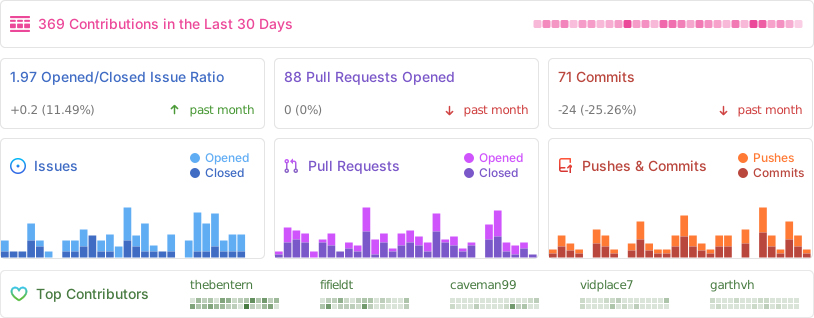
Stats