 Zoltan Kochan
6d17b669b4
Zoltan Kochan
6d17b669b4
## What

The lockfile resolution verifier now confirms that a registry entry pinning an explicit `tarball` URL points at the artifact the registry's own metadata lists for that `name@version`. A mismatch — or any entry that can't be confirmed against the registry — is rejected with `ERR_PNPM_TARBALL_URL_MISMATCH`.

## Why

Follow-up to the design discussion on #12122. The verifier checked the age/trust of `name@version` against the registry packument but never bound the lockfile's `tarball` URL to it. For the non-standard entries pnpm preserves a tarball URL for (npm Enterprise, GitHub Packages — see `toLockfileResolution`), pnpm fetches straight from that URL. So a **tampered lockfile could pair a trusted `name@version` with an attacker-chosen tarball URL** (plus a matching integrity for the attacker's bytes); verification passed against the legitimate version while the install fetched the attacker's bytes. Defending a checked-in lockfile is explicitly in this feature's threat model.

## How

- For a registry-keyed entry that pins an explicit `tarball`, fetch the packument and assert the URL equals `versions[v].dist.tarball`. The comparison canonicalizes away benign differences — http/https scheme, default ports (`:443`/`:80`), and `%2f` scope-separator encoding (case-insensitive) — so only real mismatches are flagged. The packument is fetched from the user's configured registry (the lockfile's tarball host can't redirect it), and named-registry routing uses the same canonicalization so a scheme/`%2f`-only difference doesn't route to the wrong packument.
- **The binding is unconditional.** It runs regardless of `minimumReleaseAge`/`trustPolicy` and is **not** narrowed by their exclude lists, because it guards *integrity*, not *maturity/trust*. Disabling the age/trust policies must not silently disable anti-tamper. (`createNpmResolutionVerifier` therefore always returns a verifier.)
- **It is fail-closed.** An entry passes only when the registry metadata affirmatively lists the version with a matching tarball URL. If the metadata can't be fetched, doesn't list the version, or omits `dist.tarball`, the entry is rejected — otherwise a tampered lockfile could smuggle a malicious URL past the check by pointing it at a `name@version` the registry can't vouch for.
  - **Behavior change:** as a result, an install that re-verifies a lockfile (its content changed since the last verified run, so the verification cache no longer short-circuits) now requires the configured registry to be reachable. `trustLockfile` is the opt-out for environments that treat the on-disk lockfile as already trusted.
- **Verification cache.** The policy snapshot records a `tarballUrlBinding` marker and `canTrustPastCheck` requires it, so a cache record written before this rule existed is re-verified rather than trusted (closing an upgrade-time bypass).
- Entries with no explicit `tarball` reconstruct the URL from name+version+registry and are inherently bound (no check). `file:`/git-hosted resolutions stay out of scope (#12122).
- Threads `nonSemverVersion` to the verifier so URL-keyed tarball deps (a remote `https:` tarball that carries a semver `version` copied from its manifest) are recognized as deliberate non-registry deps and skipped — also fixing a latent release-age over-match on them. The candidate dedupe key includes `nonSemverVersion` so a registry snapshot and a URL-keyed snapshot sharing a `name@version` and serialized resolution stay distinct.

Mirrored in pacquet (`create_npm_resolution_verifier`). The dedupe-key change is TS-only: pacquet's candidate `version` comes from the lockfile key suffix, so the two shapes never share a key there.

## Tests

- TS: confirmed mismatch → violation; non-standard URL matching metadata → pass; default-port/scheme difference → pass; URL-keyed dep → skipped; URL binding runs (and fails closed) with no age/trust policy configured; `canTrustPastCheck` rejects a cache record lacking the binding marker. Regression-verified (the mismatch test fails when the check is disabled).
- pacquet: mirror tests + the no-policy / `minimumReleaseAge: 0` / `trustPolicy: off` cases, default-port/scheme equivalence, and the missing-`tarballUrlBinding` cache rejection. A few install-dispatch / resolution-reuse tests that pin a deliberately bogus tarball URL (or run against an unreachable registry to prove resolution reuse) now set `trustLockfile`, since the always-on fail-closed tarball-URL check would otherwise flag the fixture before the path under test runs.
- `clippy --deny warnings`, `fmt`, and `dylint` clean.
简体中文 | 日本語 | 한국어 | Italiano | Português Brasileiro

Fast, disk space efficient package manager:
- Fast. Up to 2x faster than the alternatives (see benchmark).
- Efficient. Files inside
node_modulesare linked from a single content-addressable storage. - Great for monorepos.
- Strict. A package can access only dependencies that are specified in its
package.json. - Deterministic. Has a lockfile called
pnpm-lock.yaml. - Works as a Node.js version manager. See pnpm runtime.
- Works everywhere. Supports Windows, Linux, and macOS.
- Battle-tested. Used in production by teams of all sizes since 2016.
- See the full feature comparison with npm and Yarn.
To quote the Rush team:
Microsoft uses pnpm in Rush repos with hundreds of projects and hundreds of PRs per day, and we’ve found it to be very fast and reliable.



Platinum Sponsors

|
Gold Sponsors

|

|

|

|

|

|

|

|
Silver Sponsors

|

|

|

|

|

|
|
⏱️ Time.now |
Support this project by becoming a sponsor.
Background
pnpm uses a content-addressable filesystem to store all files from all module directories on a disk. When using npm, if you have 100 projects using lodash, you will have 100 copies of lodash on disk. With pnpm, lodash will be stored in a content-addressable storage, so:
- If you depend on different versions of lodash, only the files that differ are added to the store.
If lodash has 100 files, and a new version has a change only in one of those files,
pnpm updatewill only add 1 new file to the storage. - All the files are saved in a single place on the disk. When packages are installed, their files are linked from that single place consuming no additional disk space. Linking is performed using either hard-links or reflinks (copy-on-write).
As a result, you save gigabytes of space on your disk and you have a lot faster installations!
If you'd like more details about the unique node_modules structure that pnpm creates and
why it works fine with the Node.js ecosystem, read this small article: Flat node_modules is not the only way.
💖 Like this project? Let people know with a tweet
Getting Started
Benchmark
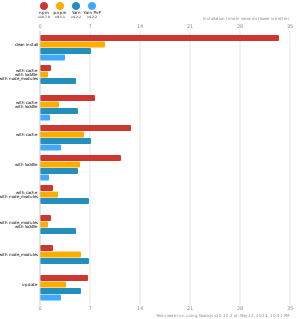
pnpm is up to 2x faster than npm and Yarn classic. See all benchmarks here.
Benchmarks on an app with lots of dependencies:
License
MIT, except the pnpr/ directory, which is source-available under the PolyForm Shield License 1.0.0.