Compare commits

...
Author SHA1 Message Date
Ettore Di Giacinto 5e24d2fc52 fix(audio-cpp): bundle rocRoller for ROCm
ROCm 7.2 links rocBLAS consumers to librocroller.so.1. Add that runtime family to the ROCm bundle so packaged backends resolve the dependency.

Assisted-by: Codex:gpt-5
Signed-off-by: Ettore Di Giacinto <mudler@localai.io>
2026-08-23 03:04:15 +00:00
Ettore Di Giacinto 8c98b6a2d0 fix(audio-cpp): install rocBLAS headers
The HIP build reaches ggml configuration and requires the rocBLAS CMake package. Install its development package with the existing hipBLAS dependency.

Assisted-by: Codex:gpt-5
Signed-off-by: Ettore Di Giacinto <mudler@localai.io>
2026-08-23 03:04:15 +00:00
Ettore Di Giacinto 8ee159b3b2 fix(audio-cpp): normalize HIP target list
audio.cpp forwards GPU_TARGETS to CMake as a semicolon-delimited list. The comma-delimited LocalAI value was treated as one invalid HIP architecture during configuration.

Assisted-by: Codex:gpt-5.6-sol
Signed-off-by: Ettore Di Giacinto <mudler@localai.io>
2026-08-23 03:04:15 +00:00
Ettore Di Giacinto 0f0292de68 fix(audio-cpp): install hipBLAS headers
The ROCm builder lacks the CMake package metadata that ggml requires. Install the development package only for hipBLAS builds.

Assisted-by: Codex:gpt-5
Signed-off-by: Ettore Di Giacinto <mudler@localai.io>
2026-08-23 03:04:15 +00:00
Ettore Di Giacinto 24e5992569 feat(audio-cpp): add ROCm backend image
The pinned audio.cpp revision supports HIP, but LocalAI neither builds a ROCm image nor accepts its backend option. AMD hosts therefore fall back to the CPU image.

Build and publish the HIP variant, connect it to AMD capability selection, and accept both upstream HIP names.

Assisted-by: Codex:gpt-5
Signed-off-by: Ettore Di Giacinto <mudler@localai.io>
2026-08-23 03:04:15 +00:00
mudler's LocalAI [bot]andEttore Di Giacinto 82c191afad fix(distributed): keep model replicas config-consistent (#11664)
* docs: design configurable copy buffering

Document the context-aware copy buffer option and its validation plan.

Assisted-by: Codex:gpt-5

* docs: design durable distributed staging operations

Assisted-by: Codex:gpt-5

* docs: design distributed model config revisions

Assisted-by: Codex:GPT-5 [apply_patch] [exec_command]

* feat(config): add stable model revisions

Hash typed model configuration and effective protobuf options deterministically for distributed revision comparisons.

Assisted-by: Codex:GPT-5 [apply_patch] [exec_command]

* feat(worker): acknowledge exact model stops

Assisted-by: Codex:GPT-5 [apply_patch] [exec_command]

* feat(nodes): track model config revisions

Assisted-by: Codex:GPT-5 [apply_patch]

* fix(distributed): retry quarantined model cleanup

Stop quarantined replicas by exact process identity, retain failed cleanup as durable capped retries, and compare-and-delete only the claimed registry row. Process one sufficiently leased row at a time so multiple frontends cannot duplicate slow cleanup work.

Assisted-by: Codex:gpt-5

* fix(distributed): bind loads to config revisions

Assisted-by: Codex: GPT-5 [OpenAI Codex]

* fix(modeladmin): apply config revisions consistently

Route model edits, patches, state changes, deletion, and peer refreshes through the same revision lifecycle. Quarantine stale replicas before exact cleanup and report durable pending cleanup without failing successful config writes.

Assisted-by: Codex: GPT-5 [OpenAI Codex]

* feat(distributed): expose model config revision state

Document replica revision observability and durable cleanup behavior. Keep pending cleanup explicit in model mutation responses and verify endpoint contracts expose revision state without serialized load options.

Assisted-by: Codex:GPT-5 [OpenAI Codex]

* test(distributed): cover model revision convergence

Exercise cross-frontend quarantine, stale replay rejection, exact cleanup retry, worker re-registration, and current-generation replica convergence against the distributed PostgreSQL harness.

Assisted-by: Codex:gpt-5

* fix(distributed): pass config revision CI checks

Keep configured gallery sources out of authoritative runtime snapshots only after validating their real schema, and harden rollback snapshots against symlink races and non-regular files.

Assisted-by: Codex: GPT-5 [OpenAI Codex]

---------

Co-authored-by: Ettore Di Giacinto <mudler@localai.io>
2026-08-22 22:44:03 +02:00
localai-org-maint-botandlocalai-org-maint-bot 6c7b45b32d fix(gallery): remove duplicate Qwopus entries (#11670)
The Qwopus variant pair was added twice, which makes the later pair unreachable and fails the gallery invariant on master.

Keep the first pair that LocalAI already resolves and remove the dead duplicate declarations.

Assisted-by: Codex:gpt-5

Co-authored-by: localai-org-maint-bot <306269227+localai-org-maint-bot@users.noreply.github.com>
2026-08-22 08:47:58 +02:00
mudler's LocalAI [bot]andmudler b013edab35 chore(model-gallery): ⬆️ update checksum (#11665)
⬆️ Checksum updates in gallery/index.yaml

Signed-off-by: github-actions[bot] <41898282+github-actions[bot]@users.noreply.github.com>
Co-authored-by: mudler <2420543+mudler@users.noreply.github.com>
2026-08-22 00:51:59 +02:00
mudler's LocalAI [bot]andEttore Di Giacinto 9d92139de4 feat(ui): edit scheduling rules in place (#11667)
* docs(ui): design scheduling rule editing

Document the approved in-place rule editing flow and scalable node-label reference for the scheduling view.

Assisted-by: Codex:gpt-5

* feat(ui): improve scheduling rule management

Add scalable node-label discovery and editable scheduling rules with responsive, accessible controls.

Assisted-by: Codex:gpt-5

* chore(ui): ratchet inline style baseline

Record the static inline style removed by the scheduling view enhancement.

Assisted-by: Codex:gpt-5

---------

Co-authored-by: Ettore Di Giacinto <mudler@localai.io>
2026-08-22 00:51:48 +02:00
localai-org-maint-botandlocalai-org-maint-bot 9feaa817f2 feat(gallery): add OpenResearcher variants (#11658)
Add the Q4_K_M and Q8_0 GGUF builds for the agentic deep-research model.

Assisted-by: Codex:gpt-5

Co-authored-by: localai-org-maint-bot <306269227+localai-org-maint-bot@users.noreply.github.com>
2026-08-21 21:21:13 +02:00
localai-org-botandlocalai-org-bot 3684a534bb docs(website): simplify installation paths (#11631)
Keep the homepage focused on runtime capabilities and move engine details to their canonical directory. Make installation choices stable and explicit for users across supported hardware.

Assisted-by: Codex:gpt-5

Co-authored-by: localai-org-bot <306113404+localai-org-bot@users.noreply.github.com>
2026-08-21 21:20:54 +02:00
mudler's LocalAI [bot]andEttore Di Giacinto a0252ad6a1 fix(distributed): keep staging operations stable (#11663)
* docs: design configurable copy buffering

Document the context-aware copy buffer option and its validation plan.

Assisted-by: Codex:gpt-5

* docs: design durable distributed staging operations

Assisted-by: Codex:gpt-5

* fix(distributed): merge durable staging operations

Use active model load jobs as the durable operations baseline and overlay replica-local staging progress without duplication. Preserve tracker-only operations when the registry cannot be read.

Assisted-by: Codex:gpt-5

---------

Co-authored-by: Ettore Di Giacinto <mudler@localai.io>
2026-08-21 20:08:47 +02:00
mudler's LocalAI [bot]andEttore Di Giacinto 5429f569e0 fix(progress): stop status updates throttling downloads (#11661)
* feat(progress): aggregate and coalesce gallery downloads

Assisted-by: Codex:gpt-5
Signed-off-by: Ettore Di Giacinto <mudler@localai.io>

* feat(ui): show rolling transfer speed

Assisted-by: Codex:gpt-5
Signed-off-by: Ettore Di Giacinto <mudler@localai.io>

* fix(ui): preserve legacy import byte labels

Assisted-by: Codex:gpt-5
Signed-off-by: Ettore Di Giacinto <mudler@localai.io>

---------

Signed-off-by: Ettore Di Giacinto <mudler@localai.io>
Co-authored-by: Ettore Di Giacinto <mudler@localai.io>
2026-08-21 18:54:28 +02:00
localai-org-maint-botandlocalai-org-maint-bot 36ad21d1f5 feat(gallery): add Qwopus 3.6 variants (#11662)
Add the trending 27B Fusion merge in Q4_K_M and Q8_0 formats with its shared vision projector.

Assisted-by: Codex:gpt-5

Co-authored-by: localai-org-maint-bot <306269227+localai-org-maint-bot@users.noreply.github.com>
2026-08-21 18:53:07 +02:00
mudler's LocalAI [bot]andEttore Di Giacinto 5072219829 feat(xio): make copy buffer size configurable (#11660)
* docs: design configurable copy buffering

Document the context-aware copy buffer option and its validation plan.

Assisted-by: Codex:gpt-5

* feat(xio): configure context copy buffer size

---------

Co-authored-by: Ettore Di Giacinto <mudler@localai.io>
2026-08-21 16:14:26 +02:00
mudler's LocalAI [bot]andmudler 5797ccb442 chore(model-gallery): ⬆️ update checksum (#11645)
⬆️ Checksum updates in gallery/index.yaml

Signed-off-by: github-actions[bot] <41898282+github-actions[bot]@users.noreply.github.com>
Co-authored-by: mudler <2420543+mudler@users.noreply.github.com>
2026-08-21 12:50:01 +02:00
Anupam Mediratta 387db04a6e fix: upgrade github.com/containerd/containerd to 1.7.33 (CVE-2026-53488) (#11655)
fix: CVE-2026-53488 security vulnerability

Automated dependency upgrade by OrbisAI Security

Signed-off-by: anupamme <mediratta@gmail.com>
2026-08-21 10:20:55 +02:00
mudler's LocalAI [bot]andmudler 22ae9f5ba7 chore: ⬆️ Update 0xShug0/audio.cpp to 43001a7e0f452d80f4588e613f13332940dd4d3a (#11649)
⬆️ Update 0xShug0/audio.cpp

Signed-off-by: github-actions[bot] <41898282+github-actions[bot]@users.noreply.github.com>
Co-authored-by: mudler <2420543+mudler@users.noreply.github.com>
2026-08-21 08:47:02 +02:00
localai-org-maint-botandlocalai-org-maint-bot 5a890bf661 fix(gallery): tag MTP-enabled models (#11653)
The gallery ranker reads serving features from tags instead of backend options. Mark two entries that enable draft MTP so ranking can identify them correctly.

Assisted-by: Codex:gpt-5

Co-authored-by: localai-org-maint-bot <306269227+localai-org-maint-bot@users.noreply.github.com>
2026-08-21 08:46:47 +02:00
github-actions[bot]andmudler 7f2c599f4a chore: bump inference defaults from unsloth (#11654)
Co-authored-by: mudler <2420543+mudler@users.noreply.github.com>
2026-08-21 08:46:35 +02:00
Anupam Mediratta ff6043b811 fix: upgrade react-router to 7.18.2, 8.3.0 (GHSA-qwww-vcr4-c8h2) (#11644)
* fix: GHSA-qwww-vcr4-c8h2 security vulnerability

Automated dependency upgrade by OrbisAI Security

Signed-off-by: anupamme <mediratta@gmail.com>

* fix: upgrade react-router-dom to 7.18.2 to fully remediate GHSA-qwww-vcr4-c8h2

The prior fix pinned react-router@7.18.2 directly but left react-router-dom
at ^7.18.1, which bun resolved to 7.18.1. That package bundles its own
react-router@7.18.1 sub-dep, leaving the vulnerable version in bun.lock
via the react-router-dom/react-router scoped resolution. Pinning
react-router-dom to 7.18.2 and regenerating the lockfile removes all
7.18.1 resolutions.

Assisted-by: Claude Code:claude-sonnet-4-6
Signed-off-by: Anupam Mediratta <mediratta@gmail.com>

---------

Signed-off-by: anupamme <mediratta@gmail.com>
Signed-off-by: Anupam Mediratta <mediratta@gmail.com>
2026-08-21 08:41:23 +02:00
mudler's LocalAI [bot]andmudler 6d8667f93a chore: ⬆️ Update ggml-org/llama.cpp to d59d455fd8ea09e5a2e87ce2a9d668267ffb5ccd (#11618)
⬆️ Update ggml-org/llama.cpp

Signed-off-by: github-actions[bot] <41898282+github-actions[bot]@users.noreply.github.com>
Co-authored-by: mudler <2420543+mudler@users.noreply.github.com>
2026-08-20 22:59:48 +02:00
dependabot[bot] 3c899961e9 chore(deps): update charset-normalizer requirement from >=3.4.9 to >=3.5.1 in /backend/python/vllm (#11637)
chore(deps): update charset-normalizer requirement

Updates the requirements on [charset-normalizer](https://github.com/jawah/charset_normalizer) to permit the latest version.
- [Release notes](https://github.com/jawah/charset_normalizer/releases)
- [Changelog](https://github.com/jawah/charset_normalizer/blob/master/CHANGELOG.md)
- [Commits](https://github.com/jawah/charset_normalizer/compare/3.4.9...3.5.1)

---
updated-dependencies:
- dependency-name: charset-normalizer
  dependency-version: 3.5.1
  dependency-type: direct:production
...

Signed-off-by: dependabot[bot] <support@github.com>
Co-authored-by: dependabot[bot] <49699333+dependabot[bot]@users.noreply.github.com>
2026-08-20 22:59:19 +02:00
Anupam Mediratta 9236be96bd fix: upgrade github.com/containerd/containerd to 1.7.32 (CVE-2026-46680) (#11634)
fix: CVE-2026-46680 security vulnerability

Automated dependency upgrade by OrbisAI Security

Signed-off-by: anupamme <mediratta@gmail.com>
2026-08-20 22:56:33 +02:00
mudler's LocalAI [bot]andmudler 80dd0fd076 docs: ⬆️ update docs version mudler/LocalAI (#11643)
⬆️ Update docs version mudler/LocalAI

Signed-off-by: github-actions[bot] <41898282+github-actions[bot]@users.noreply.github.com>
Co-authored-by: mudler <2420543+mudler@users.noreply.github.com>
2026-08-20 22:55:36 +02:00
mudler's LocalAI [bot]andEttore Di Giacinto d2588b9177 docs(blog): add the 4.9 release post and its demo clips (#11629)
* docs(blog): add the 4.9 release post and its demo clips

The 4.9 cycle changed how you authenticate, how chat handles a history
that no longer fits, and where models and backends live in the UI. The
release notes list every pull request; this post covers the three
changes that alter day-to-day use, and leads with the auth one because
it needs an action before upgrading.

Two clips are recorded from a real session against a local-ai built
from master with the live gallery loaded: model-lifecycle.mp4 walks
the unified models and backends pages, import-model.mp4 shows the
rebuilt import form. Both follow the clip conventions in
.agents/preparing-a-release.md: h264, no audio track, 1000x562, under
30 seconds, and named after the feature so they stay reusable.

Assisted-by: Claude Code:claude-opus-5 [Bash] [Playwright]
Signed-off-by: Ettore Di Giacinto <mudler@localai.io>

* docs(blog): anti-slop pass over the 4.9 post

Ran the post through the humanizer and no-ai-slop rules, calibrated
against what-landed-in-localai-4-8.md. That post is the one #11324
left unchanged, so it sets the rate for this series.

The draft ran denser than it on two constructions: "rather than" at
5.1 per thousand words against 3.5, and "instead of" at 3.1 against
1.6. Both are now at or below the 4.8 rate, 2.7 and 1.5, by rewriting
seven of them as plain statements.

Also cut: "keeping both cost a mode switch", a ledger metaphor for
something that is not money, which is the tell #11324 removed eight
times from the APEX post. "A follow-up fixed the thing that made that
awkward", an unearned framing plus a colon reveal. "This release adds
a different one: compress them", a second colon reveal. And
"byte-structurally identical", a second exactness idiom in a post that
already uses "byte-identical" where the precision carries weight.

Five paragraphs opened with "Two things" or "Two details", so three of
them start differently now. The summary listed three items, which is
the rule of three; it lists four, like the 4.8 summary.

Every figure, PR number, link and media reference is unchanged, checked
by diffing them out of both revisions. Hugo builds clean and the
rendered HTML has no em dashes.

Assisted-by: Claude Code:claude-opus-5 [Bash]
Signed-off-by: Ettore Di Giacinto <mudler@localai.io>

---------

Signed-off-by: Ettore Di Giacinto <mudler@localai.io>
Co-authored-by: Ettore Di Giacinto <mudler@localai.io>
2026-08-20 22:55:13 +02:00
Anupam Mediratta 9ba4bbf9bb fix: upgrade ip-address to 10.3.1 (CVE-2026-69192) (#11632)
fix: CVE-2026-69192 security vulnerability

Automated dependency upgrade by OrbisAI Security

Signed-off-by: anupamme <mediratta@gmail.com>
2026-08-20 20:04:11 +02:00
localai-org-maint-botandlocalai-org-maint-bot f7ad3f70eb feat(gallery): add Gemma 4 agentic variants (#11622)
Expose the upstream Q8_0 build and the MTP drafter for the existing Gemma 4 12B agentic entry. The variants let LocalAI select higher fidelity or faster speculative decoding from the same model family.

Assisted-by: Codex:gpt-5

Co-authored-by: localai-org-maint-bot <306269227+localai-org-maint-bot@users.noreply.github.com>
2026-08-20 12:53:54 +02:00
0ef6a5d7f1 chore: ⬆️ Update NVIDIA/NeMo-Speech.cpp to 4f9676226f667d14608487df744f375db87127f8 (#11417)
* ⬆️ Update NVIDIA/NeMo-Speech.cpp

Signed-off-by: github-actions[bot] <41898282+github-actions[bot]@users.noreply.github.com>

* fix(nemo-speech-cpp): build required sentencepiece

The updated runtime uses SentencePiece for RNNT context biasing even when Flashlight and text normalization are disabled. Build upstream's pinned static archive before configuring the engine so every backend variant has the newly required library and headers.

Assisted-by: Codex:gpt-5

* fix(nemo-speech-cpp): support BSD install

The pinned SentencePiece script uses GNU install -D for license files. macOS provides BSD install, which rejects that flag after the library compiles.

Create the license directory and use the portable install form on Darwin.

Assisted-by: Codex:gpt-5

* fix(nemo-speech-cpp): support CMake 4

Homebrew CMake 4 rejects the old policy floor in the pinned SentencePiece helper. Select the oldest supported policy floor for the Darwin dependency build.

Assisted-by: Codex:gpt-5.6 [Codex CLI]

---------

Signed-off-by: github-actions[bot] <41898282+github-actions[bot]@users.noreply.github.com>
Co-authored-by: mudler <2420543+mudler@users.noreply.github.com>
Co-authored-by: localai-org-maint-bot <306269227+localai-org-maint-bot@users.noreply.github.com>
2026-08-20 08:16:55 +00:00
mudler's LocalAI [bot]andmudler 98fd29c1e3 chore: ⬆️ Update CrispStrobe/CrispASR to a153b09b37c90cd55cd9336fccbdf3ba7a289596 (#11611)
⬆️ Update CrispStrobe/CrispASR

Signed-off-by: github-actions[bot] <41898282+github-actions[bot]@users.noreply.github.com>
Co-authored-by: mudler <2420543+mudler@users.noreply.github.com>
2026-08-20 09:16:17 +02:00
mudler's LocalAI [bot]andmudler 5b87f4adf7 chore(model-gallery): ⬆️ update checksum (#11615)
⬆️ Checksum updates in gallery/index.yaml

Signed-off-by: github-actions[bot] <41898282+github-actions[bot]@users.noreply.github.com>
Co-authored-by: mudler <2420543+mudler@users.noreply.github.com>
2026-08-20 08:17:43 +02:00
mudler's LocalAI [bot]andmudler ea1d19064d chore: ⬆️ Update leejet/stable-diffusion.cpp to 97d2990807fe6d558e395f8764198d7c7e7b411c (#11616)
⬆️ Update leejet/stable-diffusion.cpp

Signed-off-by: github-actions[bot] <41898282+github-actions[bot]@users.noreply.github.com>
Co-authored-by: mudler <2420543+mudler@users.noreply.github.com>
2026-08-20 08:17:28 +02:00
mudler's LocalAI [bot]andmudler ea1a876b46 chore: ⬆️ Update 0xShug0/audio.cpp to a61da671b6a81c79071500954eea3c91c1a383dd (#11613)
⬆️ Update 0xShug0/audio.cpp

Signed-off-by: github-actions[bot] <41898282+github-actions[bot]@users.noreply.github.com>
Co-authored-by: mudler <2420543+mudler@users.noreply.github.com>
2026-08-20 08:17:13 +02:00
mudler's LocalAI [bot]andmudler 63d6993e0a chore: ⬆️ Update mudler/vllm.cpp to 438305e1577768ec0f75729456a4c8b9f425e2ee (#11612)
⬆️ Update mudler/vllm.cpp

Signed-off-by: github-actions[bot] <41898282+github-actions[bot]@users.noreply.github.com>
Co-authored-by: mudler <2420543+mudler@users.noreply.github.com>
2026-08-20 08:17:00 +02:00
localai-org-maint-botandlocalai-org-maint-bot 4ee667343c feat(gallery): add Ornith 1.5 9B variants (#11603)
Add the official Q4_K_M and Q8_0 GGUF builds with the shared BF16 vision projector.

Assisted-by: Codex:gpt-5 [Hugging Face API]

Co-authored-by: localai-org-maint-bot <306269227+localai-org-maint-bot@users.noreply.github.com>
2026-08-19 20:49:55 +02:00
mudler's LocalAI [bot]andmudler 6fae75cb21 chore(model gallery): 🤖 add 1 new models via gallery agent (#11605)
chore(model gallery): 🤖 add new models via gallery agent

Signed-off-by: github-actions[bot] <41898282+github-actions[bot]@users.noreply.github.com>
Co-authored-by: mudler <2420543+mudler@users.noreply.github.com>
2026-08-19 20:49:37 +02:00
mudler's LocalAI [bot]andEttore Di Giacinto 0ab632b6bd fix(auth): protect HTTP routes by default (#11602)
* fix(auth): default to protected HTTP routes

Use a method-aware registry for the small anonymous bootstrap surface.
Unknown routes now require credentials instead of inheriting fail-open
path classification.

Keep node self-service routes behind their registration-token middleware.
Global auth no longer rejects valid worker credentials first.

Assisted-by: Codex:gpt-5

* docs(auth): document public HTTP surface

Assisted-by: Codex:gpt-5

* test(auth): align route coverage with default denial

Assisted-by: Codex:gpt-5

---------

Co-authored-by: Ettore Di Giacinto <mudler@localai.io>
2026-08-19 20:49:19 +02:00
localai-org-maint-botandlocalai-org-maint-bot 34e986de0a feat(gallery): add Carbon genomics variants (#11594)
Add the Carbon 3B and 8B genomic foundation models with Q4_K_M and Q8_0 GGUF builds.

Assisted-by: Codex:gpt-5

Co-authored-by: localai-org-maint-bot <306269227+localai-org-maint-bot@users.noreply.github.com>
2026-08-19 16:40:28 +02:00
localai-org-maint-botandlocalai-org-maint-bot 0df8de35e2 feat(gallery): add Hy-MT2 1.8B variants (#11599)
Add Tencent’s compact translation model in Q4 and Q8 GGUF formats. The linked variants let LocalAI select the best build that fits each host.

Assisted-by: Codex:gpt-5

Co-authored-by: localai-org-maint-bot <306269227+localai-org-maint-bot@users.noreply.github.com>
2026-08-19 16:40:10 +02:00
Ettore Di Giacinto 2383726d6d Revert "chore(tests): Avoid network, sleep and more during tests" (#11601)
Revert "chore(tests): Avoid network, sleep and more during tests (#11050)"

This reverts commit cb3bf7af3f.
2026-08-19 16:39:39 +02:00
localai-org-maint-botandlocalai-org-maint-bot 6d27f3b210 feat(gallery): add Ling 3.0 Flash variants (#11598)
Add IQ1_M and IQ2_XS GGUF builds for the 124B hybrid reasoning model.

Assisted-by: Codex:GPT-5 [Codex CLI] [curl]

Co-authored-by: localai-org-maint-bot <306269227+localai-org-maint-bot@users.noreply.github.com>
2026-08-19 12:43:15 +02:00
Richard Palethorpeandlocalai-org-maint-bot cb3bf7af3f chore(tests): Avoid network, sleep and more during tests (#11050)
* test: make coverage failures observable

Keep per-root logs, reject concurrent coverage runs, and avoid relying on /bin/sleep in the worker timeout test.

Assisted-by: Codex:gpt-5
Signed-off-by: Richard Palethorpe <io@richiejp.com>

* test: parallelize coverage without remote fixtures

Assisted-by: Codex:gpt-5 [apply_patch] [exec_command]
Signed-off-by: Richard Palethorpe <io@richiejp.com>

* test: add offline resource infrastructure

Introduce versioned resource manifests, a checksum-verified CAS preparer, offline test wrappers, and a guarded network transport. Replace live Hugging Face, GitHub, and OCI cases with deterministic fixtures and inject fixture metadata into importer discovery.

Assisted-by: Codex:gpt-5
Signed-off-by: Richard Palethorpe <io@richiejp.com>

* test: enforce offline resource replay

Assisted-by: Codex:gpt-5
Signed-off-by: Richard Palethorpe <io@richiejp.com>

* test: harden offline resource refresh

Assisted-by: Codex:gpt-5
Signed-off-by: Richard Palethorpe <io@richiejp.com>

* test: expose slow coverage waits

Assisted-by: Codex:gpt-5
Signed-off-by: Richard Palethorpe <io@richiejp.com>

* test: eliminate avoidable wall-clock waits

Inject a clock into Hugging Face retry handling, reuse a process-scoped PostgreSQL container with per-spec schemas in the nodes suite, and poll local import jobs promptly.

Assisted-by: Codex:gpt-5
Signed-off-by: Richard Palethorpe <io@richiejp.com>

* test: remove repeated fixture startup waits

Share PostgreSQL fixtures across parallel endpoint and agent suite workers, and make the worker Free deadline injectable so the wedged-backend test does not spend five seconds on wall-clock time.

Assisted-by: Codex:gpt-5
Signed-off-by: Richard Palethorpe <io@richiejp.com>

* test: fix offline resource CI portability

Normalize Docker archive metadata before content addressing, derive archive checksums during explicit refreshes, make network lint portable to macOS, and prepare distributed images before running their offline suite.

Assisted-by: Codex:gpt-5
Signed-off-by: Richard Palethorpe <io@richiejp.com>

* ci: cache Go modules before offline tests

Warm the complete module graph before the Linux and macOS test jobs enter offline replay mode, so tool dependencies such as Ginkgo are not fetched through the guarded proxy.

Assisted-by: Codex:gpt-5
Signed-off-by: Richard Palethorpe <io@richiejp.com>

* test: drop the static network lint in favour of real isolation

The offline test suite already prevents tests from reaching the network
twice over: run-test-linux-offline.sh puts the test process in a cgroup
and REJECTs egress outside the private ranges, and HardenedTransport
installs testnetwork.LocalGuard to refuse dials that resolve to a public
address. Both fail the test with a precise error at the moment of the
dial.

test-network-lint.sh added neither. Its diff stage defaulted to a HEAD
base, so on a clean checkout it compared the tree against itself and
inspected nothing; the branch's own commits were never examined. It only
produced output when an earlier job step dirtied the tree, and then it
matched a bare https?:// against whatever changed. make react-ui runs
npm install rather than npm ci, so CI rewrote
core/http/react-ui/package-lock.json and the lint reported an npm
registry URL as forbidden test network access:

  +      "resolved": "https://registry.npmjs.org/hono/-/hono-4.12.25.tgz",

Its fingerprint stage was self-defeating in a quieter way: hashing the
whole tree's network-mechanism inventory meant every rebase onto a master
that touched any _test.go needed a manual baseline bump, so the check
mostly caught its own staleness.

Remove the script, its make target and the two prerequisite edges, along
with the test-network: fixture markers that existed only to suppress it.
The isolation itself is untouched.

Assisted-by: Claude:claude-opus-5 [go vet]
Signed-off-by: Richard Palethorpe <io@richiejp.com>

* ci: keep hidden files in the offline test bundle artifact

Cherry-picked from 15a37b0ac on the remote branch. The offline bundle lives
under .cache/, which actions/upload-artifact skips by default, so the Linux
job packed an artifact missing the very file the next step restores.

The other half of 15a37b0ac moved test-network-lint out of the `test` and
`test-coverage` prerequisite lists into a recipe line, so parallel make could
not fingerprint the tree while generated fixtures were still changing. That
is dropped: the preceding commit removes the lint entirely, and the race it
worked around is one more reason a whole-tree fingerprint was the wrong
mechanism.

Assisted-by: Codex:gpt-5
Signed-off-by: Richard Palethorpe <io@richiejp.com>

* refactor: share bounded exponential backoff

Use overflow-safe saturating arithmetic for retry delays across model import polling, downloads, registration, node operations, and model loading. Keep model import status checks responsive initially while capping their interval at 500ms.

Assisted-by: Codex:gpt-5
Signed-off-by: Richard Palethorpe <io@richiejp.com>

* ci: mirror Jetson Python wheels

Keep the CUDA aarch64 wheel subset in GHCR and serve it as a local PEP 503 index during L4T backend builds, preserving last-known-good packages through upstream outages.

Assisted-by: Codex:gpt-5
Signed-off-by: Richard Palethorpe <io@richiejp.com>

* docs(agents): index the Jetson wheels mirror

Mention the GHCR-hosted L4T wheel mirror in the CI caching guide summary so maintainers can find its outage and cache documentation.

Assisted-by: Codex:gpt-5
Signed-off-by: Richard Palethorpe <io@richiejp.com>

* ci: add defensive build network proxy

Record build destinations and byte counts, retry observable idempotent HTTP downloads, and isolate explorer database tests that race under coverage.

Assisted-by: Codex:gpt-5
Signed-off-by: Richard Palethorpe <io@richiejp.com>

* fix(kokoros): implement updated backend trait

Return unimplemented for image upscaling, matching the backend's other unsupported modalities after the protobuf API update.

Assisted-by: Codex:gpt-5
Signed-off-by: Richard Palethorpe <io@richiejp.com>

* fix(ci): clear recovered proxy errors

Do not mark a request failed when a later safe retry succeeds.

Assisted-by: Codex:gpt-5
Signed-off-by: Richard Palethorpe <io@richiejp.com>

* ci: require HTTPS build interception

Inject a short-lived proxy CA into BuildKit and Dockerfile RUN steps, reject plain HTTP and opaque tunnels, and retain method/status/byte telemetry for verified HTTPS traffic.

Assisted-by: Codex:gpt-5
Signed-off-by: Richard Palethorpe <io@richiejp.com>

* fix(ci): preserve system trust in unproxied builds

Mount the generated interception CA at a dedicated secret path and add it to the trust bundle only in proxy-aware dependency stages. This prevents optional secret mounts from masking the system CA bundle in ordinary backend test builds.

Install the requested Go toolchain before starting the proxy and satisfy cleanup error checks found by CI lint.

Assisted-by: Codex:gpt-5
Signed-off-by: Richard Palethorpe <io@richiejp.com>

* fix(ci): persist build proxy trust

Install the generated proxy CA through the system-managed local certificate directory so ca-certificates upgrades retain it. Avoid turning canceled matrix jobs into proxy cleanup failures.

Assisted-by: Codex:gpt-5

Signed-off-by: Richard Palethorpe <io@richiejp.com>

* fix(ci): trust proxy in nested build scripts

Install the build proxy CA before nested source fetches, route the DS4 package setup through the HTTPS mirror helper, and avoid repeated OCI setup in gallery behavior tests.

Assisted-by: Codex:gpt-5

Signed-off-by: Richard Palethorpe <io@richiejp.com>

* fix(ci): use HTTPS apt sources for Bonsai

Rewrite ARM64 package sources before installing GCC and check gallery fixture cleanup errors so the optimized tests satisfy errcheck.

Assisted-by: Codex:gpt-5

Signed-off-by: Richard Palethorpe <io@richiejp.com>

* fix(privacy-filter): trust build proxy CA

Install the mounted build proxy certificate before privacy-filter's make target fetches its HTTPS sources, for both source and prebuilt builder paths.\n\nAssisted-by: Codex:gpt-5

Signed-off-by: Richard Palethorpe <io@richiejp.com>

* test: fail on hidden offline egress

Count cgroup-scoped firewall rejects and fail the offline test harness with bounded aggregate diagnostics. Inject the gen-audio GGUF probe so fixture-backed importer tests do not attempt real network access.

Assisted-by: Codex:gpt-5
Signed-off-by: Richard Palethorpe <io@richiejp.com>

* fix(ci): preserve system CA trust

Build a combined runner certificate bundle instead of replacing public roots with the generated proxy CA. Centralize additive container installation in the shared proxy CA helper.

Assisted-by: Codex:gpt-5
Signed-off-by: Richard Palethorpe <io@richiejp.com>

---------

Signed-off-by: Richard Palethorpe <io@richiejp.com>
Co-authored-by: localai-org-maint-bot <306269227+localai-org-maint-bot@users.noreply.github.com>
2026-08-19 10:59:31 +02:00
localai-org-maint-botandlocalai-org-maint-bot de3329e332 feat(gallery): add UI-Mate 9B variants (#11584)
Add Q4_K_M and Q8_0 GGUF builds for Tencent UI-Mate-9B. Include the f16 vision projector so llama.cpp can process desktop screenshots.

Assisted-by: Codex:gpt-5

Co-authored-by: localai-org-maint-bot <306269227+localai-org-maint-bot@users.noreply.github.com>
2026-08-19 08:48:35 +02:00
localai-org-maint-botandlocalai-org-maint-bot aa7d016a48 feat(gallery): add North Mini Code variants (#11559)
Add the supported Q4_K_M and Q8_0 GGUF builds for Cohere Labs' 30B-A3B coding model.

Assisted-by: Codex:gpt-5

Co-authored-by: localai-org-maint-bot <306269227+localai-org-maint-bot@users.noreply.github.com>
2026-08-19 08:48:24 +02:00
mudler's LocalAI [bot]andmudler 89d1cda0fc chore(model gallery): 🤖 add 1 new models via gallery agent (#11596)
chore(model gallery): 🤖 add new models via gallery agent

Signed-off-by: github-actions[bot] <41898282+github-actions[bot]@users.noreply.github.com>
Co-authored-by: mudler <2420543+mudler@users.noreply.github.com>
2026-08-19 08:46:12 +02:00
localai-org-maint-botandlocalai-org-maint-bot 4cad809003 fix(ci): test stale chunks in split bundle (#11595)
The V8 coverage build inlines every dynamic import, so the stale chunk tests cannot intercept a page chunk. Run those tests against the normal code-split bundle and exclude them from the inlined coverage pass.

Assisted-by: Codex:gpt-5

Co-authored-by: localai-org-maint-bot <306269227+localai-org-maint-bot@users.noreply.github.com>
2026-08-19 08:45:59 +02:00
mudler's LocalAI [bot]andmudler ea60f62d66 chore: ⬆️ Update mudler/parakeet.cpp to e75de9b6b9b688fd293aa22f7e27aa724ea286f8 (#11592)
⬆️ Update mudler/parakeet.cpp

Signed-off-by: github-actions[bot] <41898282+github-actions[bot]@users.noreply.github.com>
Co-authored-by: mudler <2420543+mudler@users.noreply.github.com>
2026-08-19 08:45:27 +02:00
mudler's LocalAI [bot]andmudler 25cfc7c3c9 chore: ⬆️ Update CrispStrobe/CrispASR to a117d433855ecc36b0cb20bd1abddd852902ed13 (#11591)
⬆️ Update CrispStrobe/CrispASR

Signed-off-by: github-actions[bot] <41898282+github-actions[bot]@users.noreply.github.com>
Co-authored-by: mudler <2420543+mudler@users.noreply.github.com>
2026-08-19 08:45:07 +02:00
mudler's LocalAI [bot]andmudler a57fce10c5 chore: ⬆️ Update ggml-org/llama.cpp to 60addddf3c567c43ec3caf70fc953fba3572d96f (#11590)
⬆️ Update ggml-org/llama.cpp

Signed-off-by: github-actions[bot] <41898282+github-actions[bot]@users.noreply.github.com>
Co-authored-by: mudler <2420543+mudler@users.noreply.github.com>
2026-08-19 08:44:55 +02:00
mudler's LocalAI [bot]andmudler 2ba3265c67 chore: ⬆️ Update mudler/vllm.cpp to 6e99e4540b8d0811542a9d7690dc9aa0bda5812f (#11589)
⬆️ Update mudler/vllm.cpp

Signed-off-by: github-actions[bot] <41898282+github-actions[bot]@users.noreply.github.com>
Co-authored-by: mudler <2420543+mudler@users.noreply.github.com>
2026-08-19 08:44:44 +02:00
mudler's LocalAI [bot]andmudler 61f02f7504 chore: ⬆️ Update ggml-org/whisper.cpp to 4834a2327d008ace3ec5a9ed00f51454bcabbc1c (#11588)
⬆️ Update ggml-org/whisper.cpp

Signed-off-by: github-actions[bot] <41898282+github-actions[bot]@users.noreply.github.com>
Co-authored-by: mudler <2420543+mudler@users.noreply.github.com>
2026-08-19 08:44:32 +02:00
mudler's LocalAI [bot]andmudler 59001291e1 chore: ⬆️ Update 0xShug0/audio.cpp to 92816fc5c48d33a58171b49678ccf884d70142fb (#11587)
⬆️ Update 0xShug0/audio.cpp

Signed-off-by: github-actions[bot] <41898282+github-actions[bot]@users.noreply.github.com>
Co-authored-by: mudler <2420543+mudler@users.noreply.github.com>
2026-08-19 08:44:13 +02:00
mudler's LocalAI [bot]andmudler 77ff6889ec chore: ⬆️ Update vllm-metal (darwin) to v0.3.0.dev20260818075955 (#11586)
⬆️ Update vllm-project/vllm-metal (darwin)

Signed-off-by: github-actions[bot] <41898282+github-actions[bot]@users.noreply.github.com>
Co-authored-by: mudler <2420543+mudler@users.noreply.github.com>
2026-08-19 08:39:14 +02:00
mudler's LocalAI [bot]andmudler 08786395be feat(swagger): update swagger (#11585)
Signed-off-by: github-actions[bot] <41898282+github-actions[bot]@users.noreply.github.com>
Co-authored-by: mudler <2420543+mudler@users.noreply.github.com>
2026-08-19 08:37:21 +02:00
Ettore Di Giacinto b806b1fec3 fix(ui): reload once when a page chunk 404s
A deploy replaces the whole content-hashed asset set at once. A tab
holding an older index.html, or one whose request lands on a replica
that the rollout has not swapped yet, asks for a page chunk the server
no longer has. The dynamic import rejects and React Router's default
error boundary replaces the app with "Unexpected Application Error!"
until someone reloads by hand.

The router now reloads the page itself when a chunk fails to load.
index.html is served no-cache, so the reload lands on a self-consistent
asset set. A timestamp in sessionStorage bounds this to one reload per
10 seconds, so a chunk that is genuinely gone reaches the error boundary
instead of looping forever.

Signed-off-by: Ettore Di Giacinto <mudler@localai.io>
Assisted-by: Claude Code:claude-opus-5[1m]
2026-08-18 19:51:15 +00:00
Stefan Walcz 178ac66d77 docs(ecosystem): add Walcz to contributors (#11582)
Nine commits in this repository, all merged: native Prometheus metrics for agent
chat runs (#10689), PII/audit events as a Prometheus counter (#10641), optional
Anthropic prompt-cache breakpoints (#11158), plus fixes to cloud-proxy, the agent
UI and the Python backend.

The author's public GitHub profile names the employer, which is the evidence this
file asks for. Counts verified with the GitHub commit search API on 2026-08-18.

Placed by commit count, between Spectro Cloud and VictoriaMetrics.

Signed-off-by: Stefan Walcz <stefan.walcz@walcz.de>
2026-08-18 17:55:58 +02:00
Stefan Walcz 906868992e docs(adopters): add walcz.de (#11581)
We run LocalAI as the inference layer of a self-hosted appliance for a German
B2B consultancy — local-only, on AMD Strix Halo (gfx1151) with ROCm.

In daily production use for agents with MCP tools, RAG over an internal
knowledge base, and a document/bookkeeping pipeline.

Signed-off-by: Stefan Walcz <stefan.walcz@walcz.de>
2026-08-18 17:55:35 +02:00
localai-org-maint-botandlocalai-org-maint-bot 0761bd02c7 feat(chat): add end-to-end context compression (#11556)
* feat(config): add context compression policy

Define the opt-in model configuration contract before the chat middleware consumes it. Document each policy field so later request handling does not invent a second schema.\n\nRefs #9534\n\nAssisted-by: Codex:gpt-5

* fix(config): register compression fields

The model editor metadata gate rejects new config fields without descriptions and suitable controls. Register the compression policy so operators can edit its six fields safely.

Assisted-by: Codex:gpt-5 [monitoring-prs]

* feat(chat): compress long contexts

Long conversations currently fail once they reach the model context window. The opt-in policy now summarizes complete older turns before primary inference and preserves the newest tool chains.

Both OpenAI and MCP chat routes share the same transformation. Usage metadata and metrics expose each compression event.

Refs #9534

Assisted-by: Codex:gpt-5

---------

Co-authored-by: localai-org-maint-bot <306269227+localai-org-maint-bot@users.noreply.github.com>
2026-08-18 11:31:03 +00:00
Nicholas Ciechanowski cf93c04878 fix: tts text wrap (#11576)
Signed-off-by: Nicholas Ciechanowski <nicholas@ciech.anow.ski>
2026-08-18 12:57:55 +02:00
4058194b18 chore: ⬆️ Update 0xShug0/audio.cpp to 3407559d7c83b543bd60ca8fa2b630374e71083f (#11474)
* ⬆️ Update 0xShug0/audio.cpp

Signed-off-by: github-actions[bot] <41898282+github-actions[bot]@users.noreply.github.com>

* fix(audio-cpp): map the MIDI task

audio.cpp now appends MIDI to its task enum. Keep the LocalAI mirror and conversion switches aligned so the backend builds against the new pin.

Assisted-by: Codex:gpt-5

---------

Signed-off-by: github-actions[bot] <41898282+github-actions[bot]@users.noreply.github.com>
Co-authored-by: mudler <2420543+mudler@users.noreply.github.com>
Co-authored-by: localai-org-maint-bot <306269227+localai-org-maint-bot@users.noreply.github.com>
2026-08-18 09:46:56 +02:00
6d4c64c6c3 chore: ⬆️ Update mudler/vllm.cpp to 76f2a6d84e41cc9a593146a9a958f63645542731 (#11555)
* ⬆️ Update mudler/vllm.cpp

Signed-off-by: github-actions[bot] <41898282+github-actions[bot]@users.noreply.github.com>

* fix(vllm-cpp): track ABI v21

The updated engine exposes ABI v21 after extending its speech API. The Go
backend does not bind that API, so its existing mirrors remain valid.

The qwen3.5 warning fix is now present upstream, so the old patch no
longer applies.

Assisted-by: Codex:gpt-5

---------

Signed-off-by: github-actions[bot] <41898282+github-actions[bot]@users.noreply.github.com>
Co-authored-by: mudler <2420543+mudler@users.noreply.github.com>
Co-authored-by: localai-org-maint-bot <306269227+localai-org-maint-bot@users.noreply.github.com>
2026-08-18 09:46:15 +02:00
mudler's LocalAI [bot]andlocalai-org-maint-bot 4c4911fe2c chore: ⬆️ Update ggml-org/llama.cpp to 0021a77de0a8966059dc94548fb3b96654e0bb12 (#11508)
* chore(llama-cpp): update upstream revision

Assisted-by: Codex:gpt-5.6

* fix(llama-cpp): refresh server patch contexts

The new llama.cpp pin changed the slot reset and prompt batch code. GNU patch accepted stale hunks with fuzz, which left the L4T build with invalid source.

Refresh both server patches against the pinned source so each hunk applies at its intended location.

Assisted-by: Codex:gpt-5

* fix(llama-cpp): adapt metrics result fields

The updated llama.cpp groups cumulative counters under server_metrics. Probe the result layout so the shared adapter also compiles against older forks.

Assisted-by: Codex:gpt-5

* fix(llama-cpp): refresh TTS patch offsets

GNU patch rejects the stale pre-decode hunk after the score patch changes the same file. Anchor the TTS hunks to the pinned llama.cpp source so the full series applies without fuzz.

Assisted-by: Codex:gpt-5.4

* fix(llama-cpp): normalize batch threads

The updated llama.cpp creates its batch threadpool during model initialization, before the context-level fallback can replace the -1 sentinel. Resolve that sentinel from the inference thread count so model loading does not overflow the threadpool allocation.\n\nAssisted-by: Codex:gpt-5.4

---------

Co-authored-by: localai-org-maint-bot <306269227+localai-org-maint-bot@users.noreply.github.com>
2026-08-18 09:45:56 +02:00
Richard Palethorpe d10374f849 feat(router): make KNN a first-class classifier with a persisted, curated corpus (#10652)
* feat(router): make KNN a first-class classifier with a persisted, curated corpus

Add `classifier: knn` — similarity-weighted voting over labelled
example prompts. Unlike score/colbert it needs no classifier model:
label knowledge lives in a corpus seeded and curated through the
admin API, so routing decisions are deterministic, auditable, and
grounded in graded experience rather than a model's opinion.

Epistemic gate: corpus entries below knn.similarity_threshold cannot
vote; when none clears it the classifier activates no labels and the
router uses the fallback — a prompt unlike all labelled experience is
treated as undecidable, not guessed. Decisions record
nearest_similarity (also on fallback rows) so admins can see how far
the nearest labelled experience was; the Routing tab explains
out-of-corpus fallbacks and shows per-label corpus counts.

Persistence: one JSONL file per router under
<data path>/router-corpus (text, labels, vector, embedder
fingerprint). The file is the source of truth; the local-store index
is rebuilt from it at classifier build time and stays a pure
in-memory index. Entries recorded under a different embedding model
re-embed on load. Also corrects the docs' false claim that
local-store collections persist — the embedding cache never survived
restarts (and still doesn't); the corpus does.

Corpus input is API-only by design (entries may contain example user
content): POST /api/router/{name}/corpus seeds (labels validated
against declared policies, embedded server-side, indexed
immediately), GET .../corpus/stats inspects — label counts only,
entry texts are never returned by any surface — DELETE .../corpus
wipes. Admin-gated like the sibling router endpoints, and exposed as
MCP tools (seed_router_corpus / get_router_corpus_stats /
clear_router_corpus) in both the httpapi and inproc clients with
coverage-test route mappings.

Plumbing: VectorStore gains SearchK (top-K was hardcoded to 1);
local-store gets InsertBatch/Delete as optional fast paths;
RouterConfig gains a knn block (embedding_model, k,
similarity_threshold, vote_threshold, store_name) with meta-registry
fields; the classifier dropdown now offers knn and the
previously-missing colbert; embedding_cache is ignored (with a
warning) for knn — it IS an embedding-KNN lookup; the stale
/api/instructions intelligent-routing entry is rewritten (it
described a classifier that no longer exists); swagger regenerated.

Tests: KNN vote/gate specs with hand-computed vote shares, corpus
manager suite (restart reload without re-embedding, fingerprint
re-embed, dedupe, hostile store names), middleware specs (corpus
routing, gate fallback, config validation, cache-wrap refusal),
corpus endpoint specs pinning the texts-never-returned contract, MCP
catalog + route-mapping gates, and a Playwright spec for corpus
stats and the out-of-corpus decision detail.

Assisted-by: Claude:claude-fable-5 [Claude Code]
Signed-off-by: Richard Palethorpe <io@richiejp.com>

* feat(router): name consulted corpus neighbours in knn decisions

Every knn decision (decision log rows and the /api/router/decide
response) now carries neighbors: the K retrieved corpus entries by
descending similarity - including ones below the epistemic gate, which
is what makes fallback decisions diagnosable - each as {id, similarity,
labels}. The id is the entry's content hash (first 8 bytes of the
SHA-256 of its text, hex): stable across reseeds and re-embeds, and
text-free, so an external platform that seeded the corpus can recompute
text->id on its own copy and bucket decisions by corpus region (per-
region reliability accounting) without corpus text ever leaving the
server. A corrupt index payload surfaces as an id-less neighbour at a
real similarity instead of disappearing.

Assisted-by: Claude:claude-fable-5 [Claude Code]
Signed-off-by: Richard Palethorpe <io@richiejp.com>

* refactor(router): deduplicate knn plumbing and cut corpus hot-path waste

Post-review cleanup of the knn-first-class-router branch; no behaviour
changes on the API surface.

Reuse/altitude:
- RouterKNNConfig.ResolvedStoreName is now the single source of the
  router-corpus-<name> default (was hand-derived in four files).
- corpus.ResolveKNNRouter + corpus.Seed carry the shared model
  resolution and seed validation; the REST endpoints and the assistant
  MCP client are thin transport adapters over them, with sentinel
  errors mapped to HTTP statuses at the echo boundary.
- middleware.NewClassifierDeps assembles the classifier dependency set
  once for all five entry points (OpenAI, Anthropic, realtime, decide,
  corpus) instead of five hand-copied literals.
- router.AllClassifiers feeds both the status endpoint and the
  unknown-classifier error, ending the classifier-list drift.
- Per-classifier requirements moved out of validateRouterPolicies into
  their buildClassifier arms; the knn arm owns its embedding_cache
  opt-out instead of a name-check in the shared wrap tail.
- adminOnly replaces four inline copies of the admin gate in the
  middleware routes.
- localVectorStore.Search delegates to SearchK (identical traces).

Efficiency:
- Manager.Add embeds outside the manager mutex and appends to the
  JSONL file (O(new) instead of O(corpus) rewrite); a torn tail from a
  crash mid-append is tolerated on read and repaired on next write.
- Stats memoises per store keyed on the file's stat fingerprint and no
  longer takes the manager mutex, so the 5s status poll stops parsing
  vector-laden JSONL and stops blocking behind seeds.
- KNN Classify decodes each neighbour payload once (was twice) and
  builds refs and votes in a single pass with one fallback return.
- Corpus file writes fsync before rename/close.
- The corpus manager is built eagerly in newApplication (sync.Once
  dropped); test helper dead branch removed.

Assisted-by: Claude:claude-fable-5 [Claude Code]
Signed-off-by: Richard Palethorpe <io@richiejp.com>

* feat(router): bind knn corpus vectors to an embedder fingerprint and fail closed on mismatch

Assisted-by: Claude:claude-fable-5 [Claude Code]
Signed-off-by: Richard Palethorpe <io@richiejp.com>

* chore(mcp): align corpus tool prompts and the mutating-tool safety list

Assisted-by: Claude:claude-fable-5 [Claude Code]
Signed-off-by: Richard Palethorpe <io@richiejp.com>

* feat(proto,backend): report embedding shape from the llama-cpp backend

Assisted-by: Claude:claude-fable-5 [Claude Code]
Signed-off-by: Richard Palethorpe <io@richiejp.com>

* feat(embeddings): Go-side pooling — mean/last/decayed_mean with half-life

Assisted-by: Claude:claude-fable-5 [Claude Code]
Signed-off-by: Richard Palethorpe <io@richiejp.com>

* feat(embeddings): accept chat messages[] and per-request pooling on /v1/embeddings

Assisted-by: Claude:claude-fable-5 [Claude Code]
Signed-off-by: Richard Palethorpe <io@richiejp.com>

* chore(middleware): name the failing fields when post-merge validation 400s

An intermittent post-merge validation failure surfaced as an opaque 400
during integration (pooling scheme mismatch that no client had sent).
Log the model, the request's pooling override, and the merged config's
pooling fields at the failure point so the next occurrence identifies
whether the request or the stored config carried the bad value.

Assisted-by: Claude:claude-fable-5 [Claude Code]
Signed-off-by: Richard Palethorpe <io@richiejp.com>

* fix(embeddings): scheme override must not inherit the config's half-life

A model config defaulting to decayed_mean pooling carries
pooling_half_life_tokens; a request overriding the scheme to mean/last
without its own half-life inherited that value, and post-merge
validation rejected the pair the server itself had assembled. Zero the
inherited half-life when the overridden scheme is not decayed_mean; a
request that explicitly pairs a half-life with a non-decayed scheme
still 400s.

Assisted-by: Claude:claude-fable-5 [Claude Code]
Signed-off-by: Richard Palethorpe <io@richiejp.com>

* fix embedding pooling validation and router bounds

Declare backend embedding layouts and reject incompatible pooling modes. Reset local-store dimensions after a full clear, validate KNN thresholds, and add real backend and store integration coverage.

Assisted-by: Codex:gpt-5
Signed-off-by: Richard Palethorpe <io@richiejp.com>

* ci: run local-store integration tests

Build and install the local-store backend in the Linux test job, then run the existing store integration suite so new specs are discovered automatically.

Assisted-by: Codex:gpt-5
Signed-off-by: Richard Palethorpe <io@richiejp.com>

---------

Signed-off-by: Richard Palethorpe <io@richiejp.com>
2026-08-18 09:37:43 +02:00
localai-org-maint-botandlocalai-org-maint-bot 10b4a8a5ae feat(gallery): add MiniCPM5 1B Q8 variant (#11561)
The official GGUF repository publishes both Q4_K_M and Q8_0 builds, but the gallery only exposed Q4_K_M. Link the higher-quality Q8_0 build so capable hosts can select it automatically.

Assisted-by: Codex:gpt-5

Co-authored-by: localai-org-maint-bot <306269227+localai-org-maint-bot@users.noreply.github.com>
2026-08-18 09:04:03 +02:00
localai-org-maint-botandlocalai-org-maint-bot a7bce6a128 fix(audio): reject incompatible transform streams (#11565)
The transform WebSocket accepted any model and opened its frame-based RPC. Any-to-any models use a different stream contract, so liquid-audio failed with an unimplemented RPC after the handshake.

Reject incompatible model use cases before loading the backend. Direct realtime-audio callers to the OpenAI Realtime API.

Assisted-by: Codex:gpt-5

Co-authored-by: localai-org-maint-bot <306269227+localai-org-maint-bot@users.noreply.github.com>
2026-08-18 09:03:16 +02:00
localai-org-maint-botandlocalai-org-maint-bot 411fdf10c3 fix(fish-speech): preserve ROCm PyTorch (#11568)
The upstream editable install pins generic PyTorch packages. It
replaces the HIP wheels with CUDA wheels in ROCm images.

Remove those pins only for hipBLAS builds before the editable install.
Keep the existing CPU and CUDA dependency behavior unchanged.

Assisted-by: Codex:gpt-5

Co-authored-by: localai-org-maint-bot <306269227+localai-org-maint-bot@users.noreply.github.com>
2026-08-18 08:58:38 +02:00
Richard Palethorpe 799cc9f211 feat: bound global admission and expose running backend traces (#11560)
feat: bound backend admission and expose running traces

Add process-wide backend execution admission without blocking UI or administrative HTTP work. Represent backend operations while they are in flight, surface running traces with immediate log links, and tie streaming admission leases to the gRPC receive lifecycle.

Assisted-by: OpenAI Codex: GPT-5

Signed-off-by: Richard Palethorpe <io@richiejp.com>
2026-08-18 08:56:59 +02:00
mudler's LocalAI [bot]andmudler 2ae7b45940 chore: ⬆️ Update CrispStrobe/CrispASR to 007fda47128aaba7e2ce2279b0947a1c13800d68 (#11569)
⬆️ Update CrispStrobe/CrispASR

Signed-off-by: github-actions[bot] <41898282+github-actions[bot]@users.noreply.github.com>
Co-authored-by: mudler <2420543+mudler@users.noreply.github.com>
2026-08-18 08:55:42 +02:00
mudler's LocalAI [bot]andmudler a755608cff chore: ⬆️ Update vllm-metal (darwin) to v0.3.0.dev20260817081527 (#11570)
⬆️ Update vllm-project/vllm-metal (darwin)

Signed-off-by: github-actions[bot] <41898282+github-actions[bot]@users.noreply.github.com>
Co-authored-by: mudler <2420543+mudler@users.noreply.github.com>
2026-08-18 08:54:51 +02:00
localai-org-maint-botandlocalai-org-maint-bot b858f334fa feat(gallery): add Qwen3.8 small variants (#11571)
Add the 2B and 4B reasoning distillations in Q4_K_M and Q8_0 formats. These sizes extend the existing Qwen3.8 family to compact and edge hosts.

Assisted-by: Codex:gpt-5 [web]

Co-authored-by: localai-org-maint-bot <306269227+localai-org-maint-bot@users.noreply.github.com>
2026-08-18 08:54:41 +02:00
localai-org-maint-botandlocalai-org-maint-bot b5258f5d46 fix(ci): refresh site counters through a PR (#11572)
Branch protection rejects the weekly workflow's direct push to master. Reuse the repository's create-pull-request automation so counter updates go through the protected-branch review and CI path.

Assisted-by: Codex:gpt-5 [actionlint]

Co-authored-by: localai-org-maint-bot <306269227+localai-org-maint-bot@users.noreply.github.com>
2026-08-18 08:54:30 +02:00
localai-org-maint-botandlocalai-org-maint-bot 4c740a0c65 feat(gallery): add Qwen3.8 Ridge variant (#11573)
Add the smaller 3.69-bit mixed quantization to the existing Qwen3.8 27B variant group. Enable its embedded MTP head so compatible hosts can prefer speculative decoding.

Assisted-by: Codex:gpt-5 [Web]

Co-authored-by: localai-org-maint-bot <306269227+localai-org-maint-bot@users.noreply.github.com>
2026-08-18 08:54:12 +02:00
localai-org-maint-botandlocalai-org-maint-bot c29c99e120 feat(gallery): add Ornith 1.0 9B variants (#11552)
Add Q4_K_M and Q8_0 llama.cpp builds with the shared vision projector. The MIT-licensed agentic coding model is absent from the current gallery.

Assisted-by: Codex:gpt-5

Co-authored-by: localai-org-maint-bot <306269227+localai-org-maint-bot@users.noreply.github.com>
2026-08-17 08:57:29 +02:00
localai-org-maint-botandlocalai-org-maint-bot 2fa431bf6f feat(gallery): add Qwen3.8 9B variants (#11557)
Add Q4_K_M and Q8_0 llama.cpp builds for the text-only Qwen3.8 9B distillation.

Assisted-by: Codex:gpt-5

Co-authored-by: localai-org-maint-bot <306269227+localai-org-maint-bot@users.noreply.github.com>
2026-08-17 08:57:13 +02:00
mudler's LocalAI [bot]andmudler 8d8ea91fbf chore: ⬆️ Update CrispStrobe/CrispASR to 3721d402f7bcc911dd4143a58e3da1cc67f09cc2 (#11554)
⬆️ Update CrispStrobe/CrispASR

Signed-off-by: github-actions[bot] <41898282+github-actions[bot]@users.noreply.github.com>
Co-authored-by: mudler <2420543+mudler@users.noreply.github.com>
2026-08-17 08:57:01 +02:00
mudler's LocalAI [bot]andmudler b6d7046a51 chore: ⬆️ Update vllm-metal (darwin) to v0.3.0.dev20260816085229 (#11553)
⬆️ Update vllm-project/vllm-metal (darwin)

Signed-off-by: github-actions[bot] <41898282+github-actions[bot]@users.noreply.github.com>
Co-authored-by: mudler <2420543+mudler@users.noreply.github.com>
2026-08-17 08:51:04 +02:00
869b30d18f chore: ⬆️ Update mudler/vllm.cpp to 4880c5715f36445a30bd39d3349a06dc96085a11 (#11515)
* ⬆️ Update mudler/vllm.cpp

Signed-off-by: github-actions[bot] <41898282+github-actions[bot]@users.noreply.github.com>

* fix(vllm-cpp): mirror ABI v20 layouts

The dependency bump advances the engine ABI from v17 to v20. The old
binding stops every backend build at the ABI guard and undersizes
structures used at runtime.

Mirror the appended model and video fields so every platform uses the
pinned engine layout.

Assisted-by: Codex:gpt-5

* fix(vllm-cpp): satisfy Apple Clang

The new engine pin captures a namespace-scope help string in a lambda. Apple Clang rejects the redundant capture because upstream enables -Werror.

Carry the one-line source patch until the engine pin includes the fix.

Assisted-by: Codex:gpt-5

* fix(vllm-cpp): align the carry patch

The Apple Clang patch used context from another source revision.
Source preparation rejected it before every backend build.

Align the patch with the pinned engine revision.

Assisted-by: Codex:gpt-5 [monitoring-prs]

---------

Signed-off-by: github-actions[bot] <41898282+github-actions[bot]@users.noreply.github.com>
Co-authored-by: mudler <2420543+mudler@users.noreply.github.com>
Co-authored-by: localai-org-maint-bot <306269227+localai-org-maint-bot@users.noreply.github.com>
2026-08-16 21:45:49 +02:00
localai-org-maint-botandlocalai-org-maint-bot dcb8b278a5 feat(gallery): add OvisOCR2 variants (#11549)
Add Q4_K_M and Q8_0 llama.cpp builds with the required F16 vision projector.

Assisted-by: Codex:gpt-5 [web]

Co-authored-by: localai-org-maint-bot <306269227+localai-org-maint-bot@users.noreply.github.com>
2026-08-16 21:45:05 +02:00
localai-org-maint-botandlocalai-org-maint-bot 069204e0e7 feat(gallery): add AREX Turbo variants (#11551)
Add Q4_K_M and Q8_0 llama.cpp builds for BAAI AREX-Turbo. The compact research agent is absent from the current gallery.

Assisted-by: Codex:gpt-5

Co-authored-by: localai-org-maint-bot <306269227+localai-org-maint-bot@users.noreply.github.com>
2026-08-16 21:44:53 +02:00
localai-org-maint-botandlocalai-org-maint-bot 804dc10968 feat(gallery): add Tess 4 27B variants (#11547)
Add Q4_K_M and Q8_0 multimodal builds. Include an MTP-enabled Q4_K_M build for speculative decoding.

Assisted-by: Codex:gpt-5

Co-authored-by: localai-org-maint-bot <306269227+localai-org-maint-bot@users.noreply.github.com>
2026-08-16 21:44:22 +02:00
localai-org-maint-botandlocalai-org-maint-bot d666f1a0f0 feat(gallery): add HunyuanOCR variants (#11540)
Add the official Q8 and BF16 llama.cpp builds for the archived HunyuanOCR 1.0 checkpoint.

Assisted-by: Codex:gpt-5

Co-authored-by: localai-org-maint-bot <306269227+localai-org-maint-bot@users.noreply.github.com>
2026-08-16 21:44:09 +02:00
localai-org-maint-botandlocalai-org-maint-bot 1e3e72ecb8 chore(deps): bump golang.org/x/net to v0.55.0 (#11544)
Assisted-by: Codex:gpt-5.6

Co-authored-by: localai-org-maint-bot <306269227+localai-org-maint-bot@users.noreply.github.com>
2026-08-16 11:57:55 +02:00
mudler's LocalAI [bot]andEttore Di Giacinto 0aaff91ebd feat(ui): unify model and backend lifecycle (#11548)
* feat(ui): add installed model lifecycle

Models now owns catalog exploration and installed runtime controls under one canonical route. URL-owned state keeps lifecycle context recoverable through links and browser history.

Assisted-by: Codex:gpt-5 Playwright

* feat(ui): add installed backend lifecycle

Backends split discovery from backend-binary management. The canonical
page now keeps both lifecycle views under one URL-backed shell while it
preserves target-node placement.

Assisted-by: Codex:gpt-5 Playwright

* fix(ui): repair lifecycle state updates

Installed models lost distributed refreshes and kept a deleted selection. Backend searches also stopped tracking URL changes, while batch upgrades stopped after their first error.

Preserve background refreshes and finish each requested batch action. Drive catalog results from URL-backed state without losing full metadata.

Assisted-by: Codex:gpt-5 [Playwright]

* feat(ui): make resource pages canonical

Replace Host navigation with canonical Models and Backends lifecycle routes, preserve legacy management URLs, and surface shared host capacity on the Operate overview.

Assisted-by: Codex:gpt-5 [Playwright]

* feat(ui): complete canonical resource lifecycle

Finish the responsive list-to-detail behavior, remove the retired Host implementation, and keep Explore focused on discovery while Installed owns destructive actions. Update regression coverage, localization, documentation, and development binding for the canonical resource pages.

Assisted-by: Codex:gpt-5 [Playwright]

* docs(ui): record the UI design context

Record the approved users, brand character, and design principles so
future interface work uses the same product direction. Index the context
from the repository's agent instructions.

Assisted-by: Codex:gpt-5

---------

Co-authored-by: Ettore Di Giacinto <mudler@localai.io>
2026-08-16 11:57:31 +02:00
mudler's LocalAI [bot]andEttore Di Giacinto 6fb9ab38aa feat(gallery): add vllm.cpp text-generation models (#11511)
Adds eight curated vllm-cpp entries to the model gallery. Until now the
backend had gallery coverage only for MiniMax-H3 video, so serving text on
it meant hand-writing engine_args.

The flagship tier is what vllm.cpp gates its correctness and speed claims
on: Qwen3.6-27B and Qwen3.6-35B-A3B in NVFP4, each with a speculative
sibling (MTP on both, DFlash on the 27B). Qwen3-Coder-30B-A3B covers
agentic tool use, and Qwen3-4B / Qwen3-0.6B in bf16 are the entries that
run where NVFP4 cannot, CPU included.

Three details are load-bearing rather than incidental:

- The 27B entries pin revision 890bdef7. That repository was later
  re-quantized in place from NVFP4 to FP8 W8A8 under the same name, so an
  unpinned entry resolves to different weights and reports nothing.
- Qwen3-Coder names tool_parser: qwen3_coder explicitly. Its dialect is
  byte-identical on the wire to step3p5's, so chat-template sniffing
  cannot separate them and auto-detection picks wrong.
- enable_prefix_caching is deliberately left unset everywhere. It defaults
  on for dense models and off for the GDN hybrids, and that per-model
  default is the right answer.

num_blocks is sized per model from its real KV footprint rather than
copied between entries, which ranges from 20 KiB/token on the 35B to
144 KiB/token on the 4B.

Docs: adds features/vllm-cpp.md covering installation, the model table,
the pinning rationale and how to choose between the speculative variants,
and cross-links it from the existing engine_args reference. It also
records that the CUDA images are built for Blackwell only, which is
narrower than vllm.cpp's own ten-architecture release and makes an
otherwise cryptic "no kernel image is available" failure legible.

Verified: gallery suite green; all eight decode and validate as a
ModelConfig. qwen3-0.6b-vllm-cpp confirmed end to end on a real cluster,
chat plus engine-parsed tool_calls. The NVFP4 entries are not yet
runtime-verified: no available node has kernels for them.


Assisted-by: Claude Code:claude-opus-5[1m] [Read] [Bash] [Edit]

Signed-off-by: Ettore Di Giacinto <mudler@localai.io>
Co-authored-by: Ettore Di Giacinto <mudler@localai.io>
2026-08-16 00:32:37 +02:00
mudler's LocalAI [bot]andmudler 7a2a624424 chore: ⬆️ Update vllm-metal (darwin) to v0.3.0.dev20260815085651 (#11541)
⬆️ Update vllm-project/vllm-metal (darwin)

Signed-off-by: github-actions[bot] <41898282+github-actions[bot]@users.noreply.github.com>
Co-authored-by: mudler <2420543+mudler@users.noreply.github.com>
2026-08-16 00:32:04 +02:00
mudler's LocalAI [bot]andmudler a556b1a10d chore: ⬆️ Update ikawrakow/ik_llama.cpp to 8337e4cd3861406fc04e0854b1409cd1b027fbc9 (#11542)
⬆️ Update ikawrakow/ik_llama.cpp

Signed-off-by: github-actions[bot] <41898282+github-actions[bot]@users.noreply.github.com>
Co-authored-by: mudler <2420543+mudler@users.noreply.github.com>
2026-08-16 00:31:54 +02:00
localai-org-maint-botandlocalai-org-maint-bot db21c47a76 fix(downloader): retry checksum mismatches (#11536)
A remote can serve stale or corrupted bytes for one request. Mark the
integrity failure as transient so the bounded download planner retries it.

Assisted-by: Codex:gpt-5.6

Co-authored-by: localai-org-maint-bot <306269227+localai-org-maint-bot@users.noreply.github.com>
2026-08-15 18:07:17 +02:00
dependabot[bot]andlocalai-org-maint-bot 4f807eaa06 chore(deps): bump vllm from 0.25.1 to 0.26.0 in /backend/python/vllm (#11402)
* chore(deps): bump vllm from 0.25.1 to 0.26.0 in /backend/python/vllm

Bumps [vllm](https://github.com/vllm-project/vllm) from 0.25.1 to 0.26.0.
- [Release notes](https://github.com/vllm-project/vllm/releases)
- [Changelog](https://github.com/vllm-project/vllm/blob/main/RELEASE.md)
- [Commits](https://github.com/vllm-project/vllm/compare/v0.25.1...v0.26.0)

---
updated-dependencies:
- dependency-name: vllm
  dependency-version: 0.26.0
  dependency-type: direct:production
  update-type: version-update:semver-minor
...

Signed-off-by: dependabot[bot] <support@github.com>

* fix(vllm): pin Intel source build to release

Build the Intel XPU backend from vLLM 0.26.0 instead of the moving main branch, and use the Triton XPU version required by that release's torch 2.12 dependency.

Assisted-by: Codex:gpt-5 [systematic-debugging]

---------

Signed-off-by: dependabot[bot] <support@github.com>
Co-authored-by: dependabot[bot] <49699333+dependabot[bot]@users.noreply.github.com>
Co-authored-by: localai-org-maint-bot <306269227+localai-org-maint-bot@users.noreply.github.com>
2026-08-15 14:38:08 +02:00
88edd7fc7f fix(distributed): run cold model loads as durable jobs instead of holding the advisory lock (#11514)
* fix(advisorylock): set statement_timeout alongside lock_timeout

WithLockCtx already overrides a deployment-wide lock_timeout on its
dedicated connection so a blocking pg_advisory_lock() waits its turn
instead of failing with 55P03. statement_timeout aborts that exact same
statement independently, with SQLSTATE 57014, and was not overridden.

Production roles commonly carry statement_timeout=60s. Any guarded
section longer than that (a cold model load stages for tens of minutes)
therefore killed every concurrent waiter:

  advisorylock: acquiring lock 9003261067483446873: ERROR: canceling
  statement due to statement timeout (SQLSTATE 57014)

Derive it from the same context budget as lock_timeout, with a matching
RESET so the pooled connection is returned clean.

Assisted-by: Claude Opus 5 [claude-code]

* feat(distributed): add ModelLoadJob, the durable cold-load record

A cold load in distributed mode is a long-running background job, but it
was modelled as a synchronous side effect of an inference request: the
whole of it (backend install, multi-GB staging, checkpoint load) ran
inside the per-model advisory lock. Loading a 35.7 GB GGUF held that lock
for ~20 minutes, so every concurrent request for the same model blocked
on pg_advisory_lock and died at the role's 60s statement_timeout.

Introduce the row that lets the lock shrink to a decision. Exactly one
ModelLoadJob may be active per tracking key; that uniqueness — not the
lifetime of a lock — is what de-duplicates concurrent loaders across
replicas. ClaimLoadJob does its read-then-write under the advisory lock
and nothing else: no network, file or gRPC I/O inside the guarded
section, so a claim costs milliseconds no matter how long the resulting
load takes.

LastProgress is a heartbeat rather than a byte counter. A checkpoint load
legitimately moves zero bytes for many minutes, so a reaper keyed on byte
movement would reclaim a healthy job mid-load; byte progress stays the
concern of load_deadline.go. A job whose heartbeat stops for longer than
the orphan window is reclaimable, so a replica killed mid-load cannot
wedge a model permanently.

Failed jobs keep their row for a short grace so an immediately-following
request reports the real cause instead of silently starting a fresh load
of a model that just failed.

No caller yet — the router moves onto this in the next commit.

Assisted-by: Claude Opus 5 [claude-code]

* refactor(distributed): run cold loads as jobs, outside the advisory lock

Route wrapped the entire cold load — node selection, backend install,
multi-GB staging and the remote LoadModel — in the per-model advisory
lock. The lock's job is to de-duplicate concurrent loaders, a decision
that takes milliseconds; holding it for the tens of minutes the resulting
work takes is what turned a dedup mechanism into a cluster-wide outage
for that model.

Split it into a claim and a run. The claim is the only thing left inside
the lock. The run is a background job owned by the claiming replica and
bounded by the same progress-extended deadline as before; every other
request for that model — local or on another replica — attaches as a
waiter and is served the moment the model is ready, with no duplicate
load and no lock contention.

Waiters share one broadcast rather than an ordered queue: they all want
the identical outcome, so ordering them would add fairness machinery that
changes no result. The local channel wakes same-replica waiters instantly
and a 2s DB poll is the authority, because a waiter on another replica
has no channel to close. On wake a waiter re-runs the warm path rather
than trusting the signal — the model may have been evicted in between.

A waiter whose client disconnects returns immediately and the job keeps
running; it belongs to the job record, not to the request. A failure is
recorded on the row so every waiter reports the real cause, and the row
survives briefly so the next request does not read "no job" as "not
loading" and start a duplicate load of a model that just failed.

The runner heartbeats the row on a fixed interval whether or not bytes
are moving, which is what keeps a legitimately silent checkpoint load
from being reclaimed as an orphan. Phase (installing/staging/loading) and
placement ride to the heartbeat on the context, the same seam
load_deadline.go already uses, so single-host paths are untouched.

Non-distributed mode (no DB) keeps the inline load exactly as it was.

Assisted-by: Claude Opus 5 [claude-code]

* feat(distributed): bound the wait for a loading model and answer with progress

A request whose model is cold-loading now attaches to the running job and
is served the moment the model is ready. That wait has to be bounded: a
held HTTP request cannot survive real infrastructure, and an ingress or LB
idle timeout kills a twenty-minute request regardless of what LocalAI
does.

New LOCALAI_MODEL_LOAD_WAIT (default 60s) bounds the CALLER, never the
load — the job keeps running either way. On expiry the request gets 503
with Retry-After and a structured body naming the model, the node, the
phase, byte progress and an ETA. The `error` envelope keeps OpenAI
clients working; `loading` is additive so they ignore it.

The ETA comes from the job's own observed rate and is omitted rather than
guessed until enough bytes have moved for that rate to mean anything: a
confidently wrong ETA on a twenty-minute wait is worse than none.
Retry-After is that ETA when known, clamped to [5s, 300s], and the wait
budget otherwise.

LOCALAI_MODEL_LOAD_WAIT=0 waits unbounded, for deployments with no proxy
in front. Zero in the config struct still means "unset, use the default",
so the CLI records the operator's zero as ModelLoadWaitUnbounded rather
than losing the distinction.

The distributed branch of ModelLoader.loadModel wrapped the router's
error with %s, which flattened it to a string. Use %w: the typed error is
what the HTTP layer keys the 503 off.

Assisted-by: Claude Opus 5 [claude-code]

* feat(api): add GET /api/models/{id}/load-status

A client that receives 503 while a model stages onto a worker needs
somewhere to poll. This returns the same `loading` object the 503 carries
— phase, node, byte progress and ETA — or 404 when no load is running.

Read-only and observability-shaped, so it is deliberately neither
admin-gated nor feature-gated: it explains a 503 the caller just
received, and hiding that behind a per-modality feature would make the
explanation for a failed image request depend on chat permissions. It
also gets no MCP tool, since there is nothing here an admin would manage
conversationally.

Registered on the surfaces from .agents/api-endpoints-and-auth.md: the
swagger block (existing `models` tag, so /api/instructions needs no new
area), the endpoint discovery maps in RegisterLocalAIRoutes, regenerated
swagger, and the distributed-mode docs page. No FLAG_* usecase is
involved, so capabilities.js is unchanged.

Assisted-by: Claude Opus 5 [claude-code]

* feat(ui): show cold-load progress in Chat and retry when the model is ready

A chat request for a model that is still staging onto a worker now gets a
503 carrying live progress instead of an error. Render it: the composer
shows the phase (installing / staging / loading), the node, the percent
and the ETA, then polls load-status and re-sends the request the moment
the model is ready.

Reuses the staging progress idiom the page already had rather than
inventing a second one — the two sources are folded into one
loadProgress, with the load job winning because it is authoritative
across frontend replicas and knows the phase, where the staging operation
only knows about a byte transfer this replica happens to be performing.

Waiting is bounded (three send attempts, ~30 min of polling each), so a
load that never finishes still surfaces as an error rather than as a
spinner nobody questions. An aborted generation stops the polling too.

Assisted-by: Claude Opus 5 [claude-code]

* fix(distributed): check warm-path cleanup errors

The router moved legacy cleanup calls onto newly linted lines. Report
cleanup failures while preserving the fallback to a cold load.

Assisted-by: Codex:gpt-5 [golangci-lint]

---------

Co-authored-by: Ettore Di Giacinto <mudler@localai.io>
Co-authored-by: localai-org-maint-bot <306269227+localai-org-maint-bot@users.noreply.github.com>
2026-08-15 13:20:11 +02:00
localai-org-maint-botandlocalai-org-maint-bot 08563942b5 feat(gallery): add LFM2.5 230M variants (#11526)
Add LiquidAI’s compact edge model in Q4_K_M and Q8_0 builds. The
variant pair lets LocalAI choose the highest-quality build that fits.

Assisted-by: Codex:gpt-5.4

Co-authored-by: localai-org-maint-bot <306269227+localai-org-maint-bot@users.noreply.github.com>
2026-08-15 13:17:52 +02:00
localai-org-maint-botandlocalai-org-maint-bot 342c3d0e17 fix(model): report backend crash diagnostics (#11532)
Unexpected runtime exits only reported an exit code, which hid the backend diagnostic. Include the final non-empty stderr line when one exists.

Assisted-by: Codex:gpt-5

Co-authored-by: localai-org-maint-bot <306269227+localai-org-maint-bot@users.noreply.github.com>
2026-08-15 13:17:24 +02:00
localai-org-maint-botandlocalai-org-maint-bot ce8a04fe46 fix(stablediffusion): embed Metal library (#11531)
The Darwin workflow passes BUILD_TYPE=metal but does not define OS=Darwin. The backend therefore omitted its Metal CMake flags and shipped the runtime source path instead of the embedded library.

Map the requested build type directly to the Metal flags and guard the build contract with a dry-run regression test.

Assisted-by: Codex:gpt-5

Co-authored-by: localai-org-maint-bot <306269227+localai-org-maint-bot@users.noreply.github.com>
2026-08-15 13:15:55 +02:00
dependabot[bot] 9f17f5e76c chore(deps): bump sentence-transformers from 5.6.1 to 5.7.0 in /backend/python/transformers (#11499)
chore(deps): bump sentence-transformers in /backend/python/transformers

Bumps [sentence-transformers](https://github.com/huggingface/sentence-transformers) from 5.6.1 to 5.7.0.
- [Release notes](https://github.com/huggingface/sentence-transformers/releases)
- [Commits](https://github.com/huggingface/sentence-transformers/compare/v5.6.1...v5.7.0)

---
updated-dependencies:
- dependency-name: sentence-transformers
  dependency-version: 5.7.0
  dependency-type: direct:production
  update-type: version-update:semver-minor
...

Signed-off-by: dependabot[bot] <support@github.com>
Co-authored-by: dependabot[bot] <49699333+dependabot[bot]@users.noreply.github.com>
2026-08-15 13:14:13 +02:00
localai-org-maint-botandlocalai-org-maint-bot c82eec3bbd feat(gallery): add DeepSeek V4 Pro 0813 (#11533)
Add the UD-Q4_K_XL GGUF build as a 20-shard llama.cpp entry for the latest DeepSeek V4 Pro release.

Assisted-by: Codex:gpt-5

Co-authored-by: localai-org-maint-bot <306269227+localai-org-maint-bot@users.noreply.github.com>
2026-08-15 13:12:18 +02:00
mudler's LocalAI [bot]andmudler 342f9bc9d2 chore: ⬆️ Update ggml-org/whisper.cpp to 1fe009caeda75f69bc864d6370b10674e45a92bd (#11524)
⬆️ Update ggml-org/whisper.cpp

Signed-off-by: github-actions[bot] <41898282+github-actions[bot]@users.noreply.github.com>
Co-authored-by: mudler <2420543+mudler@users.noreply.github.com>
2026-08-15 13:11:59 +02:00
mudler's LocalAI [bot]andmudler ac468f743c chore: ⬆️ Update CrispStrobe/CrispASR to cc498701f1a68d88dd489803ebad10053a924322 (#11523)
⬆️ Update CrispStrobe/CrispASR

Signed-off-by: github-actions[bot] <41898282+github-actions[bot]@users.noreply.github.com>
Co-authored-by: mudler <2420543+mudler@users.noreply.github.com>
2026-08-15 12:41:56 +02:00
mudler's LocalAI [bot]andmudler ee3604b294 chore: ⬆️ Update vllm-metal (darwin) to v0.3.0.dev20260814013332 (#11522)
⬆️ Update vllm-project/vllm-metal (darwin)

Signed-off-by: github-actions[bot] <41898282+github-actions[bot]@users.noreply.github.com>
Co-authored-by: mudler <2420543+mudler@users.noreply.github.com>
2026-08-15 12:41:10 +02:00
mudler's LocalAI [bot]andmudler f4a8dd73fd chore(model-gallery): ⬆️ update checksum (#11525)
⬆️ Checksum updates in gallery/index.yaml

Signed-off-by: github-actions[bot] <41898282+github-actions[bot]@users.noreply.github.com>
Co-authored-by: mudler <2420543+mudler@users.noreply.github.com>
2026-08-15 12:40:37 +02:00
mudler's LocalAI [bot]andmudler 81d8507a26 chore: ⬆️ Update ikawrakow/ik_llama.cpp to 43afea46c25a12aae6db1e3105643267164898b4 (#11527)
⬆️ Update ikawrakow/ik_llama.cpp

Signed-off-by: github-actions[bot] <41898282+github-actions[bot]@users.noreply.github.com>
Co-authored-by: mudler <2420543+mudler@users.noreply.github.com>
2026-08-15 12:40:10 +02:00
localai-org-maint-botandlocalai-org-maint-bot 44413a9d06 feat(gallery): add Qwen3.8 27B variants (#11519)
Add the official Q4_K_M and Q8_0 GGUF files with the shared vision projector. Include an MTP variant for speculative decoding.

Assisted-by: Codex:gpt-5

Co-authored-by: localai-org-maint-bot <306269227+localai-org-maint-bot@users.noreply.github.com>
2026-08-14 19:02:32 +02:00
Ettore Di Giacinto 3a3c31114b Remove Star history from README
Removed the Star history section from the README.

Signed-off-by: Ettore Di Giacinto <mudler@users.noreply.github.com>
2026-08-14 15:07:40 +02:00
localai-org-maint-botandlocalai-org-maint-bot 95653f221e fix(ui): keep agent import action visible (#11488)
* fix(ui): keep agent import action visible

The header hid its full import label after the agent list became non-empty. Hide only the nested file input so users can import more agents.

Assisted-by: Codex:gpt-5

* test(ui): match the agent import label

The Agents page renders the action as Import.

The test searched for Import Agent, so it failed before checking visibility.

Mock the observables request to remove backend timing from the fixture.

Assisted-by: Codex:gpt-5

---------

Co-authored-by: localai-org-maint-bot <306269227+localai-org-maint-bot@users.noreply.github.com>
2026-08-14 15:06:51 +02:00
mudler's LocalAI [bot]andmudler 58a37fa2c9 chore: ⬆️ Update CrispStrobe/CrispASR to cb082743c456ac77aec0947de36e6420a933da04 (#11510)
⬆️ Update CrispStrobe/CrispASR

Signed-off-by: github-actions[bot] <41898282+github-actions[bot]@users.noreply.github.com>
Co-authored-by: mudler <2420543+mudler@users.noreply.github.com>
2026-08-14 15:05:08 +02:00
mudler's LocalAI [bot]andmudler 1dd6af0977 chore: ⬆️ Update ikawrakow/ik_llama.cpp to 981e5ea0d7579b4803c86afbb09a7cd7d7bf3bb8 (#11509)
⬆️ Update ikawrakow/ik_llama.cpp

Signed-off-by: github-actions[bot] <41898282+github-actions[bot]@users.noreply.github.com>
Co-authored-by: mudler <2420543+mudler@users.noreply.github.com>
2026-08-14 15:04:53 +02:00
tom-mi 9e8a4b5f34 fix (gallery): Parse harmony output of gpt-oss-* models correctly (#8037) (#11518)
fix: Parse harmony output of gpt-oss-* models correctly (#8037)

* Delegate templating to llama.cpp's jinja runtime

Assisted-by: opencode:GLM-5.2

Signed-off-by: Thomas Reifenberger <tom-mi@users.noreply.github.com>
2026-08-14 15:04:12 +02:00
mudler's LocalAI [bot]andEttore Di Giacinto 0c9d4bf9cc fix(vllm-cpp): build every CUDA architecture the platform can host (#11512)
The vllm-cpp CUDA images were built for Blackwell only: 120a;121a on
amd64 and 121a alone on arm64. vllm.cpp's own release archive builds ten
architectures, so LocalAI shipped one or two of them.

The failure mode is the problem. An unlisted card is not slower, it dies
at the first request with "no kernel image is available for execution on
the device", long after `backends install` reported success. That covers
A100, A10/3090, L4/4090/RTX 6000 Ada, H100/H200, B200, B300, Jetson Orin
and Jetson Thor, and it is how a Jetson Thor node was found serving
nothing at all.

amd64 now builds 80;86;89;90a;100a;103a;120a;121a and arm64 builds
87;90a;100a;110;121a, split by where the silicon exists: Jetson is
arm64-only, desktop 120a is amd64-only, and 90a/100a are on both because
of GH200/GB200.

Triton-AOT stays ON for both, which the old comment said was impossible.
It is not, at the version we pin: only maintainer REGEN needs a single
arch, while the BUILDER path embeds every vendored cubin tree and selects
by exact SM, so 87/103a/110/120a take the portable CUDA kernels and can
never load a neighbouring cubin. Upstream ships its ten-SM archive that
way.

The CUDA 13 guard now covers both branches rather than amd64 alone. arm64
needs compute_121a just as much, and CI already builds it with 13.

Cost is smaller than the arch count suggests, because gencode is
per-source: fp4-mma still resolves to 120a;121a, and the CUTLASS
scaled-mm kernels to one arch each, so the added architectures do not
multiply the expensive translation units.

Verified: flag generation checked for both branches, CUDA 12 still
refused, CPU build untouched; both arch lists expanded through vllm.cpp's
own vt_cuda_gencode_options and per-feature arch gating, and all six
vendored Triton trees confirmed intact, at the exact pinned commit. A
real compile is CI-only: there is no CUDA toolchain on the dev box.


Assisted-by: Claude Code:claude-opus-5[1m] [Read] [Bash] [Edit]

Signed-off-by: Ettore Di Giacinto <mudler@localai.io>
Co-authored-by: Ettore Di Giacinto <mudler@localai.io>
2026-08-14 08:53:27 +02:00
mudler's LocalAI [bot]andmudler f86df43415 chore: ⬆️ Update vllm-metal (darwin) to v0.3.0.dev20260813121949 (#11507)
⬆️ Update vllm-project/vllm-metal (darwin)

Signed-off-by: github-actions[bot] <41898282+github-actions[bot]@users.noreply.github.com>
Co-authored-by: mudler <2420543+mudler@users.noreply.github.com>
2026-08-14 08:42:23 +02:00
dependabot[bot] 90b3585080 chore(deps): update transformers requirement from >=5.14.1 to >=5.15.0 in /backend/python/transformers (#11500)
chore(deps): update transformers requirement

Updates the requirements on [transformers](https://github.com/huggingface/transformers) to permit the latest version.
- [Release notes](https://github.com/huggingface/transformers/releases)
- [Commits](https://github.com/huggingface/transformers/compare/v5.14.1...v5.15.0)

---
updated-dependencies:
- dependency-name: transformers
  dependency-version: 5.15.0
  dependency-type: direct:production
...

Signed-off-by: dependabot[bot] <support@github.com>
Co-authored-by: dependabot[bot] <49699333+dependabot[bot]@users.noreply.github.com>
2026-08-13 22:28:05 +02:00
071952a964 chore: ⬆️ Update ggml-org/llama.cpp to 84e908c625fb60992b4cdef8180fb12fa9b4c4bf (#11473)
* ⬆️ Update ggml-org/llama.cpp

Signed-off-by: github-actions[bot] <41898282+github-actions[bot]@users.noreply.github.com>

* fix(llama-cpp): refresh the TTS patch

The llama.cpp update moved and changed the generated-audio pipeline. Refresh the carried patch so backend builds can apply it to the new revision.

Assisted-by: Codex:gpt-5.4

---------

Signed-off-by: github-actions[bot] <41898282+github-actions[bot]@users.noreply.github.com>
Co-authored-by: mudler <2420543+mudler@users.noreply.github.com>
Co-authored-by: localai-org-maint-bot <306269227+localai-org-maint-bot@users.noreply.github.com>
2026-08-13 22:27:45 +02:00
Richard Palethorpe 5c63969760 fix: Show MCP connection errors in the UI (#11495)
* fix(mcp): surface configured server failures

Keep model-configured MCP servers visible when discovery or connection setup fails, propagate status through distributed discovery, and let the Chat UI show actionable errors while retrying unavailable servers.

Add model-editor metadata for remote and stdio configuration and document the expected format, deployment networking boundary, and alternate MCP scopes.

Assisted-by: Codex:gpt-5 Ordino golangci-lint
Signed-off-by: Richard Palethorpe <io@richiejp.com>

* build(compose): match CUDA development image

Configure the API image with the cublas, CUDA 13, auth-tagged build settings used by the local development Makefile invocation, including the 24-way Docker build.

Assisted-by: Codex:gpt-5 Ordino
Signed-off-by: Richard Palethorpe <io@richiejp.com>

* revert: keep host build settings out of compose

The CUDA development deployment is managed from ~/docker/localai, not the repository example Compose file. Restore the generic example and keep machine-specific build settings in the host deployment.

Assisted-by: Codex:gpt-5 Ordino
Signed-off-by: Richard Palethorpe <io@richiejp.com>

* fix(docker): exclude local agent artifacts

Keep Claude worktrees and locally installed verification tools out of the Docker build context. These host-only directories added roughly 1.9 GB to every root image build.

Assisted-by: Codex:gpt-5 Ordino
Signed-off-by: Richard Palethorpe <io@richiejp.com>

---------

Signed-off-by: Richard Palethorpe <io@richiejp.com>
2026-08-13 22:25:58 +02:00
dependabot[bot] b2ff2b5477 chore(deps): bump packaging from 26.2 to 26.3 in /backend/python/coqui (#11497)
Bumps [packaging](https://github.com/pypa/packaging) from 26.2 to 26.3.
- [Release notes](https://github.com/pypa/packaging/releases)
- [Changelog](https://github.com/pypa/packaging/blob/main/CHANGELOG.rst)
- [Commits](https://github.com/pypa/packaging/compare/26.2...26.3)

---
updated-dependencies:
- dependency-name: packaging
  dependency-version: '26.3'
  dependency-type: direct:production
  update-type: version-update:semver-minor
...

Signed-off-by: dependabot[bot] <support@github.com>
Co-authored-by: dependabot[bot] <49699333+dependabot[bot]@users.noreply.github.com>
2026-08-13 22:25:41 +02:00
dependabot[bot] 8c69a5f77a chore(deps): bump backend/rust/kokoros/sources/Kokoros from 7089168 to 29e99ad (#11496)
chore(deps): bump backend/rust/kokoros/sources/Kokoros

Bumps [backend/rust/kokoros/sources/Kokoros](https://github.com/lucasjinreal/Kokoros) from `7089168` to `29e99ad`.
- [Commits](https://github.com/lucasjinreal/Kokoros/compare/7089168f0ca2d8e1fcd8e523c9d75d915c6afdff...29e99ad5a5aa64b97e1e8e963e6d73b0267d796a)

---
updated-dependencies:
- dependency-name: backend/rust/kokoros/sources/Kokoros
  dependency-version: 29e99ad5a5aa64b97e1e8e963e6d73b0267d796a
  dependency-type: direct:production
...

Signed-off-by: dependabot[bot] <support@github.com>
Co-authored-by: dependabot[bot] <49699333+dependabot[bot]@users.noreply.github.com>
2026-08-13 22:25:22 +02:00
Dedy F. Setyawan 9fd7ea7e93 i18n(id): translate admin, media, and nav UI strings to Indonesian (#11493)
Signed-off-by: Dedy F. Setyawan <dedyfajars@gmail.com>
2026-08-13 16:27:45 +02:00
localai-org-maint-botandlocalai-org-maint-bot 8b01ac2d4e feat(gallery): add LFM2.5 VL 1.6B variants (#11490)
Add the official Q4_K_M and Q8_0 GGUF builds with the F16 vision projector.

Assisted-by: Codex:gpt-5.4 [web]

Co-authored-by: localai-org-maint-bot <306269227+localai-org-maint-bot@users.noreply.github.com>
2026-08-13 10:47:56 +02:00
fieryWaters 1ef10721c8 fix(parakeet-cpp): enable Metal in macOS builds (#11492)
Forward BUILD_TYPE=metal to PARAKEET_GGML_METAL so macOS backend artifacts include Metal support.

Assisted-by: Codex:gpt-5.6-sol

Signed-off-by: fierywaters <fierywaters13@gmail.com>
2026-08-13 10:47:27 +02:00
mudler's LocalAI [bot]andmudler 9ab62cbb38 chore: ⬆️ Update leejet/stable-diffusion.cpp to de298c225bed97c3f9026b73cd7b71e7879bd41b (#11469)
⬆️ Update leejet/stable-diffusion.cpp

Signed-off-by: github-actions[bot] <41898282+github-actions[bot]@users.noreply.github.com>
Co-authored-by: mudler <2420543+mudler@users.noreply.github.com>
2026-08-13 08:25:21 +02:00
mudler's LocalAI [bot]andmudler e9b94e54a3 chore: ⬆️ Update CrispStrobe/CrispASR to ce521ee178867ceaa5fdc11803616578c8936c19 (#11470)
⬆️ Update CrispStrobe/CrispASR

Signed-off-by: github-actions[bot] <41898282+github-actions[bot]@users.noreply.github.com>
Co-authored-by: mudler <2420543+mudler@users.noreply.github.com>
2026-08-13 08:25:05 +02:00
mudler's LocalAI [bot]andmudler 6fc46e83e1 chore: ⬆️ Update vllm-project/vllm cu130 wheel to 0.27.1 (#11468)
⬆️ Update vllm-project/vllm cu130 wheel

Signed-off-by: github-actions[bot] <41898282+github-actions[bot]@users.noreply.github.com>
Co-authored-by: mudler <2420543+mudler@users.noreply.github.com>
2026-08-13 08:24:45 +02:00
mudler's LocalAI [bot]andmudler 1fa9f2969d chore: ⬆️ Update vllm-metal (darwin) to v0.3.0.dev20260812005333 (#11467)
⬆️ Update vllm-project/vllm-metal (darwin)

Signed-off-by: github-actions[bot] <41898282+github-actions[bot]@users.noreply.github.com>
Co-authored-by: mudler <2420543+mudler@users.noreply.github.com>
2026-08-13 08:24:32 +02:00
mudler's LocalAI [bot]andmudler 2b1f6d27e9 chore: ⬆️ Update ikawrakow/ik_llama.cpp to c46ffaa5665cfb2d6cf372c9a054dbab896e14fe (#11482)
⬆️ Update ikawrakow/ik_llama.cpp

Signed-off-by: github-actions[bot] <41898282+github-actions[bot]@users.noreply.github.com>
Co-authored-by: mudler <2420543+mudler@users.noreply.github.com>
2026-08-13 00:47:11 +02:00
mudler's LocalAI [bot]andmudler 3aa097af44 chore: ⬆️ Update mudler/vllm.cpp to 9fd9e8f34408d5dd21d7f9385e96fc755708950b (#11472)
⬆️ Update mudler/vllm.cpp

Signed-off-by: github-actions[bot] <41898282+github-actions[bot]@users.noreply.github.com>
Co-authored-by: mudler <2420543+mudler@users.noreply.github.com>
2026-08-13 00:46:58 +02:00
localai-org-maint-botandlocalai-org-maint-bot c52808c38b feat(gallery): add Fara1.5 4B variants (#11479)
Add the smaller Fara1.5 computer-use model alongside the existing 9B and 27B gallery entries. Offer Q4_K_M and Q8_0 builds so LocalAI can select for memory or quality.

Assisted-by: Codex:gpt-5

Co-authored-by: localai-org-maint-bot <306269227+localai-org-maint-bot@users.noreply.github.com>
2026-08-12 22:43:26 +02:00
localai-org-maint-botandlocalai-org-maint-bot 0647939953 fix(gallery): repair DeepSeek V4 fallback (#11480)
The DeepSeek V4 Flash base entry points at a Hugging Face repository page instead of a GGUF object. When variant probing cannot rank a concrete build, the base fallback downloads no usable model weights.

Use the validated IQ2XXS object and checksum already shipped by the q2 variant. Pin that payload in the gallery resolution test.

Assisted-by: Codex:gpt-5.6

Co-authored-by: localai-org-maint-bot <306269227+localai-org-maint-bot@users.noreply.github.com>
2026-08-12 22:42:55 +02:00
mudler's LocalAI [bot]andmudler b295c936fb chore: ⬆️ Update mudler/depth-anything.cpp to 54abd5c0abfd1f394e01cb3c38f2e3af4daedf85 (#11481)
⬆️ Update mudler/depth-anything.cpp

Signed-off-by: github-actions[bot] <41898282+github-actions[bot]@users.noreply.github.com>
Co-authored-by: mudler <2420543+mudler@users.noreply.github.com>
2026-08-12 22:42:26 +02:00
localai-org-maint-botandlocalai-org-maint-bot d54067d4c6 feat(gallery): add TwIL-LM3 variants (#11478)
Add the publisher-recommended Q4_K_M build and a near-lossless Q8_0 variant for the 3B formal-logic reasoning model.

Assisted-by: Codex:gpt-5

Co-authored-by: localai-org-maint-bot <306269227+localai-org-maint-bot@users.noreply.github.com>
2026-08-12 18:54:15 +02:00
localai-org-maint-botandlocalai-org-maint-bot d50a1b9c98 feat(gallery): add Nemotron 3.5 Lightning 30B (#11477)
Add the official llama.cpp GGUF builds for NVIDIA Nemotron 3.5 Lightning 30B-A3B, linking Q4_K_M, NVFP4, and Q8_0 as installable variants.

Assisted-by: Codex:gpt-5

Co-authored-by: localai-org-maint-bot <306269227+localai-org-maint-bot@users.noreply.github.com>
2026-08-12 15:53:12 +02:00
localai-org-maint-botandlocalai-org-maint-bot ecdb8e768a fix(gallery): align Higgs Audio checksum test (#11476)
The validated gallery checksum changed in #11459, but its dedicated regression assertion kept the previous value and now fails the master test suite on Linux and macOS.

Assisted-by: Codex:gpt-5.4

Co-authored-by: localai-org-maint-bot <306269227+localai-org-maint-bot@users.noreply.github.com>
2026-08-12 15:52:59 +02:00
mudler's LocalAI [bot]andmudler 4916e44c07 chore(model-gallery): ⬆️ update checksum (#11471)
⬆️ Checksum updates in gallery/index.yaml

Signed-off-by: github-actions[bot] <41898282+github-actions[bot]@users.noreply.github.com>
Co-authored-by: mudler <2420543+mudler@users.noreply.github.com>
2026-08-12 09:12:26 +02:00
github-actions[bot]andmudler b7a0646587 chore: bump inference defaults from unsloth (#11270)
Co-authored-by: mudler <2420543+mudler@users.noreply.github.com>
2026-08-12 09:12:12 +02:00
3ec466b61b chore: ⬆️ Update ikawrakow/ik_llama.cpp to 26ceed9d4091a1696cf50e2ed87e5767d5811d81 (#11475)
* ⬆️ Update ikawrakow/ik_llama.cpp

Signed-off-by: github-actions[bot] <41898282+github-actions[bot]@users.noreply.github.com>

* fix(gallery): align Higgs Audio checksum test

The validated gallery checksum changed in #11459, but its dedicated regression assertion kept the previous value and now fails the master test suite on Linux and macOS.

Assisted-by: Codex:gpt-5.6

---------

Signed-off-by: github-actions[bot] <41898282+github-actions[bot]@users.noreply.github.com>
Co-authored-by: mudler <2420543+mudler@users.noreply.github.com>
Co-authored-by: localai-org-maint-bot <306269227+localai-org-maint-bot@users.noreply.github.com>
2026-08-12 08:46:16 +02:00
mudler's LocalAI [bot]andmudler f92e4e1303 chore: ⬆️ Update mudler/vllm.cpp to 24306364ab8beaed9197604a042a56aaccfde493 (#11385)
⬆️ Update mudler/vllm.cpp

Signed-off-by: github-actions[bot] <41898282+github-actions[bot]@users.noreply.github.com>
Co-authored-by: mudler <2420543+mudler@users.noreply.github.com>
2026-08-11 23:05:57 +02:00
Dimitris Karakasilis 3636fcbd38 fix(realtime): keep the ICE interface allow-list working with a fixed UDP port (#11466)
LOCALAI_WEBRTC_ICE_INTERFACES was silently ignored whenever
LOCALAI_WEBRTC_UDP_PORT was set. Every interface was gathered regardless
of the allow-list, so a browser was handed the docker0/veth addresses the
setting exists to suppress, and the connection established on a good pair
and then dropped when consent checks failed on the unreachable ones.

Two things combine to cause it. A mux built over a wildcard socket makes
pion derive its host candidates by enumerating interfaces itself, with a
nil filter and loopback included. Independently, the muxed gathering path
in pion/ice never consults SetInterfaceFilter, so setting it has no effect
there either.

Bind one socket per admitted interface address via NewMultiUDPMuxFromPort,
which takes the filter, instead of one wildcard socket. All the sockets
share the same port, so the firewall requirement is still a single rule.
Networks are pinned to UDP4 to match the socket family this replaces.

An allow-list that matches no address on the host now reports the
misconfiguration rather than binding nothing and leaving signaling to
succeed while no candidate is ever advertised.

Two tests: one asserts an unmatched allow-list is an error, and one gathers
against a real peer connection and asserts no address outside the allowed
interface appears (skipped on single-interface hosts).

Assisted-by: Claude:claude-opus-5 go vet gofmt

Signed-off-by: Dimitris Karakasilis <dimitris@karakasilis.me>
2026-08-11 18:37:49 +02:00
localai-org-maint-botandlocalai-org-maint-bot 22076774f0 fix(gallery): correct Higgs Audio v3 checksum (#11459)
The gallery checksum did not match the Q8_0 object currently published by audio-cpp. Use the SHA256 reported by both Hugging Face LFS metadata and the live x-linked-etag so model installation can verify the download.

Assisted-by: Codex:gpt-5

Co-authored-by: localai-org-maint-bot <306269227+localai-org-maint-bot@users.noreply.github.com>
2026-08-11 12:07:55 +02:00
mudler's LocalAI [bot]andEttore Di Giacinto 45cb3983ee fix(ui): unmerge the class strings that left buttons in browser chrome (#11462)
Eight header controls across seven pages had two or three elements' classes
collapsed into one string. The wrapper or the icon ended up wearing the
button classes, and the buttons themselves were left with no class at all,
so they rendered in the browser's own chrome. Reported on Agent Jobs; the
grep found the rest.

`fas` does not draw anything by itself: it sets
`font-family: "Font Awesome 6 Free"` and weight 900 on whatever carries it,
and the `fa-*` class supplies the glyph via ::before. So

    <button className="btn btn-primary fas fa-plus">

renders its own label "New Task" in the icon font, and

    <div className="hstack btn btn-primary btn-sm fas fa-edit btn-secondary fa-arrow-left">
      <button>Edit</button>
      <button>Back</button>
    </div>

styles the flex wrapper as a button that is both primary and secondary,
points two glyphs at one ::before, and leaves both real buttons bare.

Fixed, all of them keeping the correct `<i>` child they already had:

  - AgentJobs, AgentTaskDetails (x2), AgentCreate - icon classes off the
    button.
  - AgentTaskDetails, AgentJobDetails - wrapper back to plain `hstack`, and
    the two buttons inside each get the variants the wrapper had been
    holding. Back is secondary and leads, Edit/Cancel is the emphatic one
    and trails, matching every other detail header.
  - VoiceLibrary, VoiceProfileCreate - the title `<i>` had swallowed the
    action link's classes, so "Create voice" and "Back to library" were
    unstyled anchors. Back was also drawing a "+" because it had inherited
    fa-plus while its own fa-arrow-left sat up in the title.
  - P2P - a stray fa-circle-info on the title icon.

The ninth instance was ImportModel, where this class of bug was first
found. #11461 rewrote that file and landed first, so nothing is left to fix
there.

Guarded by e2e/class-hygiene.spec.js, which reads the source rather than
walking routes: several of these pages need agent or voice data before they
render a header, so a route walk would skip exactly the pages that had the
bug. It fails on an icon-font class outside an `<i>`/`<span>`, on two glyphs
or two button variants on one element, and on a layout wrapper that is also
a button. Font Awesome modifiers (fa-spin, fa-fw, sizes) are excluded, so
the `fa-spinner fa-spin` idiom stays legal.

e2e: 428 passed.


Assisted-by: Claude Code:claude-opus-5[1m] [Read] [Edit] [Bash] [Playwright]

Signed-off-by: Ettore Di Giacinto <mudler@localai.io>
Co-authored-by: Ettore Di Giacinto <mudler@localai.io>
2026-08-11 12:07:42 +02:00
mudler's LocalAI [bot]andEttore Di Giacinto 7a7fb00730 feat(ui): rebuild the import form on the restyled design language (#11461)
The import page took the new palette in #11305 but kept its old layout, so
it stayed a 760px column with the primary action detached from the form it
submits. Two of the problems were outright bugs.

The Import button carried no className at all, so the page's single most
important control fell through to the user-agent button: system chrome,
wrong radius, no design-system focus ring. The YAML button carried
`fas fa-save fa-upload`, which sets Font Awesome as the button's own font
family (its label text inherits it) and points two glyph classes at one
::before.

On the layout: `page--narrow` is documented for "forms / single-record edit
views", and in Advanced mode this page held a URI field, a six-section
format guide, ten modality chips, nine preference fields, a key-value
repeater and a YAML editor at `calc(100vh - 400px)`. The width was the
symptom; one column was the disease.

  - `page--medium` with a work column and a format reference beside it.
    The reference answers the only question a first-time admin has and used
    to sit behind a chevron, closed by default. Below 1024px it becomes a
    disclosure rather than disappearing.
  - The source field is the hero: monospace, because it holds something you
    paste, and it carries its own Import button. That removes the hidden
    aria-hidden submit button that existed only because the real action sat
    outside the form.
  - Simple and Advanced are gone. They were ~80% the same surface, and the
    overlap cost a mode switch, a localStorage key and a three-button
    Keep/Discard/Cancel dialog whose only job was protecting state that
    switching modes would hide. One form with a collapsible options panel
    hides nothing, so none of it is needed. What genuinely differs is the
    kind of input, which is now the two tabs: a source, or YAML.
  - The size/VRAM estimate reports under the field that produced it instead
    of as a banner above the page header, and an import in flight gets the
    progress, phase and byte counts the poller already returned and the old
    status card threw away.
  - ModalityChips resolves its labels through the same `modality.*` keys as
    the dropdown it filters. It hardcoded English shorthand, so one modality
    carried two names on one screen ("Speech" on the chip, "Speech
    recognition" on the group it scrolled to) and seven locales had neither.
    Its inline styles and its pill radius move onto the design system.
  - Three inline styles go, including both conditional-padding hacks; the
    only one left is the progress bar's runtime width. Baseline 538 -> 535.

Docs updated in the same change: the WebUI section described a Simple and an
Advanced mode and told the reader to "Toggle to Advanced Mode".

e2e: 426 passed. The mode-switch suite is replaced by one covering the tabs
and the disclosure, and a new layout suite pins the width, the styled
primary action, the absence of an icon-font button, the reference column at
both widths, and the estimate's position.


Assisted-by: Claude Code:claude-opus-5[1m] [Read] [Edit] [Bash] [Playwright]

Signed-off-by: Ettore Di Giacinto <mudler@localai.io>
Co-authored-by: Ettore Di Giacinto <mudler@localai.io>
2026-08-11 12:00:59 +02:00
localai-org-maint-botandlocalai-org-maint-bot f2cdc06781 fix(model): surface backend startup exits (#11447)
* fix(model): surface backend startup exits

Preserve the local backend process exit code and bounded stderr diagnostic when the process dies before its gRPC service becomes ready.

Fixes #9050

Assisted-by: Codex:gpt-5

* fix(model): satisfy startup diagnostic checks

Assisted-by: Codex:gpt-5.6 [Codex]

---------

Co-authored-by: localai-org-maint-bot <306269227+localai-org-maint-bot@users.noreply.github.com>
2026-08-11 09:54:29 +02:00
localai-org-maint-botandlocalai-org-maint-bot 16dd81ecd2 fix(ci): parse current vllm-metal version pins (#11457)
* fix(ci): parse current vllm-metal version pins

vllm-metal renamed its installer pin from vllm_v to VLLM_VERSION, breaking both the nightly bumper and the Darwin backend installer after a bump. Share a strict parser that accepts both formats and cover the transition with shell regressions.

Assisted-by: Codex:gpt-5 [Codex]

* fix(ci): parse scoped vllm-metal pins

The pinned vllm-metal installer declares its version as a local shell variable. Accept that optional declaration while retaining strict validation of the assignment and semantic version.

Assisted-by: Codex:gpt-5.4

---------

Co-authored-by: localai-org-maint-bot <306269227+localai-org-maint-bot@users.noreply.github.com>
2026-08-11 09:53:50 +02:00
localai-org-maint-botandlocalai-org-maint-bot f3ea275c05 feat(gallery): add XYZ Aquila mini variants (#11455)
Add Q4_K_M and Q6_K llama.cpp builds with the matching vision projector and verified Hugging Face artifact hashes.

Assisted-by: Codex:gpt-5

Co-authored-by: localai-org-maint-bot <306269227+localai-org-maint-bot@users.noreply.github.com>
2026-08-11 09:53:24 +02:00
localai-org-maint-botandlocalai-org-maint-bot b0d731288f feat(gallery): add BTL-4 Compact (#11449)
Add the text-only IQ2_XXS build with the model card's required Jinja, reasoning parser, KV cache, and sampling defaults.

Assisted-by: Codex:gpt-5

Co-authored-by: localai-org-maint-bot <306269227+localai-org-maint-bot@users.noreply.github.com>
2026-08-11 09:53:13 +02:00
localai-org-maint-botandlocalai-org-maint-bot 16193e1982 feat(gallery): add Higgs Audio v3 TTS (#11456)
Expose the existing audio.cpp Higgs support as an installable Q8 gallery model and document voice cloning and licensing constraints.

Assisted-by: Codex:gpt-5

Co-authored-by: localai-org-maint-bot <306269227+localai-org-maint-bot@users.noreply.github.com>
2026-08-11 09:52:38 +02:00
7cfccdc2bf chore: ⬆️ Update ggml-org/llama.cpp to 030ebb558a5820b444a8f836ed5cdd46c9b4bd7a (#11454)
* ⬆️ Update ggml-org/llama.cpp

Signed-off-by: github-actions[bot] <41898282+github-actions[bot]@users.noreply.github.com>

* fix(llama-cpp): rebase server patches

Adapt score output limits and TTS backend sampling to the updated llama.cpp server APIs.

Assisted-by: Codex:gpt-5.4

---------

Signed-off-by: github-actions[bot] <41898282+github-actions[bot]@users.noreply.github.com>
Co-authored-by: mudler <2420543+mudler@users.noreply.github.com>
Co-authored-by: localai-org-maint-bot <306269227+localai-org-maint-bot@users.noreply.github.com>
2026-08-11 09:52:24 +02:00
localai-org-maint-botandlocalai-org-maint-bot 129f834039 feat(gallery): add Muse Glimmer 30B variants (#11446)
Add the official dynamic and 17 GB K-quant GGUF builds with the shared multimodal projector and optional DFlash acceleration.

Assisted-by: Codex:gpt-5

Co-authored-by: localai-org-maint-bot <306269227+localai-org-maint-bot@users.noreply.github.com>
2026-08-11 09:51:58 +02:00
mudler's LocalAI [bot]andmudler 0df63de1ed chore(model-gallery): ⬆️ update checksum (#11453)
⬆️ Checksum updates in gallery/index.yaml

Signed-off-by: github-actions[bot] <41898282+github-actions[bot]@users.noreply.github.com>
Co-authored-by: mudler <2420543+mudler@users.noreply.github.com>
2026-08-11 09:51:36 +02:00
mudler's LocalAI [bot]andmudler b08eaeeec0 chore: ⬆️ Update 0xShug0/audio.cpp to 9d6e7b39236e0151ad28a70fab0d538b84ce8718 (#11451)
⬆️ Update 0xShug0/audio.cpp

Signed-off-by: github-actions[bot] <41898282+github-actions[bot]@users.noreply.github.com>
Co-authored-by: mudler <2420543+mudler@users.noreply.github.com>
2026-08-11 09:51:22 +02:00
mudler's LocalAI [bot]andmudler c045a57e96 chore: ⬆️ Update CrispStrobe/CrispASR to 8b91f4c5490b88ae6193673c35644d91d8695821 (#11450)
⬆️ Update CrispStrobe/CrispASR

Signed-off-by: github-actions[bot] <41898282+github-actions[bot]@users.noreply.github.com>
Co-authored-by: mudler <2420543+mudler@users.noreply.github.com>
2026-08-11 09:48:07 +02:00
mudler's LocalAI [bot]andmudler 48118678ef chore: ⬆️ Update ikawrakow/ik_llama.cpp to 5763a901de3f525b65ed5574fd57623905685755 (#11452)
⬆️ Update ikawrakow/ik_llama.cpp

Signed-off-by: github-actions[bot] <41898282+github-actions[bot]@users.noreply.github.com>
Co-authored-by: mudler <2420543+mudler@users.noreply.github.com>
2026-08-11 09:47:56 +02:00
localai-org-maint-botandlocalai-org-maint-bot fbe1d5036d feat(gallery): add Gemma 4 Scotoma 2 variants (#11458)
Add Q4_K_M and Q8_0 multimodal builds with the matching vision projector.

Assisted-by: Codex:gpt-5 [HF API]

Co-authored-by: localai-org-maint-bot <306269227+localai-org-maint-bot@users.noreply.github.com>
2026-08-11 09:47:40 +02:00
Richard Palethorpe 8ad22eeaef docs: remove broken stars counter (#11448)
Assisted-by: Codex:gpt-5

Signed-off-by: Richard Palethorpe <io@richiejp.com>
2026-08-10 21:58:55 +02:00
localai-org-maint-botandlocalai-org-maint-bot f7db51bdf5 feat(realtime): add shared WebRTC UDP port (#11436)
* feat(realtime): add shared WebRTC UDP port

Allow realtime WebRTC peer connections to reuse one configurable UDP mux, and surface listener bind failures through signaling.

Assisted-by: Codex:gpt-5

* test(realtime): keep UDP mux alive during bind check

The returned SettingEngine owns the UDP listener. Retain it through the duplicate-bind assertion so macOS cannot finalize the listener early and make the exclusivity check spuriously pass.

Assisted-by: Codex:gpt-5 [systematic-debugging]

* test(realtime): use IPv4 for UDP mux checks

Match the socket family used by the WebRTC UDP mux so macOS does not allocate an IPv6 probe that can coexist with the IPv4 listener.\n\nAssisted-by: Codex:gpt-5

---------

Co-authored-by: localai-org-maint-bot <306269227+localai-org-maint-bot@users.noreply.github.com>
2026-08-10 17:57:58 +02:00
localai-org-maint-botandlocalai-org-maint-bot e1b1a2564a feat(gallery): add BigBang v1 variants (#11443)
Add official multimodal GGUF builds for the new BigBang-v1 scientific and agentic reasoning model, including Q4_K_M and Q6_K variants with MTP enabled.\n\nAssisted-by: Codex:gpt-5 [Hugging Face API]

Co-authored-by: localai-org-maint-bot <306269227+localai-org-maint-bot@users.noreply.github.com>
2026-08-10 15:12:09 +02:00
mudler's LocalAI [bot]andEttore Di Giacinto da6fc8f14a feat(gallery): add minimax-h3-ref2va-q4 - the Ref2VA partition, verified coherent (#11439)
MiniMax-H3 ships two independently-served DiT partitions and each refuses the
other's tasks. The gallery had only the FL2VA one (t2va + fl2va); this adds the
Ref2VA checkpoint, which is what serves REFERENCE conditioning - a reference
image, a reference clip, or reference audio prepended as their own blocks.

It is a genuinely separate 19.9 GB download, not a mode flag, which is why it
needs its own entry. Everything except the DiT is shared with the FL2VA entry.

Q4_K_M specifically, and the description says why: the NVFP4 Ref2VA weights
render a multicolour patch grid. Three upstream investigations attributed that to
the ref2va reference-row path before the checkpoint was varied; on Q4_K_M the
identical code renders coherently (period-16 seam 1.13 against 2.28 broken,
VAE-input latent adjacent-cell cosine 0.8526 against 0.06 white). Pointing users
at NVFP4 here would hand them that dead end.

known_input_modalities carries image, video AND audio, unlike the FL2VA entry:
the ABI's ref2va slots are ref_image (PPM), ref_video (a directory of
frame_%06d.ppm) and ref_audio (16-bit PCM WAV), and the backend's
checkPartitionConditioning already routes all three.

Checksum verified two ways: sha256 computed over the downloaded 19,864,208,064
byte file, and HuggingFace's x-linked-etag for the same URI - both
17925612821ea3037ffaf5f7f9789f5460e87025385bd45e9ec6c7d536684d56.

Not verified here: an end-to-end render through LocalAI itself. The render was
proven with vllm.cpp's own driver on this exact checkpoint; the backend path is
the same library seam but has not been exercised with these weights.

Assisted-by: Claude Code:claude-opus-5 [ClaudeCode]

Co-authored-by: Ettore Di Giacinto <mudler@localai.io>
2026-08-10 10:33:58 +02:00
dependabot[bot] 6cf2e97868 chore(deps): bump dompurify from 3.4.12 to 3.4.13 in /core/http/react-ui in the npm_and_yarn group across 1 directory (#11425)
chore(deps): bump dompurify

Bumps the npm_and_yarn group with 1 update in the /core/http/react-ui directory: [dompurify](https://github.com/cure53/DOMPurify).


Updates `dompurify` from 3.4.12 to 3.4.13
- [Release notes](https://github.com/cure53/DOMPurify/releases)
- [Commits](https://github.com/cure53/DOMPurify/compare/3.4.12...3.4.13)

---
updated-dependencies:
- dependency-name: dompurify
  dependency-version: 3.4.13
  dependency-type: direct:production
  dependency-group: npm_and_yarn
...

Signed-off-by: dependabot[bot] <support@github.com>
Co-authored-by: dependabot[bot] <49699333+dependabot[bot]@users.noreply.github.com>
2026-08-10 10:21:41 +02:00
localai-org-maint-botandlocalai-org-maint-bot 32bf33f7d7 feat(gallery): add Genesis Hermes V7 variants (#11435)
Add the recommended APEX, compact, MTP-enabled, and Q8_K_P builds of Qwen3.6 35B A3B Genesis Hermes V7 with its shared multimodal projector.

Assisted-by: Codex:gpt-5

Co-authored-by: localai-org-maint-bot <306269227+localai-org-maint-bot@users.noreply.github.com>
2026-08-10 10:21:25 +02:00
mudler's LocalAI [bot]andEttore Di Giacinto 7b9167eaad feat(llama-cpp): serve Qwen3-TTS through the llama.cpp backend (#11392)
* fix(config): do not read a TTS speaker-encoder mmproj as vision support

Qwen3-TTS on llama-cpp ships an mmproj holding the speaker encoder and
code predictor. VisionSupported() treated any non-empty MMProj as proof
of image input, so every such model would be advertised as vision-capable.

Assisted-by: Claude:claude-fable-5 [Claude Code]
Signed-off-by: Ettore Di Giacinto <mudler@localai.io>

* feat(llama-cpp): add TTS request option parsing helper

Validates text and speaker reference presence and strictly parses the
top_k / top_p per-request params, in a header with no llama.cpp or gRPC
dependencies so the standalone C++ unit test gate picks it up.

Assisted-by: Claude:claude-fable-5 [Claude Code]
Signed-off-by: Ettore Di Giacinto <mudler@localai.io>

* fix(llama-cpp): range-check the TTS top_k and top_p request params

Format validation alone let NaN, infinity and out-of-range values through.
The consumer copies both values into the audio generation input
unconditionally and only guards its separate sampler assignment with
"> 0", a test NaN also fails, so a NaN reached llama.cpp with the guard
never firing. top_k must now be >= 0 and top_p must fall within 0.0 to 1.0
inclusive, with the bound written as a negated in-range test so NaN is
rejected rather than silently accepted.

Also cover the two checks the suite could not previously kill: the
whole-string check in the float parser and the int32 range check.

Assisted-by: Claude:claude-fable-5 [Claude Code]
Signed-off-by: Ettore Di Giacinto <mudler@localai.io>

* chore(llama-cpp): bump pin to f9e832c10 and carry the TTS server task

Picks up ggml-org/llama.cpp#26254 (Qwen3-TTS via mtmd) and #26536 (the
short-input audio chunk fix). Adds 0002-add-server-task-type-tts.patch,
the server-side half of the still-draft #26603, so TTS runs through the
slot scheduler instead of racing it. Remove that patch when #26603 merges.

The patch is rebased on top of the score patch: its tokenize-switch hunk
collided with the SERVER_TASK_TYPE_SCORE case, and its lone SRV_WRN call
passes no variadic argument, which the macro cannot expand. The score
patch itself needed no refresh.

Also fixes fallout from the bump in grpc-server.cpp: upstream dropped the
per-slot n_ctx argument from server_schema::eval_llama_cmpl_schema. Only
the schema branch loses it, since forks predating the server-schema split
still expect the old argument list.

Assisted-by: Claude:claude-fable-5 [Claude Code]
Signed-off-by: Ettore Di Giacinto <mudler@localai.io>

* feat(llama-cpp): implement the TTS and TTSStream RPCs

Both were declared in backend.proto but unimplemented. They now submit a
SERVER_TASK_TYPE_TTS task and drain the response reader, the same shape
PredictStream uses.

The streaming path emits a leading sample_rate message and then raw PCM,
because ModelTTSStream builds the WAV header itself; the non-streaming
path emits a complete WAV to the requested dst.

The streamed samples are converted from the pipeline's float32 to signed
16-bit first. MTMD_HELPER_GEN_AUDIO_OUTTYPE_PCM hands back floats, while
the header ModelTTSStream writes announces 16-bit samples, so shipping
the floats verbatim would decode as noise.

prepare.sh and CMakeLists.txt now stage tts_request_options.h alongside
the other grpc-server helpers, and register its standalone test with
ctest the way passthrough_options_test is registered.

Assisted-by: Claude:claude-fable-5 [Claude Code]
Signed-off-by: Ettore Di Giacinto <mudler@localai.io>

* fix(llama-cpp): mask non-codec tokens for Qwen3-TTS generation

The Qwen3-TTS gen-audio pipeline maps a sampled backbone token to a
codebook row with an unchecked subtraction, in mtmd-helper-gen.cpp:

    inp.code0 = sampled - codec_0;

For ggml-org/Qwen3-TTS-12Hz-1.7B-Base-GGUF the vocab is 155008 tokens,
<|codec_0|> is 151936 and the codec codes end at 153983. The model's own
tokenizer.ggml.suppress_tokens holds 1023 ids covering 153984..155007,
every special above the codec range except <|codec_eos_token|> (154086)
which stays reachable as the stop token. Nothing masks the text range
0..151935, so the backbone can sample a text token at any step, the
subtraction goes negative, and ggml_compute_forward_get_rows aborts the
whole backend process on GGML_ASSERT(i01 >= 0 && i01 < ne01).

Complete the mask upstream started: bias every token below <|codec_0|>
to -INFINITY for TTS tasks so only codec codes and the codec EOS remain
reachable. The biases are appended to task.params.sampling.logit_bias,
which common_sampler_init already merges with the model's suppress
tokens into one llama_sampler_init_logit_bias, so no sampler is added to
the chain. Measured cost is 0.082 ms per sampled token and 1.16 MB, set
against a forward pass in the multi-millisecond range.

It lands in launch_slot_with_task rather than in a route handler so that
llama.cpp's own POST /tts and LocalAI's TTS/TTSStream RPCs are both
covered, and <|codec_0|> is resolved from the vocab rather than
hardcoded so a model without it is left alone.

This is reproducible with upstream's own llama-tts and no LocalAI code
loaded, aborting at frame 55 on Q4_K_M and frame 71 on Q8_0, so it is
neither a quantization artifact nor an artifact of the gRPC adapter.
Two further defects in the same draft pipeline still prevent end-to-end
audio; they are independent of this one and are recorded in the task
report for an upstream bug report.

Assisted-by: Claude:claude-fable-5 [Claude Code]
Signed-off-by: Ettore Di Giacinto <mudler@localai.io>

* chore(llama-cpp): bump pin to 9de0fcf2b and drop the TTS codec mask

Upstream fixed the Qwen3-TTS abort in ggml-org/llama.cpp c8e03ce81
("mtmd/ggml: add ggml_build_forward_order", #26649), landed one hour
after the previous pin. ggml_build_forward_expand marks a tensor and all
its ancestors for compute, so using it as a pure ordering hint defeated
ggml_build_forward_select and made GEN_WAV calls execute the GEN_CODE
branch against a stale inp_code0, hitting the get_rows bound assert in
ggml_compute_forward_get_rows.

That single defect accounts for every abort seen on this model, so
0003-mask-non-codec-tokens-for-tts.patch is removed rather than rebased.
The mask changed the observed behavior, but it was perturbing a graph
ordering bug rather than fixing a sampling one: at the new pin the whole
path works without it. Keeping it would have meant carrying a 152k-entry
logit bias, and rebasing it on every pin bump, for no benefit.

Verified at 9de0fcf2b with only 0001 and 0002 applied, which both apply
clean with no fuzz and needed no rebase:

  non-streaming  HTTP 200, 410924 bytes, 8.56 s
                 RIFF (little-endian) data, WAVE audio, Microsoft PCM,
                 16 bit, mono 24000 Hz
  streaming      HTTP 200, 560684 bytes, 11.68 s, exactly one RIFF at
                 byte 0, same format, which also exercises the
                 float32-to-s16 conversion at runtime for the first time

Pristine unpatched llama-tts at the same pin now also completes, 130
frames to a valid WAV, where it aborted at frame 55 before.

Assisted-by: Claude:claude-fable-5 [Claude Code]
Signed-off-by: Ettore Di Giacinto <mudler@localai.io>

* fix(llama-cpp): clear the TTS slot sequence between requests

Only the first TTS request in a backend process succeeded. Every later
one failed instantly, in about 0.13 s, with "TTS prompt processing
failed" from step_prompt, regardless of streaming or non-streaming and
regardless of the text. With LOCALAI_SINGLE_ACTIVE_BACKEND=true the
process is kept alive between requests, so a deployment would have
served exactly one utterance per backend start.

The cause is missing KV hygiene, not anything in the gRPC adapter. TTS
slots never enter the shared batch: pre_decode() returns early for them
and process_tts_slots() drives them instead, so they skip the
prompt-cache bookkeeping that clears a slot's sequence between requests.
Nothing in the gen-audio path makes up for it: mtmd_helper_gen_audio_reset
only clears host-side buffers, and the pipeline always decodes from
position 0 into the sequence identified by slot.id. So the second task
on a slot writes positions 0..N over the first task's tokens and
llama_decode fails.

Fix is one call to slot.prompt_clear(), the same helper the normal path
uses, in the SERVER_TASK_TYPE_TTS branch of launch_slot_with_task before
set_input. It goes into 0002 rather than a new patch file because it is
a defect in the code that patch introduces, and the header now records
it as ours so we know whether it still needs carrying if #26603 merges
without it.

Verified in one backend process, different text on every request:
three consecutive non-streaming requests, three consecutive streaming
requests, and an interleaved non-streaming, streaming, non-streaming,
streaming run. All ten returned HTTP 200 with
RIFF ... WAVE audio, Microsoft PCM, 16 bit, mono 24000 Hz, the streamed
ones carrying exactly one RIFF header at byte 0, and every output
measured as real speech rather than silence or a truncated fragment.

Assisted-by: Claude:claude-fable-5 [Claude Code]
Signed-off-by: Ettore Di Giacinto <mudler@localai.io>

* feat(llama-cpp): expose max_frames for TTS requests

The Qwen3-TTS backbone does not always emit <|codec_eos_token|>, and
when it does not, generation runs to upstream's 512-frame n_predict
default. At the model's 12.5 Hz frame rate that is 40.96 s of audio,
which a short input can trigger: one request in this session produced
40.96 s for a ten-word sentence. prepareTTSTask hardcoded n_predict to
-1, so callers had no way to bound it.

Add a max_frames key alongside top_k and top_p, parsed with the same
strict whole-string parsing so a typo is an error rather than a silently
truncated value, and rejected with a field-naming message when negative.
0 keeps the existing sentinel convention and means unset, so a request
that omits it behaves exactly as before.

Named max_frames rather than n_predict because frames are what the
parameter means at a TTS endpoint: one frame is 0.08 s of audio.

The 512-frame default is deliberately unchanged. Lowering it would
truncate legitimately long inputs, which is a worse failure than an
occasionally overlong one.

Verified end to end on one text of thirty words:

  max_frames=25    HTTP 200,  96044 bytes,  2.00 s, exactly 25 frames
  max_frames=50    HTTP 200, 192044 bytes,  4.00 s, exactly 50 frames
  no max_frames    HTTP 200, 572204 bytes, 11.92 s, stopped at its own
                   codec EOS after 149 frames, unchanged behavior

  max_frames=-1    InvalidArgument "max_frames must be >= 0, got \"-1\""
  max_frames=many  InvalidArgument "max_frames must be an integer, got \"many\""

Assisted-by: Claude:claude-fable-5 [Claude Code]
Signed-off-by: Ettore Di Giacinto <mudler@localai.io>

* fix(llama-cpp): send the TTS sample rate up front, and tidy three review items

Four items from the Task 4 review.

Streaming first-byte latency. TTSStream sent the sample-rate reply only
once the first audio result arrived, and a chunk needs a whole 72-frame
window, roughly 5.8 s of audio and far longer in wall time on CPU. The
Go side blocks on that reply before it can emit the WAV header, so a
streaming client sat at zero bytes for the whole stretch. The rate is a
property of the loaded model and is available synchronously from
mtmd_gen_audio_get_info, so it now goes out immediately after post_task
and the rate_sent bookkeeping is gone. Measured on a warm model, first
byte drops from 30.48 s to 0.014 s, and the output is still a valid WAV
with exactly one RIFF header at byte 0.

Unchecked close. The non-streaming path ignored ofstream::close(), so a
failure that only surfaces on flush was reported as success while
leaving a truncated file at dst. It now returns INTERNAL like the other
write failures.

Wrong comment on set_lang. gen_audio::inp::get() already maps a stored
blank to nullptr, so our guard is behavior-preserving, not
behavior-fixing. The comment claimed otherwise; the code was right.

Repetition penalty. penalty_last_n = -1 is inert at this pin, because
llama_sampler_init_penalties clamps it with std::max(penalty_last_n, 0)
and then builds a disabled sampler, so the 1.05 penalty never applies.
Upstream's README attributes looping to a missing repeat_penalty, so it
was worth testing as a root-cause fix for the model running to the frame
cap. Dropping the line lets the sampling default of 64 apply, which was
confirmed in the sampler chain trace as penalty_last_n = 64 with
repeat_penalty = 1.050. Over 15 uncapped short requests each way it did
not help: 0 of 15 ran to the cap with the penalty inert, 1 of 15 with it
active. Both lines are therefore kept for parity with upstream's draft,
and a comment now records that the pair is inert and why, so the next
reader does not believe a penalty is applied. max_frames remains the way
to bound output.

Assisted-by: Claude:claude-fable-5 [Claude Code]
Signed-off-by: Ettore Di Giacinto <mudler@localai.io>

* build(llama-cpp): let unpatched forks opt out of the TTS task

turboquant and bonsai copy grpc-server.cpp into llama.cpp forks that do
not carry our patches. disable-tts-task.sh injects the same kind of
preprocessor switch disable-score-task.sh already uses, so those builds
answer UNIMPLEMENTED rather than failing to compile.

Assisted-by: Claude:claude-fable-5 [Claude Code]
Signed-off-by: Ettore Di Giacinto <mudler@localai.io>

* fix(config): keep a TTS speaker-encoder projector out of vision detection

Task 1 exempted a declared-TTS model's mmproj from VisionSupported, but the
first real gallery entry with an mmproj still came back vision-capable through
two paths the earlier fix did not close.

GuessUsecases has no FLAG_VISION branch, so it falls through to true for any
chat-ish model. That is not just a wrong answer at the call site:
syncKnownUsecasesFromString rewrites KnownUsecaseStrings from HasUsecases, and
the loader calls it more than once per config file, so the guessed FLAG_VISION
is written out and parsed back into KnownUsecases as if the operator had
declared it. Give GuessUsecases a FLAG_VISION branch that defers to the same
explicit signals VisionSupported uses.

Second, llama.cpp builds an mtmd context for the speaker-encoder projector and
reports its media marker on the first chat probe, which resurrected vision
after the model had been used once. Apply the same declared-TTS exemption to
MediaMarker that the mmproj check already had.

Verified against the qwen3-tts-llamacpp-q4 gallery entry: no vision capability
and no image input modality, before load, after a TTS request, and after a chat
probe.

Assisted-by: Claude:claude-fable-5 [Claude Code]
Signed-off-by: Ettore Di Giacinto <mudler@localai.io>

* feat(gallery): add Qwen3-TTS entries for the llama-cpp backend

Two entries over upstream's own GGUF conversion, Q8_0 and Q4_K_M, each
pairing a backbone with the Q8_0 projector. Named to sit alongside the
existing qwen3-tts-cpp entries rather than replace them.

Also tags the llama-cpp backend text-to-speech / TTS so the backend browser
surfaces the capability.

Assisted-by: Claude:claude-fable-5 [Claude Code]
Signed-off-by: Ettore Di Giacinto <mudler@localai.io>

* docs: cover Qwen3-TTS on the llama-cpp backend

Adds the gallery variants, the two-file mmproj configuration, the
required voice reference, and the language and sampling knobs. Also
corrects the streaming-support list, which named only voxcpm.

Assisted-by: Claude:claude-fable-5 [Claude Code]
Signed-off-by: Ettore Di Giacinto <mudler@localai.io>

* fix(config): register llama-cpp as a TTS and voice-cloning backend

The branch taught the llama-cpp backend to serve Qwen3-TTS and shipped two
gallery entries for it, but never told the capability table. llama-cpp still
declared only the text RPCs and usecases, so:

- VoiceCloningForModel returned nil at the capability check, before it ever
  reached the model's own tts.voice_cloning override, and /tts answered 400
  "selected model does not support reference-audio voice cloning" for any
  localai://voice-profiles/... voice. No model YAML could opt back in.
- GET /api/backends/usecases did not list tts for llama-cpp, so the gallery
  greyed out the TTS filter for the entries this branch adds.
- The React TTS page saw voice_cloning: null and kept both models out of the
  Voice Library.

Add the TTS RPCs and usecase, and the reference-audio contract.

The contract needs narrowing, because the per-backend switch in
VoiceCloningForModel ends in a permissive default: an unnarrowed entry would
have advertised reference-audio cloning on every GGUF chat model in the
gallery. Narrow on the declared TTS usecase rather than the model name. The
TTS checkpoints are the only llama-cpp models carrying known_usecases: [tts];
name matching would have to guess at third-party repacks, and "base", the
substring the neighbouring Qwen and vLLM cases key on, is a routine word in
text-model names. The check reads the declared bit directly instead of going
through HasUsecases, which falls through to GuessUsecases and would hand the
decision to a heuristic that never had a llama.cpp TTS model in mind.

DefaultUsecases stays [chat]: a bare GGUF served by llama.cpp is a chat model,
and both the gallery filter and the importer read that field.

Assisted-by: Claude:claude-fable-5 [Claude Code]
Signed-off-by: Ettore Di Giacinto <mudler@localai.io>

* fix(gallery): declare what nemotron-3-nano-omni actually accepts

The entry is backend: vllm-omni with known_usecases: [chat, completion], no
mmproj and no media marker, so it used to report vision only through the
blanket GuessUsecases fallthrough that the vision branch in this branch
removed. Nemotron 3 Nano Omni is a multimodal understanding model: image,
video and audio in, text out. Declaring that is what the sibling
vllm-omni-qwen3-omni-30b already does.

known_usecases gains vision only. FLAG_VIDEO is video GENERATION, an output
modality, and this model generates none; video and audio input belong in
known_input_modalities, which is where AudioInputSupported and
VideoInputSupported read them from.

Assisted-by: Claude:claude-fable-5 [Claude Code]
Signed-off-by: Ettore Di Giacinto <mudler@localai.io>

* fix(importers): import a Qwen3-TTS GGUF repo as TTS, not chat

The llama-cpp importer hardcodes known_usecases: [chat] and assigns any
mmproj-matching file as a vision projector, so ggml-org/Qwen3-TTS-12Hz-1.7B-
Base-GGUF imported as a chat model with vision. Both fields were wrong, and
the model was unreachable from /tts and from the Voice Library.

Filenames cannot fix this. A Qwen3-TTS repo has the exact shape of a vision
repo, one backbone GGUF plus one mmproj-*.gguf, so the projector's own header
is the only honest signal: mtmd writes clip.has_gen_audio_encoder for the
projectors it can drive as a speech pipeline and refuses to build one without
it. Probe the selected mmproj for that flag, reusing the range-fetch the MTP
detection already does, and declare tts when it is set. The mmproj assignment
then stops reading as vision on its own, since a declared-TTS model already
exempts its projector from vision detection.

The probe is best-effort like the MTP one: a network blip leaves the chat
default in place rather than failing the import.

Verified against the real artifacts on disk: the Qwen3-TTS projector reports
gen-audio, its backbone does not.

Assisted-by: Claude:claude-fable-5 [Claude Code]
Signed-off-by: Ettore Di Giacinto <mudler@localai.io>

* fix(llama-cpp): stop non-TTS models crashing on the new pin

Two regressions, both hit every ordinary llama-cpp model and neither was
caught locally because every test on this branch loaded a TTS model.

The first is a null dereference. server_slot::tts_ctx::reset() called
mtmd_helper_gen_audio_reset() unconditionally, but the gen-audio pipeline
is only allocated for models carrying a gen-audio mmproj, and upstream's
implementation reads ctx->pipeline before null-checking anything. Since
server_slot::reset() runs during slot initialization for every model, any
non-TTS model segfaulted the backend the moment it loaded. Guard the call
on the is_supported() predicate already defined beside it, and keep the
plain field resets unconditional.

The second is unrelated to TTS and came in with the pin bump.
PredictOptions.Penalty is a bare proto float, so a caller that names no
repetition penalty sends 0 rather than omitting the field. Since
9de0fcf2b, common_sampler_init() rejects a non-positive penalty_repeat
outright because it would divide logits by zero, turning every such
request into "Failed to initialize samplers". Treat 0 as unset and leave
llama.cpp's own neutral default in place.

Verified with the same suite CI runs, which is what caught both:
tests/e2e-backends passes 6 of 6 including the load and predict specs
that were red. Qwen3-TTS still synthesises on both paths, 24 kHz mono
16-bit WAV with exactly one RIFF header on the streamed output.

Assisted-by: Claude:claude-fable-5 [Claude Code]
Signed-off-by: Ettore Di Giacinto <mudler@localai.io>

---------

Signed-off-by: Ettore Di Giacinto <mudler@localai.io>
Co-authored-by: Ettore Di Giacinto <mudler@localai.io>
2026-08-10 10:18:47 +02:00
localai-org-maint-botandlocalai-org-maint-bot 7a22586399 feat(gallery): add Shieldstral 1.0 3B variants (#11441)
Add Q4_K_M and Q8_0 llama.cpp builds of Mistral AI’s multimodal safety classifier, including the shared Pixtral projector.

Assisted-by: Codex:gpt-5

Co-authored-by: localai-org-maint-bot <306269227+localai-org-maint-bot@users.noreply.github.com>
2026-08-10 10:17:44 +02:00
localai-org-maint-botandlocalai-org-maint-bot 7ef3c6f786 fix(vllm): align Intel basekit runtime (#11437)
* fix(vllm): align Intel basekit runtime

The latest vLLM XPU requirements install oneAPI 2026 runtime packages. The 2025.3.0 base image ships an older libsycl/UR loader pair and fails while importing torch with an undefined urDeviceWaitExp symbol. Use the current repository-wide 2025.3.2 Intel basekit patch level, which carries the compatible loader.

Assisted-by: Codex:gpt-5 [systematic-debugging]

* fix(vllm): pin Intel source build to release

Build the Intel XPU backend from vLLM 0.26.0 instead of the moving main branch, and use the Triton XPU version required by that release's torch 2.12 dependency.

Assisted-by: Codex:gpt-5 [systematic-debugging]

---------

Co-authored-by: localai-org-maint-bot <306269227+localai-org-maint-bot@users.noreply.github.com>
2026-08-10 09:44:52 +02:00
localai-org-maint-botandlocalai-org-maint-bot 2b62f1815f feat(gallery): add Grug 12B variants (#11438)
Add Q4_K_M and Q8_0 llama.cpp builds of the compact-reasoning Gemma 4 fine-tune, including its multimodal projector.

Assisted-by: Codex:gpt-5

Co-authored-by: localai-org-maint-bot <306269227+localai-org-maint-bot@users.noreply.github.com>
2026-08-10 09:44:38 +02:00
mudler's LocalAI [bot]andmudler 68e2b127b1 chore: ⬆️ Update CrispStrobe/CrispASR to 8898b0fee199b1765321a5d0d8314aee51a34583 (#11422)
⬆️ Update CrispStrobe/CrispASR

Signed-off-by: github-actions[bot] <41898282+github-actions[bot]@users.noreply.github.com>
Co-authored-by: mudler <2420543+mudler@users.noreply.github.com>
2026-08-10 08:13:19 +02:00
mudler's LocalAI [bot]andmudler f129a76cc4 chore: ⬆️ Update 0xShug0/audio.cpp to 748c5e28f6a7228b8f38ad7142ca97d29584544b (#11401)
⬆️ Update 0xShug0/audio.cpp

Signed-off-by: github-actions[bot] <41898282+github-actions[bot]@users.noreply.github.com>
Co-authored-by: mudler <2420543+mudler@users.noreply.github.com>
2026-08-10 00:48:23 +02:00
localai-org-maint-botandlocalai-org-maint-bot daa8d2adbd fix(gallery): identify invalid preload JSON (#11434)
Wrap PRELOAD_MODELS decoding failures with the setting name and expected top-level shape so startup errors point directly to the invalid configuration. Document the required array format and cover scalar and empty-array inputs.

Assisted-by: Codex:gpt-5

Co-authored-by: localai-org-maint-bot <306269227+localai-org-maint-bot@users.noreply.github.com>
2026-08-10 00:18:01 +02:00
mudler's LocalAI [bot]andmudler e9cfc2d284 chore(model-gallery): ⬆️ update checksum (#11433)
⬆️ Checksum updates in gallery/index.yaml

Signed-off-by: github-actions[bot] <41898282+github-actions[bot]@users.noreply.github.com>
Co-authored-by: mudler <2420543+mudler@users.noreply.github.com>
2026-08-09 23:26:55 +02:00
mudler's LocalAI [bot]andmudler 1f5dbe8ffc chore: ⬆️ Update ikawrakow/ik_llama.cpp to a7c81affa48c6800d63111bdb33469a01d062daa (#11431)
⬆️ Update ikawrakow/ik_llama.cpp

Signed-off-by: github-actions[bot] <41898282+github-actions[bot]@users.noreply.github.com>
Co-authored-by: mudler <2420543+mudler@users.noreply.github.com>
2026-08-09 22:56:28 +02:00
mudler's LocalAI [bot]andmudler 1ffc68a153 chore: ⬆️ Update antirez/ds4 to 84cc882352757baf628a1776badf7cc54d584e28 (#11432)
⬆️ Update antirez/ds4

Signed-off-by: github-actions[bot] <41898282+github-actions[bot]@users.noreply.github.com>
Co-authored-by: mudler <2420543+mudler@users.noreply.github.com>
2026-08-09 22:56:12 +02:00
localai-org-maint-botandlocalai-org-maint-bot 06ff56e674 feat(pii): restore request-scoped pseudonyms (#11272)
* feat(pii): restore request-scoped pseudonyms

Replace masked request values with unique per-request tokens when response restoration is enabled, then restore them across JSON and SSE write boundaries. Document the opt-in model setting and expose it in config metadata.\n\nAssisted-by: Codex:gpt-5

* fix(pii): wrap reversible redaction tokens

Use configurable token delimiters to avoid restoring ordinary model text that happens to match an internal identifier. Rename the option and document the confidentiality tradeoff.

Assisted-by: Codex:gpt-5

---------

Co-authored-by: localai-org-maint-bot <306269227+localai-org-maint-bot@users.noreply.github.com>
2026-08-09 22:37:13 +02:00
mudler's LocalAI [bot]andEttore Di Giacinto a0f50b2af2 feat(vllm-cpp): serve MiniMax-H3 video+audio generation (#11424)
* feat(vllm-cpp): serve MiniMax-H3 video+audio generation

vllm.cpp's C ABI grew a video slice (ABI v12): a second engine handle
loaded from the MiniMax-H3 checkpoint SET, one blocking generate, and a
composed ffmpeg argv the caller execs. This wires that into LocalAI's
existing /video endpoint, so `vllm-cpp` now serves both text and video
and a clip comes back as an MP4 with a real audio track rather than a
silent render.

The video engine is a separate handle rather than a mode of the text
one because H3 is not a model directory: the DiT, the text encoder and
two VAEs are separate artifacts, and vllm.cpp has the two loaders refuse
each other's checkpoints. `Load` takes the video branch when the config
declares any of the video options; `parameters.model` is the DiT and the
rest of the set is named in `options:`.

Three details are worth calling out because getting them wrong is
expensive:

- The partition is DECLARED, not detected. The community quantisations
  strip the release metadata and the FL2VA and Ref2VA DiTs are
  byte-structurally identical, so the engine refuses to generate until
  it is told which it has. Worse, a mismatch does not fail cleanly: a
  reference passed to an FL2VA DiT renders for hours and returns a
  coloured lattice over the frame. The backend refuses that combination
  up front instead.
- ffmpeg comes from the host. libvllm writes frames plus a WAV and
  composes the mux argv, then spawns nothing - that process boundary is
  upstream's decision. The backend execs it, the same arrangement
  vibevoice-cpp uses for transcoding, and ffmpeg also converts a
  start_image upload into the binary PPM at the exact output canvas the
  engine requires.
- It is slow. Roughly 176 s per denoise step at the default 1344x768
  canvas on a 20-SM device, so the 50-step default is a multi-hour job.
  Nothing on this path imposes a deadline.

The /video endpoint no longer forces 512x512 when the request omits the
geometry. Every video backend already supplies its own default for a
zero (512x512 for stablediffusion-ggml, 1280x720 for diffusers, 832x480
for longcat-video, 1344x768 for H3), so the hardcoded value only ever
overrode the model's trained canvas with one three of the four were
never trained at.

Moving the engine pin from ABI v10 to v16 also grows the text
vllm_model_params mirror by the v14 device field and the v16 KV-sizing
knobs. LocalAI sets none of them - 0 is the pre-v14 engine byte for byte
- but the struct SIZE is part of the layout contract, so leaving them
out would have vllm_engine_load read past the allocation.

Gallery: `minimax-h3-fl2va-q4` installs the Q4_K_M FL2VA set (~40 GB
across five weight files plus the two VAE configs that carry the latent
statistics).

Assisted-by: Claude:claude-opus-5 golangci-lint yamllint go-vet

* fix(vllm-cpp): unbreak the Darwin build at the new engine pin

src/capi/vllm_c.cpp opens one `extern "C" {` for the whole ABI surface,
so file-local helpers declared inside it inherit C linkage. The video
slice added one that returns std::string, which Apple Clang reports as
-Wreturn-type-c-linkage and vllm.cpp's target-local -Werror turns into a
build failure. GCC and upstream Clang do not diagnose it, so only the
metal-darwin-arm64 job saw it.

Suppress it the same way this Makefile already suppresses Apple Clang's
-Wgnu-folding-constant on the Metal build. The helper is never called
across the boundary so the warning describes no hazard here, but it is a
real upstream wart: the fix belongs in vllm.cpp, hoisting the helper
above the extern "C" block, and this flag should go when a pin carrying
that fix lands.

Assisted-by: Claude:claude-opus-5

* fix(vllm-cpp): patch the engine clone instead of the warning flag

The -Wno-return-type-c-linkage added in the previous commit does nothing.
vllm_cpp_set_warnings adds `-Wall -Wextra -Werror` as PRIVATE target
options, so they land after anything CMAKE_CXX_FLAGS contributes, and
-Wall re-enables the -Wreturn-type group that -Wreturn-type-c-linkage
belongs to. The darwin job failed again on the same line, which is the
evidence: a consumer cannot wave this off from outside the engine.

Position is the only fix, so carry it as a patch against the pinned SHA,
the way longcat-video patches its own upstream. It hoists the helper
above the `extern "C" {` that gives it C linkage; it is file-local and
never called across the boundary, so nothing else moves.

`git apply` is unguarded on purpose: a patch that stops applying must
fail the clone loudly, because the alternative is a pin that silently
ships without a fix it is documented to carry. The patch header names
what retires it - a pin carrying the fix upstream, where it belongs.

Verified by applying the patch with `git apply` to the exact blob at the
pinned SHA and diffing the result against the intended file.

Assisted-by: Claude:claude-opus-5

* chore(vllm-cpp): bump the engine pin to ABI v17 and drop the vendored OrEmpty patch

The OrEmpty linkage fix this backend carried as patches/0001-* landed upstream
(mudler/vllm.cpp#195, 7534da65), so the patch has done its job. It is deleted
rather than left in place: the Makefile applies patches/*.patch unguarded and
documents that "a patch that no longer applies must FAIL the clone", so keeping
it against fixed source would break the build the moment the pin moved. Bumping
the pin and deleting the patch therefore have to be the SAME change.

Pin f921062b -> 776c56f1 (current vllm.cpp main).

That range also carries the engine's ABI v17 (vllm_server_main: the OpenAI server
published on the public surface). registerLib compares the library's
vllm_abi_version against `abiVersion` for EXACT equality, so the constant moves
16 -> 17 in the same commit or every load fails with an ABI mismatch.

The bump is safe for the layout assertions in video_test.go: diffing include/vllm.h
across the two pins shows zero struct-field changes -- v17 adds one function
declaration, the version macro and a doc comment, nothing else -- so every
unsafe.Offsetof in the video params test still holds.

Assisted-by: Claude Code:claude-opus-5 [ClaudeCode]

* chore(vllm-cpp): re-pin to pick up the VLLM_CPP_SERVER=OFF link fix

The previous pin carried vllm.cpp's ABI v17 (vllm_server_main) but not the guard
that makes it link when the server is compiled out. This backend builds libvllm
with VLLM_CPP_SERVER off, so the darwin lane failed at the dylib link with
vllm::entrypoints::openai::VllmServerMain undefined.

Fixed upstream in mudler/vllm.cpp#202: the C entry point is now guarded, so the
symbol is still exported (ABI v17 stays resolvable for dlopen) while the
no-server arm reports the missing capability instead of dragging in a translation
unit that was never compiled.

Verified upstream in BOTH arms before re-pinning: SERVER=ON builds and runs, and
SERVER=OFF configures, links, produces libvllm.so, and `nm -D` shows
vllm_server_main exported next to vllm_video_generate and vllm_transcribe.

Assisted-by: Claude Code:claude-opus-5 [ClaudeCode]

---------

Co-authored-by: Ettore Di Giacinto <mudler@localai.io>
2026-08-09 22:34:51 +02:00
Matheus C. França f31c3bbf1b feat(i18n): add pt-BR translation (#11427)
Adds a complete Brazilian Portuguese (pt-BR) translation for the
LocalAI WebUI across 14 namespaces with full key parity against the
English locale, including modelEditor.json. Registers pt-BR in
SUPPORTED_LANGUAGES with the code 'pt-BR', name 'Português (Brasil)'
and flag 'BR'. Brand/model/product names and technical identifiers are
kept untranslated, matching the existing locale conventions.

Assisted-by: opencode:deepseek-v4-flash-free python3

Signed-off-by: Matheus C. França <matheus-catarino@hotmail.com>
2026-08-09 22:34:19 +02:00
mudler's LocalAI [bot]andmudler 1f30ecc398 chore(model-gallery): ⬆️ update checksum (#11423)
⬆️ Checksum updates in gallery/index.yaml

Signed-off-by: github-actions[bot] <41898282+github-actions[bot]@users.noreply.github.com>
Co-authored-by: mudler <2420543+mudler@users.noreply.github.com>
2026-08-08 23:04:23 +02:00
mudler's LocalAI [bot]andmudler 6c4acece2a chore: ⬆️ Update ikawrakow/ik_llama.cpp to f2328aa0c19954d0ab31a3de60fbf50e47c2429f (#11421)
⬆️ Update ikawrakow/ik_llama.cpp

Signed-off-by: github-actions[bot] <41898282+github-actions[bot]@users.noreply.github.com>
Co-authored-by: mudler <2420543+mudler@users.noreply.github.com>
2026-08-08 23:04:08 +02:00
mudler's LocalAI [bot]andmudler ea9f4f5bc5 chore: ⬆️ Update CrispStrobe/CrispASR to 17a6cc99422bfafadf7161e96dd7294c89da9c36 (#11404)
⬆️ Update CrispStrobe/CrispASR

Signed-off-by: github-actions[bot] <41898282+github-actions[bot]@users.noreply.github.com>
Co-authored-by: mudler <2420543+mudler@users.noreply.github.com>
2026-08-08 08:23:40 +02:00
mudler's LocalAI [bot]andmudler 53637e5397 docs: ⬆️ update docs version mudler/LocalAI (#11415)
⬆️ Update docs version mudler/LocalAI

Signed-off-by: github-actions[bot] <41898282+github-actions[bot]@users.noreply.github.com>
Co-authored-by: mudler <2420543+mudler@users.noreply.github.com>
2026-08-08 08:23:24 +02:00
Copilotandmudler c5645795ba fix(kokoros): add missing upscale_image stub to Backend trait impl (#11414)
* Initial plan

* fix(kokoros): add missing upscale_image stub to Backend impl

Co-authored-by: mudler <2420543+mudler@users.noreply.github.com>

---------

Co-authored-by: copilot-swe-agent[bot] <198982749+Copilot@users.noreply.github.com>
Co-authored-by: mudler <2420543+mudler@users.noreply.github.com>
2026-08-08 08:23:05 +02:00
mudler's LocalAI [bot]andmudler 7047ae7210 chore: ⬆️ Update ikawrakow/ik_llama.cpp to 40dffce6857b4fe051f096379dc464764c718458 (#11403)
⬆️ Update ikawrakow/ik_llama.cpp

Signed-off-by: github-actions[bot] <41898282+github-actions[bot]@users.noreply.github.com>
Co-authored-by: mudler <2420543+mudler@users.noreply.github.com>
2026-08-08 08:22:34 +02:00
mudler's LocalAI [bot]andmudler 40343ebeed chore(model-gallery): ⬆️ update checksum (#11418)
⬆️ Checksum updates in gallery/index.yaml

Signed-off-by: github-actions[bot] <41898282+github-actions[bot]@users.noreply.github.com>
Co-authored-by: mudler <2420543+mudler@users.noreply.github.com>
2026-08-08 08:22:16 +02:00
mudler's LocalAI [bot]andmudler 18041b615e chore: ⬆️ Update ggml-org/whisper.cpp to 592feef04a1802b18cbeffd0fd0eb5d02570c2ec (#11416)
⬆️ Update ggml-org/whisper.cpp

Signed-off-by: github-actions[bot] <41898282+github-actions[bot]@users.noreply.github.com>
Co-authored-by: mudler <2420543+mudler@users.noreply.github.com>
2026-08-08 08:21:59 +02:00
Adiraandlocalai-org-maint-bot ab52813342 feat(modelartifacts): support bounded parallel Hugging Face file downloads (#11162)
* feat(modelartifacts): support bounded parallel Hugging Face file downloads

Closes #11114.

Snapshot materialization fetched every file through the sequential
executor in DownloadFilesWithContext, so a repository split into many
shards spent most of its wall clock in per-file request latency rather
than moving bytes.

Add DownloadFilesWithConcurrency, an errgroup with SetLimit, and keep
DownloadFilesWithContext as a wrapper that passes a limit of 1. That
leaves the two non-artifact callers (core/gallery and the model config
loader) on exactly the path they had: tasks still run in slice order,
and the first failure still returns before any later task starts.

Only whole files run in parallel. A single file is never split, so the
.partial resume machinery and the per-file SHA check in
downloadTaskWithRetry are untouched.

Two details the parallel path forced:

- completedBytes becomes an atomic.Int64. Several AfterDownload hooks
  add to it while other files' progress callbacks read it; without this
  the race detector reports three races on the new specs.
- The caller's status callback is serialized. The sequential path gave
  it an implicit guarantee of never being entered twice at once, and it
  belongs to the caller, so the executor keeps that promise rather than
  pushing locking onto every caller. AfterDownload is deliberately not
  serialized -- it does the verify-and-promote work that parallelism
  exists to overlap.

Manifest order needed no work: each hook already writes its own
manifest.Files slot by snapshot index, so entries stay in snapshot
order whatever the completion order. A spec now pins that.

The default is 1, unchanged behaviour. A shared models volume is often
the bottleneck rather than the link, so raising it is a deployment
decision; --artifact-download-concurrency and
LOCALAI_ARTIFACT_DOWNLOAD_CONCURRENCY expose it on both `run` and
`models install`.

Not done here, per the issue: no chunk-level parallelism within a single
file, and no throughput measurements across concurrency 1/2/4/8 -- that
needs a representative sharded repo and a real link.

Assisted-by: Claude:claude-opus-5 go-test gofmt
Signed-off-by: Adira Denis Muhando <dennisadira@gmail.com>

* feat(modelartifacts): expose download concurrency in settings

Follow-up to review feedback on #11162:

- The CLI flag and docs no longer describe the limit as Hugging Face
  specific. It applies to any artifact source, as @mudler pointed out.
- artifact_download_concurrency is now a persisted runtime setting and
  is editable from the WebUI, so it can be changed without a restart.

The manager's limit becomes an atomic.Int64 behind
SetDownloadConcurrency, because a live runtime setting can be updated
while a materialization is already in flight. Injected materializers
stay compatible through an optional setter interface, so a manager that
does not implement it is simply left alone.

Verified before taking this on: go build, go vet and go test -race all
pass for pkg/modelartifacts, pkg/downloader and core/config. The React
UI builds with vite, artifact_download_concurrency is present in the
built Settings chunk, and eslint reports the same 8 pre-existing
warnings on Settings.jsx as it does without the change.

Implementation contributed by localai-org-maint-bot on the review
thread; reviewed, verified and signed off by me.

Assisted-by: Codex:gpt-5
Assisted-by: Claude:claude-opus-5 go-test vite eslint
Signed-off-by: Adira Denis Muhando <dennisadira@gmail.com>

---------

Signed-off-by: Adira Denis Muhando <dennisadira@gmail.com>
Co-authored-by: localai-org-maint-bot <bot-opensource@localaisrl.com>
2026-08-07 18:00:45 +02:00
mudler's LocalAI [bot]andEttore Di Giacinto 5ff25d9d14 fix(ci): remove unsupported cosign bundle flag (#11413)
Cosign v2.4.1 emits the current Sigstore bundle format by default and rejects --new-bundle-format. Keep recursive OCI 1.1 referrer signing, and update the producer contract test to reject the unsupported option.

Assisted-by: Codex:gpt-5

Co-authored-by: Ettore Di Giacinto <mudler@localai.io>
2026-08-07 17:51:31 +02:00
mudler's LocalAI [bot]andEttore Di Giacinto 9a6156d808 feat(nemo-speech-cpp): add the NVIDIA NeMo-Speech.cpp backend (#11406)
* feat(nemo-speech-cpp): scaffold the backend and upstream build

Adds the backend skeleton and the NeMo-Speech.cpp build, pinned at
2e12e2def8a98ed06666f7ee3ca94e7193e04be4. The Go side is deliberately a stub:
it dlopens the runtime and starts the gRPC server, later work fills in the
symbol table and the model logic.

Three details of the upstream layout differ from what the plan assumed, and the
build reflects the real tree:

* The TTS C ABI ships as libnemo_speech_tts, not libnemo_speech_tts_c. Upstream
  compiles c_api.cpp straight into the implementation library and only aliases
  the nemo_speech_tts_c CMake target, so no _c object exists on disk. ASR and
  NMT do build a real _c shim.
* Shared objects land in build/bin, since upstream points
  CMAKE_LIBRARY_OUTPUT_DIRECTORY at ${CMAKE_BINARY_DIR}/bin.
* The ASR and NMT _c shims carry a DT_NEEDED on libnemo_speech_asr and
  libnemo_speech_nmt, so those are staged and packaged alongside them.
  Otherwise dlopen fails at startup.

The ggml patch step uses an order-only prerequisite. cmake writes into the
checkout and bumps its mtime past the sentinel, which would otherwise re-run
git apply over an already-patched tree and break every incremental build.

Assisted-by: Claude Code:claude-opus-5[1m]
Signed-off-by: Ettore Di Giacinto <mudler@localai.io>

* fix(nemo-speech-cpp): make 'build' produce the package and bundle the ITN stack

Addresses the review of the scaffold commit.

backend/Dockerfile.golang runs 'make -C backend/go/$(BACKEND) build' and then
copies package/ into the final image, so 'build' has to end with a populated
package/. It only staged shared objects, which would have shipped an image with
no binary and no libraries at all. The old staging recipe is now stage-libs and
the chain is stage-libs, nemo-speech-cpp-grpc, package, build, matching every
sibling Go backend.

Text normalization was packaged incorrectly. nemo_speech_text_normalization is
STATIC but links sparrowhawk, fstfar and fst PUBLIC, so they land as DT_NEEDED
on libnemo_speech_asr.so, and they live in a project-local prefix that nothing
else provides. WITH_NORM stays ON by default on Linux, since normalization is a
wanted feature. Instead stage_libs now copies .deps/itn/lib when WITH_NORM=ON,
and package.sh bundles it.

Staging that prefix is still not enough on its own: Sparrowhawk drags in
protobuf, re2 and absl, which neither build_itn_deps.sh nor
package-system-libs.sh provides. Rather than hard-code another hand-maintained
list, package.sh now walks the DT_NEEDED entries of everything staged and copies
whatever is unresolved, skipping the core set and the GPU set that the shared
scripts already own. It fails at package time, not at first dlopen, when
something cannot be resolved. On a WITH_NORM=OFF build the closure is already
complete and it copies nothing.

Restore CGO_ENABLED=0 on the Go build to match whisper, parakeet-cpp and
omnivoice-cpp. Note that purego reaches dlopen through fakecgo, so the binary is
dynamically linked either way; what the flag changes is the NEEDED set, and
lib/ld.so routing in run.sh exists precisely because the binary is not static.

Replace the hand-rolled .patched sentinel with upstream's
scripts/apply-ggml-patches.sh. It applies the series in filename order, exits
non-zero when a patch does not apply, and detects "already applied" by comparing
the full-series tree hash rather than an mtime, so it is safe to run every time
and there is no sentinel left to go stale or to wedge the build when deleted. It
is wired as an order-only prerequisite so running it does not force a relink.

Also: correct the package.sh header, which claimed three shared objects when
there are five and none of the TTS ones carry a _c suffix; give 'make test' the
LD_LIBRARY_PATH the dlopen tests will need; document that a NEMO_SPEECH_VERSION
bump needs 'make purge'; and extend 'clean' to remove package/ and the ITN
libraries.

Assisted-by: Claude Code:claude-opus-5[1m]
Signed-off-by: Ettore Di Giacinto <mudler@localai.io>

* fix(nemo-speech-cpp): make the closure guard fail closed and give CI its toolchain

Addresses the second review round.

The dependency-closure guard failed open. Its glob expands once per pass, so
each pass advanced the closure by exactly one level, and the fixed count of five
passes then fell out of the loop without checking whether anything remained. An
eight-deep chain packaged six libraries, exited zero and reported success. That
is the case the guard was written for: asr to sparrowhawk to protobuf to absl
already runs several levels deep, so a WITH_NORM build could ship missing its
deepest libraries and fail at first dlopen. The loop now runs until the staged
set stops growing, and exhausting the bound is a hard error rather than a silent
exit.

For the same reason, a build image with neither readelf nor objdump no longer
warns and skips. It cannot show the package is complete, so it refuses to ship
it. The guard is entered only when there is something to check, so an empty
package cannot trip the new error.

Dockerfile.golang installed ninja-build only in the Vulkan branch while this
Makefile runs cmake -G Ninja unconditionally, so the CPU, cuBLAS and L4T images
could not configure at all. ninja-build moves to the common apt list; it does
not change CMake's default generator, so it is inert for the other backends.

gcc-12 was nowhere in the tree, yet WITH_NORM defaults ON and
build_itn_deps.sh needs it, so the committed default was unbuildable in CI.
Install it, with the protobuf, absl, re2 and autotools that Sparrowhawk and
OpenFST need, gated on BACKEND so the other Go images do not carry it. The list
follows upstream's own docker/Dockerfile, trimmed of the gRPC, portaudio and
python entries a BUILD_GRPC=OFF build does not use. Text normalization stays ON:
downgrading it silently would ship a backend advertising a feature it lacks.

Also: make test depend on stage-libs, so LD_LIBRARY_PATH is not an empty
directory on a clean tree, and add an engine target so Dockerfile.golang's
cacheable prebuild layer is not skipped and a CUDA build stops recompiling all
of upstream on every Go-side change.

Assisted-by: Claude Code:claude-opus-5[1m]
Signed-off-by: Ettore Di Giacinto <mudler@localai.io>

* fix(nemo-speech-cpp): pin protoc for ITN and make the norm stack its own target

Addresses the third review round.

Dockerfile.golang installs protoc 27.1 into /usr/local/bin, ahead of /usr/bin,
while libprotobuf-dev is the distro's 3.21 on noble and 3.12 on jammy.
Sparrowhawk resolves protoc from PATH at make time (configure.ac uses
AC_CHECK_PROG, so PROTOC substitutes to the bare word, and src/proto/Makefile.am
invokes it) and commits no pregenerated stubs, so the rule always runs. Code
generated by 27.1 includes google/protobuf/runtime_version.h and a
PROTOBUF_VERSION guard the older headers lack, so the WITH_NORM build could not
complete. Pin PROTOC to the apt one for that step; configure documents that a
pre-set value wins. The apt protoc and libprotobuf-dev come from one source
package at one version, which is the property that makes this correct.

The text-normalization stack is now a target keyed on a file build_itn_deps.sh
actually produces, rather than a side effect of the runtime library rule. As a
side effect make could not see whether it existed, so once the library was up to
date the script could never run again: a tree built WITH_NORM=OFF could not move
to ON, and make test hard-failed with no escape but a full 345 MB clean. It is
now built on demand and reachable on its own as 'make itn'. Staging keys on the
prefix existing rather than on WITH_NORM, so it stages what the tree actually
built, and package.sh's closure guard remains the backstop.

An already-configured build tree also now wins over the platform default, so a
tree built WITH_NORM=OFF is not silently reconfigured to ON by a bare make test,
which is what demanded gcc-12 from developers who chose not to have it. An
explicit WITH_NORM= on the command line still overrides both, and the ITN rule
preflights for gcc-12 with an error that names the alternative.

Move ninja-build out of the shared apt layer into the existing BACKEND-gated
block. Dockerfile.golang serves 225 matrix entries and only this backend
configures with -G Ninja, so the common list is byte-identical to master again
and no other image loses its cache.

Drop libabsl-dev and correct the comment that justified it. No base image here
ships protobuf 25, so nothing needs the absl split, and the cmake glob looks in
/usr/lib rather than the multiarch directory Ubuntu actually uses, so the
package could never have contributed anything.

Assisted-by: Claude Code:claude-opus-5[1m]
Signed-off-by: Ettore Di Giacinto <mudler@localai.io>

* fix(nemo-speech-cpp): move the backend apt gate below the expensive layers

Addresses the fourth review round.

The nemo-speech-cpp apt block sat immediately after the shared apt layer, above
the Vulkan SDK build, the CUDA and ROCm installs, the Go toolchain and the
protoc download. Docker keys each layer on its parent, so inserting a step there
re-keys everything below it: a byte-identical shared layer is not enough, and
merging as it stood would have forced all of those to re-execute once for every
Go backend image. Move it down beside the existing opus, crispasr and
sherpa-onnx gates, which sit after those layers for the same reason.

Checked the ordering both ways before moving. Nothing between the two positions
uses these packages: the Vulkan and opus blocks install their own ninja and
pkg-config, go install protoc-gen-go needs the Go toolchain rather than protoc,
and the protoc 27.1 step is a release-binary download that needs neither
protobuf-compiler nor libprotobuf-dev. Nothing in the block needs anything those
layers provide; it uses only apt, and the mirror rewrite from the first RUN
persists in the image. It also runs no update-alternatives, so the default
compiler stays untouched for later layers. The diff against master is now a
single additive hunk with no shared layer touched.

Also preflight ITN_PROTOC. configure gates a preset PROTOC on test -n alone, so
a path that does not exist is accepted and the error surfaces much later as a
bare "No such file or directory" from inside make -C src/proto. The pin
introduced that failure on a box whose only protoc is in /usr/local/bin, which
worked before. Check it alongside the gcc-12 check and name the ITN_PROTOC=
override in the message.

Assisted-by: Claude Code:claude-opus-5[1m]
Signed-off-by: Ettore Di Giacinto <mudler@localai.io>

* feat(nemo-speech-cpp): parse model options

Assisted-by: Claude Code:claude-opus-5[1m]
Signed-off-by: Ettore Di Giacinto <mudler@localai.io>

* feat(nemo-speech-cpp): guard the empty option value and warn on a bad gpu index

An empty value like "vad_model:" must stay empty, since callers read the
empty string as "unset". That branch of resolve() had no spec: dropping the
guard left every spec green while parseOptions started returning the models
directory itself. Add the spec that fails without the guard.

A known key with an unparseable value is a typo, not a config from a newer
backend, and "gpu:banna" failed expensively: the model loaded, produced
correct output, and ran on CPU with no signal anywhere. Log it. Unknown keys
stay silently ignored, which is what keeps configs forward compatible.

Assisted-by: Claude Code:claude-opus-5[1m]
Signed-off-by: Ettore Di Giacinto <mudler@localai.io>

* feat(nemo-speech-cpp): detect model family and discover TTS assets

Assisted-by: Claude Code:claude-opus-5[1m]
Signed-off-by: Ettore Di Giacinto <mudler@localai.io>

* feat(nemo-speech-cpp): bind the C ABI with layout assertions

purego binds by name at runtime and the config structs are passed by pointer,
so both a renamed symbol and a mismatched struct layout would otherwise survive
a green build. registerSymbols names the failing symbol, and the layout specs
compare each Go mirror against the size the library reports for itself, against
the offsets a C compiler produces for the installed headers, and against the
default values upstream writes into the structs it returns.

Two of the bindings differ from the plan because the headers do. The plan's
nemo_speech_diar_segments signature omits the segmentation-config pointer that
diar.h declares as the second parameter, which would have shifted the output
buffer, the capacity and the count pointer one position each. And
nemo_speech_diar_stream_push_f32 was missing from the symbol table although
standalone diarization cannot work without it.

Also close the two panic and equality gaps left in family.go: ValueString panics
on a mistyped general.architecture, and the self-codec guard compared a Cleaned
candidate path against an uncleaned one, so a doubled separator let the primary
GGUF be selected as its own codec.

Assisted-by: Claude Code:claude-opus-5[1m]
Signed-off-by: Ettore Di Giacinto <mudler@localai.io>

* test(nemo-speech-cpp): run the ABI specs in CI and refuse to skip them

The layout assertions were inert. TEST_PATHS does not cover this backend and
the per-backend list in test-extra had no entry for it, so nothing invoked the
package's tests. Add it next to depth-anything-cpp, supertonic and vllm-cpp,
the group whose own test target carries its build prerequisites; stage-libs
already pulls the native build chain, so no prepare-test-extra entry is needed.

The skip guard was also loader-inconsistent: librariesPresent stats bare
filenames relative to the working directory while openLibraries resolves them
through the loader search path, so any invocation other than make test skipped
every library-backed spec and still reported green. NEMO_SPEECH_REQUIRE_LIBS=1
turns that into a failure naming the directory and the remedy, and the Makefile
test target sets it. Unset, the plain skip survives so a developer without a
build can still run the pure-Go layer specs.

Trim the default-value fingerprint from roughly forty assertions to eight. It
was pinning tunables such as threads and flush_partial_chunk, so a legitimate
pin bump would have failed with a message reading like a layout error. What
survives is only header-documented contract: the lone non-zero max_alternatives,
the run of -1 sentinels and the zero that witnesses where it stops. Verified the
narrowed spec still catches a mirror and offset table corrupted in lockstep,
which is the one class only this layer sees.

Assisted-by: Claude Code:claude-opus-5[1m]
Signed-off-by: Ettore Di Giacinto <mudler@localai.io>

* feat(nemo-speech-cpp): select the family at load and gate RPCs on it

Load sniffs the GGUF architecture, maps it to a family and dispatches to
the family's loader. requireFamily gates every other RPC, returning
Unimplemented naming both the loaded and the wanted family so a
misconfigured model YAML produces a message a user can act on.

The family is committed only once its loader has succeeded. A load that
fails part way through would otherwise leave the gate open on a handle
that was never created.

cstr uses runtime.Pinner rather than an ordinary Go allocation. The
address crosses the ABI as a uintptr, which the collector does not
trace, so incidental reachability through the release closure is not a
guarantee: a caller discarding that closure could have the bytes
collected before the create call reads them. Pinning is the sanctioned
mechanism, makes the release function do real work, and turns a dropped
release into a loud leaked-Pinner panic instead of silent corruption.

Free overrides the base no-op to destroy the handle and reset the
family. Every family owns C memory only its own destroy entry point can
release, so without this an unloaded model leaks an acoustic model.

Assisted-by: Claude Code:claude-opus-5[1m]
Signed-off-by: Ettore Di Giacinto <mudler@localai.io>

* fix(nemo-speech-cpp): pin the load ordering, close the engineMu race

Three review items, plus a defect the race detector turned up.

The spec covering "no family selected after a failed load" wrote junk to
a .gguf, so Load returned at ggufArchitecture before a family was ever
chosen and the assertion was vacuous. Generalised the GGUF test helper
to take a string architecture, and added a spec that loads a magpietts
GGUF with no sibling codec, so familyFor succeeds and discoverTTSAssets
then fails. It self-guards on ggufArchitecture so it cannot degrade back
into the earlier path.

requireFamily read n.fam unlocked while Free wrote it under engineMu,
which the race detector confirms is a real race. pkg/grpc/server.go
calls Free without the backend lock every other RPC holds, so teardown
can land mid-request. withEngine now takes the lock, checks the family
and runs the body under one acquisition; two would leave a window for
Free to destroy the handle between check and use. The locking protocol
is stated in both directions for the RPCs still to be written.

Running -race also enables checkptr, which aborts on cstr's pointer
being read back by goString: converting a uintptr to a pointer is fatal
whenever the address lands in a Go allocation, so a pinned Go buffer can
never be dereferenced from Go. The pointer is for C alone. Both helpers
now document the one-way contract, and goString is tested against a real
C-owned string by rebinding the version symbol to return a raw char*.

Assisted-by: Claude Code:claude-opus-5[1m]
Signed-off-by: Ettore Di Giacinto <mudler@localai.io>

* feat(nemo-speech-cpp): implement offline transcription

Create the ASR recognizer in loadASR and serve AudioTranscription.

Segment times are int64 nanoseconds, not seconds: the proto field is an
int64 that core/backend reads straight into a time.Duration, while the
runtime reports word offsets in milliseconds. Words are grouped into one
segment per consecutive speaker run, with the 1-based speaker tag carried
through and 0 (untagged) left unlabelled.

The whole RPC body runs inside withEngine so the family check and the C
calls happen under one acquisition of engineMu. Free runs without the
backend lock, so checking the family and then relocking would let a
teardown destroy the handle in the gap. The audio decode is inside the
closure too, which costs nothing: base.SingleThread already serialises
this backend's RPCs.

recognizeF32 guards zero-length PCM. &pcm[0] panics on an empty slice, so
Go never reaches the C side's own "empty audio" rejection, and a silent
clip or a truncated upload is ordinary input.

pkg/utils has no WAV decode helper, only the ffmpeg normalisation, so
audio.go pairs AudioToWav with go-audio the way parakeet-cpp does. It
returns the sample rate rather than a duration, since the C API resamples
off that number.

Also closes the write-side half of the race Task 5 fixed on the read
side: Load now holds engineMu across the family switch and the n.fam
commit, matching Free. The loaders still must not take it.

Assisted-by: Claude Code:claude-opus-5[1m]
Signed-off-by: Ettore Di Giacinto <mudler@localai.io>

* feat(nemo-speech-cpp): implement streaming and live transcription

AudioTranscriptionStream drives a whole clip through the cache-aware
streaming API in 100 ms pushes, emitting each finalized utterance as a
delta and closing with the assembled result. AudioTranscriptionLive
serves the bidirectional RPC over the same session: config first, a ready
ack, deltas with word timings as utterances land, and a terminal result
when the caller closes its send side.

Both wrap their body in withEngine, so a stream holds engineMu for its
whole life and Free waits on it rather than destroying the recognizer
underneath a half-finished stream. That makes the way out load-bearing:
the file loop honours the request context between pushes, and the live
loop ends when the host closes the request channel, so a disconnected
client cannot pin the model against unload.

Only finals become deltas. The runtime applies punctuation and inverse
text normalization on finals only, so a final rewrites the utterance
rather than extending its interim, and delta on the wire is
newly-finalized text that consumers concatenate. Forwarding interims
would duplicate and mispunctuate every utterance.

The four streaming entry points sit behind an asrSession interface. No
NeMo GGUF is small enough to keep in the tree, so without that seam the
need-more-audio drain would have no test at all: nemo_speech_asr_stream_next
reports OK with a NULL handle when it wants more audio, which is a pause
rather than an end, and reading it either way round drops results or
spins forever.

Also folds in three items from the offline transcription review:

  - empty audio is now refused before anything crosses the ABI, not
    inside recognizeF32. The added integration spec caught the old
    ordering panicking on an unbound entry point instead of failing;
  - an undecodable sample rate is an error rather than 0, which this
    runtime reads as "already at the model rate" and would have made a
    wrong rate silently pitch-shift the audio;
  - AudioTranscription guards its result pointer instead of relying on
    an unstated invariant.

Assisted-by: Claude Code:claude-opus-5[1m]
Signed-off-by: Ettore Di Giacinto <mudler@localai.io>

* fix(nemo-speech-cpp): make live deltas concatenate and fill segment words

runLive wrote the inter-utterance separator into the accumulated
transcript but emitted the delta without it, so a two-utterance turn sent
"one." and "two." while the terminal result read "one. two.". The live
consumer is the one that really concatenates: the realtime semantic-VAD
path joins the accumulated deltas with the empty string and clears them
only at a turn reset, never at an endpoint, so the running caption read
"one.two.". The separator now goes into the delta, as it already did on
the file path, and the terminal text is the verbatim concatenation rather
than a trimmed rebuild.

TranscriptSegment.Words was never populated, so a request asking for
timestamp_granularities ["word"] came back with no words at all even
though the timings were decoded. wordsToSegments now attaches them,
gated on the granularity the same way parakeet-cpp gates it, so a
transcript that did not ask for word timestamps does not pay for them.

Also: the final that comes back from the tail flush no longer claims an
end-of-utterance. It is the end of the stream, not a user yielding the
turn, and eou is what the realtime turn detector acts on.

The comment explaining why interims are suppressed led with the runtime's
postprocessing. The wire contract is the stronger reason and now comes
first: consumers concatenate deltas, so forwarding a growing hypothesis
assembles to "hehellhelloHello.". The postprocessing only explains why no
diffing trick would rescue them. It is also ITN and strip_formatting
rather than punctuation, which is off by default here.

Assisted-by: Claude Code:claude-opus-5[1m]
Signed-off-by: Ettore Di Giacinto <mudler@localai.io>

* feat(nemo-speech-cpp): implement standalone diarization

loadDiarizer creates the Sortformer diarizer and Diarize serves the RPC
over a diarization stream: decode, chunked push, finish, then the
count-then-fill segments protocol.

nemo_speech_diar_segment carries start_time and end_time in SECONDS
already, not frame indices, so no conversion happens on the way to
DiarizeSegment.start/end and the model's seconds-per-frame is not
involved at all. The speaker label is the runtime's 1-based tag as a
decimal string, matching what wordsToSegments emits on the ASR path, so
the same speaker reads the same way whether a caller diarized a file or
transcribed it.

The six frame-geometry overrides are written as -1 rather than left
zero. c_api.cpp applies left_context_frames when it is >= 0 while every
other override needs > 0, so a zeroed config would silently pin the left
context to zero and change the model's streaming geometry.

nemo_speech_diar_segments writes *count before it rejects a buffer that
is too small, so a rejected fill still reports the size to retry with.
collectSegments uses that rather than truncating, bounded at four
attempts because the RPC holds engineMu for its whole body and an
unbounded retry would block an unload behind it.

Two DiarizeRequest knobs map onto the segmentation config, and the
proto and header names cross over: min_duration_on is the C
min_duration_sec and min_duration_off is the C min_gap_sec. Six fields
have no equivalent in this pipeline and are logged rather than dropped
in silence: num_speakers, min_speakers and max_speakers (Sortformer's
capacity is fixed by the checkpoint), clustering_threshold (there is no
clustering stage), include_text (no ASR here) and threads.

The empty-PCM guard fires before the stream is opened, so a silent clip
never reaches a purego entry point that would dereference &pcm[0].

Assisted-by: Claude Code:claude-opus-5[1m]
Signed-off-by: Ettore Di Giacinto <mudler@localai.io>

* fix(nemo-speech-cpp): pin the diarizer geometry sentinels and cap the segment buffer

The six frame-geometry overrides were written as -1 with nothing
asserting it. c_api.cpp applies left_context_frames at >= 0 while the
other five need > 0, so a dropped sentinel there pins the model's left
context to zero, and the struct keeps exactly the same shape, which is
all the layout assertions can see. Extracting diarModelConfig makes the
values assertable: five specs now pin all six frame fields, the device
index, the declared size and the NULL preset, each frame field on its
own line so a missing sentinel names itself.

distinctSpeakers had a spec with three segments over three distinct
labels, which len(segs) satisfies just as well as the real thing. Four
segments over three labels makes it a spec that can fail.

collectSegments sized its buffer straight from a count the C side
reported, and make() panics rather than erroring on a length it cannot
satisfy, so an uninitialised size_t coming back across the ABI killed
the backend process instead of failing one request. A ceiling of 2^22
segments, upwards of 93 hours of audio at one 80 ms frame each, turns
that into a diagnosable error.

Assisted-by: Claude Code:claude-opus-5[1m]
Signed-off-by: Ettore Di Giacinto <mudler@localai.io>

* feat(nemo-speech-cpp): implement TTS and streaming TTS

The PCM callback is compiled once per process behind a sync.Once, not once per
request and not once per load. purego.NewCallback writes into a fixed table of
2000 entries (purego/syscall_sysv.go) and never releases one, so a per-request
callback panics the backend process on the 2001st synthesis, and a per-load one
reaches the same ceiling on a server that swaps models. Synthesis is routed
through that single callback plus a user_data id: engineMu is per-model, one
process holds several models, so a single current-sink pointer would be
overwritten by two TTS models synthesizing at once.

Deviations from the brief, all verified against the real headers and proto:

  - TTS is TTS(*pb.TTSRequest) error and TTSStream is
    TTSStream(*pb.TTSRequest, chan []byte) error, per pkg/grpc/interface.go.
    The brief's context/pb.Result and server-stream forms do not implement the
    interface. The channel is closed on every path, including the family
    rejection, because pkg/grpc/server.go blocks on its drain goroutine and an
    unclosed channel hangs the RPC with the backend lock held.
  - The callback takes unsafe.Pointer, not uintptr. Converting a uintptr
    parameter back to a pointer is a checkptr violation that aborts under
    -race.
  - resolveSpeaker refuses to turn a negative number into a speaker index. -1
    is the C API's "use the default" sentinel, so the brief's rule would have
    made a request naming an invalid voice synthesize in the default voice
    instead of being rejected.

temperature and cfg_scale each write their override flag as well:
magpietts/runtime.cpp reads the float only when the flag is set, so a
temperature without it is silently discarded.

Also folds in Task 8's review finding on asr.go: the six bare -1 sentinels in
loadASR move to an asrDiarConfig builder reusing diarGeometryDefault, with
specs. src/asr/c_api.cpp applies left_context_frames at >= 0, so a dropped
sentinel pins the model geometry to 0 and no layout assertion can see it.

Assisted-by: Claude Code:claude-opus-5[1m]
Signed-off-by: Ettore Di Giacinto <mudler@localai.io>

* feat(nemo-speech-cpp): surface NMT translation through Predict

nemo_speech_nmt_translate takes explicit source and target languages and has no
free-form generation or token-callback entry point, so there is no prompt in the
LLM sense. The pair comes from the source_language / target_language model
options, with an optional leading [src->tgt] directive as the only per-request
override, and PredictStream emits the whole translation as a single chunk
because the C API has nothing finer to give it.

Both RPCs wrap their body in withEngine so the family check and the C calls that
trust the handle share one acquisition of engineMu. PredictStream closes its
channel on every path, including the family rejection: this is the legacy
streaming contract, and pkg/grpc/server.go blocks on a drain goroutine that only
finishes when the channel closes, so leaving it open hangs the RPC rather than
failing it.

nmtTranslatorConfig is extracted so its four adjacent pointer fields can be
asserted against distinct sentinels. Transposing two of them changes neither the
struct size nor any field offset, so the layout assertions cannot see it.

Also removes goString, which had no production caller: every string-returning
symbol in abi.go is bound with a Go string return that purego converts itself.

Assisted-by: Claude Code:claude-opus-5[1m]
Signed-off-by: Ettore Di Giacinto <mudler@localai.io>

* test(nemo-speech-cpp): pin the three-segment pair tag in an NMT directive

The directive regex allowed an unbounded run of two-letter segments per side, but
nothing tested it: narrowing that run back to a single optional segment left every
spec green. resolve_tag accepts a ready pair tag in one field with the other empty
(src/nmt/langpairs.cc), and those tags run to three segments (en-zh-cn, pt-br-en),
so a shorter pattern does not mis-split the tag, it fails to match the directive at
all and the whole bracket is handed to the model as text to translate.

The justification on the regex was also wrong and is corrected: pt-br and zh-cn are
two segments and parse either way. It is the single-field form that needs the run.

Renames the NMT handle to n.nmt so it stops sharing a name with the translator
interface, following n.synth, which is shortened for the same reason.

Assisted-by: Claude Code:claude-opus-5[1m]
Signed-off-by: Ettore Di Giacinto <mudler@localai.io>

* feat(nemo-speech-cpp): register the backend and give its specs a CI job

Registers nemo-speech-cpp across every surface .agents/adding-backends.md
requires, and adds the CI job its unit suite never had.

backend/index.yaml gets the meta backend (capabilities map, no uri), a
development meta and 12 image entries. No amd and no intel capability keys:
upstream NeMo-Speech.cpp builds ggml with CUDA, Vulkan or Metal only, and
SystemState.Capability falls back to "default", so those hosts get the CPU
build rather than a tag that does not exist. The nvidia-cuda-* and
nvidia-l4t-cuda-* keys are present because getSystemCapabilities() refines an
NVIDIA host to them whenever the CUDA directory exists; without them every
modern CUDA host and Jetson would miss the map and quietly run on CPU.

.github/backend-matrix.yml gets 7 include rows and 1 includeDarwin row. No
hipblas and no sycl rows, for the same upstream reason. cpu and vulkan are
per-arch pairs sharing a tag-suffix so backend-merge-jobs builds a multi-arch
manifest: an ARM host with no NVIDIA GPU reports "default" and the Jetson image
does not cover it.

The CI job is the substantive part. make test-extra is dead on master, because
prepare-test-extra depends on a protogen-python target that does not exist and
no workflow invokes it anyway, so the entry added earlier in this series ran
nowhere. abi_test.go asserts the size and field offsets of every Go mirror
struct against the C ABI it is dlopened into, and those assertions are the only
defence against silent memory corruption after a purego symbol rename or an
upstream header change. tests-nemo-speech-cpp in test-extra.yml now executes
them on pull_request and on master, gated on the backend's own path filter.
The recipe sets NEMO_SPEECH_REQUIRE_LIBS=1, so a missing library fails rather
than skips. WITH_NORM=OFF skips the OpenFST leg and costs no coverage: nothing
in the four C ABI headers is conditional on it, so the layouts are identical.

Also registers the upstream pin with the bump bot, which the backend Makefile
already claimed but was never wired up, and adds the BackendCapabilities entry
so a hand-written model config gets a real usecase surface. PossibleUsecases is
the union of the four families and DefaultUsecases is transcript alone, the
audio-cpp pattern. No VoiceCloning key: MagpieTTS synthesizes from baked
speaker ids, not a reference clip.

No gallery entries: publishing converted GGUFs is a follow-up.

ModelIdentity needs no work in this backend. main.go serves through
grpc.StartServer, so every RPC lands on pkg/grpc's shared server wrapper first,
and checkModelIdentity is the first statement of all seven handlers this
backend implements. A second check inside NemoSpeech would be unreachable and
would risk diverging from the cross-language sentinel the router matches on.
AudioTranscriptionLive stays unguarded because TranscriptLiveRequest carries no
ModelIdentity field at all, which is a proto-level gap affecting every backend
and needs its own change.

Assisted-by: Claude Code:claude-opus-5[1m]
Signed-off-by: Ettore Di Giacinto <mudler@localai.io>

* fix(nemo-speech-cpp): build the CUDA-13 Jetson image the l4t-cuda-13 key needs

The nvidia-l4t-cuda-13 capability pointed at nvidia-l4t-arm64-nemo-speech-cpp,
which is built on nvcr.io/nvidia/l4t-jetpack:r36.4.0 and therefore links ggml
against CUDA 12. A Jetson whose CUDA 13 runtime is present reports that
capability and would have pulled an image with no libcudart.so.12 to dlopen,
failing hard at load. That is worse than omitting the key: with no key
Capability() falls back to "default" and the host gets a working CPU build.

Fixed the way parakeet-cpp and moss-transcribe-cpp already do it, by shipping
the second L4T image rather than dropping the key. Nothing prevents building it
here: those peers use plain ubuntu:24.04 on ubuntu-24.04-arm with the same
Dockerfile.golang as this backend's other rows, and every package in the
nemo-speech-cpp apt gate exists on noble arm64.

Adds the -nvidia-l4t-cuda-13-arm64-nemo-speech-cpp matrix row and its two index
entries, repoints the key on both metas, and rewrites the capability-map comment,
which had the reasoning backwards.

Also adds the documentary inferBackendPath branch, matching all six sibling
*-cpp Go backends. Behaviour is unchanged; the generic golang fallthrough
already resolved this backend correctly.

The previous commit message said "all seven handlers" of the shared gRPC
wrapper. There are eight RPC entry points: seven are guarded by
checkModelIdentity and AudioTranscriptionLive is the unguarded eighth, which
that message already called out separately. Wording only.

Assisted-by: Claude Code:claude-opus-5[1m]
Signed-off-by: Ettore Di Giacinto <mudler@localai.io>

* docs(nemo-speech-cpp): document the backend and list it in the importer

Adds docs/content/features/nemo-speech-cpp.md, alongside the audio.cpp page
that is its closest sibling, and cross-links it from the speech-to-text,
diarization, text-to-speech, backend-type and compatibility-table pages so the
backend is reachable from every surface that lists its modalities.

The page covers the architecture-to-family table, every option key with a model
YAML per family, the translation prefix directive, the acceleration matrix, and
the four limitations this backend ships with: Linux-only inverse text
normalization, suppressed interim streaming results, the library's default
translation context and generation limits, and the absence of gallery entries.

knownPrefOnlyBackends gains the backend so it appears in the /import-model
dropdown. It stays preference-only and AutoDetect=false: general.architecture
lives inside the GGUF where no remote-repo probe can read it, and a translation
model carries an ordinary LLM architecture with no NeMo-specific marker.

Assisted-by: Claude Code:claude-opus-5[1m]
Signed-off-by: Ettore Di Giacinto <mudler@localai.io>

* docs(nemo-speech-cpp): correct the translation limits, the macOS gap and the TTS conversion

Three factual errors found in review, all of them the kind a user would act on.

The translation limits were described backwards. Input longer than the 1024-token
context is rejected, not truncated: translator.cpp throws "nmt: prompt too long
(N tokens) for context 1024", which reaches the caller as a failed request. What
is silently cut is the output, by the max_new_tokens loop at 256. The bullet now
separates the two and says which one fails quietly.

The macOS gap covers TTS text normalization as well. Both directions sit behind
the single NEMO_SPEECH_WITH_NORM flag, which the Makefile forces off on Darwin,
so tn_dir is as inert there as itn_dir. Neither fails the load: both warn and
carry on. pnc_model really is unaffected, since punctuation is compiled in
unconditionally. The tn_dir row in the option reference gained the caveat the
itn_dir row already had.

The TTS conversion procedure produced a model that could not load. It converted
MagpieTTS and stopped, leaving no NanoCodec, which the same page lists as
required; following it gave "no NanoCodec GGUF found next to ...". Both halves
are now there, each with the download that feeds it, so the block runs top to
bottom on a clean machine.

Also: any negative gpu value pins TTS to the CPU, not only -1, and FLAG_CHAT
additionally surfaces the model in the web UI chat picker.

Assisted-by: Claude Code:claude-opus-5[1m]
Signed-off-by: Ettore Di Giacinto <mudler@localai.io>

* fix(nemo-speech-cpp): map every C status, not just the NMT one

INVALID_ARGUMENT was translated to codes.InvalidArgument at exactly one of
sixteen C call sites. Everywhere else a non-zero status collapsed to
codes.Internal, so the same backend answered an unsupported language pair with
HTTP 400 and an unknown TTS voice, which is the same class of caller mistake
against the same process, with HTTP 500. Status 4 is CANCELLED on the ASR and
TTS surfaces and was reported as a backend failure rather than as the consumer
having stopped listening.

asr.h, tts.h and nmt.h each declare their own status enum and diar.h reuses the
ASR one; the values they share agree, and the single divergence is that NMT
declares no CANCELLED because nemo_speech_nmt_translate has no callback for a
consumer to stop with. That is an absence, not a disagreement, so one table
serves all three. status.go carries it, with the header line numbers and a note
that a pin bump has to recheck it: purego binds by name and the status crosses
as a bare int32, so nothing in the build or the linker can see a drift.

New specs cover the whole enum, unknown values, and one real INVALID_ARGUMENT
per family driven through the shared objects rather than through the Go mapping
asserting against itself.

Also add UsecaseChat to this backend's capability entry, which the docs already
told operators to set for translation models. chat is a gallery filter key and
completion is not, so GET /api/backends/usecases would have greyed the Chat
filter out and hidden a Riva-Translate gallery entry from the one filter that
fits it. The flag gates no endpoint; it makes the model eligible as the default
chat model and puts it in the web UI chat picker, both of which Predict and
PredictStream already serve.

Assisted-by: Claude Code:claude-opus-5[1m]
Signed-off-by: Ettore Di Giacinto <mudler@localai.io>

* fix(nemo-speech-cpp): audit the gosec unsafe and file-inclusion sites

gosec flags 13 alerts on this backend: one G304 and twelve G103. Each was
checked individually rather than blanket-suppressed, and each annotation
states what makes that particular site safe.

The G304 at audio.go is a false positive. The opened path is
filepath.Join of a directory the function just created with os.MkdirTemp
and a constant basename; the request-controlled path is the input to
AudioToWav and never reaches the open.

The twelve G103 sites are the package's three established shapes, and
every one was verified against them: cstr and pinPtr take the address of
something pinned on the line above and return it one-way (nothing in the
package converts either result back, which is what keeps checkptr out of
it under -race), and each *Create hands C a stack-local POD config whose
uintptr members are cstr allocations or pinPtr addresses held by a pinner
the loader unpins only after the call. The two slice-building sites are
bounded by construction: DiarSegments is handed exactly len(buf) with the
buffer sized under maxDiarSegments and a reported count larger than it
rejected rather than sliced to, and the TTS callback copies out a slice
whose length is the length the runtime declared for that buffer.

Separately, sampleRateOf gets a real fix rather than an annotation.
go-audio reads the WAV header's sample rate from an unsigned 32-bit field
into an int, so a header claiming more than 2^31-1 passed the "> 0" test
and then narrowed to a NEGATIVE rate, which the runtime would take as a
resampling ratio. AudioToWav cannot produce one today, but that is a
property of another package and this function exists precisely because
the rate is read back rather than assumed, so the bound is enforced here
and pinned by a spec.

The four remaining integer narrowings are annotated with the bound that
makes each safe: the WAV payload length is already checked against
maxWAVDataBytes, the speaker count is bounded by maxDiarSegments, and the
two segment ids are the proto's own int32 wire type.

Assisted-by: Claude Code:claude-opus-5[1m]
Signed-off-by: Ettore Di Giacinto <mudler@localai.io>

* fix(nemo-speech-cpp): skip the CUDA-only ggml patch series on darwin

The macOS backend build died in patch-ggml:

    scripts/apply-ggml-patches.sh: line 56: mapfile: command not found
    make[1]: *** [patch-ggml] Error 127

mapfile is a bash 4 builtin (and its -d flag needs 4.4). macOS ships bash
3.2.57 as /bin/bash and GitHub's runner images add no newer one, so the
bare `bash` the recipe resolves from PATH cannot run upstream's script.

Rather than hunt for a capable bash that the runner does not have, drop
the step where it does nothing. ggml-patches/ is a CUDA series: every
kernel it adds is under src/ggml-cuda/, and its whole footprint outside
that directory is an op enum plus prototype in include/ggml.h, the
constructor and a name-table entry in src/ggml.c, and two ggml-cpu lines
that make the CUDA-only op report unsupported and abort. Nothing it
touches is compiled into a Metal kernel or changes a CPU one.

The project's own references to patch-only ggml symbols sit behind
NEMO_SPEECH_FUSED_RELPOS_ATTN and NEMO_SPEECH_FASTCONFORMER_CUDA_FUSIONS,
which cmake already forces OFF without GGML_CUDA, or behind
NEMO_SPEECH_GGML_PATCHED itself, which guards a GGML_TENSOR_FLAG_Q8_PLANAR
write that a non-CUDA buffer throws before reaching. So passing
NEMO_SPEECH_GGML_PATCHED=OFF costs the Metal build nothing, and it is
required once the series is skipped: that flag is what stops the ASR
sources referencing a tensor flag stock ggml does not define.

This is upstream's own Metal configuration. Its metal-* and vulkan-*
CMake presets inherit the cpu-* ones, which set NEMO_SPEECH_GGML_PATCHED
to OFF; docker/Dockerfile and scripts/windows/build.ps1 do the same for
their non-CUDA targets. LocalAI's Makefile never passed the flag at all
and so inherited the CUDA default everywhere.

Linux is untouched and keeps applying the series, including its
idempotency and its hard failure on a patch that does not apply. The gate
is the same uname test the WITH_NORM block above already uses, and both
branches keep the order-only clone prerequisite, which on a WITH_NORM=OFF
tree is the only thing that pulls sources/ in.

Assisted-by: Claude Code:claude-opus-5[1m]
Signed-off-by: Ettore Di Giacinto <mudler@localai.io>

* fix(nemo-speech-cpp): restore std::binary_function for MeCab on libc++

NEMO_SPEECH_TTS_WITH_JA=ON compiles Open JTalk's bundled MeCab, and
mecab/src/dictionary.cpp derives a comparator from std::binary_function,
which C++17 removed. libstdc++ still ships it as deprecated-but-present
under -std=gnu++17, so Linux never notices. libc++ compiles it out and
the macOS arm64 build dies with "no template named 'binary_function' in
namespace 'std'".

This is ours, not an upstream regression: upstream defaults both
NEMO_SPEECH_TTS_WITH_JA and NEMO_SPEECH_TTS_WITH_ZH to OFF and the OSS
drop carries no CI at all, so that target is never built there. Upstream
does already carry the equivalent workaround for MSVC's STL
(_HAS_AUTO_PTR_ETC plus /FIfunctional) but has no libc++ branch.

libc++ gates the two templates on
_LIBCPP_ENABLE_CXX17_REMOVED_UNARY_BINARY_FUNCTION, and has since LLVM
16, older than any clang Xcode still ships. The name is the whole
problem: _LIBCPP_ENABLE_CXX17_REMOVED_BINDERS covers bind1st, bind2nd,
ptr_fun and mem_fun and not unary_function or binary_function, and the
umbrella _LIBCPP_ENABLE_CXX17_REMOVED_FEATURES no longer exists in
libcxx at all. A wrong name preprocesses fine and fixes nothing.

Applied through CMAKE_CXX_FLAGS rather than to the one target, because
the tokenizer CMakeLists is upstream's and sources/ is a pinned
checkout. Project-wide is also the safer scope: the macro decides
whether libc++'s internal __binary_function alias resolves to
std::binary_function or to __binary_function_keep_layout_base, a base
class of std::less and friends, so defining it for a subset of
translation units would give those class templates two spellings in one
binary. Both bases are empty and, at C++17, carry identical members, so
the define changes no layout and no ABI.

Darwin only. On Linux the branch is unreachable and the macro is not a
name libstdc++ knows, so it would be inert even if taken; a Linux
configure with the flag forced on puts it on all 23 C++ TUs of
nemo_speech_openjtalk_frontend including dictionary.cpp at -std=gnu++17,
and on none of the 16 C TUs.

Mandarin needs nothing: cppjieba v5.6.7 and limonp have no removed C++17
constructs left (limonp replaced std::not1 and std::bind2nd with
lambdas) and cppjieba's own CI builds macos-14 and macos-latest at C++11
through C++20.

Assisted-by: Claude Code:claude-opus-5[1m]
Signed-off-by: Ettore Di Giacinto <mudler@localai.io>

* fix(nemo-speech-cpp): repair OpenFST's FstImpl::operator= for gcc-14

The first WITH_NORM=ON build failed compiling fst_normalizer.cpp against the
installed OpenFST 1.8.3 headers:

  fst.h:690:59: error: no match for 'operator=' (operand types are
    'std::unique_ptr<fst::SymbolTable, ...>' and 'fst::SymbolTable*')

FstImpl's copy-assignment operator assigns the raw pointer returned by
SymbolTable::Copy() straight to a std::unique_ptr member. No C++ standard
allows that, so the line is ill-formed everywhere; it survived because nothing
instantiates FstImpl::operator= and gcc up to 13 only checks a template
member's body when it is instantiated. gcc 14 resolves non-dependent operator
expressions at template definition time, so it rejects the line in any
translation unit that includes <fst/fst.h>. The CI diagnostic confirms the
phase: it reads "In member function", not "In instantiation of", and carries
no instantiation backtrace.

That is why this surfaces only here. build_itn_deps.sh compiles OpenFST with
gcc-12 and upstream's own images build the runtime with gcc-13, so neither
compiler reaches the check; backend/Dockerfile.golang installs gcc-14 and
promotes it with update-alternatives, and fst_normalizer.cpp is the one
translation unit in this backend that includes OpenFST.

Fix it in the installed ITN prefix, which is the only copy the cmake build
compiles against, using the same .reset() spelling FstImpl::SetInputSymbols
already uses for the identical operation. libfst.so is linked before this runs
and cannot contain the function, since no compiler could ever have emitted it,
so there is no ABI or ODR consequence. The rule is guarded on both sides so a
pin bump to a fixed OpenFST fails loudly rather than silently no-opping.

Verified with a real gcc 14.2: the CI error reproduces byte for byte from a
file whose entire content is '#include <fst/fst.h>', and gcc 14 reports
exactly two errors over the whole OpenFST include closure this backend uses,
both of them these two lines. After the patch that closure compiles clean
under gcc-14 with the target's own flags. The step is reachable only under
WITH_NORM=ON, so 'make -n stage-libs WITH_NORM=OFF' mentions neither it nor
the ITN build, and darwin, which defaults WITH_NORM to OFF, never evaluates it.

Assisted-by: Claude Code:claude-opus-5[1m]
Signed-off-by: Ettore Di Giacinto <mudler@localai.io>

* fix(nemo-speech-cpp): install cmake 3.31 on bases that ship less than 3.26

The JetPack r36.4.0 row dies on the first line of NeMo-Speech.cpp's
CMakeLists.txt:

  CMake Error at CMakeLists.txt:3 (cmake_minimum_required):
  -- Configuring incomplete, errors occurred!

Upstream opens with cmake_minimum_required(VERSION 3.26). That base image is
Ubuntu 22.04 jammy, whose apt cmake is 3.22.1, so configure aborts before it
reads a single one of the backend's -D flags. Every other Linux row in this
block is noble, which ships 3.28 and clears the bar, so the failure is one
base image wide rather than a code problem. Everything before it on that row
had already worked, including the OpenFST and Sparrowhawk ITN build.

No other Go backend needs this. parakeet-cpp and moss-transcribe-cpp share
the same JetPack base and both declare cmake_minimum_required(VERSION 3.18),
and nothing in the repo installs a cmake newer than the distro's, so there is
no existing pattern to reuse. Nothing depends on jammy's cmake staying 3.22
either: build_itn_deps.sh never invokes cmake at all, since OpenFST and
Sparrowhawk are autotools builds.

Kitware's release tarball rather than their APT repo or pip. The tarball is a
pinned URL with a published checksum, so an upstream release cannot change
what lands here. The APT repo does carry jammy arm64, but it serves a moving
latest that today is CMake 4.4, and 4.x drops compatibility with
cmake_minimum_required below 3.5, which vendored third_party subprojects
still declare; pinning it there would mean tracking Kitware's Debian revision
string instead of an upstream version. pip would drag a Python toolchain into
a backend that has none. 3.31.12 is the last 3.x release, so it clears 3.26
while keeping the CMake 3 policy surface, and it stays close to the 3.28 the
green noble rows already use. The binaries need only glibc 2.17 and carry no
libstdc++ DT_NEEDED, well under jammy's 2.35. doc/, man/, ccmake and cmake-gui
are not extracted; the final image is FROM scratch, but there is no reason to
page 100 MB of Qt GUI and docs through the CI cache.

Gated on the installed cmake actually being older than 3.26, so the rows that
already build green keep configuring with exactly the cmake they use today,
and folded into the existing ${BACKEND} block rather than added as a new
instruction, so no other Go backend image gains a layer and nothing above the
Vulkan SDK, CUDA, Go and protoc layers moves.

The symlink lands in /usr/local/bin and shadows apt's cmake. Unlike the protoc
shadowing that broke Sparrowhawk earlier in this series that is inert: protoc
has to agree with the libprotobuf headers it generates against, whereas cmake
links nothing into the product and has no ABI relationship with anything in
the image, and it resolves the symlink back to /opt to find its own Modules/
tree, so a 3.31 binary can never read 3.22's modules.

The version test avoids $(...) deliberately. BuildKit delivers a RUN heredoc
through an outer shell with an unquoted delimiter, so a command substitution
runs there, too early, in a container where the files it reads do not exist
yet, and its empty output is pasted into the script; the first draft took the
install branch on every row because of it.

Verified by building the block against nvcr.io/nvidia/l4t-jetpack:r36.4.0
arm64 under qemu, the row's actual base image: cmake 3.22.1 detected, tarball
checksum verified, 3.31.12 installed, and a cmake_minimum_required(VERSION
3.26) project configures with -G Ninja and builds, with CMAKE_ROOT resolving
to /opt/cmake/share/cmake-3.31. Same on ubuntu:22.04 amd64 and arm64.
ubuntu:24.04 skips the install, gains no /opt/cmake and still configures on
/usr/share/cmake-3.28. The NeMo-Speech.cpp compile itself on JetPack CUDA 12
is not reproducible here and remains for CI.

Assisted-by: Claude Code:claude-opus-5[1m]
Signed-off-by: Ettore Di Giacinto <mudler@localai.io>

---------

Signed-off-by: Ettore Di Giacinto <mudler@localai.io>
Co-authored-by: Ettore Di Giacinto <mudler@localai.io>
2026-08-07 12:32:39 +02:00
mudler's LocalAI [bot]andEttore Di Giacinto 8845ccebf7 feat(gallery): default to index.localai.io with GitHub as a mirror (#11409)
The primary is a caching mirror of the same two files, so an install
resolves its gallery from infrastructure the project controls. The GitHub
URI stays as a mirror, so behaviour is unchanged whenever the primary is
unreachable.

Docs and agent guides that either state the shipped defaults or hand out a
copy-pasteable gallery list are updated to match, so following them no
longer silently demotes an install off the new primary.

Assisted-by: Claude:claude-opus-5 [go vet] [go test] [golangci-lint]

Co-authored-by: Ettore Di Giacinto <mudler@localai.io>
2026-08-07 09:19:49 +02:00
mudler's LocalAI [bot]andmudler 07dfb32bc9 feat(swagger): update swagger (#11398)
Signed-off-by: github-actions[bot] <41898282+github-actions[bot]@users.noreply.github.com>
Co-authored-by: mudler <2420543+mudler@users.noreply.github.com>
2026-08-07 01:25:45 +02:00
mudler's LocalAI [bot]andmudler 1101d72707 docs: ⬆️ update docs version mudler/LocalAI (#11397)
⬆️ Update docs version mudler/LocalAI

Signed-off-by: github-actions[bot] <41898282+github-actions[bot]@users.noreply.github.com>
Co-authored-by: mudler <2420543+mudler@users.noreply.github.com>
2026-08-07 01:25:26 +02:00
dependabot[bot] b5137ad26f chore(deps): bump actions/checkout from 4 to 7 (#11396)
Bumps [actions/checkout](https://github.com/actions/checkout) from 4 to 7.
- [Release notes](https://github.com/actions/checkout/releases)
- [Changelog](https://github.com/actions/checkout/blob/main/CHANGELOG.md)
- [Commits](https://github.com/actions/checkout/compare/v4...v7)

---
updated-dependencies:
- dependency-name: actions/checkout
  dependency-version: '7'
  dependency-type: direct:production
  update-type: version-update:semver-major
...

Signed-off-by: dependabot[bot] <support@github.com>
Co-authored-by: dependabot[bot] <49699333+dependabot[bot]@users.noreply.github.com>
2026-08-07 01:25:07 +02:00
mudler's LocalAI [bot]andmudler ee1bf0e25b chore(model-gallery): ⬆️ update checksum (#11405)
⬆️ Checksum updates in gallery/index.yaml

Signed-off-by: github-actions[bot] <41898282+github-actions[bot]@users.noreply.github.com>
Co-authored-by: mudler <2420543+mudler@users.noreply.github.com>
2026-08-07 01:24:30 +02:00
dependabot[bot] a5ba3577a4 chore(deps): bump actions/stale from 10.4.0 to 11.0.0 (#11395)
Bumps [actions/stale](https://github.com/actions/stale) from 10.4.0 to 11.0.0.
- [Release notes](https://github.com/actions/stale/releases)
- [Changelog](https://github.com/actions/stale/blob/main/CHANGELOG.md)
- [Commits](https://github.com/actions/stale/compare/1e223db275d687790206a7acac4d1a11bd6fe629...4391f3da665fdf50b6810c1a66712fb9ba21aa93)

---
updated-dependencies:
- dependency-name: actions/stale
  dependency-version: 11.0.0
  dependency-type: direct:production
  update-type: version-update:semver-major
...

Signed-off-by: dependabot[bot] <support@github.com>
Co-authored-by: dependabot[bot] <49699333+dependabot[bot]@users.noreply.github.com>
2026-08-07 00:35:18 +02:00
mudler's LocalAI [bot]andEttore Di Giacinto a77780ad14 feat(gallery): fall back to mirrors and a cached index when the primary source fails (#11389)
* feat(version): include OS and arch in the outbound User-Agent

Registries and galleries already receive LocalAI/<version>; adding the
platform follows ordinary client convention and discloses nothing a
registry cannot infer from the manifest it is asked for.

Updates the User-Agent note in docs/content/getting-started/models.md,
which documented the old format.

Assisted-by: Claude:claude-opus-5 [go vet] [go test]

* feat(downloader): identify LocalAI on outbound requests

pkg/oci has always sent a User-Agent; the downloader sent none, so gallery
reads, model-file downloads, resume probes, content-length probes and the
HuggingFace safety scan all went out as a bare Go HTTP client, unattributable
to LocalAI by the hosts serving them.

HuggingFaceScan moves off the client's Get shorthand to an explicit request
for the same reason — the shorthand gives no place to hang a header.

Extends the User-Agent note in docs/content/getting-started/models.md, which
claimed the header was sent only to Ollama and OCI registries.

Assisted-by: Claude:claude-opus-5 [go vet] [go test]

* feat(gallery): add a mirrors list to gallery configuration

Mirrors are an availability fallback, tried in order only after the primary
URL fails. omitempty keeps existing configurations byte-identical.

The slice makes config.Gallery non-comparable with ==, which broke the two
slices.Equal callers in the runtime settings registry. Replace them with an
explicit Gallery.Equal / GalleriesEqual so a gallery list that differs from
the baseline only by its mirrors still counts as env/CLI-set. Equal compares
the Verification block by value; == compared it by pointer identity, which
called two structurally identical policies different.

Assisted-by: Claude:claude-opus-5 [go vet] [go test]

* fix(downloader): treat an HTTP error status as a failed read

ReadWithCallback handed the response body to its callback whatever the
status was, so a 404 page or a 502 from a CDN arrived as if it were a
gallery index or a model config: it parsed to nothing, got cached for an
hour, and no caller could tell the source had been down. DownloadFile has
always checked the status; this path never did.

Mirror fallback depends on it — a source that answers with an error page
has to count as unreachable, or the next candidate is never tried.

Assisted-by: Claude:claude-opus-5 [go vet] [go test]

* feat(gallery): fall back to mirrors when the primary source fails

Candidates are tried primary-first with a bounded timeout each, and a
source that just failed is skipped for a cooldown so a dead host is not
re-dialled on every listing. When every candidate is in cooldown they are
all tried anyway: refusing to serve a gallery we might be able to reach is
worse than one slow request.

The one-hour index cache is untouched and stays keyed on the gallery's own
identity, so a mirror-served fetch fills the entry the primary would have.

No SSRF validation is applied to the candidates. validateGalleryConfigURL
guards GetGalleryConfigFromURL because that URL arrives in a request body;
mirrors come from the operator's gallery configuration, the same place the
primary has always come from, and the index fetch has never validated the
primary. Validating mirrors while the primary goes unchecked would buy
nothing and would break the deployment mirrors exist for — an index served
from a host on the LAN.

Assisted-by: Claude:claude-opus-5 [go vet] [go test]

* fix(gallery): loosen the mirror fetch timeout and stop blaming the caller

The downloader only ever bounded response headers, never the body, so the
per-attempt deadline added with mirror fallback was the first whole-transfer
timeout this path has had. At 30s the default 2.2 MB index demanded ~75 KB/s
sustained: a rural-DSL, mobile or satellite user who used to wait 60s and
succeed would now fail, and then eat a 10-minute cooldown on a source that
was perfectly healthy. Raised to 120s (~19 KB/s), which no link that could
go on to download a model will miss, and made it a var so a test can shorten
it and prove a hanging candidate is actually abandoned.

Caller cancellation is no longer recorded as a failure of the source.
Unreachable today since getGalleryElements passes context.Background(), but
once a request context is wired through, a browser disconnect would have
blackholed every candidate for ten minutes over something the sources had
no part in.

Also document that mirrors do not cover a .ref gallery URL: the reference is
resolved before mirrors are considered, so a .ref that cannot be fetched
fails the gallery outright. Routing .ref resolution through the candidate
list needs a per-candidate resolve-and-fetch and a decision about cache
identity, which is more than this change should carry.

Assisted-by: Claude:claude-opus-5 [go vet] [go test]

* feat(gallery): serve the last known good index when everything is offline

A successful fetch is cached alongside the models directory and served when
no source is reachable, so an offline or airgapped machine can still list
its gallery. Entries may be stale in that state, and the fallback is logged.

The copy is deliberately kept out of the models directory, where a <name>.yaml
file is read as an installed model's configuration, and is named after a digest
of the gallery URL so the model and backend galleries cannot collide. Writing
it is best effort: a read-only or full disk must not fail a fetch that
otherwise succeeded.

Also corrects the mirror scheme list in the docs: the HuggingFace prefixes are
huggingface://, hf:// and hf.co/, not huggingface:.

Assisted-by: Claude:claude-opus-5 [go vet] [go test]

* fix(gallery): only cache a response that is really a gallery index

The last known good copy was written on any 2xx, before anything looked
at the bytes: the parse only happens later, in getGalleryElements. A
captive portal, a corporate proxy or a CDN error page all answer HTTP 200
with HTML, so any of them could overwrite a good copy. The listing fails
then and there, and the next offline start — the one case this cache
exists for — serves the interception page instead of the gallery it
already had.

Probe the body before persisting it: unmarshal into a []any and keep the
older copy unless the result is a non-empty sequence. An empty document
is rejected too. It parses fine, so a parse-only check would still let a
blank response replace a populated index with one that lists nothing,
which from the user's side is the same outage; and an empty index is
worth nothing offline, so there is no case where caching it beats keeping
what came before. The live body is still returned to the caller — the
probe gates persistence only, and getGalleryElements remains the thing
that reports a real parse failure.

Also in this pass:

- The empty-basePath guard only caught exact "". galleryCachePath(".")
  and galleryCachePath("models") still resolved the cache sibling against
  the process working directory, which is what the guard was written to
  prevent. Reject any non-absolute base.

- The docs claimed the offline cache "applies to every gallery, with or
  without mirrors". Not true for a .ref URL: the reference is resolved
  before the cache is consulted, so a .ref gallery fails offline even
  after a successful earlier fetch, and the cache file it writes can
  never be read. Extend the .ref warning and qualify the sentence.

- pkg/oci's UserAgent comment never mentioned the platform component
  added earlier on this branch.

- resetGalleryFailures and expireGalleryFailure had no non-test callers;
  move them into the test file.

- The all-candidates-failed error reported len(attempt), so a three
  mirror gallery with two sources in cooldown said "all 1 source(s)
  failed" — which reads as a misconfiguration. Report how many were
  configured and how many were skipped.

- Give the package's tests their own TMPDIR. The cache is a sibling of
  the models directory, which is right in production, but specs that
  build a models directory directly under /tmp made the sibling resolve
  to /tmp/cache and left it behind after every run.

Assisted-by: Claude:claude-opus-5 [go vet] [go test]

* fix(gallery): convert the new tests to Ginkgo and clear the lint gate

.agents/coding-style.md requires Ginkgo v2 + Gomega for every Go test and
has forbidigo enforce it; the stdlib-style tests still in the tree are tech
debt, not a pattern. Every test file this branch added was written in the
forbidden style, which is what turned CI red.

Convert all five of them. internal had no suite bootstrap, so add one;
core/config, core/gallery and pkg/downloader already have theirs and are
reused, so no package mixes styles. pkg/downloader/useragent_test.go and
read_status_test.go were not in CI's forbidigo list but used the same
forbidden calls, so they are converted too.

The one conversion with a trap in it is core/gallery. Go's t.TempDir()
yields $TMPDIR/<TestName>NNNN/001, so the gallery cache — a sibling of the
models directory — was isolated per test. GinkgoT().TempDir() yields a flat
$TMPDIR/ginkgoNNNN, which would put every spec's cache in one shared
directory and break the specs that count files in it. tempModelsDir()
restores the original isolation.

Also make the deliberate cleanup-path ignores explicit with `_ =`, drop the
gallery cache directory to 0750 (nothing outside the server's own user and
group reads it), and justify the cache read with a #nosec G304 comment in
the form already used elsewhere in the tree: the path is a hex sha256 under
a fixed directory with a non-absolute base already rejected, so no
caller-supplied text reaches it.

Re-ran the mutations these specs were verified against — dropping the
platform suffix from UserAgent, making Gallery.Equal ignore Mirrors and
ignore Name, removing persistGalleryIndex's validity probe, removing the
!filepath.IsAbs guard, not skipping a cooled-down candidate, and dropping
the per-attempt timeout. All seven still fail the converted specs.

Assisted-by: Claude:claude-opus-5 [go vet] [go test] [golangci-lint] [gosec]

---------

Co-authored-by: Ettore Di Giacinto <mudler@localai.io>
2026-08-06 17:56:36 +02:00
mudler's LocalAI [bot]andEttore Di Giacinto 8052c950cf fix(cli): ignore a half-populated socket activation environment (#11394)
A container engine started from a socket-activated system unit leaks a bare
LISTEN_PID into every container it spawns, with no matching LISTEN_FDS. LocalAI
read that as a malformed activation attempt and refused to start:

    ERROR Error running the application error=loading systemd socket
    activation listeners: invalid LISTEN_FDS ""

systemd's own sd_listen_fds() treats either variable being absent as "not
activated" rather than as an error, so do the same and fall back to ordinary
--address binding. A value that is present but malformed is still rejected, so
a real activation attempt cannot silently bind the wrong socket.

Fixes #11390


Assisted-by: Claude:claude-opus-5 [golangci-lint]

Signed-off-by: Ettore Di Giacinto <mudler@localai.io>
Co-authored-by: Ettore Di Giacinto <mudler@localai.io>
2026-08-06 17:35:23 +02:00
Richard Palethorpe 5ac445e1d4 fix(react-ui): restore 3D Studio results and history (#11393)
* fix(react-ui): restore 3D Studio results and history

Keep large conditioning-image payloads out of the rendered request panel so the generated viewer can mount reliably. Accept clipboard images and synchronize 3D history consumers so new results appear in Studio without a reload.

Cover clipboard input, bounded request rendering, result display, and cross-view history synchronization with Playwright.

Assisted-by: Codex:gpt-5 Playwright

* perf(react-ui): idle the 3D viewport when still

Limit auto-rotate rendering to 30 FPS and stop scheduling frames when rotation is disabled. Resize, view controls, and pointer input invalidate the still frame on demand.

Assisted-by: Codex:gpt-5 Playwright
2026-08-06 17:34:46 +02:00
mudler's LocalAI [bot]andEttore Di Giacinto ea438cdeaf feat(vllm-cpp): wire the full engine config surface through engine_args (#11159)
The backend could configure four of the engine's knobs (block size, KV block
count, max sequence length, max concurrent sequences) out of a config surface
that is considerably larger. Speculative decoding, prefix caching, the
chunked-prefill token budget, the scheduling policy and the external KV
connector were reachable from vllm.cpp's own HTTP server and from nothing
LocalAI could write in a model config.

Config now goes through `engine_args:`, the same map the vLLM and SGLang
backends take, with keys spelled as vLLM's own CLI flags so a speculative_config
or kv_transfer_config block written for vLLM works verbatim. The legacy
`options:` list keeps working and reads every key too; engine_args wins where
both set one. Unknown keys are logged and ignored rather than fatal: the field
is shared with the other engines, so a config carrying their knobs must not take
the model down.

Two details worth knowing:

`enable_prefix_caching: false` maps to the ABI tri-state force-OFF (2), not 0.
0 means "let the model capability decide" and dense architectures default the
cache on, so collapsing the two would silently enable it against an explicit
false. enable_jump_forward (ABI v10) shares the encoding, deferring to
VT_ENABLE_JUMP_FORWARD instead of to the model.

The importer probes config.json on a vllm-cpp import and writes
speculative_config: {method: mtp} when the checkpoint declares an MTP head, the
safetensors analogue of the llama-cpp importer's GGUF probe. DFlash draft repos
are refused with a warning instead, since a drafter cannot serve alone and the
pairing is not derivable from either repo. The draft path is resolved against
LocalAI's model directory, because the engine only looks in a directory holding
config.json or in the HF cache and never downloads: the repo-id spelling the
vLLM docs teach used to die deep in the load with "draft checkpoint not found".

docs/content/features/text-generation.md gains a vllm.cpp section covering the
engine_args table, all three speculative methods, LMCache and the legacy list.
The backend had no documentation page before.

This replaces a branch that had gone stale behind master and carried its own
route to ABI v10, which #11386 has since landed in minimal form. Rebased onto
that as a single commit rather than replaying the intermediate steps, whose
ABI v9 mirrors no longer make sense against master's pin. The Darwin build
fixes for Apple Clang's gnu-folding-constant diagnostic on C++, Objective-C and
Objective-C++, originally authored by localai-org-maint-bot, are folded in here.

Verified: `make abi-check` agrees at v10; unit specs, core/config and
core/gallery/importers green; and the full e2e passes in 1330s against a CPU
libvllm.so reporting ABI v10 with Qwen_Qwen3.5-0.8B-Q4_K_M.gguf (load, blocking
completion, streaming, chat and tool calls).

Assisted-by: Claude:claude-fable-5 golangci-lint

Signed-off-by: Ettore Di Giacinto <mudler@localai.io>
Co-authored-by: Ettore Di Giacinto <mudler@localai.io>
2026-08-06 12:10:56 +02:00
localai-org-maint-botandlocalai-org-maint-bot 32023f3cb9 gallery: add Qwen3.5 9B Defiant Fable variants (#11335)
Add the MTP and plain Q4_K_M GGUF builds with their shared vision projector so LocalAI users can select accelerated or fallback llama.cpp inference.

Assisted-by: Codex:gpt-5

Co-authored-by: localai-org-maint-bot <306269227+localai-org-maint-bot@users.noreply.github.com>
2026-08-06 09:07:43 +02:00
localai-org-maint-botandlocalai-org-maint-bot 1b69da3bd7 gallery: add Qwen3.5 9B HauhauCS variants (#11339)
Add Q4_K_M and Q8_0 builds of the popular refusal-removed Qwen3.5 9B fine-tune, including its multimodal projector.

Assisted-by: Codex:gpt-5 [web]

Co-authored-by: localai-org-maint-bot <306269227+localai-org-maint-bot@users.noreply.github.com>
2026-08-06 09:07:06 +02:00
mudler's LocalAI [bot]andmudler 5c29a79246 chore(model-gallery): ⬆️ update checksum (#11382)
⬆️ Checksum updates in gallery/index.yaml

Signed-off-by: github-actions[bot] <41898282+github-actions[bot]@users.noreply.github.com>
Co-authored-by: mudler <2420543+mudler@users.noreply.github.com>
2026-08-06 09:06:41 +02:00
mudler's LocalAI [bot]andmudler 93bc537e99 chore: ⬆️ Update antirez/ds4 to b0309611041655f4e45671cfd9c9886aff161406 (#11381)
⬆️ Update antirez/ds4

Signed-off-by: github-actions[bot] <41898282+github-actions[bot]@users.noreply.github.com>
Co-authored-by: mudler <2420543+mudler@users.noreply.github.com>
2026-08-06 09:06:28 +02:00
Nandana Dileep 147a5ee783 fix(react-ui): stop traces page crash when switching trace tabs (#11387)
Switching from Backend Traces back to API Traces crashed the page
with "can't access property status, e.response is undefined" (#11376).
The API table briefly renders the previous tab's backend rows while the
refetch effect is still pending, and those rows carry no `response`
envelope. The status column dereferenced it unguarded. Render a neutral
placeholder instead of throwing, and cover the tab-switch scenario with
a regression spec.

Assisted-by: opencode:big-pickle

Signed-off-by: Nandana Dileep <110280757+nandanadileep@users.noreply.github.com>
2026-08-06 09:06:08 +02:00
mudler's LocalAI [bot]andEttore Di Giacinto 102d91414e fix(vllm-cpp): mirror the engine's ABI v10 so the backend loads again (#11386)
The Go bindings mirror vllm.h by hand and refuse a library whose
vllm_abi_version differs from what they were written against. Two
automated pin bumps (#11174, #11352) moved VLLM_CPP_VERSION onto engines
declaring ABI v10 while govllmcpp.go still mirrored v5, so every
vllm-cpp image built since then panics at startup on every platform:

  panic: vllm-cpp: ABI mismatch: library reports v10, backend built against v5

Grow both PODs to the v10 layout: vllm_model_params gains
speculative_config, enable_prefix_caching, max_num_batched_tokens,
scheduling_policy, kv_transfer_config and enable_jump_forward (88 bytes),
vllm_sampling_params gains the v8 logits-processor pair (136 bytes). The
offsets in the specs come from offsetof() against the pinned header. All
of the new fields are inert when zeroed, so the engine behaves exactly as
it did under v5; the backend sets none of them.

Nothing cross-checked the two files, which is why a blind pin bump could
ship a backend that cannot load. The library build now runs abi-check
first: it compares VLLM_ABI_VERSION in the fetched header against
abiVersion in govllmcpp.go and fails the build naming both, instead of
leaving the mismatch for a user's runtime.

Fixes #11379

Assisted-by: Claude:claude-fable-5 golangci-lint

Signed-off-by: Ettore Di Giacinto <mudler@localai.io>
Co-authored-by: Ettore Di Giacinto <mudler@localai.io>
2026-08-06 09:05:41 +02:00
mudler's LocalAI [bot]andmudler b8264b48ad chore: ⬆️ Update CrispStrobe/CrispASR to 21901d3f7c23554f072964828363e49ddbc2dc68 (#11383)
⬆️ Update CrispStrobe/CrispASR

Signed-off-by: github-actions[bot] <41898282+github-actions[bot]@users.noreply.github.com>
Co-authored-by: mudler <2420543+mudler@users.noreply.github.com>
2026-08-06 09:03:25 +02:00
mudler's LocalAI [bot]andmudler bfce3ccfb9 chore: ⬆️ Update leejet/stable-diffusion.cpp to c6beeef35526c6dc94b74a7fb69f9d2e6a2a7a12 (#11384)
⬆️ Update leejet/stable-diffusion.cpp

Signed-off-by: github-actions[bot] <41898282+github-actions[bot]@users.noreply.github.com>
Co-authored-by: mudler <2420543+mudler@users.noreply.github.com>
2026-08-06 09:02:52 +02:00
mudler's LocalAI [bot]andmudler c86f617f61 chore: ⬆️ Update ikawrakow/ik_llama.cpp to cf1aa57e1a0fabfd015831718fc99d1aec01ada5 (#11380)
⬆️ Update ikawrakow/ik_llama.cpp

Signed-off-by: github-actions[bot] <41898282+github-actions[bot]@users.noreply.github.com>
Co-authored-by: mudler <2420543+mudler@users.noreply.github.com>
2026-08-06 09:02:36 +02:00
mudler's LocalAI [bot]andmudler 8b059e7ad7 chore: ⬆️ Update 0xShug0/audio.cpp to 7efbb58def443722ea540d931dd3debee3e4d5e8 (#11378)
⬆️ Update 0xShug0/audio.cpp

Signed-off-by: github-actions[bot] <41898282+github-actions[bot]@users.noreply.github.com>
Co-authored-by: mudler <2420543+mudler@users.noreply.github.com>
2026-08-06 09:02:22 +02:00
mudler's LocalAI [bot]andmudler 75839de46a docs: ⬆️ update docs version mudler/LocalAI (#11377)
⬆️ Update docs version mudler/LocalAI

Signed-off-by: github-actions[bot] <41898282+github-actions[bot]@users.noreply.github.com>
Co-authored-by: mudler <2420543+mudler@users.noreply.github.com>
2026-08-06 09:02:09 +02:00
Richard Palethorpe f8d3f31594 fix(vram): contain malformed GGUF metadata (#11374)
Recover parser panics at metadata boundaries, skip unneeded remote arrays, and use the parser's overflow-hardened release. Keep detached gallery workers and CrispASR probes from terminating their processes on malformed GGUF input. Disable startup warming in the provided Compose files as an operational fallback.

Assisted-by: Codex:gpt-5

Signed-off-by: Richard Palethorpe <io@richiejp.com>
2026-08-06 09:01:56 +02:00
mudler's LocalAI [bot]andEttore Di Giacinto 1271b97a46 docs(blog): cover the terminal agent in the 4.8 post (#11372)
docs(blog): cover the terminal agent, and fix the counts in the intro

The 4.8 post never mentions that `local-ai chat` stopped being a REPL
and became an agent (#11291): the nib harness compiled into the binary,
with tool use behind an approval gate, sub-agents, MCP servers, plugins
and skills, auto-configured against the local instance. It also ships a
shell integration script for zsh, bash and fish that binds Ctrl+Space.

That is one of the larger user-facing changes in the release and it was
missing from both the post and the release-notes highlights. Added a
section after 3D generation, including the breaking changes for anyone
who had habits around the old REPL: `/clear` is gone in favour of
`/compact`, and a model switch now keeps the conversation.

While in the intro, corrected the counts. The post said 374 pull
requests in twenty-one days, which was accurate when it was drafted on
the 4th but not once v4.8.0 was tagged on the 5th. The published release
notes say 386 in twenty-two days, and the intro now matches them rather
than contradicting them.

For the record, neither figure is exactly right: `git log --format=%s
v4.7.1..v4.8.0 | grep -cE '\(#[0-9]+\)$'` counts 388 squash-merged pull
requests, and 389 from v4.7.0. The notes were cut before the last few
landed. Matching the published notes was the priority here, since that
is the artifact everyone else quotes, and 386 is the number already in
circulation.


Assisted-by: Claude:claude-opus-5 [Claude Code]

Signed-off-by: Ettore Di Giacinto <mudler@localai.io>
Co-authored-by: Ettore Di Giacinto <mudler@localai.io>
2026-08-05 16:46:27 +02:00
Ettore Di Giacinto 2c0e7c584d website: re-record the hero and gallery clips for the 4.8 UI
The two landing-page clips predated the v4.8.0 interface work (#11288,
#11305, #11307): the gallery clip showed the retired light-theme Install
Models table, and the hero clip toured the Nodes pages in a full browser
window while its caption promised a chat completion on CPU.

Both are re-recorded from a real local-ai built from v4.8.0, dark theme,
app chrome only:

- hero-ui.mp4: a chat completion on lfm2.5-1.2b-instruct streaming on
  CPU with the live tok/s meter, so the caption now matches the footage.
  The poster frame is regenerated from the new clip.
- gallery.mp4: the Discover rail and detail pane, the hardware
  recommendation lanes, the VRAM-by-context chart, and a real install
  with the live progress banner.

The hand-typed model count moves from 1,585 to 1,255 in the three places
it appears, matching the distinct-model count the recorded UI shows on
screen. The 3d-generation clip is untouched: the post-capture UI changes
do not show in its footage.

Signed-off-by: Ettore Di Giacinto <mudler@localai.io>
Assisted-by: Claude Code:claude-fable-5
2026-08-05 12:46:44 +00:00
localai-org-maint-botandlocalai-org-maint-bot fb444f917f gallery: add Agents-A1 4B variants (#11365)
Add the official Q4_K_M and Q8_0 GGUF builds with their matching vision projectors so the compact agentic model can be installed through LocalAI.

Assisted-by: Codex:gpt-5 [web]

Co-authored-by: localai-org-maint-bot <306269227+localai-org-maint-bot@users.noreply.github.com>
2026-08-05 09:40:37 +02:00
localai-org-maint-botandlocalai-org-maint-bot a05a790021 fix(ci): emit verifiable backend signature bundles (#11366)
Cosign v2.4.1 does not select the Sigstore bundle format by default, while LocalAI's verifier only consumes OCI bundle referrers. Request the format explicitly for both registries and guard the producer contract with a shell regression test.

Document strict backend integrity configuration and release-tag identities for operators.

Assisted-by: Codex:gpt-5

Co-authored-by: localai-org-maint-bot <306269227+localai-org-maint-bot@users.noreply.github.com>
2026-08-05 09:39:35 +02:00
localai-org-maint-botandlocalai-org-maint-bot 9f62401fca feat(traces): show in-flight API requests (#11368)
Register JSON API exchanges before their handlers run so the traces dashboard can surface active work. Replace the live entry with the completed persisted record under the same ID, and clean it up if a handler panics.

Assisted-by: Codex:gpt-5

Co-authored-by: localai-org-maint-bot <306269227+localai-org-maint-bot@users.noreply.github.com>
2026-08-05 09:37:05 +02:00
Ettore Di Giacinto 4a5c5e51b7 website: say plainly that engines are swappable behind the same API
The runtime section described the small core and on-demand backends but
never stated the simple fact readers look for: one model can run on
llama.cpp while the next loads on vLLM, SGLang or MLX, behind the same
endpoint, and switching is one line in the model's config.

Signed-off-by: Ettore Di Giacinto <mudler@localai.io>
Assisted-by: Claude Code:claude-fable-5
2026-08-05 07:33:08 +00:00
mudler's LocalAI [bot]andEttore Di Giacinto c61b6f2286 docs(blog): new DeepSeek and Laguna numbers, visuals, humanizer pass (#11369)
* docs(blog): new DeepSeek and Laguna numbers, visuals, humanizer pass

vllm.cpp master moved 26 commits past what the post was written against,
and two results changed enough to matter. Both came from the same lever:
staging weights device-resident at load instead of reading them from the
GGUF mmap over unified memory, which the GB10 reads about 20% slower per
GEMV than device memory.

- DeepSeek-V4-Flash against DwarfStar: 0.997x parity becomes 1.144x
  ahead, 18.69 vs 16.33 tok/s decode, same generated tokens.
- Laguna-XS-2.1 against vLLM: 87% becomes 1.03x, 44.46 vs 43.10 tok/s.
  New row in the scoreboard.

Adds three visuals. A chart of throughput against every reference engine,
which is worth having now that the spread is 0.976 to 1.144 rather than a
flat line at parity. The Activity page with four installs running, and the
model detail pane with all four pocket-35b variants. Both screenshots were
recaptured on 2026-08-04 because #11288, #11305, #11307 and #11222 had all
changed those pages since the earlier set.

llama.cpp is deliberately absent from the chart: its 1.18x is a prefill
ratio, and putting it on the same axis as throughput ratios would be
comparing two different measurements.

Also carries the media the release notes embed, since a GitHub release
body needs URLs that survive publishing and drag-and-drop has no CLI.
Supersedes #11364.

Humanizer pass on the prose. The post had collected five exactness idioms
in one section (token-for-token, byte-exact twice, byte-identical,
token-identical). One is precision, five is a tic, so the 27B row keeps
its "token-for-token identical" where identical output is the actual
claim and the rest say what they mean. That also fixed a hyphen in
predicate position ("is token-identical").

Signed-off-by: Ettore Di Giacinto <mudler@localai.io>
Assisted-by: Claude Code:claude-opus-5 [Read] [Edit] [Bash]

* docs(blog): redraw the benchmark chart as a branded card

The Flint bar chart was generic: default palette, no brand, and drawn
from zero, which made five ratios between 0.976 and 1.144 look like five
bars of roughly equal length.

Redrawn in the style of recorder-for-agents' render-card.sh cards, the
same shape as the vllm.cpp README GIF. Palette taken from the two logos
rather than invented (LocalAI navy #0E2632 and teal #469AAF, vllm.cpp
teal #3AB4CA), SVG generated by a small JS loop so the geometry is exact
at any scale, headless Chrome to PNG at 2x.

The substantive change is that bars now run from the 1.00 parity line
instead of from zero. Deviation is what the data is about, so DeepSeek's
+14.4% and MLX-LM's -2.4% are both legible, and the one row that is
behind is the one row in amber. Each bar carries its ratio and the raw
measurement under it.

Keeps the .html source next to the .png so the chart is editable later:
change a number, re-run render-card.sh.

Signed-off-by: Ettore Di Giacinto <mudler@localai.io>
Assisted-by: Claude Code:claude-opus-5 [Read] [Edit] [Bash]

---------

Signed-off-by: Ettore Di Giacinto <mudler@localai.io>
Co-authored-by: Ettore Di Giacinto <mudler@localai.io>
2026-08-05 09:14:51 +02:00
localai-org-maint-botandlocalai-org-maint-bot 0332e9729f gallery: add LFM2.5 2.6B variants (#11351)
Add LiquidAI official Q4_K_M and Q8_0 GGUF builds with linked variant selection and documented generation defaults.

Assisted-by: Codex:gpt-5 [Hugging Face]

Co-authored-by: localai-org-maint-bot <306269227+localai-org-maint-bot@users.noreply.github.com>
2026-08-05 01:37:33 +02:00
mudler's LocalAI [bot]andmudler a8d310573e chore: ⬆️ Update mudler/vllm.cpp to 0757cac231ecd571a83c4fd2f50805c9251fc225 (#11352)
⬆️ Update mudler/vllm.cpp

Signed-off-by: github-actions[bot] <41898282+github-actions[bot]@users.noreply.github.com>
Co-authored-by: mudler <2420543+mudler@users.noreply.github.com>
2026-08-05 01:37:09 +02:00
mudler's LocalAI [bot]andmudler 144baaa809 chore: ⬆️ Update ggml-org/whisper.cpp to 306c88f4d1286aec1bf96e544632897886af5501 (#11353)
⬆️ Update ggml-org/whisper.cpp

Signed-off-by: github-actions[bot] <41898282+github-actions[bot]@users.noreply.github.com>
Co-authored-by: mudler <2420543+mudler@users.noreply.github.com>
2026-08-05 01:36:56 +02:00
mudler's LocalAI [bot]andmudler 86c2e9a273 chore: ⬆️ Update leejet/stable-diffusion.cpp to ea7f0c87cfe4c673263b4c201c596c7f1cbe2528 (#11354)
⬆️ Update leejet/stable-diffusion.cpp

Signed-off-by: github-actions[bot] <41898282+github-actions[bot]@users.noreply.github.com>
Co-authored-by: mudler <2420543+mudler@users.noreply.github.com>
2026-08-05 01:36:41 +02:00
mudler's LocalAI [bot]andmudler 89995d7535 chore: ⬆️ Update 0xShug0/audio.cpp to 238ab6a9e321c17de8e120559f57efeedaeb1345 (#11355)
⬆️ Update 0xShug0/audio.cpp

Signed-off-by: github-actions[bot] <41898282+github-actions[bot]@users.noreply.github.com>
Co-authored-by: mudler <2420543+mudler@users.noreply.github.com>
2026-08-05 01:36:26 +02:00
mudler's LocalAI [bot]andmudler 1f4ec3bdf8 chore: ⬆️ Update CrispStrobe/CrispASR to ec730908a418b6032f9e69ded6186d3f042a7747 (#11356)
⬆️ Update CrispStrobe/CrispASR

Signed-off-by: github-actions[bot] <41898282+github-actions[bot]@users.noreply.github.com>
Co-authored-by: mudler <2420543+mudler@users.noreply.github.com>
2026-08-05 01:36:13 +02:00
mudler's LocalAI [bot]andmudler 1466aaa9f7 chore: ⬆️ Update antirez/ds4 to 6747e7718dd08f00b680d0c16231f2d59ec3747e (#11357)
⬆️ Update antirez/ds4

Signed-off-by: github-actions[bot] <41898282+github-actions[bot]@users.noreply.github.com>
Co-authored-by: mudler <2420543+mudler@users.noreply.github.com>
2026-08-05 01:36:01 +02:00
mudler's LocalAI [bot]andmudler e6712844ee chore: ⬆️ Update ikawrakow/ik_llama.cpp to 6b55d2c7504f482e7c8ec6cbf22a19f3778c522b (#11358)
⬆️ Update ikawrakow/ik_llama.cpp

Signed-off-by: github-actions[bot] <41898282+github-actions[bot]@users.noreply.github.com>
Co-authored-by: mudler <2420543+mudler@users.noreply.github.com>
2026-08-05 01:35:49 +02:00
mudler's LocalAI [bot]andmudler b1d964ef7b chore(model-gallery): ⬆️ update checksum (#11359)
⬆️ Checksum updates in gallery/index.yaml

Signed-off-by: github-actions[bot] <41898282+github-actions[bot]@users.noreply.github.com>
Co-authored-by: mudler <2420543+mudler@users.noreply.github.com>
2026-08-05 01:35:37 +02:00
mudler's LocalAI [bot]andEttore Di Giacinto 0d342c61d8 docs(backends): correct the vllm-cpp description in the gallery (#11363)
This is the text users read in the backends list and the gallery, and it
was the last place still describing vllm.cpp as "a from-scratch C++20
port of vLLM created and maintained by the LocalAI team" with no
indication of maturity.

Three corrections, matching the v4.8 release notes and blog post:

- It leads with ALPHA. These are alpha development builds and llama-cpp
  stays the recommendation for production, which is the single most
  useful thing to know before clicking install.
- It is maintained by the LocalAI team but developed in its own
  repository and usable without LocalAI. vLLM is named for what it
  actually is, the reference implementation that output is checked
  against and benchmarked against, rather than just the thing that was
  ported.
- It records the featureset that has grown past vLLM: GGUF loading,
  speculative decoding and KV offload, alongside the architecture and
  hardware coverage that were already listed.

Also notes that the project is expected to be renamed, with the new name
still to be decided, so anyone who installs it now is not surprised
later.

vllm-cpp-development inherits all of this through the YAML anchor, so
both entries are covered by the one edit. Verified the file still parses
and that both entries carry the new text.


Assisted-by: Claude Code:claude-opus-5 [Read] [Edit] [Bash]

Signed-off-by: Ettore Di Giacinto <mudler@localai.io>
Co-authored-by: Ettore Di Giacinto <mudler@localai.io>
2026-08-05 01:35:21 +02:00
mudler's LocalAI [bot]andEttore Di Giacinto 4fec33966a docs(blog): final figures for the 4.8 post, and the MLX provider (#11362)
* docs(blog): final figures for the 4.8 post, and the MLX provider

The cycle closed at 374 PRs over twenty-one days, not the 321 over
eighteen the post was written against. Corrects the summary, the opening
line, the contributor count and the gallery total, and moves the date to
the day the release is cut.

Adds the MLX GEMM provider (#11137), which merged after the post was
written and is the one number an Apple Silicon reader wants: 1.54x to
2.19x on an M4 with time to first token roughly halving, both arms
toggled on one binary. The +/-10% caveat travels with the table rather
than being left in the PR.

Two lines edited against the no-ai-slop skill while I was in the file,
the same pass #11324 ran over the engines post:

- The opener balanced two clauses across a colon and closed on "without
  lying to you", which is the built-to-be-quoted shape readers picked
  out of the HN thread. It is a flat statement now.
- "This is a new modality rather than a new backend under an existing
  one" is a binary contrast that says nothing the next clause does not.

Signed-off-by: Ettore Di Giacinto <mudler@localai.io>
Assisted-by: Claude Code:claude-opus-5 [Read] [Edit] [Bash]

* docs(blog): call vllm.cpp alpha, and finish the no-ai-slop pass

vllm.cpp is not a released backend and the post read like it was. The
old wording buried the caveat in a block quote at the end of the section
and still said "first release of a young engine". It now says plainly,
before the caveat can be skipped, that these are alpha development
builds, that shipping them in 4.8 is about letting people try the thing
rather than recommending it, and that llama-cpp stays the default.

Also completes the no-ai-slop pass I had only half run. Counting the
lines built to be quoted, headings and section endings included, the post
is in reasonable shape: long flat informational stretches, tables
followed by a plain finding, headings that are labels rather than
epigram-verdicts. Three patterns survived, each one an item in eval.md:

- "and inverts that:" set the usual shape against ours across a colon.
  The sentence works without the frame.
- "Two things were conflated there: a signal, which needs one line, and
  the detail, which needs somewhere to put it" is a role-assignment pair.
  Says what happens instead.
- "The maturity statement from the release notes is worth repeating in
  full" is throat-clearing in front of a quote, and the quote is gone.

Left the rest alone. Minimum effective edit, not a rewrite.

Signed-off-by: Ettore Di Giacinto <mudler@localai.io>
Assisted-by: Claude Code:claude-opus-5 [Read] [Edit] [Bash]

* docs(blog): present vllm.cpp as a community project, with its own numbers

The post described vllm.cpp as "a from-scratch port of vLLM, written and
maintained by the LocalAI team". Two things wrong with that. It is a
community project, and it has stopped being only a port: it loads GGUF,
runs on CPU, Metal and Vulkan, ships speculative decoding and KV offload,
and its benchmark page measures against llama.cpp, MLX-LM and DwarfStar
as well as vLLM, because those are the engines it competes with on that
hardware.

vLLM's role is now stated for what it is, the reference implementation.
Correctness is checked against it and the scoreboard is kept against it.
Also flags that the name will probably change, since it is drifting far
enough that vllm.cpp will eventually mislead.

Adds real numbers from the project's own docs/BENCHMARKS.md rather than
adjectives: 1.045x vLLM at concurrency 1 on Qwen3.6-27B NVFP4 with
token-for-token identical output, 1.010x and 1.013x at c16 and c32 on the
35B MoE and behind below that, prefill 1.18x over llama.cpp on CPU
aarch64, 97.6% of MLX-LM warm total on an M4. Upstream's own caution
travels with them: it treats c2 through c32 as ties because its noise
band is 0.5% and those margins are 0.7% to 1.7%.

Every figure was checked against ~/_git/vllm.cpp/docs/BENCHMARKS.md
rather than restated from memory. The heading is marked alpha to match
the section body.

Signed-off-by: Ettore Di Giacinto <mudler@localai.io>
Assisted-by: Claude Code:claude-opus-5 [Read] [Edit] [Bash]

* docs(blog): say who maintains vllm.cpp, and add the DeepSeek Flash result

Two corrections to the previous commit.

"A community project" says nothing and was not quite true either. The
LocalAI team maintains vllm.cpp. Community-first is the intent, not a
description, so it now says that and says what backs it: its own
repository, its own docs, benchmark record and issue tracker, and it runs
without LocalAI anywhere in the picture.

Adds the DeepSeek-V4-Flash result, which makes the divergence point
better than any of the prose around it. That model does not run on vLLM
on a single GB10: every vLLM-loadable checkpoint is 156 GB or more
against a 119 GiB unified pool, and the only quant that fits is an
extreme-low-bit GGUF that vLLM cannot load. vllm.cpp reads GGUF and runs
it at 16.28 tok/s against ds4's 16.33, a parity result. Also notes MTP
speculative decoding, token-identical to vLLM's and about 4% faster at
concurrency 1.

Both figures checked against ~/_git/vllm.cpp/docs/BENCHMARKS.md.

Signed-off-by: Ettore Di Giacinto <mudler@localai.io>
Assisted-by: Claude Code:claude-opus-5 [Read] [Edit] [Bash]

* docs(blog): lead the DeepSeek result with what we run, not with what vLLM cannot

The previous version opened on "that model does not run on vLLM on a
single GB10 at all". Wrong emphasis twice over: it makes a strong
negative claim about another project the headline, and it buries the
actual result, which is that vllm.cpp runs DeepSeek-V4-Flash at roughly
2-bit (IQ2_XXS mixed, about 80 GB) on a single DGX Spark and decodes at
16.28 tok/s against DwarfStar's 16.33.

The size constraint is still there, stated as the reason the quant is
what it is rather than as a point about vLLM: at 300B+ total parameters
even a 4-bit checkpoint is 156 GB or more, so a 2-bit GGUF is what fits
the Spark's 119 GiB unified pool.

The table row now names the quant and the box (IQ2_XXS, one DGX Spark)
instead of just "GGUF, GB10", since that is the part a reader with a
Spark wants.

Figures unchanged and still from ~/_git/vllm.cpp/docs/BENCHMARKS.md.

Signed-off-by: Ettore Di Giacinto <mudler@localai.io>
Assisted-by: Claude Code:claude-opus-5 [Read] [Edit] [Bash]

* docs(blog): say the new name is undecided

"The name will probably change at some point" invited the obvious
question. It now says the rename is expected and the name is still to be
decided, which is the actual state.

Signed-off-by: Ettore Di Giacinto <mudler@localai.io>
Assisted-by: Claude Code:claude-opus-5 [Read] [Edit] [Bash]

---------

Signed-off-by: Ettore Di Giacinto <mudler@localai.io>
Co-authored-by: Ettore Di Giacinto <mudler@localai.io>
2026-08-05 01:23:49 +02:00
localai-org-maint-botandlocalai-org-maint-bot 8f52437c81 fix(gallery): describe Genesis Hermes model accurately (#11342)
Replace copied HauhauCS base-model text with metadata for the actual Genesis Hermes V6 artifact and link its upstream base model.

Assisted-by: Codex:gpt-5 [Hugging Face]

Co-authored-by: localai-org-maint-bot <306269227+localai-org-maint-bot@users.noreply.github.com>
2026-08-04 17:47:32 +02:00
mudler's LocalAI [bot]andEttore Di Giacinto cd516452dd fix(rocm): stop building the ggml CPU variant matrix for hipblas llama.cpp (#11346)
No -gpu-rocm-hipblas-llama-cpp image has been published since 2026-08-01.
Every build since has been killed by GitHub at exactly its 6h job limit:

    job 91830652349  cancelled  6h00m   (2026-08-04)
    job 91763226161  cancelled  6h00m   (2026-08-03)
    job 91466626154  cancelled  6h00m   (2026-08-02 full matrix)

The registry shows the damage: master-gpu-rocm-hipblas-llama-cpp last
built 2026-08-01 05:53, latest-gpu-rocm-hipblas-llama-cpp 2026-07-15,
against master-cpu-llama-cpp which is current.

Same cause as #11321, different mechanism. Since #11255 every x86 GPU
image also builds ggml's CPU_ALL_VARIANTS matrix. SYCL died because icpx
stalls on one translation unit; ROCm dies on volume. hipcc compiles the
HIP kernels once per entry in AMDGPU_TARGETS, and that list is eleven
architectures (gfx908, gfx90a, gfx942, gfx950, gfx1030, gfx1100, gfx1101,
gfx1102, gfx1151, gfx1200, gfx1201). The CPU matrix lands on top of that.

The numbers are unambiguous. The same job took 2h27m in the 2026-07-26
full matrix, before #11255. #11255 merged 2026-08-01 07:26, an hour and a
half after the last image was published, and it has been 6h00m ever since.
The tail of the last run shows it 61% through ggml-hip at the 83 minute
mark, still building HIP template instances.

Route hipblas to the portable fallback, exactly as #11321 did for SYCL and
for the same practical reason: it is what these images shipped before
#11255, and run.sh already prefers *-cpu-all when present and falls back
otherwise. Expected to restore the 2h27m build with room to spare.

Not fixed here: the CPU variant matrix is genuinely wanted on ROCm for
partial offload. Getting it needs the build to fit in 6h, which means
trimming AMDGPU_TARGETS or splitting the job per architecture. Both are
larger changes than unbreaking the image, and neither should ride along
with a build that is currently not shipping at all.

Verified: make test-build-scripts passes, including the extended
llama-cpp-build-target_test.sh. bonsai is unaffected (own compile script,
ROCm builds in 1h52m) and turboquant has no hipblas variant.


Assisted-by: Claude Code:claude-opus-5 [Read] [Edit] [Bash]

Signed-off-by: Ettore Di Giacinto <mudler@localai.io>
Co-authored-by: Ettore Di Giacinto <mudler@localai.io>
2026-08-04 15:55:58 +02:00
3f0db2a9c2 feat(vllm-cpp): enable and vendor the MLX GEMM provider on darwin/metal (#11137)
* feat(vllm-cpp): enable and vendor the MLX GEMM provider on darwin/metal

The darwin vllm-cpp image built the Metal backend with vllm.cpp's native MSL
GEMM only. vllm.cpp also ships an optional MLX provider for the dense GEMM,
kept OFF upstream because it costs a ~19 MB libmlx.dylib plus a ~105 MB
mlx.metallib, on the stated position that it must earn that cost by
measurement.

Measured on an Apple M4 (16 GiB, macOS 26.5.2) it does. One binary, arms
toggled with VT_OP_PROVIDER_DISABLE=mlx so there is no build-difference
confound, Qwen3-1.7B-bf16 p=512 g=128, 2 reps, arm order alternated per rep:

  B=1   5.79 vs 3.08 agg tok/s (1.88x)   TTFT 3.32 s vs 7.68 s
  B=8   25.70 vs 13.69 (1.88x)           TTFT 13.95 s vs 34.38 s
  B=16  38.65 vs 17.69 (2.19x)           TTFT 18.33 s vs 54.48 s

Peak RSS is unchanged (6.65 to 7.50 GB in both arms) and the output is
bit-identical: vllm.cpp's three-way parity test measures mlx-vs-msl NMSE of 0
on all six shapes, and mlx-vs-cpu equal to msl-vs-cpu, against a 5e-4 bar. MLX
serves the dense GEMM alone; paged attention stays vllm.cpp's own kernel
because MLX has no paged-KV primitive. Full disposition, including the
INDICATIVE status and the isolation actually achieved, is in vllm.cpp
docs/BENCHMARKS.md "MLX GEMM provider A/B on Apple M4".

Build: MLX comes from the pinned prebuilt pip wheel (MLX_VERSION, default
0.29.3) into a venv under the backend dir. Building MLX from source needs
`xcrun metal`, i.e. a full Xcode the macOS runners do not have, while the wheel
ships include/, lib/libmlx.dylib and the compiled metallib ready to link. The
install is a stamp FILE rather than a phony target, because a phony
prerequisite is always newer than libvllm and would re-link it every
invocation. VLLM_CPP_MLX=off restores the previous Metal build.

Packaging vendors libmlx.dylib, mlx.metallib and MLX's MIT license into
package/lib/. Three things this had to get right, each verified on the M4
before it was written rather than after:

  1. libvllm.dylib links @rpath/libmlx.dylib and its build-time LC_RPATH points
     inside the build venv, a path no user has. Every build rpath is deleted
     and replaced with @loader_path/lib.
  2. MLX loads its metallib from beside its OWN dylib, so both files must land
     in the same directory or every Metal op fails with "Failed to load the
     default metallib".
  3. install_name_tool invalidates the code signature and macOS refuses to load
     an arm64 image with a stale one, so the patched library is re-signed
     ad-hoc.

Verified end to end on the M4 by building through this Makefile and running the
packaged artifact: `DYLD_PRINT_LIBRARIES` resolves libmlx from package/lib/,
`codesign -v` passes, no build-venv path survives in the load commands, and a
real generation runs with the provider selected (op=65 selected=mlx) and zero
metallib failures. A missing rpath now fails the build instead of the user's
first inference.

Cost: the darwin vllm-cpp image grows by about 124 MB.

Signed-off-by: Ettore Di Giacinto <mudler@localai.io>
Assisted-by: Claude Code:claude-opus-5 [ClaudeCode]

* fix(vllm-cpp): default the MLX GEMM provider OFF on darwin

This branch opened with VLLM_CPP_MLX=on, justified by an A/B that measured the
MLX provider at 1.88x to 2.19x against the native MSL GEMM. That measurement was
correct when taken and is now stale: vllm.cpp's own Metal kernels have improved
several-fold since, through mma prefill attention, a vectorised decode V
accumulation, vectorised attention staging, a fused qk-norm-RoPE preamble and a
simdgroup-per-row softmax. The native path MLX was compared against no longer
exists.

Re-measured on the same Apple M4, in the same binary, with the arms toggled by
VT_OP_PROVIDER_DISABLE=mlx, on Qwen3-1.7B-bf16 warm at p=512 g=128:

  MLX provider ON   prefill TTFT 1370 ms   warm throughput 11.98 tok/s
  MLX provider OFF  prefill TTFT 1400 ms   warm throughput 22.06 tok/s

Shipping the previous default would have halved Apple Silicon throughput.

MLX's steel GEMM is still about 20% faster than ours in isolation, but the
provider pays a per-op mx::eval synchronisation plus an output memcpy, because it
cannot write into our buffer. Across prefill's roughly 112 GEMMs that overhead
leaves a 2% gain; on decode, where the same synchronisation is paid once per
matmul per token, it costs 46%. The option is kept for prefill-dominated
workloads, where the margin is small but real.

The README section is rewritten rather than patched: it previously presented the
stale table as the reason for the default, so leaving it in place would have made
the new default look arbitrary.

Assisted-by: Claude Code:claude-opus-5 [ClaudeCode]
Signed-off-by: Ettore Di Giacinto <mudler@localai.io>

* feat(vllm-cpp): bump vllm.cpp and default MLX ON, gated to prefill

Bumps VLLM_CPP_VERSION from 9e1c9025 to eec09bed and turns VLLM_CPP_MLX back on.
These two must move together, which is why they are one commit.

Upstream now shape-gates the MLX provider to prefill: it declines m < 2, which is
exactly the decode GEMV. MLX's steel GEMM wins prefill, 524.5 ms of TTFT against
602 for the native path, but loses decode badly because the provider pays an
mx::eval synchronisation and an output memcpy on every call while decode makes
about 112 calls per token. Ungated it does both; gated it does only the good half.

Measured on an Apple M4 with Qwen3-1.7B-bf16 warm at p=512 g=128:

  MLX gated to prefill (pin >= 89c46aeb)   TTFT 524.5 ms   24.40 tok/s, 99.1% of MLX-LM
  MLX ungated (older pins)                 TTFT 537 ms     12.7 tok/s
  MLX off                                  TTFT 602 ms     23.9 tok/s

This branch briefly defaulted the provider off, which was the correct call for an
ungated provider at the old pin. The gate is what makes on correct again, so the
pin and the flag are coupled: rolling VLLM_CPP_VERSION back before 89c46aeb while
leaving MLX on would select the middle row and roughly halve throughput. Both the
Makefile comment and the README state that dependency explicitly.

The bump also brings six Metal kernels landed upstream since the old pin — mma
prefill attention, a vectorised decode V accumulation, vectorised attention
staging, a fused qk-norm-RoPE preamble, a simdgroup-per-row softmax and a
simdgroup-per-head preamble — which take the non-MLX Metal path from 89.4% to
96.4% of MLX-LM on their own.

One caveat, recorded in the README: MLX's GEMM is not bit-identical to the native
kernel, so an MLX build produces a different greedy sequence than a non-MLX build.
That is a property of the provider rather than of the gate and predates this
packaging.

Assisted-by: Claude Code:claude-opus-5 [ClaudeCode]
Signed-off-by: Ettore Di Giacinto <mudler@localai.io>

* docs(vllm-cpp): correct the MLX-gated figure to 97.6%, from 99.1%

The previous commit quoted 99.1% of MLX-LM for the prefill-gated MLX build. That
figure divided by a two-run MLX-LM baseline, 27.135 and 27.744 generation tok/s
averaged to 27.44. Re-measured interleaved with ours over four ABBA blocks,
MLX-LM's decode is 27.848 with a 0.34% spread across six runs, so the 27.135 was
an outlier and averaging it in overstated us by roughly 1.5 points.

Corrected: the gated configuration is 24.37 tok/s, or 97.6% of MLX-LM, and the
MLX-off build is 23.9 tok/s or 95.9%. Prefill TTFT is unchanged at 524.5 ms
against MLX-LM's 532.6, so we remain about 1.5% faster there.

Nothing else changes. MLX still wins prefill and loses decode, the shape gate is
still the right disposition, and the pin and the flag are still coupled. The gate
is worth about 1.7 points over the MLX-off build rather than 2.7.

Assisted-by: Claude Code:claude-opus-5 [ClaudeCode]
Signed-off-by: Ettore Di Giacinto <mudler@localai.io>

* fix(vllm-cpp): pin MLX gate from mainline

The previous pin was a merge commit from the experimental C ABI v9 branch. Pin the same MLX prefill gate on upstream main so the backend build does not pull unrelated ABI v9 work into every platform variant.

Assisted-by: Codex:gpt-5 [systematic-debugging]

* fix(vllm-cpp): restore backend build portability

Keep the current master pin when enabling MLX so every backend variant builds against the known-good vllm.cpp revision. Suppress Apple clang’s GNU constant-folding diagnostic for Objective-C++ Metal compilation only, since upstream treats warnings as errors.

Assisted-by: Codex:gpt-5 [systematic-debugging]

* fix(vllm-cpp): demote MLX header VLA warning

MLX 0.29.3 headers trigger Apple clang's gnu-folding-constant diagnostic in the Objective-C++ provider. Keep the diagnostic visible while exempting only it from vllm.cpp's global warnings-as-errors policy.

Assisted-by: Codex:gpt-5 [systematic-debugging]

* fix(vllm-cpp): suppress MLX header VLA warning

Target-level Objective-C++ -Werror is appended after the directory flags, so a no-error demotion is re-promoted. Disable this single warning for the MLX header while keeping every other warning fatal.

Assisted-by: Codex:gpt-5 [systematic-debugging]

* fix(vllm-cpp): pin source-scoped MLX warning fix

Move the AppleClang warning exception into vllm.cpp where its target warning policy is defined, and pin LocalAI to that source-scoped fix.

Assisted-by: Codex:gpt-5

* fix(vllm-cpp): pin effective MLX warning suppression

The source-scoped no-error flag was overridden by the target warning policy. Pin the companion vllm.cpp change that disables only the MLX header diagnostic for its Objective-C++ translation unit.

Assisted-by: Codex:gpt-5

* fix(vllm-cpp): pin diagnostic pragma fix

Pin the companion vllm.cpp correction that scopes the AppleClang folding warning suppression inside the MLX translation unit, after command-line warning policy.

Assisted-by: Codex:gpt-5 [systematic-debugging]

* fix(vllm-cpp): pin remaining Darwin build fixes

Advance the MLX-enabled backend to the vllm.cpp revision already validated by the dependency update branch. This includes the feature guards and AppleClang pragma boundary needed by the Darwin build.

Assisted-by: Codex:gpt-5 [systematic-debugging]

* fix(vllm-cpp): pin MLX system dependency boundary

Pin the companion vllm.cpp change that models MLX as an imported system dependency, keeping third-party header diagnostics out of the project's warnings-as-errors policy while retaining fatal warnings for project sources.

Assisted-by: Codex:gpt-5 [Codex]

* fix(vllm-cpp): pin scoped MLX warning guard

Advance vllm.cpp to the companion fix that keeps MLX headers on a SYSTEM dependency and scopes AppleClang folding-constant suppression to the external includes.

Assisted-by: Codex:gpt-5 [systematic-debugging] [test-driven-development]

* fix(vllm-cpp): use available MLX wheel

MLX 0.29.3 is no longer available to the Darwin runner, so the backend build stopped before CMake. Pin the first available compatible wheel and keep the documented default in sync.

Assisted-by: Codex:gpt-5

---------

Signed-off-by: Ettore Di Giacinto <mudler@localai.io>
Co-authored-by: Ettore Di Giacinto <mudler@localai.io>
Co-authored-by: localai-org-maint-bot <306269227+localai-org-maint-bot@users.noreply.github.com>
2026-08-04 15:41:39 +02:00
137dfcf15a chore: ⬆️ Update antirez/ds4 to b7e9f0091139999b6c070a57590c447c5741da5c (#11333)
* ⬆️ Update antirez/ds4

Signed-off-by: github-actions[bot] <41898282+github-actions[bot]@users.noreply.github.com>

* fix(ds4): link upstream CUDA MMQ objects

The updated ds4 CUDA object now calls into the vendored MMQ implementation. Build and link those objects into both the gRPC server and distributed worker.

Assisted-by: Codex:gpt-5 [Codex]

---------

Signed-off-by: github-actions[bot] <41898282+github-actions[bot]@users.noreply.github.com>
Co-authored-by: mudler <2420543+mudler@users.noreply.github.com>
Co-authored-by: localai-org-maint-bot <306269227+localai-org-maint-bot@users.noreply.github.com>
2026-08-04 15:27:03 +02:00
localai-org-maint-botandlocalai-org-maint-bot 750ab91b2b test(advisorylock): replace fixed sleeps with signals (#11343)
Wait for observable loop events instead of budgeting hundreds of milliseconds for scheduler timing. Keep a short bounded overlap observation for the two-leader exclusion check.

Assisted-by: Codex:gpt-5

Co-authored-by: localai-org-maint-bot <306269227+localai-org-maint-bot@users.noreply.github.com>
2026-08-04 15:04:29 +02:00
dependabot[bot] 08598a8611 chore(deps): bump the npm_and_yarn group across 1 directory with 5 updates (#11341)
Bumps the npm_and_yarn group with 5 updates in the /core/http/react-ui directory:

| Package | From | To |
| --- | --- | --- |
| [hono](https://github.com/honojs/hono) | `4.12.25` | `4.12.34` |
| [@hono/node-server](https://github.com/honojs/node-server) | `1.19.14` | `2.1.0` |
| [fast-uri](https://github.com/fastify/fast-uri) | `3.1.4` | `3.1.5` |
| [ip-address](https://github.com/beaugunderson/ip-address) | `10.2.0` | `10.4.0` |
| [undici](https://github.com/nodejs/undici) | `7.28.0` | `7.29.0` |


Updates `hono` from 4.12.25 to 4.12.34
- [Release notes](https://github.com/honojs/hono/releases)
- [Commits](https://github.com/honojs/hono/compare/v4.12.25...v4.12.34)

Updates `@hono/node-server` from 1.19.14 to 2.1.0
- [Release notes](https://github.com/honojs/node-server/releases)
- [Commits](https://github.com/honojs/node-server/compare/v1.19.14...v2.1.0)

Updates `fast-uri` from 3.1.4 to 3.1.5
- [Release notes](https://github.com/fastify/fast-uri/releases)
- [Commits](https://github.com/fastify/fast-uri/compare/v3.1.4...v3.1.5)

Updates `ip-address` from 10.2.0 to 10.4.0
- [Release notes](https://github.com/beaugunderson/ip-address/releases)
- [Commits](https://github.com/beaugunderson/ip-address/compare/v10.2.0...v10.4.0)

Updates `undici` from 7.28.0 to 7.29.0
- [Release notes](https://github.com/nodejs/undici/releases)
- [Commits](https://github.com/nodejs/undici/compare/v7.28.0...v7.29.0)

---
updated-dependencies:
- dependency-name: hono
  dependency-version: 4.12.34
  dependency-type: direct:production
  dependency-group: npm_and_yarn
- dependency-name: "@hono/node-server"
  dependency-version: 2.1.0
  dependency-type: indirect
  dependency-group: npm_and_yarn
- dependency-name: fast-uri
  dependency-version: 3.1.5
  dependency-type: indirect
  dependency-group: npm_and_yarn
- dependency-name: ip-address
  dependency-version: 10.4.0
  dependency-type: indirect
  dependency-group: npm_and_yarn
- dependency-name: undici
  dependency-version: 7.29.0
  dependency-type: indirect
  dependency-group: npm_and_yarn
...

Signed-off-by: dependabot[bot] <support@github.com>
Co-authored-by: dependabot[bot] <49699333+dependabot[bot]@users.noreply.github.com>
2026-08-04 12:13:49 +02:00
mudler's LocalAI [bot]andmudler 211aa0a536 chore: ⬆️ Update mudler/vllm.cpp to a42b8187caff02c570c28e19e4dc2b1d7f55ed14 (#11174)
⬆️ Update mudler/vllm.cpp

Signed-off-by: github-actions[bot] <41898282+github-actions[bot]@users.noreply.github.com>
Co-authored-by: mudler <2420543+mudler@users.noreply.github.com>
2026-08-04 08:17:41 +02:00
mudler's LocalAI [bot]andmudler c86b3b207b chore: ⬆️ Update ikawrakow/ik_llama.cpp to 60389410a1ff01f9d37dcc6261db33b3183bdea2 (#11331)
⬆️ Update ikawrakow/ik_llama.cpp

Signed-off-by: github-actions[bot] <41898282+github-actions[bot]@users.noreply.github.com>
Co-authored-by: mudler <2420543+mudler@users.noreply.github.com>
2026-08-04 08:17:14 +02:00
mudler's LocalAI [bot]andmudler 62316e52a9 chore: ⬆️ Update 0xShug0/audio.cpp to 4e3aea2fd99aeaa5924e71c51eb2793846045332 (#11332)
⬆️ Update 0xShug0/audio.cpp

Signed-off-by: github-actions[bot] <41898282+github-actions[bot]@users.noreply.github.com>
Co-authored-by: mudler <2420543+mudler@users.noreply.github.com>
2026-08-04 08:17:02 +02:00
mudler's LocalAI [bot]andmudler 3090101156 chore: ⬆️ Update CrispStrobe/CrispASR to fe3caf8e363b27572dbdd1a9d37083f25e6decda (#11334)
⬆️ Update CrispStrobe/CrispASR

Signed-off-by: github-actions[bot] <41898282+github-actions[bot]@users.noreply.github.com>
Co-authored-by: mudler <2420543+mudler@users.noreply.github.com>
2026-08-04 08:16:49 +02:00
mudler's LocalAI [bot]andmudler 8b667cd1ce chore: ⬆️ Update ggml-org/whisper.cpp to 64d57d3df5c8dacee098577257edcaa154bf5ef3 (#11326)
⬆️ Update ggml-org/whisper.cpp

Signed-off-by: github-actions[bot] <41898282+github-actions[bot]@users.noreply.github.com>
Co-authored-by: mudler <2420543+mudler@users.noreply.github.com>
2026-08-04 08:16:36 +02:00
dependabot[bot] 93fe086798 chore(deps): bump the npm_and_yarn group across 1 directory with 2 updates (#11338)
Bumps the npm_and_yarn group with 2 updates in the /core/http/react-ui directory: [@hono/node-server](https://github.com/honojs/node-server) and [brace-expansion](https://github.com/juliangruber/brace-expansion).


Updates `@hono/node-server` from 1.19.14 to 2.0.12
- [Release notes](https://github.com/honojs/node-server/releases)
- [Commits](https://github.com/honojs/node-server/compare/v1.19.14...v2.0.12)

Updates `brace-expansion` from 1.1.12 to 1.1.18
- [Release notes](https://github.com/juliangruber/brace-expansion/releases)
- [Commits](https://github.com/juliangruber/brace-expansion/compare/v1.1.12...v1.1.18)

---
updated-dependencies:
- dependency-name: "@hono/node-server"
  dependency-version: 2.0.12
  dependency-type: indirect
  dependency-group: npm_and_yarn
- dependency-name: brace-expansion
  dependency-version: 1.1.18
  dependency-type: indirect
  dependency-group: npm_and_yarn
...

Signed-off-by: dependabot[bot] <support@github.com>
Co-authored-by: dependabot[bot] <49699333+dependabot[bot]@users.noreply.github.com>
2026-08-04 08:16:22 +02:00
mudler's LocalAI [bot]andEttore Di Giacinto 2e14511fe2 docs(blog): add release write-ups for 3.10 through 4.3 (#11330)
The blog has a deep post for 4.8 and a history post that covers the earlier
releases at summary altitude, but nothing in between. These five fill that
gap in the same shape as what-landed-in-localai-4-8: what the release was
for, runnable examples, and the limits that apply.

Every endpoint, CLI flag, env var and gallery entry is verified against the
matching release tag rather than taken from the release notes. That caught
two paths the published 3.10.0 notes got wrong: tracing is /api/traces, not
/api/v1/trace, and a stored response is fetched from /v1/responses/:id, not
/api/v1/responses/{response_id}.


Assisted-by: Claude Code:claude-opus-5[1m]

Signed-off-by: Ettore Di Giacinto <mudler@localai.io>
Co-authored-by: Ettore Di Giacinto <mudler@localai.io>
2026-08-04 00:13:45 +02:00
mudler's LocalAI [bot]andmudler 88fdda6211 chore(model-gallery): ⬆️ update checksum (#11327)
⬆️ Checksum updates in gallery/index.yaml

Signed-off-by: github-actions[bot] <41898282+github-actions[bot]@users.noreply.github.com>
Co-authored-by: mudler <2420543+mudler@users.noreply.github.com>
2026-08-03 23:17:12 +02:00
mudler's LocalAI [bot]andmudler f447faf08d chore: ⬆️ Update ggml-org/llama.cpp to 221f0f6356efe2260023208365705ec5d5a7c8f5 (#11303)
⬆️ Update ggml-org/llama.cpp

Signed-off-by: github-actions[bot] <41898282+github-actions[bot]@users.noreply.github.com>
Co-authored-by: mudler <2420543+mudler@users.noreply.github.com>
2026-08-03 23:03:39 +02:00
6e7c0a4df8 blog, website: edit out the AI writing tells readers called out on HN (#11324)
* blog: rewrite the engines post without the AI tells

The HN thread on this post (item 49125065) spent most of its comments on the
writing rather than the engines. Readers quoted specific lines back as tells.
This is the same post with the same numbers, edited against the updated
no-ai-slop skill.

Every figure, table and link is unchanged, except that "27% of the memory"
is now the underlying 363 MB against 1328 MB from the table.

Two substantive framing fixes, both from the reply draft in
hn-reply-engines-post.md:

- vllm.cpp is no longer implied to be a speed win. The table is a tie, the
  result is the install size, and the post now says so before a reader has to
  work it out and post about it.
- Added one line on the language mix. Readers took the C++/Python/Go tree as
  incoherence rather than as a Go core with per-ecosystem backends.

Cut throughout: the ledger metaphor ("what those ports buy", "not paid for in
throughput"), unearned framing ("the honest reading is", "has nothing to do
with"), the shape summary ("that is the general shape of these wins"),
confident deference ("people who are better at those models than we are"),
self-grading numbers ("a good result for a 66 MiB binary"), verbless
comparisons, three of the four exactness idioms, and the aphoristic headings
and verdicts. The double-tricolon summary is one plain clause now.

Co-Authored-By: Claude Opus 5 (1M context) <noreply@anthropic.com>

* blog, website: same anti-slop sweep over the rest of the site

One-by-one pass over the other four posts and the site templates, with the
same rules used on the engines post. All figures, tables, links and PR
numbers are unchanged everywhere; the edits are to prose only.

apex-moe-quantization: ledger metaphors were the main issue, eight uses of
buy/cost/pay/spend for things that are not money. Also "the honest reading
is", "that is the comparison that matters", and two section-ending aphorisms
("Size is a speed knob as much as a memory knob", "Q6_K is the ceiling worth
paying for").

localai-since-march-2023: light touch, this one already reads like a person.
Removed "the curve is not the point", a "not the feature list, but the four
decisions" contrast, and two "X is what made / is the piece that" forms.

parakeet-cpp-asr-on-cpu: six exactness idioms across one post, "byte for
byte" twice, "character for character" twice, "byte-identical" twice and
"bit-identical" once, including in the title. Down to one, kept where the
precision is load-bearing. Also the "what end-of-utterance detection buys
you" heading and the "we say so rather than averaging it away" flex.

what-landed-in-localai-4-8: no changes. It is dense, flat and ends every
section on a PR number or a plain fact, which is the shape the other posts
should look like.

Site templates: "Most backends wrap somebody else's engine. These do not."
was the same contrast the engines post opened with. Also "Not a degraded mode
that technically runs", "A port only ships once it matches the original",
"Speed is the part we then go and win ... not a marketing run", and the last
"byte for byte" on the landing page.

Hugo builds clean.

Co-Authored-By: Claude Opus 5 (1M context) <noreply@anthropic.com>

* website: it is eighteen engines, not nineteen

Three places said nineteen: the /engines/ page description, the JUL 2026
timeline entry on the landing page, and the header comment in
data/engines.yaml.

Eighteen is right, confirmed two ways. The "Backends built by us" table in
the README has exactly 18 rows, and data/engines.yaml has 19 entries of which
one is apex-quant, which is a quantization recipe rather than an engine. The
two lists otherwise match name for name.

The yaml comment is the likely origin: it read "the nineteen native engines
the LocalAI team wrote, and the one quantization recipe that feeds them",
which counts apex-quant twice.

Co-Authored-By: Claude Opus 5 (1M context) <noreply@anthropic.com>

---------

Co-authored-by: Ettore Di Giacinto <mudler@localai.io>
Co-authored-by: Claude Opus 5 (1M context) <noreply@anthropic.com>
2026-08-03 23:03:25 +02:00
mudler's LocalAI [bot]andEttore Di Giacinto e2311045d3 fix(mcp): drop the duplicated scheduling methods on stubClient (#11323)
master does not compile:

    vet: core/http/endpoints/mcp/localai_assistant_test.go:157:19:
    method stubClient.ListScheduling already declared at
    core/http/endpoints/mcp/localai_assistant_test.go:87:19

Two fixes for the same breakage landed. The four Scheduling methods were
already present at lines 87-99, in interface order after ListNodes, by
the time #11318 merged; #11318 appended its own copy after
GetRouterDecisions. The two blocks sit in different parts of the file, so
git merged both without a conflict and nothing flagged it.

Remove the appended copy and keep the one in interface order. Pure
deletion, no behaviour change.

Verified: go vet clean on ./core/http/endpoints/mcp/, and
go test ./core/http/endpoints/mcp/ passes.


Assisted-by: Claude Code:claude-opus-5 [Read] [Edit] [Bash]

Signed-off-by: Ettore Di Giacinto <mudler@localai.io>
Co-authored-by: Ettore Di Giacinto <mudler@localai.io>
2026-08-03 22:53:04 +02:00
Ettore Di Giacinto 6bdb04ab5d docs: point the News page at the blog instead of a stale highlights list
The News page kept a hand-maintained "Highlights" list that had drifted:
it was missing all of 2025, duplicated the README's own news list, and
linked /features/middleware/ for a page that lives at operations/.

Both of its jobs already have owners. website/content/blog/ carries the
release write-ups and engineering notes, and GitHub Releases carries the
full changelog. Replace the list with a pointer at those two, so there is
one place to update instead of three.

The page keeps its url and front matter, so /docs/basics/news/ and the
root /basics/news/ redirect that .github/ci/gen-redirects.sh generates
both keep resolving.

Also drop the two contributor instructions in .agents that told authors
to add a whats-new.md bullet per feature: announcing a capability is the
release blog post's job, per .agents/preparing-a-release.md.

Signed-off-by: Ettore Di Giacinto <mudler@localai.io>
Assisted-by: Claude Code:claude-opus-5[1m] [Read] [Edit] [Write] [Bash]
2026-08-03 20:29:50 +00:00
mudler's LocalAI [bot]andEttore Di Giacinto bd076376be fix(ci): install the Go the module asks for when building the site (#11322)
Deploy site to GitHub Pages failed on five of the last eight master
pushes, always in the build job before Hugo runs:

    Setup go version spec 1.22
    ...
    go: downloading go1.26.0 (linux/amd64)
    go: download go1.26.0: golang.org/toolchain@v0.0.1-go1.26.0.linux-amd64:
        Get "https://proxy.golang.org/...": connect: network is unreachable
    ##[error]Command failed: go env GOPATH

The workflow pinned setup-go to 1.22 while go.mod declares go 1.26.0, so
the `go run ./.github/ci/modelslist.go` step that generates the gallery
page had to fetch the real toolchain from proxy.golang.org first. That
fetch is not reliably reachable from the runner, which is why the deploy
alternated between passing and failing rather than failing outright.

Track go.mod instead of a literal. The version the module needs is then
installed directly and there is no toolchain download to fail.

This matters beyond CI noise: the docs and the site, including the
release blog post, ship through this workflow.

Scoped deliberately to gh-pages, the workflow with the observed failure.
test-extra.yml pins 1.25.4 in a dozen places and is below go.mod for the
same reason, so those jobs also download a toolchain, but they are
currently green and rewriting twelve pins on a hunch risks more than it
fixes. Worth a follow-up.


Assisted-by: Claude Code:claude-opus-5 [Read] [Edit] [Bash]

Signed-off-by: Ettore Di Giacinto <mudler@localai.io>
Co-authored-by: Ettore Di Giacinto <mudler@localai.io>
2026-08-03 19:18:56 +02:00
localai-org-maint-botandlocalai-org-maint-bot d28ccf32b5 gallery: add Qwen3.6 14B FableVibes variants (#11317)
Add Q4_K_M and Q8_0 llama.cpp entries with the shared Q8_0 multimodal projector.

Assisted-by: Codex:gpt-5

Co-authored-by: localai-org-maint-bot <306269227+localai-org-maint-bot@users.noreply.github.com>
2026-08-03 19:02:10 +02:00
mudler's LocalAI [bot]andEttore Di Giacinto 95bd59d78e fix(mcp): teach the assistant test stub the scheduling methods (#11318)
#11228 added ListScheduling, GetScheduling, SetScheduling and
DeleteScheduling to localaitools.LocalAIClient but did not update
stubClient, the hand-written test double in the mcp endpoints package.
The package therefore fails to typecheck, which takes out both lint and
tests on master:

    cannot use stubClient{} as localaitools.LocalAIClient value in
    argument to h.Initialize: stubClient does not implement
    localaitools.LocalAIClient (missing method DeleteScheduling)

Red on 8f74f74b, fd4ec083 and 8a68f357; green on cd62e8ff, the commit
before.

Add the four methods with the same inert bodies the rest of the stub
uses. The real implementations are covered in the localaitools suites;
this double only exists so the holder can be constructed.


Assisted-by: Claude Code:claude-opus-5 [Read] [Edit] [Bash]

Signed-off-by: Ettore Di Giacinto <mudler@localai.io>
Co-authored-by: Ettore Di Giacinto <mudler@localai.io>
2026-08-03 19:01:40 +02:00
mudler's LocalAI [bot]andEttore Di Giacinto 1741df0bf1 fix(ui): scale the chrome audit's timeout to the number of routes it walks (#11319)
chrome-audit.spec.js walks 25 routes in a single test, and has been the
UI E2E suite's failure on 5 of the last 6 master runs. It always dies the
same way, at the 30s per-test default:

    Test timeout of 30000ms exceeded.
    Error: page.waitForTimeout: Test timeout of 30000ms exceeded.
      19 |     await page.goto(route)
    > 20 |     await page.waitForTimeout(400)

The spec is new in 5cb0c1a8; the commit before it was green, and every
run since has been red on this file.

The failure is cumulative rather than one bad route. Across those runs
the clock runs out at line 19, 20 or 21 depending on where the loop
happens to be, and the timeout lands on waitForTimeout rather than on
goto, which is what running out of budget looks like as opposed to a
navigation that hangs. 30s over 25 routes is ~1.2s each, including a
deliberate 400ms settle, so there is very little headroom to begin with.

Give the test a budget proportional to its work: six seconds a route.
That absorbs a slow runner and still fails promptly if a route genuinely
hangs.

Verified: the spec passes on the current UI in 12.2s solo, and the full
suite passes 418 at 8 workers locally. What I could NOT do is reproduce
the CI timeout on this machine, which has 20 cores against the runner's
2 to 4; under synthetic CPU load it still finished in 13.5s. So the fix
is argued from the CI signature and the arithmetic, not from a local
repro, and the proof is this spec going green on the hosted runner.

Note test.setTimeout() has to be called inside the test body. At module
scope Playwright rejects it with "test.setTimeout() can only be called
from a test".


Assisted-by: Claude Code:claude-opus-5 [Read] [Edit] [Bash]

Signed-off-by: Ettore Di Giacinto <mudler@localai.io>
Co-authored-by: Ettore Di Giacinto <mudler@localai.io>
2026-08-03 19:01:06 +02:00
mudler's LocalAI [bot]andEttore Di Giacinto b6d2e94153 fix(sglang): bound cuda-tile below the 1.6 prereleases (#11320)
Every CUDA sglang image failed in the 2026-08-02 full-matrix rebuild:
-gpu-nvidia-cuda-12-sglang, -gpu-nvidia-cuda-13-sglang and
-nvidia-l4t-cuda-13-arm64-sglang, all with the same build error.

    Building cuda-tile==1.6.0rc3
    x Failed to build `cuda-tile==1.6.0rc3`
      ModuleNotFoundError: No module named 'wheel_stub'
    hint: `cuda-tile` (v1.6.0rc3) was included because `sglang` (v0.5.16)
          depends on `flashinfer-python` (v0.6.14) which depends on `cuda-tile`

This is the failure mode requirements-cublas1{2,3}-after.txt already
carries an nvidia-modelopt bound for, arriving through a different
package. install.sh passes a global --prerelease=allow, which is
load-bearing for flash-attn-4, so an unbounded dependency resolves to a
prerelease; cuda-tile 1.6.0rc3's build backend imports wheel_stub without
declaring it in build-system.requires; --no-build-isolation means nothing
provides it, and the build dies.

Nothing in this repo changed. cuda-tile published 1.6.0rc1 and rc3 and
the weekly cron picked them up, which is the drift that job exists to
catch.

Bound the one package rather than dropping the global flag, matching the
existing precedent. 1.5.0 is the newest stable release, so <1.6 takes the
last good one. l4t13 gets the same bound: it installs plain sglang rather
than sglang[all], but flashinfer-python is a dependency of both.

NOT VERIFIED LOCALLY: reproducing this needs a CUDA docker build, which
this machine cannot run. The diagnosis is from the CI log and the
resolver's own hint, and the change follows a fix already proven in these
same files. CI on this PR is the check that matters.


Assisted-by: Claude Code:claude-opus-5 [Read] [Edit] [Bash]

Signed-off-by: Ettore Di Giacinto <mudler@localai.io>
Co-authored-by: Ettore Di Giacinto <mudler@localai.io>
2026-08-03 19:00:28 +02:00
mudler's LocalAI [bot]andEttore Di Giacinto a0f7faaa2a fix(sycl): stop building the ggml CPU variant matrix with icpx (#11321)
Since #11255 and #11276 every GPU image also builds ggml's CPU_ALL_VARIANTS
matrix, so a partial offload uses the host's SIMD kernels. That works
everywhere except SYCL, where the Makefile compiles the whole tree with
icpx -fsycl: icpx never finishes ggml-cpu/arch/x86/repack.cpp at
-march=sapphirerapids. In run 30765516644 both sycl_f16 and sycl_f32 stopped
at that translation unit and sat there for 5h30m with a single compile in
flight until GitHub killed the job at its 6h limit, and turboquant's f16 job
lost its runner outright. gcc compiles the same file in seconds in the vulkan
and CPU jobs of the same run, so the CPU variant matrix is only unbuildable
under icpx.

Route SYCL back to the portable fallback binary, which is what these images
shipped before #11255. run.sh already prefers *-cpu-all when present and falls
back otherwise, so nothing else has to change.


Assisted-by: Claude Code:claude-opus-5[1m] [Read] [Edit] [Bash]

Signed-off-by: Ettore Di Giacinto <mudler@localai.io>
Co-authored-by: Ettore Di Giacinto <mudler@localai.io>
2026-08-03 19:00:00 +02:00
localai-org-maint-botandlocalai-org-maint-bot 133c546c3f feat(api): add text moderation endpoint (#11316)
* feat(api): add text moderation endpoint

Add an OpenAI-compatible /v1/moderations endpoint backed by constrained local text generation. Register its auth and discovery surfaces, document the text-only MVP, and cover response shaping and access control.

Assisted-by: Codex:gpt-5

* test(mcp): update assistant client stub

Keep the LocalAI Assistant holder test stub aligned with the scheduling methods added to LocalAIClient so repository-wide type checking succeeds.\n\nAssisted-by: Codex:gpt-5

---------

Co-authored-by: localai-org-maint-bot <306269227+localai-org-maint-bot@users.noreply.github.com>
2026-08-03 18:03:46 +02:00
Peteandlocalai-org-maint-bot 8a68f3571c feat(api): add POST /v1/images/upscale endpoint (#10227)
* feat(api): add POST /v1/images/upscale endpoint

Add a new image upscaling endpoint that accepts a source image and
returns an upscaled version. Supports selectable upscaler models
(e.g. realesrgan) and a configurable scale factor (2x or 4x).

- backend.proto: add UpscaleImage RPC and UpscaleImageRequest message
- pkg/grpc: implement UpscaleImage in Backend interface, client, server
  and embed shim
- core/backend/upscale.go: new backend helper (mirrors ImageGeneration)
- core/http/endpoints/openai/upscale.go: new multipart/form-data handler
- core/http/routes/openai.go: register POST /v1/images/upscale
- core/http/auth/features.go: gate upscale routes under FeatureImages
- backend/python/diffusers/backend.py: implement UpscaleImage — uses
  diffusers upscale pipeline when loaded, falls back to Lanczos resize

* fix(grpc): add UpscaleImage stub to Base backend

All Go backends embedding Base now satisfy the AIModel interface
without needing to implement UpscaleImage explicitly.

* fix(images): complete upscale endpoint integration

Store generated upscales under the served images directory, validate scale factors, document and advertise the endpoint, and add a functional Stable Diffusion x4 gallery model.

Assisted-by: Codex:gpt-5

---------

Co-authored-by: localai-org-maint-bot <306269227+localai-org-maint-bot@users.noreply.github.com>
2026-08-03 15:27:22 +02:00
localai-org-maint-botandlocalai-org-maint-bot fd4ec083b9 feat(downloads): add resume-safe pause action (#11222)
Give gallery operations distinct pause and cancel paths. Pause preserves partial download data so reinstalling the same model or backend resumes through HTTP Range, while cancel keeps its destructive semantics. Surface the action in the Activity UI and document the API behavior.

Assisted-by: Codex:gpt-5

Co-authored-by: localai-org-maint-bot <306269227+localai-org-maint-bot@users.noreply.github.com>
2026-08-03 15:25:23 +02:00
Owen Adirah 8f74f74b10 feat(mcp): expose scheduling admin tools (#11228)
* feat(mcp): add scheduling client contracts

Assisted-by: Hephaestus:openai/gpt-5.5
Signed-off-by: Owen Adirah <owenadira@gmail.com>

* feat(mcp): add scheduling HTTP client support

Assisted-by: Hephaestus:openai/gpt-5.5
Signed-off-by: Owen Adirah <owenadira@gmail.com>

* feat(mcp): add in-process scheduling stubs

Assisted-by: Hephaestus:openai/gpt-5.5
Signed-off-by: Owen Adirah <owenadira@gmail.com>

* feat(mcp): register scheduling tools

Assisted-by: Hephaestus:openai/gpt-5.5
Signed-off-by: Owen Adirah <owenadira@gmail.com>

* test(mcp): map scheduling tools to REST routes

Assisted-by: Hephaestus:openai/gpt-5.5
Signed-off-by: Owen Adirah <owenadira@gmail.com>

* docs(mcp): document scheduling assistant tools

Assisted-by: Hephaestus:openai/gpt-5.5
Signed-off-by: Owen Adirah <owenadira@gmail.com>

* fix(mcp): wire in-process scheduling

Use an explicit MCP scheduling DTO and route in-process scheduling calls through the distributed node registry so the embedded assistant matches the REST scheduling surface.

Assisted-by: Hephaestus:openai/gpt-5.5
Signed-off-by: Owen Adirah <owenadira@gmail.com>

* fix(mcp): narrow scheduling dto

Assisted-by: Hephaestus:openai/gpt-5.5 [opencode]
Signed-off-by: Owen Adirah <owenadira@gmail.com>

---------

Signed-off-by: Owen Adirah <owenadira@gmail.com>
2026-08-03 15:24:29 +02:00
localai-org-maint-botandlocalai-org-maint-bot cd62e8ff18 gallery: add Nemotron 3 embedding models (#11314)
Add multilingual 1B and 8B Q4_K_M GGUF embedding entries and link them as variants for automatic memory-aware selection.

Assisted-by: Codex:gpt-5 [web]

Co-authored-by: localai-org-maint-bot <306269227+localai-org-maint-bot@users.noreply.github.com>
2026-08-03 15:23:08 +02:00
localai-org-maint-botandlocalai-org-maint-bot af98e76f84 fix(gallery): remove broken DeepSeek V4 0731 entry (#11313)
fix(gallery): repair DeepSeek V4 0731 entry

Use the official single-file ggml-org MXFP4 artifact with its verified SHA256 and route it through llama.cpp instead of treating an unsloth repository page as a ds4 model file.

Assisted-by: Codex:gpt-5 [Hugging Face API]

Co-authored-by: localai-org-maint-bot <306269227+localai-org-maint-bot@users.noreply.github.com>
2026-08-03 13:25:19 +02:00
localai-org-maint-botandlocalai-org-maint-bot 7f9ffd9f54 gallery: add AMD Instella MoE 16B variants (#11308)
Add Q4_K_M and Q8_0 GGUF builds for the trending Instella-MoE-16B-A3B-Think model, with host-selectable variant metadata and verified Hugging Face LFS hashes.

Assisted-by: Codex:gpt-5

Co-authored-by: localai-org-maint-bot <306269227+localai-org-maint-bot@users.noreply.github.com>
2026-08-03 12:16:29 +02:00
mudler's LocalAI [bot]andEttore Di Giacinto 5cb0c1a872 feat(ui): close the gap between the shipped UI and the design mocks (#11307)
* feat(ui): give the Operate overview real numbers and traces a latency shape

First two items from a component-by-component comparison against the mocks.
The pattern that audit found: everything newly built matched, everything
pre-existing got the palette but not the layout, and an "absent rather than
empty" rule hid most of the overview exactly when someone was looking at an
idle installation.

**The headline grid is always rendered**, including at zero, with a fourth cell
for host memory. Hiding it removed the page's structure precisely when it was
most likely to be read, and "0 failed" is information — an absent panel is not.
The quiet case is now said in a line underneath instead of by showing nothing.

**The sections state counts** rather than listing their destinations: backends,
models, updates and running operations instead of the words "Usage and traces".
That needed installed backend and model counts in the summary context, which
are two more cheap reads on the poll that was already running.

**Traces rows carry latency as a bar as well as a figure**, scaled against the
slowest request currently in view and turning amber past two seconds. The table
had no latency column at all — the number was buried in the expanded detail, so
the shape of the tail was invisible while scanning. Scaling against the view
rather than an absolute ceiling is deliberate: what matters when reading a page
of traces is which of these are the outliers, and an absolute scale flattens
every row on a fast installation into nothing.

Full e2e suite: 409 passed, 4 skipped.

Signed-off-by: Ettore Di Giacinto <mudler@localai.io>
Assisted-by: Claude Code:claude-opus-5[1m] [Read] [Edit] [Bash]

* feat(ui): name the engine on Home's resident models, and add jump-back-in

Third item from the mock comparison.

The mock showed each resident model with the engine serving it. /system carried
only the id, so the audit recorded this as blocked on a server field — but the
config loader is already in scope where that response is built, so it is one
lookup. SysInfoModel gains an optional `backend`, resolved from the model's
config and omitted rather than guessed when there is none (a loose file, or a
config since removed). Home renders the column blank in that case; the test
pins both halves of that.

Memory per model stays out. It is not one lookup — it would mean asking each
backend process — and inventing a number beside a real one is worse than
leaving the column off.

"Jump back in" is the block the mock had and Home did not. The quick-links row
above it is a set of first-run actions; these are the three places someone
returns to, each stated with what it currently holds rather than as a bare
label.

Go: routes suite passes. Full e2e suite: 412 passed, 4 skipped.

Signed-off-by: Ettore Di Giacinto <mudler@localai.io>
Assisted-by: Claude Code:claude-opus-5[1m] [Read] [Edit] [Bash]

* feat(ui): rank the recommended models as lanes instead of equal cards

The hardware recommendations were a grid of equally-weighted cards. The list is
already sorted by fit, and a grid throws that order away: three cards side by
side say "pick one", when the page has actually formed an opinion about which
one.

They are lanes now, read top to bottom in fit order, with the leader carrying
the single amber "Best fit" label and the rest marked "Also fits". One opinion
per page — the alternatives are alternatives, not runners-up each worth their
own colour, which is how a strip of coloured badges ends up meaning nothing.

Below 720px the size and VRAM columns drop and the lane keeps the name and the
install action, which are the two things a narrow screen needs.

The existing panel spec moves off .rec-models-item onto .lane rather than being
deleted; dismissal, collapse, keyboard operation and install all still pass
unchanged, and there is a new assertion that exactly one row is called out.

Full e2e suite: 413 passed, 4 skipped.

Signed-off-by: Ettore Di Giacinto <mudler@localai.io>
Assisted-by: Claude Code:claude-opus-5[1m] [Read] [Edit] [Bash]

* fix(ui): drop capsule chips app-wide, and un-break the empty voice library

**Pills are gone.** A capsule radius reads as a tag floating on the surface,
which fights a system whose structure is hairlines and square corners — and
with chips on Discover, Host, Activity and the biometrics pages, "some pages
have pills" was the real inconsistency rather than any one page.

Sixteen selectors move to the small radius: filter buttons, tab pills, activity
and biometrics chips, file and count badges, the jump-to-latest control, the
nav badge. Round *buttons* keep their circle — .lightbox__nav and
.home-send-btn are circles, not capsules — as do every progress track, status
dot and avatar, which are round because they are round, not because they are
tags.

**The empty voice library was unusable.** `.voice-library-empty` sets
min-height: 430px, border: 0 and background: transparent — a description of the
empty PANEL — and it had been attached to the action instead. The create button
was therefore a 430px transparent box that pushed itself out of the panel and
could not be seen. Moved onto the container it describes, which now centres its
action rather than letting it fall off the bottom. Same class-mangling shape as
the Agents header fixed earlier.

Full e2e suite: 416 passed, 4 skipped.

Signed-off-by: Ettore Di Giacinto <mudler@localai.io>
Assisted-by: Claude Code:claude-opus-5[1m] [Read] [Edit] [Bash]

* feat(ui): put Host's headline figures on the shared hairline strip

Host had shadowed, clickable StatCards above a page that already has a rail, a
pane and a tab bar — a second dashboard language on one screen, and a different
one again from the figures inside its own detail pane.

The Operate overview's figure grid is generalised into a shared `.stat-strip`
and Host adopts it, so the two pages read as one system: same cell, same figure
scale, same tone vocabulary, and the same hairline grid the split-view StatGrid
already uses. The cells stay clickable and still route into the tab and filter
they describe, because a count is worth more when it is also the way to the
thing counted.

Tone is spent only where the number means something — running and updates when
non-zero — since a strip where every cell is coloured has no emphasis left.

Two bugs made on the way, both now covered:

- The first version put `<button>` elements inside a `<dl>` with `<dt>`/`<dd>`
  inside the buttons. Neither is valid, the browser re-parents both, and the
  cells collapsed. These cells are a set of controls, so a plain container of
  buttons is also the honest markup.
- Even correct, the strip rendered 2px tall: `.page--app` is a flex column
  whose split view takes flex:1, so a child with no intrinsic minimum is shrunk
  away. The old cards survived only because `.stat-card` carried
  min-height:96px. The strip now declines to shrink, with a test pinning it.

The stat-card specs are retargeted rather than deleted: they were written to
guard a class collision on a page that no longer uses cards, so they now guard
the strip's labels and its height.

Full e2e suite: 417 passed, 4 skipped.

Signed-off-by: Ettore Di Giacinto <mudler@localai.io>
Assisted-by: Claude Code:claude-opus-5[1m] [Read] [Edit] [Bash]

* feat(ui): make Backends notices an edge rather than a filled card

The install and upgrade banners were tinted cards with a full border. A filled
panel makes every notice shout at the weight of an error, which is how notices
stop being read — and Backends shows one on most visits, so it was shouting
routinely.

They are now a hairline with a coloured left edge, the same treatment the
Operate overview gives rows that want a decision, so "this needs you" looks the
same wherever it appears. Counts in the notice take the monospace tabular
figures the rest of the console uses.

Also drops the last inline style on the page, and refreshes the inline-style
baseline, which has read 624 against a real count since #11288 landed. The gate
exits 0 either way, so nothing was failing — but a baseline 86 above the truth
would have let that many inline styles back in unnoticed. Now at 538, which
tightens the ratchet rather than loosening it.

The spec creates the upgrade it asserts on rather than skipping when the mock
has no notice: a test that skips is a test that proves nothing.

Full e2e suite: 418 passed, 4 skipped.

Signed-off-by: Ettore Di Giacinto <mudler@localai.io>
Assisted-by: Claude Code:claude-opus-5[1m] [Read] [Edit] [Bash]

* feat(ui): finish the mock parity list, and stop hiding the recommendations

The last two items from the audit, plus a correction.

**Discover's use-case shelf is lanes.** These are a list of ways in, read in
order; a grid of equal cards asks the reader to compare them, which is not the
choice on offer.

**The request panel reaches every generator.** Video, 3D, Sound and Audio FX
join Images and Speech, so each one teaches its own endpoint rather than two of
six doing it. Audio FX records the fields that shape the request rather than
the bytes, since its payload is multipart.

**Recommendations no longer collapse themselves.** They were folded away by
default once anything was installed. That is the page's one opinion about this
host, and an opinion hidden by default is one the reader never gets. Someone
who disagrees can still collapse it and that choice is remembered — the
difference is that we no longer make it for them. Three specs asserted the old
default and now assert the new one.

The use-case heading also sat a line's width from the text it introduces, so
the two read as one paragraph. It has air under it now, and the shelf is
separated from the recommendations above it.

Two tests removed rather than kept: a generator loop whose only real assertion
was `expect(endpoint.length).toBeGreaterThan(0)`, and an earlier card-gap guard
that could only skip. A test that cannot fail is worse than no test, because it
reads as coverage.

Full e2e suite: 418 passed, 4 skipped. Inline styles at baseline.

Signed-off-by: Ettore Di Giacinto <mudler@localai.io>
Assisted-by: Claude Code:claude-opus-5[1m] [Read] [Edit] [Bash]

* fix(ui): make the Host figures legible and give the strip its spacing back

Three defects introduced by the Host redesign, all found by looking at the
running app rather than by the suite.

**The figures were invisible.** "Running now" and "Updates available" rendered
pure black on the dark ground. Two causes compounding: the `--muted` tone alias
never landed, because the source rule has extra spaces before its brace and the
exact-match edit missed it silently; and a `<button>` does not inherit colour,
so with no tone rule the value fell back to the user agent's `buttontext`.
Both fixed, and a test now fails on any figure computing to pure black.

**The strip sat flush against the resources panel.** `.stat-strip` declares
`margin: 0 0 ...` and is declared later in the file than `.manage-summary`, so
the shorthand quietly won and the top margin became zero. Raised to
`.stat-strip.manage-summary` so it beats the shorthand on specificity rather
than on declaration order, which is the kind of thing that breaks again the
next time a rule moves.

**Discover's use-case heading had a doubled gap.** `.zero-pane` is a flex
column that already separates its children; adding a margin on top of the gap
stacked the two. The margin is gone and the heading keeps only its own breathing
room.

Full e2e suite: 420 passed, 4 skipped.

Signed-off-by: Ettore Di Giacinto <mudler@localai.io>
Assisted-by: Claude Code:claude-opus-5[1m] [Read] [Edit] [Bash]

* feat(ui): make Studio's tabs path segments rather than a query parameter

`/app/studio?tab=images` reads like a filter applied to a page. It is
navigation: a different generator, with its own state and its own deep link. It
is now `/app/studio/images`, with the overview at `/app/studio`.

Legacy `?tab=` links are redirected once to the path form, replacing the
history entry so Back does not bounce between two spellings of the same place.
Bookmarks and older links keep working and land on the canonical URL rather
than a second version of it, which is the part worth having a test for.

The nine `?tab=` references were all in specs, none in docs, so the migration
is contained. They move to paths, and a new spec pins the redirect.

Full e2e suite: 421 passed, 4 skipped.

Signed-off-by: Ettore Di Giacinto <mudler@localai.io>
Assisted-by: Claude Code:claude-opus-5[1m] [Read] [Edit] [Bash]

* feat(ui): make the hardware recommendation a section, not a dismissable card

It was a bordered card with a collapse control and a close button, sitting
inside a pane that is otherwise hairline sections. Two problems: it read as
something bolted onto the page rather than part of it, and treating it as an
interruption to be shut is the wrong frame for the one thing the page has to
say about the machine it is running on.

It is now a plain section with the same heading treatment as the shelves below
it. The collapse state, the dismissal, their storage keys and the legacy key
read for backwards compatibility all go with it, along with the installedCount
prop that existed only to pick a default collapse.

Five specs described behaviour that no longer exists and are removed rather
than adjusted — collapsing, dismissing, persistence of both, and the toggle's
keyboard handling. One new spec asserts the replacement contract: no control
with aria-expanded, no dismiss, and no card border.

Full e2e suite: 416 passed, 4 skipped.

Signed-off-by: Ettore Di Giacinto <mudler@localai.io>
Assisted-by: Claude Code:claude-opus-5[1m] [Read] [Edit] [Bash]

* fix(ui): restore every stripped icon and every default-chrome control

You reported two broken icons. They were not two: an earlier automated edit had
stripped the `fa-*` class from twenty `<i>` elements across eleven pages, and an
`<i>` with no icon class renders nothing at all. Settings' save button, the
voice-profile back link, and eighteen others — agent row actions, task and job
buttons, import and create actions — were all drawing empty space.

Each is restored from its own context rather than a blanket icon: the agent row
gets pause/play, pen, comments, file-export and trash; the fine-tune toggle
swaps plus for xmark as it opens; the P2P documentation link gets the
external-link glyph.

The same edit left controls without their classes. Fine-tune's "Import config"
was rendering in the browser's own chrome, and `.p2p-cmd__copy` set a border
but no background, so it fell back to `buttonface` — a pale grey chip on a dark
command block. FineTune's "New job" also had its icon classes folded into the
button's className, the same mangling already fixed on the Agents header.

Rather than fix the reported two and wait for the next report, this adds a
standing audit: twenty-five routes are walked and the test fails on any visible
control rendering with user-agent chrome, or any `<i>` without an `fa-*` class.
It found the three remaining cases after the first sweep, and it is the reason
the next one cannot ship quietly.

Full e2e suite: 417 passed, 4 skipped.

Signed-off-by: Ettore Di Giacinto <mudler@localai.io>
Assisted-by: Claude Code:claude-opus-5[1m] [Read] [Edit] [Bash]

---------

Signed-off-by: Ettore Di Giacinto <mudler@localai.io>
Co-authored-by: Ettore Di Giacinto <mudler@localai.io>
2026-08-03 12:16:09 +02:00
mudler's LocalAI [bot]andmudler cd890b6a26 chore: ⬆️ Update leejet/stable-diffusion.cpp to db99efdd6d2a43c7937fd55b3359206c680a75b0 (#11299)
⬆️ Update leejet/stable-diffusion.cpp

Signed-off-by: github-actions[bot] <41898282+github-actions[bot]@users.noreply.github.com>
Co-authored-by: mudler <2420543+mudler@users.noreply.github.com>
2026-08-03 08:40:23 +02:00
mudler's LocalAI [bot]andmudler 1c0380ad44 chore: ⬆️ Update 0xShug0/audio.cpp to 5a8312ef7b8aa7cf14e9a24ac568cabd8725d68a (#11302)
⬆️ Update 0xShug0/audio.cpp

Signed-off-by: github-actions[bot] <41898282+github-actions[bot]@users.noreply.github.com>
Co-authored-by: mudler <2420543+mudler@users.noreply.github.com>
2026-08-03 08:36:53 +02:00
mudler's LocalAI [bot]andmudler cb6e4d4391 chore: ⬆️ Update CrispStrobe/CrispASR to fcb79282a6bc52e13d858026c42b24fb6e63c97a (#11304)
⬆️ Update CrispStrobe/CrispASR

Signed-off-by: github-actions[bot] <41898282+github-actions[bot]@users.noreply.github.com>
Co-authored-by: mudler <2420543+mudler@users.noreply.github.com>
2026-08-03 08:35:38 +02:00
localai-org-maint-botandlocalai-org-maint-bot cba54c5ea1 gallery: add grug-27b GGUF variants (#11311)
Assisted-by: Codex:gpt-5

Co-authored-by: localai-org-maint-bot <306269227+localai-org-maint-bot@users.noreply.github.com>
2026-08-03 08:35:16 +02:00
mudler's LocalAI [bot]andmudler f951419207 chore(model-gallery): propose variant groupings for review (#11312)
chore(model-gallery): propose variant groupings

Signed-off-by: github-actions[bot] <41898282+github-actions[bot]@users.noreply.github.com>
Co-authored-by: mudler <2420543+mudler@users.noreply.github.com>
2026-08-03 08:34:21 +02:00
mudler's LocalAI [bot]andEttore Di Giacinto 58ea2f5d79 feat(ui): give Operate and Studio a front door, and fix two layout regressions (#11305)
* feat(ui): give Operate a front door and fold six rail groups into four

Opening Operate ran firstVisiblePath() and landed on Backends, because
Backends happens to be written first in operateConsole.groups. The section
that should answer "is anything wrong" opened on a package manager, and
nothing was reported until you visited it.

Adds /app/operate. Its one irreplaceable block is "Needs attention", which
is empty when nothing is wrong and says so in a line rather than rendering a
reassuring green panel. It collects stale backends, failed operations and
unhealthy nodes. Everything else on the page is a summary you could already
assemble by visiting four others.

The rail regroups from six headings to four: Inference and Activity were both
"the runtime right now", Access and System were both administration. No
destination is removed and no gate changes, so isConsoleItemVisible and
consolePaths are untouched. Overview leads the first group, which is what
makes firstVisiblePath() return it without knowing it exists.

Rail entries now carry a signal beside the label. This does not replace the
sidebar badge and is not built as if it does: the badge stays on the
always-visible sidebar entry for the reason recorded in Sidebar.jsx, that the
rail exists only on Operate routes and can be collapsed. The signals are
orientation while inside Operate, so they are aria-hidden and nothing urgent
depends on them alone.

OperateSummaryContext polls once for the whole console, following
OperationsContext, which exists because per-consumer setInterval against one
endpoint was the defect it fixed. It is mounted by ConsoleLayout for the
Operate console only, so "poll only while in Operate" needs no route check.
Built on usePolling, so it pauses on a hidden tab. Operations are read from
OperationsContext rather than polled a second time, and each source degrades
to no-signal on its own so one dead endpoint cannot blank the rest. It reads
the cached GET /api/backends/upgrades and never the POST that forces a real
registry check.

Traces and Usage get no signal yet: /api/traces returns the list, so a count
would mean fetching every trace to render one number. A counts endpoint is
the honest fix and is scoped separately.

Full e2e suite green (369 passed, 4 skipped), including a render-smoke entry
for the new route.

Signed-off-by: Ettore Di Giacinto <mudler@localai.io>
Assisted-by: Claude Code:claude-opus-5[1m] [Read] [Edit] [Bash]

* feat(ui): open Studio on what this machine can actually make

Studio was a tab strip over six generators that opened on Images, which was
never a decision, only the first entry in BASE_TABS. Nothing said which
modalities this installation could run, so the way to learn that video had no
model was to pick the tab and find an empty select.

Adds an overview tab and makes it the fallback. Explicit tabs still win, so
existing deep links keep working; anything unrecognised or gated now lands on
the overview rather than Images.

Each tab carries a dot: filled when an installed model advertises that
modality, hollow when nothing serves it. That is the feature in one detail,
turning the strip from navigation into a report of what the machine can do
before anything is clicked. The dot is aria-hidden because the overview states
the same facts in words and the dots change as models load.

Two kinds of unavailable, which had to stop looking alike:
  - switched off, via a permission: no tab and no lane, unchanged
  - available with no model: a lane, and a route to installing one

Studio now owns one MODALITIES table so the tab strip and the overview cannot
disagree about what exists, and calls useModels() once, unfiltered, grouping in
the browser. useModels(capability) fetches the whole list and filters locally,
so a hook per modality would have been six identical requests to
/api/models/capabilities on every mount. There is a test for that.

Recent outputs read every localStorage store through a new
readAllMediaHistory(), which avoids mounting five hooks that carry save timers
the overview has no use for. 3D is read separately through use3DHistory rather
than folded in: its entries are GLB blobs in IndexedDB, so they cannot come
from the same synchronous read.

Typical cost is the median of this machine's own history, not a guess, and
renders as a dash when there is nothing to go on.

Signed-off-by: Ettore Di Giacinto <mudler@localai.io>
Assisted-by: Claude Code:claude-opus-5[1m] [Read] [Edit] [Bash]

* fix(ui): stop the stat cards and the console rail breaking on small screens

Two unrelated causes behind one report that /app/manage looks wrong when the
window is narrow.

The stat cards were being laid out by the wrong rule at every width. Two
different components both claimed `.stat-grid`: the dashboard card strip that
holds .stat-card children, and the detail-pane StatGrid the split views
introduced further down App.css. Being later, the second won every shared
property, so the cards got its 120px columns and its 1px hairline gap in place
of their own 180px columns and spacing-md. Four cards were packed onto a row
that fits two, labels wrapped to three lines and clipped, and the icon crowded
the value. Renamed the strip to `.stat-cards`, after the children it actually
holds, which also removes the mismatch of a `.stat-grid` container full of
`.stat-card`s. The split-view component keeps `.stat-grid` and its BEM parts.

The expanded console rail had no bounded height. Thirteen destinations stacked
in one column is taller than a phone, so opening the menu pushed the page's own
heading past the fold: the menu replaced the page rather than annotating it.
Capped at 55vh with internal scrolling below 768px, so the content behind stays
reachable.

Both are asserted on behaviour rather than markup: no stat-card label may be
clipped, the card gap must not be the detail pane's hairline, and expanding the
rail must leave the page heading on screen.

Signed-off-by: Ettore Di Giacinto <mudler@localai.io>
Assisted-by: Claude Code:claude-opus-5[1m] [Read] [Edit] [Bash]

* feat(ui): retemper the palette to localai.io and add the lane primitive

The token half of the style transfer, plus the shared list idiom the two
overviews had each grown their own copy of.

theme.css moves from Nord to the website's palette, variable names preserved so
every consumer moves with it: ground #13171f -> #0d1117, accent frost cyan
#88c0d0 -> action blue #4f8cff, success sage -> mint #56d6a4, warning -> the
amber #f1b95d the site spends only on the thing asking for a decision. Eyebrows
go mint. Dividers become an opaque #29384a hairline rather than alpha over a
varying surface, which is what makes stacked surfaces read crisply on the site.

Light is derived, not inverted. The site ships one theme and never had to
answer this, but the app does: blue darkens to #2f62d8, mint to #0d8b60 and
amber to #8a5d0b, all clearing 4.5:1 on a cool paper ground, where the
dark-mode values sit near 2:1. Same three roles, different values.

Three files restate the palette because CSS variables cannot reach them:
cmTheme.js (the whole CodeMirror theme), VoiceVisualizer and WaveformPlayer
(canvas). Left alone they would have quietly kept the app half-Nord.

The `.lane` primitive replaces the near-identical row CSS that OperateOverview
and StudioOverview had each written: a full-bleed row on a hairline that insets
on hover, with no card and no shadow. Callers supply only the column template.
Both pages now use it, along with `.lane-head` for section rhythm and a
`.page-pad` container for top-level pages outside a console shell — without
which Studio sat flush against the sidebar with its eyebrow clipped.

Studio's tab strip wraps rather than running off the edge at narrow widths.

Full e2e suite: 386 passed, 4 skipped.

Signed-off-by: Ettore Di Giacinto <mudler@localai.io>
Assisted-by: Claude Code:claude-opus-5[1m] [Read] [Edit] [Bash]

* feat(ui): put Home's resident models on lanes and give the footer one line

Home's status line was three chips saying a thing was true. It now reports
figures: how many models are resident, how many nodes are healthy, what share
of memory is in use, set in tabular monospace so the digits line up. A chip
answers whether; a figure answers how much, which is what someone opening the
page at a glance is after.

Resident models move from status chips to lanes, with the id set in a new
`.lane__name--id` because an id is something you might type or paste and the UI
face makes it read as a label. /api/system-information carries only the id, so
there is deliberately no backend or memory column: inventing one would mean a
server change this does not make.

The footer was three centred rows and cost the bottom sixth of every page for
chrome. It is one line now, version left and links right, wrapping to centred
when the viewport is too narrow to hold both. Every link it had, it keeps.

Full e2e suite: 392 passed, 4 skipped.

Signed-off-by: Ettore Di Giacinto <mudler@localai.io>
Assisted-by: Claude Code:claude-opus-5[1m] [Read] [Edit] [Bash]

* fix(ui): correct three contrast failures and stop a guaranteed-404 poll

A contrast audit of the new palette found three values below WCAG AA, one of
which the previous commit message claimed was fine:

- White on the #4f8cff button is 3.22:1, which is large-text only. The website
  does exactly this, but a button label in an app is not large text, so the
  label goes to dark ink at 5.88:1. Light mode keeps white, which is 5.44:1 on
  its darker blue.
- Light-mode success was 4.08:1 on paper, not the 4.5 claimed. Darkened to
  #0a734f, 5.56:1.
- Nord red was already 4.28:1 on raised surfaces, a pre-existing miss carried
  over unexamined. Lifted to #c96f78, 5.02:1.

Lanes gain the two states they were missing: a 44px target on coarse pointers,
matching what EntityRail already does so the two list idioms feel the same
under a thumb, and a reduced-motion variant that keeps the background feedback
while dropping the hover inset, which is a position change.

The Operate summary no longer asks for /api/nodes on a single-node install. The
cluster API answers 503 when distributed mode is off, so it was a guaranteed
miss every fifteen seconds; it is now gated on useDistributedMode, the same
condition the rail already uses for the Nodes entry.

Full e2e suite: 392 passed, 4 skipped.

Signed-off-by: Ettore Di Giacinto <mudler@localai.io>
Assisted-by: Claude Code:claude-opus-5[1m] [Read] [Edit] [Bash]

* fix(ui): restore the gap between overview blocks, and stop claiming zero nodes

Two defects a design review surfaced.

`.lane-head:first-child { margin-top: 0 }` was meant to stop the first block on
a page carrying a top margin. But every <section> makes its lane-head a first
child, so the reset applied to all of them and the gap between blocks vanished:
"Sections" sat flush against the attention row above it. The header supplies its
own bottom margin, so a uniform top margin is correct everywhere.

The Cluster summary read "0 nodes" on a single-node install, which looks like a
fault when the cluster API is simply switched off. It now says "Single node".

Full e2e suite: 392 passed, 4 skipped.

Signed-off-by: Ettore Di Giacinto <mudler@localai.io>
Assisted-by: Claude Code:claude-opus-5[1m] [Read] [Edit] [Bash]

* feat(ui): open dark by default, and stop clipping the collapsed sidebar footer

Dark is the identity rather than a preference: localai.io ships one theme and
it is this one, so an install should look like LocalAI before anyone has chosen
anything. The OS setting no longer selects light on first load. The toggle
still does, and a stored choice wins forever after, which the tests assert
both ways.

The collapsed sidebar footer stacked its controls but kept the expanded row's
inline padding, so their edges were clipped against the 51px rail.

Full e2e suite: 394 passed, 4 skipped.

Signed-off-by: Ettore Di Giacinto <mudler@localai.io>
Assisted-by: Claude Code:claude-opus-5[1m] [Read] [Edit] [Bash]

* feat(api): count traces server-side and give the Operate overview real totals

The overview's headline block had no source. /api/traces returns the trace
list, so "37 errors in 24h" meant fetching every buffered exchange to count it
in the browser — waste that grows with the buffer, to produce three integers.

Adds GET /api/traces/summary: totals, failures, p95 and a bucketed series for
sparklines, over a window that defaults to 24 hours and is capped at a week.

Deliberate calls, each with a spec:
- A 4xx is the caller getting it wrong, not the installation being unhealthy,
  so only 5xx and transport errors count as failures.
- p95 is a nearest-rank percentile rather than the slowest request, which is
  what a max would report and what makes latency panels lie.
- Buckets are oldest-first so a sparkline reads left to right, and the slice is
  never nil: nil serialises as null and breaks .map() on the other side, which
  is a silent runtime error rather than an empty chart.
- Exchanges outside the window are not counted at all.

The route is registered before /api/traces/:id so "summary" is not captured as
a trace ID.

On the client, Traces and Usage gain the rail signals they were shipped
without, the Observability section summary now states counts instead of listing
its destinations, and an installation that has served nothing says so rather
than showing three zeroes dressed as telemetry.

Sparkline is a bare stroke with an emphasised endpoint and no axes: the figure
above it already states the value, so its only job is the shape.

Go: 185 middleware specs pass. Full e2e suite: 396 passed, 4 skipped.

Signed-off-by: Ettore Di Giacinto <mudler@localai.io>
Assisted-by: Claude Code:claude-opus-5[1m] [Read] [Edit] [Bash]

* fix(ui): stop the memory chart calling a trade-off an error

The VRAM-by-context chart rendered any build over the limit in error red, and
escalated the verdict to the error tone as soon as two context sizes crossed
it. But an over-limit build still installs — #11288 keeps a test on exactly
that — so red overstates what is happening. A model that fits at 32k and not
64k is a trade-off, not a fault.

Over-limit bars and the limit line now use the warning tone, which is the
constraint colour used everywhere else in this branch: know what you are doing,
not you may not. The error tone is reserved for "fits nowhere", where the model
genuinely cannot run on this host.

Full e2e suite: 397 passed, 4 skipped.

Signed-off-by: Ettore Di Giacinto <mudler@localai.io>
Assisted-by: Claude Code:claude-opus-5[1m] [Read] [Edit] [Bash]

* feat(ui): give the new surfaces orchestrated motion

Uses the reveal system already in the codebase rather than adding a library:
pageReveal, .reveal-stagger and staggerStyle() were built for exactly this, and
anime.js would be ~17KB duplicating four lines of CSS for list reveals.

The overview's headline figures, attention rows and section lanes stagger in,
as do Studio's modality lanes and recent outputs, so a page assembles in the
order it is read instead of appearing all at once.

Two additions beyond stagger. Rail signals transition on opacity when a poll
lands, so a number changing reads as an update rather than a jump cut, and it
stays on the compositor so it cannot reflow the rail. The attention block
animates its left edge in — the one thing on the page that should announce
itself, and on the border rather than the text so nothing moves under a reader.

Both are dropped entirely under prefers-reduced-motion, alongside the lane
hover inset already handled.

Full e2e suite: 397 passed, 4 skipped.

Signed-off-by: Ettore Di Giacinto <mudler@localai.io>
Assisted-by: Claude Code:claude-opus-5[1m] [Read] [Edit] [Bash]

* feat(ui): put the generators on a hairline field stack and record the request

The workbench treatment from the mocks, applied where it costs least: both
changes land on shared surfaces, so all six generators get them at once rather
than drifting apart page by page.

The control column stops being a shadowed card of boxed groups and becomes a
hairline field stack — the panel is the page's left half, not an object
floating on it — with uppercase micro-labels matching the eyebrow treatment
used elsewhere. Because .media-controls is shared, Images, Video, 3D, Speech,
Sound and Audio FX all move together.

RequestPanel shows the request the form actually built, with a copy-as-curl.
LocalAI is API-first and Studio is the best place in the app to teach its own
endpoints: the form stops being a black box, and a result worth keeping can be
reproduced from a shell without reverse-engineering which fields the page sent.
It records what was sent rather than what the form currently holds, and renders
nothing until a request has been made — a panel describing a request nobody
made is a tutorial, not a record. Wired into Images and Speech.

Full e2e suite: 401 passed, 4 skipped.

Signed-off-by: Ettore Di Giacinto <mudler@localai.io>
Assisted-by: Claude Code:claude-opus-5[1m] [Read] [Edit] [Bash]

* feat(ui): make Chat a transcript instead of a bubble thread

Rounded, filled, asymmetric bubbles fight a system built on hairlines, and they
carry the speaker in shape and side rather than in words. The assistant side
had already given up its bubble; this finishes the job.

Both roles now run full width down one column, separated by a rule, each with a
mono role label. The user turn keeps a left edge in the action tone so the two
are still told apart at a glance, without a fill or a corner radius. The
avatars go: the accent and the label carry the speaker, so the glyph was
decoration once neither side had a bubble.

Saying who is speaking in words rather than in geometry is also what survives
being read aloud, printed, or looked at by someone who cannot pick the sides
apart by colour.

Full e2e suite: 404 passed, 4 skipped.

Signed-off-by: Ettore Di Giacinto <mudler@localai.io>
Assisted-by: Claude Code:claude-opus-5[1m] [Read] [Edit] [Bash]

* feat(ui): dress the API reference in LocalAI's palette

The Swagger page was the last surface still shipping in someone else's colours,
which is conspicuous now that everything it links from is dark.

Swagger UI has no theming hook, so rather than fork it we serve our own index
ahead of the library's wildcard and restate the palette over its stylesheet.
The library's own bundle and assets are still what load, so a swagger-ui
upgrade cannot silently break the page — this is a skin, not a fork.

Two things needed real care. Swagger tints the entire operation row per method
via .opblock.opblock-post and friends, so the palette had to match that
specificity rather than reach for !important; the method now lives on one edge
instead of washing across the row, because a page where every row is a status
colour has no status colour left. And the filled method chip put white on pale
green, which was the least readable thing on the page — it is an outlined mono
chip now, carrying the method in its border and text.

Palette values are copied from theme.css rather than referenced: this page is
served by Go and never sees the app's CSS. The comment says so, and says to
keep them in step.

Go: routes and middleware suites pass. Full e2e suite: 405 passed, 4 skipped.

Signed-off-by: Ettore Di Giacinto <mudler@localai.io>
Assisted-by: Claude Code:claude-opus-5[1m] [Read] [Edit] [Bash]

* fix(ui): make tall split-view pages reachable, repair the Agents header, scale titles

Three things found by actually using the app rather than measuring it.

**Host was unusable.** The shell above a split view is overflow:hidden so the
document cannot grow, which left anything taller than the viewport simply
unreachable — and Host stacks a resources card, four stat cards and a tab bar
above its split, so the bottom of the pane fell off at every window height with
nothing to scroll. Every sweep I ran for this was horizontal, which is why it
kept coming back clean.

The page now scrolls inside the pinned shell. The pane keeps its own scroller:
letting it grow instead pushes the document taller and stretches the rail to
match, which is the regression e2e/discover-height.spec.js exists to catch, and
which the first version of this fix duly caused.

**The Agents header controls were unstyled** — "Create Agent" was rendering
with the browser's default chrome. The markup had been mangled at some point:
six unrelated classes merged into one string on the link, and the label and
button left with none at all and empty icons. Repaired, with the inline flex
replaced by a shared .header-actions class.

**Page titles take the editorial scale from the site**: larger, tracked at
-0.04em, on a line height near 1, so a two-word title reads as a statement
rather than a label. The typeface is unchanged — DESIGN.md keeps the existing
type system — so the whole difference is scale, tracking and leading, which is
where the site gets its voice from. This was the biggest reason the running app
still did not look like the mocks.

Full e2e suite: 404 passed, 4 skipped.

Signed-off-by: Ettore Di Giacinto <mudler@localai.io>
Assisted-by: Claude Code:claude-opus-5[1m] [Read] [Edit] [Bash]

---------

Signed-off-by: Ettore Di Giacinto <mudler@localai.io>
Co-authored-by: Ettore Di Giacinto <mudler@localai.io>
2026-08-03 00:16:08 +02:00
mudler's LocalAI [bot]andmudler b89b0f73e5 chore(model-gallery): ⬆️ update checksum (#11306)
⬆️ Checksum updates in gallery/index.yaml

Signed-off-by: github-actions[bot] <41898282+github-actions[bot]@users.noreply.github.com>
Co-authored-by: mudler <2420543+mudler@users.noreply.github.com>
2026-08-02 22:59:45 +02:00
mudler's LocalAI [bot]andmudler 45cd47cb99 chore: ⬆️ Update ikawrakow/ik_llama.cpp to cb9147fd0d9c08a9a84eee5ac405a73f4e10e3e1 (#11300)
⬆️ Update ikawrakow/ik_llama.cpp

Signed-off-by: github-actions[bot] <41898282+github-actions[bot]@users.noreply.github.com>
Co-authored-by: mudler <2420543+mudler@users.noreply.github.com>
2026-08-02 22:59:17 +02:00
mudler's LocalAI [bot]andEttore Di Giacinto 1aa97381f3 perf(gallery): warm variant descriptions alongside VRAM estimates (#11297)
Follow-up to #11288, which warmed the VRAM estimate caches at startup and left
the variant picker paying its own way.

Describing an entry's variants probes the weight files of every build it
offers, so the first time a model is opened costs 1.2-1.9s against a cold
cache. That is the same cost as an estimate wearing a different hat, and it
lands in the same caches underneath, so it belongs in the same pass rather than
in a second mechanism.

The warm-up now describes variants for the entries it walks. Entries that
declare none cost nothing: the call is gated on HasVariants rather than
attempted and discarded. The host resolve env is derived once for the run,
since it describes the machine rather than the entry.

Failure handling matches the estimate half. An entry whose variants cannot be
described is logged at debug and skipped, and the estimate for that same entry
is unaffected, because neither half is allowed to fail the other.

Measured against a live instance with 1,595 models, first ever call to
/api/models/variants/:id after a cold boot:

  before   1.2-1.9s
  after    2ms

The warm-up's own cost barely moves: 3m0s to 3m19s for 300 entries, of which
40 declared variants. It stays bounded by the same knobs, and
LOCALAI_VRAM_WARM_LIMIT=0 still turns the whole thing off.


Assisted-by: Claude:claude-opus-5 [Claude Code]

Signed-off-by: Ettore Di Giacinto <mudler@localai.io>
Co-authored-by: Ettore Di Giacinto <mudler@localai.io>
2026-08-02 19:42:54 +02:00
mudler's LocalAI [bot]andEttore Di Giacinto 74b7ea2829 feat(ui): replace the gallery and inventory tables with a rail and a detail pane (#11288)
* feat(ui): rename the Install Models nav entry to Discover

"Install Models" named the action rather than the destination, and it was
the only multi-word entry in a rail of one-word ones (Home, Chat, Studio,
Talk, Build, Operate). A bare "Models" was the obvious fix but it collides
with the installed-models view under Host, which is a different page for a
different job.

"Discover" keeps the rhythm and says what the page is for. The icon moves
from a download arrow to a compass for the same reason: the page is browsed
before it is installed from.

Translated in all seven locales rather than left to fall back, so a locale
switch does not leave the entry in English.

Signed-off-by: Ettore Di Giacinto <mudler@localai.io>
Assisted-by: Claude:claude-opus-5 [Claude Code]

* feat(ui): replace the gallery table with a rail and a detail pane

The eight-column table was not the real problem; the click-to-expand row
underneath it was. Variants, files and a VRAM estimate never fitted inside a
<tr>, so they were pushed into a drawer that could hold one model at a time,
could not be linked to, and had no room to say anything useful.

The gallery is now a rail to scan and a pane that answers. The pane has two
states and no third: with nothing selected it is the discovery page, and with
a model selected it is that model's detail. Selection lives in the URL, so a
model is linkable and Back steps out of the detail instead of off the page.

The rail groups by capability while browsing and flattens to results the
moment a term is typed. That is a rule rather than a toggle: once someone has
said what they are looking for, the buckets are between them and the answer,
and making the user choose would be handing them our problem.

The detail pane plots VRAM against context length with the host's own limit
drawn across it. This is new information, not a restyle. A single number
invites "so will it run?", and the honest answer is usually "yes, up to a 32k
context", which is a shape rather than a number. The estimates were already
fetched for every context size, so it costs no new request. Backends that
take no context length say so instead of being given a meaningless chart, and
a host with no GPU gets no chart at all rather than bars with nothing to
compare against.

The split-button variant menu goes with the actions column. The pane lists
every build with its backend, quantization, size, fit and a details
disclosure, each installable, which is what the dropdown was a cramped
substitute for. Its tests move onto that list; the three contracts it alone
carried (fetch-once caching, the loading state, an unfit build staying
installable) are backfilled against the pane.

RecommendedModels moves inside the pane, where it has the width to argue for
a model instead of listing one, and keeps its own dismissal and collapse.

Rail entries carry no description. Two lines is the budget and the second is
better spent on whether the thing will run; the stripped-Markdown contract
moves to the pane's lede, tooltip included.

e2e: 123 passing across models-gallery, navigation, recommended-panel,
model-artifact-operation, operations-strip and page-render-smoke. Inline
styles in Models.jsx drop from 82 to 41.

Signed-off-by: Ettore Di Giacinto <mudler@localai.io>
Assisted-by: Claude:claude-opus-5 [Claude Code]

* refactor(ui): extract the split view into shared components

Discover shipped its rail, pane and detail header as private functions inside
Models.jsx. Backends and Host have the same defect and want the same shape, so
leaving them there guarantees three rails that drift.

SplitView, EntityRail, DetailHeader and StatGrid now live under
components/split/. EntityRail is deliberately data-driven: a surface maps its
own entity onto { id, name, icon, meta, stripe, groupId } and keeps its
vocabulary to itself, which is what stops the rail learning about models,
backends and loaded state all at once.

The CSS moves with it. What was .discover__rail is .entity-rail, .discover__
pane is .split-view__pane and so on, because a class named after one page is a
lie on the next two. Only what is genuinely Discover's stays behind the old
prefix: the shelves, the hero and the VRAM-by-context chart.

Two additions the shared rail needs and Discover did not: a state stripe, for
surfaces read by condition before they are read by name, and an empty label.
Discover passes neither.

No behaviour change. e2e 100 passing across models-gallery, navigation and
models-recommended-panel.

Signed-off-by: Ettore Di Giacinto <mudler@localai.io>
Assisted-by: Claude:claude-opus-5 [Claude Code]

* feat(ui): put the backend gallery on the split view

Same defect as the model gallery, so the same shape: a seven-column table over
a click-to-expand row that was the only place the repository, licence, tags and
links could go.

The rail groups backends by the use case they serve, sharing Discover's
taxonomy on purpose: a backend is the runtime a use case needs, so "vision"
ought to mean the same thing one level down. It flattens on a query for the
same reason it does on Discover.

The zero state is the one real departure. A backend's fitness is not free
memory, it is the accelerator and platform it was built for, so the pane leads
with what this host is, then what is not installed yet, then whether anything
installed has gone stale. The table listed 37 runtimes and left "which of these
can even run here" entirely to the reader.

Distribution moves into the pane, which is the one thing a row could never
carry: which nodes hold a copy and which do not, with the install-on-more
control next to it rather than squeezed against a chip.

The distributed and target-node action logic is unchanged, including the guard
that keeps a hardware-specific build off the fan-out path. The split-button
popover loses its per-row anchoring because there are no rows; one pane, one
anchor.

Selection lives in ?backend=, preserving the ?target= scope rather than
clobbering it.

e2e: 139 passing across models-gallery, navigation, backends-management,
models-recommended-panel, nodes-per-node-backend-actions, page-render-smoke,
operations-strip and model-artifact-operation. The backends spec gains six
split-view tests; its three description-cell tests move onto the pane lede.

Signed-off-by: Ettore Di Giacinto <mudler@localai.io>
Assisted-by: Claude:claude-opus-5 [Claude Code]

* feat(ui): put the Host inventory on the split view

The last of the three surfaces, and the one that is not a catalog. Both tabs
had the same click-to-expand row, so the shell transfers; what does not
transfer is the zero state, because there is nothing to discover in your own
inventory.

With nothing selected the pane reports what is happening: how many models are
loaded, what failed, what has an update, and which models are holding VRAM
right now. Every number was already on the page. None of them had been
assembled into one statement, so "what is going on" was a question the tabs
could not answer however long you looked at them.

The rail buckets by state rather than capability - Running, Idle, Disabled for
models; Update available, Installed for backends - which is the opposite of the
galleries and deliberately so: nobody opens Host wondering which of their
models does vision. Entries carry a state stripe for the same reason.

Load and Stop are promoted out of the kebab, because that is what an operator
came for; the rest stays behind the menu rather than diluting it. Adopted,
pinned and alias badges follow the model into the pane: they are facts about
the thing, not about its state, and the rail line is spent on state.

Deliberately NOT done: folding the two tabs into one rail, as the mock had it.
It costs five URL parameters, the manage-tab localStorage key and the
stat-card shortcuts, all of which are live deep-links today. The tabs stay as
the group selector; merging them is a follow-up with its own migration.

e2e: full suite 355 passing. New host-split-view spec; alias-template,
manage-logs-link, manage-action-menu-position and model-editor-back-nav move
off `.table` and the row kebab onto the rail and the pane.

Signed-off-by: Ettore Di Giacinto <mudler@localai.io>
Assisted-by: Claude:claude-opus-5 [Claude Code]

* polish(ui): accessibility and consistency pass over the three split views

Findings from a pass over what the previous four commits actually shipped,
rather than what they were supposed to.

The rail was not a listbox. ARIA lets a listbox contain options and groups,
and nothing else, but each group's collapse control is a button that has to
sit inside the scroller with the entries it folds. It is now a labelled group
of buttons, which is the honest description; selection is announced with
aria-current and the arrow keys are unaffected.

Every entry was its own tab stop, so tabbing past a forty-entry rail to reach
the pane took forty keystrokes. Roving tabindex makes the rail one stop, and
arrowing now moves focus with the selection instead of leaving it behind on an
entry Tab can no longer reach.

The rail rounds its corners with overflow:hidden, which was clipping the focus
ring off the first and last entries entirely. Inset outlines fix it.

A 30px row is fine under a mouse and too small under a thumb, so coarse
pointers get a 44px target without costing density on a desktop.

One slot said three different things: "9 models loaded" on Discover, "12
loaded" on Backends, "3 of 9" on Host. All three lists are a page of a larger
set, so all three now say so the same way.

Also removed: an emptyLabel prop on EntityRail that nothing passed, its dead
CSS rule, and MODELS_COLSPAN and ResourceRowDesc, which died with the tables.

e2e: full suite 355 passing.

Signed-off-by: Ettore Di Giacinto <mudler@localai.io>
Assisted-by: Claude:claude-opus-5 [Claude Code]

* fix(ui): correct three defects only a real gallery exposed

Running the branch against a live instance with 1,595 models and 1,017
backends, rather than against mocked fixtures, surfaced three things the e2e
suite could not.

Grouping did nothing. The rails matched on the use-case keys the filter chips
send (`chat`, `tts`, `transcript`), but those are a server-side vocabulary the
handler maps onto entries. What entries actually carry is free-form and
inconsistent: models come back tagged `llm`, `gguf`, `vision`, `coding`, and
backends `LLM`, `text-to-text`, `audio-transcription`. Nothing matched, so
every model landed in "Everything else" and the feature was decorative.

Grouping now lives in utils/entityGroups.js, shared by both galleries, matching
case-insensitively against the vocabulary the API really uses, with the entry's
backend as a fallback signal - a backend named `whisper` is a speech backend
whatever its tags say. Order is specific before general and that is
load-bearing: a vision model is tagged `llm` too, so testing text first would
swallow it.

The zero state claimed GPU memory on a machine with no GPU. The resources
endpoint reports system RAM in the same field when gpu_count is 0, so the hero
read "84.4 GB of GPU memory" next to the recommendations panel correctly
saying "No GPU detected". The number was never wrong, only its label; it now
says system memory unless a GPU is actually present.

The page title still said "Install Models" under a nav entry saying Discover.

Also: the keyboard test named the model it expected to arrive at, which made it
a hostage of the grouping table and broke the moment the buckets were fixed. It
now asserts that the selection moves and returns.

e2e: full suite 355 passing.

Signed-off-by: Ettore Di Giacinto <mudler@localai.io>
Assisted-by: Claude:claude-opus-5 [Claude Code]

* fix(ui): the filters and the rail were fighting over the same job

Four things you find odd on Discover, and they turn out to be one mistake seen
from four sides.

The rail grouped the current page. The listing is paginated at nine rows, so
those bucket headers described nine entries out of 1,595, and turning a page
reshuffled the sections under the reader. The structure was never stable
because it was computed over the wrong set.

The chips were redundant for the same reason, seen from the other side. They
send tag= and filter all 1,595 server-side. The rail grouped nine of them
client-side by the same axis. Two controls for one job, and the weaker one was
the one this branch added, so it goes. Grouping stays only on Host, where the
list is complete, local, and bucketed by state rather than capability.

The search bar felt odd because it sat in a full-width band while the thing it
narrowed was a 290px rail below and to the left. The whole band now lives in
the rail column: search, backend, use cases, refinements, then the list it
narrows. One column to say what you want, one to show what you got. Nineteen
chips do not fit at that width, so they fold into a disclosure that states the
selection. A disclosure and not a popover, deliberately: picking use cases is
multi-select and interleaves with the backend select and the toggles below,
and a popover dismisses itself the moment you touch either.

The header held two counts and two buttons at arm's length from all of it. The
counts were the third statement of the same number on one screen, after the
rail's "9 of 1,247" and the pane's own headline, so they go. The buttons move
into the pane's zero state, which is the surface that answers "what do I do
here".

Also: the two first-run empty states wore .loading-center, which is
display:flex in the default row direction because it exists to centre one
spinner. With four children that put the icon, the heading, the sentence and
the buttons on a single line with no gap. They are now a proper full-height
empty state.

e2e: full suite 353 passing. Grouping tests are replaced by ones asserting the
rail stays flat; chip tests open the disclosure first; two filter-layout tests
that asserted the old three-band arrangement now assert the column.

Signed-off-by: Ettore Di Giacinto <mudler@localai.io>
Assisted-by: Claude:claude-opus-5 [Claude Code]

* polish(ui): make Discover a full-height view, group the chips, name the refinements

Four things, all of them the same complaint: the page read as a document with
controls scattered on it rather than as one view.

The header is fused. A title block with its own padding, a subtitle and two
counts made the split view look like an attachment to a document that happened
to sit below it. It is now a slim bar carrying the title, the count and the two
page-level actions, and the split fills the rest of the window. Rail and pane
scroll independently, so the filters and the pane's headline stay put while a
long list moves under them.

The chips group. Nineteen in a flat row is a lot to scan even behind a
disclosure, and they already belong to the four families the rest of the UI
speaks, so they are bucketed by those. "All" sits on its own above them without
a heading, because it is a reset rather than a use case.

The refinements stop looking dumped. When the band became a column they were
three controls left where they landed; they now read as a named section with
one control per row.

The zero state suggests again. It had decayed into a "Browsing / 9 of 1,247 /
select a model" line that restated the count for the third time on one screen.
It now offers the four use cases as tiles that set the filter, which is the
shelf idea from the mock without inventing curation or paying for a second
fetch.

Two bugs found by looking at it rather than at the tests: the disclosure was
clamped to 190px, which cut it off partway through its third section so two of
the five never appeared at all; and the creation actions rendered twice, once
in the new bar and once in the pane hero a few pixels away.

e2e: full suite 353 passing. The chip-row test now holds its contract across
the per-family rows rather than a single one, and additionally asserts every
family is present and non-empty.

Signed-off-by: Ettore Di Giacinto <mudler@localai.io>
Assisted-by: Claude:claude-opus-5 [Claude Code]

* fix(ui): pin the split view's height so a long detail scrolls the pane

Selecting a model with a long description grew the whole page and dragged the
rail down with it, which is the opposite of what "full height" was supposed to
buy.

The flex chain was right and the ceiling was missing. .app-layout and
.main-content are min-height:100dvh, which is a floor: flex distributes free
space but nothing caps growth, so a pane taller than the viewport expanded the
column, the document scrolled, and the rail stretched to match. height:100% on
the pane then resolved against an auto-height parent and did nothing.

The chat route already solves this by pinning .main-content to 100dvh. The
same treatment now applies to any route containing a .page--app, selected with
:has() so the shell does not have to learn which pages happen to be split
views. Below the stacking breakpoint the pin is lifted, because two stacked
halves in two short scrollers is worse than a page that scrolls.

Measured on a live instance: document height stays at the viewport across
selection (950px either side) and the pane overflows internally instead.

Adds discover-height.spec.js, which asserts the page height and the rail height
are unchanged by selection and that the pane is the thing that scrolls. The
existing specs could not have caught this: they mock short descriptions, and
the bug only appears when the pane has more content than the viewport holds.

e2e: full suite 355 passing.

Signed-off-by: Ettore Di Giacinto <mudler@localai.io>
Assisted-by: Claude:claude-opus-5 [Claude Code]

* feat(ui): give Backends and Host the full-height view, and fix the Update button

Backends now matches Discover: the header fuses into a slim bar carrying the
title, the count and the page-level actions, the filters move into the rail
column where they narrow the rail and nothing else, and the split fills the
window. Its seven chips fit at rail width, so unlike Discover's nineteen they
need no disclosure. Host gets the bar and the height; its resource monitor,
summary cards and tabs stay above the split, because those are read once while
the rail and the pane are worked in.

Two things the height change surfaced.

The console layout is a flex row with align-items:flex-start, so its body sizes
to content. Right for the pages it was built for, wrong for a split view, which
needs a ceiling to scroll inside: without it the Backends rail ran past the
viewport and over the footer. Pinned with :has() so only split-view routes are
affected.

The filters vanished when nothing matched. Both galleries swapped the whole
shell for an empty state, which took the search box and the chips with it, so
the page said "try adjusting your search or filters" while offering neither.
The shell now stays and the empty state moves into the pane.

Also fixes the Update control on Host, which had no className at all and
rendered as bare text, next to a status span that had picked up btn classes and
two copies of `fas` and so rendered as a button you cannot press. They have
swapped appearances back.

e2e: full suite 355 passing. The render-smoke selector learns .view-bar__title,
since the pages it checks no longer all use PageHeader.

Signed-off-by: Ettore Di Giacinto <mudler@localai.io>
Assisted-by: Claude:claude-opus-5 [Claude Code]

* fix(ui): keep the view mounted while searching, and bring rail grouping back

Searching replaced the whole view with a loader. The search box lives in the
rail column, so every debounced refetch unmounted the field being typed into
and dropped its focus with it. The list, the filters and the pane went too.

The shell now stays and the rail says it is busy: a sweep bar under its header
and the stale list dimmed, so the eye knows the answer is being replaced
without losing its place. A cold start still gets the skeleton, because there
is nothing to keep.

The condition for that is "nothing has loaded yet", not "the list is empty".
Those differ exactly when someone is editing a query that matched nothing, and
getting it wrong there would unmount the view on the keystroke after a
no-results search - the worst possible moment.

Grouping comes back on both galleries. It was removed because nine rows could
not fill five buckets, so a page turn rebuilt the rail's whole structure. That
was a symptom of the page size rather than of grouping: the rail now asks for
30 rows instead of 9 (Backends 60 instead of 21), which is enough for the
sections to read as structure and turns five times fewer pages. The order of
the sections is fixed, so what changes between pages is membership, not
arrangement.

Grouped while browsing, flat while searching, as before: once a term is typed
the buckets stand between the reader and the answer.

Also gives GalleryLoader a class and a testid instead of six inline style
declarations on a bare div, which is why nothing could select it.

e2e: full suite 359 passing, including a new spec asserting the search box
keeps its focus and its value across a refetch, and that a cold start still
shows the skeleton.

Signed-off-by: Ettore Di Giacinto <mudler@localai.io>
Assisted-by: Claude:claude-opus-5 [Claude Code]

* perf(gallery): stop invalidating the VRAM estimate caches on every request

Searching or turning a page felt slow. It was not the search and not the
listing: /api/models answers in 3-9ms. It was the VRAM estimate, which the
gallery asks for once per row, and which took ~2.3s every single time however
often the same model was asked about.

pkg/vram already caches what makes that expensive - the remote content-length
probes, the GGUF metadata reads and the HF repo sizes. Those caches key on a
gallery generation counter, and AvailableGalleryModelsCached triggered a
background refresh on every call, with each refresh bumping the counter. One
page view is one listing request plus thirty estimate requests, each of which
re-read the gallery and started another refresh, so the generation moved
constantly and every cache entry was stale before it could ever be read. The
caches were dead in production.

Three changes, each doing one thing:

A refresh interval. The cached list is still served immediately; this only
decides how often re-fetching from upstream is worth starting. Five minutes,
as a package variable so tests can drive it without waiting.

A generation bump only when the gallery actually changed. An unchanged gallery
re-fetched on schedule must not throw away work that is still valid, which is
the difference between an estimate costing nothing and costing a network round
trip.

A separate "loaded" flag. The cache engaged on `cached != nil`, so a gallery
that legitimately holds nothing read as never-loaded and took the blocking path
on every call, bumping the generation each time. Found by the test for the
interval, which could not pass while this was true.

Measured against a live instance with 1,595 models:

  one estimate, repeated     2.3s  -> 2ms
  a page of 30, in parallel  10s   -> 0.04s

A first, genuinely unseen model still costs its remote probe. That is inherent;
what changed is that it is now paid once per model per gallery version rather
than once per request.

Signed-off-by: Ettore Di Giacinto <mudler@localai.io>
Assisted-by: Claude:claude-opus-5 [Claude Code]

* perf(gallery): warm VRAM estimates at startup, and stop the UI waiting on them

Two halves of the same complaint: the gallery stalls on VRAM estimation.

Server side, the estimates are now warmed in the background at startup.
Estimating an entry nobody has asked about costs a remote probe of its weight
files, and the gallery needs one per row, so the first visitor was paying for
the whole page. The warm-up walks the gallery in the order the UI lists it, so
the first page is ready before anyone reaches it.

It is bounded and it never blocks: 300 entries at 4 at a time by default, on
its own goroutine, stopping with the server's context. Warming the whole
gallery would be thousands of probes on every boot, which is rude to the
upstream and slow to finish; warming nothing leaves the first page paying two
seconds a row. Anything past the limit still warms itself on first view.
LOCALAI_VRAM_WARM_LIMIT=0 turns it off for an air-gapped host,
LOCALAI_VRAM_WARM_CONCURRENCY=1 slows it for a metered link.

Client side, the page no longer waits on estimates it does not need yet. It
fired one request per row at once; a browser allows about six connections per
host, so thirty estimates took every slot and the request behind a click - the
variant list, an install - queued behind work nobody asked for. That is the
freeze: the list was already usable, and the UI was busy fetching sizes. Four
at a time leaves room for the interactive request to overtake, and a row whose
estimate is still in flight says "sizing…" rather than leaving a blank where a
number will appear.

buildEstimateInput moves to core/gallery as EstimateInput, since the handler
and the warmer both need it.

Measured against 1,595 models, from a cold boot:

  page 1, 30 estimates in parallel   10s -> 0.04s
  full warm-up (299 of 300 entries)  3m, in the background

Signed-off-by: Ettore Di Giacinto <mudler@localai.io>
Assisted-by: Claude:claude-opus-5 [Claude Code]

* chore: untrack data/.local_user_id and ignore the runtime data dir

`local-ai run` writes its instance state under ./data when started from the
repo root, which is exactly what a contributor testing a build does. The
identity file ended up committed on this branch by a `git add -A` while
verifying the gallery changes against a live instance.

Anchored, so it matches the runtime directory at the repo root and not a
`data` directory nested inside some package.

Signed-off-by: Ettore Di Giacinto <mudler@localai.io>
Assisted-by: Claude:claude-opus-5 [Claude Code]

---------

Signed-off-by: Ettore Di Giacinto <mudler@localai.io>
Co-authored-by: Ettore Di Giacinto <mudler@localai.io>
2026-08-02 19:28:36 +02:00
mudler's LocalAI [bot]andmudler 8a80830f33 chore: ⬆️ Update ggml-org/llama.cpp to a7a6d0d269c896218b6c78e0933bd6a17519d3f6 (#11283)
⬆️ Update ggml-org/llama.cpp

Signed-off-by: github-actions[bot] <41898282+github-actions[bot]@users.noreply.github.com>
Co-authored-by: mudler <2420543+mudler@users.noreply.github.com>
2026-08-02 18:15:49 +02:00
localai-org-maint-botandlocalai-org-maint-bot 7621939028 gallery: add Qwythos 27B variants (#11292)
Add the recommended Q4_K_M build and an MTP-enabled variant with the shared vision projector. Tag the existing Qwythos 9B MTP entry so serving-feature ranking recognizes it.

Assisted-by: Codex:gpt-5

Co-authored-by: localai-org-maint-bot <306269227+localai-org-maint-bot@users.noreply.github.com>
2026-08-02 18:14:40 +02:00
localai-org-maint-botandlocalai-org-maint-bot cff69a05bf gallery: add Qwen3.6 27B Q8 variant (#11293)
Assisted-by: Codex:gpt-5

Co-authored-by: localai-org-maint-bot <306269227+localai-org-maint-bot@users.noreply.github.com>
2026-08-02 18:14:08 +02:00
localai-org-maint-botandlocalai-org-maint-bot 896b4b6785 gallery: add VibeVoice ASR BitNet variants (#11296)
Add the recommended TQ2 build and a smaller aggressive quantization for the CrispASR backend.

Assisted-by: Codex:gpt-5

Co-authored-by: localai-org-maint-bot <306269227+localai-org-maint-bot@users.noreply.github.com>
2026-08-02 18:13:49 +02:00
mudler's LocalAI [bot]andmudler 0990be35b7 chore: ⬆️ Update PrismML-Eng/llama.cpp to 9ca265a57f85f2117942490f421f64a226dd9847 (#11280)
⬆️ Update PrismML-Eng/llama.cpp

Signed-off-by: github-actions[bot] <41898282+github-actions[bot]@users.noreply.github.com>
Co-authored-by: mudler <2420543+mudler@users.noreply.github.com>
2026-08-02 17:55:32 +02:00
d0119bf62c feat(chat): local-ai chat is now a terminal agent (#11291)
* chore(deps): bump cogito to v0.11 ahead of the nib harness

nib is the agent harness that becomes 'local-ai chat'. It requires cogito
v0.11, so pull that bump forward on its own: minimal version selection would
apply it to LocalAI anyway, and both repos use cogito and cogito/clients.
Landing it separately keeps the harness change reviewable.

nib itself is not pinned yet. Nothing in LocalAI imports it, and 'go mod
tidy' runs as a goreleaser before-hook in CI, so an unimported require line
does not survive. It lands with its first importer.

No LocalAI call site needed a change. Both cogito.WithMaxAttempts callers
guard the argument above zero, so v0.11's new clamp is unreachable, and
LocalAI's Multimedia values implement only URL(), so v0.11's new
TypedMultimedia routing treats them as images exactly as v0.10 did.

Binary size (cmd/local-ai): 200,301,381 -> 200,336,045 bytes (+34,664).
A throwaway probe that links nib measured 201,042,243 bytes (+740,862 over
the pre-change baseline).

Assisted-by: Claude Code:claude-opus-5 [Bash] [Edit] [Write]
Signed-off-by: Ettore Di Giacinto <mudler@localai.io>

* feat(chat): resolve and seed the agent state directory

Assisted-by: Claude Code:claude-opus-5 [Bash] [Edit] [Write]
Signed-off-by: Ettore Di Giacinto <mudler@localai.io>

* fix(chat): write the agent config atomically and tighten its modes

Replacing config.yaml in place truncated it first, so an interrupted write
would have destroyed the api_key nib keeps in the same file. Stage through a
sibling temp file and rename over the target instead, and match nib's 0700
directory mode.

Assisted-by: Claude Code:claude-opus-5 [Bash] [Edit] [Write]
Signed-off-by: Ettore Di Giacinto <mudler@localai.io>

* feat(chat): probe the endpoint and classify failures

Probe lists what a LocalAI endpoint advertises and separates the two
failures that need different advice: nothing listening, and rejected
credentials.

go-openai reports a rejected key as one of two concrete types depending
on the error body, and both occur against a real LocalAI. The normal
error handler sends an OpenAI error envelope, which arrives as
*openai.APIError; the opaque-errors handler replies with a bare status
and no body, which arrives as *openai.RequestError. Classifying on only
one of them misses half the cases, so the status is read from either.

A cancelled probe is not reported as an unreachable server, because it
learned nothing about the endpoint, and neither is a reply that could
not be parsed, because something did answer. Both would otherwise send
the user off to start a server that may already be running.

The model list is returned verbatim and in server order. LocalAI lists
whatever it finds in the models directory, including stray archives and
dotfiles, and deciding which advertised ids are real belongs to whoever
presents them.

Assisted-by: Claude Code:claude-opus-5 [Bash] [Edit] [Write]
Signed-off-by: Ettore Di Giacinto <mudler@localai.io>

* feat(chat): resolve the model from flag, config, or the server

Assisted-by: Claude Code:claude-opus-5 [Bash] [Edit] [Write]
Signed-off-by: Ettore Di Giacinto <mudler@localai.io>

* test(chat): pin that model resolution sorts a copy of the caller's slice

The sort spec asserted only on what the chooser was offered, so replacing the
defensive copy with an in-place sort of req.Available still passed all 37
specs. Assert the input slice's order after the call, so the guarantee cannot
be dropped silently by a later refactor.

Assisted-by: Claude Code:claude-opus-5 [Bash] [Edit] [Write]
Signed-off-by: Ettore Di Giacinto <mudler@localai.io>

* feat(chat): offer to start a server when none is reachable

Assisted-by: Claude Code:claude-opus-5 [Bash] [Edit] [Write]
Signed-off-by: Ettore Di Giacinto <mudler@localai.io>

* fix(chat): bound the server wait and pin readiness and stop semantics

Set cmd.WaitDelay so a backend subprocess holding the child's stderr pipe
cannot block cmd.Wait forever, which would leave exited unclosed, burn the
whole shutdown grace on a clean exit, and leak the waiter goroutine.

Two test gaps closed alongside it: the readiness spec now counts polls, so
treating 503 as ready is observable, and Stop's single-interrupt contract is
pinned by giving StartedServer interrupt/kill hooks that a spec can count.

Assisted-by: Claude Code:claude-opus-5 [Bash] [Edit] [Write]
Signed-off-by: Ettore Di Giacinto <mudler@localai.io>

* refactor(chat): drive Stop through one process interface, hide exec plumbing

Two independent interrupt/kill func fields plus a nil check admitted wirings
no test could distinguish: the pair swapped, so a SIGKILL would strand the
backends SIGINT exists to let local-ai run clean up, or kill left nil, so a
wedged server never escalates. One two-method interface that *os.Process
already satisfies leaves nothing to swap and nothing to nil.

Also translate exec.ErrWaitDelay, whose text names an os/exec struct field,
into what the user can act on. os/exec only substitutes that sentinel when the
process exited without an error of its own, so no exit status is swallowed.

Assisted-by: Claude Code:claude-opus-5 [Bash] [Edit] [Write]
Signed-off-by: Ettore Di Giacinto <mudler@localai.io>

* feat(chat): replace the REPL with the built-in agent

local-ai chat is now the nib agent harness compiled into the binary: tool
use behind an approval gate, sub-agents, MCP, plugins, and skills, all
auto-configured against the local server.

The REPL goes with it. Its model listing and its 401 classifier were
duplicates of the ones Probe now owns, and the classifier was the version
that misreads a bare 401 with no OpenAI error envelope, so keeping either
would leave the package with two divergent answers to the same question.

github.com/mudler/nib lands in go.mod in this commit rather than earlier:
go mod tidy runs as a goreleaser before-hook on every PR, so a require
line with no importer is stripped before it reaches CI.

Assisted-by: Claude Code:claude-opus-5 [Bash] [Edit] [Write]
Signed-off-by: Ettore Di Giacinto <mudler@localai.io>

* refactor(chat): split the pre-agent phase out of Run and pin it

Everything before the handoff is testable and nothing after it is: once
app.Run owns the terminal there is no seam left. prepare draws that line,
takes interactivity as a parameter so the prompts can be driven over a
pipe, and hands Run the state dir, the model, and any server it started.

The questions move onto one prompter that owns its buffered reader. A
fresh bufio.Reader per question reads ahead and discards what it buffered,
so the model choice typed behind an answer to "start a server?" was lost
and the next question saw EOF.

choose answers with a list index and refuses an empty offer, so a value
that was never on the list cannot reach ResolveModel, which persists it
and starts every later run against it.

Assisted-by: Claude Code:claude-opus-5 [Bash] [Edit] [Write]
Signed-off-by: Ettore Di Giacinto <mudler@localai.io>

* fix(chat): bound each server check with a deadline

Nothing bounded the model listing, so pointing chat at an address that
accepts the connection and then never replies left the user with no
output and no offer to start a server.

The budget is context.WithTimeout rather than a cancel plus a timer.
Probe deliberately refuses to call an endpoint unreachable on a
context.Canceled, since a caller who gave up learned nothing about the
server, and only honours a deadline. A cancel-based budget therefore
expires as the one error that suppresses ErrUnreachable, exactly for the
hung servers the offer exists to rescue.

Assisted-by: Claude Code:claude-opus-5 [Bash] [Edit] [Write]
Signed-off-by: Ettore Di Giacinto <mudler@localai.io>

* fix(chat): tell the user when their model choice cannot be saved

The choice is meant to be asked for once. When saving it fails the user
is silently asked again on the next run, and the only trace was an
xlog.Warn: the agent runs at log level error, and a --log-level=error run
swallows it entirely.

ModelRequest gains Notify for exactly this class of problem, one that is
worth telling the user about but not worth failing over, and the chat
wiring points it at the same writer the question was asked on.

Assisted-by: Claude Code:claude-opus-5 [Bash] [Edit] [Write]
Signed-off-by: Ettore Di Giacinto <mudler@localai.io>

* fix(chat): stop a session's server when the process is signalled

A server started for the session is stopped by a deferred call, and a
signal skips deferred calls: a SIGTERM between the spawn and the exit
left 'local-ai run' reparented to init with nothing left that knew to
shut it down. Ctrl+C was already safe, but only incidentally, because the
child shares this process' foreground process group.

A signal handler rather than Pdeathsig on the child. Pdeathsig is
Linux-only and, in Go, is delivered when the OS thread that forked exits
rather than when the process does, so it can fire on a healthy parent.
Setpgid would break the Ctrl+C that works today by taking the child out
of the foreground group.

SIGHUP joins SIGINT and SIGTERM: a terminal program whose terminal is
gone has nobody left to talk to. The same context is what cancels the
agent, which nib leaves to its embedder.

Assisted-by: Claude Code:claude-opus-5 [Bash] [Edit] [Write]
Signed-off-by: Ettore Di Giacinto <mudler@localai.io>

* fix(chat): only skip the server checks for work that stays local

Two argument shapes were classified wrongly. Every 'mcp ...' invocation
counted as management, so 'local-ai chat mcp --stdio', which serves the
agent over MCP and needs a model like any other session, was handed an
empty one. And --init, whose shell snippet a user pastes into an rc file
long before any server exists, went the other way: it demanded a running
server to print a static string.

The mcp split is asked of nib's own IsMCPManageSubcommand rather than
restated here, so a verb added upstream cannot drift out of this list.

Assisted-by: Claude Code:claude-opus-5 [Bash] [Edit] [Write]
Signed-off-by: Ettore Di Giacinto <mudler@localai.io>

* fix(chat): exit with the agent's status instead of reporting it twice

nib writes what went wrong to stderr and returns nothing but an exit
code, so returning that error unchanged had main log "Error running the
application error=exit status 1" underneath the message the user had just
read. The refusal to render the full-screen interface into a pipe is the
one they meet in practice: it names --cli, and burying that hides the fix.

ExitCodeError says "already reported, exit with this status". main
honours it and prints nothing more, so a piped or redirected chat still
fails a script the way it should.

Assisted-by: Claude Code:claude-opus-5 [Bash] [Edit] [Write]
Signed-off-by: Ettore Di Giacinto <mudler@localai.io>

* style(chat): route interactive chatter through one writer helper

The prompts and notices all write to a terminal, where a failed write is
not worth failing the session over and the read that follows the question
reports the real problem. say says that once instead of five discarded
error returns.

The command's one-line help comes along: chat is no longer "an
interactive chat session".

Assisted-by: Claude Code:claude-opus-5 [Bash] [Edit] [Write]
Signed-off-by: Ettore Di Giacinto <mudler@localai.io>

* docs(chat): record why the agent gets this process' streams

Injecting them is what makes nib refuse to draw its full-screen interface
into a pipe and name --cli, instead of rendering onto a terminal the
caller may not own. The tradeoff is worth stating where the wiring is.

Assisted-by: Claude Code:claude-opus-5 [Bash] [Edit] [Write]
Signed-off-by: Ettore Di Giacinto <mudler@localai.io>

* fix(chat): stop the session's server on cancellation, not on the way out

The deferred Stop is reached only if the agent returns, and cancelling
the context does not make it: nib hands the TUI to bubbletea without the
context, so what actually unwinds a running session today is bubbletea's
own SIGINT and SIGTERM handler. SIGHUP has no such backstop, and
registering for it removed the default disposition that used to end the
process outright, so kill -HUP left a live TUI with a cancelled context
and the started server still running.

runSession watches the context alongside the agent and stops the server
the moment it is cancelled, so the guarantee no longer depends on what
the agent does with cancellation. Stop is idempotent, so the deferred
call stays correct and free.

The doc comment on shutdownContext described the mechanism it was
supposed to work by rather than the one that does. Corrected, bubbletea's
handler included.

ResolveModel now checks the chooser's answer against what it offered.
The shipped chooser answers by list index and cannot be wrong, but
ModelChooser is exported, the answer is persisted, and every later run
starts against it, so the invariant belongs at the consumer.

Assisted-by: Claude Code:claude-opus-5 [Bash] [Edit] [Write]
Signed-off-by: Ettore Di Giacinto <mudler@localai.io>

* chore(chat): bump nib to v0.5.1

v0.5.1 carries four fixes that matter to 'local-ai chat':

- --init now names the embedder's command, so the emitted widget invokes
  'local-ai chat' rather than a bare 'nib' the user does not have.
- A piped CLI session that succeeds exits 0 instead of failing with EOF.
- EOF at a tool-approval prompt denies the call rather than approving it,
  and the session exits 3 (app.ExitCodeApprovalNoInput) so a script can tell
  "answered" from "refused to act" without reading stdout. Read-only tools
  are unaffected and still run. ExitStatus already unwraps app.ExitError,
  so the code propagates with no change here.
- RunTUI passes the context to bubbletea and gives up bubbletea's own signal
  handler, which makes shutdownContext the single owner of the signal and
  stops a SIGHUP leaving a wedged TUI behind.

Verified against a live server on 127.0.0.1:8080: the three --init shells,
a piped prompt exiting 0, a denied 'touch' that left no file and exited 3,
a read-only 'ls' that still ran and exited 0, and a SIGHUP that unwound a
TUI running under a pty.

Two comment blocks in run.go described the old TUI behavior and are now
wrong, so they are corrected in the same change. No behavior change: both
shutdownContext and runSession are untouched, and stopping the server on
cancellation is still worth keeping independent of how promptly nib unwinds.

One known gap, not addressed here. The widget --init now emits runs
'output=$(local-ai chat --height 50%)', and runAgent injects Stdout
unconditionally, so under $(...) nib refuses the TUI for a non-terminal
stream. This is the cost the runAgent comment already anticipated, now that
the snippets no longer hardcode standalone nib. Ctrl+Space should not be
documented until that is decided.

Assisted-by: Claude Code:claude-opus-5 [Bash] [Edit] [Write]
Signed-off-by: Ettore Di Giacinto <mudler@localai.io>

* fix(chat): let nib own stdout, so the Ctrl+Space widget works

The widget 'local-ai chat --init' emits runs
'output=$(local-ai chat --height 50%)', which puts a pipe on stdout by
construction. runAgent injected os.Stdout unconditionally, and nib refuses
every mode but --cli when a stream it was handed is not a terminal, so
Ctrl+Space printed "Re-run with --cli to use the injected streams" and
inserted nothing. Verified against a pty before and after.

nib reads a nil stream as "not injected" and falls back to the process
stream, which is how an embedder asks for nib's own behavior. That is what
stdout needs: the interface renders on /dev/tty but writes the chosen
command to stdout even when stdout is a pipe, and that write is the whole
of the shell-capture idiom.

Stdin is deliberately left injected. A piped or redirected stdin really is
ignored by the interface, so the refusal is the honest answer there, and it
is the one users meet: 'echo q | local-ai chat' still says to re-run with
--cli, once, exit 1. Nilling stdin the way stdout is nilled would delete
that silently. Stderr is not gated by nib at all and is unchanged.

One case does change and cannot be kept: 'local-ai chat > out.txt' from a
terminal no longer refuses, because it is indistinguishable from the
widget. It renders on /dev/tty and writes the capture line to the file,
which is what standalone nib does.

The app.Options literal moves into agentOptions so the decision is
reachable from a spec rather than being a detail of a function that takes
the terminal. Both sides of the asymmetry are pinned: reinstating
'Stdout: opts.Out' fails "hands nib nothing for the process stdout", and
nilling stdin fails "hands the process stdin over".

Also rewrites the last comments describing the pre-v0.5.1 behavior.

Assisted-by: Claude Code:claude-opus-5 [Bash] [Edit] [Write]
Signed-off-by: Ettore Di Giacinto <mudler@localai.io>

* docs(chat): say what the stream refusal actually keys on

Two comments still called it the refusal to render the interface "into a
pipe". That was true when both stdin and stdout were injected, but a pipe on
stdout no longer refuses, so the wording now points at precisely the case
that was un-refused to make Ctrl+Space work. Only a stdin that cannot be
read triggers it, and both comments now say so and name the command a user
meets it with, 'echo q | local-ai chat'.

The agentOptions doc also said a "file a caller chose" stays injected and
refused, which reads as though 'local-ai chat > out.txt' still refuses. It
does not: a shell redirect arrives as os.Stdout and is nil-ed like the
widget's pipe, because the two differ only in being a regular file rather
than a FIFO and nib's gate does not look at that. What stays injected is a
writer an in-process caller chose for itself. Says that now, in the doc and
in the spec comment that had the same ambiguity.

Comments only. No behavior change.

Assisted-by: Claude Code:claude-opus-5 [Bash] [Edit] [Write]
Signed-off-by: Ettore Di Giacinto <mudler@localai.io>

* docs: local-ai chat is now the built-in terminal agent

`local-ai chat` was a plain chat prompt and is now an agent that runs
shell commands behind an approval gate, so the pages that described a
REPL were wrong rather than merely thin.

Adds a Terminal agent feature page at /features/terminal-agent covering
the approval gate, piped runs and their exit codes, Ctrl+Space, model
resolution, state directory, and the pass-through management commands
(including the `--yes` caveat that leaves a plugin installed but
disabled in a script).

The three-way "looking for something else" notice becomes four-way and
moves into an agentic-routing shortcode. Four hand-kept copies of the
same paragraph is what produced the drift the new page would otherwise
have added to; the shortcode takes `current=` so each page still marks
itself, and errors the build on a name that is not one of the four.

Assisted-by: Claude Code:claude-opus-5 [Bash] [Edit] [Write]
Signed-off-by: Ettore Di Giacinto <mudler@localai.io>

* website: the agent is in the binary, not a second install

The nib section sold a separate tool you also install, with a GitHub
link as the only way in, which is now the wrong order: the agent ships
compiled into local-ai, and the standalone binary is the second reason
to care rather than the first.

Leads with `local-ai chat`, keeps nib as the SSH-anywhere story, and
adds a docs CTA pointing at the new Terminal agent page. id="nib" is
left alone because localai.io/#nib is linked from outside.

The two credits on the demo clip named nib as the thing that drove the
machine; they now credit the agent in LocalAI, which is the same agent.

Assisted-by: Claude Code:claude-opus-5 [Bash] [Edit] [Write]
Signed-off-by: Ettore Di Giacinto <mudler@localai.io>

* website: fix the exit keys, the plugin warning, and the redirect gap

Three claims on the chat-agent pages that the code does not back.

try-it-out told readers to press Ctrl+D. nib has no Ctrl+D handler: the
full-screen interface quits on Esc or Ctrl+C, and Ctrl+D is only an exit
in --cli, where it arrives as ordinary tty EOF. That sentence had
replaced the removed /exit and /quit text, so the page was left with no
working way to leave a session. Document both modes, since they differ.

The plugin warning said nothing tells you the install stopped short. It
does: the command prints that the plugin was left disabled. What it does
not do is say so in its exit code, which is 0 either way. That is the
part a script cannot work around, and it is the reason to pass --yes.
Overstating it in the paragraph that gives the advice only makes the
advice easier to dismiss.

Redirecting stdout no longer refuses; the interface goes to /dev/tty and
only the yanked command reaches the file. It is what lets the Ctrl+Space
widget capture a command at all, since a redirect and out=$(...) are the
same thing to the stream gate. It was documented nowhere. A non-terminal
stdin is still refused, and the new text says which of the two it is.

Assisted-by: Claude Code:claude-opus-5 [Bash] [Edit] [Write]
Signed-off-by: Ettore Di Giacinto <mudler@localai.io>

* fix(chat): make the CLI flags outrank the agent config file

local-ai chat routed --endpoint, --model, --api-key, --trace-dir and --yolo
through nib's app.Options.Defaults. Defaults are seeds: they sit beneath the
config file, so the file silently undoes them. That made the flags accepted and
inert, and not in an edge case, since EnsureStateDir writes base_url on the
first run and the interactive picker writes model, so from the second run on
the file carried a value for both.

Observed against a live server: with base_url: http://127.0.0.1:9999/v1 in the
config and --endpoint http://127.0.0.1:8080 on the command line, the probe hit
8080 and every agent turn posted to 9999. With model: gemma-4-e2b-it-qat-q4_0
in the config, --model lfm2.5-8b-a1b was ignored on the wire.

nib v0.6.0 adds app.Options.Overrides, applied above the config file and above
the bare environment block. Move the whole block there: all five values are
decisions this invocation already made on the user's behalf, and a flag the
config file can undo is not a flag. Nothing is left in Defaults, because
LocalAI's one genuine seed, the initial base_url, is written into the config
file by EnsureStateDir rather than handed to nib.

Two limits come with the channel and are documented on agentOptions rather than
worked around. An override can only raise a field, since nib cannot tell "set
to the zero value" from "not set", so --yolo can turn approval off but nothing
on the command line turns it back on over an approval_mode: auto in the file.
And nib's own NIB_TRACE_DIR and NIB_YOLO are resolved after the config load and
still outrank these, deliberately, upstream.

The existing spec pinned that the right values reach app.Options, which they
always did, which is exactly why it could not see nib discarding them. The new
specs resolve the config the way app.Run resolves it, against a real config
file that disagrees with every flag, and one asserts Defaults stays empty.

docs/content/features/terminal-agent.md already documented --model as winning
over the saved model; that was false before this change and is true now, so no
docs edit was needed.

Assisted-by: Claude Code:claude-opus-5 [Bash] [Edit] [Write]
Signed-off-by: Ettore Di Giacinto <mudler@localai.io>

* fix(chat): document intentional config file read

Assisted-by: Codex:gpt-5 [gosec]

---------

Signed-off-by: Ettore Di Giacinto <mudler@localai.io>
Co-authored-by: Ettore Di Giacinto <mudler@localai.io>
Co-authored-by: localai-org-maint-bot <306269227+localai-org-maint-bot@users.noreply.github.com>
2026-08-02 09:23:26 +02:00
mudler's LocalAI [bot]andEttore Di Giacinto 359bd4850d docs(blog): bring the 4.8 release post up to the final changelog (#11287)
The post was written against the first draft of the release notes, when the
cycle stood at 214 PRs over thirteen days. It closed at 321 PRs over eighteen
days, and three of the larger user-facing changes landed after it was written.

- Correct the counts throughout: 321 PRs, eighteen days, 24 contributors
  (11 first-time), gallery 1,221 to 1,505.
- Add sections for the three new capabilities: 3D generation as a modality
  (Generate3D, FLAG_3D, /v1/3d/generations, trellis2cpp), audio.cpp serving
  six audio endpoints from one process, and the operations bar becoming the
  Activity page.
- Cover the two further hardening fixes (tar hardlink escape, cyclic $ref
  stack overflow) alongside the TRL one.
- Note the Valkey store, systemd socket activation, persistent trace history,
  in-place chat edits, the self-contained SYCL backend and the site split.
- Group the new-engine sections together rather than splitting them across
  the operational ones.

Embeds the existing vllm-race and magpie clips, and adds a 3D generation clip
cut from the demo recording to the conventions in .agents/preparing-a-release.md
(no audio track, 14s, named for the feature). blog.css styled figure img but
not figure video, so a clip in a post rendered outside the card; both selectors
now share the rule.


Assisted-by: Claude Code:claude-opus-5 [Read] [Edit] [Bash]

Signed-off-by: Ettore Di Giacinto <mudler@localai.io>
Co-authored-by: Ettore Di Giacinto <mudler@localai.io>
2026-08-02 00:37:19 +02:00
mudler's LocalAI [bot]andmudler a49f115b0d chore: ⬆️ Update ikawrakow/ik_llama.cpp to 0be97a7a5ad113f33e08729261649ccea2cdc5ff (#11282)
⬆️ Update ikawrakow/ik_llama.cpp

Signed-off-by: github-actions[bot] <41898282+github-actions[bot]@users.noreply.github.com>
Co-authored-by: mudler <2420543+mudler@users.noreply.github.com>
2026-08-01 23:53:14 +02:00
mudler's LocalAI [bot]andmudler 0d6b38e709 chore: ⬆️ Update 0xShug0/audio.cpp to 545e29a6f2fde24298cb3b0f07baab4352987ac9 (#11281)
⬆️ Update 0xShug0/audio.cpp

Signed-off-by: github-actions[bot] <41898282+github-actions[bot]@users.noreply.github.com>
Co-authored-by: mudler <2420543+mudler@users.noreply.github.com>
2026-08-01 23:52:58 +02:00
mudler's LocalAI [bot]andmudler bef30732cd chore: ⬆️ Update CrispStrobe/CrispASR to 66ac7843e319b588f5410051c575affd19424fb3 (#11279)
⬆️ Update CrispStrobe/CrispASR

Signed-off-by: github-actions[bot] <41898282+github-actions[bot]@users.noreply.github.com>
Co-authored-by: mudler <2420543+mudler@users.noreply.github.com>
2026-08-01 23:52:44 +02:00
mudler's LocalAI [bot]andmudler 5b7ca31bd1 chore(model-gallery): ⬆️ update checksum (#11285)
⬆️ Checksum updates in gallery/index.yaml

Signed-off-by: github-actions[bot] <41898282+github-actions[bot]@users.noreply.github.com>
Co-authored-by: mudler <2420543+mudler@users.noreply.github.com>
2026-08-01 23:52:32 +02:00
mudler's LocalAI [bot]andEttore Di Giacinto 21ecc799e5 fix(qwen3-tts-cpp): hold qwentts.cpp at 35ebe537, upstream master hangs in synthesis (#11286)
tests-qwen3-tts-cpp has been failing on master since 2026-07-31. The suite
loads every component fine and then stops: TTS() never returns from the
native call, so a job that takes ~5 minutes runs into the 20 minute Go test
timeout instead.

    goroutine 74 [syscall, 19 minutes]:
    github.com/ebitengine/purego.RegisterFunc.func4
    qwen3-tts-cpp.(*Qwen3TtsCpp).TTS  goqwen3ttscpp.go:154
    qwen3-tts-cpp.init.func2.4        e2e_test.go:90

Not a flake: reproduced on master and again on an explicit re-run.

Bisected across this cycle's eight qwentts.cpp bumps by their own check:
10832, 10850, 10902, 10964, 11006, 11039 and 11127 all pass in ~5 minutes;
11241 (abab6b3) fails at 1h58m. That PR was merged with this check already
red, which is how the hang reached master.

35ebe537..abab6b3 is three upstream commits, and the only functional one is
26dd8adb, "predictor: unroll the frame into one cgraph and sample in standard
ops", which is consistent with a generation loop that never reaches its stop
condition.

Hold the pin at the last known-good commit. The bump entry is commented out
rather than left in place, because it tracks upstream master and would put
the hang straight back on the next nightly run. Both spots carry a pointer to
the other so the hold is discoverable, and restoring it is uncommenting four
lines once upstream is fixed.


Assisted-by: Claude Code:claude-opus-5 [Read] [Edit] [Bash]

Signed-off-by: Ettore Di Giacinto <mudler@localai.io>
Co-authored-by: Ettore Di Giacinto <mudler@localai.io>
2026-08-01 23:40:35 +02:00
745 changed files with 62323 additions and 7752 deletions

No files matched your search

+4 -2
View File
@@ -304,7 +304,9 @@ React pages that want to filter the ModelSelector by capability import this symb
### 4. `docs/content/` (user-facing documentation)
A new capability deserves its own page under `docs/content/features/`, plus cross-links from related features and an entry in `docs/content/whats-new.md`. See the pattern used by `face-recognition.md` / `object-detection.md`.
A new capability deserves its own page under `docs/content/features/`, plus cross-links from related features. See the pattern used by `face-recognition.md` / `object-detection.md`.
Announcing it is the release's job, not this page's: the capability gets covered in the release blog post under `website/content/blog/`. See [preparing-a-release.md](preparing-a-release.md). `docs/content/whats-new.md` is only a pointer at the blog and GitHub Releases, so there is nothing to add there.
## Path protection rules
@@ -334,7 +336,7 @@ When adding a new endpoint:
- [ ] Swagger block on the handler: `@Summary`, `@Tags`, `@Param`, `@Success`, `@Router`
- [ ] If new capability area (new swagger tag): entry in `instructionDefs` in `core/http/endpoints/localai/api_instructions.go` + test count bumped in `api_instructions_test.go`
- [ ] If new `FLAG_*` usecase flag: matching `CAP_*` symbol exported from `core/http/react-ui/src/utils/capabilities.js`
- [ ] `docs/content/features/<feature>.md` created; cross-links from related feature pages; entry in `docs/content/whats-new.md`
- [ ] `docs/content/features/<feature>.md` created; cross-links from related feature pages; capability covered in the release blog post (see [preparing-a-release.md](preparing-a-release.md))
**Quality**
- [ ] Error responses use `schema.ErrorResponse` format (or `echo.NewHTTPError` with a mapped gRPC status — see the `mapBackendError` helper in `core/http/endpoints/localai/images.go`)
+8 -6
View File
@@ -16,8 +16,7 @@ side (`pkg/oci/cosignverify` plus the gallery YAML).
per-arch manifest before checking signatures.
- **Storage:** Signatures are written as OCI 1.1 referrers
(`--registry-referrers-mode=oci-1-1`) in the new Sigstore bundle format
(current cosign releases do this by default; no `--new-bundle-format`
flag). No `:sha256-<hex>.sig` tag clutter.
(`--new-bundle-format`). No `:sha256-<hex>.sig` tag clutter.
- **Consumer:** `pkg/oci/cosignverify` discovers the bundle via the
referrers API, hands it to `sigstore-go`, and verifies it against the
policy declared in the gallery YAML (`Gallery.Verification`).
@@ -34,14 +33,15 @@ to sign. The job needs:
- `permissions: { id-token: write, contents: read }` at the job level so
the runner can exchange its GitHub OIDC token for a Fulcio cert.
- `sigstore/cosign-installer@v3` step (current cosign releases already
default to the new bundle format).
- `sigstore/cosign-installer@v3` step (the pinned cosign v2 release needs
`--new-bundle-format` explicitly).
- After each `docker buildx imagetools create`, resolve the resulting
list digest with `docker buildx imagetools inspect <tag> --format
'{{.Manifest.Digest}}'` and sign:
```sh
cosign sign --yes --recursive \
--new-bundle-format \
--registry-referrers-mode=oci-1-1 \
"${REGISTRY_REPO}@${DIGEST}"
```
@@ -67,10 +67,12 @@ entry (`backend/index.yaml`):
```yaml
- name: localai
url: github:mudler/LocalAI/backend/index.yaml@master
url: https://index.localai.io/backends
mirrors:
- github:mudler/LocalAI/backend/index.yaml@master
verification:
issuer: "https://token.actions.githubusercontent.com"
identity_regex: "^https://github\\.com/mudler/LocalAI/\\.github/workflows/backend_merge\\.yml@refs/heads/master$"
identity_regex: "^https://github\\.com/mudler/LocalAI/\\.github/workflows/backend_merge\\.yml@refs/(heads/master|tags/.+)$"
# Optional revocation cutoff; advance during incident response.
# not_before: "2026-06-01T00:00:00Z"
```
+1 -1
View File
@@ -198,7 +198,7 @@ Two properties this relies on:
The same reasoning applies to master pushes, and the volume is larger there: on 2026-07-30, **12 of the 23 queued `image.yml` runs** were commits like "add 1 new model to gallery" or a docs fix, each rebuilding all 18 container images.
`image.yml` now has a `changes` job that decides once whether the push can affect any image; the other 11 jobs carry `needs: changes` plus an `if:` on its output. Verified against the shipped `Dockerfile`: the final stage copies only `entrypoint.sh`, `healthcheck.sh` and the `local-ai` binary, there is no `go:embed` of `gallery/` or `docs/`, and the gallery is fetched at runtime from `github:mudler/LocalAI/gallery/index.yaml@master`. A gallery-only commit therefore produces byte-identical images, and the gallery change reaches users through GitHub immediately whether or not an image is rebuilt.
`image.yml` now has a `changes` job that decides once whether the push can affect any image; the other 11 jobs carry `needs: changes` plus an `if:` on its output. Verified against the shipped `Dockerfile`: the final stage copies only `entrypoint.sh`, `healthcheck.sh` and the `local-ai` binary, there is no `go:embed` of `gallery/` or `docs/`, and the gallery is fetched at runtime from `https://index.localai.io/models` (a caching mirror of `gallery/index.yaml` on master, with `github:mudler/LocalAI/gallery/index.yaml@master` as the fallback mirror). A gallery-only commit therefore produces byte-identical images, and the gallery change reaches users over the network immediately whether or not an image is rebuilt.
Two properties to preserve if you touch it:
+18
View File
@@ -4,6 +4,24 @@ set -euo pipefail
arch=${1:?target architecture is required}
build_type=${2-}
# SYCL compiles the whole tree with icpx -fsycl, and icpx never finishes
# ggml-cpu/arch/x86/repack.cpp at -march=sapphirerapids: the job sits on that one
# translation unit until GitHub kills it at 6h. gcc builds the same file in
# seconds, so only the SYCL images have to give up the CPU variant matrix.
#
# ROCm runs out of the same 6h budget for a different reason: volume, not a
# stall. hipcc compiles ggml's HIP kernels once per entry in AMDGPU_TARGETS,
# which is eleven architectures (gfx908 through gfx1201), and the CPU variant
# matrix lands on top of that. The job built in 2h27m before it was added and
# has been killed at exactly 6h00m on every run since, so no ROCm llama-cpp
# image has been published since 2026-08-01.
case "$build_type" in
sycl*|hipblas*)
echo llama-cpp-fallback
exit 0
;;
esac
# GPU arm64 base images do not consistently provide the gcc-14 toolchain needed
# to compile ggml's armv9.2 CPU variants. Keep their portable fallback until the
# builder images can supply that compiler.
+11
View File
@@ -4,6 +4,17 @@ set -euo pipefail
arch=${1:?target architecture is required}
build_type=${2-}
# SYCL compiles the whole tree with icpx -fsycl, and icpx never finishes
# ggml-cpu/arch/x86/repack.cpp at -march=sapphirerapids: the job sits on that one
# translation unit until GitHub kills it at 6h. gcc builds the same file in
# seconds, so only the SYCL images have to give up the CPU variant matrix.
case "$build_type" in
sycl*)
echo turboquant-fallback
exit 0
;;
esac
# GPU arm64 base images do not consistently provide the gcc-14 toolchain needed
# to compile ggml's armv9.2 CPU variants. Keep their portable fallback until the
# builder images can supply that compiler.
+2
View File
@@ -59,7 +59,9 @@ backend/rust/*/target
backend-images
local-backends
local-ai
.claude
.crush
.tools
protoc
tests
+146 -4
View File
@@ -860,6 +860,19 @@ include:
dockerfile: "./backend/Dockerfile.golang"
context: "./"
ubuntu-version: '2404'
- build-type: 'cublas'
cuda-major-version: "12"
cuda-minor-version: "8"
platforms: 'linux/amd64'
tag-latest: 'auto'
tag-suffix: '-gpu-nvidia-cuda-12-nemo-speech-cpp'
runs-on: 'ubuntu-latest'
base-image: "ubuntu:24.04"
skip-drivers: 'false'
backend: "nemo-speech-cpp"
dockerfile: "./backend/Dockerfile.golang"
context: "./"
ubuntu-version: '2404'
- build-type: 'cublas'
cuda-major-version: "12"
cuda-minor-version: "8"
@@ -1911,6 +1924,19 @@ include:
dockerfile: "./backend/Dockerfile.golang"
context: "./"
ubuntu-version: '2404'
- build-type: 'cublas'
cuda-major-version: "13"
cuda-minor-version: "0"
platforms: 'linux/amd64'
tag-latest: 'auto'
tag-suffix: '-gpu-nvidia-cuda-13-nemo-speech-cpp'
runs-on: 'ubuntu-latest'
base-image: "ubuntu:24.04"
skip-drivers: 'false'
backend: "nemo-speech-cpp"
dockerfile: "./backend/Dockerfile.golang"
context: "./"
ubuntu-version: '2404'
- build-type: 'cublas'
cuda-major-version: "13"
cuda-minor-version: "0"
@@ -1963,6 +1989,24 @@ include:
backend: "parakeet-cpp"
dockerfile: "./backend/Dockerfile.golang"
context: "./"
# The CUDA-13 counterpart to the JetPack r36.4.0 row in the nemo-speech-cpp
# block below. A Jetson whose CUDA 13 runtime is present reports the
# nvidia-l4t-cuda-13 capability, and pointing that key at the JetPack image
# would hand it a ggml linked against CUDA 12 whose libcudart.so.12 is not
# there to dlopen. Same base and runner as the parakeet-cpp row above.
- build-type: 'cublas'
cuda-major-version: "13"
cuda-minor-version: "0"
platforms: 'linux/arm64'
skip-drivers: 'false'
tag-latest: 'auto'
tag-suffix: '-nvidia-l4t-cuda-13-arm64-nemo-speech-cpp'
base-image: "ubuntu:24.04"
ubuntu-version: '2404'
runs-on: 'ubuntu-24.04-arm'
backend: "nemo-speech-cpp"
dockerfile: "./backend/Dockerfile.golang"
context: "./"
- build-type: 'cublas'
cuda-major-version: "13"
cuda-minor-version: "0"
@@ -2540,7 +2584,7 @@ include:
tag-latest: 'auto'
tag-suffix: '-gpu-intel-vllm'
runs-on: 'ubuntu-latest'
base-image: "intel/oneapi-basekit:2025.3.0-0-devel-ubuntu24.04"
base-image: "intel/oneapi-basekit:2025.3.2-0-devel-ubuntu24.04"
skip-drivers: 'false'
backend: "vllm"
dockerfile: "./backend/Dockerfile.python"
@@ -3164,9 +3208,10 @@ include:
# consumed. Same reason CUDA needs its toolkit in base-image rather than in a
# builder image: this is the ds4 shape, not the llama-cpp one.
#
# No ROCm entry: upstream has no HIP configuration. No CUDA arm64 or L4T
# entry: upstream documents and validates CUDA on x86 only. Darwin/Metal is in
# the includeDarwin matrix below, built by scripts/build/audio-cpp-darwin.sh.
# ROCm uses upstream's HIP backend and the project-wide ROCm 7.2.1 base. No
# CUDA arm64 or L4T entry: upstream documents and validates CUDA on x86 only.
# Darwin/Metal is in the includeDarwin matrix below, built by
# scripts/build/audio-cpp-darwin.sh.
#
# No vulkan entry either, though Dockerfile.audio-cpp and the backend Makefile
# both handle BUILD_TYPE=vulkan for local builds. Every other vulkan backend
@@ -3234,6 +3279,19 @@ include:
dockerfile: "./backend/Dockerfile.audio-cpp"
context: "./"
ubuntu-version: '2404'
- build-type: 'hipblas'
cuda-major-version: ""
cuda-minor-version: ""
platforms: 'linux/amd64'
tag-latest: 'auto'
tag-suffix: '-gpu-rocm-hipblas-audio-cpp'
runs-on: 'ubuntu-latest'
base-image: "rocm/dev-ubuntu-24.04:7.2.1"
skip-drivers: 'false'
backend: "audio-cpp"
dockerfile: "./backend/Dockerfile.audio-cpp"
context: "./"
ubuntu-version: '2404'
- build-type: ''
cuda-major-version: ""
cuda-minor-version: ""
@@ -4183,6 +4241,86 @@ include:
dockerfile: "./backend/Dockerfile.golang"
context: "./"
ubuntu-version: '2404'
# nemo-speech-cpp
#
# No hipblas and no sycl rows, unlike the parakeet-cpp block above: upstream
# NeMo-Speech.cpp builds ggml with CUDA, Vulkan or Metal only, so a ROCm or
# SYCL image would be a CPU build wearing a GPU tag.
#
# cpu and vulkan are per-arch pairs sharing one tag-suffix, so
# backend-merge-jobs assembles a multi-arch manifest from the two digests.
# The arm64 legs are not redundant with the Jetson image below: an ARM server
# with no NVIDIA GPU reports the "default" capability and would otherwise pull
# an amd64-only manifest.
- build-type: ''
cuda-major-version: ""
cuda-minor-version: ""
platforms: 'linux/amd64'
platform-tag: 'amd64'
tag-latest: 'auto'
tag-suffix: '-cpu-nemo-speech-cpp'
runs-on: 'ubuntu-latest'
base-image: "ubuntu:24.04"
skip-drivers: 'false'
backend: "nemo-speech-cpp"
dockerfile: "./backend/Dockerfile.golang"
context: "./"
ubuntu-version: '2404'
- build-type: ''
cuda-major-version: ""
cuda-minor-version: ""
platforms: 'linux/arm64'
platform-tag: 'arm64'
tag-latest: 'auto'
tag-suffix: '-cpu-nemo-speech-cpp'
runs-on: 'ubuntu-24.04-arm'
base-image: "ubuntu:24.04"
skip-drivers: 'false'
backend: "nemo-speech-cpp"
dockerfile: "./backend/Dockerfile.golang"
context: "./"
ubuntu-version: '2404'
- build-type: 'vulkan'
cuda-major-version: ""
cuda-minor-version: ""
platforms: 'linux/amd64'
platform-tag: 'amd64'
tag-latest: 'auto'
tag-suffix: '-gpu-vulkan-nemo-speech-cpp'
runs-on: 'ubuntu-latest'
base-image: "ubuntu:24.04"
skip-drivers: 'false'
backend: "nemo-speech-cpp"
dockerfile: "./backend/Dockerfile.golang"
context: "./"
ubuntu-version: '2404'
- build-type: 'vulkan'
cuda-major-version: ""
cuda-minor-version: ""
platforms: 'linux/arm64'
platform-tag: 'arm64'
tag-latest: 'auto'
tag-suffix: '-gpu-vulkan-nemo-speech-cpp'
runs-on: 'ubuntu-24.04-arm'
base-image: "ubuntu:24.04"
skip-drivers: 'false'
backend: "nemo-speech-cpp"
dockerfile: "./backend/Dockerfile.golang"
context: "./"
ubuntu-version: '2404'
- build-type: 'cublas'
cuda-major-version: "12"
cuda-minor-version: "0"
platforms: 'linux/arm64'
skip-drivers: 'false'
tag-latest: 'auto'
tag-suffix: '-nvidia-l4t-arm64-nemo-speech-cpp'
base-image: "nvcr.io/nvidia/l4t-jetpack:r36.4.0"
runs-on: 'ubuntu-24.04-arm'
backend: "nemo-speech-cpp"
dockerfile: "./backend/Dockerfile.golang"
context: "./"
ubuntu-version: '2204'
# moss-transcribe-cpp
- build-type: ''
cuda-major-version: ""
@@ -6226,6 +6364,10 @@ includeDarwin:
tag-suffix: "-metal-darwin-arm64-moss-transcribe-cpp"
build-type: "metal"
lang: "go"
- backend: "nemo-speech-cpp"
tag-suffix: "-metal-darwin-arm64-nemo-speech-cpp"
build-type: "metal"
lang: "go"
- backend: "ced"
tag-suffix: "-metal-darwin-arm64-ced"
build-type: "metal"
+3 -3
View File
@@ -3,7 +3,7 @@
# darwin (Apple Silicon) install path. The macOS/Metal build
# (backend/python/vllm/install.sh, Darwin branch) installs vllm-metal, which is
# version-locked to a specific vLLM source release. install.sh derives that vLLM
# version at build time from vllm-metal's own installer (`vllm_v=`) at the pinned
# version at build time from vllm-metal's own installer at the pinned
# tag, so there is only ONE value to bump here -- mirroring bump_vllm_wheel.sh,
# which bumps the Linux cu130 wheel pin.
#
@@ -32,10 +32,10 @@ LATEST_TAG=$(gh_curl -H "Accept: application/vnd.github+json" \
# The coupled vLLM source version lives in vllm-metal's installer at that tag.
NEW_VLLM_VERSION=$(gh_curl \
"https://raw.githubusercontent.com/$REPO/$LATEST_TAG/install.sh" \
| grep -oE 'vllm_v="[0-9]+\.[0-9]+\.[0-9]+"' | head -1 | cut -d'"' -f2)
| "$(dirname "${BASH_SOURCE[0]}")/../scripts/lib/extract-vllm-metal-version.sh")
if [ -z "$LATEST_TAG" ] || [ -z "$NEW_VLLM_VERSION" ]; then
echo "Could not resolve vllm-metal tag ($LATEST_TAG) or its vllm_v ($NEW_VLLM_VERSION)." >&2
echo "Could not resolve vllm-metal tag ($LATEST_TAG) or its vLLM version ($NEW_VLLM_VERSION)." >&2
exit 1
fi
+44
View File
@@ -0,0 +1,44 @@
#!/usr/bin/env bash
set -euo pipefail
python3 - <<'PY'
from pathlib import Path
home = Path("website/layouts/index.html").read_text()
css = Path("website/static/css/site.css").read_text()
install = Path("docs/content/getting-started/install.md").read_text()
containers = Path("docs/content/getting-started/containers.md").read_text()
def require(condition, message):
if not condition:
raise SystemExit(f"FAIL: {message}")
require("Drop-in replacement for most upstream APIs." in home,
"homepage must use the requested drop-in API heading")
require("Everything else plugs into LocalAI." not in home,
"old runtime heading must be removed")
require("When the engine we need" not in home,
"hero must describe user outcomes instead of team implementation")
require('href="mailto:contact@localai.io"' in home and "business" in home.lower(),
"homepage must provide a direct business contact action")
require(home.index('id="localai"') < home.index('id="proof-quotes"') < home.index('id="mission"'),
"headline testimonials must directly follow the runtime section")
require(home.count('id="proof-quotes"') == 1,
"headline testimonials must appear exactly once")
require('id="engines"' not in home and "Engines we build" not in home,
"homepage engine showcase must be removed")
require('href="/docs/installation/index.html"' in home,
"installation guide action must use the direct installation URL")
require('<iframe' in install and "youtube.com/embed/cMVNnlqwfw4" in install,
"installation page must embed the walkthrough video")
require("## Quick Start" not in install,
"installation landing page must not duplicate Quick Start")
for text in ("CUDA 12", "CUDA 13", "ROCm", "Intel", "Jetson", "Vulkan", "fallback"):
require(text.lower() in containers.lower(), f"GPU chooser must explain {text}")
require('class="sn__e"><a href="https://github.com/mudler/parakeet.cpp">parakeet.cpp</a>' in home,
"capability engine names must link to their repositories")
require(".pane{min-height:" in css.replace(" ", ""),
"all installation panes must have a fixed minimum height")
print("website review 143 source checks passed")
PY
+2 -2
View File
@@ -71,8 +71,8 @@ jobs:
# cosign signs each pushed manifest list with --recursive so the
# index and every per-arch entry get an attached Sigstore bundle.
# Recent cosign releases always emit the new bundle format, so
# there's no extra CLI flag to opt into it.
# Cosign v2.4.1 emits the current bundle format by default; the
# verifier discovers those bundles through OCI 1.1 referrers.
- name: Install cosign
if: github.event_name != 'pull_request'
uses: sigstore/cosign-installer@v3
+12 -4
View File
@@ -62,6 +62,10 @@ jobs:
variable: "MOSS_VERSION"
branch: "master"
file: "backend/go/moss-transcribe-cpp/Makefile"
- repository: "NVIDIA/NeMo-Speech.cpp"
variable: "NEMO_SPEECH_VERSION"
branch: "main"
file: "backend/go/nemo-speech-cpp/Makefile"
- repository: "localai-org/ced.cpp"
variable: "CED_VERSION"
branch: "main"
@@ -110,10 +114,14 @@ jobs:
variable: "LOCATEANYTHING_VERSION"
branch: "master"
file: "backend/go/locate-anything-cpp/Makefile"
- repository: "ServeurpersoCom/qwentts.cpp"
variable: "QWEN3TTS_CPP_VERSION"
branch: "master"
file: "backend/go/qwen3-tts-cpp/Makefile"
# qwentts.cpp is held, not tracked: upstream master hangs in synthesis
# (see the comment on QWEN3TTS_CPP_VERSION in the backend Makefile).
# Leaving it here would re-bump the pin back onto the hang every night.
# Restore this entry once the upstream fix lands.
# - repository: "ServeurpersoCom/qwentts.cpp"
# variable: "QWEN3TTS_CPP_VERSION"
# branch: "master"
# file: "backend/go/qwen3-tts-cpp/Makefile"
- repository: "ServeurpersoCom/omnivoice.cpp"
variable: "OMNIVOICE_VERSION"
branch: "master"
+10 -1
View File
@@ -51,7 +51,16 @@ jobs:
- name: Setup Go
uses: actions/setup-go@v5
with:
go-version: '1.22'
# Track go.mod rather than a literal. Pinned at 1.22 this installed a
# toolchain older than the module's `go 1.26.0`, so the `go run` below
# downloaded the real one from proxy.golang.org on every run. That
# fetch is not always reachable from the runner and the deploy failed
# on five of eight consecutive master pushes with:
# go: download go1.26.0: ... connect: network is unreachable
# ##[error]Command failed: go env GOPATH
# Installing the version the module asks for removes the download
# instead of depending on it succeeding.
go-version-file: go.mod
cache: false
- name: Setup Hugo
+21 -10
View File
@@ -14,6 +14,7 @@ on:
permissions:
contents: write
pull-requests: write
concurrency:
group: refresh-site-counters
@@ -23,22 +24,32 @@ jobs:
refresh:
runs-on: ubuntu-latest
steps:
- uses: actions/checkout@v4
- uses: actions/checkout@v7
- name: Read the counts off the GitHub API
env:
GH_TOKEN: ${{ secrets.GITHUB_TOKEN }}
run: ./.github/ci/refresh-site-counters.sh
- name: Commit only if something moved
- name: Show changes
run: |
if git diff --quiet -- website/data/stats.yaml; then
echo "counters unchanged, nothing to commit"
exit 0
echo "counters unchanged"
else
git diff --unified=0 -- website/data/stats.yaml
fi
git diff --unified=0 -- website/data/stats.yaml
git config user.name "github-actions[bot]"
git config user.email "41898282+github-actions[bot]@users.noreply.github.com"
git add website/data/stats.yaml
git commit -m "chore(website): refresh the counters"
git push
- name: Create pull request when counters moved
uses: peter-evans/create-pull-request@v8
with:
token: ${{ secrets.UPDATE_BOT_TOKEN }}
push-to-fork: ci-forks/LocalAI
commit-message: "chore(website): refresh the counters"
title: "chore(website): refresh the counters"
body: |
Weekly refresh of the landing-page counters from the GitHub API.
This PR was created automatically by the `refresh-site-counters` workflow.
branch: update/site-counters
delete-branch: true
labels: automated
+1 -1
View File
@@ -11,7 +11,7 @@ jobs:
if: github.repository == 'mudler/LocalAI'
runs-on: ubuntu-latest
steps:
- uses: actions/stale@1e223db275d687790206a7acac4d1a11bd6fe629 # v9
- uses: actions/stale@4391f3da665fdf50b6810c1a66712fb9ba21aa93 # v9
with:
stale-issue-message: 'This issue is stale because it has been open 90 days with no activity. Remove stale label or comment or this will be closed in 5 days.'
stale-pr-message: 'This PR is stale because it has been open 90 days with no activity. Remove stale label or comment or this will be closed in 10 days.'
+53
View File
@@ -50,6 +50,7 @@ jobs:
sherpa-onnx: ${{ steps.detect.outputs.sherpa-onnx }}
whisper: ${{ steps.detect.outputs.whisper }}
parakeet-cpp: ${{ steps.detect.outputs.parakeet-cpp }}
nemo-speech-cpp: ${{ steps.detect.outputs.nemo-speech-cpp }}
steps:
- name: Checkout repository
uses: actions/checkout@v7
@@ -525,6 +526,7 @@ jobs:
- name: Build llama-cpp backend image and run gRPC e2e tests
run: |
make test-extra-backend-llama-cpp
make test-extra-backend-llama-cpp-embeddings
tests-llama-cpp-grpc-transcription:
needs: detect-changes
if: needs.detect-changes.outputs.llama-cpp == 'true' || needs.detect-changes.outputs.run-all == 'true'
@@ -900,6 +902,57 @@ jobs:
- name: Test magpie-tts-cpp
run: |
make --jobs=5 --output-sync=target -C backend/go/magpie-tts-cpp test
# Per-backend unit suite for nemo-speech-cpp. This job exists for one reason
# above all: abi_test.go asserts the size and field offsets of every Go mirror
# struct against the C ABI it is dlopened into. Those assertions are the only
# thing standing between a purego symbol rename or an upstream header change
# and silent memory corruption at run time, and they are worthless unless
# something executes them. `make -C backend/go/nemo-speech-cpp test` sets
# NEMO_SPEECH_REQUIRE_LIBS=1, which turns "library missing" from a skip into a
# failure, so this job cannot report green having checked nothing.
#
# The backend Makefile's `test` target depends on `stage-libs`, so it clones
# upstream at the pinned SHA and builds the native runtime itself. There is no
# separate build step for that reason, and no model download: the specs are
# ABI and pure-Go only.
#
# WITH_NORM=OFF skips the Sparrowhawk/OpenFST inverse-text-normalization
# stack, which is the single most expensive leg of the build and needs a gcc-12
# pin because OpenFST's templates ICE on gcc-13/14. It costs no coverage here:
# nothing in include/nemo_speech/{asr,tts,diar,nmt}.h is conditional on it (the
# only preprocessor conditionals in those headers are include guards,
# __cplusplus and the _WIN32 export macros), so every struct layout this suite
# checks is identical either way. The shipped images still build WITH_NORM=ON;
# that path is covered by the backend image build in backend_pr.yml.
tests-nemo-speech-cpp:
needs: detect-changes
if: needs.detect-changes.outputs.nemo-speech-cpp == 'true' || needs.detect-changes.outputs.run-all == 'true'
runs-on: ubuntu-latest
timeout-minutes: 90
steps:
- name: Clone
uses: actions/checkout@v7
with:
submodules: true
- name: Dependencies
run: |
sudo apt-get update
sudo apt-get install -y build-essential cmake ninja-build curl libopenblas-dev ffmpeg
- name: Setup Go
uses: actions/setup-go@v5
- name: Display Go version
run: go version
- name: Proto Dependencies
run: |
curl -L -s https://github.com/protocolbuffers/protobuf/releases/download/v26.1/protoc-26.1-linux-x86_64.zip -o protoc.zip && \
unzip -j -d /usr/local/bin protoc.zip bin/protoc && \
rm protoc.zip
go install google.golang.org/protobuf/cmd/protoc-gen-go@v1.34.2
go install google.golang.org/grpc/cmd/protoc-gen-go-grpc@1958fcbe2ca8bd93af633f11e97d44e567e945af
PATH="$PATH:$HOME/go/bin" make protogen-go
- name: Test nemo-speech-cpp
run: |
make --jobs=5 --output-sync=target -C backend/go/nemo-speech-cpp WITH_NORM=OFF test
# Per-backend smoke for rfdetr-cpp: builds the .so + Go binary and runs
# `make -C backend/go/rfdetr-cpp test`. test.sh fetches the small (~20 MB)
# rfdetr-nano-q8_0 GGUF from the published mudler/rfdetr-cpp-nano HF repo
+6
View File
@@ -65,6 +65,12 @@ jobs:
- name: Test (with coverage gate)
run: |
PATH="$PATH:/root/go/bin" make --jobs 5 --output-sync=target test-coverage-check
# tests/integration is outside the coverage roots because its store specs
# need a live backend. test-stores builds and installs local-store before
# running the complete suite, so new local-store specs are collected
# automatically without adding another workflow entry.
- name: Test local-store integration
run: PATH="$PATH:$HOME/go/bin" make test-stores
- name: Upload coverage report
if: ${{ always() }}
uses: actions/upload-artifact@v4
+2
View File
@@ -52,6 +52,8 @@ jobs:
run: |
sudo apt-get update
sudo apt-get install -y build-essential libopus-dev
- name: Run stale chunk recovery tests
run: PATH="$PATH:$HOME/go/bin" make test-ui-stale-chunk
# Builds an instrumented UI bundle, runs the Playwright specs, and fails
# if line coverage regressed beyond the jitter tolerance (the gate is
# in `make test-ui-coverage-check`). PLAYWRIGHT_CHROMIUM_PATH is unset
+5
View File
@@ -124,3 +124,8 @@ formal-verification/out/
# package directory itself and untrack the source.
/apexentries
/.github/ci/apexentries/apexentries
# Runtime state written by `local-ai run` when it is started from the repo
# root, which is what a contributor testing a build does. Nothing under here is
# source: it is the instance's own models, outputs, traces and identity.
/data/
+21
View File
@@ -0,0 +1,21 @@
## Design Context
### Users
LocalAI serves both single-host users who want to install and try models quickly and experienced developers, ML engineers, system administrators, and DevOps operators who manage production hosts or distributed clusters. The interface must support first-time discovery without hiding the runtime state, configuration, and control that returning operators need.
### Brand Personality
Capable, easy to use, and trustworthy. The interface should make sophisticated local-AI infrastructure feel understandable and under control. It should be direct and calm rather than playful, ornamental, or intimidating.
### Aesthetic Direction
Use LocalAI's established technical, editorial design language: Geist typography, compact information density, sharp geometry, deep blue-black surfaces, action blue, mint for healthy/local/live state, and amber only for decisions requiring attention. Support both dark and light themes. Avoid generic card dashboards, decorative gradients, glass effects, and visual noise.
### Design Principles
1. Use progressive disclosure to serve newcomers and operators in the same workflow: make the common path obvious, then reveal operational depth in context.
2. Organize navigation around user intent and lifecycle state, not implementation concepts or nested containers.
3. Give each resource one canonical home; expose discovery, installed state, and runtime state as clear views of that resource instead of duplicating management surfaces.
4. Keep operational status visible and trustworthy through precise labels, explicit scope, and actionable state—not decoration.
5. Preserve information density for expert use while flattening navigation and reducing repeated summaries, tabs, rails, and panels.
+1
View File
@@ -27,6 +27,7 @@ To be removed, open a pull request deleting your row, or email
| Organisation | What they use it for | Status |
|---|---|---|
| [walcz.de](https://walcz.de) | Self-hosted appliance for a German B2B consultancy: local-only inference on AMD Strix Halo (gfx1151/ROCm), agents with MCP tools, RAG over an internal knowledge base, and a document/bookkeeping pipeline. | Production |
| _Your organisation here_ | | |
## What this list is not
+1
View File
@@ -33,6 +33,7 @@ LocalAI follows the Linux kernel project's [guidelines for AI coding assistants]
| [.agents/localai-assistant-mcp.md](.agents/localai-assistant-mcp.md) | LocalAI Assistant chat modality — adding admin tools to the in-process MCP server, editing skill prompts, keeping REST + MCP + skills in sync |
| [.agents/backend-signing.md](.agents/backend-signing.md) | Backend OCI image signing (keyless cosign + sigstore-go) — producer-side CI setup, consumer-side gallery `verification:` block, strict mode (`LOCALAI_REQUIRE_BACKEND_INTEGRITY`), revocation via `not_before` |
| [.agents/preparing-a-release.md](.agents/preparing-a-release.md) | Cutting a release: PR labels, `RELEASE_NOTES_vX.Y.Z.md`, the blog post under `website/content/blog/`, and the demo clips under `website/static/media/` |
| [.impeccable.md](.impeccable.md) | Design context for UI/UX work — users, brand personality, aesthetic direction, and design principles |
## Quick Reference
+26 -4
View File
@@ -1,5 +1,5 @@
# Disable parallel execution for backend builds
.NOTPARALLEL: backends/diffusers backends/llama-cpp backends/turboquant backends/bonsai backends/outetts backends/piper backends/stablediffusion-ggml backends/trellis2cpp backends/trellis2cpp-darwin backends/whisper backends/crispasr backends/parakeet-cpp backends/moss-transcribe-cpp backends/faster-whisper backends/silero-vad backends/local-store backends/valkey-store backends/cloud-proxy backends/huggingface backends/rfdetr backends/rfdetr-cpp backends/insightface backends/speaker-recognition backends/kitten-tts backends/kokoro backends/chatterbox backends/llama-cpp-darwin backends/neutts build-darwin-python-backend build-darwin-go-backend backends/mlx backends/diffuser-darwin backends/mlx-vlm backends/mlx-audio backends/mlx-distributed backends/stablediffusion-ggml-darwin backends/vllm backends/vllm-omni backends/longcat-video backends/sglang backends/moonshine backends/pocket-tts backends/qwen-tts backends/faster-qwen3-tts backends/qwen-asr backends/nemo backends/voxcpm backends/whisperx backends/ace-step backends/acestep-cpp backends/fish-speech backends/voxtral backends/opus backends/trl backends/llama-cpp-quantization backends/kokoros backends/sam3-cpp backends/qwen3-tts-cpp backends/moss-tts-cpp backends/magpie-tts-cpp backends/vllm-cpp backends/omnivoice-cpp backends/vibevoice-cpp backends/localvqe backends/tinygrad backends/sherpa-onnx backends/ds4 backends/ds4-darwin backends/liquid-audio backends/supertonic backends/depth-anything-cpp backends/privacy-filter backends/privacy-filter-darwin backends/audio-cpp backends/audio-cpp-darwin
.NOTPARALLEL: backends/diffusers backends/llama-cpp backends/turboquant backends/bonsai backends/outetts backends/piper backends/stablediffusion-ggml backends/trellis2cpp backends/trellis2cpp-darwin backends/whisper backends/crispasr backends/parakeet-cpp backends/moss-transcribe-cpp backends/nemo-speech-cpp backends/faster-whisper backends/silero-vad backends/local-store backends/valkey-store backends/cloud-proxy backends/huggingface backends/rfdetr backends/rfdetr-cpp backends/insightface backends/speaker-recognition backends/kitten-tts backends/kokoro backends/chatterbox backends/llama-cpp-darwin backends/neutts build-darwin-python-backend build-darwin-go-backend backends/mlx backends/diffuser-darwin backends/mlx-vlm backends/mlx-audio backends/mlx-distributed backends/stablediffusion-ggml-darwin backends/vllm backends/vllm-omni backends/longcat-video backends/sglang backends/moonshine backends/pocket-tts backends/qwen-tts backends/faster-qwen3-tts backends/qwen-asr backends/nemo backends/voxcpm backends/whisperx backends/ace-step backends/acestep-cpp backends/fish-speech backends/voxtral backends/opus backends/trl backends/llama-cpp-quantization backends/kokoros backends/sam3-cpp backends/qwen3-tts-cpp backends/moss-tts-cpp backends/magpie-tts-cpp backends/vllm-cpp backends/omnivoice-cpp backends/vibevoice-cpp backends/localvqe backends/tinygrad backends/sherpa-onnx backends/ds4 backends/ds4-darwin backends/liquid-audio backends/supertonic backends/depth-anything-cpp backends/privacy-filter backends/privacy-filter-darwin backends/audio-cpp backends/audio-cpp-darwin
GOCMD=go
GOTEST=$(GOCMD) test
@@ -103,7 +103,7 @@ COVERAGE_E2E_LABELS?=!real-models
COVERAGE_EXCLUDE_RE?=grpc/proto/.*[.]pb[.]go
.PHONY: all test test-coverage test-coverage-baseline test-coverage-check test-backend-cpp test-build-scripts test-ui test-ui-coverage-baseline test-ui-coverage-check build vendor lint lint-all
.PHONY: all test test-coverage test-coverage-baseline test-coverage-check test-backend-cpp test-build-scripts test-ui test-ui-stale-chunk test-ui-coverage-baseline test-ui-coverage-check build vendor lint lint-all
all: help
@@ -654,6 +654,7 @@ test-extra: prepare-test-extra
$(MAKE) -C backend/go/depth-anything-cpp test
$(MAKE) -C backend/go/supertonic test
$(MAKE) -C backend/go/vllm-cpp test
$(MAKE) -C backend/go/nemo-speech-cpp test
$(MAKE) -C backend/go/trellis2cpp test
$(MAKE) -C backend/go/valkey-store test
@@ -675,6 +676,7 @@ test-extra: prepare-test-extra
## BACKEND_TEST_PROMPT Override the prompt used in predict/stream specs.
## BACKEND_TEST_OPTIONS Comma-separated Options[] entries forwarded to LoadModel,
## e.g. "tool_parser:hermes,reasoning_parser:qwen3".
## BACKEND_TEST_EMBEDDING_LAYOUT Expected EmbeddingResult layout: "final" or "per_token".
##
## Direct usage (image already built, no docker-build-* dependency):
##
@@ -704,6 +706,7 @@ test-extra-backend: protogen-go
BACKEND_TEST_CAPS="$$BACKEND_TEST_CAPS" \
BACKEND_TEST_PROMPT="$$BACKEND_TEST_PROMPT" \
BACKEND_TEST_OPTIONS="$$BACKEND_TEST_OPTIONS" \
BACKEND_TEST_EMBEDDING_LAYOUT="$$BACKEND_TEST_EMBEDDING_LAYOUT" \
BACKEND_TEST_TOOL_PROMPT="$$BACKEND_TEST_TOOL_PROMPT" \
BACKEND_TEST_TOOL_NAME="$$BACKEND_TEST_TOOL_NAME" \
BACKEND_TEST_CACHE_TYPE_K="$$BACKEND_TEST_CACHE_TYPE_K" \
@@ -723,6 +726,15 @@ test-extra-backend-llama-cpp: docker-build-llama-cpp
BACKEND_TEST_CAPS=health,load,predict,stream,logprobs,logit_bias \
$(MAKE) test-extra-backend
## Raw llama.cpp embeddings are required by Go-side pooling. This exercises the
## real C++ backend and verifies that it marks the flattened matrix per-token.
test-extra-backend-llama-cpp-embeddings: docker-build-llama-cpp
BACKEND_IMAGE=local-ai-backend:llama-cpp \
BACKEND_TEST_CAPS=health,load,embeddings \
BACKEND_TEST_OPTIONS=pooling:none \
BACKEND_TEST_EMBEDDING_LAYOUT=per_token \
$(MAKE) test-extra-backend
test-extra-backend-ik-llama-cpp: docker-build-ik-llama-cpp
BACKEND_IMAGE=local-ai-backend:ik-llama-cpp $(MAKE) test-extra-backend
@@ -812,6 +824,7 @@ test-extra-backend-tinygrad-embeddings: docker-build-tinygrad
BACKEND_IMAGE=local-ai-backend:tinygrad \
BACKEND_TEST_MODEL_NAME=Qwen/Qwen3-0.6B \
BACKEND_TEST_CAPS=health,load,embeddings \
BACKEND_TEST_EMBEDDING_LAYOUT=final \
$(MAKE) test-extra-backend
## tinygrad — Stable Diffusion 1.5. The original CompVis/runwayml repos have
@@ -1298,6 +1311,7 @@ BACKEND_WHISPER = whisper|golang|.|false|true
BACKEND_CRISPASR = crispasr|golang|.|false|true
BACKEND_PARAKEET_CPP = parakeet-cpp|golang|.|false|true
BACKEND_MOSS_TRANSCRIBE_CPP = moss-transcribe-cpp|golang|.|false|true
BACKEND_NEMO_SPEECH_CPP = nemo-speech-cpp|golang|.|false|true
BACKEND_DEPTH_ANYTHING_CPP = depth-anything-cpp|golang|.|false|true
BACKEND_VOXTRAL = voxtral|golang|.|false|true
BACKEND_ACESTEP_CPP = acestep-cpp|golang|.|false|true
@@ -1400,6 +1414,7 @@ $(eval $(call generate-docker-build-target,$(BACKEND_WHISPER)))
$(eval $(call generate-docker-build-target,$(BACKEND_CRISPASR)))
$(eval $(call generate-docker-build-target,$(BACKEND_PARAKEET_CPP)))
$(eval $(call generate-docker-build-target,$(BACKEND_MOSS_TRANSCRIBE_CPP)))
$(eval $(call generate-docker-build-target,$(BACKEND_NEMO_SPEECH_CPP)))
$(eval $(call generate-docker-build-target,$(BACKEND_DEPTH_ANYTHING_CPP)))
$(eval $(call generate-docker-build-target,$(BACKEND_VOXTRAL)))
$(eval $(call generate-docker-build-target,$(BACKEND_OPUS)))
@@ -1456,7 +1471,7 @@ $(eval $(call generate-docker-build-target,$(BACKEND_SUPERTONIC)))
docker-save-%: backend-images
docker save local-ai-backend:$* -o backend-images/$*.tar
docker-build-backends: docker-build-llama-cpp docker-build-ik-llama-cpp docker-build-turboquant docker-build-bonsai docker-build-ds4 docker-build-rerankers docker-build-vllm docker-build-vllm-omni docker-build-longcat-video docker-build-sglang docker-build-transformers docker-build-outetts docker-build-diffusers docker-build-kokoro docker-build-faster-whisper docker-build-crispasr docker-build-coqui docker-build-chatterbox docker-build-vibevoice docker-build-liquid-audio docker-build-moonshine docker-build-pocket-tts docker-build-qwen-tts docker-build-fish-speech docker-build-faster-qwen3-tts docker-build-qwen-asr docker-build-nemo docker-build-voxcpm docker-build-whisperx docker-build-ace-step docker-build-acestep-cpp docker-build-voxtral docker-build-mlx-distributed docker-build-trl docker-build-llama-cpp-quantization docker-build-tinygrad docker-build-kokoros docker-build-sam3-cpp docker-build-rfdetr-cpp docker-build-qwen3-tts-cpp docker-build-moss-tts-cpp docker-build-magpie-tts-cpp docker-build-vllm-cpp docker-build-omnivoice-cpp docker-build-vibevoice-cpp docker-build-localvqe docker-build-insightface docker-build-speaker-recognition docker-build-sherpa-onnx docker-build-cloud-proxy docker-build-supertonic docker-build-depth-anything-cpp docker-build-moss-transcribe-cpp docker-build-privacy-filter docker-build-trellis2cpp docker-build-valkey-store docker-build-audio-cpp
docker-build-backends: docker-build-llama-cpp docker-build-ik-llama-cpp docker-build-turboquant docker-build-bonsai docker-build-ds4 docker-build-rerankers docker-build-vllm docker-build-vllm-omni docker-build-longcat-video docker-build-sglang docker-build-transformers docker-build-outetts docker-build-diffusers docker-build-kokoro docker-build-faster-whisper docker-build-crispasr docker-build-coqui docker-build-chatterbox docker-build-vibevoice docker-build-liquid-audio docker-build-moonshine docker-build-pocket-tts docker-build-qwen-tts docker-build-fish-speech docker-build-faster-qwen3-tts docker-build-qwen-asr docker-build-nemo docker-build-voxcpm docker-build-whisperx docker-build-ace-step docker-build-acestep-cpp docker-build-voxtral docker-build-mlx-distributed docker-build-trl docker-build-llama-cpp-quantization docker-build-tinygrad docker-build-kokoros docker-build-sam3-cpp docker-build-rfdetr-cpp docker-build-qwen3-tts-cpp docker-build-moss-tts-cpp docker-build-magpie-tts-cpp docker-build-vllm-cpp docker-build-omnivoice-cpp docker-build-vibevoice-cpp docker-build-localvqe docker-build-insightface docker-build-speaker-recognition docker-build-sherpa-onnx docker-build-cloud-proxy docker-build-supertonic docker-build-depth-anything-cpp docker-build-moss-transcribe-cpp docker-build-nemo-speech-cpp docker-build-privacy-filter docker-build-trellis2cpp docker-build-valkey-store docker-build-audio-cpp
########################################################
### Mock Backend for E2E Tests
@@ -1502,6 +1517,13 @@ test-ui: build-mock-backend protogen-go
$(GOCMD) build -o tests/e2e-ui/ui-test-server ./tests/e2e-ui
cd core/http/react-ui && sh $(CURDIR)/scripts/ensure-playwright-browser.sh && bunx playwright test $(PLAYWRIGHT_WORKERS_FLAG)
## The stale-chunk specs need the production code-split bundle. The V8 coverage
## bundle below inlines dynamic imports to keep every page in its denominator.
test-ui-stale-chunk: build-mock-backend protogen-go
cd core/http/react-ui && bun install && bun run build
$(GOCMD) build -o tests/e2e-ui/ui-test-server ./tests/e2e-ui
cd core/http/react-ui && sh $(CURDIR)/scripts/ensure-playwright-browser.sh && bunx playwright test --grep @production-chunks --workers=1
## React UI code coverage from the Playwright e2e suite. Builds a
## NON-instrumented bundle with source maps (COVERAGE_V8=true), re-embeds it
## into the ui-test-server (the dist is //go:embed'ed at compile time), runs the
@@ -1517,7 +1539,7 @@ test-ui-coverage: build-mock-backend protogen-go
$(GOCMD) build -o tests/e2e-ui/ui-test-server ./tests/e2e-ui && \
( cd core/http/react-ui && rm -rf .nyc_output coverage && \
sh $(CURDIR)/scripts/ensure-playwright-browser.sh && \
PW_V8_COVERAGE=1 bunx playwright test $(PLAYWRIGHT_WORKERS_FLAG) && bun run coverage:report )
PW_V8_COVERAGE=1 bunx playwright test --grep-invert @production-chunks $(PLAYWRIGHT_WORKERS_FLAG) && bun run coverage:report )
## UI coverage baseline (committed) and the strict gate that compares against
## it — the React mirror of test-coverage-baseline / test-coverage-check.
+4 -11
View File
@@ -5,9 +5,6 @@
</h1>
<p align="center">
<a href="https://github.com/go-skynet/LocalAI/stargazers" target="blank">
<img src="https://img.shields.io/github/stars/go-skynet/LocalAI?style=for-the-badge" alt="LocalAI stars"/>
</a>
<a href='https://github.com/go-skynet/LocalAI/releases'>
<img src='https://img.shields.io/github/release/go-skynet/LocalAI?&label=Latest&style=for-the-badge'>
</a>
@@ -161,7 +158,7 @@ local-ai run https://gist.githubusercontent.com/.../phi-2.yaml
local-ai run oci://localai/phi-2:latest
```
To test a running LocalAI server from the terminal, open an interactive chat session from another shell. Inside the prompt, `/models` lists installed models and `/model <name>` switches between them.
To work with a running LocalAI server from the terminal, start the built-in agent from another shell. It answers questions, reads your files and runs commands on your machine, asking you to approve anything that changes state. Inside a session, `/models` lists installed models and `/model <name>` switches between them. See the [Terminal agent](https://localai.io/docs/features/terminal-agent/) docs.
```bash
# Terminal 1
@@ -195,7 +192,7 @@ For more details, see the [Getting Started guide](https://localai.io/basics/gett
- **August 2025**: MLX, MLX-VLM, Diffusers, llama.cpp now supported on Apple Silicon
- **July 2025**: All backends migrated outside the main binary — [lightweight, modular architecture](https://github.com/mudler/LocalAI/releases/tag/v3.2.0)
For older news and full release notes, see [GitHub Releases](https://github.com/mudler/LocalAI/releases) and the [News page](https://localai.io/basics/news/).
For older news and full release notes, see [GitHub Releases](https://github.com/mudler/LocalAI/releases) and the [blog](https://localai.io/blog/).
## Features
@@ -231,7 +228,7 @@ Most backends wrap a best-in-class upstream engine. A handful of them are native
| Backend | What it does |
|---------|-------------|
| [vllm.cpp](https://github.com/mudler/vllm.cpp) | From-scratch C++20 port of vLLM for text generation: paged KV cache, continuous batching, prefix caching, safetensors + GGUF loading, engine-enforced structured output, on CPU, CUDA, Metal and Vulkan |
| [vllm.cpp](https://github.com/mudler/vllm.cpp) | From-scratch C++20 port of vLLM for text generation: paged KV cache, continuous batching, prefix caching, safetensors + GGUF loading, engine-enforced structured output, on CPU, CUDA, Metal and Vulkan. Also serves MiniMax-H3 joint video+audio generation |
| [parakeet.cpp](https://github.com/mudler/parakeet.cpp) | C++/GGML port of NVIDIA NeMo Parakeet ASR (tdt/ctc/rnnt/hybrid), with cache-aware streaming transcription |
| [moss-transcribe.cpp](https://github.com/localai-org/moss-transcribe.cpp) | C++/GGML port of OpenMOSS MOSS-Transcribe-Diarize: joint long-form transcription, speaker diarization and timestamping in a single pass |
| [moss-tts.cpp](https://github.com/mudler/moss-tts.cpp) | C++/GGML port of the OpenMOSS MOSS-TTS family: text-to-speech (MOSS-TTS-Local v1.5, 48 kHz stereo) with reference-audio voice cloning, through the MOSS-Audio-Tokenizer neural codec |
@@ -260,7 +257,7 @@ We also maintain [apex-quant](https://github.com/localai-org/apex-quant), a per-
- [Kubernetes installation](https://localai.io/basics/getting_started/#run-localai-in-kubernetes)
- [Integrations & community projects](https://localai.io/docs/integrations/)
- [Installation video walkthrough](https://www.youtube.com/watch?v=cMVNnlqwfw4)
- [Media & blog posts](https://localai.io/basics/news/#media-blogs-social)
- [Blog: release write-ups, benchmarks and engineering notes](https://localai.io/blog/)
- [Examples](https://github.com/mudler/LocalAI-examples) — including the [realtime voice assistant demo](https://github.com/localai-org/localai-realtime-demo) (Go client for the Realtime API with tool calling)
## Team
@@ -318,10 +315,6 @@ Past sponsors
A special thanks to individual sponsors, a full list is on [GitHub](https://github.com/sponsors/mudler) and [buymeacoffee](https://buymeacoffee.com/mudler). Special shout out to [drikster80](https://github.com/drikster80) for being generous. Thank you everyone!
## Star history
[![LocalAI Star history Chart](https://api.star-history.com/svg?repos=go-skynet/LocalAI&type=Date)](https://star-history.com/#go-skynet/LocalAI&Date)
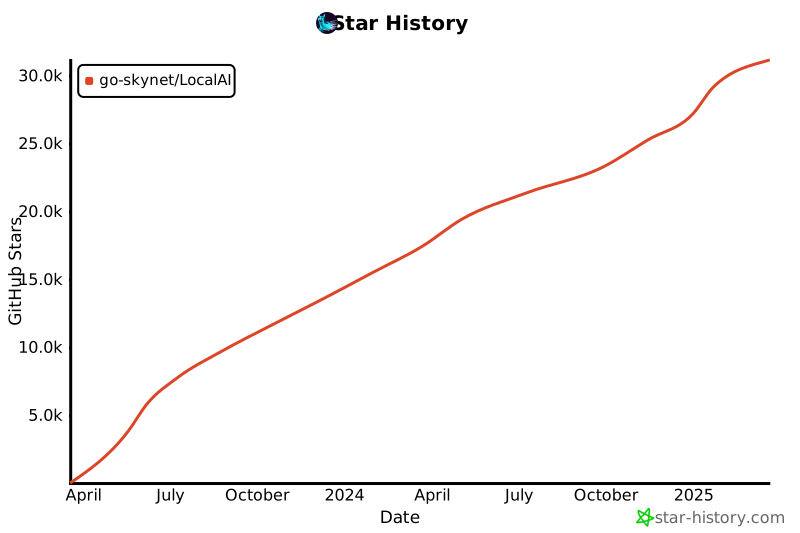
## License
LocalAI is a community-driven project created by [Ettore Di Giacinto](https://github.com/mudler/) and maintained by the [LocalAI team](#team).
+13 -9
View File
@@ -6,13 +6,14 @@ ARG APT_PORTS_MIRROR=""
# ASR, VAD, diarization, source separation and music generation, wrapped as a
# LocalAI gRPC backend.
#
# BASE_IMAGE is ubuntu:24.04 for cpu and vulkan builds, or
# nvidia/cuda:<ver>-devel-ubuntu24.04 for cublas builds; both ship apt and
# Ubuntu Noble packages, and the CUDA base additionally provides
# /usr/local/cuda. BUILD_TYPE selects the engine backend in the Makefile:
# "" = portable CPU with all ggml CPU variants, "cublas" ->
# -DENGINE_ENABLE_CUDA=ON, "vulkan" -> -DENGINE_ENABLE_VULKAN=ON. Darwin
# (Metal) builds bypass this Dockerfile entirely.
# BASE_IMAGE is ubuntu:24.04 for cpu and vulkan builds,
# nvidia/cuda:<ver>-devel-ubuntu24.04 for cublas builds, or
# rocm/dev-ubuntu-24.04:<ver> for hipblas builds. All ship apt and Ubuntu Noble
# packages; the GPU bases also provide their toolkits. BUILD_TYPE selects the
# engine backend in the Makefile: "" = portable CPU with all ggml CPU variants,
# "cublas" -> -DENGINE_ENABLE_CUDA=ON, "hipblas" -> -DENGINE_ENABLE_HIP=ON,
# and "vulkan" -> -DENGINE_ENABLE_VULKAN=ON. Darwin (Metal) builds bypass this
# Dockerfile entirely.
#
# Upstream needs GCC 13 or newer, which ubuntu:24.04 and the CUDA 12/13
# devel-ubuntu24.04 images all provide.
@@ -62,7 +63,7 @@ ENV BUILD_TYPE=${BUILD_TYPE} \
APT_MIRROR=${APT_MIRROR} \
APT_PORTS_MIRROR=${APT_PORTS_MIRROR} \
DEBIAN_FRONTEND=noninteractive \
PATH=/usr/local/cuda/bin:${PATH}
PATH=/opt/rocm/bin:/usr/local/cuda/bin:${PATH}
WORKDIR /build
@@ -73,7 +74,7 @@ WORKDIR /build
# fallback of its own.
#
# BUILD_TYPE=vulkan additionally needs the loader headers and glslc; both are in
# Noble. The CUDA toolkit for BUILD_TYPE=cublas comes from BASE_IMAGE.
# Noble. The CUDA and ROCm toolkits come from their matching BASE_IMAGE.
RUN --mount=type=bind,source=.docker/apt-mirror.sh,target=/usr/local/sbin/apt-mirror \
sh /usr/local/sbin/apt-mirror && \
apt-get update && \
@@ -83,6 +84,9 @@ RUN --mount=type=bind,source=.docker/apt-mirror.sh,target=/usr/local/sbin/apt-mi
if [ "${BUILD_TYPE}" = "vulkan" ]; then \
apt-get install -y --no-install-recommends libvulkan-dev glslc; \
fi && \
if [ "${BUILD_TYPE}" = "hipblas" ]; then \
apt-get install -y --no-install-recommends hipblas-dev rocblas-dev; \
fi && \
if [ "${TARGETARCH}" = "arm64" ]; then \
apt-get install -y --no-install-recommends gcc-14 g++-14; \
fi && \
+128
View File
@@ -248,6 +248,134 @@ RUN <<EOT bash
fi
EOT
# nemo-speech-cpp builds NVIDIA NeMo-Speech.cpp with text normalization enabled,
# which compiles the Sparrowhawk/OpenFST WFST stack from source via
# scripts/build_itn_deps.sh. That step needs gcc-12 specifically: OpenFST's
# template-heavy translation units ICE on gcc-13 and gcc-14 at -O2, so upstream
# pins gcc-12 for it while the runtime itself builds with the image default.
# No update-alternatives here, so the default compiler is untouched; the backend
# Makefile reaches gcc-12 by name for that one step.
#
# The rest is what build_itn_deps.sh and the WITH_NORM cmake block expect:
# protobuf (headers plus protoc, which must come from the same apt set so the
# generated stubs match the headers they compile against) and re2 for
# Sparrowhawk, and autotools because OpenFST and Sparrowhawk ship autoconf
# builds. ninja is not in the common apt list because this is the only Go
# backend that configures with -G Ninja, and that list is a layer shared by
# every backend image in the matrix.
#
# No libabsl-dev, despite upstream's Dockerfile installing it: upstream builds
# against protobuf 25, which splits its runtime across libabsl_*, whereas every
# base image in this matrix carries protobuf 3.21 (noble) or 3.12 (jammy), which
# has no absl dependency. The cmake block's file(GLOB ... /usr/lib/libabsl_*.so)
# would not match on Ubuntu anyway, since multiarch puts those under
# /usr/lib/<triplet>/.
#
# Placed down here with the other per-backend gates rather than next to the
# shared apt layer: Docker re-keys every layer below an inserted one, so adding
# a step above the Vulkan SDK, CUDA, Go and protoc layers would force all of
# them to re-execute once for every Go backend image, not just this one.
# Nothing between there and here needs any of these packages (the Vulkan and
# opus blocks install their own ninja and pkg-config, and the protoc download is
# a release binary that needs neither libprotobuf-dev nor protoc from apt), and
# nothing here needs anything those layers provide.
#
# The second half of this block backfills cmake. NeMo-Speech.cpp opens with
# cmake_minimum_required(VERSION 3.26), which every noble base in the matrix
# satisfies (24.04 ships 3.28) but the JetPack r36.4.0 row does not: that image
# is jammy, whose apt cmake is 3.22, so configure aborts before it reads a
# single one of our -D flags. This is the only Go backend that needs more than
# jammy's cmake; parakeet-cpp and moss-transcribe-cpp share the same JetPack
# base and both declare cmake_minimum_required(VERSION 3.18).
#
# Taken from Kitware's own release tarball rather than from their APT repo or
# from pip. The tarball is a pinned URL with a published checksum, so the build
# is reproducible and an upstream release cannot change what lands here; the
# APT repo serves a moving 'latest', which today would be CMake 4.x, and 4.x
# drops compatibility with cmake_minimum_required below 3.5 and so would break
# vendored third_party subprojects that still declare one. pip would drag a
# Python toolchain into a backend that otherwise has none. The binaries need
# only glibc 2.17 and carry no libstdc++ DT_NEEDED, so jammy's 2.35 is far
# above the floor. doc/, man/, ccmake and cmake-gui are left in the tarball;
# this is a builder stage and the final image is FROM scratch, but there is no
# reason to page 50 MB of Qt GUI and docs through the CI cache.
#
# Conditional on the installed cmake being too old rather than unconditional,
# so the rows that already build green (noble cpu, vulkan, cublas and hipblas)
# keep configuring with exactly the cmake they configure with today.
#
# The version test compares through two temp files and a grep on the exit
# status rather than the obvious "$(sort -V ... | head -n1)". BuildKit delivers
# a RUN heredoc through an outer shell with an unquoted delimiter, so the outer
# shell expands the body before bash ever sees it: a $(...) here runs once, too
# early, in a container where the files it reads do not exist yet, and its empty
# output is then pasted into the script. Same reason there are no shell
# variables below. ${BACKEND} and ${TARGETARCH} are fine because they are build
# args, which BuildKit exports into that outer shell's environment.
#
# The symlink goes in /usr/local/bin, which precedes /usr/bin on PATH, so it
# shadows apt's cmake. That is deliberate and, unlike the protoc shadowing that
# broke Sparrowhawk earlier in this PR, it is inert: protoc has to agree with
# the libprotobuf headers it generates against, whereas cmake is a standalone
# build driver with no ABI relationship to anything in the image, and it locates
# its own Modules/ tree by resolving the symlink back to /opt, so a 3.31 binary
# can never read 3.22's modules. Scope is the ${BACKEND} gate: no other Go
# backend image gets /opt/cmake or the symlink. Inside this image the only
# other cmake consumers, the base apt layer and the Vulkan SDK build, both run
# in layers above this one and have already finished.
RUN <<EOT bash
if [ "${BACKEND}" = "nemo-speech-cpp" ]; then
set -e
apt-get update
apt-get install -y --no-install-recommends \
gcc-12 g++-12 \
ninja-build \
libprotobuf-dev protobuf-compiler \
libre2-dev \
autoconf automake libtool pkg-config
apt-get clean
rm -rf /var/lib/apt/lists/*
echo 3.26.0 > /tmp/cmake-required
cmake --version 2>/dev/null | head -n1 | cut -d' ' -f3 > /tmp/cmake-present
if [ ! -s /tmp/cmake-present ]; then
echo 0.0.0 > /tmp/cmake-present
fi
if sort -V /tmp/cmake-required /tmp/cmake-present | head -n1 | grep -qxF 3.26.0; then
echo "==> cmake is new enough for NeMo-Speech.cpp:"
cmake --version | head -n1
else
echo "==> cmake is below the 3.26 NeMo-Speech.cpp requires; installing 3.31.12. Found:"
cat /tmp/cmake-present
mkdir -p /opt/cmake
if [ "${TARGETARCH}" = "arm64" ]; then
curl -fsSL -o /tmp/cmake.tar.gz https://github.com/Kitware/CMake/releases/download/v3.31.12/cmake-3.31.12-linux-aarch64.tar.gz
echo "83f8fd91d2038a56556e1400390fcfe42f79602940c494f6c6f1cdae7f9e7f40 /tmp/cmake.tar.gz" | sha256sum -c -
tar -xzf /tmp/cmake.tar.gz -C /opt/cmake --strip-components=1 \
cmake-3.31.12-linux-aarch64/bin/cmake \
cmake-3.31.12-linux-aarch64/bin/cpack \
cmake-3.31.12-linux-aarch64/bin/ctest \
cmake-3.31.12-linux-aarch64/share
else
curl -fsSL -o /tmp/cmake.tar.gz https://github.com/Kitware/CMake/releases/download/v3.31.12/cmake-3.31.12-linux-x86_64.tar.gz
echo "0dc2e9a6860f06bf10bd8fadc03e35d9eeb4df46e33763a7e480e987758f385c /tmp/cmake.tar.gz" | sha256sum -c -
tar -xzf /tmp/cmake.tar.gz -C /opt/cmake --strip-components=1 \
cmake-3.31.12-linux-x86_64/bin/cmake \
cmake-3.31.12-linux-x86_64/bin/cpack \
cmake-3.31.12-linux-x86_64/bin/ctest \
cmake-3.31.12-linux-x86_64/share
fi
rm -f /tmp/cmake.tar.gz
ln -sf /opt/cmake/bin/cmake /usr/local/bin/cmake
ln -sf /opt/cmake/bin/cpack /usr/local/bin/cpack
ln -sf /opt/cmake/bin/ctest /usr/local/bin/ctest
hash -r
cmake --version
fi
rm -f /tmp/cmake-required /tmp/cmake-present
fi
EOT
RUN git config --global --add safe.directory /LocalAI
# Prebuild the native engine from a layer that depends on this backend's own
+27
View File
@@ -15,6 +15,7 @@ service Backend {
rpc PredictStream(PredictOptions) returns (stream Reply) {}
rpc Embedding(PredictOptions) returns (EmbeddingResult) {}
rpc GenerateImage(GenerateImageRequest) returns (Result) {}
rpc UpscaleImage(UpscaleImageRequest) returns (Result) {}
rpc GenerateVideo(GenerateVideoRequest) returns (Result) {}
rpc Generate3D(Generate3DRequest) returns (Result) {}
rpc AudioTranscription(TranscriptRequest) returns (TranscriptResult) {}
@@ -535,8 +536,28 @@ message Result {
bool success = 2;
}
// EmbeddingLayout describes whether embeddings contains one final vector or
// a matrix of per-token vectors. Go-side pooling must never infer this from
// tokens/dim alone: a one-token raw matrix and a final vector have the same
// shape.
enum EmbeddingLayout {
EMBEDDING_LAYOUT_UNSPECIFIED = 0;
EMBEDDING_LAYOUT_FINAL = 1;
EMBEDDING_LAYOUT_PER_TOKEN = 2;
}
message EmbeddingResult {
repeated float embeddings = 1;
// Shape of the payload above: dim is the embedding width, tokens is the
// number of vectors packed into `embeddings` (1 when the backend pooled
// server-side, N with pooling:none; total across prompts if a request
// carried several). tokens=0/dim=0 means the backend predates shape
// reporting. prompt_tokens is the number of prompt tokens evaluated, for
// usage accounting.
int32 tokens = 2;
int32 dim = 3;
int32 prompt_tokens = 4;
EmbeddingLayout layout = 5;
}
message TranscriptRequest {
@@ -637,6 +658,12 @@ message GenerateImageRequest {
string ModelIdentity = 13;
}
message UpscaleImageRequest {
string src = 1; // input image path
string dst = 2; // output image path
int32 scale = 3; // upscale factor (e.g. 2 or 4)
}
message GenerateVideoRequest {
string prompt = 1;
string negative_prompt = 2; // Negative prompt for video generation
+11 -1
View File
@@ -9,7 +9,7 @@
# recipe is a make target (not a prepare.sh) so 'make purge && make' is a clean
# rebuild and so the bump bot can see the pin.
AUDIO_CPP_VERSION?=f78227c52736a4792a50aa3f82ead7e7385c891b
AUDIO_CPP_VERSION?=43001a7e0f452d80f4588e613f13332940dd4d3a
AUDIO_CPP_REPO?=https://github.com/0xShug0/audio.cpp
CURRENT_MAKEFILE_DIR := $(dir $(abspath $(lastword $(MAKEFILE_LIST))))
@@ -77,6 +77,16 @@ endif
ifeq ($(BUILD_TYPE),cublas)
CMAKE_ARGS += -DENGINE_ENABLE_CUDA=ON "-DCMAKE_CUDA_ARCHITECTURES=$(CUDA_ARCHITECTURES)"
else ifeq ($(BUILD_TYPE),hipblas)
ROCM_HOME ?= /opt/rocm
ROCM_PATH ?= /opt/rocm
export CXX=$(ROCM_HOME)/llvm/bin/clang++
export CC=$(ROCM_HOME)/llvm/bin/clang
AMDGPU_TARGETS ?= gfx908,gfx90a,gfx942,gfx950,gfx1030,gfx1100,gfx1101,gfx1102,gfx1151,gfx1200,gfx1201
# audio.cpp forwards GPU_TARGETS to CMake's semicolon-delimited HIP list.
comma := ,
HIP_TARGETS := $(subst $(comma),;,$(AMDGPU_TARGETS))
CMAKE_ARGS += -DENGINE_ENABLE_HIP=ON "-DGPU_TARGETS=$(HIP_TARGETS)"
else ifeq ($(BUILD_TYPE),vulkan)
CMAKE_ARGS += -DENGINE_ENABLE_VULKAN=ON
else ifeq ($(UNAME_S),Darwin)
@@ -29,6 +29,7 @@ const NamedTask kTaskNames[] = {
{Task::VoiceDesign, "vdes"},
{Task::SpeakerRecognition, "spk"},
{Task::Svc, "svc"},
{Task::Midi, "midi"},
};
// Accepted on input but never emitted. "spkrec" was this backend's own earlier
@@ -25,6 +25,7 @@ enum class Task {
VoiceDesign,
SpeakerRecognition,
Svc,
Midi,
};
// Mirrors engine::runtime::RunMode.
@@ -361,7 +361,7 @@ static void test_names_round_trip() {
Task::SourceSeparation, Task::AudioGeneration, Task::Tts,
Task::VoiceCloning, Task::VoiceConversion,
Task::SpeechToSpeech, Task::Alignment, Task::VoiceDesign,
Task::SpeakerRecognition, Task::Svc};
Task::SpeakerRecognition, Task::Svc, Task::Midi};
for (const Task t : all) {
Task parsed = Task::Vad;
const bool ok = parse_task_name(task_name(t), parsed);
+9 -2
View File
@@ -69,7 +69,8 @@ static_assert(kEngine(engine::runtime::VoiceTaskKind::VoiceDesign) == 10, "Voice
static_assert(kEngine(engine::runtime::VoiceTaskKind::SpeakerRecognition) == 11, "VoiceTaskKind drifted");
// The last member. Pinning it pins the member count too, as long as the
// enumerators stay contiguous and unassigned, which upstream's declaration is.
static_assert(kEngine(engine::runtime::VoiceTaskKind::Svc) == 12,
static_assert(kEngine(engine::runtime::VoiceTaskKind::Svc) == 12, "VoiceTaskKind drifted");
static_assert(kEngine(engine::runtime::VoiceTaskKind::Midi) == 13,
"engine::runtime::VoiceTaskKind gained, lost or reordered a member. "
"audiocpp_backend::Task mirrors it positionally: update capability_routing.h, "
"to_engine_task and from_engine_task together, then move this pin.");
@@ -87,6 +88,7 @@ static_assert(kMirror(Task::Alignment) == 9, "Task drifted from VoiceTaskKind");
static_assert(kMirror(Task::VoiceDesign) == 10, "Task drifted from VoiceTaskKind");
static_assert(kMirror(Task::SpeakerRecognition) == 11, "Task drifted from VoiceTaskKind");
static_assert(kMirror(Task::Svc) == 12, "Task drifted from VoiceTaskKind");
static_assert(kMirror(Task::Midi) == 13, "Task drifted from VoiceTaskKind");
static_assert(static_cast<int>(engine::runtime::RunMode::Offline) == 0, "RunMode drifted");
static_assert(static_cast<int>(engine::runtime::RunMode::Streaming) == 1,
@@ -101,6 +103,9 @@ engine::core::BackendType parse_backend_type(const std::string &value) {
if (value == "cuda") {
return engine::core::BackendType::Cuda;
}
if (value == "hip" || value == "rocm") {
return engine::core::BackendType::Hip;
}
if (value == "vulkan") {
return engine::core::BackendType::Vulkan;
}
@@ -114,7 +119,7 @@ engine::core::BackendType parse_backend_type(const std::string &value) {
return engine::core::BackendType::Cpu;
}
throw ConfigError("audio-cpp: unknown backend option '" + value +
"'. Known backends: cpu, cuda, vulkan, metal, best");
"'. Known backends: cpu, cuda, hip, rocm, vulkan, metal, best");
}
std::filesystem::path executable_directory() {
@@ -241,6 +246,7 @@ engine::runtime::VoiceTaskKind to_engine_task(Task task) {
case Task::VoiceDesign: return K::VoiceDesign;
case Task::SpeakerRecognition: return K::SpeakerRecognition;
case Task::Svc: return K::Svc;
case Task::Midi: return K::Midi;
}
// Unreachable for any valid enumerator. No `default:` label, so -Wswitch
// still reports a member this switch stops covering.
@@ -263,6 +269,7 @@ Task from_engine_task(engine::runtime::VoiceTaskKind kind) {
case K::VoiceDesign: return Task::VoiceDesign;
case K::SpeakerRecognition: return Task::SpeakerRecognition;
case K::Svc: return Task::Svc;
case K::Midi: return Task::Midi;
}
return Task::Vad;
}
+12
View File
@@ -59,6 +59,12 @@ bool starts_with(const std::string &value, const std::string &prefix) {
value.compare(0, prefix.size(), prefix) == 0;
}
bool is_known_backend(const std::string &value) {
return value == "cpu" || value == "cuda" || value == "hip" ||
value == "rocm" || value == "vulkan" || value == "metal" ||
value == "best";
}
} // namespace
ParsedOptions parse_model_options(const std::vector<std::string> &entries) {
@@ -107,6 +113,12 @@ ParsedOptions parse_model_options(const std::vector<std::string> &entries) {
} else if (key == "task") {
parsed.options.task = value;
} else if (key == "backend") {
if (!is_known_backend(value)) {
parsed.error = "audio-cpp: unknown backend option '" + value +
"'. Known backends: cpu, cuda, hip, rocm, "
"vulkan, metal, best";
return parsed;
}
parsed.options.backend = value;
} else if (key == "model_spec_override") {
parsed.options.model_spec_override = value;
+1 -1
View File
@@ -17,7 +17,7 @@ struct ModelOptions {
std::string family;
// Pins the audio.cpp task, overriding RPC-based routing. Empty means route.
std::string task;
// ggml backend: cpu, cuda, vulkan, metal, best.
// ggml backend: cpu, cuda, hip (or rocm), vulkan, metal, best.
std::string backend = "cpu";
int device = 0;
// True once a `device:` entry has been seen. 0 is both the default and a
@@ -75,6 +75,11 @@ static void test_scalar_options() {
check(parse_model_options({"live_idle_timeout_ms:0"}).options.live_idle_timeout_ms == 0,
"an explicit 0 turns the live idle limit off rather than reverting to "
"the default");
check(parse_model_options({"backend:hip"}).error.empty(),
"HIP backend option is accepted");
check(parse_model_options({"backend:rocm"}).error.empty(),
"ROCm backend alias is accepted");
}
// Values containing colons must survive: split on the FIRST colon only.
@@ -124,6 +129,8 @@ static void test_errors() {
"negative device is rejected");
check(!parse_model_options({"threads:x"}).error.empty(),
"non-numeric threads is rejected");
check(!parse_model_options({"backend:unknown"}).error.empty(),
"unknown compute backend is rejected before model loading");
// Values too large for int must be rejected, not silently wrapped into a
// negative device index that then reaches the ggml backend selector.
+3 -1
View File
@@ -1,7 +1,7 @@
# Pinned to the HEAD of the `prism` branch on https://github.com/PrismML-Eng/llama.cpp.
# Auto-bumped nightly by .github/workflows/bump_deps.yaml.
BONSAI_VERSION?=4dd165625bb6c020285eec8b342af25cf60233dd
BONSAI_VERSION?=9ca265a57f85f2117942490f421f64a226dd9847
LLAMA_REPO?=https://github.com/PrismML-Eng/llama.cpp
CMAKE_ARGS?=
@@ -42,6 +42,7 @@ define bonsai-build
rm -rf $(CURRENT_MAKEFILE_DIR)/../bonsai-$(1)-build/patches
$(MAKE) -C $(CURRENT_MAKEFILE_DIR)/../bonsai-$(1)-build purge
bash $(LLAMA_CPP_DIR)/disable-score-task.sh $(CURRENT_MAKEFILE_DIR)/../bonsai-$(1)-build/grpc-server.cpp
bash $(LLAMA_CPP_DIR)/disable-tts-task.sh $(CURRENT_MAKEFILE_DIR)/../bonsai-$(1)-build/grpc-server.cpp
$(info $(GREEN)I bonsai build info:$(1)$(RESET))
LLAMA_REPO=$(LLAMA_REPO) LLAMA_VERSION=$(BONSAI_VERSION) \
$(MAKE) -C $(CURRENT_MAKEFILE_DIR)/../bonsai-$(1)-build llama.cpp
@@ -79,6 +80,7 @@ bonsai-cpu-all:
rm -rf $(CURRENT_MAKEFILE_DIR)/../bonsai-cpu-all-build/patches
$(MAKE) -C $(CURRENT_MAKEFILE_DIR)/../bonsai-cpu-all-build purge
bash $(LLAMA_CPP_DIR)/disable-score-task.sh $(CURRENT_MAKEFILE_DIR)/../bonsai-cpu-all-build/grpc-server.cpp
bash $(LLAMA_CPP_DIR)/disable-tts-task.sh $(CURRENT_MAKEFILE_DIR)/../bonsai-cpu-all-build/grpc-server.cpp
$(info $(GREEN)I bonsai build info:cpu-all-variants$(RESET))
LLAMA_REPO=$(LLAMA_REPO) LLAMA_VERSION=$(BONSAI_VERSION) \
$(MAKE) -C $(CURRENT_MAKEFILE_DIR)/../bonsai-cpu-all-build llama.cpp
+9 -1
View File
@@ -69,7 +69,15 @@ target_include_directories(hw_grpc_proto PUBLIC ${CMAKE_CURRENT_BINARY_DIR})
set(DS4_OBJS "${DS4_DIR}/ds4.o")
if(DS4_GPU STREQUAL "cuda")
list(APPEND DS4_OBJS "${DS4_DIR}/ds4_cuda.o")
list(APPEND DS4_OBJS
"${DS4_DIR}/ds4_cuda.o"
"${DS4_DIR}/cuda/mmq/ds4_ggml_stubs.o"
"${DS4_DIR}/cuda/mmq/ds4_mmq.o"
"${DS4_DIR}/cuda/mmq/ds4_mmq_d2r.o"
"${DS4_DIR}/cuda/mmq/quantize.o"
"${DS4_DIR}/cuda/mmq/mmid.o"
"${DS4_DIR}/cuda/mmq/mmvq.o"
"${DS4_DIR}/cuda/mmq/ds4_repack.o")
elseif(DS4_GPU STREQUAL "metal")
list(APPEND DS4_OBJS "${DS4_DIR}/ds4_metal.o")
elseif(DS4_GPU STREQUAL "cpu")
+6 -4
View File
@@ -1,10 +1,10 @@
# ds4 backend Makefile.
#
# Upstream pin lives below as DS4_VERSION?=54b36ed9ba42da31b24f2d1a5feb075c2475dbb1
# Upstream pin lives below as DS4_VERSION?=84cc882352757baf628a1776badf7cc54d584e28
# (.github/bump_deps.sh) can find and update it - matches the
# llama-cpp / ik-llama-cpp / turboquant convention.
DS4_VERSION?=54b36ed9ba42da31b24f2d1a5feb075c2475dbb1
DS4_VERSION?=84cc882352757baf628a1776badf7cc54d584e28
DS4_REPO?=https://github.com/antirez/ds4
CURRENT_MAKEFILE_DIR := $(dir $(abspath $(lastword $(MAKEFILE_LIST))))
@@ -23,7 +23,9 @@ CMAKE_ARGS ?= -DCMAKE_BUILD_TYPE=Release
# are shared by every GPU mode, so append them unconditionally below.
ifeq ($(BUILD_TYPE),cublas)
CMAKE_ARGS += -DDS4_GPU=cuda
DS4_OBJ_TARGET := ds4.o ds4_cuda.o ds4_distributed.o ds4_tp.o ds4_ssd.o ds4_layer_pack.o
DS4_OBJ_TARGET := ds4.o ds4_cuda.o ds4_distributed.o ds4_tp.o ds4_ssd.o ds4_layer_pack.o \
cuda/mmq/ds4_ggml_stubs.o cuda/mmq/ds4_mmq.o cuda/mmq/ds4_mmq_d2r.o \
cuda/mmq/quantize.o cuda/mmq/mmid.o cuda/mmq/mmvq.o cuda/mmq/ds4_repack.o
else ifeq ($(UNAME_S),Darwin)
CMAKE_ARGS += -DDS4_GPU=metal
DS4_OBJ_TARGET := ds4.o ds4_metal.o ds4_distributed.o ds4_tp.o ds4_ssd.o ds4_layer_pack.o
@@ -55,7 +57,7 @@ ds4:
# the right per-platform compile flags (Objective-C/Metal on Darwin, nvcc on Linux+CUDA).
ds4/ds4.o: ds4
ifeq ($(BUILD_TYPE),cublas)
+$(MAKE) -C ds4 ds4.o ds4_cuda.o ds4_distributed.o ds4_tp.o ds4_ssd.o ds4_layer_pack.o
+$(MAKE) -C ds4 $(DS4_OBJ_TARGET)
else ifeq ($(UNAME_S),Darwin)
+$(MAKE) -C ds4 ds4.o ds4_metal.o ds4_distributed.o ds4_tp.o ds4_ssd.o ds4_layer_pack.o
else
+1 -1
View File
@@ -1,5 +1,5 @@
IK_LLAMA_VERSION?=3f53a059024039358e9fef75b5dc0c99dbcb40f9
IK_LLAMA_VERSION?=8337e4cd3861406fc04e0854b1409cd1b027fbc9
LLAMA_REPO?=https://github.com/ikawrakow/ik_llama.cpp
CMAKE_ARGS?=
+1
View File
@@ -2565,6 +2565,7 @@ public:
grpc::Status Embedding(ServerContext* context, const backend::PredictOptions* request, backend::EmbeddingResult* embeddingResult) {
auto identity = checkModelIdentity(request);
if (!identity.ok()) return identity;
embeddingResult->set_layout(backend::EMBEDDING_LAYOUT_FINAL);
json data = parse_options(false, request, llama);
const int task_id = llama.queue_tasks.get_new_id();
llama.queue_results.add_waiting_task_id(task_id);
+10
View File
@@ -115,4 +115,14 @@ if(LLAMA_GRPC_BUILD_TESTS)
target_include_directories(passthrough_options_test PRIVATE ${CMAKE_CURRENT_SOURCE_DIR})
target_compile_features(passthrough_options_test PRIVATE cxx_std_17)
add_test(NAME passthrough_options_test COMMAND passthrough_options_test)
add_executable(tts_request_options_test tts_request_options_test.cpp tts_request_options.h)
target_include_directories(tts_request_options_test PRIVATE ${CMAKE_CURRENT_SOURCE_DIR})
target_compile_features(tts_request_options_test PRIVATE cxx_std_17)
add_test(NAME tts_request_options_test COMMAND tts_request_options_test)
add_executable(thread_params_test thread_params_test.cpp thread_params.h)
target_include_directories(thread_params_test PRIVATE ${CMAKE_CURRENT_SOURCE_DIR})
target_compile_features(thread_params_test PRIVATE cxx_std_17)
add_test(NAME thread_params_test COMMAND thread_params_test)
endif()
+1 -1
View File
@@ -1,5 +1,5 @@
LLAMA_VERSION?=876a4321163249c43ca4e986818fab5ab081f282
LLAMA_VERSION?=d59d455fd8ea09e5a2e87ce2a9d668267ffb5ccd
LLAMA_REPO?=https://github.com/ggerganov/llama.cpp
CMAKE_ARGS?=
+43
View File
@@ -0,0 +1,43 @@
#!/bin/bash
# Mark a copied gRPC server as targeting a llama.cpp fork that does not carry
# LocalAI's SERVER_TASK_TYPE_TTS patch. The RPCs remain present in the shared
# protobuf service, but respond with UNIMPLEMENTED instead of referencing
# server task types and mtmd gen-audio APIs absent from those forks.
set -euo pipefail
if [[ $# -ne 1 ]]; then
echo "usage: $0 <grpc-server.cpp>" >&2
exit 2
fi
SRC=$1
if [[ ! -f "$SRC" ]]; then
echo "grpc-server.cpp not found at $SRC" >&2
exit 2
fi
if grep -q '^#define LOCALAI_LLAMA_CPP_NO_TTS_TASK' "$SRC"; then
echo "==> $SRC already disables the LocalAI TTS task, skipping"
exit 0
fi
awk '
!done && /^#include/ {
print "#define LOCALAI_LLAMA_CPP_NO_TTS_TASK 1"
print "// ^ injected by disable-tts-task.sh for an unpatched llama.cpp fork"
print ""
done = 1
}
{ print }
END {
if (!done) {
print "disable-tts-task.sh: no #include anchor found" > "/dev/stderr"
exit 1
}
}
' "$SRC" > "$SRC.tmp"
mv "$SRC.tmp" "$SRC"
echo "==> LocalAI TTS task disabled in $SRC"
+313 -33
View File
@@ -53,8 +53,10 @@
#include "arg.h"
#include "chat-auto-parser.h"
#include "llama_compat.h" // fork-skew switches, generated by prepare.sh
#include "thread_params.h"
#include "message_content.h"
#include "passthrough_options.h"
#include "tts_request_options.h"
#include <getopt.h>
#include <grpcpp/ext/proto_server_reflection_plugin.h>
#include <grpcpp/grpcpp.h>
@@ -65,6 +67,7 @@
#include <atomic>
#include <cmath>
#include <cstdlib>
#include <cstring>
#include <fstream>
#include <iterator>
#include <list>
@@ -233,7 +236,15 @@ json parse_options(bool streaming, const backend::PredictOptions* predict, const
data["typical_p"] = predict->typicalp();
data["temperature"] = predict->temperature();
data["repeat_last_n"] = predict->repeat();
data["repeat_penalty"] = predict->penalty();
// PredictOptions.Penalty is a bare proto float, so a caller that names no
// repetition penalty sends 0 rather than omitting the field. Since
// llama.cpp 9de0fcf2b, common_sampler_init() rejects a non-positive
// penalty_repeat outright (it would divide logits by zero), which turned
// every such request into "Failed to initialize samplers". Treat 0 as
// "unset" and leave llama.cpp's own neutral default in place.
if (predict->penalty() > 0.0f) {
data["repeat_penalty"] = predict->penalty();
}
data["frequency_penalty"] = predict->frequencypenalty();
data["presence_penalty"] = predict->presencepenalty();
data["mirostat"] = predict->mirostat();
@@ -1402,6 +1413,12 @@ static void params_parse(server_context& /*ctx_server*/, const backend::ModelOpt
passthrough_draft_gpu_layers);
}
// The library initializer now creates both threadpools before the server
// can apply llama_context's fallback for the -1 batch-thread sentinel.
params.cpuparams_batch.n_threads = llama_grpc::resolve_batch_threads(
params.cpuparams_batch.n_threads,
params.cpuparams.n_threads);
#ifndef LOCALAI_LLAMA_CPP_NO_SCORE_TASK
// Score-task suffix forking: reserve seq ids (and recurrent-state cells)
// beyond the slots so one scoring call decodes all candidate tails in a
@@ -1445,6 +1462,26 @@ static void params_parse(server_context& /*ctx_server*/, const backend::ModelOpt
}
#ifndef LOCALAI_LLAMA_CPP_NO_TTS_TASK
// MTMD_HELPER_GEN_AUDIO_OUTTYPE_PCM hands back raw float32 samples, but the
// WAV header core/backend/tts.go builds around the streamed chunks announces
// 16-bit samples, so the wire has to carry s16 or the client decodes floats as
// integers and hears noise. The scaling matches write_wav16() in
// tools/mtmd/mtmd-helper-gen.cpp, which is what the non-streaming path writes.
static std::string tts_pcm_f32_to_s16(const std::string & samples) {
const size_t n = samples.size() / sizeof(float);
std::string out;
out.resize(n * sizeof(int16_t));
for (size_t i = 0; i < n; i++) {
float v = 0.0f;
std::memcpy(&v, samples.data() + i * sizeof(float), sizeof(float));
const int16_t s = (int16_t) (std::max(-1.0f, std::min(1.0f, v)) * 32767.0f);
std::memcpy(&out[i * sizeof(int16_t)], &s, sizeof(int16_t));
}
return out;
}
#endif
// GRPC Server start
class BackendServiceImpl final : public backend::Backend::Service {
private:
@@ -2089,15 +2126,23 @@ public:
task.tokens = std::move(inputs[i]);
#ifdef LOCALAI_HAS_SERVER_SCHEMA
// The schema evaluator no longer takes the per-slot n_ctx: upstream
// dropped the parameter and server-schema stopped consulting n_ctx at
// all, leaving the context bound to the slot. Forks that predate the
// server-schema split still expect it, so only this branch loses it.
task.params = server_schema::eval_llama_cmpl_schema(
ctx_server.impl->vocab,
params_base,
ctx_server.get_meta().logit_bias_eog,
data);
#else
task.params = server_task::params_from_json_cmpl(
#endif
ctx_server.impl->vocab,
params_base,
ctx_server.get_meta().slot_n_ctx,
ctx_server.get_meta().logit_bias_eog,
data);
#endif
task.id_slot = json_value(data, "id_slot", -1);
// OAI-compat: enable autoparser (PEG-based chat parsing) so that
@@ -2659,15 +2704,23 @@ public:
task.tokens = std::move(inputs[i]);
#ifdef LOCALAI_HAS_SERVER_SCHEMA
// The schema evaluator no longer takes the per-slot n_ctx: upstream
// dropped the parameter and server-schema stopped consulting n_ctx at
// all, leaving the context bound to the slot. Forks that predate the
// server-schema split still expect it, so only this branch loses it.
task.params = server_schema::eval_llama_cmpl_schema(
ctx_server.impl->vocab,
params_base,
ctx_server.get_meta().logit_bias_eog,
data);
#else
task.params = server_task::params_from_json_cmpl(
#endif
ctx_server.impl->vocab,
params_base,
ctx_server.get_meta().slot_n_ctx,
ctx_server.get_meta().logit_bias_eog,
data);
#endif
task.id_slot = json_value(data, "id_slot", -1);
// OAI-compat: enable autoparser (PEG-based chat parsing) so that
@@ -2865,42 +2918,40 @@ public:
return grpc::Status(grpc::StatusCode::INTERNAL, all_results.error->to_json().value("message", "Error in receiving results"));
}
// Collect responses
json responses = json::array();
// Extract the embeddings typed, straight from the task results (no
// JSON round-trip), and report the payload shape alongside the same
// flat float array as before: dim is the embedding width, tokens the
// number of vectors packed into `embeddings` (1 per prompt when the
// server pooled, one per token with pooling:none; summed across
// prompts if the request carried several), prompt_tokens the prompt
// tokens evaluated, for usage accounting. Consumers seeing 0/0 know
// the backend predates shape reporting.
int32_t n_vectors = 0;
int32_t dim = 0;
int32_t prompt_tokens = 0;
for (auto & res : all_results.results) {
GGML_ASSERT(dynamic_cast<server_task_result_embd*>(res.get()) != nullptr);
responses.push_back(res->to_json());
}
std::cout << "[DEBUG] Responses size: " << responses.size() << std::endl;
// Process the responses and extract embeddings
for (const auto & response_elem : responses) {
// Check if the response has an "embedding" field
if (response_elem.contains("embedding")) {
json embedding_data = json_value(response_elem, "embedding", json::array());
if (embedding_data.is_array() && !embedding_data.empty()) {
for (const auto & embedding_vector : embedding_data) {
if (embedding_vector.is_array()) {
for (const auto & embedding_value : embedding_vector) {
embeddingResult->add_embeddings(embedding_value.get<float>());
}
}
}
auto * embd_res = dynamic_cast<server_task_result_embd*>(res.get());
GGML_ASSERT(embd_res != nullptr);
prompt_tokens += embd_res->n_tokens;
for (const auto & vec : embd_res->embedding) {
for (const float value : vec) {
embeddingResult->add_embeddings(value);
}
} else {
// Check if the response itself contains the embedding data directly
if (response_elem.is_array()) {
for (const auto & embedding_value : response_elem) {
embeddingResult->add_embeddings(embedding_value.get<float>());
}
if (!vec.empty()) {
n_vectors++;
dim = (int32_t) vec.size();
}
}
}
embeddingResult->set_tokens(n_vectors);
embeddingResult->set_dim(dim);
embeddingResult->set_prompt_tokens(prompt_tokens);
embeddingResult->set_layout(
llama_pooling_type(ctx_server.get_llama_context()) == LLAMA_POOLING_TYPE_NONE
? backend::EMBEDDING_LAYOUT_PER_TOKEN
: backend::EMBEDDING_LAYOUT_FINAL);
std::cout << "[DEBUG] Embedding vectors: " << n_vectors << " x " << dim << std::endl;
return grpc::Status::OK;
}
@@ -2994,6 +3045,229 @@ public:
return grpc::Status::OK;
}
#ifndef LOCALAI_LLAMA_CPP_NO_TTS_TASK
// Builds the shared TTS task from a request. Returns a non-OK status and
// leaves `task` untouched when the request is malformed or the loaded model
// cannot synthesise audio.
grpc::Status prepareTTSTask(const backend::TTSRequest* request, bool stream, server_task & task) {
if (!ctx_server.get_meta().has_cap_tts) {
return grpc::Status(grpc::StatusCode::UNIMPLEMENTED,
"the loaded model does not support audio generation (no gen-audio mmproj)");
}
std::map<std::string, std::string> params(request->params().begin(), request->params().end());
const auto opts = llama_grpc::parse_tts_request_options(
request->text(),
request->voice(),
request->has_language() ? request->language() : std::string(),
params);
if (!opts.ok) {
return grpc::Status(grpc::StatusCode::INVALID_ARGUMENT, opts.error);
}
auto wrapper = mtmd_helper_bitmap_init_from_file(ctx_server.impl->mctx, opts.voice_path.c_str(), false);
if (!wrapper.bitmap) {
return grpc::Status(grpc::StatusCode::INVALID_ARGUMENT,
"failed to read speaker reference audio: " + opts.voice_path);
}
task.tts_inp.set_prompt(opts.text);
// core/backend/tts.go always sets TTSRequest.language, so has_language()
// is true even when the caller named no language and the string is empty.
// gen_audio::inp::get() already maps a stored blank to nullptr, so this
// guard is behavior-preserving rather than behavior-fixing. It is kept
// so the "unset" intent is visible at the call site instead of resting
// on a detail of the helper.
if (!opts.language.empty()) {
task.tts_inp.set_lang(opts.language);
}
task.tts_inp.set_speaker_ref(mtmd::bitmap_ptr(wrapper.bitmap));
task.tts_inp.data.top_k = opts.top_k;
task.tts_inp.data.top_p = opts.top_p;
task.tts_inp.data.stream = stream;
task.tts_inp.data.out_type = stream
? MTMD_HELPER_GEN_AUDIO_OUTTYPE_PCM // Go prepends its own WAV header, see core/backend/tts.go
: MTMD_HELPER_GEN_AUDIO_OUTTYPE_WAV;
task.params.stream = stream;
// -1 keeps upstream's 512-frame default. The model does not always emit
// its codec EOS, so a short input can otherwise generate the full cap.
task.params.n_predict = opts.max_frames > 0 ? opts.max_frames : -1;
task.params.sampling = params_base.sampling;
// Both values mirror upstream's draft POST /tts handler. Note that the
// pair is INERT at this pin: llama_sampler_init_penalties() clamps
// penalty_last_n with std::max(penalty_last_n, 0), so -1 means "off",
// not "the whole generation", and the penalty sampler is then built
// disabled. No repetition penalty is actually applied.
//
// That is deliberate. Dropping the second line lets the sampling
// default of 64 apply and genuinely engages the 1.05 penalty, which was
// measured here against the model's habit of never emitting its codec
// EOS and running to the frame cap: 0 of 15 short requests ran away
// with the penalty inert, 1 of 15 with it active over the last 64
// tokens. It does not fix the runaway, so the line stays for parity
// with the draft. Use max_frames to bound the output instead.
task.params.sampling.penalty_repeat = 1.05f;
task.params.sampling.penalty_last_n = -1;
if (opts.top_k > 0) {
task.params.sampling.top_k = opts.top_k;
}
if (opts.top_p > 0) {
task.params.sampling.top_p = opts.top_p;
}
return grpc::Status::OK;
}
grpc::Status TTS(ServerContext* context, const backend::TTSRequest* request, backend::Result* result) override {
auto auth = checkAuth(context);
if (!auth.ok()) return auth;
auto identity = checkModelIdentity(request);
if (!identity.ok()) return identity;
if (params_base.model.path.empty()) {
return grpc::Status(grpc::StatusCode::FAILED_PRECONDITION, "Model not loaded");
}
if (request->dst().empty()) {
return grpc::Status(grpc::StatusCode::INVALID_ARGUMENT, "dst must name an output file path");
}
server_task task(SERVER_TASK_TYPE_TTS);
auto prepared = prepareTTSTask(request, /* stream= */ false, task);
if (!prepared.ok()) return prepared;
auto rd = ctx_server.get_response_reader();
task.id = rd.get_new_id();
rd.post_task(std::move(task));
auto should_stop = [context]() { return context->IsCancelled(); };
std::string audio;
while (true) {
auto res = rd.next(should_stop);
if (!res) {
return grpc::Status(grpc::StatusCode::CANCELLED, "TTS request cancelled");
}
if (res->is_error()) {
return grpc::Status(grpc::StatusCode::INTERNAL, res->to_json().dump());
}
auto * tts_res = dynamic_cast<server_task_result_tts *>(res.get());
if (tts_res == nullptr) {
return grpc::Status(grpc::StatusCode::INTERNAL, "unexpected result type for a TTS task");
}
audio.append(tts_res->audio);
if (tts_res->final) {
break;
}
}
std::ofstream out(request->dst(), std::ios::binary | std::ios::trunc);
if (!out) {
return grpc::Status(grpc::StatusCode::INTERNAL, "failed to open output file: " + request->dst());
}
out.write(audio.data(), (std::streamsize) audio.size());
if (!out) {
return grpc::Status(grpc::StatusCode::INTERNAL, "failed to write output file: " + request->dst());
}
// Buffered data is flushed here, so a full disk or a failing device can
// surface for the first time on close. Reporting success then would
// leave a truncated file behind under the name the caller will read.
out.close();
if (!out) {
return grpc::Status(grpc::StatusCode::INTERNAL, "failed to close output file: " + request->dst());
}
result->set_success(true);
result->set_message("TTS audio generated");
return grpc::Status::OK;
}
grpc::Status TTSStream(ServerContext* context, const backend::TTSRequest* request, grpc::ServerWriter<backend::Reply>* writer) override {
auto auth = checkAuth(context);
if (!auth.ok()) return auth;
auto identity = checkModelIdentity(request);
if (!identity.ok()) return identity;
if (params_base.model.path.empty()) {
return grpc::Status(grpc::StatusCode::FAILED_PRECONDITION, "Model not loaded");
}
server_task task(SERVER_TASK_TYPE_TTS);
auto prepared = prepareTTSTask(request, /* stream= */ true, task);
if (!prepared.ok()) return prepared;
auto rd = ctx_server.get_response_reader();
task.id = rd.get_new_id();
rd.post_task(std::move(task));
auto should_stop = [context]() { return context->IsCancelled(); };
// core/backend/tts.go:ModelTTSStream builds the WAV header itself from
// the sample rate in the first reply's Message, then concatenates every
// Reply.Audio verbatim. So the rate goes out once, up front, and the
// chunks stay raw PCM.
//
// Send it before draining rather than off the first audio result: a
// chunk needs a whole 72-frame window, about 5.8 s of audio and far
// longer in wall time on CPU, and the Go side cannot emit the WAV
// header until this reply lands. Waiting would hold the client at zero
// bytes for that entire stretch. The rate is a property of the loaded
// model, available synchronously, so there is nothing to wait for.
{
backend::Reply header;
const json info = { {"sample_rate", mtmd_gen_audio_get_info(ctx_server.impl->mctx).sample_rate} };
header.set_message(info.dump());
if (!writer->Write(header)) {
return grpc::Status(grpc::StatusCode::CANCELLED, "client closed the TTS stream");
}
}
while (true) {
auto res = rd.next(should_stop);
if (!res) {
return grpc::Status(grpc::StatusCode::CANCELLED, "TTS request cancelled");
}
if (res->is_error()) {
return grpc::Status(grpc::StatusCode::INTERNAL, res->to_json().dump());
}
auto * tts_res = dynamic_cast<server_task_result_tts *>(res.get());
if (tts_res == nullptr) {
return grpc::Status(grpc::StatusCode::INTERNAL, "unexpected result type for a TTS task");
}
if (!tts_res->audio.empty()) {
backend::Reply chunk;
chunk.set_audio(tts_pcm_f32_to_s16(tts_res->audio));
if (!writer->Write(chunk)) {
return grpc::Status(grpc::StatusCode::CANCELLED, "client closed the TTS stream");
}
}
if (tts_res->final) {
break;
}
}
return grpc::Status::OK;
}
#else
grpc::Status TTS(ServerContext* context, const backend::TTSRequest* request, backend::Result* result) override {
auto auth = checkAuth(context);
if (!auth.ok()) return auth;
(void) request;
(void) result;
return grpc::Status(grpc::StatusCode::UNIMPLEMENTED,
"TTS is unavailable in this llama.cpp fork backend");
}
grpc::Status TTSStream(ServerContext* context, const backend::TTSRequest* request, grpc::ServerWriter<backend::Reply>* writer) override {
auto auth = checkAuth(context);
if (!auth.ok()) return auth;
(void) request;
(void) writer;
return grpc::Status(grpc::StatusCode::UNIMPLEMENTED,
"TTSStream is unavailable in this llama.cpp fork backend");
}
#endif
// Score returns the model's joint log-probability of each candidate
// continuation given a shared prompt.
//
@@ -3328,9 +3602,15 @@ public:
// Populate the response with metrics
response->set_slot_id(0);
response->set_prompt_json_for_slot("");
#if LOCALAI_HAS_SERVER_METRICS
response->set_tokens_per_second(res_metrics->metrics.prompt_bucket.n_per_second());
response->set_tokens_generated(res_metrics->metrics.predict.count);
response->set_prompt_tokens_processed(res_metrics->metrics.prompt.count);
#else
response->set_tokens_per_second(res_metrics->n_prompt_tokens_processed ? 1.e3 / res_metrics->t_prompt_processing * res_metrics->n_prompt_tokens_processed : 0.);
response->set_tokens_generated(res_metrics->n_tokens_predicted_total);
response->set_prompt_tokens_processed(res_metrics->n_prompt_tokens_processed_total);
#endif
return grpc::Status::OK;
@@ -1,8 +1,21 @@
From 75220a0d74892e3315f4042274b1efa6195868d8 Mon Sep 17 00:00:00 2001
From: Codex <codex@local>
Date: Mon, 10 Aug 2026 23:05:52 +0000
Subject: [PATCH 1/2] score-patch
---
common/common.cpp | 6 +-
common/common.h | 3 +
tools/CMakeLists.txt | 1 +
tools/server/server-context.cpp | 358 +++++++++++++++++++++++++++++++-
tools/server/server-task.h | 47 +++++
5 files changed, 406 insertions(+), 9 deletions(-)
diff --git a/common/common.cpp b/common/common.cpp
index 8f13217..fc584e1 100644
index 2e3f14c..0cec0dc 100644
--- a/common/common.cpp
+++ b/common/common.cpp
@@ -1591,8 +1591,10 @@ struct llama_context_params common_context_params_to_llama(const common_params &
@@ -1636,8 +1636,10 @@ struct llama_context_params common_context_params_to_llama(const common_params &
auto cparams = llama_context_default_params();
cparams.n_ctx = params.n_ctx;
@@ -13,13 +26,13 @@ index 8f13217..fc584e1 100644
+ cparams.n_seq_max = params.n_parallel + params.n_seq_score_forks;
+ cparams.n_rs_seq = std::max(params.speculative.need_n_rs_seq(), (uint32_t) std::max(0, params.n_rs_seq));
cparams.n_outputs_max = std::max(params.n_outputs_max, 0);
cparams.n_outputs_max_per_seq = std::max(params.n_outputs_max_per_seq, 0);
cparams.n_batch = params.n_batch;
cparams.n_ubatch = params.n_ubatch;
diff --git a/common/common.h b/common/common.h
index bffc176..e313bd6 100644
index 878534d..4001df2 100644
--- a/common/common.h
+++ b/common/common.h
@@ -455,6 +455,9 @@ struct common_params {
@@ -445,6 +445,9 @@ struct common_params {
int32_t n_keep = 0; // number of tokens to keep from initial prompt
int32_t n_chunks = -1; // max number of chunks to process (-1 = unlimited)
int32_t n_parallel = 1; // number of parallel sequences to decode
@@ -28,7 +41,7 @@ index bffc176..e313bd6 100644
+ bool score_enabled = false; // reserve server resources for the Score task type
int32_t n_sequences = 1; // number of sequences to decode
int32_t n_outputs_max = 0; // max outputs in a batch (0 = n_batch)
int32_t grp_attn_n = 1; // group-attention factor
int32_t n_outputs_max_per_seq = 1; // max outputs per sequence
diff --git a/tools/CMakeLists.txt b/tools/CMakeLists.txt
index 780df32..1d2fe8f 100644
--- a/tools/CMakeLists.txt
@@ -39,28 +52,24 @@ index 780df32..1d2fe8f 100644
endif()
+add_subdirectory(grpc-server)
diff --git a/tools/server/server-context.cpp b/tools/server/server-context.cpp
index 715477e..de5bed8 100644
index 3b5f6a1..d0e18e6 100644
--- a/tools/server/server-context.cpp
+++ b/tools/server/server-context.cpp
@@ -49,7 +49,16 @@ static uint32_t server_n_outputs_max(const common_params & params) {
@@ -48,6 +48,13 @@ static common_speculative_output_limits server_output_limits(const common_params
auto result = common_speculative_get_output_limits(
params.n_batch, params.n_parallel, common_speculative_n_max(&params.speculative));
const uint32_t n_outputs_per_seq = 1 + common_speculative_n_max(&params.speculative);
- const uint64_t n_outputs = (uint64_t) params.n_parallel * n_outputs_per_seq;
+ // score tasks (SERVER_TASK_TYPE_SCORE) output logits for every candidate
+ // token, so reserve room for a bounded candidate tail per parallel slot
+ if (!params.score_enabled) {
+ return std::max<uint32_t>(1, std::min<uint64_t>(n_batch,
+ (uint64_t) params.n_parallel * n_outputs_per_seq));
+ // Score tasks output logits for every candidate token, so reserve room
+ // for a bounded candidate tail per parallel slot.
+ if (params.score_enabled) {
+ result.per_seq = std::max<int32_t>(result.per_seq, 1 + SERVER_SCORE_MAX_CAND_TOKENS);
+ result.total = std::min<int32_t>(params.n_batch, params.n_parallel * result.per_seq);
+ }
+
+ const uint32_t n_outputs_score_seq = 1 + SERVER_SCORE_MAX_CAND_TOKENS;
+
+ const uint64_t n_outputs = (uint64_t) params.n_parallel * std::max(n_outputs_per_seq, n_outputs_score_seq);
return std::max<uint32_t>(1, std::min<uint64_t>(n_batch, n_outputs));
}
@@ -202,6 +211,26 @@ struct server_slot {
result.total = std::max<int32_t>(1, result.total);
result.per_seq = std::max<int32_t>(1, result.per_seq);
return result;
@@ -239,6 +246,26 @@ struct server_slot {
std::vector<completion_token_output> generated_token_probs;
@@ -87,7 +96,7 @@ index 715477e..de5bed8 100644
bool has_next_token = true;
bool has_new_line = false;
bool truncated = false;
@@ -311,6 +340,10 @@ struct server_slot {
@@ -341,6 +368,10 @@ struct server_slot {
}
generated_tokens.clear();
generated_token_probs.clear();
@@ -97,8 +106,8 @@ index 715477e..de5bed8 100644
+ score_divergence = -1;
json_schema = json();
// clear speculative decoding stats
@@ -2205,6 +2238,229 @@ private:
task_prev = std::move(task);
@@ -2271,6 +2302,229 @@ private:
queue_results.send(std::move(res));
}
@@ -328,7 +337,7 @@ index 715477e..de5bed8 100644
//
// Functions to process the task
//
@@ -2341,6 +2597,7 @@ private:
@@ -2407,6 +2661,7 @@ private:
case SERVER_TASK_TYPE_INFILL:
case SERVER_TASK_TYPE_EMBEDDING:
case SERVER_TASK_TYPE_RERANK:
@@ -336,7 +345,7 @@ index 715477e..de5bed8 100644
{
// special case: if input is provided via CLI, tokenize it first
// otherwise, no need to tokenize as it's already done inside the HTTP thread
@@ -2832,6 +3089,13 @@ private:
@@ -2903,6 +3158,13 @@ private:
break; // stop any further processing
}
}
@@ -350,7 +359,7 @@ index 715477e..de5bed8 100644
}
void pre_decode() {
@@ -3154,6 +3418,16 @@ private:
@@ -3222,6 +3484,16 @@ private:
n_past = std::min(n_past, slot.alora_invocation_start - 1);
}
@@ -367,7 +376,7 @@ index 715477e..de5bed8 100644
const auto n_cache_reuse = slot.task->params.n_cache_reuse;
const bool can_cache_reuse =
@@ -3395,8 +3669,12 @@ private:
@@ -3455,8 +3727,12 @@ private:
bool do_checkpoint = params_base.n_ctx_checkpoints > 0;
@@ -382,7 +391,7 @@ index 715477e..de5bed8 100644
// make a checkpoint of the parts of the memory that cannot be rolled back.
// checkpoints are created only if:
@@ -3463,10 +3741,17 @@ private:
@@ -3444,9 +3720,16 @@ private:
// embedding requires all tokens in the batch to be output;
// MTP also wants logits at every prompt position so the
// streaming hook can mirror t_h_nextn into ctx_dft.
@@ -395,16 +404,12 @@ index 715477e..de5bed8 100644
+ slot.prompt.n_tokens() + 1 < slot.task->n_tokens();
add_ok &= batch.add(slot.id,
cur_tok,
slot.prompt.tokens.pos_next(),
- slot.need_embd());
+ slot.need_embd() || need_score_logit);
/* pos = */ slot.prompt.tokens.pos_next(),
- /* output = */ slot.need_embd(),
+ /* output = */ slot.need_embd() || need_score_logit,
/* is_prompt = */ true);
slot.prompt.tokens.push_back(cur_tok);
slot.n_prompt_tokens_processed++;
@@ -3481,6 +3766,32 @@ private:
}
}
@@ -3454,2 +3737,28 @@ private:
+ // score tasks: break at the shared-prompt boundary so the checkpoint
+ // below lands exactly there — the other candidates of the same
+ // scoring call re-process only their own tokens. Also break at the
@@ -431,10 +436,9 @@ index 715477e..de5bed8 100644
+ }
+ }
+
// process the last few tokens of the prompt separately in order to allow for a checkpoint to be created.
// create checkpoints that many tokens before the end of the prompt:
// - 4 + n_ubatch
@@ -3513,6 +3824,15 @@ private:
// break at the last user message, or at user messages at least min step past the last checkpoint
if (do_checkpoint && spans.is_user_start(slot.prompt.n_tokens())) {
@@ -3573,6 +3882,15 @@ private:
const bool is_user_start = spans.is_user_start(n_tokens_start);
const bool is_last_user_message = n_tokens_start == last_user_pos;
@@ -450,7 +454,7 @@ index 715477e..de5bed8 100644
// entire prompt has been processed
if (slot.prompt.n_tokens() == slot.task->n_tokens()) {
slot.state = SLOT_STATE_DONE_PROMPT;
@@ -3528,8 +3848,8 @@ private:
@@ -3588,8 +3906,8 @@ private:
slot.init_sampler();
} else {
// skip ordinary mid-prompt checkpoints, unless the batch starts a user
@@ -461,7 +465,7 @@ index 715477e..de5bed8 100644
do_checkpoint = false;
}
}
@@ -3546,10 +3866,10 @@ private:
@@ -3606,10 +3924,10 @@ private:
// do not checkpoint after mtmd chunks
do_checkpoint = do_checkpoint && !has_mtmd;
@@ -474,7 +478,7 @@ index 715477e..de5bed8 100644
n_tokens_start > slot.prompt.checkpoints.back().n_tokens + params_base.checkpoint_min_step);
SLT_DBG(slot, "main/do_checkpoint = %s, pos_min = %d, pos_max = %d\n", do_checkpoint ? "yes" : "no", pos_min, pos_max);
@@ -3703,6 +4023,13 @@ private:
@@ -3772,6 +4090,13 @@ private:
}
}
@@ -488,7 +492,7 @@ index 715477e..de5bed8 100644
if (!is_inside_view(slot.i_batch)) {
// the required token not in this sub-batch, skip
return;
@@ -3724,6 +4051,25 @@ private:
@@ -3793,6 +4118,25 @@ private:
return;
}
@@ -515,7 +519,7 @@ index 715477e..de5bed8 100644
// prompt evaluated for next-token prediction
diff --git a/tools/server/server-task.h b/tools/server/server-task.h
index c3eea2e..fb3c178 100644
index 6275ec7..5bedf19 100644
--- a/tools/server/server-task.h
+++ b/tools/server/server-task.h
@@ -13,10 +13,25 @@
@@ -597,3 +601,5 @@ index c3eea2e..fb3c178 100644
struct server_task_result_error : server_task_result {
error_type err_type = ERROR_TYPE_SERVER;
std::string err_msg;
--
2.39.5
@@ -0,0 +1,845 @@
diff --git a/tools/mtmd/mtmd-helper-gen.cpp b/tools/mtmd/mtmd-helper-gen.cpp
index 1c58d3ae1..196cbd433 100644
--- a/tools/mtmd/mtmd-helper-gen.cpp
+++ b/tools/mtmd/mtmd-helper-gen.cpp
@@ -50,29 +50,38 @@ static llama_token find_special_token(const llama_vocab * vocab, const std::stri
return LLAMA_TOKEN_NULL;
}
+static void put_bytes(std::vector<char> & buf, const void * p, size_t n) {
+ const char * c = (const char *) p;
+ buf.insert(buf.end(), c, c + n);
+}
+
+// data_sz == UINT32_MAX writes the "unknown length" sentinel (streaming), same as ffmpeg does on a pipe
+static void write_wav16_header(std::vector<char> & buf, uint32_t data_sz, int32_t rate) {
+ const uint32_t riff_sz = data_sz == UINT32_MAX ? UINT32_MAX : 36 + data_sz;
+ const uint32_t fmt_sz = 16, byte_rate = (uint32_t) rate * 2;
+ const uint16_t fmt = 1, ch = 1, align = 2, bits = 16;
+ const uint32_t rate32 = (uint32_t) rate;
+ put_bytes(buf, "RIFF", 4); put_bytes(buf, &riff_sz, 4); put_bytes(buf, "WAVE", 4);
+ put_bytes(buf, "fmt ", 4); put_bytes(buf, &fmt_sz, 4);
+ put_bytes(buf, &fmt, 2); put_bytes(buf, &ch, 2); put_bytes(buf, &rate32, 4);
+ put_bytes(buf, &byte_rate, 4); put_bytes(buf, &align, 2); put_bytes(buf, &bits, 2);
+ put_bytes(buf, "data", 4); put_bytes(buf, &data_sz, 4);
+}
+
+static void append_wav16_pcm(std::vector<char> & buf, const float * pcm, size_t n) {
+ for (size_t i = 0; i < n; i++) {
+ int16_t s = (int16_t) (std::max(-1.0f, std::min(1.0f, pcm[i])) * 32767.0f);
+ put_bytes(buf, &s, 2);
+ }
+}
+
static bool write_wav16(std::vector<char> & buf, const std::vector<float> & pcm, int32_t rate) {
// RIFF chunk sizes are 32-bit; refuse to emit a file with a truncated header
if (pcm.size() > ((size_t) UINT32_MAX - 36) / 2) {
return false;
}
- const uint32_t data_sz = (uint32_t) (pcm.size() * 2);
- const uint32_t riff_sz = 36 + data_sz;
- const uint32_t fmt_sz = 16, byte_rate = (uint32_t) rate * 2;
- const uint16_t fmt = 1, ch = 1, align = 2, bits = 16;
- const uint32_t rate32 = (uint32_t) rate;
- auto put = [&](const void * p, size_t n) {
- const char * c = (const char *) p;
- buf.insert(buf.end(), c, c + n);
- };
- put("RIFF", 4); put(&riff_sz, 4); put("WAVE", 4);
- put("fmt ", 4); put(&fmt_sz, 4);
- put(&fmt, 2); put(&ch, 2); put(&rate32, 4);
- put(&byte_rate, 4); put(&align, 2); put(&bits, 2);
- put("data", 4); put(&data_sz, 4);
- for (float v : pcm) {
- int16_t s = (int16_t) (std::max(-1.0f, std::min(1.0f, v)) * 32767.0f);
- put(&s, 2);
- }
+ write_wav16_header(buf, (uint32_t) (pcm.size() * 2), rate);
+ append_wav16_pcm(buf, pcm.data(), pcm.size());
return true;
}
@@ -92,6 +101,8 @@ public:
// set out_stop on end-of-speech, h_state_out must be null if no frame is generated
virtual int32_t step_gen(llama_token sampled, const float * h_state_in, const float ** h_state_out, bool * out_stop) = 0;
virtual int32_t get_output(int32_t * out_sample_rate, const char ** out_data, size_t * out_data_len, int64_t * out_n_samples) = 0;
+ // forces any buffered codes through code2wav now, regardless of window_frames
+ virtual int32_t flush() { return 0; }
protected:
llama_context * lctx;
@@ -121,6 +132,9 @@ public:
prompt_batch.reset();
n_prompt = 0;
prompt_pos = 0;
+ stream = false;
+ pcm_sent = 0;
+ wav_header_sent = false;
}
int32_t set_input(const mtmd_helper_gen_audio_inp * inp) override {
@@ -208,6 +222,7 @@ public:
top_p = inp->top_p > 0 ? inp->top_p : def.top_p;
seed = inp->seed;
out_type = inp->out_type;
+ stream = inp->stream;
// the prompt above holds the whole text stream up to tts_eos, so every generated
// frame adds tts_pad on top of the codes embedding
@@ -302,31 +317,60 @@ public:
}
int32_t get_output(int32_t * out_sample_rate, const char ** out_data, size_t * out_data_len, int64_t * out_n_samples) override {
- if (!flush_gen_wav()) {
- return 1;
+ *out_sample_rate = info.sample_rate;
+
+ if (!stream) {
+ // one-shot call: force out whatever's left, regardless of window_frames
+ if (!flush_gen_wav()) {
+ return 1;
+ }
+ if (out_n_samples) {
+ *out_n_samples = (int64_t) audio_pcm.size();
+ }
+ if (out_type == MTMD_HELPER_GEN_AUDIO_OUTTYPE_PCM) {
+ *out_data = (const char *) audio_pcm.data();
+ *out_data_len = audio_pcm.size() * sizeof(float);
+ return 0;
+ }
+ out_buf.clear();
+ if (!write_wav16(out_buf, audio_pcm, info.sample_rate)) {
+ LOG_ERR("mtmd_helper_gen_audio: output too large for WAV\n");
+ return 1;
+ }
+ *out_data = out_buf.data();
+ *out_data_len = out_buf.size();
+ return 0;
}
- *out_sample_rate = info.sample_rate;
+ // streaming: only return audio produced since the previous call
+ const size_t n_new = audio_pcm.size() - pcm_sent;
if (out_n_samples) {
- *out_n_samples = (int64_t) audio_pcm.size();
+ *out_n_samples = (int64_t) n_new;
}
if (out_type == MTMD_HELPER_GEN_AUDIO_OUTTYPE_PCM) {
- *out_data = (const char *) audio_pcm.data();
- *out_data_len = audio_pcm.size() * sizeof(float);
+ *out_data = (const char *) (audio_pcm.data() + pcm_sent);
+ *out_data_len = n_new * sizeof(float);
+ pcm_sent = audio_pcm.size();
return 0;
}
out_buf.clear();
- if (!write_wav16(out_buf, audio_pcm, info.sample_rate)) {
- LOG_ERR("mtmd_helper_gen_audio: output too large for WAV\n");
- return 1;
+ if (!wav_header_sent) {
+ write_wav16_header(out_buf, UINT32_MAX, info.sample_rate);
+ wav_header_sent = true;
}
+ append_wav16_pcm(out_buf, audio_pcm.data() + pcm_sent, n_new);
+ pcm_sent = audio_pcm.size();
*out_data = out_buf.data();
*out_data_len = out_buf.size();
return 0;
}
+ int32_t flush() override {
+ return flush_gen_wav() ? 0 : 1;
+ }
+
private:
bool ensure_cache() {
if (specials_ok) {
@@ -370,7 +414,7 @@ private:
LOG_ERR("mtmd_helper_gen_audio: mmproj has no speaker/audio encoder\n");
return false;
}
- const std::string marker = mtmd_default_marker();
+ const std::string marker = mtmd_get_marker(mctx);
mtmd_input_text text{ marker.c_str(), marker.size(), false, true };
mtmd_input_chunks * chunks = mtmd_input_chunks_init();
const mtmd_bitmap * bptr = bitmap;
@@ -456,6 +500,9 @@ private:
std::vector<float> h_state_buf;
mtmd_helper_gen_audio_outtype out_type = MTMD_HELPER_GEN_AUDIO_OUTTYPE_WAV;
std::vector<char> out_buf;
+ bool stream = false;
+ size_t pcm_sent = 0; // samples already returned by get_output()
+ bool wav_header_sent = false;
};
// settings that only live in the reference's per-pack yaml, not in the checkpoint
@@ -1024,6 +1071,14 @@ void mtmd_helper_gen_audio_reset(mtmd_helper_gen_audio * ctx) {
}
}
+struct mtmd_helper_gen_audio_inp mtmd_helper_gen_audio_inp_default(void) {
+ mtmd_helper_gen_audio_inp inp{};
+ inp.top_k = 50;
+ inp.top_p = 1.0f;
+ inp.out_type = MTMD_HELPER_GEN_AUDIO_OUTTYPE_WAV;
+ return inp;
+}
+
int32_t mtmd_helper_gen_audio_set_input(mtmd_helper_gen_audio * ctx, const mtmd_helper_gen_audio_inp * inp) {
if (!ctx->pipeline) {
LOG_ERR("mtmd_helper_gen_audio: unsupported or missing gen-audio pipeline\n");
@@ -1060,3 +1115,10 @@ int32_t mtmd_helper_gen_audio_get_output(mtmd_helper_gen_audio * ctx, int32_t *
}
return ctx->pipeline->get_output(out_sample_rate, out_data, out_data_len, out_n_samples);
}
+
+int32_t mtmd_helper_gen_audio_flush(mtmd_helper_gen_audio * ctx) {
+ if (!ctx->pipeline) {
+ return 1;
+ }
+ return ctx->pipeline->flush();
+}
diff --git a/tools/mtmd/mtmd-helper.h b/tools/mtmd/mtmd-helper.h
index 832f7171a..3eaa01aab 100644
--- a/tools/mtmd/mtmd-helper.h
+++ b/tools/mtmd/mtmd-helper.h
@@ -175,6 +175,7 @@ enum mtmd_helper_gen_audio_outtype {
MTMD_HELPER_GEN_AUDIO_OUTTYPE_WAV, // WAV PCM 16-bit LE, mono
};
struct mtmd_helper_gen_audio_inp {
+ bool stream; // if true, output() must be called after each step_gen()
llama_seq_id seq_id;
const char * prompt;
@@ -190,6 +191,8 @@ struct mtmd_helper_gen_audio_inp {
enum mtmd_helper_gen_audio_outtype out_type;
};
+MTMD_API struct mtmd_helper_gen_audio_inp mtmd_helper_gen_audio_inp_default(void);
+
MTMD_API mtmd_helper_gen_audio * mtmd_helper_gen_audio_init(
struct llama_context * lctx,
struct mtmd_context * mctx);
@@ -221,6 +224,8 @@ MTMD_API int32_t mtmd_helper_gen_audio_step_gen(
// out_data valid until next get_output() or reset() call
// out_n_samples (optional, can be NULL) receives the number of generated PCM samples
+// if inp->stream is true: returns only audio produced since the previous call, and
+// *out_data_len == 0 whenever a full window_frames batch hasn't accumulated yet
MTMD_API int32_t mtmd_helper_gen_audio_get_output(
mtmd_helper_gen_audio * ctx,
int32_t * out_sample_rate,
@@ -228,6 +233,10 @@ MTMD_API int32_t mtmd_helper_gen_audio_get_output(
size_t * out_data_len,
int64_t * out_n_samples);
+// forces any buffered codes through code2wav now, regardless of window_frames;
+// call once when generation has ended, before the last get_output() in stream mode
+MTMD_API int32_t mtmd_helper_gen_audio_flush(mtmd_helper_gen_audio * ctx);
+
#ifdef __cplusplus
} // extern "C"
#endif
@@ -254,8 +263,41 @@ struct mtmd_helper_gen_audio_deleter {
};
using gen_audio_ptr = std::unique_ptr<mtmd_helper_gen_audio, mtmd_helper_gen_audio_deleter>;
struct gen_audio {
+
+ // sub-struct, RAII wrapper for mtmd_helper_gen_audio_inp
+ struct inp {
+ mtmd_helper_gen_audio_inp data = mtmd_helper_gen_audio_inp_default();
+ std::string prompt_str;
+ std::string lang_str;
+ mtmd::bitmap_ptr speaker_ref_ptr;
+
+ inp() = default;
+ inp(inp &&) = default;
+ inp & operator=(inp &&) = default;
+ inp(const inp &) = delete;
+ inp & operator=(const inp &) = delete;
+
+ void set_prompt (std::string p) { prompt_str = std::move(p); }
+ void set_lang (std::string l) { lang_str = std::move(l); }
+ void set_speaker_ref(mtmd::bitmap_ptr bmp) { speaker_ref_ptr = std::move(bmp); }
+
+ // pointers are only valid as long as *this is alive
+ const mtmd_helper_gen_audio_inp * get() {
+ data.prompt = prompt_str.c_str();
+ data.prompt_len = prompt_str.size();
+ data.lang = lang_str.empty() ? nullptr : lang_str.c_str();
+ data.speaker_ref = speaker_ref_ptr.get();
+ return &data;
+ }
+ };
+
gen_audio_ptr ctx;
- gen_audio(struct llama_context * lctx, struct mtmd_context * mctx) : ctx(mtmd_helper_gen_audio_init(lctx, mctx)) {}
+ void init(struct llama_context * lctx, struct mtmd_context * mctx) {
+ ctx.reset(mtmd_helper_gen_audio_init(lctx, mctx));
+ }
+ bool valid() const {
+ return ctx.get() != nullptr;
+ }
void reset() {
mtmd_helper_gen_audio_reset(ctx.get());
}
@@ -271,6 +313,9 @@ struct gen_audio {
int32_t get_output(int32_t * out_sample_rate, const char ** out_data, size_t * out_data_len, int64_t * out_n_samples = nullptr) {
return mtmd_helper_gen_audio_get_output(ctx.get(), out_sample_rate, out_data, out_data_len, out_n_samples);
}
+ int32_t flush() {
+ return mtmd_helper_gen_audio_flush(ctx.get());
+ }
};
} // namespace mtmd_helper
diff --git a/tools/server/server-context.cpp b/tools/server/server-context.cpp
index 9069463fe..b7fa1e534 100644
--- a/tools/server/server-context.cpp
+++ b/tools/server/server-context.cpp
@@ -16,6 +16,7 @@
#include "speculative.h"
#include "mtmd.h"
#include "mtmd-helper.h"
+#include "base64.hpp"
#include <algorithm>
#include <cstddef>
@@ -41,8 +42,9 @@ constexpr int HTTP_POLLING_SECONDS = 1;
static common_speculative_output_limits server_output_limits(const common_params & params) {
if (params.embedding ||
- (params.pooling_type != LLAMA_POOLING_TYPE_UNSPECIFIED && params.pooling_type != LLAMA_POOLING_TYPE_NONE)) {
- return { params.n_batch, 1 };
+ (params.pooling_type != LLAMA_POOLING_TYPE_UNSPECIFIED && params.pooling_type != LLAMA_POOLING_TYPE_NONE) ||
+ !params.mmproj.path.empty()) { // gen-audio (TTS) capability isn't known until the mmproj loads, size generously
+ return { params.n_batch, params.n_batch };
}
auto result = common_speculative_get_output_limits(
@@ -212,6 +214,30 @@ struct server_slot {
mtmd_context * mctx = nullptr;
mtmd::batch_ptr mbatch = nullptr;
+ struct tts_ctx {
+ mtmd_helper::gen_audio ctx;
+ const float * h_state;
+ llama_token sampled;
+ int32_t n_decoded;
+ bool is_supported() const {
+ return ctx.valid();
+ }
+ void reset() {
+ // mtmd_helper_gen_audio_reset() dereferences its argument before it
+ // null-checks the pipeline, and the pipeline is only allocated for
+ // models that actually carry a gen-audio mmproj. server_slot::reset()
+ // runs for every slot of every model, so without this guard any
+ // non-TTS model segfaults during slot initialization.
+ if (is_supported()) {
+ ctx.reset();
+ }
+ h_state = nullptr;
+ sampled = LLAMA_TOKEN_NULL;
+ n_decoded = 0;
+ }
+ };
+ tts_ctx tts;
+
// speculative decoding
common_speculative * spec;
@@ -391,6 +417,8 @@ struct server_slot {
// clear multimodal state
mbatch.reset();
+
+ tts.reset();
}
void init_sampler() const {
@@ -829,6 +857,14 @@ public:
mtmd_context * mctx = nullptr;
const llama_vocab * vocab = nullptr;
+ bool has_cap_tts() const {
+ return mctx != nullptr && mtmd_gen_audio_get_info(mctx).type != MTMD_GEN_AUDIO_TYPE_NONE;
+ }
+
+ bool has_cap_chat() const {
+ return mctx == nullptr || mtmd_helper_model_can_chat(ctx_tgt, mctx);
+ }
+
server_queue queue_tasks;
server_response queue_results;
@@ -1288,6 +1324,10 @@ private:
slot.mctx = mctx;
slot.prompt.tokens.has_mtmd = mctx != nullptr;
+ if (has_cap_tts()) {
+ slot.tts.ctx.init(ctx_tgt, mctx);
+ }
+
SLT_TRC(slot, "new slot, n_ctx = %d\n", slot.n_ctx);
slot.callback_on_release = [this](int id_slot) {
@@ -1748,6 +1788,28 @@ private:
SLT_DBG(slot, "launching slot : %s\n", safe_json_to_str(slot.to_json()).c_str());
+ if (task.type == SERVER_TASK_TYPE_TTS) {
+ GGML_ASSERT(has_cap_tts()); // should already checked in route handler
+ if (!slot.tts.is_supported()) {
+ slot.tts.ctx.init(ctx_tgt, slot.mctx);
+ }
+
+ // TTS slots never enter the shared batch: pre_decode() returns early for
+ // them and process_tts_slots() drives them instead, so they skip the
+ // prompt-cache bookkeeping that clears this sequence between requests.
+ // The gen-audio pipeline always decodes from position 0, and its own
+ // reset() only clears host-side buffers, so without this the second and
+ // later tasks on a slot decode over the previous request's tokens and
+ // step_prompt() fails immediately.
+ slot.prompt_clear();
+
+ task.tts_inp.data.seq_id = slot.id;
+ if (slot.tts.ctx.set_input(task.tts_inp.get()) != 0) {
+ send_error(task, "failed to process TTS prompt", ERROR_TYPE_SERVER);
+ return false;
+ }
+ }
+
// initialize samplers
if (task.need_sampling()) {
try {
@@ -1765,6 +1827,9 @@ private:
// TODO: getting pre sampling logits is not yet supported with backend sampling
use_backend_sampling &= !need_pre_sample_logits;
+ // TODO: check verify if this actually works with TTS
+ use_backend_sampling &= task.type != SERVER_TASK_TYPE_TTS;
+
// TODO: tmp until backend sampling is fully implemented
if (use_backend_sampling) {
llama_set_sampler(ctx_tgt, slot.id, common_sampler_get(slot.smpl.get()));
@@ -1783,9 +1848,13 @@ private:
slot.task = std::make_unique<const server_task>(std::move(task));
- slot.state = slot.task->is_child()
- ? SLOT_STATE_WAIT_OTHER // wait for the parent to process prompt
- : SLOT_STATE_STARTED;
+ if (slot.task->type == SERVER_TASK_TYPE_TTS) {
+ slot.state = SLOT_STATE_PROCESSING_PROMPT;
+ } else {
+ slot.state = slot.task->is_child()
+ ? SLOT_STATE_WAIT_OTHER // wait for the parent to process prompt
+ : SLOT_STATE_STARTED;
+ }
// reset server kill-switch counter
n_empty_consecutive = 0;
@@ -2050,6 +2119,18 @@ private:
queue_results.send(std::move(res));
}
+ void send_tts_result(server_slot & slot, int32_t sample_rate, const char * data, size_t data_len, bool final) {
+ auto res = std::make_unique<server_task_result_tts>();
+
+ res->id = slot.task->id;
+ res->index = slot.task->index;
+ res->sample_rate = sample_rate;
+ res->audio.assign(data, data_len);
+ res->final = final;
+
+ queue_results.send(std::move(res));
+ }
+
void send_final_response(server_slot & slot) {
auto res = std::make_unique<server_task_result_cmpl_final>();
@@ -2556,6 +2637,7 @@ private:
case SERVER_TASK_TYPE_EMBEDDING:
case SERVER_TASK_TYPE_RERANK:
case SERVER_TASK_TYPE_SCORE:
+ case SERVER_TASK_TYPE_TTS:
{
// special case: if input is provided via CLI, tokenize it first
// otherwise, no need to tokenize as it's already done inside the HTTP thread
@@ -3007,1 +3089,9 @@ private:
+ // note: TTS slots bypass the shared batch entirely
+ try {
+ process_tts_slots();
+ } catch (const std::exception & e) {
+ SRV_ERR("process_tts_slots() failed: %s\n", e.what());
+ abort_all_slots("process_tts_slots() failed: " + std::string(e.what()));
+ }
+
GGML_ASSERT(batch.slot_batched || batch.size() == 0);
@@ -3074,10 +3164,77 @@ private:
}
}
+ void process_tts_slots() {
+ iterate(slots, [&](server_slot & slot) {
+ if (!slot.is_processing() || slot.task->type != SERVER_TASK_TYPE_TTS) {
+ return;
+ }
+
+ llama_set_embeddings(ctx_tgt, true);
+
+ if (slot.state == SLOT_STATE_PROCESSING_PROMPT) {
+ const int32_t ret = slot.tts.ctx.step_prompt(llama_n_batch(ctx_tgt));
+ if (ret < 0) {
+ send_error(slot, "TTS prompt processing failed", ERROR_TYPE_SERVER);
+ slot.release();
+ } else if (ret == 0) {
+ slot.tts.sampled = common_sampler_sample(slot.smpl.get(), ctx_tgt, -1);
+ common_sampler_accept(slot.smpl.get(), slot.tts.sampled, true);
+ slot.tts.h_state = llama_get_embeddings_ith(ctx_tgt, -1);
+ slot.state = SLOT_STATE_GENERATING;
+ }
+ return;
+ }
+
+ const int32_t n_predict = slot.task->params.n_predict > 0 ? slot.task->params.n_predict : 512;
+ if (slot.tts.n_decoded >= n_predict || llama_vocab_is_eog(vocab, slot.tts.sampled)) {
+ int32_t sample_rate = 0;
+ const char * data = nullptr;
+ size_t data_len = 0;
+ // generation truly ends here: force out any sub-window remainder still buffered
+ if (slot.tts.ctx.flush() != 0 || slot.tts.ctx.get_output(&sample_rate, &data, &data_len) != 0) {
+ send_error(slot, "failed to finalize TTS output", ERROR_TYPE_SERVER);
+ } else {
+ send_tts_result(slot, sample_rate, data, data_len, true);
+ }
+ slot.release();
+ return;
+ }
+
+ const float * h_state_next = nullptr;
+ if (slot.tts.ctx.step_gen(slot.tts.sampled, slot.tts.h_state, &h_state_next) != 0) {
+ send_error(slot, "TTS generation failed", ERROR_TYPE_SERVER);
+ slot.release();
+ return;
+ }
+ slot.tts.h_state = h_state_next;
+ slot.tts.n_decoded++;
+
+ slot.tts.sampled = common_sampler_sample(slot.smpl.get(), ctx_tgt, -1);
+ common_sampler_accept(slot.smpl.get(), slot.tts.sampled, true);
+
+ if (slot.task->params.stream) {
+ int32_t sample_rate = 0;
+ const char * data = nullptr;
+ size_t data_len = 0;
+ if (slot.tts.ctx.get_output(&sample_rate, &data, &data_len) != 0) {
+ send_error(slot, "TTS streaming output failed", ERROR_TYPE_SERVER);
+ slot.release();
+ } else if (data_len > 0) {
+ send_tts_result(slot, sample_rate, data, data_len, false);
+ }
+ }
+ });
+ }
+
void pre_decode() {
// apply context-shift if needed
// TODO: simplify and improve
iterate(slots, [&](server_slot & slot) {
+ if (slot.task && slot.task->type == SERVER_TASK_TYPE_TTS) {
+ // TTS slots drive their own decode loop in process_tts_slots(), never enter the shared batch
+ return;
+ }
if (slot.state == SLOT_STATE_GENERATING && slot.prompt.n_tokens() + 1 >= slot.n_ctx) {
if (!params_base.ctx_shift) {
// this check is redundant (for good)
@@ -3150,7 +3307,7 @@ private:
// determine which slots are generating and drafting
iterate(slots, [&](server_slot & slot) {
- if (slot.state != SLOT_STATE_GENERATING) {
+ if (slot.state != SLOT_STATE_GENERATING || slot.task->type == SERVER_TASK_TYPE_TTS) {
return;
}
@@ -3284,7 +3441,7 @@ private:
return; // batch is full, skip remaining slots
}
- if (!slot.is_processing()) {
+ if (!slot.is_processing() || slot.task->type == SERVER_TASK_TYPE_TTS) {
return;
}
@@ -4433,6 +4590,8 @@ server_context_meta server_context::get_meta() const {
/* has_inp_image */ impl->chat_params.allow_image,
/* has_inp_audio */ impl->chat_params.allow_audio,
/* has_inp_video */ impl->chat_params.allow_video,
+ /* has_cap_chat */ impl->has_cap_chat(),
+ /* has_cap_tts */ impl->has_cap_tts(),
/* json_ui_settings */ impl->json_ui_settings,
/* slot_n_ctx */ impl->get_slot_n_ctx(),
/* pooling_type */ llama_pooling_type(impl->ctx_tgt),
@@ -4512,6 +4671,11 @@ std::unique_ptr<server_res_generator> server_routes::handle_completions_impl(
res->set_req(&req); // will also set spipe if needed
+ if (!ctx_server.has_cap_chat()) {
+ res->error(format_error_response("this server does not support chat/completions", ERROR_TYPE_NOT_SUPPORTED));
+ return res;
+ }
+
int32_t sse_ping_interval = params.sse_ping_interval;
try {
@@ -5399,6 +5563,150 @@ void server_routes::init_routes() {
return res;
};
+ this->post_tts = [this](const server_http_req & req) {
+ auto res = create_response();
+ res->set_req(&req); // will also set spipe if needed
+
+ if (!ctx_server.has_cap_tts()) {
+ res->error(format_error_response("this server does not support audio generation", ERROR_TYPE_NOT_SUPPORTED));
+ return res;
+ }
+
+ const json body = json::parse(req.body);
+
+ std::string prompt = json_value(body, "input", json_value(body, "prompt", std::string()));
+ if (prompt.empty()) {
+ res->error(format_error_response("\"input\" must be a non-empty string", ERROR_TYPE_INVALID_REQUEST));
+ return res;
+ }
+
+ const std::string response_format = json_value(body, "response_format", std::string("wav"));
+ const bool stream = json_value(body, "stream", false);
+
+ server_task task(SERVER_TASK_TYPE_TTS);
+ task.tts_inp.set_prompt(prompt);
+ task.tts_inp.set_lang(json_value(body, "lang", std::string()));
+ task.tts_inp.data.top_k = json_value(body, "top_k", 0);
+ task.tts_inp.data.top_p = json_value(body, "top_p", 0.0f);
+ task.tts_inp.data.stream = stream;
+ task.tts_inp.data.out_type = response_format == "pcm"
+ ? MTMD_HELPER_GEN_AUDIO_OUTTYPE_PCM
+ : MTMD_HELPER_GEN_AUDIO_OUTTYPE_WAV;
+ task.params.stream = stream;
+ task.params.n_predict = json_value(body, "n_predict", -1);
+ task.params.sampling = params.sampling; // baseline defaults, then apply overrides below
+ task.params.sampling.penalty_repeat = json_value(body, "repeat_penalty", 1.05f);
+ task.params.sampling.penalty_last_n = -1;
+ if (task.tts_inp.data.top_k > 0) {
+ task.params.sampling.top_k = task.tts_inp.data.top_k;
+ }
+ if (task.tts_inp.data.top_p > 0) {
+ task.params.sampling.top_p = task.tts_inp.data.top_p;
+ }
+
+ // speaker reference: either an uploaded form file ("speaker_ref") or a base64 JSON field ("speaker_ref_b64")
+ const unsigned char * speaker_ref_data = nullptr;
+ size_t speaker_ref_len = 0;
+ std::string speaker_ref_b64_decoded;
+
+ auto speaker_ref_file = req.files.find("speaker_ref");
+ if (speaker_ref_file != req.files.end()) {
+ speaker_ref_data = speaker_ref_file->second.data.data();
+ speaker_ref_len = speaker_ref_file->second.data.size();
+ } else {
+ std::string speaker_ref_b64 = json_value(body, "speaker_ref_b64", std::string());
+ if (!speaker_ref_b64.empty()) {
+ speaker_ref_b64_decoded = base64::decode(speaker_ref_b64);
+ speaker_ref_data = (const unsigned char *) speaker_ref_b64_decoded.data();
+ speaker_ref_len = speaker_ref_b64_decoded.size();
+ }
+ }
+
+ if (speaker_ref_len > 0) {
+ auto wrapper = mtmd_helper_bitmap_init_from_buf(ctx_server.mctx, speaker_ref_data, speaker_ref_len, false);
+ if (!wrapper.bitmap) {
+ res->error(format_error_response("failed to decode \"speaker_ref\"", ERROR_TYPE_INVALID_REQUEST));
+ return res;
+ }
+ task.tts_inp.set_speaker_ref(mtmd::bitmap_ptr(wrapper.bitmap));
+ } else {
+ // SRV_WRN expands __VA_ARGS__ without the GNU comma-elision extension,
+ // so a bare format string leaves a trailing comma and will not compile
+ SRV_WRN("%s", "no speaker reference provided, the model may behave randomly\n");
+ }
+
+ auto & rd = res->rd;
+ task.id = rd.get_new_id();
+ rd.post_task(std::move(task));
+
+ const std::string content_type = response_format == "pcm" ? "audio/L16" : "audio/wav";
+
+ if (!stream) {
+ auto result = rd.next(req.should_stop);
+ if (!result) {
+ GGML_ASSERT(req.should_stop());
+ return res; // connection is closed
+ }
+ if (result->is_error()) {
+ res->error(result->to_json());
+ return res;
+ }
+ auto * tts_res = dynamic_cast<server_task_result_tts *>(result.get());
+ GGML_ASSERT(tts_res != nullptr);
+ res->status = 200;
+ res->content_type = content_type;
+ res->data = std::move(tts_res->audio);
+ return res;
+ } else {
+ auto first_result = rd.next(req.should_stop);
+ if (!first_result) {
+ GGML_ASSERT(req.should_stop());
+ return res; // connection is closed
+ }
+ if (first_result->is_error()) {
+ res->error(first_result->to_json());
+ return res;
+ }
+ auto * first_tts_res = dynamic_cast<server_task_result_tts *>(first_result.get());
+ GGML_ASSERT(first_tts_res != nullptr);
+
+ res->status = 200;
+ res->content_type = content_type;
+ res->data = std::move(first_tts_res->audio);
+ bool is_done = first_tts_res->final;
+
+ res->set_next([res_this = res.get(), is_done](std::string & output) mutable -> bool {
+ if (is_done) {
+ return false;
+ }
+ if (res_this->should_stop()) {
+ return false;
+ }
+ if (!res_this->data.empty()) {
+ output = std::move(res_this->data);
+ res_this->data.clear();
+ return true;
+ }
+
+ server_response_reader & rd = res_this->rd;
+ if (!rd.has_next()) {
+ return false;
+ }
+ auto result = rd.next([&res_this]() { return res_this->should_stop(); });
+ if (!result || result->is_error()) {
+ return false;
+ }
+ auto * tts_res = dynamic_cast<server_task_result_tts *>(result.get());
+ GGML_ASSERT(tts_res != nullptr);
+ output = std::move(tts_res->audio);
+ is_done = tts_res->final;
+ return true;
+ });
+ }
+
+ return res;
+ };
+
this->get_lora_adapters = [this](const server_http_req & req) {
auto res = create_response();
diff --git a/tools/server/server-context.h b/tools/server/server-context.h
index f9ab1132b..610512678 100644
--- a/tools/server/server-context.h
+++ b/tools/server/server-context.h
@@ -22,6 +22,8 @@ struct server_context_meta {
bool has_inp_image;
bool has_inp_audio;
bool has_inp_video;
+ bool has_cap_chat;
+ bool has_cap_tts;
json json_ui_settings;
int slot_n_ctx;
enum llama_pooling_type pooling_type;
@@ -151,6 +153,7 @@ struct server_routes {
server_http_context::handler_t post_embeddings;
server_http_context::handler_t post_embeddings_oai;
server_http_context::handler_t post_rerank;
+ server_http_context::handler_t post_tts;
server_http_context::handler_t get_lora_adapters;
server_http_context::handler_t post_lora_adapters;
diff --git a/tools/server/server-task.cpp b/tools/server/server-task.cpp
index 1ee677553..939630b8b 100644
--- a/tools/server/server-task.cpp
+++ b/tools/server/server-task.cpp
@@ -1497,6 +1497,17 @@ json server_task_result_rerank::to_json() {
};
}
+//
+// server_task_result_tts
+//
+json server_task_result_tts::to_json() {
+ return json {
+ {"sample_rate", sample_rate},
+ {"n_bytes", audio.size()},
+ {"final", final},
+ };
+}
+
//
// server_task_result_error
//
diff --git a/tools/server/server-task.h b/tools/server/server-task.h
index 5bedf1987..e6ca67a65 100644
--- a/tools/server/server-task.h
+++ b/tools/server/server-task.h
@@ -10,6 +10,7 @@
// TODO: prevent including the whole server-common.h as we only use server_tokens
#include "server-common.h"
+#include "mtmd-helper.h"
using json = nlohmann::ordered_json;
@@ -42,6 +43,7 @@ enum server_task_type {
SERVER_TASK_TYPE_SLOT_ERASE,
SERVER_TASK_TYPE_GET_LORA,
SERVER_TASK_TYPE_SET_LORA,
+ SERVER_TASK_TYPE_TTS,
};
// TODO: change this to more generic "response_format" to replace the "format_response_*" in server-common
@@ -202,6 +204,9 @@ struct server_task {
// used by SERVER_TASK_TYPE_SET_LORA
std::map<int, float> set_lora; // mapping adapter ID -> scale
+ // used by SERVER_TASK_TYPE_TTS
+ mtmd_helper::gen_audio::inp tts_inp;
+
server_task() = default;
server_task(server_task_type type) : type(type) {}
@@ -235,6 +240,7 @@ struct server_task {
switch (type) {
case SERVER_TASK_TYPE_COMPLETION:
case SERVER_TASK_TYPE_INFILL:
+ case SERVER_TASK_TYPE_TTS:
return true;
default:
return false;
@@ -494,5 +500,15 @@ struct server_task_result_embd : server_task_result {
json to_json_oaicompat();
};
+struct server_task_result_tts : server_task_result {
+ std::string audio; // raw bytes for this chunk (WAV or PCM, per request's out_type)
+ int32_t sample_rate = 0;
+ bool final = false; // true for the last chunk of a request
+
+ virtual bool is_stop() override { return final; }
+
+ virtual json to_json() override;
+};
+
struct server_task_result_rerank : server_task_result {
float score = -1e6;
+13
View File
@@ -28,6 +28,13 @@ cp -r message_content_test.cpp llama.cpp/tools/grpc-server/
# Generic passthrough parser staging and its standalone regression test.
cp -r passthrough_options.h llama.cpp/tools/grpc-server/
cp -r passthrough_options_test.cpp llama.cpp/tools/grpc-server/
# TTS request validation (included by grpc-server.cpp) and its standalone
# regression test.
cp -r tts_request_options.h llama.cpp/tools/grpc-server/
cp -r tts_request_options_test.cpp llama.cpp/tools/grpc-server/
# Thread-count default normalization and its standalone regression test.
cp -r thread_params.h llama.cpp/tools/grpc-server/
cp -r thread_params_test.cpp llama.cpp/tools/grpc-server/
# Parent-death watcher (included by grpc-server.cpp) and its standalone unit
# test (run via backend/cpp/run-unit-tests.sh; also buildable under ctest).
cp -r parent_watch.h llama.cpp/tools/grpc-server/
@@ -49,10 +56,16 @@ else
echo "==> llama.cpp predates the load-mode enum, using the legacy mmap/mlock/direct-io booleans"
LEGACY_LOAD_MODE=1
fi
if grep -q "server_metrics metrics;" llama.cpp/tools/server/server-task.h; then
HAS_SERVER_METRICS=1
else
HAS_SERVER_METRICS=0
fi
cat > llama.cpp/tools/grpc-server/llama_compat.h <<EOF
// Generated by backend/cpp/llama-cpp/prepare.sh. Do not edit.
#pragma once
#define LOCALAI_LEGACY_LOAD_MODE ${LEGACY_LOAD_MODE}
#define LOCALAI_HAS_SERVER_METRICS ${HAS_SERVER_METRICS}
EOF
set +e
+3 -2
View File
@@ -12,10 +12,11 @@ grep -e "flags" /proc/cpuinfo | head -1
BINARY=llama-cpp-fallback
# CPU images and x86 GPU images ship a single llama-cpp-cpu-all built with ggml
# CPU images and most x86 GPU images ship a single llama-cpp-cpu-all built with ggml
# CPU_ALL_VARIANTS: ggml's backend registry dlopens the best libggml-cpu-*.so for this
# host, so no shell-side AVX probing. GPU arm64 images still ship llama-cpp-fallback
# until their builder toolchains support ggml's complete arm variant matrix.
# until their builder toolchains support ggml's complete arm variant matrix, and so do
# the SYCL images, whose icpx compiler hangs on the sapphirerapids variant.
if [ -e "$CURDIR"/llama-cpp-cpu-all ]; then
BINARY=llama-cpp-cpu-all
fi
+11
View File
@@ -0,0 +1,11 @@
#pragma once
#include <cstdint>
namespace llama_grpc {
inline int32_t resolve_batch_threads(int32_t batch_threads, int32_t inference_threads) {
return batch_threads < 0 ? inference_threads : batch_threads;
}
} // namespace llama_grpc
@@ -0,0 +1,15 @@
#include "thread_params.h"
#include <cstdio>
int main() {
if (llama_grpc::resolve_batch_threads(-1, 4) != 4) {
std::fprintf(stderr, "default batch threads did not inherit inference threads\n");
return 1;
}
if (llama_grpc::resolve_batch_threads(2, 4) != 2) {
std::fprintf(stderr, "explicit batch threads were overwritten\n");
return 1;
}
return 0;
}
+149
View File
@@ -0,0 +1,149 @@
// SPDX-License-Identifier: MIT
#pragma once
#include <cstdint>
#include <exception>
#include <map>
#include <string>
namespace llama_grpc {
// Validated, parsed form of a backend::TTSRequest, kept free of llama.cpp,
// mtmd and gRPC headers so backend/cpp/run-unit-tests.sh can compile it as a
// standalone translation unit. grpc-server.cpp turns this into a
// mtmd_helper::gen_audio::inp.
struct tts_request_options {
bool ok = false;
std::string error;
std::string text;
std::string voice_path;
std::string language;
// 0 / 0.0f mean "unset": upstream only overrides the sampler defaults when
// the value is strictly positive.
int32_t top_k = 0;
float top_p = 0.0f;
// Upper bound on generated audio frames, exposed because the model does not
// always emit its codec EOS and will otherwise run to the 512-frame default,
// which is roughly 41 s at the 12.5 Hz frame rate. 0 means unset, leaving
// that default in place.
int32_t max_frames = 0;
};
namespace detail {
// Strict whole-string numeric parsing. std::stoi/stof accept trailing garbage
// ("40abc" -> 40), which would silently honour a typo'd request.
inline bool parse_whole_int32(const std::string & value, int32_t & out) {
if (value.empty()) {
return false;
}
try {
size_t consumed = 0;
const long parsed = std::stol(value, &consumed);
if (consumed != value.size()) {
return false;
}
if (parsed < INT32_MIN || parsed > INT32_MAX) {
return false;
}
out = static_cast<int32_t>(parsed);
return true;
} catch (const std::exception &) {
return false;
}
}
inline bool parse_whole_float(const std::string & value, float & out) {
if (value.empty()) {
return false;
}
try {
size_t consumed = 0;
const float parsed = std::stof(value, &consumed);
if (consumed != value.size()) {
return false;
}
out = parsed;
return true;
} catch (const std::exception &) {
return false;
}
}
inline tts_request_options reject(const std::string & message) {
tts_request_options opts;
opts.ok = false;
opts.error = message;
return opts;
}
} // namespace detail
inline tts_request_options parse_tts_request_options(
const std::string & text,
const std::string & voice,
const std::string & language,
const std::map<std::string, std::string> & params) {
if (text.empty()) {
return detail::reject("text must be a non-empty string");
}
// The Qwen3-TTS Base checkpoints have no built-in speaker. Without a
// reference clip the model picks an arbitrary voice, so an unset voice is
// a request error rather than a defaulted one.
if (voice.empty()) {
return detail::reject("voice must name a speaker reference audio file");
}
tts_request_options opts;
opts.text = text;
opts.voice_path = voice;
opts.language = language;
// Both values are range-checked here rather than left to the caller: the
// consumer copies them straight into mtmd_helper::gen_audio::inp, and only
// its separate sampler assignment is guarded by "> 0". An out-of-range or
// non-finite value would slip past that guard and reach llama.cpp.
const auto top_k_it = params.find("top_k");
if (top_k_it != params.end()) {
if (!detail::parse_whole_int32(top_k_it->second, opts.top_k)) {
return detail::reject("top_k must be an integer, got \"" + top_k_it->second + "\"");
}
if (opts.top_k < 0) {
return detail::reject("top_k must be >= 0, got \"" + top_k_it->second + "\"");
}
}
const auto top_p_it = params.find("top_p");
if (top_p_it != params.end()) {
if (!detail::parse_whole_float(top_p_it->second, opts.top_p)) {
return detail::reject("top_p must be a number, got \"" + top_p_it->second + "\"");
}
// Phrased as a negated in-range test, not "p < 0.0f || p > 1.0f",
// because every comparison against NaN is false: the obvious form
// would accept NaN, and NaN then defeats the consumer's "> 0" guard
// too, since that comparison is false as well.
if (!(opts.top_p >= 0.0f && opts.top_p <= 1.0f)) {
return detail::reject("top_p must be between 0.0 and 1.0, got \"" + top_p_it->second + "\"");
}
}
const auto max_frames_it = params.find("max_frames");
if (max_frames_it != params.end()) {
if (!detail::parse_whole_int32(max_frames_it->second, opts.max_frames)) {
return detail::reject("max_frames must be an integer, got \"" + max_frames_it->second + "\"");
}
if (opts.max_frames < 0) {
return detail::reject("max_frames must be >= 0, got \"" + max_frames_it->second + "\"");
}
}
opts.ok = true;
return opts;
}
} // namespace llama_grpc
@@ -0,0 +1,209 @@
// SPDX-License-Identifier: MIT
#include <cstdio>
#include <map>
#include <string>
#include "tts_request_options.h"
static int failures = 0;
static void check(bool ok, const char * name) {
if (!ok) {
++failures;
std::fprintf(stderr, "FAIL: %s\n", name);
}
}
static void test_accepts_a_minimal_valid_request() {
const auto opts = llama_grpc::parse_tts_request_options(
"Hello world", "/models/voices/ref.wav", "en", {});
check(opts.ok, "minimal request is accepted");
check(opts.error.empty(), "minimal request has no error");
check(opts.text == "Hello world", "text passes through");
check(opts.voice_path == "/models/voices/ref.wav", "voice path passes through");
check(opts.language == "en", "language passes through");
check(opts.top_k == 0, "top_k defaults to the unset sentinel");
check(opts.top_p == 0.0f, "top_p defaults to the unset sentinel");
check(opts.max_frames == 0, "max_frames defaults to the unset sentinel");
}
static void test_rejects_empty_text() {
const auto opts = llama_grpc::parse_tts_request_options(
"", "/models/voices/ref.wav", "en", {});
check(!opts.ok, "empty text is rejected");
check(opts.error.find("text") != std::string::npos, "empty-text error names the field");
}
static void test_rejects_missing_speaker_reference() {
// Qwen3-TTS Base has no built-in speaker; without a reference it produces
// an arbitrary voice, so this must be a hard error rather than a surprise.
const auto opts = llama_grpc::parse_tts_request_options(
"Hello world", "", "en", {});
check(!opts.ok, "missing voice is rejected");
check(opts.error.find("voice") != std::string::npos, "missing-voice error names the field");
}
static void test_parses_sampling_params() {
const std::map<std::string, std::string> params{
{"top_k", "40"},
{"top_p", "0.85"},
};
const auto opts = llama_grpc::parse_tts_request_options(
"Hello world", "/models/voices/ref.wav", "", params);
check(opts.ok, "sampling params are accepted");
check(opts.top_k == 40, "top_k is parsed");
check(opts.top_p > 0.849f && opts.top_p < 0.851f, "top_p is parsed");
check(opts.language.empty(), "absent language stays empty");
}
static void test_rejects_malformed_sampling_params() {
const auto bad_top_k = llama_grpc::parse_tts_request_options(
"Hello world", "/models/voices/ref.wav", "", {{"top_k", "forty"}});
check(!bad_top_k.ok, "non-numeric top_k is rejected");
check(bad_top_k.error.find("top_k") != std::string::npos, "top_k error names the field");
const auto bad_top_p = llama_grpc::parse_tts_request_options(
"Hello world", "/models/voices/ref.wav", "", {{"top_p", ""}});
check(!bad_top_p.ok, "empty top_p is rejected");
const auto trailing = llama_grpc::parse_tts_request_options(
"Hello world", "/models/voices/ref.wav", "", {{"top_k", "40abc"}});
check(!trailing.ok, "top_k with trailing garbage is rejected");
const auto trailing_float = llama_grpc::parse_tts_request_options(
"Hello world", "/models/voices/ref.wav", "", {{"top_p", "0.8abc"}});
check(!trailing_float.ok, "top_p with trailing garbage is rejected");
// std::stol returns a long, which is wider than int32_t on 64-bit hosts, so
// an in-range-for-long value still has to be caught before the narrowing.
const auto overflow_top_k = llama_grpc::parse_tts_request_options(
"Hello world", "/models/voices/ref.wav", "", {{"top_k", "99999999999"}});
check(!overflow_top_k.ok, "top_k beyond int32 range is rejected");
check(overflow_top_k.error.find("top_k") != std::string::npos,
"top_k overflow error names the field");
}
static void test_rejects_out_of_range_sampling_params() {
// These reach mtmd_helper::gen_audio::inp unconditionally downstream, where
// the "> 0" sampler guard does not screen them, so they must die here.
const auto negative_top_k = llama_grpc::parse_tts_request_options(
"Hello world", "/models/voices/ref.wav", "", {{"top_k", "-5"}});
check(!negative_top_k.ok, "negative top_k is rejected");
check(negative_top_k.error.find("top_k") != std::string::npos,
"negative top_k error names the field");
const auto negative_top_p = llama_grpc::parse_tts_request_options(
"Hello world", "/models/voices/ref.wav", "", {{"top_p", "-0.1"}});
check(!negative_top_p.ok, "negative top_p is rejected");
check(negative_top_p.error.find("top_p") != std::string::npos,
"negative top_p error names the field");
const auto large_top_p = llama_grpc::parse_tts_request_options(
"Hello world", "/models/voices/ref.wav", "", {{"top_p", "1.5"}});
check(!large_top_p.ok, "top_p above 1.0 is rejected");
// NaN survives a naive "p < 0.0f || p > 1.0f" range test because every
// comparison against NaN is false. This case pins the correct form.
const auto nan_top_p = llama_grpc::parse_tts_request_options(
"Hello world", "/models/voices/ref.wav", "", {{"top_p", "nan"}});
check(!nan_top_p.ok, "NaN top_p is rejected");
const auto inf_top_p = llama_grpc::parse_tts_request_options(
"Hello world", "/models/voices/ref.wav", "", {{"top_p", "inf"}});
check(!inf_top_p.ok, "infinite top_p is rejected");
}
static void test_accepts_sampling_param_boundaries() {
const auto zero_top_p = llama_grpc::parse_tts_request_options(
"Hello world", "/models/voices/ref.wav", "", {{"top_p", "0.0"}});
check(zero_top_p.ok, "top_p of 0.0 is accepted");
check(zero_top_p.top_p == 0.0f, "top_p of 0.0 round-trips");
const auto one_top_p = llama_grpc::parse_tts_request_options(
"Hello world", "/models/voices/ref.wav", "", {{"top_p", "1.0"}});
check(one_top_p.ok, "top_p of 1.0 is accepted");
check(one_top_p.top_p == 1.0f, "top_p of 1.0 round-trips");
const auto zero_top_k = llama_grpc::parse_tts_request_options(
"Hello world", "/models/voices/ref.wav", "", {{"top_k", "0"}});
check(zero_top_k.ok, "top_k of 0 is accepted");
}
static void test_parses_max_frames() {
// The consumer maps a positive value onto n_predict and leaves upstream's
// 512-frame default in place when it is unset, so the sentinel matters as
// much as the parsed value.
const auto opts = llama_grpc::parse_tts_request_options(
"Hello world", "/models/voices/ref.wav", "", {{"max_frames", "120"}});
check(opts.ok, "max_frames is accepted");
check(opts.max_frames == 120, "max_frames is parsed");
const auto absent = llama_grpc::parse_tts_request_options(
"Hello world", "/models/voices/ref.wav", "", {{"top_k", "40"}});
check(absent.ok, "a request without max_frames is accepted");
check(absent.max_frames == 0, "absent max_frames leaves the unset sentinel");
const auto zero = llama_grpc::parse_tts_request_options(
"Hello world", "/models/voices/ref.wav", "", {{"max_frames", "0"}});
check(zero.ok, "max_frames of 0 is accepted");
check(zero.max_frames == 0, "max_frames of 0 means unset");
}
static void test_rejects_malformed_max_frames() {
const auto negative = llama_grpc::parse_tts_request_options(
"Hello world", "/models/voices/ref.wav", "", {{"max_frames", "-1"}});
check(!negative.ok, "negative max_frames is rejected");
check(negative.error.find("max_frames") != std::string::npos,
"negative max_frames error names the field");
const auto non_numeric = llama_grpc::parse_tts_request_options(
"Hello world", "/models/voices/ref.wav", "", {{"max_frames", "many"}});
check(!non_numeric.ok, "non-numeric max_frames is rejected");
check(non_numeric.error.find("max_frames") != std::string::npos,
"non-numeric max_frames error names the field");
const auto trailing = llama_grpc::parse_tts_request_options(
"Hello world", "/models/voices/ref.wav", "", {{"max_frames", "120abc"}});
check(!trailing.ok, "max_frames with trailing garbage is rejected");
const auto empty = llama_grpc::parse_tts_request_options(
"Hello world", "/models/voices/ref.wav", "", {{"max_frames", ""}});
check(!empty.ok, "empty max_frames is rejected");
const auto overflow = llama_grpc::parse_tts_request_options(
"Hello world", "/models/voices/ref.wav", "", {{"max_frames", "99999999999"}});
check(!overflow.ok, "max_frames beyond int32 range is rejected");
}
static void test_ignores_unknown_params() {
// Unknown keys are backend-specific knobs meant for other TTS engines. A
// request routed here must not fail just because it carries them.
const auto opts = llama_grpc::parse_tts_request_options(
"Hello world", "/models/voices/ref.wav", "", {{"exaggeration", "0.7"}});
check(opts.ok, "unknown params are ignored, not rejected");
}
int main() {
test_accepts_a_minimal_valid_request();
test_rejects_empty_text();
test_rejects_missing_speaker_reference();
test_parses_sampling_params();
test_rejects_malformed_sampling_params();
test_rejects_out_of_range_sampling_params();
test_accepts_sampling_param_boundaries();
test_parses_max_frames();
test_rejects_malformed_max_frames();
test_ignores_unknown_params();
if (failures == 0) {
std::printf("tts_request_options_test: all checks passed\n");
}
return failures;
}
+2
View File
@@ -48,6 +48,7 @@ define turboquant-build
# stays compiling against vanilla upstream.
bash $(CURRENT_MAKEFILE_DIR)/patch-grpc-server.sh $(CURRENT_MAKEFILE_DIR)/../turboquant-$(1)-build/grpc-server.cpp
bash $(LLAMA_CPP_DIR)/disable-score-task.sh $(CURRENT_MAKEFILE_DIR)/../turboquant-$(1)-build/grpc-server.cpp
bash $(LLAMA_CPP_DIR)/disable-tts-task.sh $(CURRENT_MAKEFILE_DIR)/../turboquant-$(1)-build/grpc-server.cpp
$(info $(GREEN)I turboquant build info:$(1)$(RESET))
LLAMA_REPO=$(LLAMA_REPO) LLAMA_VERSION=$(TURBOQUANT_VERSION) \
$(MAKE) -C $(CURRENT_MAKEFILE_DIR)/../turboquant-$(1)-build llama.cpp
@@ -86,6 +87,7 @@ turboquant-cpu-all:
$(MAKE) -C $(CURRENT_MAKEFILE_DIR)/../turboquant-cpu-all-build purge
bash $(CURRENT_MAKEFILE_DIR)/patch-grpc-server.sh $(CURRENT_MAKEFILE_DIR)/../turboquant-cpu-all-build/grpc-server.cpp
bash $(LLAMA_CPP_DIR)/disable-score-task.sh $(CURRENT_MAKEFILE_DIR)/../turboquant-cpu-all-build/grpc-server.cpp
bash $(LLAMA_CPP_DIR)/disable-tts-task.sh $(CURRENT_MAKEFILE_DIR)/../turboquant-cpu-all-build/grpc-server.cpp
$(info $(GREEN)I turboquant build info:cpu-all-variants$(RESET))
LLAMA_REPO=$(LLAMA_REPO) LLAMA_VERSION=$(TURBOQUANT_VERSION) \
$(MAKE) -C $(CURRENT_MAKEFILE_DIR)/../turboquant-cpu-all-build llama.cpp
+3 -2
View File
@@ -12,11 +12,12 @@ grep -e "flags" /proc/cpuinfo | head -1
BINARY=turboquant-fallback
# CPU images and x86 GPU images ship a single turboquant-cpu-all built with ggml
# CPU images and most x86 GPU images ship a single turboquant-cpu-all built with ggml
# CPU_ALL_VARIANTS: ggml's
# backend registry dlopens the best libggml-cpu-*.so for this host, so no shell-side
# probing. GPU arm64 images still ship turboquant-fallback until their builder toolchains
# support ggml's complete arm variant matrix.
# support ggml's complete arm variant matrix, and so do the SYCL images, whose icpx
# compiler hangs on the sapphirerapids variant.
if [ -e "$CURDIR"/turboquant-cpu-all ]; then
BINARY=turboquant-cpu-all
fi
+1 -1
View File
@@ -8,7 +8,7 @@ JOBS?=$(shell nproc --ignore=1)
# CrispASR version (release tag)
CRISPASR_REPO?=https://github.com/CrispStrobe/CrispASR
CRISPASR_VERSION?=b5211ac635489049ee8ce86a82d69faa18e8d8da
CRISPASR_VERSION?=a153b09b37c90cd55cd9336fccbdf3ba7a289596
SO_TARGET?=libgocrispasr.so
CMAKE_ARGS+=-DBUILD_SHARED_LIBS=OFF
+11 -2
View File
@@ -67,7 +67,16 @@ const defaultTTSSampleRate = 24000
// resampling, so the WAV header must match it. Returns ok=false for non-piper
// models (key absent) or an unreadable file, letting the caller fall back to
// defaultTTSSampleRate.
func piperSampleRate(modelPath string) (int, bool) {
func piperSampleRate(modelPath string) (rate int, ok bool) {
// A malformed metadata length can make gguf-parser-go panic before it can
// return an error. Keep a bad voice file from crash-looping the backend.
defer func() {
if recover() != nil {
rate = 0
ok = false
}
}()
// Only scalar architecture keys are read, so skip the large array metadata
// (phoneme map) and mmap the header - same rationale as pkg/vram's reader.
f, err := gguf.ParseGGUFFile(modelPath, gguf.UseMMap(), gguf.SkipLargeMetadata())
@@ -78,7 +87,7 @@ func piperSampleRate(modelPath string) (int, bool) {
if !ok || kv.ValueType != gguf.GGUFMetadataValueTypeUint32 {
return 0, false
}
rate := int(kv.ValueUint32())
rate = int(kv.ValueUint32())
if rate <= 0 {
return 0, false
}
@@ -3,6 +3,7 @@ package main
import (
"bytes"
"encoding/binary"
"math"
"os"
"path/filepath"
@@ -102,6 +103,24 @@ var _ = Describe("piper sample rate", func() {
_, ok := piperSampleRate(p)
Expect(ok).To(BeFalse())
})
It("returns ok=false instead of panicking on a malformed string length", func() {
p := filepath.Join(GinkgoT().TempDir(), "malformed.gguf")
var b bytes.Buffer
b.WriteString("GGUF")
Expect(binary.Write(&b, binary.LittleEndian, uint32(3))).To(Succeed())
Expect(binary.Write(&b, binary.LittleEndian, uint64(0))).To(Succeed())
Expect(binary.Write(&b, binary.LittleEndian, uint64(1))).To(Succeed())
key := "general.name"
Expect(binary.Write(&b, binary.LittleEndian, uint64(len(key)))).To(Succeed())
b.WriteString(key)
Expect(binary.Write(&b, binary.LittleEndian, ggufTypeString)).To(Succeed())
Expect(binary.Write(&b, binary.LittleEndian, uint64(math.MaxInt64))).To(Succeed())
Expect(os.WriteFile(p, b.Bytes(), 0o644)).To(Succeed())
_, ok := piperSampleRate(p)
Expect(ok).To(BeFalse())
})
})
// End-to-end through the built .so. Gated on CRISPASR_PIPER_MODEL_PATH (a
+1 -1
View File
@@ -14,7 +14,7 @@ JOBS?=$(shell nproc --ignore=1)
# It is kept alive by the upstream tag da2-support (survives a squash-merge);
# repoint to the master merge commit once mudler/depth-anything.cpp PR #1 lands.
DEPTHANYTHING_REPO?=https://github.com/mudler/depth-anything.cpp.git
DEPTHANYTHING_VERSION?=2028b47ac75a8659c6a9aa617baf09be193eb55f
DEPTHANYTHING_VERSION?=54abd5c0abfd1f394e01cb3c38f2e3af4daedf85
ifeq ($(NATIVE),false)
CMAKE_ARGS+=-DGGML_NATIVE=OFF
+7 -2
View File
@@ -38,8 +38,9 @@ type Store struct {
// keysAreNormalized stays true until any non-unit-magnitude key
// is added; once false, the magnitude-aware fallback path is
// used by Find. Re-evaluated only at Set time, never again on
// its own — a deletion of the offending key does NOT flip it
// back to true (the bookkeeping cost would dominate the gain).
// its own — a partial deletion of the offending key does NOT flip
// it back to true (the bookkeeping cost would dominate the gain).
// An empty store returns to its initial state.
keysAreNormalized bool
// keyLen is the dimension of every stored key. -1 means "no
@@ -142,6 +143,10 @@ func (s *Store) StoresDelete(opts *pb.StoresDeleteOptions) error {
mergedV = append(mergedV, tailV...)
s.keys = mergedK
s.values = mergedV
if len(s.keys) == 0 {
s.keyLen = -1
s.keysAreNormalized = true
}
assert(slices.IsSortedFunc(s.keys, slices.Compare[[]float32]), "Delete: s.keys not sorted post-merge")
assert(len(s.keys) == len(s.values), "Delete: keys/values length skew")
return nil
+40
View File
@@ -105,6 +105,46 @@ var _ = Describe("StoresDelete", func() {
})).To(Succeed(), "delete of missing key should succeed")
Expect(s.keys).To(HaveLen(1))
})
It("reopens the dimension after deleting every key", func() {
s := NewStore()
oldKey := []float32{2, 0, 0}
mustSet(s, [][]float32{oldKey}, [][]byte{[]byte("3d")})
Expect(s.keysAreNormalized).To(BeFalse())
Expect(s.StoresDelete(&pb.StoresDeleteOptions{
Keys: wrapKeys([][]float32{oldKey}),
})).To(Succeed())
Expect(s.keys).To(BeEmpty())
Expect(s.keyLen).To(Equal(-1))
Expect(s.keysAreNormalized).To(BeTrue())
newKey := normalizeVec([]float32{1, 1})
mustSet(s, [][]float32{newKey}, [][]byte{[]byte("2d")})
res, err := s.StoresFind(&pb.StoresFindOptions{
Key: &pb.StoresKey{Floats: newKey},
TopK: 1,
})
Expect(err).NotTo(HaveOccurred())
Expect(res.Values).To(HaveLen(1))
Expect(string(res.Values[0].Bytes)).To(Equal("2d"))
})
It("retains the dimension after a partial delete", func() {
s := NewStore()
mustSet(s,
[][]float32{{1, 0, 0}, {0, 1, 0}},
[][]byte{[]byte("x"), []byte("y")},
)
Expect(s.StoresDelete(&pb.StoresDeleteOptions{
Keys: wrapKeys([][]float32{{1, 0, 0}}),
})).To(Succeed())
Expect(s.keyLen).To(Equal(3))
Expect(s.StoresSet(&pb.StoresSetOptions{
Keys: wrapKeys([][]float32{{1, 0}}),
Values: wrapValues([][]byte{[]byte("2d")}),
})).NotTo(Succeed())
})
})
var _ = Describe("StoresFind", func() {
+22
View File
@@ -0,0 +1,22 @@
# Fetched upstream sources
sources/
# CMake build directories
build*/
# Packaging output
package/
# Compiled backend binary. The second name is what a bare `go build ./...` from
# this directory produces (it names the binary after the directory), as opposed
# to the -o name the Makefile asks for.
nemo-speech-cpp-grpc
/nemo-speech-cpp
# Shared libraries staged in-tree by the Makefile (cp from sources/). The
# SOVERSION suffix means the payload is libnemo_speech_*.so.1, hence both globs.
*.so
*.so.*
*.dylib
compile_commands.json
+391
View File
@@ -0,0 +1,391 @@
# nemo-speech-cpp backend Makefile.
#
# Upstream pin lives below as NEMO_SPEECH_VERSION so .github/bump_deps.sh can
# find and update it, matching the parakeet-cpp / vibevoice-cpp convention.
#
# Bumping NEMO_SPEECH_VERSION is a no-op on an existing checkout: sources/ is a
# directory target, so make only clones when it is missing and never re-checks
# out an already-cloned tree. After a bump run 'make purge && make', the same
# rule the parakeet-cpp Makefile documents.
#
# 'build' is the entry point the backend image calls (backend/Dockerfile.golang
# runs 'make -C backend/go/$(BACKEND) build' and then copies package/), so it
# has to produce the binary and the package, not just the shared libraries.
NEMO_SPEECH_VERSION?=4f9676226f667d14608487df744f375db87127f8
NEMO_SPEECH_REPO?=https://github.com/NVIDIA/NeMo-Speech.cpp
GOCMD?=go
GO_TAGS?=
JOBS?=$(shell nproc 2>/dev/null || sysctl -n hw.ncpu 2>/dev/null || echo 4)
BUILD_TYPE?=
NATIVE?=false
# NEMO_SPEECH_CUBLAS_SHIM defaults ON upstream and builds a drop-in
# libcublas.so.13. LocalAI's CUDA images ship the real cuBLAS, so the shim would
# shadow it with a slower native GEMM. Always OFF here.
CMAKE_ARGS?=-DCMAKE_BUILD_TYPE=Release \
-DBUILD_SHARED_LIBS=OFF \
-DCMAKE_POSITION_INDEPENDENT_CODE=ON \
-DNEMO_SPEECH_CUBLAS_SHIM=OFF \
-DNEMO_SPEECH_BUILD_ASR=ON \
-DNEMO_SPEECH_BUILD_DIAR=ON \
-DNEMO_SPEECH_BUILD_TTS=ON \
-DNEMO_SPEECH_BUILD_NMT=ON \
-DNEMO_SPEECH_BUILD_CLI=OFF \
-DNEMO_SPEECH_BUILD_HTTP=OFF \
-DNEMO_SPEECH_BUILD_GRPC=OFF \
-DNEMO_SPEECH_WITH_FLASHLIGHT=OFF \
-DNEMO_SPEECH_TTS_WITH_ZH=ON \
-DNEMO_SPEECH_TTS_WITH_JA=ON
ifeq ($(NATIVE),false)
CMAKE_ARGS+=-DGGML_NATIVE=OFF
endif
# NEMO_SPEECH_TTS_WITH_JA=ON compiles Open JTalk's bundled MeCab, and
# mecab/src/dictionary.cpp derives a comparator from std::binary_function, which
# C++17 removed. libstdc++ still ships it as deprecated-but-present under
# -std=gnu++17, so Linux never notices; libc++ compiles it out and the build dies
# with "no template named 'binary_function' in namespace 'std'". Upstream's own
# CMakeLists already carries the equivalent workaround for MSVC's STL
# (_HAS_AUTO_PTR_ETC plus /FIfunctional) but has no libc++ branch, because
# NEMO_SPEECH_TTS_WITH_JA defaults OFF upstream and only LocalAI turns it on.
#
# libc++ gates the two templates on _LIBCPP_ENABLE_CXX17_REMOVED_UNARY_BINARY_FUNCTION,
# and has done since LLVM 16, which is older than any clang Xcode still ships.
# The name matters: the older _LIBCPP_ENABLE_CXX17_REMOVED_BINDERS covers
# bind1st/bind2nd/ptr_fun/mem_fun and NOT unary_function/binary_function, and the
# umbrella _LIBCPP_ENABLE_CXX17_REMOVED_FEATURES no longer exists at all. A wrong
# name is silently accepted by the preprocessor and fixes nothing.
#
# Applied through CMAKE_CXX_FLAGS rather than to the one target because the
# tokenizer CMakeLists is upstream's and this tree is a pinned checkout, not a
# patched one. Project-wide is also the safer scope: the macro decides whether
# libc++'s internal __binary_function alias resolves to std::binary_function or
# to __binary_function_keep_layout_base, which is a base class of std::less and
# friends, so defining it for a subset of translation units would give those
# class templates two spellings in one binary. Both bases are empty and, at
# C++17, carry identical members, so the project-wide define changes no layout
# and no ABI. On Linux the macro is not a name libstdc++ knows, so the branch is
# unreachable there and would be inert even if it were taken.
ifeq ($(shell uname -s),Darwin)
CXX_COMPAT_FLAGS?=-D_LIBCPP_ENABLE_CXX17_REMOVED_UNARY_BINARY_FUNCTION
else
CXX_COMPAT_FLAGS?=
endif
ifneq ($(strip $(CXX_COMPAT_FLAGS)),)
CMAKE_ARGS+=-DCMAKE_CXX_FLAGS=$(CXX_COMPAT_FLAGS)
endif
# scripts/build_itn_deps.sh installs the Sparrowhawk/OpenFST runtime here.
# NEMO_SPEECH_DEPENDENCY_PREFIX defaults to <src>/.deps upstream, and the ITN
# stack goes under its itn/ subdirectory. ITN_MARKER is a real output of that
# script (it prints exactly this file on success), so it can drive a make rule.
ITN_PREFIX=sources/NeMo-Speech.cpp/.deps/itn
ITN_LIB_DIR=$(ITN_PREFIX)/lib
ITN_MARKER=$(ITN_LIB_DIR)/libsparrowhawk.so
ITN_FST_HEADER=$(ITN_PREFIX)/include/fst/fst.h
# SentencePiece became a core ASR dependency in 5be7bfb: RNNT context biasing
# uses it even when Flashlight and text normalization are disabled. Build the
# pinned static archive provided by upstream so every platform gets the same
# dependency instead of relying on an undeclared system package.
SENTENCEPIECE_PREFIX=sources/NeMo-Speech.cpp/.deps/sentencepiece
SENTENCEPIECE_MARKER=$(SENTENCEPIECE_PREFIX)/lib/libsentencepiece.a
# Linux's ASR CMake block looks in NEMO_SPEECH_DEPENDENCY_PREFIX directly, but
# the Apple branch uses generic find_library()/find_path(). Put the same private
# prefix on CMake's search path so Darwin consumes the archive built above too.
CMAKE_ARGS+=-DCMAKE_PREFIX_PATH=$(abspath $(SENTENCEPIECE_PREFIX))
ITN_CC?=gcc-12
ITN_CXX?=g++-12
# Pin protoc to the apt one. backend/Dockerfile.golang drops protoc 27.1 into
# /usr/local/bin, which precedes /usr/bin on PATH, while libprotobuf-dev is the
# distro's (3.21 on noble, 3.12 on jammy). Sparrowhawk resolves protoc from PATH
# at make time (configure.ac uses AC_CHECK_PROG, so PROTOC substitutes to the
# bare word, and src/proto/Makefile.am invokes $(PROTOC)), and it commits no
# pregenerated stubs, so this always runs. Code generated by 27.1 includes
# google/protobuf/runtime_version.h and a PROTOBUF_VERSION #error guard that the
# older headers do not have, so the mismatch breaks the build. configure honours
# a pre-set PROTOC ("Let the user override the test"), which is what this is.
ITN_PROTOC?=/usr/bin/protoc
# Text normalization is Linux-only: Sparrowhawk/OpenFST assume a GNU toolchain
# and the gcc-12 pin has no macOS analogue. Documented gap, see the spec.
#
# An already-configured build tree wins over the platform default. Without that,
# a tree configured WITH_NORM=OFF would silently try to reconfigure itself to ON
# on the next bare `make test`, which means demanding gcc-12 from a developer who
# deliberately built without it. An explicit WITH_NORM= on the command line still
# overrides both, since command-line variables beat ?= assignments.
CMAKE_CACHE=sources/NeMo-Speech.cpp/build/CMakeCache.txt
CACHED_WITH_NORM=$(shell sed -n 's/^NEMO_SPEECH_WITH_NORM:BOOL=//p' $(CMAKE_CACHE) 2>/dev/null)
ifeq ($(shell uname -s),Darwin)
WITH_NORM?=OFF
else ifneq ($(CACHED_WITH_NORM),)
WITH_NORM?=$(CACHED_WITH_NORM)
else
WITH_NORM?=ON
endif
CMAKE_ARGS+=-DNEMO_SPEECH_WITH_NORM=$(WITH_NORM)
ifeq ($(BUILD_TYPE),cublas)
CMAKE_ARGS+=-DGGML_CUDA=ON
else ifeq ($(BUILD_TYPE),vulkan)
CMAKE_ARGS+=-DGGML_VULKAN=ON
else ifeq ($(BUILD_TYPE),metal)
CMAKE_ARGS+=-DGGML_METAL=ON
endif
# ggml-patches/ is a CUDA series. Every kernel it adds lives under
# src/ggml-cuda/; the only files it touches outside that directory are enum and
# name-table entries in include/ggml.h and src/ggml.c plus, in ggml-cpu, a
# supports_op returning false and an abort case for the CUDA-only op. Upstream
# agrees: its metal-* and vulkan-* CMake presets inherit the cpu-* ones, which
# set NEMO_SPEECH_GGML_PATCHED=OFF, and every use of a patch-only symbol in the
# ASR sources sits behind NEMO_SPEECH_FUSED_RELPOS_ATTN /
# NEMO_SPEECH_FASTCONFORMER_CUDA_FUSIONS (both force-OFF without GGML_CUDA) or
# behind NEMO_SPEECH_GGML_PATCHED itself, which guards a Q8_PLANAR flag write
# that a non-CUDA buffer already throws before reaching.
#
# So on macOS the series buys nothing, and it cannot be applied there anyway:
# upstream's scripts/apply-ggml-patches.sh uses mapfile, a bash 4 builtin, and
# macOS ships bash 3.2 as the only bash on the runner's PATH. Skip the patch
# step and tell cmake the linked ggml is stock, which is exactly upstream's own
# Metal configuration. Linux keeps applying the series unchanged.
ifeq ($(shell uname -s),Darwin)
GGML_PATCHED?=OFF
else
GGML_PATCHED?=ON
endif
CMAKE_ARGS+=-DNEMO_SPEECH_GGML_PATCHED=$(GGML_PATCHED)
.PHONY: nemo-speech-cpp-grpc package build clean purge test all stage-libs patch-ggml engine itn sentencepiece patch-itn-headers
all: nemo-speech-cpp-grpc package
sources/NeMo-Speech.cpp:
mkdir -p sources
cd sources && git clone $(NEMO_SPEECH_REPO) NeMo-Speech.cpp
cd sources/NeMo-Speech.cpp && git checkout $(NEMO_SPEECH_VERSION)
# NMT links llama.cpp; ja needs open_jtalk; zh needs cppjieba. flashlight and
# kenlm are deliberately not initialized, they are out of scope.
cd sources/NeMo-Speech.cpp && git submodule update --init --recursive \
ggml llama.cpp third_party/open_jtalk third_party/cppjieba third_party/cpp-httplib
# NEMO_SPEECH_GGML_PATCHED defaults ON and silently assumes the ggml-patches
# series is applied. An unpatched checkout builds fine and produces wrong CUDA
# encoder output, so a failure here must stop the build rather than warn.
#
# Upstream's own script is the right tool: it applies the series in filename
# order, exits non-zero when a patch does not apply, and decides "already
# applied" by comparing the full-series tree hash rather than a timestamp. That
# makes it safe to run unconditionally, so there is no sentinel file to go stale
# or to wedge the build when deleted.
#
# Both branches keep the order-only clone prerequisite: it is the only thing
# that pulls sources/ in on a WITH_NORM=OFF tree, where the library rule has no
# other prerequisite left.
ifeq ($(GGML_PATCHED),ON)
patch-ggml: | sources/NeMo-Speech.cpp
cd sources/NeMo-Speech.cpp && bash scripts/apply-ggml-patches.sh
else
patch-ggml: | sources/NeMo-Speech.cpp
@echo "[ggml-patch] skipped: NEMO_SPEECH_GGML_PATCHED=$(GGML_PATCHED), the series is CUDA-only"
endif
# The Sparrowhawk/OpenFST text-normalization stack, as a target in its own right
# keyed on a file the build script actually produces.
#
# It used to be a side effect of the runtime library rule, which meant make had
# no idea whether it existed: once the library was up to date the script could
# never run again, so a tree built WITH_NORM=OFF could not be moved to ON, and
# anything that needed the ITN prefix was stuck demanding a full clean. As its
# own rule it is built on demand, rebuilt independently, and reachable directly
# with 'make itn'.
#
# OpenFST's templates ICE on gcc-13/14 at -O2, hence the gcc-12 pin for this one
# step; the runtime itself builds with the image default compiler.
$(ITN_MARKER): | sources/NeMo-Speech.cpp
@command -v $(ITN_CC) >/dev/null 2>&1 && command -v $(ITN_CXX) >/dev/null 2>&1 || { \
echo "ERROR: $(ITN_CC)/$(ITN_CXX) not found, and text normalization needs them:" >&2; \
echo " OpenFST's templates ICE on gcc-13 and gcc-14 at -O2." >&2; \
echo " Install them, or build this backend with WITH_NORM=OFF." >&2; \
exit 1; }
# configure's only gate on a preset PROTOC is test -n, so a path that does not
# exist is accepted here and surfaces much later as a bare "No such file or
# directory" from inside make -C src/proto. Check it up front instead.
@command -v $(ITN_PROTOC) >/dev/null 2>&1 || { \
echo "ERROR: protoc not found at $(ITN_PROTOC)." >&2; \
echo " Install the protobuf-compiler package, whose protoc matches" >&2; \
echo " the libprotobuf-dev headers Sparrowhawk compiles against, or" >&2; \
echo " point this at a matching one with ITN_PROTOC=/path/to/protoc." >&2; \
exit 1; }
cd sources/NeMo-Speech.cpp && CC=$(ITN_CC) CXX=$(ITN_CXX) PROTOC=$(ITN_PROTOC) \
JOBS=$(JOBS) scripts/build_itn_deps.sh
@$(MAKE) --no-print-directory patch-itn-headers
# OpenFST 1.8.3's FstImpl copy-assignment operator assigns a raw SymbolTable*
# (what SymbolTable::Copy() returns) straight to a std::unique_ptr member:
#
# isymbols_ = impl.isymbols_ ? impl.isymbols_->Copy() : nullptr;
#
# std::unique_ptr has no operator= taking a raw pointer in any C++ standard, so
# that line is ill-formed everywhere. It survived because nothing instantiates
# FstImpl::operator=, and gcc <= 13 only checks a template member's body when it
# is instantiated. gcc 14 resolves non-dependent operator expressions at template
# definition time, so it rejects the line in every translation unit that so much
# as includes <fst/fst.h>, with no instantiation involved. Verified: gcc 14.2
# fails on a file whose entire content is '#include <fst/fst.h>'.
#
# That is why this only shows up now. build_itn_deps.sh builds OpenFST with
# gcc-12 (its templates ICE on newer gcc at -O2) and upstream's own images build
# the runtime with gcc-13, so neither compiler ever sees it. LocalAI's
# backend/Dockerfile.golang installs gcc-14 and makes it the default via
# update-alternatives, and fst_normalizer.cpp is the one translation unit here
# that includes OpenFST, so it is the one that breaks.
#
# The fix is the same spelling FstImpl::SetInputSymbols already uses 80 lines
# further down, and matches the copy constructor's deep-copy intent exactly. It
# is applied to the installed prefix rather than to the OpenFST checkout because
# the prefix is the only copy the cmake build compiles against; libfst.so is
# already linked by this point and cannot contain the function, since no
# compiler could ever have emitted it. Only these two lines are affected: gcc 14
# reports exactly two errors over the whole OpenFST include closure, both here.
#
# Guarded on both sides so a pinned-version bump cannot silently no-op it: the
# first check fails if neither the broken nor the fixed spelling is present, the
# last fails if the broken one survives.
patch-itn-headers:
@test -f $(ITN_FST_HEADER) || { \
echo "ERROR: $(ITN_FST_HEADER) missing; the ITN prefix is not installed." >&2; \
exit 1; }
@grep -q 'isymbols_ = impl.isymbols_' $(ITN_FST_HEADER) || \
grep -q 'isymbols_.reset(impl.isymbols_' $(ITN_FST_HEADER) || { \
echo "ERROR: FstImpl::operator= in $(ITN_FST_HEADER) matches neither the" >&2; \
echo " known-broken nor the patched form. OpenFST changed upstream;" >&2; \
echo " re-check whether this patch is still needed before removing it." >&2; \
exit 1; }
sed -i -E 's|^([[:space:]]*)([io]symbols_) = (impl\.[io]symbols_ \? impl\.[io]symbols_->Copy\(\) : nullptr);$$|\1\2.reset(\3);|' $(ITN_FST_HEADER)
@if grep -q 'symbols_ = impl.[io]symbols_' $(ITN_FST_HEADER); then \
echo "ERROR: the FstImpl::operator= patch did not apply to $(ITN_FST_HEADER)." >&2; \
exit 1; \
fi
itn: $(ITN_MARKER)
$(SENTENCEPIECE_MARKER): | sources/NeMo-Speech.cpp
# Upstream's license copies use GNU install's -D flag, which BSD install
# does not support. Homebrew CMake 4 also rejects SentencePiece's old policy
# floor. Patch both incompatibilities before running the helper on Darwin.
@if [ "$(shell uname -s)" = Darwin ]; then \
cd sources/NeMo-Speech.cpp && \
mkdir -p .deps/sentencepiece/share/licenses/nemo-speech/third_party/sentencepiece && \
perl -pi \
-e 's/install -Dm0644/install -m 0644/g;' \
-e 's/-DCMAKE_BUILD_TYPE=Release /-DCMAKE_BUILD_TYPE=Release -DCMAKE_POLICY_VERSION_MINIMUM=3.5 /;' \
scripts/build_sentencepiece_static.sh; \
fi
cd sources/NeMo-Speech.cpp && JOBS=$(JOBS) scripts/build_sentencepiece_static.sh
sentencepiece: $(SENTENCEPIECE_MARKER)
# Only a WITH_NORM=ON build needs the ITN stack, and it must exist before cmake
# configures, since the WITH_NORM cmake block find_library()s into the prefix
# with REQUIRED.
NEMO_RUNTIME_PREREQS=$(SENTENCEPIECE_MARKER)
ifeq ($(WITH_NORM),ON)
NEMO_RUNTIME_PREREQS+=$(ITN_MARKER)
endif
# Upstream sets CMAKE_LIBRARY_OUTPUT_DIRECTORY to ${CMAKE_BINARY_DIR}/bin, so the
# shared objects land in build/bin rather than at the top of the build tree.
#
# patch-ggml is order-only: it is phony and therefore always runs, but an
# order-only prerequisite does not mark this target out of date, so an
# already-built tree is not relinked on every invocation.
sources/NeMo-Speech.cpp/build/bin/libnemo_speech_asr_c.so: $(NEMO_RUNTIME_PREREQS) | patch-ggml
cd sources/NeMo-Speech.cpp && cmake -B build -G Ninja $(CMAKE_ARGS)
cd sources/NeMo-Speech.cpp && cmake --build build -j$(JOBS)
# Stage the runtime next to the Go sources so purego.Dlopen finds it during
# local development and so package.sh has a single directory to bundle from.
#
# ASR and NMT build a dedicated _c shared object that links the C++ implementation
# in privately. TTS does not: upstream compiles its c_api.cpp straight into
# libnemo_speech_tts and only aliases the nemo_speech_tts_c CMake target, so the
# TTS C ABI ships without the _c suffix.
stage-libs: sources/NeMo-Speech.cpp/build/bin/libnemo_speech_asr_c.so
# -a keeps the SOVERSION symlink a symlink instead of duplicating the payload.
cp -af sources/NeMo-Speech.cpp/build/bin/libnemo_speech_asr_c.* .
cp -af sources/NeMo-Speech.cpp/build/bin/libnemo_speech_tts.* .
cp -af sources/NeMo-Speech.cpp/build/bin/libnemo_speech_nmt_c.* .
# The _c libraries are thin ABI shims with a DT_NEEDED on the C++
# implementation DSO, so dlopen fails without these next to them. TTS needs
# no counterpart, its implementation and ABI live in the same object.
cp -af sources/NeMo-Speech.cpp/build/bin/libnemo_speech_asr.* .
cp -af sources/NeMo-Speech.cpp/build/bin/libnemo_speech_nmt.* .
# nemo_speech_text_normalization is STATIC but links sparrowhawk, fstfar and
# fst PUBLIC, so those become DT_NEEDED on libnemo_speech_asr.so. They live in
# a project-local prefix that nothing else on the system provides, so without
# staging them here the packaged backend cannot dlopen at all.
#
# Keyed on the prefix existing rather than on WITH_NORM, so this stages what
# the tree actually built. A WITH_NORM=ON build cannot reach here without the
# prefix (the library rule takes ITN_MARKER as a prerequisite), and if a
# library that needs Sparrowhawk somehow arrives unstaged, package.sh's
# closure guard fails the build rather than shipping it.
@if [ -d "$(ITN_LIB_DIR)" ]; then \
echo "cp -af $(ITN_LIB_DIR)/*.so* ."; \
cp -af $(ITN_LIB_DIR)/*.so* .; \
fi
## Builds the native runtime and stops short of the Go binary. Everything it
## touches lives under sources/, a clone pinned by NEMO_SPEECH_VERSION, so
## nothing here can observe a change elsewhere in the LocalAI tree.
## Dockerfile.golang calls this from a layer that copies in this directory and
## nothing else, which keeps the multi-minute ggml/llama.cpp compile in the
## registry layer cache across builds whose only change is on the Go side.
## Without it that prebuild is skipped and a CUDA build recompiles all of
## upstream on every Go-side edit. See .agents/ci-caching.md.
engine: stage-libs
nemo-speech-cpp-grpc: stage-libs
# CGO_ENABLED=0 matches whisper / parakeet-cpp / omnivoice-cpp: the runtime is
# reached through purego.Dlopen, not cgo, and a static binary is what lets
# run.sh route execution through the packaged lib/ld.so.
CGO_ENABLED=0 $(GOCMD) build -tags "$(GO_TAGS)" -o nemo-speech-cpp-grpc .
# The dlopen tests need the staged shared objects on the loader path, the same
# way parakeet-cpp sets it up. Depends on stage-libs so that path is not an
# empty directory on a clean tree, which would fail the tests confusingly.
#
# NEMO_SPEECH_REQUIRE_LIBS turns a missing library from a skip into a failure.
# The ABI specs are the only thing standing between this backend and silent
# memory corruption, so a run that reaches them and quietly skips them is worse
# than one that fails: it reports green having checked nothing.
test: stage-libs
NEMO_SPEECH_REQUIRE_LIBS=1 LD_LIBRARY_PATH=$(CURDIR):$$LD_LIBRARY_PATH $(GOCMD) test ./... -count=1
package: nemo-speech-cpp-grpc
bash package.sh
# What backend/Dockerfile.golang invokes. It must leave both the binary and a
# populated package/ behind, because the final image stage copies package/.
build: package
clean:
# Every .so here is staged output (nemo runtime plus, on a WITH_NORM build,
# the ITN stack), and the SOVERSION suffix means the payload is *.so.1, so
# the globs have to reach past the .so.
rm -f nemo-speech-cpp-grpc
rm -f *.so *.so.* *.dylib
rm -rf package
rm -rf sources/NeMo-Speech.cpp/build
purge: clean
rm -rf sources
+423
View File
@@ -0,0 +1,423 @@
package main
// purego binds by name at runtime and the config structs cross the ABI by
// pointer, so neither a renamed symbol nor a mis-laid-out mirror struct is
// visible to the compiler or the linker. Everything here is transcribed from
// sources/NeMo-Speech.cpp/include/nemo_speech/{asr,diar,tts,nmt}.h, and
// abi_test.go asserts it against the real shared objects.
import (
"fmt"
"unsafe"
"github.com/ebitengine/purego"
)
var (
asrLib uintptr
ttsLib uintptr
nmtLib uintptr
)
// ---- ASR ----
var (
ASRCreate func(cfg unsafe.Pointer, out *uintptr) int32
ASRDestroy func(recognizer uintptr)
ASRRecognizeF32 func(recognizer uintptr, options unsafe.Pointer, samples *float32, nSamples uint64, sampleRate int32, out *uintptr) int32
ASRStreamingRecognize func(recognizer uintptr, options unsafe.Pointer, out *uintptr) int32
ASRStreamPushF32 func(stream uintptr, samples *float32, nSamples uint64, sampleRate int32) int32
ASRStreamForceEndpoint func(stream uintptr) int32
ASRStreamFinish func(stream uintptr) int32
ASRStreamNext func(stream uintptr, out *uintptr) int32
ASRStreamClose func(stream uintptr)
ASRRecognitionOptionsDef func() cASRRecognitionOptions
ASRResultIsFinal func(result uintptr) bool
ASRResultAudioProcessed func(result uintptr) float32
ASRResultAlternativeCount func(result uintptr) uint64
ASRResultTranscript func(result uintptr, alt uint64) string
ASRResultConfidence func(result uintptr, alt uint64) float32
ASRResultWordCount func(result uintptr, alt uint64) uint64
ASRResultWordText func(result uintptr, alt, i uint64) string
ASRResultWordStartTime func(result uintptr, alt, i uint64) int32
ASRResultWordEndTime func(result uintptr, alt, i uint64) int32
ASRResultWordConfidence func(result uintptr, alt, i uint64) float32
ASRResultWordSpeakerTag func(result uintptr, alt, i uint64) int32
ASRResultLanguageCount func(result uintptr, alt uint64) uint64
ASRResultLanguageCode func(result uintptr, alt, i uint64) string
ASRResultDestroy func(result uintptr)
ASRLastError func() string
ASRVersion func() string
)
// ---- Diarization (exported from the ASR library) ----
var (
DiarCreate func(cfg unsafe.Pointer, out *uintptr) int32
DiarDestroy func(model uintptr)
DiarNumSpeakers func(model uintptr) int32
DiarSecondsPerFrame func(model uintptr) float64
DiarStreamOpen func(model uintptr, out *uintptr) int32
DiarStreamPushF32 func(stream uintptr, samples *float32, nSamples uint64, sampleRate int32) int32
DiarStreamFinish func(stream uintptr) int32
DiarStreamClose func(stream uintptr)
// cfg is the optional nemo_speech_diar_segmentation_config (NULL = library
// defaults). The two-call count-then-fill pattern is documented on the C
// declaration in diar.h.
DiarSegments func(stream uintptr, cfg unsafe.Pointer, out unsafe.Pointer, capacity uint64, count *uint64) int32
)
// ---- TTS ----
var (
TTSCreate func(cfg unsafe.Pointer, out *uintptr) int32
TTSDestroy func(synthesizer uintptr)
TTSSampleRate func(synthesizer uintptr) int32
TTSSpeakerCount func(synthesizer uintptr) int32
TTSSpeakerName func(synthesizer uintptr, i uint64) string
TTSSynthesizeText func(synthesizer uintptr, options unsafe.Pointer, text string, callback uintptr, userData uintptr, statsOut unsafe.Pointer) int32
TTSRuntimeConfigDefault func() cTTSRuntimeConfig
TTSSynthesisOptionsDefault func() cTTSSynthesisOptions
TTSLastError func() string
TTSVersion func() string
)
// ---- NMT ----
var (
NMTCreate func(cfg unsafe.Pointer, out *uintptr) int32
NMTDestroy func(translator uintptr)
NMTTranslate func(translator uintptr, texts *uintptr, nTexts uint64, source, target string, out *uintptr) int32
NMTResultCount func(result uintptr) uint64
NMTResultText func(result uintptr, i uint64) string
NMTResultLanguage func(result uintptr, i uint64) string
NMTResultDestroy func(result uintptr)
NMTLastError func() string
NMTVersion func() string
)
// ---- C struct mirrors ----
//
// Each mirrors a struct in include/nemo_speech/*.h field for field. The leading
// Size field is the C `size_t size` the runtime validates against its own
// sizeof, which is what makes a layout mismatch detectable at runtime instead
// of silently corrupting memory. Blank fields are System V AMD64 / AAPCS64
// padding: C inserts it implicitly, Go does not, so it has to be written out.
// See abi_test.go, which pins both every total size and every field offset.
type cASRBackendConfig struct {
Size uintptr
GPU int32
_ [4]byte // trailing pad to the struct's 8-byte alignment
}
type cASRModelConfig struct {
Size uintptr
Path uintptr
Name uintptr
}
type cASRVADConfig struct {
Size uintptr
ModelPath uintptr
EnableMasking bool
_ [3]byte
Onset float32
Offset float32
_ [4]byte
}
type cASRPostprocConfig struct {
Size uintptr
ProfanityListPath uintptr
ITNModelDir uintptr
PNCModelPath uintptr
}
type cASRDiarConfig struct {
Size uintptr
ModelPath uintptr
ChunkFrames int32
RightContextFrames int32
LeftContextFrames int32
FIFOFrames int32
SpkcacheFrames int32
UpdatePeriodFrames int32
}
type cASRRecognizerConfig struct {
Size uintptr
Backend uintptr
Model uintptr
Streaming uintptr
Decoder uintptr
VAD uintptr
Endpointing uintptr
Postproc uintptr
Diar uintptr
Batching uintptr
}
type cASRRecognitionOptions struct {
Size uintptr
RequestID uintptr
LanguageCode uintptr
InterimResults bool
EnableWordTimeOffsets bool
EnableAutomaticPunctuation bool
VerbatimTranscripts bool
ProfanityFilter bool
_ [3]byte
StopHistoryEouMs int32
_ [4]byte
SpeechContexts uintptr
SpeechContextCount uintptr
MaxAlternatives int32
EnableSpeakerDiarization bool
_ [3]byte
MaxSpeakerCount int32
_ [4]byte
}
// cDiarModelConfig mirrors nemo_speech_diar_model_config (diar.h). This is the
// standalone Sortformer pipeline's own config and is NOT cASRDiarConfig, which
// is the diarizer attached to a recognizer: this one carries gpu and preset,
// that one does not.
//
// The six frame counts are sentinel-sensitive. src/asr/c_api.cpp applies each
// one only when it is > 0, EXCEPT left_context_frames, which it applies when it
// is >= 0. A zero-valued struct would therefore pin the left context to 0
// rather than leave the preset's value alone, so loadDiarizer writes -1 into
// all six.
type cDiarModelConfig struct {
Size uintptr
ModelPath uintptr
GPU int32
_ [4]byte // pad to the alignment of the pointer that follows
Preset uintptr
// Encoder-frame geometry overrides, applied on top of the preset.
ChunkFrames int32
RightContextFrames int32
LeftContextFrames int32
FIFOFrames int32
SpkcacheFrames int32
UpdatePeriodFrames int32
}
// cDiarSegmentationConfig mirrors nemo_speech_diar_segmentation_config
// (diar.h): the NeMo ts_vad postprocessing applied when turning per-frame
// speaker probabilities into segments.
//
// onset and offset are float, the four durations are double. That mixture is
// the whole reason this mirror needs its offsets pinned: writing all six as
// float32 or all six as float64 both produce a struct C would read shifted.
type cDiarSegmentationConfig struct {
Size uintptr
Onset float32
Offset float32
PadOnsetSec float64
PadOffsetSec float64
MinGapSec float64
MinDurationSec float64
}
// cDiarSegment mirrors nemo_speech_diar_segment (diar.h), the element type
// nemo_speech_diar_segments fills.
//
// It has no leading size field: unlike the config structs it travels from C to
// Go, so there is no caller-declared size for the runtime to validate against.
// The times are already SECONDS (double), not frame indices, so nothing here
// needs the model's seconds-per-frame to be interpreted. Speaker is 1-based,
// matching WordInfo.speaker_tag on the ASR surface.
type cDiarSegment struct {
StartTime float64
EndTime float64
Speaker int32
_ [4]byte // trailing pad to the struct's 8-byte alignment
}
type cTTSModelConfig struct {
Size uintptr
MagpieModel uintptr
CodecModel uintptr
TokenizerModelDir uintptr
TextNormalizerModelDir uintptr
}
// cTTSRuntimeConfig mirrors nemo_speech_tts_runtime_config. The four backend /
// mode fields are C enums, which this toolchain lays out as int32.
type cTTSRuntimeConfig struct {
Size uintptr
Speaker int32
Threads int32
CodecThreads int32
Seed int32
Steps int32
TopK int32
ChunkFrames int32
CodecQueueDepth int32
CodecHistoryFrames int32
CodecFutureFrames int32
WindowMs int32
Temperature float32
OverrideTemperature bool
_ [3]byte
CFGScale float32
OverrideCFGScale bool
UseCFG bool
UseLocalTransformer bool
UseKVCache bool
UseStatefulCodec bool
CodecCPU bool
FlushPartialChunk bool
Verbose bool
LTBackend int32
SamplingBackend int32
UMAMode int32
LongformMode int32
LTFP32 bool
_ [7]byte
}
type cTTSSynthesizerConfig struct {
Size uintptr
Model uintptr
Runtime uintptr
DefaultLanguageCode uintptr
DefaultVoiceName uintptr
}
type cTTSSynthesisOptions struct {
Size uintptr
RequestID uintptr
LanguageCode uintptr
Speaker int32
Seed int32
Steps int32
TopK int32
Temperature float32
OverrideTemperature bool
_ [3]byte
CFGScale float32
OverrideCFGScale bool
_ [3]byte
VoiceName uintptr
OutputSampleRate int32
_ [4]byte
}
type cNMTBackendConfig struct {
Size uintptr
GPU int32
_ [4]byte
}
type cNMTModelConfig struct {
Size uintptr
Path uintptr
NCtx int32
_ [4]byte
}
type cNMTTranslatorConfig struct {
Size uintptr
Backend uintptr
Model uintptr
Generation uintptr
Pool uintptr
}
// symbol pairs a Go function pointer with its exported C name. Keeping the
// name next to the var means `nm -D libnemo_speech_asr_c.so.1 | grep nemo_speech`
// is enough to spot drift after a pin bump.
type symbol struct {
fn any
name string
lib *uintptr
}
func symbols() []symbol {
return []symbol{
{&ASRCreate, "nemo_speech_asr_create", &asrLib},
{&ASRDestroy, "nemo_speech_asr_destroy", &asrLib},
{&ASRRecognizeF32, "nemo_speech_asr_recognize_f32", &asrLib},
{&ASRStreamingRecognize, "nemo_speech_asr_streaming_recognize", &asrLib},
{&ASRStreamPushF32, "nemo_speech_asr_stream_push_f32", &asrLib},
{&ASRStreamForceEndpoint, "nemo_speech_asr_stream_force_endpoint", &asrLib},
{&ASRStreamFinish, "nemo_speech_asr_stream_finish", &asrLib},
{&ASRStreamNext, "nemo_speech_asr_stream_next", &asrLib},
{&ASRStreamClose, "nemo_speech_asr_stream_close", &asrLib},
{&ASRRecognitionOptionsDef, "nemo_speech_asr_recognition_options_default", &asrLib},
{&ASRResultIsFinal, "nemo_speech_asr_result_is_final", &asrLib},
{&ASRResultAudioProcessed, "nemo_speech_asr_result_audio_processed", &asrLib},
{&ASRResultAlternativeCount, "nemo_speech_asr_result_alternative_count", &asrLib},
{&ASRResultTranscript, "nemo_speech_asr_result_transcript", &asrLib},
{&ASRResultConfidence, "nemo_speech_asr_result_confidence", &asrLib},
{&ASRResultWordCount, "nemo_speech_asr_result_word_count", &asrLib},
{&ASRResultWordText, "nemo_speech_asr_result_word_text", &asrLib},
{&ASRResultWordStartTime, "nemo_speech_asr_result_word_start_time", &asrLib},
{&ASRResultWordEndTime, "nemo_speech_asr_result_word_end_time", &asrLib},
{&ASRResultWordConfidence, "nemo_speech_asr_result_word_confidence", &asrLib},
{&ASRResultWordSpeakerTag, "nemo_speech_asr_result_word_speaker_tag", &asrLib},
{&ASRResultLanguageCount, "nemo_speech_asr_result_language_count", &asrLib},
{&ASRResultLanguageCode, "nemo_speech_asr_result_language_code", &asrLib},
{&ASRResultDestroy, "nemo_speech_asr_result_destroy", &asrLib},
{&ASRLastError, "nemo_speech_asr_last_error", &asrLib},
{&ASRVersion, "nemo_speech_asr_version", &asrLib},
{&DiarCreate, "nemo_speech_diar_create", &asrLib},
{&DiarDestroy, "nemo_speech_diar_destroy", &asrLib},
{&DiarNumSpeakers, "nemo_speech_diar_num_speakers", &asrLib},
{&DiarSecondsPerFrame, "nemo_speech_diar_seconds_per_frame", &asrLib},
{&DiarStreamOpen, "nemo_speech_diar_stream_open", &asrLib},
{&DiarStreamPushF32, "nemo_speech_diar_stream_push_f32", &asrLib},
{&DiarStreamFinish, "nemo_speech_diar_stream_finish", &asrLib},
{&DiarStreamClose, "nemo_speech_diar_stream_close", &asrLib},
{&DiarSegments, "nemo_speech_diar_segments", &asrLib},
{&TTSCreate, "nemo_speech_tts_create", &ttsLib},
{&TTSDestroy, "nemo_speech_tts_destroy", &ttsLib},
{&TTSSampleRate, "nemo_speech_tts_sample_rate", &ttsLib},
{&TTSSpeakerCount, "nemo_speech_tts_speaker_count", &ttsLib},
{&TTSSpeakerName, "nemo_speech_tts_speaker_name", &ttsLib},
{&TTSSynthesizeText, "nemo_speech_tts_synthesize_text", &ttsLib},
{&TTSRuntimeConfigDefault, "nemo_speech_tts_runtime_config_default", &ttsLib},
{&TTSSynthesisOptionsDefault, "nemo_speech_tts_synthesis_options_default", &ttsLib},
{&TTSLastError, "nemo_speech_tts_last_error", &ttsLib},
{&TTSVersion, "nemo_speech_tts_version", &ttsLib},
{&NMTCreate, "nemo_speech_nmt_create", &nmtLib},
{&NMTDestroy, "nemo_speech_nmt_destroy", &nmtLib},
{&NMTTranslate, "nemo_speech_nmt_translate", &nmtLib},
{&NMTResultCount, "nemo_speech_nmt_result_count", &nmtLib},
{&NMTResultText, "nemo_speech_nmt_result_text", &nmtLib},
{&NMTResultLanguage, "nemo_speech_nmt_result_language", &nmtLib},
{&NMTResultDestroy, "nemo_speech_nmt_result_destroy", &nmtLib},
{&NMTLastError, "nemo_speech_nmt_last_error", &nmtLib},
{&NMTVersion, "nemo_speech_nmt_version", &nmtLib},
}
}
// registerSymbols binds every entry point. purego panics on a missing symbol,
// so this recovers and returns the offending name: after an upstream pin bump a
// rename must fail loudly at startup, not at first inference.
func registerSymbols() error {
for _, s := range symbols() {
if err := registerOne(s); err != nil {
return err
}
}
return nil
}
func registerOne(s symbol) (err error) {
defer func() {
if r := recover(); r != nil {
err = fmt.Errorf("nemo-speech-cpp: binding %q: %v", s.name, r)
}
}()
purego.RegisterLibFunc(s.fn, *s.lib, s.name)
return nil
}
+317
View File
@@ -0,0 +1,317 @@
package main
import (
"os"
"unsafe"
. "github.com/onsi/ginkgo/v2"
. "github.com/onsi/gomega"
)
// requireLibs reports whether a missing shared library must fail the specs
// instead of skipping them.
//
// librariesPresent stats bare filenames relative to the working directory,
// while openLibraries resolves them through the loader search path, so the two
// can legitimately disagree. Under `make test` that is harmless because the
// stage-libs prerequisite puts the .so files in the working directory, but any
// other invocation would skip every library-backed spec and still report a
// green run. The Makefile sets NEMO_SPEECH_REQUIRE_LIBS=1 so no CI path can
// pass on a silent skip; leaving it unset keeps the pure-Go specs runnable on a
// checkout with no build.
func requireLibs() bool {
return os.Getenv("NEMO_SPEECH_REQUIRE_LIBS") == "1"
}
// librariesPresent reports whether a local build is available to bind against.
func librariesPresent() bool {
for _, n := range []string{
libraryName("NEMO_SPEECH_ASR_LIBRARY", "libnemo_speech_asr_c"),
libraryName("NEMO_SPEECH_TTS_LIBRARY", "libnemo_speech_tts"),
libraryName("NEMO_SPEECH_NMT_LIBRARY", "libnemo_speech_nmt_c"),
} {
if _, err := os.Stat(n); err != nil {
return false
}
}
return true
}
// layout is one expected number transcribed from the C headers.
type layout struct {
what string
got uintptr
want uintptr
}
// The `want` column is what a C compiler reports for the structs in
// include/nemo_speech/{asr,diar,tts,nmt}.h under the System V AMD64 / AAPCS64 rules
// both supported targets follow. Regenerate after an upstream pin bump with a
// throwaway program over the installed headers:
//
// printf('SIZE %%zu\n', sizeof(nemo_speech_asr_recognition_options));
// printf('OFF %%zu\n', offsetof(nemo_speech_asr_recognition_options, max_speaker_count));
//
// Sizes alone are not enough: two padding mistakes can cancel out and leave the
// total unchanged while every field between them reads from the wrong offset,
// so each mirror pins its field offsets too.
func structSizes() []layout {
return []layout{
{"cASRBackendConfig", unsafe.Sizeof(cASRBackendConfig{}), 16},
{"cASRModelConfig", unsafe.Sizeof(cASRModelConfig{}), 24},
{"cASRVADConfig", unsafe.Sizeof(cASRVADConfig{}), 32},
{"cASRPostprocConfig", unsafe.Sizeof(cASRPostprocConfig{}), 32},
{"cASRDiarConfig", unsafe.Sizeof(cASRDiarConfig{}), 40},
{"cASRRecognizerConfig", unsafe.Sizeof(cASRRecognizerConfig{}), 80},
{"cASRRecognitionOptions", unsafe.Sizeof(cASRRecognitionOptions{}), 72},
{"cDiarModelConfig", unsafe.Sizeof(cDiarModelConfig{}), 56},
{"cDiarSegmentationConfig", unsafe.Sizeof(cDiarSegmentationConfig{}), 48},
{"cDiarSegment", unsafe.Sizeof(cDiarSegment{}), 24},
{"cTTSModelConfig", unsafe.Sizeof(cTTSModelConfig{}), 40},
{"cTTSRuntimeConfig", unsafe.Sizeof(cTTSRuntimeConfig{}), 96},
{"cTTSSynthesizerConfig", unsafe.Sizeof(cTTSSynthesizerConfig{}), 40},
{"cTTSSynthesisOptions", unsafe.Sizeof(cTTSSynthesisOptions{}), 72},
{"cNMTBackendConfig", unsafe.Sizeof(cNMTBackendConfig{}), 16},
{"cNMTModelConfig", unsafe.Sizeof(cNMTModelConfig{}), 24},
{"cNMTTranslatorConfig", unsafe.Sizeof(cNMTTranslatorConfig{}), 40},
}
}
func structOffsets() []layout {
return []layout{
{"cASRBackendConfig.GPU", unsafe.Offsetof(cASRBackendConfig{}.GPU), 8},
{"cASRModelConfig.Path", unsafe.Offsetof(cASRModelConfig{}.Path), 8},
{"cASRModelConfig.Name", unsafe.Offsetof(cASRModelConfig{}.Name), 16},
{"cASRVADConfig.ModelPath", unsafe.Offsetof(cASRVADConfig{}.ModelPath), 8},
{"cASRVADConfig.EnableMasking", unsafe.Offsetof(cASRVADConfig{}.EnableMasking), 16},
{"cASRVADConfig.Onset", unsafe.Offsetof(cASRVADConfig{}.Onset), 20},
{"cASRVADConfig.Offset", unsafe.Offsetof(cASRVADConfig{}.Offset), 24},
{"cASRPostprocConfig.ProfanityListPath", unsafe.Offsetof(cASRPostprocConfig{}.ProfanityListPath), 8},
{"cASRPostprocConfig.ITNModelDir", unsafe.Offsetof(cASRPostprocConfig{}.ITNModelDir), 16},
{"cASRPostprocConfig.PNCModelPath", unsafe.Offsetof(cASRPostprocConfig{}.PNCModelPath), 24},
{"cASRDiarConfig.ModelPath", unsafe.Offsetof(cASRDiarConfig{}.ModelPath), 8},
{"cASRDiarConfig.ChunkFrames", unsafe.Offsetof(cASRDiarConfig{}.ChunkFrames), 16},
{"cASRDiarConfig.RightContextFrames", unsafe.Offsetof(cASRDiarConfig{}.RightContextFrames), 20},
{"cASRDiarConfig.LeftContextFrames", unsafe.Offsetof(cASRDiarConfig{}.LeftContextFrames), 24},
{"cASRDiarConfig.FIFOFrames", unsafe.Offsetof(cASRDiarConfig{}.FIFOFrames), 28},
{"cASRDiarConfig.SpkcacheFrames", unsafe.Offsetof(cASRDiarConfig{}.SpkcacheFrames), 32},
{"cASRDiarConfig.UpdatePeriodFrames", unsafe.Offsetof(cASRDiarConfig{}.UpdatePeriodFrames), 36},
{"cASRRecognizerConfig.Backend", unsafe.Offsetof(cASRRecognizerConfig{}.Backend), 8},
{"cASRRecognizerConfig.Model", unsafe.Offsetof(cASRRecognizerConfig{}.Model), 16},
{"cASRRecognizerConfig.Streaming", unsafe.Offsetof(cASRRecognizerConfig{}.Streaming), 24},
{"cASRRecognizerConfig.Decoder", unsafe.Offsetof(cASRRecognizerConfig{}.Decoder), 32},
{"cASRRecognizerConfig.VAD", unsafe.Offsetof(cASRRecognizerConfig{}.VAD), 40},
{"cASRRecognizerConfig.Endpointing", unsafe.Offsetof(cASRRecognizerConfig{}.Endpointing), 48},
{"cASRRecognizerConfig.Postproc", unsafe.Offsetof(cASRRecognizerConfig{}.Postproc), 56},
{"cASRRecognizerConfig.Diar", unsafe.Offsetof(cASRRecognizerConfig{}.Diar), 64},
{"cASRRecognizerConfig.Batching", unsafe.Offsetof(cASRRecognizerConfig{}.Batching), 72},
{"cASRRecognitionOptions.RequestID", unsafe.Offsetof(cASRRecognitionOptions{}.RequestID), 8},
{"cASRRecognitionOptions.LanguageCode", unsafe.Offsetof(cASRRecognitionOptions{}.LanguageCode), 16},
{"cASRRecognitionOptions.InterimResults", unsafe.Offsetof(cASRRecognitionOptions{}.InterimResults), 24},
{"cASRRecognitionOptions.EnableWordTimeOffsets", unsafe.Offsetof(cASRRecognitionOptions{}.EnableWordTimeOffsets), 25},
{"cASRRecognitionOptions.EnableAutomaticPunctuation", unsafe.Offsetof(cASRRecognitionOptions{}.EnableAutomaticPunctuation), 26},
{"cASRRecognitionOptions.VerbatimTranscripts", unsafe.Offsetof(cASRRecognitionOptions{}.VerbatimTranscripts), 27},
{"cASRRecognitionOptions.ProfanityFilter", unsafe.Offsetof(cASRRecognitionOptions{}.ProfanityFilter), 28},
{"cASRRecognitionOptions.StopHistoryEouMs", unsafe.Offsetof(cASRRecognitionOptions{}.StopHistoryEouMs), 32},
{"cASRRecognitionOptions.SpeechContexts", unsafe.Offsetof(cASRRecognitionOptions{}.SpeechContexts), 40},
{"cASRRecognitionOptions.SpeechContextCount", unsafe.Offsetof(cASRRecognitionOptions{}.SpeechContextCount), 48},
{"cASRRecognitionOptions.MaxAlternatives", unsafe.Offsetof(cASRRecognitionOptions{}.MaxAlternatives), 56},
{"cASRRecognitionOptions.EnableSpeakerDiarization", unsafe.Offsetof(cASRRecognitionOptions{}.EnableSpeakerDiarization), 60},
{"cASRRecognitionOptions.MaxSpeakerCount", unsafe.Offsetof(cASRRecognitionOptions{}.MaxSpeakerCount), 64},
{"cDiarModelConfig.ModelPath", unsafe.Offsetof(cDiarModelConfig{}.ModelPath), 8},
{"cDiarModelConfig.GPU", unsafe.Offsetof(cDiarModelConfig{}.GPU), 16},
{"cDiarModelConfig.Preset", unsafe.Offsetof(cDiarModelConfig{}.Preset), 24},
{"cDiarModelConfig.ChunkFrames", unsafe.Offsetof(cDiarModelConfig{}.ChunkFrames), 32},
{"cDiarModelConfig.RightContextFrames", unsafe.Offsetof(cDiarModelConfig{}.RightContextFrames), 36},
{"cDiarModelConfig.LeftContextFrames", unsafe.Offsetof(cDiarModelConfig{}.LeftContextFrames), 40},
{"cDiarModelConfig.FIFOFrames", unsafe.Offsetof(cDiarModelConfig{}.FIFOFrames), 44},
{"cDiarModelConfig.SpkcacheFrames", unsafe.Offsetof(cDiarModelConfig{}.SpkcacheFrames), 48},
{"cDiarModelConfig.UpdatePeriodFrames", unsafe.Offsetof(cDiarModelConfig{}.UpdatePeriodFrames), 52},
{"cDiarSegmentationConfig.Onset", unsafe.Offsetof(cDiarSegmentationConfig{}.Onset), 8},
{"cDiarSegmentationConfig.Offset", unsafe.Offsetof(cDiarSegmentationConfig{}.Offset), 12},
{"cDiarSegmentationConfig.PadOnsetSec", unsafe.Offsetof(cDiarSegmentationConfig{}.PadOnsetSec), 16},
{"cDiarSegmentationConfig.PadOffsetSec", unsafe.Offsetof(cDiarSegmentationConfig{}.PadOffsetSec), 24},
{"cDiarSegmentationConfig.MinGapSec", unsafe.Offsetof(cDiarSegmentationConfig{}.MinGapSec), 32},
{"cDiarSegmentationConfig.MinDurationSec", unsafe.Offsetof(cDiarSegmentationConfig{}.MinDurationSec), 40},
{"cDiarSegment.StartTime", unsafe.Offsetof(cDiarSegment{}.StartTime), 0},
{"cDiarSegment.EndTime", unsafe.Offsetof(cDiarSegment{}.EndTime), 8},
{"cDiarSegment.Speaker", unsafe.Offsetof(cDiarSegment{}.Speaker), 16},
{"cTTSModelConfig.MagpieModel", unsafe.Offsetof(cTTSModelConfig{}.MagpieModel), 8},
{"cTTSModelConfig.CodecModel", unsafe.Offsetof(cTTSModelConfig{}.CodecModel), 16},
{"cTTSModelConfig.TokenizerModelDir", unsafe.Offsetof(cTTSModelConfig{}.TokenizerModelDir), 24},
{"cTTSModelConfig.TextNormalizerModelDir", unsafe.Offsetof(cTTSModelConfig{}.TextNormalizerModelDir), 32},
{"cTTSRuntimeConfig.Speaker", unsafe.Offsetof(cTTSRuntimeConfig{}.Speaker), 8},
{"cTTSRuntimeConfig.Threads", unsafe.Offsetof(cTTSRuntimeConfig{}.Threads), 12},
{"cTTSRuntimeConfig.CodecThreads", unsafe.Offsetof(cTTSRuntimeConfig{}.CodecThreads), 16},
{"cTTSRuntimeConfig.Seed", unsafe.Offsetof(cTTSRuntimeConfig{}.Seed), 20},
{"cTTSRuntimeConfig.Steps", unsafe.Offsetof(cTTSRuntimeConfig{}.Steps), 24},
{"cTTSRuntimeConfig.TopK", unsafe.Offsetof(cTTSRuntimeConfig{}.TopK), 28},
{"cTTSRuntimeConfig.ChunkFrames", unsafe.Offsetof(cTTSRuntimeConfig{}.ChunkFrames), 32},
{"cTTSRuntimeConfig.CodecQueueDepth", unsafe.Offsetof(cTTSRuntimeConfig{}.CodecQueueDepth), 36},
{"cTTSRuntimeConfig.CodecHistoryFrames", unsafe.Offsetof(cTTSRuntimeConfig{}.CodecHistoryFrames), 40},
{"cTTSRuntimeConfig.CodecFutureFrames", unsafe.Offsetof(cTTSRuntimeConfig{}.CodecFutureFrames), 44},
{"cTTSRuntimeConfig.WindowMs", unsafe.Offsetof(cTTSRuntimeConfig{}.WindowMs), 48},
{"cTTSRuntimeConfig.Temperature", unsafe.Offsetof(cTTSRuntimeConfig{}.Temperature), 52},
{"cTTSRuntimeConfig.OverrideTemperature", unsafe.Offsetof(cTTSRuntimeConfig{}.OverrideTemperature), 56},
{"cTTSRuntimeConfig.CFGScale", unsafe.Offsetof(cTTSRuntimeConfig{}.CFGScale), 60},
{"cTTSRuntimeConfig.OverrideCFGScale", unsafe.Offsetof(cTTSRuntimeConfig{}.OverrideCFGScale), 64},
{"cTTSRuntimeConfig.UseCFG", unsafe.Offsetof(cTTSRuntimeConfig{}.UseCFG), 65},
{"cTTSRuntimeConfig.UseLocalTransformer", unsafe.Offsetof(cTTSRuntimeConfig{}.UseLocalTransformer), 66},
{"cTTSRuntimeConfig.UseKVCache", unsafe.Offsetof(cTTSRuntimeConfig{}.UseKVCache), 67},
{"cTTSRuntimeConfig.UseStatefulCodec", unsafe.Offsetof(cTTSRuntimeConfig{}.UseStatefulCodec), 68},
{"cTTSRuntimeConfig.CodecCPU", unsafe.Offsetof(cTTSRuntimeConfig{}.CodecCPU), 69},
{"cTTSRuntimeConfig.FlushPartialChunk", unsafe.Offsetof(cTTSRuntimeConfig{}.FlushPartialChunk), 70},
{"cTTSRuntimeConfig.Verbose", unsafe.Offsetof(cTTSRuntimeConfig{}.Verbose), 71},
{"cTTSRuntimeConfig.LTBackend", unsafe.Offsetof(cTTSRuntimeConfig{}.LTBackend), 72},
{"cTTSRuntimeConfig.SamplingBackend", unsafe.Offsetof(cTTSRuntimeConfig{}.SamplingBackend), 76},
{"cTTSRuntimeConfig.UMAMode", unsafe.Offsetof(cTTSRuntimeConfig{}.UMAMode), 80},
{"cTTSRuntimeConfig.LongformMode", unsafe.Offsetof(cTTSRuntimeConfig{}.LongformMode), 84},
{"cTTSRuntimeConfig.LTFP32", unsafe.Offsetof(cTTSRuntimeConfig{}.LTFP32), 88},
{"cTTSSynthesizerConfig.Model", unsafe.Offsetof(cTTSSynthesizerConfig{}.Model), 8},
{"cTTSSynthesizerConfig.Runtime", unsafe.Offsetof(cTTSSynthesizerConfig{}.Runtime), 16},
{"cTTSSynthesizerConfig.DefaultLanguageCode", unsafe.Offsetof(cTTSSynthesizerConfig{}.DefaultLanguageCode), 24},
{"cTTSSynthesizerConfig.DefaultVoiceName", unsafe.Offsetof(cTTSSynthesizerConfig{}.DefaultVoiceName), 32},
{"cTTSSynthesisOptions.RequestID", unsafe.Offsetof(cTTSSynthesisOptions{}.RequestID), 8},
{"cTTSSynthesisOptions.LanguageCode", unsafe.Offsetof(cTTSSynthesisOptions{}.LanguageCode), 16},
{"cTTSSynthesisOptions.Speaker", unsafe.Offsetof(cTTSSynthesisOptions{}.Speaker), 24},
{"cTTSSynthesisOptions.Seed", unsafe.Offsetof(cTTSSynthesisOptions{}.Seed), 28},
{"cTTSSynthesisOptions.Steps", unsafe.Offsetof(cTTSSynthesisOptions{}.Steps), 32},
{"cTTSSynthesisOptions.TopK", unsafe.Offsetof(cTTSSynthesisOptions{}.TopK), 36},
{"cTTSSynthesisOptions.Temperature", unsafe.Offsetof(cTTSSynthesisOptions{}.Temperature), 40},
{"cTTSSynthesisOptions.OverrideTemperature", unsafe.Offsetof(cTTSSynthesisOptions{}.OverrideTemperature), 44},
{"cTTSSynthesisOptions.CFGScale", unsafe.Offsetof(cTTSSynthesisOptions{}.CFGScale), 48},
{"cTTSSynthesisOptions.OverrideCFGScale", unsafe.Offsetof(cTTSSynthesisOptions{}.OverrideCFGScale), 52},
{"cTTSSynthesisOptions.VoiceName", unsafe.Offsetof(cTTSSynthesisOptions{}.VoiceName), 56},
{"cTTSSynthesisOptions.OutputSampleRate", unsafe.Offsetof(cTTSSynthesisOptions{}.OutputSampleRate), 64},
{"cNMTBackendConfig.GPU", unsafe.Offsetof(cNMTBackendConfig{}.GPU), 8},
{"cNMTModelConfig.Path", unsafe.Offsetof(cNMTModelConfig{}.Path), 8},
{"cNMTModelConfig.NCtx", unsafe.Offsetof(cNMTModelConfig{}.NCtx), 16},
{"cNMTTranslatorConfig.Backend", unsafe.Offsetof(cNMTTranslatorConfig{}.Backend), 8},
{"cNMTTranslatorConfig.Model", unsafe.Offsetof(cNMTTranslatorConfig{}.Model), 16},
{"cNMTTranslatorConfig.Generation", unsafe.Offsetof(cNMTTranslatorConfig{}.Generation), 24},
{"cNMTTranslatorConfig.Pool", unsafe.Offsetof(cNMTTranslatorConfig{}.Pool), 32},
}
}
var _ = Describe("C struct mirrors", func() {
// These need no shared object, so they run on any checkout and catch a
// transcription slip the moment it is introduced.
It("matches the C sizeof of every mirrored struct", func() {
for _, l := range structSizes() {
Expect(l.got).To(Equal(l.want), "%s: Go mirror is %d bytes, C says %d", l.what, l.got, l.want)
}
})
It("matches the C offset of every mirrored field", func() {
for _, l := range structOffsets() {
Expect(l.got).To(Equal(l.want), "%s: Go offset %d, C offset %d", l.what, l.got, l.want)
}
})
})
var _ = Describe("C ABI binding", func() {
BeforeEach(func() {
if !librariesPresent() {
if requireLibs() {
cwd, _ := os.Getwd()
Fail("NEMO_SPEECH_REQUIRE_LIBS=1 but the shared libraries are not in " + cwd +
": these specs are the ABI defence and must not be skipped." +
" Run make -C backend/go/nemo-speech-cpp stage-libs")
}
Skip("shared libraries not built, run make in backend/go/nemo-speech-cpp")
}
Expect(openLibraries()).To(Succeed())
})
It("resolves every bound symbol", func() {
Expect(symbols()).ToNot(BeEmpty())
for _, s := range symbols() {
Expect(registerOne(s)).To(Succeed())
}
})
// The library reports its own sizeof through the size field of each
// defaults struct. A Go mirror that disagrees means every field after the
// first divergence is read from the wrong offset, which no compiler or
// linker check would catch. The three structs below are the only ones with
// a defaults entry point, so they are the only ones the runtime can be
// asked about directly.
It("mirrors the C recognition-options struct layout", func() {
def := ASRRecognitionOptionsDef()
Expect(def.Size).To(Equal(unsafe.Sizeof(cASRRecognitionOptions{})),
"cASRRecognitionOptions does not match the C layout")
})
It("mirrors the C TTS runtime-config struct layout", func() {
def := TTSRuntimeConfigDefault()
Expect(def.Size).To(Equal(unsafe.Sizeof(cTTSRuntimeConfig{})),
"cTTSRuntimeConfig does not match the C layout")
})
It("mirrors the C TTS synthesis-options struct layout", func() {
def := TTSSynthesisOptionsDefault()
Expect(def.Size).To(Equal(unsafe.Sizeof(cTTSSynthesisOptions{})),
"cTTSSynthesisOptions does not match the C layout")
})
// A size match alone cannot see a field read from the wrong offset when two
// padding mistakes cancel out, and structOffsets checks the mirrors against
// numbers transcribed by the same hand that wrote them. This spec is the
// only layer independent of that transcription: it reads values back out of
// the running library, so a systematically wrong table cannot hide here.
//
// Deliberately narrow. An earlier version pinned roughly forty default
// values, which would make a legitimate pin bump (threads 4 to 8, or a
// flipped flush_partial_chunk) fail with a message that reads like a layout
// error. What survives is only the values that are contract, not tuning:
//
// - max_alternatives is the single non-zero in an otherwise memset-zero
// struct, and asr.h documents "<= 1 = 1-best (default)". It pins offset
// 56, deep in the tail past the bool run.
// - The synthesis-options run of four -1 sentinels, each documented in
// tts.h as "< 0 = synthesizer default", pins offsets 24 through 36, and
// temperature witnesses that the run stops exactly at offset 40. A
// mirror whose tail is shifted by one field spills a -1 into that zero.
// - Two -1 sentinels at the ends of the runtime config's long int32 run
// pin offset 20 and offset 40 without depending on any tunable.
//
// Sources: src/asr/c_api.cpp nemo_speech_asr_recognition_options_default,
// src/tts/magpietts/runtime.h MagpieRuntimeConfig, src/tts/c_api.cpp
// nemo_speech_tts_synthesis_options_default.
It("reads the documented default values back through the mirrors", func() {
asr := ASRRecognitionOptionsDef()
Expect(asr.MaxAlternatives).To(Equal(int32(1)))
rt := TTSRuntimeConfigDefault()
Expect(rt.Seed).To(Equal(int32(-1)))
Expect(rt.CodecHistoryFrames).To(Equal(int32(-1)))
opt := TTSSynthesisOptionsDefault()
Expect(opt.Speaker).To(Equal(int32(-1)))
Expect(opt.Seed).To(Equal(int32(-1)))
Expect(opt.Steps).To(Equal(int32(-1)))
Expect(opt.TopK).To(Equal(int32(-1)))
Expect(opt.Temperature).To(Equal(float32(0)))
})
It("reports a non-empty version from each library", func() {
Expect(ASRVersion()).ToNot(BeEmpty())
Expect(TTSVersion()).ToNot(BeEmpty())
Expect(NMTVersion()).ToNot(BeEmpty())
})
})
+374
View File
@@ -0,0 +1,374 @@
package main
import (
"context"
"runtime"
"strconv"
"strings"
"time"
"unsafe"
pb "github.com/mudler/LocalAI/pkg/grpc/proto"
"github.com/mudler/xlog"
"google.golang.org/grpc/codes"
"google.golang.org/grpc/status"
)
// asrWord is one decoded word with its millisecond offsets and 1-based speaker
// tag (0 when diarization was not requested).
type asrWord struct {
Text string
Start int32
End int32
Speaker int32
}
// pinPtr pins v for the lifetime of p and returns its address in the uintptr
// form the config structs carry.
//
// The config structs mirror C, so their pointer members are uintptr, which the
// collector does not trace. Everything reachable only through one of them is
// therefore invisible to the GC while C is reading it, exactly as described on
// cstr, and needs the same pin. runtime.KeepAlive would cover collection but
// says nothing about relocation, and the guarantee wanted here is that the
// address C holds stays the address of the object.
func pinPtr[T any](p *runtime.Pinner, v *T) uintptr {
p.Pin(v)
// #nosec G103 -- v is pinned into p on the previous line, so its address is
// stable and traced for as long as p lives; every caller defers p.Unpin only
// after the create call that reads it. One-way, like cstr: nothing converts
// this uintptr back to a pointer.
return uintptr(unsafe.Pointer(v))
}
// asrDiarConfig builds the config for the diarizer attached to a recognizer.
//
// Extracted from loadASR for the same reason diarModelConfig was extracted from
// loadDiarizer: the six frame counts are sentinel-sensitive and invisible to
// every other check in the tree. src/asr/c_api.cpp:151-165 applies five of them
// when they are > 0 but applies left_context_frames when it is >= 0, so a
// dropped -1 does not fall back to the model's own streaming geometry, it pins
// the left context to zero. The struct is the right shape either way, so the
// layout assertions in abi_test.go cannot see it and only a spec on this builder
// can.
//
// diarGeometryDefault is shared with the standalone diarizer rather than
// restated: it is the same sentinel, from the same rule, in the same runtime.
//
// modelPath is a C pointer from cstr, not a Go string, and the caller owns its
// release.
func asrDiarConfig(modelPath uintptr) cASRDiarConfig {
return cASRDiarConfig{
Size: unsafe.Sizeof(cASRDiarConfig{}),
ModelPath: modelPath,
ChunkFrames: diarGeometryDefault,
RightContextFrames: diarGeometryDefault,
LeftContextFrames: diarGeometryDefault,
FIFOFrames: diarGeometryDefault,
SpkcacheFrames: diarGeometryDefault,
UpdatePeriodFrames: diarGeometryDefault,
}
}
// loadASR creates the recognizer, attaching VAD, PnC, ITN and diarization when
// the corresponding options were set.
//
// Every field below is assigned by name against include/nemo_speech/asr.h. The
// sub-configs are optional pointers: a nil one means "library defaults", which
// is why each is populated only when its option was given rather than always
// being attached with empty strings.
//
// Each struct's Size is load-bearing, not decoration. The runtime decides a
// field is present with HAS_FIELD (src/asr/c_api.cpp), which tests the caller's
// size against offsetof(field) + sizeof(field), so a config sent with Size 0
// has every field ignored and the model silently loads with defaults.
//
// This must not take engineMu: Load is its only caller and already holds it.
func (n *NemoSpeech) loadASR(modelFile string) error {
// nemo_speech_asr_create deep-copies every const char* into a std::string
// (src/asr/c_api.cpp to_config, via str_or_empty) and retains no pointer
// afterwards, so pinning for the duration of the create call is both
// necessary and sufficient.
var pinner runtime.Pinner
defer pinner.Unpin()
pathP, freePath := cstr(modelFile)
defer freePath()
model := cASRModelConfig{Size: unsafe.Sizeof(cASRModelConfig{}), Path: pathP}
backend := cASRBackendConfig{Size: unsafe.Sizeof(cASRBackendConfig{}), GPU: n.opts.gpu}
cfg := cASRRecognizerConfig{
Size: unsafe.Sizeof(cASRRecognizerConfig{}),
Backend: pinPtr(&pinner, &backend),
Model: pinPtr(&pinner, &model),
}
var vad cASRVADConfig
if n.opts.vadModel != "" {
p, free := cstr(n.opts.vadModel)
defer free()
vad = cASRVADConfig{Size: unsafe.Sizeof(cASRVADConfig{}), ModelPath: p}
cfg.VAD = pinPtr(&pinner, &vad)
}
var postproc cASRPostprocConfig
if n.opts.itnDir != "" || n.opts.pncModel != "" {
itnP, freeITN := cstr(n.opts.itnDir)
defer freeITN()
pncP, freePNC := cstr(n.opts.pncModel)
defer freePNC()
postproc = cASRPostprocConfig{
Size: unsafe.Sizeof(cASRPostprocConfig{}),
ITNModelDir: itnP,
PNCModelPath: pncP,
}
cfg.Postproc = pinPtr(&pinner, &postproc)
}
var diar cASRDiarConfig
if n.opts.diarModel != "" {
p, free := cstr(n.opts.diarModel)
defer free()
diar = asrDiarConfig(p)
cfg.Diar = pinPtr(&pinner, &diar)
}
xlog.Info("nemo-speech-cpp: creating recognizer",
"gpu", n.opts.gpu,
"vad", n.opts.vadModel != "",
"pnc", n.opts.pncModel != "",
"itn", n.opts.itnDir != "",
"diarization", n.opts.diarModel != "")
// #nosec G103 -- cfg is a local POD struct passed as a pointer for the
// duration of this call only; every uintptr member it carries is either a
// cstr allocation or a pinPtr address, all pinned above and released by the
// defers, and nemo_speech_asr_create deep-copies and retains nothing.
if st := ASRCreate(unsafe.Pointer(&cfg), &n.recognizer); st != 0 {
return statusErrorf(st, "nemo-speech-cpp: asr create: %s", ASRLastError())
}
return nil
}
// recognizeF32 runs one offline decode and returns the result handle, which the
// caller must destroy.
//
// The empty-input guard is here rather than at the call site because &pcm[0]
// panics on a zero-length slice: Go never reaches the C side's own "empty
// audio" rejection. A silent clip or a truncated upload decodes to zero
// samples, which is ordinary input, not an exotic one.
//
// The caller must hold engineMu.
func recognizeF32(recognizer uintptr, opts *cASRRecognitionOptions, pcm []float32, sampleRate int32) (uintptr, error) {
if len(pcm) == 0 {
return 0, status.Error(codes.InvalidArgument, "nemo-speech-cpp: empty audio")
}
var result uintptr
// #nosec G103 -- opts is the caller's live struct, borrowed for this call
// only; its LanguageCode is a cstr allocation the caller keeps pinned across
// it. &pcm[0] is guarded by the empty check above and the length handed over
// is exactly len(pcm), so the runtime cannot read past the slice.
if st := ASRRecognizeF32(recognizer, unsafe.Pointer(opts),
&pcm[0], uint64(len(pcm)), sampleRate, &result); st != 0 {
return 0, statusErrorf(st, "nemo-speech-cpp: recognize: %s", ASRLastError())
}
return result, nil
}
// msToNanos converts a runtime word offset to the wire unit. The runtime
// reports milliseconds (src/asr/types.h); TranscriptSegment.start/end and
// TranscriptWord.start/end are int64 nanoseconds, which core/backend reads
// straight into a time.Duration.
func msToNanos(ms int32) int64 {
return int64(ms) * int64(time.Millisecond)
}
// extractWords pulls the top alternative's words out of a result handle.
func extractWords(result uintptr) []asrWord {
if ASRResultAlternativeCount(result) == 0 {
return nil
}
count := ASRResultWordCount(result, 0)
words := make([]asrWord, 0, count)
for i := uint64(0); i < count; i++ {
words = append(words, asrWord{
Text: ASRResultWordText(result, 0, i),
Start: ASRResultWordStartTime(result, 0, i),
End: ASRResultWordEndTime(result, 0, i),
Speaker: ASRResultWordSpeakerTag(result, 0, i),
})
}
return words
}
// wordsRequested reports whether the caller asked for word-level timestamps.
// The OpenAI transcription API gates word timings behind
// timestamp_granularities[] containing "word" and defaults to segment level
// otherwise; every backend here follows that contract (see
// backend/go/parakeet-cpp).
func wordsRequested(granularities []string) bool {
for _, g := range granularities {
if strings.EqualFold(strings.TrimSpace(g), "word") {
return true
}
}
return false
}
// wordsToSegments groups words into one segment per consecutive speaker run.
// Without diarization every word carries speaker 0, so this collapses to a
// single segment.
//
// The boundary is a CHANGE of speaker, not the first appearance of one: a
// conversation that returns to an earlier speaker has to start a new turn
// rather than reopen the old one.
//
// withWords additionally attaches the per-word timings that
// core/backend/transcript.go turns into the response's word list. It is off by
// default because the OpenAI contract asks for word timestamps explicitly, and
// a long transcript pays for every word twice otherwise.
func wordsToSegments(words []asrWord, withWords bool) []*pb.TranscriptSegment {
if len(words) == 0 {
return nil
}
var segs []*pb.TranscriptSegment
start := 0
flush := func(end int) {
run := words[start:end]
texts := make([]string, 0, len(run))
for _, w := range run {
texts = append(texts, w.Text)
}
seg := &pb.TranscriptSegment{
// #nosec G115 -- TranscriptSegment.Id is int32 on the wire, and segs
// holds one entry per speaker run over the words of a single decode
// result, which exhausts memory long before it reaches 2^31.
Id: int32(len(segs)),
Text: strings.Join(texts, " "),
Start: msToNanos(run[0].Start),
End: msToNanos(run[len(run)-1].End),
}
// The speaker tag is 1-based with 0 meaning untagged, so an undiarized
// run must stay unlabelled rather than be attributed to a speaker "0".
if run[0].Speaker > 0 {
seg.Speaker = strconv.Itoa(int(run[0].Speaker))
}
if withWords {
seg.Words = wordsToProto(run)
}
segs = append(segs, seg)
}
for i := 1; i < len(words); i++ {
if words[i].Speaker != words[start].Speaker {
flush(i)
start = i
}
}
flush(len(words))
return segs
}
// AudioTranscription decodes the audio at req.Dst and returns one offline
// transcription.
//
// The whole body runs inside withEngine, so the family check and the C calls
// that trust the handle happen under a single acquisition of engineMu. Decoding
// the audio is in there too: pkg/grpc/server.go already serialises RPCs on this
// backend through base.SingleThread, so the lock costs no concurrency, and the
// alternative (check, unlock, decode, relock) is the exact gap Free can land in.
func (n *NemoSpeech) AudioTranscription(ctx context.Context, req *pb.TranscriptRequest) (pb.TranscriptResult, error) {
var out *pb.TranscriptResult
if err := n.withEngine(familyASR, func() error {
r, err := n.transcribe(req)
out = r
return err
}); err != nil {
return pb.TranscriptResult{}, err
}
// transcribe returns a non-nil result whenever it returns a nil error, so
// this cannot fire today. It is a guard rather than a comment because the
// alternative to stating the invariant is a nil dereference in an RPC
// handler if a later edit ever adds a success path that forgets to set it.
if out == nil {
return pb.TranscriptResult{}, status.Error(codes.Internal,
"nemo-speech-cpp: transcription produced no result")
}
// Assembled field by field rather than dereferenced: the RPC signature
// returns the proto message by value, but the message embeds a mutex, so
// copying the struct is a copylocks violation. Every backend in this tree
// gets around it the same way, by only ever returning a composite literal.
return pb.TranscriptResult{
Text: out.Text,
Segments: out.Segments,
Language: out.Language,
Duration: out.Duration,
}, nil
}
// transcribe is AudioTranscription's body. The caller must hold engineMu.
func (n *NemoSpeech) transcribe(req *pb.TranscriptRequest) (*pb.TranscriptResult, error) {
if req.GetDst() == "" {
return nil, status.Error(codes.InvalidArgument,
"nemo-speech-cpp: TranscriptRequest.dst (audio path) is required")
}
pcm, sampleRate, err := decodeAudioMono16k(req.GetDst())
if err != nil {
return nil, status.Errorf(codes.InvalidArgument,
"nemo-speech-cpp: read audio: %v", err)
}
// Rejected here, before anything crosses the ABI, and not only inside
// recognizeF32: a silent or truncated upload decodes to zero samples, and
// there is no point building options and pinning strings for a request
// that cannot produce a transcript. recognizeF32 keeps its own guard as a
// precondition on the function.
if len(pcm) == 0 {
return nil, status.Error(codes.InvalidArgument, "nemo-speech-cpp: empty audio")
}
// A per-request language wins over the model-level default; both may be
// empty, which the runtime reads as auto/model default.
language := req.GetLanguage()
if language == "" {
language = n.opts.languageCode
}
langP, freeLang := cstr(language)
defer freeLang()
opts := ASRRecognitionOptionsDef()
opts.LanguageCode = langP
// Segments are built out of word offsets, so they are always asked for.
opts.EnableWordTimeOffsets = true
// Keyed on the recognizer owning a diar model, not on req.Diarize: asr.h
// documents that a request asking for diarization from a recognizer created
// without one fails with INVALID_ARGUMENT, and setting diar_model is already
// the operator's opt-in.
opts.EnableSpeakerDiarization = n.opts.diarModel != ""
result, err := recognizeF32(n.recognizer, &opts, pcm, sampleRate)
if err != nil {
return nil, err
}
defer ASRResultDestroy(result)
out := &pb.TranscriptResult{
Text: ASRResultTranscript(result, 0),
Segments: wordsToSegments(extractWords(result),
wordsRequested(req.GetTimestampGranularities())),
}
// Multilingual models report what they decided the audio was; monolingual
// ones report nothing, and an empty language is better than echoing back
// whatever the caller guessed.
if ASRResultLanguageCount(result, 0) > 0 {
out.Language = ASRResultLanguageCode(result, 0, 0)
}
if sampleRate > 0 {
out.Duration = float32(len(pcm)) / float32(sampleRate)
}
return out, nil
}
+526
View File
@@ -0,0 +1,526 @@
package main
import (
"context"
"strings"
"unsafe"
pb "github.com/mudler/LocalAI/pkg/grpc/proto"
"github.com/mudler/xlog"
"google.golang.org/grpc/codes"
"google.golang.org/grpc/status"
)
// streamChunkSamples is one push into a streaming session. At 16 kHz mono 1600
// samples is 100 ms, short enough that the decoder is polled often enough to
// see an endpoint promptly and short enough that a cancelled request stops
// within one push.
const streamChunkSamples = 1600
// The rates nemo_speech_asr_stream_push_f32 will resample from (asr.h). Outside
// this range the runtime has nothing to do with the audio, and 0 is NOT
// "unknown": it means "these samples are already at the model rate".
const (
minStreamSampleRate = 8000
maxStreamSampleRate = 96000
// TranscriptLiveConfig.sample_rate documents 0 as 16 kHz, which is a
// different meaning from the C API's 0, so it is resolved before the push.
defaultLiveSampleRate = 16000
)
// streamResult is one result lifted out of C memory. Everything is copied
// before nemo_speech_asr_result_destroy runs, so a streamResult outlives the
// handle it came from.
type streamResult struct {
Text string
Final bool
Words []asrWord
}
// asrSession is the streaming half of the ASR C API, narrowed to the four
// entry points the two streaming RPCs use.
//
// It is an interface because there is no NeMo GGUF small enough to keep in the
// tree, so the loops on top of it (chunking, the need-more-audio drain, the
// live config/reset protocol) would otherwise have no test at all. The seam is
// at the ABI, not at the model: a fake session scripts what the C API returns,
// it does not pretend to transcribe anything.
type asrSession interface {
// push buffers audio. It does not decode; next drives that.
push(pcm []float32, sampleRate int32) error
// finish flushes the decoder tail. The end-of-stream final then comes back
// from next.
finish() error
// next pulls one result. ok=false means the decoder needs more audio,
// which is a pause in the stream and not an error or an end.
next() (result streamResult, ok bool, err error)
close()
}
// sessionOpener creates a session for one language. n.openSession is the
// C-backed implementation.
type sessionOpener func(language string) (asrSession, error)
// cSession is the real asrSession, over one nemo_speech_asr_stream.
type cSession struct {
handle uintptr
}
func (s *cSession) push(pcm []float32, sampleRate int32) error {
// &pcm[0] panics on an empty slice, and an empty frame is ordinary input
// from a live caller: it is a keepalive, not audio.
if len(pcm) == 0 {
return nil
}
if st := ASRStreamPushF32(s.handle, &pcm[0], uint64(len(pcm)), sampleRate); st != 0 {
return statusErrorf(st, "nemo-speech-cpp: stream push: %s", ASRLastError())
}
return nil
}
func (s *cSession) finish() error {
if st := ASRStreamFinish(s.handle); st != 0 {
return statusErrorf(st, "nemo-speech-cpp: stream finish: %s", ASRLastError())
}
return nil
}
func (s *cSession) next() (streamResult, bool, error) {
var handle uintptr
if st := ASRStreamNext(s.handle, &handle); st != 0 {
return streamResult{}, false, statusErrorf(st, "nemo-speech-cpp: stream next: %s", ASRLastError())
}
// OK with a NULL handle is the documented "need more audio". Reading it as
// an error aborts every stream at the first gap; reading it as "keep
// pulling" spins forever.
if handle == 0 {
return streamResult{}, false, nil
}
// Destroyed here rather than by the caller: everything below is copied out
// of C memory into Go values, so nothing survives that would need it, and
// a caller that returned early would otherwise leak the result.
defer ASRResultDestroy(handle)
return streamResult{
Text: ASRResultTranscript(handle, 0),
Final: ASRResultIsFinal(handle),
Words: extractWords(handle),
}, true, nil
}
func (s *cSession) close() { ASRStreamClose(s.handle) }
// openSession starts a streaming recognition on the loaded recognizer.
//
// The caller must hold engineMu.
//
// nemo_speech_asr_streaming_recognize copies the options (src/asr/c_api.cpp
// to_options) and keeps no pointer into them, so the language buffer only has
// to stay pinned across this call, exactly as in loadASR.
func (n *NemoSpeech) openSession(language string) (asrSession, error) {
// A per-request language wins over the model-level default; both may be
// empty, which the runtime reads as auto/model default.
if language == "" {
language = n.opts.languageCode
}
langP, freeLang := cstr(language)
defer freeLang()
opts := ASRRecognitionOptionsDef()
opts.LanguageCode = langP
// Segments and the live word list are built out of word offsets, so they
// are always asked for.
opts.EnableWordTimeOffsets = true
// Keyed on the recognizer owning a diar model rather than on the request:
// asr.h documents that asking a recognizer created without one for
// diarization fails with INVALID_ARGUMENT.
opts.EnableSpeakerDiarization = n.opts.diarModel != ""
// interim_results is left off deliberately. The runtime emits interims from
// next() regardless of it, and they are filtered here rather than
// forwarded: see streamPCM's emit for why the wire contract cannot carry
// them.
var handle uintptr
// #nosec G103 -- opts is a local POD struct borrowed for this call only, and
// its one uintptr member (LanguageCode) is the cstr allocation pinned by the
// deferred freeLang above. to_options copies the struct, so nothing here
// outlives the call.
if st := ASRStreamingRecognize(n.recognizer, unsafe.Pointer(&opts), &handle); st != 0 {
return nil, statusErrorf(st, "nemo-speech-cpp: streaming recognize: %s", ASRLastError())
}
xlog.Debug("nemo-speech-cpp: streaming session open", "language", language)
return &cSession{handle: handle}, nil
}
// chunkPCM slices pcm into fixed-size chunks, leaving the final chunk short
// rather than padding it: silence padding would push audio the caller never
// sent through the encoder and shift the tail word timings.
func chunkPCM(pcm []float32, size int) [][]float32 {
if len(pcm) == 0 {
return nil
}
out := make([][]float32, 0, (len(pcm)+size-1)/size)
for off := 0; off < len(pcm); off += size {
out = append(out, pcm[off:min(off+size, len(pcm))])
}
return out
}
// drain pulls every result the session currently has, handing each to emit.
// It returns when the session reports it needs more audio, which is the loop's
// only terminating condition.
func drain(sess asrSession, emit func(streamResult) error) error {
for {
r, ok, err := sess.next()
if err != nil {
return err
}
if !ok {
return nil
}
if err := emit(r); err != nil {
return err
}
}
}
// streamPCM drives one whole clip through an open session, emitting each
// finalized utterance as a delta and closing with the assembled result.
//
// Only finals become deltas, and the reason is the wire contract:
// TranscriptStreamResponse.delta is newly-FINALIZED text that consumers
// CONCATENATE (core/http/endpoints/openai/transcription.go, and the realtime
// semantic-VAD path). An interim is the decoder's running hypothesis for the
// utterance in flight, so forwarding "he", "hell", "hello", "Hello." would
// assemble to "hehellhelloHello." rather than to the transcript. That the
// runtime also postprocesses finals only (build_result_ in
// src/asr/recognizer.cpp runs ITN and strip_formatting on the final, so it
// rewrites rather than extends the interim) means there is no diffing trick
// that would rescue them either.
//
// The cost is that the first delta of an utterance arrives at its endpoint
// rather than mid-word.
func streamPCM(ctx context.Context, sess asrSession, pcm []float32, sampleRate int32, wantWords bool, results chan<- *pb.TranscriptStreamResponse) error {
if len(pcm) == 0 {
return status.Error(codes.InvalidArgument, "nemo-speech-cpp: empty audio")
}
var (
full strings.Builder
segments []*pb.TranscriptSegment
// sawEndpoint records a final that arrived before the tail flush, i.e.
// a real endpoint rather than the end of the file.
sawEndpoint bool
flushing bool
tailText string
)
emit := func(r streamResult) error {
if !r.Final {
return nil
}
if flushing {
tailText += r.Text
} else {
sawEndpoint = true
}
if r.Text == "" {
return nil
}
// The separator is part of the delta, not added when assembling the
// final text, so concatenating the deltas reproduces FinalResult.Text
// exactly. Utterance transcripts carry no leading or trailing space of
// their own (the runner clears its buffer at each endpoint).
delta := r.Text
if full.Len() > 0 {
delta = " " + delta
}
full.WriteString(delta)
// One segment run per utterance, renumbered into the running sequence.
// wordsToSegments splits a run further on a speaker change, so a
// diarized utterance contributes one segment per turn.
segs := wordsToSegments(r.Words, wantWords)
if len(segs) == 0 {
// Word offsets were requested but a decoder head may still return
// none; a segment carrying just the text beats dropping it.
segs = []*pb.TranscriptSegment{{Text: r.Text}}
}
for _, s := range segs {
// #nosec G115 -- TranscriptSegment.Id is int32 on the wire, and
// segments holds one entry per speaker run per finalized utterance of
// a single request, which exhausts memory long before it reaches 2^31.
s.Id = int32(len(segments))
segments = append(segments, s)
}
results <- &pb.TranscriptStreamResponse{Delta: delta}
return nil
}
for _, chunk := range chunkPCM(pcm, streamChunkSamples) {
// The RPC body holds engineMu for the whole stream, so Free waits on
// it. Without this check a client that disconnected mid-file would pin
// the model against unload until the whole clip had been pushed.
if err := ctx.Err(); err != nil {
return status.Error(codes.Canceled, "nemo-speech-cpp: transcription cancelled")
}
if err := sess.push(chunk, sampleRate); err != nil {
return err
}
if err := drain(sess, emit); err != nil {
return err
}
}
flushing = true
if err := sess.finish(); err != nil {
return err
}
if err := drain(sess, emit); err != nil {
return err
}
final := &pb.TranscriptResult{
Text: full.String(),
Segments: segments,
// The tail flush returns whatever the decoder was still holding.
// Nothing held back after at least one endpoint means the last
// endpoint consumed the audio, which is what "the clip ended on an
// utterance boundary" means here. Text coming back means it ended
// mid-utterance.
Eou: sawEndpoint && tailText == "",
}
if sampleRate > 0 {
final.Duration = float32(len(pcm)) / float32(sampleRate)
}
results <- &pb.TranscriptStreamResponse{FinalResult: final}
return nil
}
// runLive drives one bidirectional live session. The protocol is the one
// documented on the RPC in backend.proto: a Config first, a ready ack once the
// session is open, deltas as utterances finalize, and a terminal result when
// the caller closes its send side.
//
// There is no context here on purpose. The gRPC host closes `in` when the
// stream context is cancelled (pkg/grpc/server.go's recv pump), so ranging
// over it is what stops this loop, and that is also what releases engineMu for
// a waiting Free.
func runLive(open sessionOpener, in <-chan *pb.TranscriptLiveRequest, out chan<- *pb.TranscriptLiveResponse) error {
first, ok := <-in
if !ok {
// The caller closed without sending anything. Nothing was opened, so
// there is nothing to report.
return nil
}
cfg := first.GetConfig()
if cfg == nil {
return status.Error(codes.InvalidArgument,
"nemo-speech-cpp: the first live message must carry a config")
}
rate, err := liveSampleRate(cfg)
if err != nil {
return err
}
sess, err := open(cfg.GetLanguage())
if err != nil {
return err
}
// A mid-stream config replaces sess, so this closes whichever session is
// current when the RPC unwinds.
defer func() { sess.close() }()
// Callers block on the first Recv waiting for this and degrade to
// non-live transcription when it does not arrive, so it goes out before
// any audio is read.
out <- &pb.TranscriptLiveResponse{Ready: true}
var (
full strings.Builder
flushing bool
)
emit := func(r streamResult) error {
// Finals only, for the same reason as streamPCM: an interim is a
// hypothesis the final rewrites, and delta is newly-finalized text.
if !r.Final || (r.Text == "" && len(r.Words) == 0) {
return nil
}
// The separator goes INTO the delta, exactly as in streamPCM, because
// the live consumer is the one that actually concatenates: the realtime
// semantic-VAD path joins the accumulated deltas with the empty string
// and only clears them at a turn reset, never at an endpoint. Adding
// the space when assembling the terminal text instead would make the
// running caption read "one.two." while the committed transcript read
// "one. two.".
delta := r.Text
if delta != "" && full.Len() > 0 {
delta = " " + delta
}
full.WriteString(delta)
out <- &pb.TranscriptLiveResponse{
Delta: delta,
// A final that arrives while audio is still coming IS the model's
// endpoint: the decoder resets its utterance there and the next one
// starts fresh, which is the turn boundary the realtime detector
// waits on. The final that comes back from the tail flush is the
// end of the STREAM, not a user yielding a turn, so it carries no
// eou even though the send side has already closed.
Eou: !flushing,
Words: wordsToProto(r.Words),
}
return nil
}
for req := range in {
switch payload := req.GetPayload().(type) {
case *pb.TranscriptLiveRequest_Config:
// A rate cannot change inside a stream (asr.h) and the decoder
// keeps utterance state, so a reconfigure has to be a fresh
// session rather than a reconfigured one.
newRate, err := liveSampleRate(payload.Config)
if err != nil {
return err
}
// Opened before the old one is closed so a failure here leaves a
// live session for the deferred close, not a dangling handle.
next, err := open(payload.Config.GetLanguage())
if err != nil {
return err
}
sess.close()
sess, rate = next, newRate
full.Reset()
case *pb.TranscriptLiveRequest_Audio:
pcm := payload.Audio.GetPcm()
if len(pcm) == 0 {
continue
}
if err := sess.push(pcm, rate); err != nil {
return err
}
if err := drain(sess, emit); err != nil {
return err
}
}
}
// Send side closed: flush the tail and emit the terminal result. Like the
// other backends' live path this carries Text only; per-utterance segments
// and the duration are the file path's concern.
flushing = true
if err := sess.finish(); err != nil {
return err
}
if err := drain(sess, emit); err != nil {
return err
}
// Not trimmed: the terminal text is the verbatim concatenation of the
// deltas, which is the invariant the concatenating consumers rely on. The
// first delta never carries the separator, so there is no leading space to
// trim off in the first place.
out <- &pb.TranscriptLiveResponse{
FinalResult: &pb.TranscriptResult{Text: full.String()},
}
return nil
}
// liveSampleRate resolves TranscriptLiveConfig.sample_rate to the rate the C
// API is given. The proto's 0 means 16 kHz; the C API's 0 means "already at the
// model rate", so the two cannot be forwarded to each other.
func liveSampleRate(cfg *pb.TranscriptLiveConfig) (int32, error) {
rate := cfg.GetSampleRate()
if rate == 0 {
return defaultLiveSampleRate, nil
}
if rate < minStreamSampleRate || rate > maxStreamSampleRate {
return 0, status.Errorf(codes.InvalidArgument,
"nemo-speech-cpp: unsupported live sample_rate %d (accepted: 0 or %d-%d Hz)",
rate, minStreamSampleRate, maxStreamSampleRate)
}
return rate, nil
}
// wordsToProto converts decoded words to the wire form. TranscriptWord.start
// and .end are int64 nanoseconds; the runtime reports milliseconds.
func wordsToProto(words []asrWord) []*pb.TranscriptWord {
if len(words) == 0 {
return nil
}
out := make([]*pb.TranscriptWord, len(words))
for i, w := range words {
out[i] = &pb.TranscriptWord{
Text: w.Text,
Start: msToNanos(w.Start),
End: msToNanos(w.End),
}
}
return out
}
// AudioTranscriptionStream decodes the audio at req.Dst through the streaming
// recognizer, emitting each finalized utterance as it lands.
//
// The body runs inside withEngine for the reason documented on withEngine, and
// that holds engineMu for the whole stream: Free waits rather than destroying
// the recognizer under a half-finished stream. streamPCM honours ctx so the
// wait is bounded by the client's disconnect rather than by its silence.
func (n *NemoSpeech) AudioTranscriptionStream(ctx context.Context, req *pb.TranscriptRequest, results chan *pb.TranscriptStreamResponse) error {
// The host ranges over this channel and only returns once it closes, so
// every path out of here, rejection included, has to close it.
defer close(results)
return n.withEngine(familyASR, func() error {
return n.transcribeStream(ctx, req, results)
})
}
// transcribeStream is AudioTranscriptionStream's body. The caller must hold
// engineMu.
func (n *NemoSpeech) transcribeStream(ctx context.Context, req *pb.TranscriptRequest, results chan<- *pb.TranscriptStreamResponse) error {
if req.GetDst() == "" {
return status.Error(codes.InvalidArgument,
"nemo-speech-cpp: TranscriptRequest.dst (audio path) is required")
}
// Checked before the decode so a client that has already gone away does
// not pay for an ffmpeg run, and so a cancellation is never reported as a
// broken file.
if err := ctx.Err(); err != nil {
return status.Error(codes.Canceled, "nemo-speech-cpp: transcription cancelled")
}
pcm, sampleRate, err := decodeAudioMono16k(req.GetDst())
if err != nil {
return status.Errorf(codes.InvalidArgument, "nemo-speech-cpp: read audio: %v", err)
}
// Before the session is opened, for the same reason as the offline path:
// there is no transcript to be had from zero samples, and opening a stream
// only to close it again asks the runtime to allocate decoder state for
// nothing.
if len(pcm) == 0 {
return status.Error(codes.InvalidArgument, "nemo-speech-cpp: empty audio")
}
sess, err := n.openSession(req.GetLanguage())
if err != nil {
return err
}
defer sess.close()
return streamPCM(ctx, sess, pcm, sampleRate,
wordsRequested(req.GetTimestampGranularities()), results)
}
// AudioTranscriptionLive serves the bidirectional live RPC over one streaming
// session. See runLive for the protocol and withEngine for the locking.
func (n *NemoSpeech) AudioTranscriptionLive(in <-chan *pb.TranscriptLiveRequest, out chan<- *pb.TranscriptLiveResponse) error {
defer close(out)
return n.withEngine(familyASR, func() error {
return runLive(n.openSession, in, out)
})
}
@@ -0,0 +1,699 @@
package main
import (
"context"
"errors"
"path/filepath"
"time"
. "github.com/onsi/ginkgo/v2"
. "github.com/onsi/gomega"
"google.golang.org/grpc/codes"
"google.golang.org/grpc/status"
pb "github.com/mudler/LocalAI/pkg/grpc/proto"
)
// fakeSession is a scripted asrSession. It stands in for the streaming C API,
// not for a model: no NeMo GGUF is small enough to keep in the tree, and the
// need-more-audio drain is the easiest thing in this file to get subtly wrong
// (a mishandled NULL either spins forever or drops every result).
//
// script is one batch of results per drain. next() hands back the current
// batch one result at a time and then reports "need more audio" exactly once,
// which advances to the next batch. That is precisely the C contract:
// nemo_speech_asr_stream_next returns OK with a NULL handle when the decoder
// has consumed the buffered audio, and the loop must resume after the next
// push rather than treat it as the end of the stream.
type fakeSession struct {
script [][]streamResult
batch int
pos int
pushed [][]float32
rates []int32
finished int
closed int
pushErr error
finishErr error
nextErr error
}
func (f *fakeSession) push(pcm []float32, sampleRate int32) error {
if f.pushErr != nil {
return f.pushErr
}
f.pushed = append(f.pushed, pcm)
f.rates = append(f.rates, sampleRate)
return nil
}
func (f *fakeSession) finish() error {
if f.finishErr != nil {
return f.finishErr
}
f.finished++
return nil
}
func (f *fakeSession) next() (streamResult, bool, error) {
if f.nextErr != nil {
return streamResult{}, false, f.nextErr
}
if f.batch >= len(f.script) {
return streamResult{}, false, nil
}
if f.pos >= len(f.script[f.batch]) {
f.batch++
f.pos = 0
return streamResult{}, false, nil
}
r := f.script[f.batch][f.pos]
f.pos++
return r, true, nil
}
func (f *fakeSession) close() { f.closed++ }
// samples returns the flat concatenation of everything pushed, so a spec can
// assert the whole clip reached the engine without caring how it was sliced.
func (f *fakeSession) samples() []float32 {
var out []float32
for _, c := range f.pushed {
out = append(out, c...)
}
return out
}
// collect drains a response channel into a slice. The channels are unbuffered
// in the specs on purpose: a producer that stops honouring cancellation would
// otherwise fill a buffer and look healthy.
func collect[T any](ch chan T) chan []T {
done := make(chan []T, 1)
go func() {
var got []T
for v := range ch {
got = append(got, v)
}
done <- got
}()
return done
}
var _ = Describe("chunkPCM", func() {
It("splits into equal chunks when evenly divisible", func() {
chunks := chunkPCM(make([]float32, 400), 100)
Expect(chunks).To(HaveLen(4))
for _, c := range chunks {
Expect(c).To(HaveLen(100))
}
})
// Padding the tail with silence would push phantom audio through the
// encoder and shift the tail word timings, so the final chunk stays short.
It("makes the final chunk short rather than padding it", func() {
chunks := chunkPCM(make([]float32, 250), 100)
Expect(chunks).To(HaveLen(3))
Expect(chunks[2]).To(HaveLen(50))
})
It("returns one chunk when the input is shorter than the chunk size", func() {
chunks := chunkPCM(make([]float32, 10), 100)
Expect(chunks).To(HaveLen(1))
Expect(chunks[0]).To(HaveLen(10))
})
It("returns nothing for empty input", func() {
Expect(chunkPCM(nil, 100)).To(BeEmpty())
Expect(chunkPCM([]float32{}, 100)).To(BeEmpty())
})
// Every spec above works on all-zero audio, so none of them can tell a
// correct slicing from one that reorders or repeats windows. Audio fed out
// of order still decodes, it just decodes to nonsense.
It("preserves sample order across the chunk boundaries", func() {
pcm := []float32{1, 2, 3, 4, 5}
chunks := chunkPCM(pcm, 2)
Expect(chunks).To(HaveLen(3))
Expect(chunks[0]).To(Equal([]float32{1, 2}))
Expect(chunks[1]).To(Equal([]float32{3, 4}))
Expect(chunks[2]).To(Equal([]float32{5}))
})
})
var _ = Describe("drain", func() {
It("emits every result in a batch and stops on need-more-audio", func() {
sess := &fakeSession{script: [][]streamResult{
{{Text: "a"}, {Text: "b", Final: true}},
{{Text: "c"}},
}}
var got []string
Expect(drain(sess, func(r streamResult) error {
got = append(got, r.Text)
return nil
})).To(Succeed())
Expect(got).To(Equal([]string{"a", "b"}))
})
// The NULL handle is a pause, not an end: the next drain, after more audio
// has been pushed, must pick the stream back up.
It("resumes on the next drain after a need-more-audio pause", func() {
sess := &fakeSession{script: [][]streamResult{{{Text: "a"}}, {{Text: "b"}}}}
var got []string
emit := func(r streamResult) error { got = append(got, r.Text); return nil }
Expect(drain(sess, emit)).To(Succeed())
Expect(got).To(Equal([]string{"a", "b"}))
})
It("returns nothing and no error for a stream with no results ready", func() {
var got []string
Expect(drain(&fakeSession{}, func(r streamResult) error {
got = append(got, r.Text)
return nil
})).To(Succeed())
Expect(got).To(BeEmpty())
})
It("propagates a failure from the runtime", func() {
sess := &fakeSession{nextErr: errors.New("boom")}
Expect(drain(sess, func(streamResult) error { return nil })).To(MatchError(ContainSubstring("boom")))
})
It("stops pulling once emit fails", func() {
sess := &fakeSession{script: [][]streamResult{{{Text: "a"}, {Text: "b"}}}}
Expect(drain(sess, func(streamResult) error {
return errors.New("send failed")
})).To(MatchError(ContainSubstring("send failed")))
Expect(sess.pos).To(Equal(1))
})
})
var _ = Describe("streamPCM", func() {
streamWords := func(ctx context.Context, sess asrSession, pcm []float32, rate int32, wantWords bool) ([]*pb.TranscriptStreamResponse, error) {
GinkgoHelper()
results := make(chan *pb.TranscriptStreamResponse)
done := collect(results)
err := streamPCM(ctx, sess, pcm, rate, wantWords, results)
close(results)
return <-done, err
}
stream := func(ctx context.Context, sess asrSession, pcm []float32, rate int32) ([]*pb.TranscriptStreamResponse, error) {
GinkgoHelper()
return streamWords(ctx, sess, pcm, rate, false)
}
It("pushes the whole clip in chunks at the clip's own sample rate", func() {
sess := &fakeSession{}
pcm := make([]float32, streamChunkSamples*2+7)
_, err := stream(context.Background(), sess, pcm, 16000)
Expect(err).ToNot(HaveOccurred())
Expect(sess.pushed).To(HaveLen(3))
Expect(sess.samples()).To(HaveLen(len(pcm)))
for _, r := range sess.rates {
Expect(r).To(Equal(int32(16000)))
}
})
It("finishes the stream once, after the last chunk", func() {
sess := &fakeSession{}
_, err := stream(context.Background(), sess, make([]float32, 10), 16000)
Expect(err).ToNot(HaveOccurred())
Expect(sess.finished).To(Equal(1))
})
// Interims are the decoder's running hypothesis for the utterance in
// flight. The wire contract is that delta is newly FINALIZED text and that
// concatenating the deltas reproduces the transcript, so forwarding an
// interim would duplicate every word it later re-sends inside the final.
It("emits a delta per final and nothing for interims", func() {
sess := &fakeSession{script: [][]streamResult{{
{Text: "hel"},
{Text: "hello"},
{Text: "Hello.", Final: true},
}}}
got, err := stream(context.Background(), sess, make([]float32, 10), 16000)
Expect(err).ToNot(HaveOccurred())
var deltas []string
for _, r := range got {
if r.GetDelta() != "" {
deltas = append(deltas, r.GetDelta())
}
}
Expect(deltas).To(Equal([]string{"Hello."}))
})
It("reproduces the final transcript by concatenating the deltas", func() {
sess := &fakeSession{script: [][]streamResult{{
{Text: "One.", Final: true},
{Text: "Two.", Final: true},
}}}
got, err := stream(context.Background(), sess, make([]float32, 10), 16000)
Expect(err).ToNot(HaveOccurred())
var joined string
var final *pb.TranscriptResult
for _, r := range got {
joined += r.GetDelta()
if r.GetFinalResult() != nil {
final = r.GetFinalResult()
}
}
Expect(final).ToNot(BeNil())
Expect(final.GetText()).To(Equal("One. Two."))
Expect(joined).To(Equal(final.GetText()))
})
It("sends the terminal final result last and only once", func() {
sess := &fakeSession{script: [][]streamResult{{{Text: "hi", Final: true}}}}
got, err := stream(context.Background(), sess, make([]float32, 10), 16000)
Expect(err).ToNot(HaveOccurred())
Expect(got).ToNot(BeEmpty())
var finals int
for _, r := range got {
if r.GetFinalResult() != nil {
finals++
}
}
Expect(finals).To(Equal(1))
Expect(got[len(got)-1].GetFinalResult()).ToNot(BeNil())
})
It("reports the clip duration in seconds", func() {
sess := &fakeSession{}
got, err := stream(context.Background(), sess, make([]float32, 8000), 16000)
Expect(err).ToNot(HaveOccurred())
Expect(got[len(got)-1].GetFinalResult().GetDuration()).To(BeNumerically("~", 0.5, 1e-6))
})
It("builds per-utterance segments with nanosecond timestamps", func() {
sess := &fakeSession{script: [][]streamResult{{
{Text: "one", Final: true, Words: []asrWord{{Text: "one", Start: 0, End: 500}}},
{Text: "two", Final: true, Words: []asrWord{{Text: "two", Start: 900, End: 1400}}},
}}}
got, err := stream(context.Background(), sess, make([]float32, 10), 16000)
Expect(err).ToNot(HaveOccurred())
segs := got[len(got)-1].GetFinalResult().GetSegments()
Expect(segs).To(HaveLen(2))
Expect(segs[0].GetId()).To(Equal(int32(0)))
Expect(segs[1].GetId()).To(Equal(int32(1)))
Expect(time.Duration(segs[1].GetStart())).To(Equal(900 * time.Millisecond))
Expect(time.Duration(segs[1].GetEnd())).To(Equal(1400 * time.Millisecond))
})
// core/backend/transcript.go builds the response's word list out of
// TranscriptSegment.Words, so leaving it unset makes
// timestamp_granularities: ["word"] come back empty.
It("attaches the word timings only when they were asked for", func() {
script := func() [][]streamResult {
return [][]streamResult{{{Text: "one", Final: true,
Words: []asrWord{{Text: "one", Start: 100, End: 500}}}}}
}
got, err := streamWords(context.Background(), &fakeSession{script: script()}, make([]float32, 10), 16000, true)
Expect(err).ToNot(HaveOccurred())
segs := got[len(got)-1].GetFinalResult().GetSegments()
Expect(segs[0].GetWords()).To(HaveLen(1))
Expect(segs[0].GetWords()[0].GetText()).To(Equal("one"))
Expect(time.Duration(segs[0].GetWords()[0].GetStart())).To(Equal(100 * time.Millisecond))
got, err = streamWords(context.Background(), &fakeSession{script: script()}, make([]float32, 10), 16000, false)
Expect(err).ToNot(HaveOccurred())
segs = got[len(got)-1].GetFinalResult().GetSegments()
Expect(segs[0].GetText()).To(Equal("one"))
Expect(segs[0].GetWords()).To(BeEmpty())
})
// The flush that nemo_speech_asr_stream_finish triggers returns whatever the
// decoder was still holding. Nothing held back means the last endpoint
// consumed the audio, which is exactly "the clip ended on an utterance
// boundary"; text coming back means it ended mid-utterance.
It("marks eou when the tail flush had nothing left to emit", func() {
sess := &fakeSession{script: [][]streamResult{
{{Text: "done.", Final: true}},
{{Text: "", Final: true}},
}}
got, err := stream(context.Background(), sess, make([]float32, 10), 16000)
Expect(err).ToNot(HaveOccurred())
Expect(got[len(got)-1].GetFinalResult().GetEou()).To(BeTrue())
})
It("does not mark eou when the tail flush produced text", func() {
sess := &fakeSession{script: [][]streamResult{
{{Text: "done.", Final: true}},
{{Text: "and more", Final: true}},
}}
got, err := stream(context.Background(), sess, make([]float32, 10), 16000)
Expect(err).ToNot(HaveOccurred())
Expect(got[len(got)-1].GetFinalResult().GetEou()).To(BeFalse())
})
// The RPC body runs inside withEngine, so it holds the engine mutex for the
// whole stream and Free waits on it. A loop that ignored cancellation would
// pin the model against unload for as long as a disconnected client's audio
// takes to push.
It("stops promptly when the request context is cancelled", func() {
ctx, cancel := context.WithCancel(context.Background())
cancel()
sess := &fakeSession{}
_, err := stream(ctx, sess, make([]float32, streamChunkSamples*4), 16000)
Expect(status.Code(err)).To(Equal(codes.Canceled))
Expect(sess.pushed).To(BeEmpty())
})
It("reports a push failure", func() {
sess := &fakeSession{pushErr: errors.New("push blew up")}
_, err := stream(context.Background(), sess, make([]float32, 10), 16000)
Expect(err).To(MatchError(ContainSubstring("push blew up")))
})
It("reports a finish failure", func() {
sess := &fakeSession{finishErr: errors.New("finish blew up")}
_, err := stream(context.Background(), sess, make([]float32, 10), 16000)
Expect(err).To(MatchError(ContainSubstring("finish blew up")))
})
})
var _ = Describe("runLive", func() {
// live drives runLive against a fake opener and returns everything the RPC
// wrote plus the sessions it opened.
live := func(reqs []*pb.TranscriptLiveRequest, script ...[][]streamResult) ([]*pb.TranscriptLiveResponse, []*fakeSession, error) {
GinkgoHelper()
var opened []*fakeSession
open := func(language string) (asrSession, error) {
s := &fakeSession{}
if len(opened) < len(script) {
s.script = script[len(opened)]
}
opened = append(opened, s)
return s, nil
}
in := make(chan *pb.TranscriptLiveRequest)
out := make(chan *pb.TranscriptLiveResponse)
done := collect(out)
go func() {
defer close(in)
for _, r := range reqs {
in <- r
}
}()
err := runLive(open, in, out)
close(out)
return <-done, opened, err
}
cfg := func(rate int32) *pb.TranscriptLiveRequest {
return &pb.TranscriptLiveRequest{Payload: &pb.TranscriptLiveRequest_Config{
Config: &pb.TranscriptLiveConfig{SampleRate: rate},
}}
}
audio := func(pcm ...float32) *pb.TranscriptLiveRequest {
return &pb.TranscriptLiveRequest{Payload: &pb.TranscriptLiveRequest_Audio{
Audio: &pb.TranscriptLiveAudio{Pcm: pcm},
}}
}
It("requires the first message to carry a config", func() {
_, opened, err := live([]*pb.TranscriptLiveRequest{audio(1, 2, 3)})
Expect(status.Code(err)).To(Equal(codes.InvalidArgument))
Expect(opened).To(BeEmpty())
})
It("returns without error when the caller closes without sending anything", func() {
got, opened, err := live(nil)
Expect(err).ToNot(HaveOccurred())
Expect(got).To(BeEmpty())
Expect(opened).To(BeEmpty())
})
// Callers block on the first Recv waiting for this ack, and degrade to
// non-live transcription when it does not arrive.
It("acknowledges a successful open before any transcript", func() {
got, _, err := live([]*pb.TranscriptLiveRequest{cfg(0)})
Expect(err).ToNot(HaveOccurred())
Expect(got).ToNot(BeEmpty())
Expect(got[0].GetReady()).To(BeTrue())
})
// The proto documents 0 as "16 kHz". The C API reads 0 as "these samples
// are already at the model rate" and skips resampling, so forwarding the
// zero through would silently mean something else.
It("resolves the default sample rate to 16 kHz before pushing", func() {
_, opened, err := live([]*pb.TranscriptLiveRequest{cfg(0), audio(1, 2, 3)})
Expect(err).ToNot(HaveOccurred())
Expect(opened).To(HaveLen(1))
Expect(opened[0].rates).To(Equal([]int32{16000}))
})
It("pushes at the configured sample rate", func() {
_, opened, err := live([]*pb.TranscriptLiveRequest{cfg(8000), audio(1, 2, 3)})
Expect(err).ToNot(HaveOccurred())
Expect(opened[0].rates).To(Equal([]int32{8000}))
Expect(opened[0].samples()).To(Equal([]float32{1, 2, 3}))
})
It("rejects a sample rate the runtime cannot resample", func() {
_, opened, err := live([]*pb.TranscriptLiveRequest{cfg(4000)})
Expect(status.Code(err)).To(Equal(codes.InvalidArgument))
Expect(opened).To(BeEmpty())
})
It("ignores an empty audio frame instead of pushing it", func() {
_, opened, err := live([]*pb.TranscriptLiveRequest{cfg(0), audio()})
Expect(err).ToNot(HaveOccurred())
Expect(opened[0].pushed).To(BeEmpty())
})
It("streams a delta with its words and marks the utterance boundary", func() {
got, _, err := live(
[]*pb.TranscriptLiveRequest{cfg(0), audio(1)},
[][]streamResult{{
{Text: "partial"},
{Text: "Hello there.", Final: true, Words: []asrWord{
{Text: "Hello", Start: 100, End: 400},
{Text: "there", Start: 400, End: 900},
}},
}},
)
Expect(err).ToNot(HaveOccurred())
var deltas []*pb.TranscriptLiveResponse
for _, r := range got {
if r.GetDelta() != "" {
deltas = append(deltas, r)
}
}
Expect(deltas).To(HaveLen(1))
Expect(deltas[0].GetDelta()).To(Equal("Hello there."))
Expect(deltas[0].GetEou()).To(BeTrue())
Expect(deltas[0].GetWords()).To(HaveLen(2))
Expect(time.Duration(deltas[0].GetWords()[1].GetStart())).To(Equal(400 * time.Millisecond))
Expect(time.Duration(deltas[0].GetWords()[1].GetEnd())).To(Equal(900 * time.Millisecond))
})
It("finishes and closes the session when the caller closes the send side", func() {
got, opened, err := live(
[]*pb.TranscriptLiveRequest{cfg(0), audio(1)},
[][]streamResult{{{Text: "one.", Final: true}}, {{Text: "two.", Final: true}}},
)
Expect(err).ToNot(HaveOccurred())
Expect(opened[0].finished).To(Equal(1))
Expect(opened[0].closed).To(Equal(1))
Expect(got[len(got)-1].GetFinalResult()).ToNot(BeNil())
Expect(got[len(got)-1].GetFinalResult().GetText()).To(Equal("one. two."))
})
// The live path is the one with a consumer that really concatenates: the
// realtime semantic-VAD path joins the accumulated deltas with the empty
// string and clears them only at a turn reset, never at an utterance
// boundary. A separator added when assembling the terminal text instead of
// inside the delta makes the running caption read "one.two." while the
// committed transcript reads "one. two.".
It("reproduces the final transcript by concatenating the deltas", func() {
got, _, err := live(
[]*pb.TranscriptLiveRequest{cfg(0), audio(1)},
[][]streamResult{{{Text: "one.", Final: true}}, {{Text: "two.", Final: true}}},
)
Expect(err).ToNot(HaveOccurred())
var joined string
var final *pb.TranscriptResult
for _, r := range got {
joined += r.GetDelta()
if r.GetFinalResult() != nil {
final = r.GetFinalResult()
}
}
Expect(final).ToNot(BeNil())
Expect(final.GetText()).To(Equal("one. two."))
Expect(joined).To(Equal(final.GetText()))
})
// Eou is the model's endpoint, which is a user yielding the turn. The final
// that comes back from the tail flush is the end of the stream: the send
// side has already closed, so reporting a turn boundary there tells the
// turn detector something that did not happen.
It("marks the endpoint finals but not the tail flush", func() {
got, _, err := live(
[]*pb.TranscriptLiveRequest{cfg(0), audio(1)},
[][]streamResult{{{Text: "one.", Final: true}}, {{Text: "two.", Final: true}}},
)
Expect(err).ToNot(HaveOccurred())
var eous []bool
for _, r := range got {
if r.GetDelta() != "" {
eous = append(eous, r.GetEou())
}
}
Expect(eous).To(Equal([]bool{true, false}))
})
// A rate cannot change inside a stream and the decoder keeps no state
// across a reset, so a second config has to be a fresh session, not a
// reconfigured one.
It("opens a fresh session on a mid-stream config and drops the old transcript", func() {
got, opened, err := live(
[]*pb.TranscriptLiveRequest{cfg(0), audio(1), cfg(0), audio(2)},
[][]streamResult{{{Text: "dropped.", Final: true}}},
[][]streamResult{{{Text: "kept.", Final: true}}},
)
Expect(err).ToNot(HaveOccurred())
Expect(opened).To(HaveLen(2))
Expect(opened[0].closed).To(Equal(1))
Expect(got[len(got)-1].GetFinalResult().GetText()).To(Equal("kept."))
})
It("reports a push failure and still closes the session", func() {
var opened []*fakeSession
open := func(string) (asrSession, error) {
s := &fakeSession{pushErr: errors.New("push blew up")}
opened = append(opened, s)
return s, nil
}
in := make(chan *pb.TranscriptLiveRequest, 2)
in <- cfg(0)
in <- audio(1, 2)
close(in)
out := make(chan *pb.TranscriptLiveResponse, 8)
err := runLive(open, in, out)
Expect(err).To(MatchError(ContainSubstring("push blew up")))
Expect(opened[0].closed).To(Equal(1))
})
It("propagates a failure to open the session", func() {
open := func(string) (asrSession, error) { return nil, errors.New("no streaming here") }
in := make(chan *pb.TranscriptLiveRequest, 1)
in <- cfg(0)
close(in)
out := make(chan *pb.TranscriptLiveResponse, 8)
Expect(runLive(open, in, out)).To(MatchError(ContainSubstring("no streaming here")))
})
})
var _ = Describe("AudioTranscriptionStream", func() {
run := func(ctx context.Context, n *NemoSpeech, req *pb.TranscriptRequest) ([]*pb.TranscriptStreamResponse, error) {
GinkgoHelper()
results := make(chan *pb.TranscriptStreamResponse)
done := collect(results)
err := n.AudioTranscriptionStream(ctx, req, results)
return <-done, err
}
// The RPC owns the channel: the gRPC host ranges over it and only returns
// once it closes, so a rejection path that forgets to close hangs the call
// instead of failing it.
It("closes the results channel on every rejection path", func() {
for _, n := range []*NemoSpeech{{fam: familyTTS}, {fam: familyASR}, {}} {
_, err := run(context.Background(), n, &pb.TranscriptRequest{})
Expect(err).To(HaveOccurred())
Expect(n.engineMu.TryLock()).To(BeTrue())
n.engineMu.Unlock()
}
})
It("refuses a model loaded as another family", func() {
n := &NemoSpeech{fam: familyTTS}
_, err := run(context.Background(), n, &pb.TranscriptRequest{Dst: "x.wav"})
Expect(status.Code(err)).To(Equal(codes.Unimplemented))
Expect(err.Error()).To(ContainSubstring("tts"))
})
It("requires a destination path", func() {
n := &NemoSpeech{fam: familyASR}
_, err := run(context.Background(), n, &pb.TranscriptRequest{})
Expect(status.Code(err)).To(Equal(codes.InvalidArgument))
})
// Cancellation is checked before the decode so a client that has already
// gone away does not pay for an ffmpeg run, and so the check cannot be
// mistaken for the decode failing.
It("returns cancelled without touching the audio", func() {
ctx, cancel := context.WithCancel(context.Background())
cancel()
n := &NemoSpeech{fam: familyASR}
_, err := run(ctx, n, &pb.TranscriptRequest{
Dst: filepath.Join(GinkgoT().TempDir(), "absent.wav"),
})
Expect(status.Code(err)).To(Equal(codes.Canceled))
})
It("reports an audio file it cannot read", func() {
n := &NemoSpeech{fam: familyASR}
_, err := run(context.Background(), n, &pb.TranscriptRequest{
Dst: filepath.Join(GinkgoT().TempDir(), "absent.wav"),
})
Expect(status.Code(err)).To(Equal(codes.InvalidArgument))
})
// Same ordering constraint as the offline path: a clip that decodes to no
// samples has to be refused before a session is opened, which is also
// before any bound entry point is called. Nothing is loaded here, so a
// guard placed after the open would panic instead of failing.
It("refuses a decodable clip that carries no samples, before opening a session", func() {
path := filepath.Join(GinkgoT().TempDir(), "silence.wav")
writeMono16kWAV(path, 0)
n := &NemoSpeech{fam: familyASR}
var err error
Expect(func() {
_, err = run(context.Background(), n, &pb.TranscriptRequest{Dst: path})
}).ToNot(Panic())
Expect(status.Code(err)).To(Equal(codes.InvalidArgument))
Expect(err.Error()).To(ContainSubstring("empty audio"))
})
})
var _ = Describe("AudioTranscriptionLive", func() {
It("refuses a model loaded as another family and closes the output", func() {
n := &NemoSpeech{fam: familyNMT}
in := make(chan *pb.TranscriptLiveRequest)
close(in)
out := make(chan *pb.TranscriptLiveResponse)
done := collect(out)
err := n.AudioTranscriptionLive(in, out)
Expect(status.Code(err)).To(Equal(codes.Unimplemented))
Expect(<-done).To(BeEmpty())
Expect(n.engineMu.TryLock()).To(BeTrue())
n.engineMu.Unlock()
})
It("refuses an unloaded model", func() {
n := &NemoSpeech{}
in := make(chan *pb.TranscriptLiveRequest)
close(in)
out := make(chan *pb.TranscriptLiveResponse)
done := collect(out)
err := n.AudioTranscriptionLive(in, out)
Expect(status.Code(err)).To(Equal(codes.Unimplemented))
Expect(<-done).To(BeEmpty())
})
})
+367
View File
@@ -0,0 +1,367 @@
package main
import (
"context"
"math"
"os"
"path/filepath"
"time"
"unsafe"
"github.com/go-audio/audio"
"github.com/go-audio/wav"
. "github.com/onsi/ginkgo/v2"
. "github.com/onsi/gomega"
"google.golang.org/grpc/codes"
"google.golang.org/grpc/status"
pb "github.com/mudler/LocalAI/pkg/grpc/proto"
)
// writeMono16kWAV writes `frames` samples of 16 kHz mono 16-bit silence.
// That is already AudioToWav's target format, so the decode path copies the
// file through instead of shelling out to ffmpeg, which the test host may not
// have.
func writeMono16kWAV(path string, frames int) {
GinkgoHelper()
f, err := os.Create(path)
Expect(err).ToNot(HaveOccurred())
enc := wav.NewEncoder(f, 16000, 16, 1, 1)
Expect(enc.Write(&audio.IntBuffer{
Format: &audio.Format{NumChannels: 1, SampleRate: 16000},
SourceBitDepth: 16,
Data: make([]int, frames),
})).To(Succeed())
Expect(enc.Close()).To(Succeed())
Expect(f.Close()).To(Succeed())
}
var _ = Describe("wordsToSegments", func() {
It("groups words into one segment per speaker run", func() {
words := []asrWord{
{Text: "hello", Start: 0, End: 400, Speaker: 1},
{Text: "there", Start: 400, End: 800, Speaker: 1},
{Text: "hi", Start: 900, End: 1200, Speaker: 2},
}
segs := wordsToSegments(words, false)
Expect(segs).To(HaveLen(2))
Expect(segs[0].Text).To(Equal("hello there"))
Expect(segs[1].Text).To(Equal("hi"))
})
// A run is bounded by a CHANGE of speaker, not by the speaker id being new.
// Grouping that keyed on the id itself (a map, or a comparison against the
// first word) would merge the two A turns into one segment spanning B, and
// the three-word spec above cannot see that because it never returns to an
// earlier speaker.
It("starts a new segment when an earlier speaker takes another turn", func() {
words := []asrWord{
{Text: "one", Start: 0, End: 100, Speaker: 1},
{Text: "two", Start: 100, End: 200, Speaker: 2},
{Text: "three", Start: 200, End: 300, Speaker: 1},
}
segs := wordsToSegments(words, false)
Expect(segs).To(HaveLen(3))
Expect(segs[0].Text).To(Equal("one"))
Expect(segs[1].Text).To(Equal("two"))
Expect(segs[2].Text).To(Equal("three"))
})
// TranscriptSegment.start/end are int64 nanoseconds, not seconds:
// core/backend/transcript.go reads them straight into a time.Duration. The
// runtime reports word offsets in milliseconds (src/asr/types.h:46).
It("converts millisecond word times to nanoseconds", func() {
words := []asrWord{{Text: "a", Start: 1500, End: 2250, Speaker: 0}}
segs := wordsToSegments(words, false)
Expect(segs).To(HaveLen(1))
Expect(time.Duration(segs[0].Start)).To(Equal(1500 * time.Millisecond))
Expect(time.Duration(segs[0].End)).To(Equal(2250 * time.Millisecond))
})
It("spans a segment from its first word's start to its last word's end", func() {
words := []asrWord{
{Text: "a", Start: 100, End: 200, Speaker: 0},
{Text: "b", Start: 500, End: 900, Speaker: 0},
}
segs := wordsToSegments(words, false)
Expect(segs).To(HaveLen(1))
Expect(time.Duration(segs[0].Start)).To(Equal(100 * time.Millisecond))
Expect(time.Duration(segs[0].End)).To(Equal(900 * time.Millisecond))
})
It("produces a single segment when no speaker tags are present", func() {
words := []asrWord{
{Text: "a", Start: 0, End: 100, Speaker: 0},
{Text: "b", Start: 100, End: 200, Speaker: 0},
}
segs := wordsToSegments(words, false)
Expect(segs).To(HaveLen(1))
Expect(segs[0].Text).To(Equal("a b"))
})
It("returns no segments for no words", func() {
Expect(wordsToSegments(nil, false)).To(BeEmpty())
Expect(wordsToSegments([]asrWord{}, false)).To(BeEmpty())
})
It("numbers the segments from zero in order", func() {
words := []asrWord{
{Text: "a", Speaker: 1},
{Text: "b", Speaker: 2},
{Text: "c", Speaker: 3},
}
segs := wordsToSegments(words, false)
Expect(segs).To(HaveLen(3))
for i, s := range segs {
Expect(s.Id).To(Equal(int32(i)))
}
})
// TranscriptSegment.Words is what core/backend/transcript.go turns into the
// response's word list, so an unset one makes timestamp_granularities:
// ["word"] come back empty however good the timings were.
It("attaches the per-word timings only when they were asked for", func() {
words := []asrWord{
{Text: "a", Start: 0, End: 100},
{Text: "b", Start: 100, End: 250},
}
with := wordsToSegments(words, true)
Expect(with[0].Words).To(HaveLen(2))
Expect(with[0].Words[1].Text).To(Equal("b"))
Expect(time.Duration(with[0].Words[1].Start)).To(Equal(100 * time.Millisecond))
Expect(time.Duration(with[0].Words[1].End)).To(Equal(250 * time.Millisecond))
Expect(wordsToSegments(words, false)[0].Words).To(BeEmpty())
})
// A speaker change splits the run, and each segment must carry only its own
// words rather than the whole utterance's.
It("gives each speaker run only its own words", func() {
segs := wordsToSegments([]asrWord{
{Text: "a", Speaker: 1},
{Text: "b", Speaker: 2},
}, true)
Expect(segs).To(HaveLen(2))
Expect(segs[0].Words).To(HaveLen(1))
Expect(segs[0].Words[0].Text).To(Equal("a"))
Expect(segs[1].Words[0].Text).To(Equal("b"))
})
// The C ABI documents the speaker tag as 1-based with 0 meaning "untagged",
// so a run of untagged words must not come back attributed to a speaker
// literally named "0".
It("labels a diarized run and leaves an untagged one unlabelled", func() {
Expect(wordsToSegments([]asrWord{{Text: "a", Speaker: 2}}, false)[0].Speaker).To(Equal("2"))
Expect(wordsToSegments([]asrWord{{Text: "a", Speaker: 0}}, false)[0].Speaker).To(BeEmpty())
})
})
var _ = Describe("wordsRequested", func() {
It("recognises the OpenAI word granularity in any casing or padding", func() {
Expect(wordsRequested([]string{"word"})).To(BeTrue())
Expect(wordsRequested([]string{"segment", " Word "})).To(BeTrue())
})
It("defaults to segment level", func() {
Expect(wordsRequested(nil)).To(BeFalse())
Expect(wordsRequested([]string{"segment"})).To(BeFalse())
})
})
var _ = Describe("recognizeF32", func() {
// &pcm[0] panics on a zero-length slice, and a silent or empty upload is
// ordinary input rather than an exotic one. The C side rejects empty audio
// too, but Go never gets that far.
It("refuses empty audio instead of indexing an empty slice", func() {
// A zero options struct is enough: the guard has to fire before the
// options are ever handed across the ABI, and building real ones would
// need the library bound, which this spec deliberately does not.
opts := cASRRecognitionOptions{}
for _, pcm := range [][]float32{nil, {}} {
var (
handle uintptr
err error
)
Expect(func() { handle, err = recognizeF32(0, &opts, pcm, 16000) }).ToNot(Panic())
Expect(err).To(HaveOccurred())
Expect(status.Code(err)).To(Equal(codes.InvalidArgument))
Expect(err.Error()).To(ContainSubstring("empty audio"))
Expect(handle).To(BeZero())
}
})
})
var _ = Describe("AudioTranscription", func() {
// The gate has to fire before anything expensive: a model loaded as TTS
// cannot transcribe whatever the request says, and reading the audio first
// would report a file problem for a configuration one.
It("refuses a model loaded as another family, before it reads the audio", func() {
n := &NemoSpeech{fam: familyTTS}
_, err := n.AudioTranscription(context.Background(), &pb.TranscriptRequest{
Dst: filepath.Join(GinkgoT().TempDir(), "does-not-exist.wav"),
})
Expect(err).To(HaveOccurred())
Expect(status.Code(err)).To(Equal(codes.Unimplemented))
Expect(err.Error()).To(ContainSubstring("tts"))
})
It("refuses an unloaded model", func() {
n := &NemoSpeech{}
_, err := n.AudioTranscription(context.Background(), &pb.TranscriptRequest{Dst: "ignored.wav"})
Expect(err).To(HaveOccurred())
Expect(status.Code(err)).To(Equal(codes.Unimplemented))
})
// A lock leaked on a rejection path deadlocks the next request rather than
// failing it, which is far harder to diagnose than the failure itself.
It("releases the engine lock on every rejection path", func() {
n := &NemoSpeech{fam: familyTTS}
_, err := n.AudioTranscription(context.Background(), &pb.TranscriptRequest{Dst: "x.wav"})
Expect(err).To(HaveOccurred())
Expect(n.engineMu.TryLock()).To(BeTrue())
n.engineMu.Unlock()
})
It("reports an audio file it cannot read", func() {
n := &NemoSpeech{fam: familyASR}
_, err := n.AudioTranscription(context.Background(), &pb.TranscriptRequest{
Dst: filepath.Join(GinkgoT().TempDir(), "absent.wav"),
})
Expect(err).To(HaveOccurred())
Expect(status.Code(err)).To(Equal(codes.InvalidArgument))
Expect(n.engineMu.TryLock()).To(BeTrue())
n.engineMu.Unlock()
})
It("requires a destination path", func() {
n := &NemoSpeech{fam: familyASR}
_, err := n.AudioTranscription(context.Background(), &pb.TranscriptRequest{})
Expect(err).To(HaveOccurred())
Expect(status.Code(err)).To(Equal(codes.InvalidArgument))
})
// The whole rejection path end to end, on the input that actually reaches
// it: a silent or truncated upload decodes to zero samples, and the guard
// has to fire between the decode and the ABI. Nothing is loaded here (no
// recognizer, and the specs that bind the library may not have run), so
// this also pins the ORDER: a guard placed after the options are built
// calls a nil-bound entry point and panics rather than failing.
It("refuses a decodable clip that carries no samples", func() {
path := filepath.Join(GinkgoT().TempDir(), "silence.wav")
writeMono16kWAV(path, 0)
n := &NemoSpeech{fam: familyASR, recognizer: 0}
var err error
Expect(func() {
_, err = n.AudioTranscription(context.Background(), &pb.TranscriptRequest{Dst: path})
}).ToNot(Panic())
Expect(err).To(HaveOccurred())
Expect(status.Code(err)).To(Equal(codes.InvalidArgument))
Expect(err.Error()).To(ContainSubstring("empty audio"))
Expect(n.engineMu.TryLock()).To(BeTrue())
n.engineMu.Unlock()
})
})
var _ = Describe("sampleRateOf", func() {
// 0 is not "unknown" to this runtime: nemo_speech_asr_recognize_f32 and
// nemo_speech_asr_stream_push_f32 both read a 0 rate as "these samples are
// already at the model rate" and skip resampling. Falling back to it for an
// undecodable header would silently pitch-shift the audio instead of
// failing, so an unknown rate has to be an error.
It("rejects a buffer whose format the decoder did not fill in", func() {
_, err := sampleRateOf(&audio.IntBuffer{})
Expect(err).To(HaveOccurred())
})
It("rejects a non-positive sample rate", func() {
_, err := sampleRateOf(&audio.IntBuffer{Format: &audio.Format{SampleRate: 0, NumChannels: 1}})
Expect(err).To(HaveOccurred())
})
// The WAV header carries the sample rate as an unsigned 32-bit field, which
// go-audio widens to int. Anything above the int32 range therefore passes a
// "> 0" test and then narrows to a NEGATIVE rate, which the runtime would take
// as a resampling ratio rather than reject. The failure is silent, so the
// bound is asserted rather than left to the caller.
//
// Written as a conversion plus one rather than as the constant MaxInt32+1:
// the untyped form does not fit an int on a 32-bit build and would not
// compile there, while this wraps to a negative rate the same guard rejects.
It("rejects a rate that would not survive the narrowing to int32", func() {
_, err := sampleRateOf(&audio.IntBuffer{
Format: &audio.Format{SampleRate: int(math.MaxInt32) + 1, NumChannels: 1},
})
Expect(err).To(HaveOccurred())
})
It("returns the decoded rate", func() {
rate, err := sampleRateOf(&audio.IntBuffer{Format: &audio.Format{SampleRate: 22050, NumChannels: 1}})
Expect(err).ToNot(HaveOccurred())
Expect(rate).To(Equal(int32(22050)))
})
})
var _ = Describe("decodeAudioMono16k", func() {
It("decodes a 16 kHz mono WAV to float32 samples at its own rate", func() {
path := filepath.Join(GinkgoT().TempDir(), "silence.wav")
writeMono16kWAV(path, 800)
pcm, rate, err := decodeAudioMono16k(path)
Expect(err).ToNot(HaveOccurred())
Expect(rate).To(Equal(int32(16000)))
Expect(pcm).To(HaveLen(800))
})
// A zero-frame WAV is what a truncated upload decodes to, and it is the
// input recognizeF32's guard exists for.
It("decodes a WAV with no frames to an empty slice", func() {
path := filepath.Join(GinkgoT().TempDir(), "empty.wav")
writeMono16kWAV(path, 0)
pcm, _, err := decodeAudioMono16k(path)
Expect(err).ToNot(HaveOccurred())
Expect(pcm).To(BeEmpty())
})
It("reports a file that does not exist", func() {
_, _, err := decodeAudioMono16k(filepath.Join(GinkgoT().TempDir(), "nope.wav"))
Expect(err).To(HaveOccurred())
})
})
// The six frame counts on the recognizer-attached diarizer are
// sentinel-sensitive and invisible to every other check in the tree.
// src/asr/c_api.cpp:151-165 applies five of them when they are > 0 but applies
// left_context_frames when it is >= 0, so a dropped -1 does not fall back to
// the model's own streaming geometry, it pins the left context to zero. The
// struct is the right shape either way, so abi_test.go's layout assertions
// cannot see it.
var _ = Describe("asrDiarConfig", func() {
It("keeps the model path it was given", func() {
Expect(asrDiarConfig(42).ModelPath).To(Equal(uintptr(42)))
})
// A config sent with the wrong size has every field past it ignored by
// HAS_FIELD, and the diarizer attaches with defaults instead of failing.
It("declares the size the runtime validates against", func() {
Expect(asrDiarConfig(42).Size).To(Equal(unsafe.Sizeof(cASRDiarConfig{})))
})
It("leaves every frame count at the sentinel that means default", func() {
cfg := asrDiarConfig(42)
Expect(cfg.ChunkFrames).To(Equal(diarGeometryDefault))
Expect(cfg.RightContextFrames).To(Equal(diarGeometryDefault))
Expect(cfg.LeftContextFrames).To(Equal(diarGeometryDefault))
Expect(cfg.FIFOFrames).To(Equal(diarGeometryDefault))
Expect(cfg.SpkcacheFrames).To(Equal(diarGeometryDefault))
Expect(cfg.UpdatePeriodFrames).To(Equal(diarGeometryDefault))
})
// Stated separately from the field-by-field assertions above: the whole
// group is only "unset" to the runtime while the sentinel stays negative,
// and zero is a value it would apply to the left context.
It("uses a negative sentinel, not zero", func() {
Expect(diarGeometryDefault).To(BeNumerically("<", 0))
})
})
+86
View File
@@ -0,0 +1,86 @@
package main
import (
"errors"
"math"
"os"
"path/filepath"
"github.com/go-audio/audio"
"github.com/go-audio/wav"
"github.com/mudler/LocalAI/pkg/utils"
)
// decodeAudioMono16k converts an arbitrary audio file to 16 kHz mono PCM and
// returns the float32 samples together with the rate they are actually at.
//
// pkg/utils exposes the ffmpeg normalisation (AudioToWav) but no decode, so
// every Go ASR backend pairs it with go-audio itself. This mirrors
// backend/go/parakeet-cpp rather than adding a shared helper: the backends
// differ in what they need back (parakeet wants a duration, this one wants the
// sample rate to hand to the runtime), so a shared signature would be a
// lowest-common-denominator of both.
func decodeAudioMono16k(path string) ([]float32, int32, error) {
dir, err := os.MkdirTemp("", "nemo-speech")
if err != nil {
return nil, 0, err
}
defer func() { _ = os.RemoveAll(dir) }()
// A WAV already at 16 kHz mono 16-bit is hardlinked or copied through
// without spawning ffmpeg, so the common case costs nothing.
converted := filepath.Join(dir, "converted.wav")
if err := utils.AudioToWav(path, converted); err != nil {
return nil, 0, err
}
// #nosec G304 -- converted is filepath.Join of a directory this function just
// created with os.MkdirTemp and a constant basename. The request-controlled
// path is the INPUT to AudioToWav and never reaches this open.
fh, err := os.Open(converted)
if err != nil {
return nil, 0, err
}
defer func() { _ = fh.Close() }()
buf, err := wav.NewDecoder(fh).FullPCMBuffer()
if err != nil {
return nil, 0, err
}
// The rate is read back from the decoded file rather than assumed to be
// 16000. AudioToWav always lands there today, but the runtime resamples
// anything from 8 to 96 kHz off this number, so a wrong one would not fail,
// it would silently pitch-shift the audio and quietly degrade the transcript.
rate, err := sampleRateOf(buf)
if err != nil {
return nil, 0, err
}
return buf.AsFloat32Buffer().Data, rate, nil
}
// sampleRateOf reads the decoded rate back off the buffer.
//
// It is an error rather than a zero fallback because 0 is not "unknown" to this
// runtime: nemo_speech_asr_recognize_f32 and nemo_speech_asr_stream_push_f32
// both read a 0 rate as "these samples are already at the model rate" and skip
// resampling (include/nemo_speech/asr.h). Handing 0 over for a header the
// decoder could not read would not fail, it would silently pitch-shift the
// audio and quietly degrade the transcript, which is the same failure the
// caller comment warns about for a wrong rate.
//
// The upper bound is what makes the narrowing to int32 safe rather than merely
// unlikely. go-audio reads the WAV header's sample rate as an unsigned 32-bit
// field into an int, so on a 64-bit build a header claiming more than 2^31-1
// survives the "> 0" test and then narrows to a NEGATIVE rate, which the runtime
// would take as a resampling ratio. Nothing this backend decodes can reach that
// today (AudioToWav either passes through a WAV it has confirmed is exactly
// 16 kHz or runs ffmpeg with -ar 16000), but that is a property of a helper in
// another package, and this function exists precisely because the rate is read
// back rather than assumed.
func sampleRateOf(buf *audio.IntBuffer) (int32, error) {
if buf.Format == nil || buf.Format.SampleRate <= 0 || buf.Format.SampleRate > math.MaxInt32 {
return 0, errors.New("nemo-speech-cpp: decoded audio has no usable sample rate")
}
return int32(buf.Format.SampleRate), nil
}
+502
View File
@@ -0,0 +1,502 @@
package main
import (
"strconv"
"unsafe"
pb "github.com/mudler/LocalAI/pkg/grpc/proto"
"github.com/mudler/xlog"
"google.golang.org/grpc/codes"
"google.golang.org/grpc/status"
)
// diarSegmentsMaxAttempts bounds the count-then-fill retry.
//
// On a finished stream the count is stable and one attempt is always enough.
// The bound exists because the RPC holds engineMu for its whole body, so a
// runtime whose count kept growing would not merely spin, it would block the
// unload behind it.
const diarSegmentsMaxAttempts = 4
// maxDiarSegments caps the buffer collectSegments will allocate from a count
// the C side reported.
//
// make() panics rather than erroring on a length it cannot satisfy, and a
// panic in an RPC handler takes the backend process down, so an uninitialised
// or corrupted size_t coming back across the ABI would kill the model rather
// than fail the request. The ceiling turns that into a diagnosable error.
//
// It is set far above anything real: a segment spans at least one 80 ms frame,
// so 2^22 segments is upwards of 93 hours of audio, and the buffer itself
// would already be 100 MB at 24 bytes each.
const maxDiarSegments = 1 << 22
// diarSegmenter is the result half of the diarization C API: the two-call
// protocol nemo_speech_diar_segments documents.
//
// The two calls are the same C function with a different `out`, but they are
// separate methods here because their contracts differ. countSegments passes
// out=NULL, which the runtime answers by writing *count and returning OK
// without touching a buffer. fillSegments passes a real buffer and gets
// INVALID_ARGUMENT if it is too short, having written *count first, which is
// what makes a growth retry possible at all.
type diarSegmenter interface {
// countSegments is the size query. It never fails for lack of a buffer.
countSegments() (uint64, error)
// fillSegments fills buf and returns the count the runtime reported. That
// count is meaningful even alongside an error: on a short buffer the
// runtime writes it before rejecting the call.
fillSegments(buf []cDiarSegment) (uint64, error)
}
// diarStream is one diarization job over the C API, narrowed to what the RPC
// uses.
//
// It is an interface for the same reason asrSession is: no Sortformer GGUF is
// small enough to keep in the tree, so without a seam at the ABI the loop on
// top of it (the empty guard, chunking, finish-before-query, the growth retry)
// would have no test at all. A fake here scripts what C returns; it does not
// pretend to diarize anything.
type diarStream interface {
diarSegmenter
push(pcm []float32, sampleRate int32) error
finish() error
close()
}
// diarStreamOpener creates a job. n.openDiarStream is the C-backed one.
//
// The segmentation config is handed over at open time rather than per query
// because it belongs to the whole job: every segments call on one stream must
// use the same postprocessing or the segment ids would not be comparable
// between calls.
type diarStreamOpener func(cfg *cDiarSegmentationConfig) (diarStream, error)
// cDiarStream is the real diarStream, over one nemo_speech_diar_stream.
type cDiarStream struct {
handle uintptr
cfg *cDiarSegmentationConfig
}
// cfgPtr hands the segmentation config to C, or NULL when the request asked
// for no postprocessing. NULL is not the same as a zeroed struct in spirit
// even though src/asr/c_api.cpp treats them alike today: diar.h documents NULL
// as "library defaults", so it is the one form that cannot be invalidated by a
// future field whose sentinel is not zero.
func (s *cDiarStream) cfgPtr() unsafe.Pointer {
if s.cfg == nil {
return nil
}
// #nosec G103 -- a plain *T to unsafe.Pointer conversion of a non-nil,
// GC-traced field. cDiarSegmentationConfig is pure scalars (no uintptr
// members to pin) and the stream owns it for its whole life, so the only
// requirement is that it outlive the DiarSegments call, which it does.
return unsafe.Pointer(s.cfg)
}
func (s *cDiarStream) push(pcm []float32, sampleRate int32) error {
// &pcm[0] panics on an empty slice before the C side ever sees the call.
if len(pcm) == 0 {
return nil
}
if st := DiarStreamPushF32(s.handle, &pcm[0], uint64(len(pcm)), sampleRate); st != 0 {
return statusErrorf(st, "nemo-speech-cpp: diarization push: %s", ASRLastError())
}
return nil
}
func (s *cDiarStream) finish() error {
if st := DiarStreamFinish(s.handle); st != 0 {
return statusErrorf(st, "nemo-speech-cpp: diarization finish: %s", ASRLastError())
}
return nil
}
func (s *cDiarStream) close() { DiarStreamClose(s.handle) }
func (s *cDiarStream) countSegments() (uint64, error) {
var count uint64
// out=NULL and capacity=0: the size query. The runtime reads capacity only
// once it has a buffer to check it against.
if st := DiarSegments(s.handle, s.cfgPtr(), nil, 0, &count); st != 0 {
return 0, statusErrorf(st,
"nemo-speech-cpp: diarization segment count: %s", ASRLastError())
}
return count, nil
}
func (s *cDiarStream) fillSegments(buf []cDiarSegment) (uint64, error) {
if len(buf) == 0 {
// A NULL out would silently turn this into a second size query, and the
// caller would read it as "filled nothing" rather than "asked nothing".
return 0, status.Error(codes.Internal,
"nemo-speech-cpp: diarization segment fill needs a buffer")
}
var count uint64
// #nosec G103 -- &buf[0] is guarded by the empty check above, and the
// capacity handed over is exactly len(buf), so the runtime cannot write past
// the caller's allocation. collectSegments sizes buf under maxDiarSegments
// and rejects a reported count larger than it rather than slicing to it.
st := DiarSegments(s.handle, s.cfgPtr(), unsafe.Pointer(&buf[0]), uint64(len(buf)), &count)
if st != 0 {
// count is returned alongside the error on purpose: a too-small buffer
// is rejected only after the runtime has written the size it wanted.
return count, statusErrorf(st,
"nemo-speech-cpp: diarization segments: %s", ASRLastError())
}
return count, nil
}
// diarGeometryDefault is the sentinel that means "keep the preset's value" for
// every one of nemo_speech_diar_model_config's six frame counts.
//
// It has to be negative, not zero, and that is not a style choice.
// src/asr/c_api.cpp:497-512 applies five of the six overrides when they are
// > 0 but applies left_context_frames when it is >= 0, so a zero-valued config
// reads as "unset" for five fields and as an explicit left context of zero for
// the sixth. That silently changes the model's streaming geometry, and no
// layout assertion can see it because the struct is the right shape either way.
const diarGeometryDefault int32 = -1
// diarModelConfig builds the create-time config for the standalone diarizer.
//
// Extracted from loadDiarizer purely so the sentinels above can be asserted:
// they are invisible to every other check in the tree, including the layout
// assertions, so a spec pinning them is the only thing standing between a
// dropped -1 and a quietly mis-configured model.
//
// modelPath is a C pointer from cstr, not a Go string, and the caller owns its
// release. preset is deliberately left NULL, which diar.h reads as "streaming".
// The "offline" preset is a different accuracy/latency tradeoff for long files
// and is worth exposing, but not on an unverified guess: no Sortformer GGUF
// exists here to measure the difference on.
func diarModelConfig(modelPath uintptr, gpu int32) cDiarModelConfig {
return cDiarModelConfig{
Size: unsafe.Sizeof(cDiarModelConfig{}),
ModelPath: modelPath,
GPU: gpu,
ChunkFrames: diarGeometryDefault,
RightContextFrames: diarGeometryDefault,
LeftContextFrames: diarGeometryDefault,
FIFOFrames: diarGeometryDefault,
SpkcacheFrames: diarGeometryDefault,
UpdatePeriodFrames: diarGeometryDefault,
}
}
// loadDiarizer creates the standalone Sortformer diarizer.
//
// This must not take engineMu: Load is its only caller and already holds it.
func (n *NemoSpeech) loadDiarizer(modelFile string) error {
pathP, freePath := cstr(modelFile)
defer freePath()
cfg := diarModelConfig(pathP, n.opts.gpu)
xlog.Info("nemo-speech-cpp: creating diarizer", "gpu", n.opts.gpu)
// #nosec G103 -- cfg is a local POD struct borrowed for this call only. Its
// only uintptr member is ModelPath, the cstr allocation pinned by the
// deferred freePath above (Preset is deliberately NULL), and
// nemo_speech_diar_create deep-copies the path and retains nothing.
if st := DiarCreate(unsafe.Pointer(&cfg), &n.diarizer); st != 0 {
return statusErrorf(st, "nemo-speech-cpp: diarizer create: %s", ASRLastError())
}
return nil
}
// openDiarStream starts a diarization job on the loaded model.
//
// The caller must hold engineMu.
func (n *NemoSpeech) openDiarStream(cfg *cDiarSegmentationConfig) (diarStream, error) {
var handle uintptr
if st := DiarStreamOpen(n.diarizer, &handle); st != 0 {
return nil, statusErrorf(st,
"nemo-speech-cpp: diarization stream open: %s", ASRLastError())
}
return &cDiarStream{handle: handle, cfg: cfg}, nil
}
// sizeofDiarSegmentationConfig is the size the runtime validates the config
// against. It is a function so the specs can assert the value the config
// actually carries rather than restate the number.
func sizeofDiarSegmentationConfig() uintptr {
return unsafe.Sizeof(cDiarSegmentationConfig{})
}
// segmentationConfig maps the request's postprocessing knobs onto
// nemo_speech_diar_segmentation_config, or returns nil when none were set.
//
// Only two of DiarizeRequest's tuning fields have a real equivalent here, and
// both are exact rather than approximate: NeMo's ts_vad postprocessing is the
// same algorithm the proto's wording describes.
//
// - min_duration_on ("discard segments shorter than this") is min_duration_sec
// ("drop segments shorter than this"), which c_api.cpp assigns to
// DiarSegmentationCfg.min_duration_on.
// - min_duration_off ("merge gaps shorter than this") is min_gap_sec ("fill
// silence gaps shorter than this"), assigned to min_duration_off.
//
// The names cross over between the proto and the C header, which is exactly the
// kind of transposition a layout assertion cannot see, so each mapping is
// pinned by its own spec.
//
// Nothing is written for a non-positive value: the runtime tests every field
// with > 0 and keeps its default otherwise, so a zero here means "unset" on
// both sides.
func segmentationConfig(req *pb.DiarizeRequest) *cDiarSegmentationConfig {
cfg := cDiarSegmentationConfig{Size: sizeofDiarSegmentationConfig()}
var set bool
if v := req.GetMinDurationOn(); v > 0 {
cfg.MinDurationSec = float64(v)
set = true
}
if v := req.GetMinDurationOff(); v > 0 {
cfg.MinGapSec = float64(v)
set = true
}
if !set {
return nil
}
return &cfg
}
// unsupportedRequestFields names the DiarizeRequest fields this backend cannot
// honour, so they are logged rather than silently dropped.
//
// Each is a deliberate omission, not a gap waiting to be filled:
//
// - num_speakers, min_speakers, max_speakers: Sortformer is end-to-end and
// its speaker capacity is fixed by the checkpoint (v2: 4).
// nemo_speech_diar_num_speakers reports that capacity, it does not set it,
// and there is no config field for a target count.
// - clustering_threshold: there is no clustering stage. The nearest knob is
// the onset/offset probability hysteresis, which is a different quantity on
// a different scale, so mapping one onto the other would invent an
// equivalence the header does not have.
// - include_text: this pipeline carries no ASR at all (diar.h: "no ASR
// involved"). Word-level speaker tags on a transcript are the ASR surface's
// job, through diar_model plus enable_speaker_diarization.
// - threads: neither nemo_speech_diar_model_config nor the segmentation
// config has a thread count.
func unsupportedRequestFields(req *pb.DiarizeRequest) []string {
var out []string
if req.GetNumSpeakers() != 0 {
out = append(out, "num_speakers")
}
if req.GetMinSpeakers() != 0 {
out = append(out, "min_speakers")
}
if req.GetMaxSpeakers() != 0 {
out = append(out, "max_speakers")
}
if req.GetClusteringThreshold() != 0 {
out = append(out, "clustering_threshold")
}
if req.GetIncludeText() {
out = append(out, "include_text")
}
if req.GetThreads() != 0 {
out = append(out, "threads")
}
return out
}
// collectSegments runs the count-then-fill protocol and returns the segments.
//
// The growth retry is not defensive padding. nemo_speech_diar_segments writes
// *count and only then rejects a buffer that is too small, so the size a
// rejected call reports is the size to retry with; without the retry a stream
// that gained a segment between the two calls would fail the whole request.
// Truncating to the first count instead would be worse still, dropping turns
// with nothing to show for it.
func collectSegments(s diarSegmenter) ([]cDiarSegment, error) {
want, err := s.countSegments()
if err != nil {
return nil, err
}
for range diarSegmentsMaxAttempts {
if want == 0 {
// No segments means no fill: the fill call needs a non-empty buffer
// to be distinguishable from a second size query.
return nil, nil
}
if want > maxDiarSegments {
return nil, status.Errorf(codes.Internal,
"nemo-speech-cpp: diarization reported %d segments, above the %d ceiling", want, maxDiarSegments)
}
buf := make([]cDiarSegment, want)
got, fillErr := s.fillSegments(buf)
if fillErr == nil {
if got > want {
// The runtime cannot report this on success (it rejects a short
// buffer instead), so it means the ABI is not what this code
// thinks it is. Slicing to it would read past the allocation.
return nil, status.Errorf(codes.Internal,
"nemo-speech-cpp: diarization returned %d segments for a %d-segment buffer", got, want)
}
return buf[:got], nil
}
// A count that did not grow means the call failed for some other
// reason, and retrying the same size would just fail the same way.
if got <= want {
return nil, fillErr
}
want = got
}
return nil, status.Error(codes.Internal,
"nemo-speech-cpp: diarization segment count kept growing, giving up")
}
// toDiarizeSegments converts the runtime's segments to the wire form.
//
// No unit conversion happens here, and that is the point: nemo_speech_diar_segment
// carries start_time and end_time in SECONDS already (diar.h), and
// DiarizeSegment.start/end are seconds too. The frame indices the model works
// in never reach this layer, so nemo_speech_diar_seconds_per_frame is not
// involved. The narrowing to float32 is the proto's choice of type; at 80 ms
// resolution it is lossless for any clip short enough to hold in memory.
//
// The speaker label is the runtime's 1-based tag rendered as a decimal string,
// which is what wordsToSegments emits for the ASR path. The same speaker has to
// read the same way whether the caller diarized a file or transcribed it.
func toDiarizeSegments(in []cDiarSegment) []*pb.DiarizeSegment {
if len(in) == 0 {
return nil
}
out := make([]*pb.DiarizeSegment, 0, len(in))
for i, s := range in {
out = append(out, &pb.DiarizeSegment{
Id: int32(i),
Start: float32(s.StartTime),
End: float32(s.EndTime),
Speaker: strconv.Itoa(int(s.Speaker)),
})
}
return out
}
// distinctSpeakers counts the speaker labels present in the segments.
//
// This is what DiarizeResponse.num_speakers is documented to hold, and it is
// NOT nemo_speech_diar_num_speakers: that reports the checkpoint's capacity
// (four for Sortformer v2), so a two-person interview would come back claiming
// four speakers.
func distinctSpeakers(segs []*pb.DiarizeSegment) int32 {
seen := make(map[string]struct{}, len(segs))
for _, s := range segs {
seen[s.GetSpeaker()] = struct{}{}
}
// #nosec G115 -- seen holds at most one entry per segment, and collectSegments
// refuses any count above maxDiarSegments (2^22), so this is orders of
// magnitude below the int32 the proto field is.
return int32(len(seen))
}
// diarizePCM drives one whole clip through a diarization job.
//
// The caller must hold engineMu.
func diarizePCM(open diarStreamOpener, pcm []float32, sampleRate int32, cfg *cDiarSegmentationConfig) (*pb.DiarizeResponse, error) {
// Before the stream is opened, not inside the push: a silent or truncated
// upload decodes to zero samples, &pcm[0] panics on that, and there is no
// diarization to be had from it anyway.
if len(pcm) == 0 {
return nil, status.Error(codes.InvalidArgument, "nemo-speech-cpp: empty audio")
}
stream, err := open(cfg)
if err != nil {
return nil, err
}
defer stream.close()
// Chunked rather than pushed whole so the runtime advances as it goes
// instead of buffering the entire clip before the first chunk boundary.
for _, chunk := range chunkPCM(pcm, streamChunkSamples) {
if err := stream.push(chunk, sampleRate); err != nil {
return nil, err
}
}
// Before the query, always: finish is what labels the audio tail, so
// segmenting first drops the last turn of every clip.
if err := stream.finish(); err != nil {
return nil, err
}
raw, err := collectSegments(stream)
if err != nil {
return nil, err
}
segs := toDiarizeSegments(raw)
out := &pb.DiarizeResponse{
Segments: segs,
NumSpeakers: distinctSpeakers(segs),
}
// 0 is the proto's "unknown" and the C API's "already at the model rate",
// so a rate that means the latter must not be divided by.
if sampleRate > 0 {
out.Duration = float32(len(pcm)) / float32(sampleRate)
}
// Language and the per-segment text stay empty: there is no ASR in this
// pipeline to fill them, and the proto documents both as optional.
return out, nil
}
// Diarize labels who spoke when in the audio at req.Dst.
//
// The whole body runs inside withEngine, so the family check and the C calls
// that trust the handle happen under a single acquisition of engineMu. The
// audio decode is in there too, for the reason documented on
// AudioTranscription: the backend already serialises RPCs, so the wider hold
// costs nothing, and the narrower one is the gap Free can land in.
func (n *NemoSpeech) Diarize(req *pb.DiarizeRequest) (pb.DiarizeResponse, error) {
var out *pb.DiarizeResponse
if err := n.withEngine(familyDiarization, func() error {
r, err := n.diarize(req)
out = r
return err
}); err != nil {
return pb.DiarizeResponse{}, err
}
if out == nil {
return pb.DiarizeResponse{}, status.Error(codes.Internal,
"nemo-speech-cpp: diarization produced no result")
}
// Assembled field by field rather than dereferenced: the RPC returns the
// message by value and the message embeds a mutex, so copying the struct is
// a copylocks violation.
return pb.DiarizeResponse{
Segments: out.Segments,
NumSpeakers: out.NumSpeakers,
Duration: out.Duration,
Language: out.Language,
}, nil
}
// diarize is Diarize's body. The caller must hold engineMu.
func (n *NemoSpeech) diarize(req *pb.DiarizeRequest) (*pb.DiarizeResponse, error) {
if req.GetDst() == "" {
return nil, status.Error(codes.InvalidArgument,
"nemo-speech-cpp: DiarizeRequest.dst (audio path) is required")
}
// Logged rather than rejected: a client that asks for a speaker count still
// wants the diarization it can have, and a request that names a field this
// backend drops should say so somewhere the operator can find it.
if dropped := unsupportedRequestFields(req); len(dropped) > 0 {
xlog.Warn("nemo-speech-cpp: ignoring diarization request fields this model has no equivalent for",
"fields", dropped)
}
pcm, sampleRate, err := decodeAudioMono16k(req.GetDst())
if err != nil {
return nil, status.Errorf(codes.InvalidArgument, "nemo-speech-cpp: read audio: %v", err)
}
return diarizePCM(n.openDiarStream, pcm, sampleRate, segmentationConfig(req))
}
+540
View File
@@ -0,0 +1,540 @@
package main
import (
"errors"
"path/filepath"
"unsafe"
. "github.com/onsi/ginkgo/v2"
. "github.com/onsi/gomega"
"google.golang.org/grpc/codes"
"google.golang.org/grpc/status"
pb "github.com/mudler/LocalAI/pkg/grpc/proto"
)
// fakeDiarStream scripts what the C API returns for one diarization job.
//
// There is no Sortformer GGUF in the tree, so this is the only way the loop on
// top of the ABI (the empty guard, chunking, the count-then-fill protocol, the
// buffer growth retry) gets tested at all. It fakes the C contract, not the
// model: segs is whatever nemo_speech_diar_segments would have produced.
type fakeDiarStream struct {
segs []cDiarSegment
// countErr and fillErrs script failures. fillErrs is consumed one entry per
// fillSegments call so a growth retry can be scripted.
countErr error
fillErrs []error
// queryCount, when non-zero, is what the size query reports instead of
// len(segs), so a runtime that under-reported can be scripted.
queryCount uint64
// growTo, when non-zero, is the count reported by the FIRST fillSegments
// call, standing in for a runtime whose segment list outgrew the size query.
growTo uint64
pushed [][]float32
rates []int32
finished int
closed int
counts int
fills int
// opened records the segmentation config the opener was handed.
cfg *cDiarSegmentationConfig
}
func (f *fakeDiarStream) push(pcm []float32, rate int32) error {
f.pushed = append(f.pushed, pcm)
f.rates = append(f.rates, rate)
return nil
}
func (f *fakeDiarStream) finish() error {
f.finished++
return nil
}
func (f *fakeDiarStream) close() { f.closed++ }
func (f *fakeDiarStream) countSegments() (uint64, error) {
f.counts++
if f.countErr != nil {
return 0, f.countErr
}
if f.queryCount > 0 {
return f.queryCount, nil
}
return uint64(len(f.segs)), nil
}
func (f *fakeDiarStream) fillSegments(buf []cDiarSegment) (uint64, error) {
f.fills++
var err error
if len(f.fillErrs) > 0 {
err, f.fillErrs = f.fillErrs[0], f.fillErrs[1:]
}
if f.fills == 1 && f.growTo > 0 {
// The runtime writes *count before it rejects a short buffer, so a
// growth failure still reports the count the caller needs.
return f.growTo, err
}
n := copy(buf, f.segs)
return uint64(n), err
}
// allPushed flattens what the fake received, so a spec can assert the audio
// arrived intact regardless of how it was chunked.
func (f *fakeDiarStream) allPushed() []float32 {
var out []float32
for _, c := range f.pushed {
out = append(out, c...)
}
return out
}
func (f *fakeDiarStream) opener() diarStreamOpener {
return func(cfg *cDiarSegmentationConfig) (diarStream, error) {
f.cfg = cfg
return f, nil
}
}
var _ = Describe("Diarize", func() {
It("refuses when the loaded model is not a diarization model", func() {
n := &NemoSpeech{fam: familyASR}
_, err := n.Diarize(&pb.DiarizeRequest{Dst: "/tmp/whatever.wav"})
Expect(err).To(HaveOccurred())
Expect(status.Code(err)).To(Equal(codes.Unimplemented))
})
It("refuses on a model that was never loaded", func() {
n := &NemoSpeech{}
_, err := n.Diarize(&pb.DiarizeRequest{Dst: "/tmp/whatever.wav"})
Expect(err).To(HaveOccurred())
Expect(status.Code(err)).To(Equal(codes.Unimplemented))
})
// The family gate has to run before anything reads the request, or a
// misrouted request would be reported as a bad path rather than as a model
// that cannot diarize.
It("reports a missing audio path on a diarization model", func() {
n := &NemoSpeech{fam: familyDiarization}
_, err := n.Diarize(&pb.DiarizeRequest{})
Expect(err).To(HaveOccurred())
Expect(status.Code(err)).To(Equal(codes.InvalidArgument))
Expect(err.Error()).To(ContainSubstring("dst"))
})
It("reports audio it cannot read", func() {
n := &NemoSpeech{fam: familyDiarization}
missing := filepath.Join(GinkgoT().TempDir(), "absent.wav")
_, err := n.Diarize(&pb.DiarizeRequest{Dst: missing})
Expect(err).To(HaveOccurred())
Expect(status.Code(err)).To(Equal(codes.InvalidArgument))
Expect(err.Error()).To(ContainSubstring("read audio"))
})
// A rejection must leave the mutex free, or the next request deadlocks
// rather than fails.
It("releases the engine lock on every rejection path", func() {
n := &NemoSpeech{fam: familyDiarization}
_, err := n.Diarize(&pb.DiarizeRequest{})
Expect(err).To(HaveOccurred())
Expect(n.engineMu.TryLock()).To(BeTrue())
n.engineMu.Unlock()
})
})
var _ = Describe("diarizePCM", func() {
// Task 7 found that a purego-bound entry point reached with zero samples
// panics on &pcm[0], so a silent clip must be rejected before the stream is
// ever opened, not inside the push.
It("rejects empty audio without opening a stream", func() {
opened := false
open := func(*cDiarSegmentationConfig) (diarStream, error) {
opened = true
return &fakeDiarStream{}, nil
}
_, err := diarizePCM(open, nil, 16000, nil)
Expect(err).To(HaveOccurred())
Expect(status.Code(err)).To(Equal(codes.InvalidArgument))
Expect(err.Error()).To(ContainSubstring("empty audio"))
Expect(opened).To(BeFalse())
})
It("pushes the whole clip, finishes, and closes the stream", func() {
pcm := make([]float32, streamChunkSamples*2+7)
for i := range pcm {
pcm[i] = float32(i)
}
f := &fakeDiarStream{}
_, err := diarizePCM(f.opener(), pcm, 16000, nil)
Expect(err).ToNot(HaveOccurred())
Expect(f.allPushed()).To(Equal(pcm))
Expect(f.pushed).To(HaveLen(3), "the clip must be chunked, not pushed whole")
Expect(f.rates).To(HaveEach(int32(16000)))
Expect(f.finished).To(Equal(1))
Expect(f.closed).To(Equal(1))
})
// Segments must come from a finished stream: the tail of the audio is only
// labelled by finish, so asking first silently drops the last turn.
It("finishes the stream before it asks for segments", func() {
f := &fakeDiarStream{segs: []cDiarSegment{{StartTime: 0, EndTime: 1, Speaker: 1}}}
f.fillErrs = nil
var finishedAtCount int
wrapped := func(cfg *cDiarSegmentationConfig) (diarStream, error) {
f.cfg = cfg
return &countObserver{fakeDiarStream: f, seen: &finishedAtCount}, nil
}
_, err := diarizePCM(wrapped, []float32{1, 2, 3}, 16000, nil)
Expect(err).ToNot(HaveOccurred())
Expect(finishedAtCount).To(Equal(1), "the size query ran before finish")
})
It("converts the runtime's seconds straight through and numbers the segments", func() {
f := &fakeDiarStream{segs: []cDiarSegment{
{StartTime: 0, EndTime: 0.8, Speaker: 1},
{StartTime: 0.8, EndTime: 2.0, Speaker: 2},
}}
res, err := diarizePCM(f.opener(), []float32{1, 2, 3}, 16000, nil)
Expect(err).ToNot(HaveOccurred())
Expect(res.Segments).To(HaveLen(2))
Expect(res.Segments[0].GetId()).To(Equal(int32(0)))
Expect(res.Segments[0].GetStart()).To(BeNumerically("~", 0.0, 1e-6))
Expect(res.Segments[0].GetEnd()).To(BeNumerically("~", 0.8, 1e-6))
Expect(res.Segments[0].GetSpeaker()).To(Equal("1"))
Expect(res.Segments[1].GetId()).To(Equal(int32(1)))
Expect(res.Segments[1].GetStart()).To(BeNumerically("~", 0.8, 1e-6))
Expect(res.Segments[1].GetEnd()).To(BeNumerically("~", 2.0, 1e-6))
Expect(res.Segments[1].GetSpeaker()).To(Equal("2"))
})
It("reports the clip duration in seconds", func() {
f := &fakeDiarStream{}
res, err := diarizePCM(f.opener(), make([]float32, 32000), 16000, nil)
Expect(err).ToNot(HaveOccurred())
Expect(res.GetDuration()).To(BeNumerically("~", 2.0, 1e-6))
})
// 0 is the proto's documented "unknown", and it is also the C API's "these
// samples are already at the model rate", so a rate that cannot be trusted
// must not be turned into a duration.
It("reports no duration when the sample rate is unknown", func() {
f := &fakeDiarStream{}
res, err := diarizePCM(f.opener(), make([]float32, 32000), 0, nil)
Expect(err).ToNot(HaveOccurred())
Expect(res.GetDuration()).To(BeZero())
})
It("hands the segmentation config to the opener", func() {
f := &fakeDiarStream{}
cfg := &cDiarSegmentationConfig{MinDurationSec: 0.5}
_, err := diarizePCM(f.opener(), []float32{1}, 16000, cfg)
Expect(err).ToNot(HaveOccurred())
Expect(f.cfg).To(BeIdenticalTo(cfg))
})
It("closes the stream when the segment query fails", func() {
f := &fakeDiarStream{countErr: errors.New("boom")}
_, err := diarizePCM(f.opener(), []float32{1}, 16000, nil)
Expect(err).To(MatchError(ContainSubstring("boom")))
Expect(f.closed).To(Equal(1))
})
// The pipeline carries no ASR, so text and language stay empty whatever the
// caller asked for.
It("leaves the transcript fields empty", func() {
f := &fakeDiarStream{segs: []cDiarSegment{{StartTime: 0, EndTime: 1, Speaker: 1}}}
res, err := diarizePCM(f.opener(), []float32{1}, 16000, nil)
Expect(err).ToNot(HaveOccurred())
Expect(res.GetLanguage()).To(BeEmpty())
Expect(res.Segments[0].GetText()).To(BeEmpty())
})
})
// countObserver records how many size queries had run by the time finish was
// called, so the ordering can be asserted without reaching into diarizePCM.
type countObserver struct {
*fakeDiarStream
seen *int
}
func (c *countObserver) finish() error {
*c.seen = c.counts + 1 // finish must run before the first query
return c.fakeDiarStream.finish()
}
var _ = Describe("distinctSpeakers", func() {
It("counts labels, not segments", func() {
segs := []*pb.DiarizeSegment{
{Speaker: "1"}, {Speaker: "2"}, {Speaker: "1"}, {Speaker: "2"}, {Speaker: "1"},
}
Expect(distinctSpeakers(segs)).To(Equal(int32(2)))
})
It("counts a single-speaker recording as one", func() {
segs := []*pb.DiarizeSegment{{Speaker: "1"}, {Speaker: "1"}, {Speaker: "1"}}
Expect(distinctSpeakers(segs)).To(Equal(int32(1)))
})
// Four segments over three labels, not three over three: with the segment
// count and the label count equal, a `return len(segs)` would satisfy this
// spec and it would assert nothing.
It("counts every distinct label once", func() {
segs := []*pb.DiarizeSegment{{Speaker: "1"}, {Speaker: "2"}, {Speaker: "3"}, {Speaker: "2"}}
Expect(distinctSpeakers(segs)).To(Equal(int32(3)))
})
It("is zero with no segments", func() {
Expect(distinctSpeakers(nil)).To(BeZero())
})
// The response field is documented as the count of distinct labels in
// `segments`, which is not the model's capacity: Sortformer v2 can label
// four speakers whatever the clip actually contains.
It("reports what the segments contain, not the model capacity", func() {
f := &fakeDiarStream{segs: []cDiarSegment{
{StartTime: 0, EndTime: 1, Speaker: 1},
{StartTime: 1, EndTime: 2, Speaker: 2},
{StartTime: 2, EndTime: 3, Speaker: 1},
}}
res, err := diarizePCM(f.opener(), []float32{1}, 16000, nil)
Expect(err).ToNot(HaveOccurred())
Expect(res.GetNumSpeakers()).To(Equal(int32(2)))
})
It("reports no speakers when the runtime found no segments", func() {
f := &fakeDiarStream{}
res, err := diarizePCM(f.opener(), []float32{1}, 16000, nil)
Expect(err).ToNot(HaveOccurred())
Expect(res.Segments).To(BeEmpty())
Expect(res.GetNumSpeakers()).To(BeZero())
})
})
var _ = Describe("collectSegments", func() {
It("skips the fill entirely when there is nothing to collect", func() {
f := &fakeDiarStream{}
segs, err := collectSegments(f)
Expect(err).ToNot(HaveOccurred())
Expect(segs).To(BeEmpty())
Expect(f.counts).To(Equal(1))
Expect(f.fills).To(BeZero(), "a zero count must not be followed by a fill")
})
It("sizes the buffer from the query and fills it", func() {
f := &fakeDiarStream{segs: []cDiarSegment{
{StartTime: 0, EndTime: 1, Speaker: 1},
{StartTime: 1, EndTime: 2, Speaker: 2},
}}
segs, err := collectSegments(f)
Expect(err).ToNot(HaveOccurred())
Expect(segs).To(HaveLen(2))
Expect(segs[1].Speaker).To(Equal(int32(2)))
Expect(f.counts).To(Equal(1))
Expect(f.fills).To(Equal(1))
})
// nemo_speech_diar_segments writes *count and only then rejects a buffer
// that is too small, so the rejected call still reports the size to retry
// with. Truncating instead would silently drop turns.
It("grows the buffer and retries when the count outran the query", func() {
f := &fakeDiarStream{
segs: []cDiarSegment{
{StartTime: 0, EndTime: 1, Speaker: 1},
{StartTime: 1, EndTime: 2, Speaker: 2},
{StartTime: 2, EndTime: 3, Speaker: 1},
},
// The query saw two, the fill found three and rejected the buffer.
queryCount: 2,
growTo: 3,
fillErrs: []error{errors.New("capacity too small (need 3)")},
}
segs, err := collectSegments(f)
Expect(err).ToNot(HaveOccurred())
Expect(segs).To(HaveLen(3))
Expect(f.fills).To(Equal(2))
})
It("propagates a failure that is not about capacity", func() {
f := &fakeDiarStream{
segs: []cDiarSegment{{StartTime: 0, EndTime: 1, Speaker: 1}},
fillErrs: []error{errors.New("boom")},
}
_, err := collectSegments(f)
Expect(err).To(MatchError(ContainSubstring("boom")))
Expect(f.fills).To(Equal(1), "a non-capacity failure must not be retried")
})
// make() panics on a length it cannot satisfy, and a panic in an RPC
// handler kills the backend process. A count that could only come from an
// uninitialised or corrupted size_t must fail the request instead.
It("refuses an implausible count rather than trying to allocate it", func() {
f := &fakeDiarStream{queryCount: maxDiarSegments + 1}
_, err := collectSegments(f)
Expect(err).To(HaveOccurred())
Expect(status.Code(err)).To(Equal(codes.Internal))
Expect(err.Error()).To(ContainSubstring("ceiling"))
Expect(f.fills).To(BeZero(), "nothing must be allocated or filled for a bad count")
})
It("still accepts a count right at the ceiling", func() {
// Only the guard is under test, so the fill is scripted to report zero
// rather than actually materialising a hundred megabytes of segments.
f := &fakeDiarStream{queryCount: maxDiarSegments}
segs, err := collectSegments(f)
Expect(err).ToNot(HaveOccurred())
Expect(segs).To(BeEmpty())
Expect(f.fills).To(Equal(1))
})
It("propagates a failed size query", func() {
f := &fakeDiarStream{countErr: errors.New("no stream")}
_, err := collectSegments(f)
Expect(err).To(MatchError(ContainSubstring("no stream")))
Expect(f.fills).To(BeZero())
})
// A runtime whose count grew on every attempt would otherwise loop forever
// holding engineMu, which blocks the unload too.
It("gives up rather than retrying forever", func() {
f := &fakeDiarStream{segs: []cDiarSegment{{StartTime: 0, EndTime: 1, Speaker: 1}}}
g := &alwaysGrowing{fakeDiarStream: f}
_, err := collectSegments(g)
Expect(err).To(HaveOccurred())
Expect(status.Code(err)).To(Equal(codes.Internal))
Expect(f.fills).To(Equal(diarSegmentsMaxAttempts))
})
})
// alwaysGrowing reports a bigger count on every fill, which is the pathological
// case the attempt bound exists for.
type alwaysGrowing struct {
*fakeDiarStream
n uint64
}
func (a *alwaysGrowing) fillSegments([]cDiarSegment) (uint64, error) {
a.n += 10
a.fills++
return a.n, errors.New("capacity too small")
}
// The six frame counts are the one part of the create config that no other
// check in the tree can see. The layout assertions pin the struct's shape, and
// a wrong VALUE keeps that shape exactly, so without these specs deleting a
// sentinel is invisible: c_api.cpp applies left_context_frames at >= 0, so a
// dropped -1 there silently pins the model's left context to zero.
var _ = Describe("diarModelConfig", func() {
It("declares its own size so the runtime accepts the fields", func() {
Expect(diarModelConfig(0, -1).Size).To(Equal(unsafe.Sizeof(cDiarModelConfig{})))
})
It("carries the model path and the configured device", func() {
cfg := diarModelConfig(0xDEADBEEF, 2)
Expect(cfg.ModelPath).To(Equal(uintptr(0xDEADBEEF)))
Expect(cfg.GPU).To(Equal(int32(2)))
})
It("passes the CPU sentinel through untouched", func() {
Expect(diarModelConfig(0, -1).GPU).To(Equal(int32(-1)))
})
// Asserted field by field rather than as a whole struct so a failure names
// the sentinel that went missing.
It("leaves every frame-geometry override at the negative sentinel", func() {
cfg := diarModelConfig(0, -1)
Expect(cfg.ChunkFrames).To(Equal(int32(-1)), "chunk_frames")
Expect(cfg.RightContextFrames).To(Equal(int32(-1)), "right_context_frames")
Expect(cfg.FIFOFrames).To(Equal(int32(-1)), "fifo_frames")
Expect(cfg.SpkcacheFrames).To(Equal(int32(-1)), "spkcache_frames")
Expect(cfg.UpdatePeriodFrames).To(Equal(int32(-1)), "update_period_frames")
// Called out on its own because it is the only one of the six the
// runtime applies at >= 0: zero here is a valid explicit left context,
// not "unset", so this is the field a dropped sentinel actually breaks.
Expect(cfg.LeftContextFrames).To(Equal(int32(-1)), "left_context_frames")
Expect(cfg.LeftContextFrames).To(BeNumerically("<", 0),
"left_context_frames is applied at >= 0, so a non-negative value pins the geometry")
})
// The preset selects the streaming geometry wholesale, so it has to stay
// NULL until there is a model to verify a different one against.
It("leaves the preset unset", func() {
Expect(diarModelConfig(0, -1).Preset).To(BeZero())
})
})
var _ = Describe("segmentationConfig", func() {
// A request that set nothing must stay NULL on the C side: diar.h documents
// NULL as "library defaults", and those defaults are NeMo's callhome-tuned
// values for this checkpoint rather than zeros.
It("is absent when the request asked for no postprocessing", func() {
Expect(segmentationConfig(&pb.DiarizeRequest{})).To(BeNil())
})
It("maps min_duration_on onto the minimum segment duration", func() {
cfg := segmentationConfig(&pb.DiarizeRequest{MinDurationOn: 0.4})
Expect(cfg).ToNot(BeNil())
Expect(cfg.MinDurationSec).To(BeNumerically("~", 0.4, 1e-6))
Expect(cfg.MinGapSec).To(BeZero())
})
It("maps min_duration_off onto the gap fill", func() {
cfg := segmentationConfig(&pb.DiarizeRequest{MinDurationOff: 0.25})
Expect(cfg).ToNot(BeNil())
Expect(cfg.MinGapSec).To(BeNumerically("~", 0.25, 1e-6))
Expect(cfg.MinDurationSec).To(BeZero())
})
It("declares its own size so the runtime accepts the fields", func() {
cfg := segmentationConfig(&pb.DiarizeRequest{MinDurationOn: 0.4})
Expect(cfg.Size).To(Equal(sizeofDiarSegmentationConfig()))
})
// The onset/offset hysteresis is not a clustering threshold and Sortformer
// has no clustering stage at all, so mapping one onto the other would be an
// invented equivalence. It has to stay unset.
It("ignores fields this pipeline has no equivalent for", func() {
Expect(segmentationConfig(&pb.DiarizeRequest{
NumSpeakers: 2,
MinSpeakers: 1,
MaxSpeakers: 4,
ClusteringThreshold: 0.7,
IncludeText: true,
Threads: 8,
})).To(BeNil())
})
It("ignores non-positive values, which the runtime reads as unset", func() {
Expect(segmentationConfig(&pb.DiarizeRequest{MinDurationOn: -1, MinDurationOff: 0})).To(BeNil())
})
})
var _ = Describe("unsupportedRequestFields", func() {
It("is empty for a request this backend can honour in full", func() {
Expect(unsupportedRequestFields(&pb.DiarizeRequest{
Dst: "/tmp/a.wav",
MinDurationOn: 0.4,
MinDurationOff: 0.2,
})).To(BeEmpty())
})
It("names every field it had to drop", func() {
Expect(unsupportedRequestFields(&pb.DiarizeRequest{
NumSpeakers: 2,
MinSpeakers: 1,
MaxSpeakers: 4,
ClusteringThreshold: 0.7,
IncludeText: true,
Threads: 8,
})).To(ConsistOf(
"num_speakers", "min_speakers", "max_speakers",
"clustering_threshold", "include_text", "threads",
))
})
})
+116
View File
@@ -0,0 +1,116 @@
package main
import (
"fmt"
"os"
"path/filepath"
"strings"
gguf "github.com/gpustack/gguf-parser-go"
)
// auxOnlyArchitectures are converted NeMo components that attach to a primary
// model but are never loadable on their own. Pointing a model config at one is
// a configuration mistake worth naming explicitly.
var auxOnlyArchitectures = map[string]string{
"nemo-nano-codec": "a TTS codec, set it with the codec_model option on a magpietts model",
"vad": "a VAD model, set it with the vad_model option on an asr model",
"pnc": "a punctuation model, set it with the pnc_model option on an asr model",
}
// familyFor maps a GGUF general.architecture value to a model family.
//
// Unknown architectures resolve to NMT rather than an error: NMT GGUFs come
// from llama.cpp's converter and carry an ordinary LLM architecture, so there
// is no NeMo-specific string to match. The user selected this backend
// explicitly, which is the signal that the model is meant for it.
func familyFor(arch string) (family, error) {
if reason, ok := auxOnlyArchitectures[arch]; ok {
return familyUnknown, fmt.Errorf(
"nemo-speech-cpp: %q is %s, not a model that can be loaded directly", arch, reason)
}
switch arch {
case "asr":
return familyASR, nil
case "sortformer":
return familyDiarization, nil
case "magpietts":
return familyTTS, nil
}
return familyNMT, nil
}
// ggufArchitecture reads general.architecture from a GGUF file.
func ggufArchitecture(path string) (string, error) {
f, err := gguf.ParseGGUFFile(path, gguf.UseMMap(), gguf.SkipLargeMetadata())
if err != nil {
return "", fmt.Errorf("nemo-speech-cpp: parse gguf %q: %w", path, err)
}
kv, found := f.Header.MetadataKV.Index([]string{"general.architecture"})
if found == 0 {
return "", fmt.Errorf("nemo-speech-cpp: %q has no general.architecture key", path)
}
arch := kv["general.architecture"]
// ValueString panics on a mistyped key, and a hand-written or half-converted
// GGUF is exactly where that happens. This function is the load-time guard;
// it reports, it does not take the process down.
if arch.ValueType != gguf.GGUFMetadataValueTypeString {
return "", fmt.Errorf(
"nemo-speech-cpp: %q has a non-string general.architecture (type %v)", path, arch.ValueType)
}
return arch.ValueString(), nil
}
// discoverTTSAssets fills in codecModel and tokenizerDir when they were not set
// explicitly, by scanning the primary GGUF's own directory.
//
// A missing asset is a hard error rather than a warning: the runtime would
// otherwise load and emit garbage audio, which surfaces far from the cause.
func discoverTTSAssets(primaryGGUF string, o *loadOptions) error {
dir := filepath.Dir(primaryGGUF)
if o.codecModel == "" {
entries, err := os.ReadDir(dir)
if err != nil {
return fmt.Errorf("nemo-speech-cpp: scan %q for a codec model: %w", dir, err)
}
for _, e := range entries {
if e.IsDir() {
continue
}
name := e.Name()
candidate := filepath.Join(dir, name)
// Skip the primary model itself: a file called nanocodec-magpie.gguf
// would otherwise be selected as its own codec. Compare basenames,
// because candidate is Cleaned by filepath.Join while primaryGGUF
// arrives as the caller wrote it, so "/models//magpie.gguf" would
// slip past a whole-path equality.
if name == filepath.Base(primaryGGUF) {
continue
}
if strings.Contains(strings.ToLower(name), "nanocodec") ||
strings.Contains(strings.ToLower(name), "nano-codec") {
o.codecModel = candidate
break
}
}
}
if o.codecModel == "" {
return fmt.Errorf(
"nemo-speech-cpp: no NanoCodec GGUF found next to %q, set the codec_model option",
primaryGGUF)
}
if o.tokenizerDir == "" {
candidate := filepath.Join(dir, "extracted")
if st, err := os.Stat(candidate); err == nil && st.IsDir() {
o.tokenizerDir = candidate
}
}
if o.tokenizerDir == "" {
return fmt.Errorf(
"nemo-speech-cpp: no tokenizer directory found next to %q, set the tokenizer_dir option",
primaryGGUF)
}
return nil
}
+168
View File
@@ -0,0 +1,168 @@
package main
import (
"encoding/binary"
"os"
"path/filepath"
gguf "github.com/gpustack/gguf-parser-go"
. "github.com/onsi/ginkgo/v2"
. "github.com/onsi/gomega"
)
var _ = Describe("familyFor", func() {
It("maps the NeMo architectures to their families", func() {
for arch, want := range map[string]family{
"asr": familyASR,
"sortformer": familyDiarization,
"magpietts": familyTTS,
} {
got, err := familyFor(arch)
Expect(err).ToNot(HaveOccurred(), "arch %q", arch)
Expect(got).To(Equal(want), "arch %q", arch)
}
})
It("treats an unknown architecture as NMT", func() {
// NMT GGUFs are produced by llama.cpp's converter, so they carry an LLM
// architecture such as qwen3 rather than a NeMo-specific string.
got, err := familyFor("qwen3")
Expect(err).ToNot(HaveOccurred())
Expect(got).To(Equal(familyNMT))
})
It("rejects an auxiliary-only architecture as a primary model", func() {
for _, arch := range []string{"nemo-nano-codec", "vad", "pnc"} {
_, err := familyFor(arch)
Expect(err).To(HaveOccurred(), "arch %q", arch)
Expect(err.Error()).To(ContainSubstring(arch))
}
})
})
// ggufWithArchValue builds a minimal GGUF v3 carrying general.architecture as
// its single metadata entry, with the caller's value type and encoded value.
func ggufWithArchValue(valueType gguf.GGUFMetadataValueType, value []byte) []byte {
const key = "general.architecture"
var b []byte
b = append(b, 'G', 'G', 'U', 'F')
b = binary.LittleEndian.AppendUint32(b, 3) // version
b = binary.LittleEndian.AppendUint64(b, 0) // tensor count
b = binary.LittleEndian.AppendUint64(b, 1) // metadata kv count
b = binary.LittleEndian.AppendUint64(b, uint64(len(key)))
b = append(b, key...)
b = binary.LittleEndian.AppendUint32(b, uint32(valueType))
return append(b, value...)
}
// writeGGUFWithUint32Arch writes a minimal GGUF v3 whose single metadata entry
// is general.architecture typed UINT32 rather than STRING. Handwritten and
// half-converted files really do carry mistyped keys, and the parser hands them
// back rather than rejecting them.
func writeGGUFWithUint32Arch(path string) {
b := ggufWithArchValue(gguf.GGUFMetadataValueTypeUint32, binary.LittleEndian.AppendUint32(nil, 7))
ExpectWithOffset(1, os.WriteFile(path, b, 0o600)).To(Succeed())
}
// writeGGUFWithArch writes a minimal GGUF v3 that parses cleanly and reports
// arch as its general.architecture. It is the only way to reach the code past
// ggufArchitecture in a test, since there are no real NeMo GGUFs to point at.
func writeGGUFWithArch(path, arch string) {
v := binary.LittleEndian.AppendUint64(nil, uint64(len(arch)))
v = append(v, arch...)
ExpectWithOffset(1, os.WriteFile(path, ggufWithArchValue(gguf.GGUFMetadataValueTypeString, v), 0o600)).To(Succeed())
}
var _ = Describe("ggufArchitecture", func() {
It("returns an error rather than panicking on a file that is not a GGUF", func() {
p := filepath.Join(GinkgoT().TempDir(), "not-a-model.gguf")
Expect(os.WriteFile(p, []byte("definitely not a gguf header"), 0o600)).To(Succeed())
_, err := ggufArchitecture(p)
Expect(err).To(HaveOccurred())
Expect(err.Error()).To(ContainSubstring(p))
})
It("returns an error rather than panicking when general.architecture is not a string", func() {
p := filepath.Join(GinkgoT().TempDir(), "mistyped-arch.gguf")
writeGGUFWithUint32Arch(p)
arch, err := ggufArchitecture(p)
Expect(err).To(HaveOccurred())
Expect(arch).To(BeEmpty())
Expect(err.Error()).To(ContainSubstring("general.architecture"))
})
})
var _ = Describe("discoverTTSAssets", func() {
var dir string
BeforeEach(func() {
dir = GinkgoT().TempDir()
})
write := func(name string) string {
p := filepath.Join(dir, name)
Expect(os.WriteFile(p, []byte("x"), 0o600)).To(Succeed())
return p
}
It("finds a sibling nanocodec gguf and extracted dir", func() {
primary := write("magpie.f16.gguf")
codec := write("nemo-nano-codec-22khz.f16.gguf")
Expect(os.Mkdir(filepath.Join(dir, "extracted"), 0o755)).To(Succeed())
o := loadOptions{}
Expect(discoverTTSAssets(primary, &o)).To(Succeed())
Expect(o.codecModel).To(Equal(codec))
Expect(o.tokenizerDir).To(Equal(filepath.Join(dir, "extracted")))
})
It("never selects the primary gguf as its own codec", func() {
// A file named so it would match a naive *.gguf scan.
primary := write("nanocodec-magpie.gguf")
Expect(os.Mkdir(filepath.Join(dir, "extracted"), 0o755)).To(Succeed())
o := loadOptions{}
err := discoverTTSAssets(primary, &o)
Expect(err).To(HaveOccurred())
Expect(err.Error()).To(ContainSubstring("codec_model"))
})
It("never selects the primary gguf as its own codec through an uncleaned path", func() {
// LocalAI joins the model directory and the model name itself, so a
// trailing separator on ModelPath produces a doubled slash here. The
// self-codec guard has to survive that.
write("nanocodec-magpie.gguf")
primary := dir + "//nanocodec-magpie.gguf"
Expect(os.Mkdir(filepath.Join(dir, "extracted"), 0o755)).To(Succeed())
o := loadOptions{}
err := discoverTTSAssets(primary, &o)
Expect(err).To(HaveOccurred())
Expect(o.codecModel).To(BeEmpty())
Expect(err.Error()).To(ContainSubstring("codec_model"))
})
It("does not overwrite explicitly configured paths", func() {
primary := write("magpie.f16.gguf")
write("nemo-nano-codec.gguf")
Expect(os.Mkdir(filepath.Join(dir, "extracted"), 0o755)).To(Succeed())
o := loadOptions{codecModel: "/explicit/codec.gguf", tokenizerDir: "/explicit/tok"}
Expect(discoverTTSAssets(primary, &o)).To(Succeed())
Expect(o.codecModel).To(Equal("/explicit/codec.gguf"))
Expect(o.tokenizerDir).To(Equal("/explicit/tok"))
})
It("names the missing option key when the tokenizer dir cannot be found", func() {
primary := write("magpie.f16.gguf")
write("nemo-nano-codec.gguf")
o := loadOptions{}
err := discoverTTSAssets(primary, &o)
Expect(err).To(HaveOccurred())
Expect(err.Error()).To(ContainSubstring("tokenizer_dir"))
})
})
+76
View File
@@ -0,0 +1,76 @@
package main
// Started internally by LocalAI, one gRPC server per loaded model.
//
// Binds NVIDIA NeMo-Speech.cpp through purego. The runtime splits its C ABI
// across three shared objects: asr (which also exports the diarization
// symbols), tts, and nmt. Library names can be overridden with
// NEMO_SPEECH_ASR_LIBRARY / _TTS_LIBRARY / _NMT_LIBRARY, mirroring the
// PARAKEET_LIBRARY convention in the sibling backends.
//
// The naming is asymmetric on purpose: upstream links a dedicated
// libnemo_speech_asr_c / libnemo_speech_nmt_c around a private C++ core, but
// compiles the TTS c_api straight into libnemo_speech_tts and only aliases the
// nemo_speech_tts_c CMake target, so there is no libnemo_speech_tts_c on disk.
import (
"flag"
"fmt"
"os"
"runtime"
"github.com/ebitengine/purego"
grpc "github.com/mudler/LocalAI/pkg/grpc"
)
var addr = flag.String("addr", "localhost:50051", "the address to connect to")
// libSuffix is the platform's shared-object extension.
func libSuffix() string {
if runtime.GOOS == "darwin" {
return ".dylib"
}
return ".so"
}
// libraryName resolves an override env var, falling back to the platform name.
func libraryName(envVar, base string) string {
if v := os.Getenv(envVar); v != "" {
return v
}
return base + libSuffix()
}
func main() {
flag.Parse()
if err := openLibraries(); err != nil {
panic(err)
}
if err := grpc.StartServer(*addr, &NemoSpeech{}); err != nil {
panic(err)
}
}
// openLibraries dlopens the three C ABI shared objects. All three are opened
// eagerly so a packaging mistake fails at startup with a clear message rather
// than at first inference of one particular family.
func openLibraries() error {
for _, l := range []struct {
env string
base string
dst *uintptr
}{
{"NEMO_SPEECH_ASR_LIBRARY", "libnemo_speech_asr_c", &asrLib},
{"NEMO_SPEECH_TTS_LIBRARY", "libnemo_speech_tts", &ttsLib},
{"NEMO_SPEECH_NMT_LIBRARY", "libnemo_speech_nmt_c", &nmtLib},
} {
name := libraryName(l.env, l.base)
h, err := purego.Dlopen(name, purego.RTLD_NOW|purego.RTLD_GLOBAL)
if err != nil {
return fmt.Errorf("nemo-speech-cpp: dlopen %q: %w", name, err)
}
*l.dst = h
}
return registerSymbols()
}
+273
View File
@@ -0,0 +1,273 @@
package main
import (
"errors"
"fmt"
"runtime"
"sync"
"unsafe"
"github.com/mudler/LocalAI/pkg/grpc/base"
pb "github.com/mudler/LocalAI/pkg/grpc/proto"
"github.com/mudler/xlog"
"google.golang.org/grpc/codes"
"google.golang.org/grpc/status"
)
// family is the model family selected at load time from the GGUF architecture.
type family int
const (
familyUnknown family = iota
familyASR
familyDiarization
familyTTS
familyNMT
)
func (f family) String() string {
switch f {
case familyASR:
return "asr"
case familyDiarization:
return "diarization"
case familyTTS:
return "tts"
case familyNMT:
return "nmt"
}
return "unknown"
}
// NemoSpeech is one loaded model. Exactly one of the handles is non-zero,
// matching fam.
type NemoSpeech struct {
base.SingleThread
fam family
opts loadOptions
// engineMu guards fam and the handles, and serializes calls into the C
// runtime for this model. Its participants today are withEngine and Free;
// the per-family RPCs in Tasks 6 to 9 join it by routing through withEngine.
engineMu sync.Mutex
// synth and nmt are shortened rather than spelled out: synthesizer and
// translator are the names of the two RPC-side interfaces those handles are
// wrapped in (tts.go, nmt.go), and a field sharing a name with an interface in
// the same package makes every construction site read as a conversion.
recognizer uintptr
diarizer uintptr
synth uintptr
nmt uintptr
}
// cstr allocates a NUL-terminated C string and returns its pointer plus a
// release function. The empty string maps to a null pointer because the C API
// treats NULL and "" as equivalent for every optional field.
//
// The address leaves the Go type system as a uintptr, which the collector does
// not trace, so the bytes are pinned for as long as C may read them. Pinning is
// the only mechanism with a documented guarantee here: the config structs hold
// raw addresses, and an unpinned Go allocation is free to be collected (and, in
// principle, moved) the moment its last traced reference dies.
//
// The returned pointer is for C only, and the direction is one-way. Converting
// it back to an unsafe.Pointer to read the bytes from Go is checked by checkptr
// (which -race turns on) and kills the process with
//
// fatal error: checkptr: pointer arithmetic result points to invalid allocation
//
// as soon as the address lands inside a Go allocation, which is exactly what
// this produces. C reading it is fine because C is not instrumented; Go reading
// it back is not.
//
// The caller MUST defer the release function immediately, in the same statement
// that takes the pointer. Dropping it leaks the pin, which the runtime reports
// at the next collection as:
//
// runtime.Pinner: found leaking pinned pointer; forgot to call Unpin()?
//
// That is loud and wrong-looking on purpose: the alternative failure mode is C
// reading freed memory, which shows up as rare corruption with no trace back
// to here.
func cstr(s string) (uintptr, func()) {
if s == "" {
return 0, func() {}
}
b := append([]byte(s), 0)
pin := new(runtime.Pinner)
pin.Pin(&b[0])
// #nosec G103 -- b is non-empty (s != "" above) and &b[0] is pinned on the
// previous line, so the address C receives cannot be collected or moved
// until the returned release runs. One-way by construction: the doc comment
// above forbids converting this uintptr back, which is what keeps checkptr
// (and therefore -race) out of it.
return uintptr(unsafe.Pointer(&b[0])), func() {
if pin == nil {
return
}
pin.Unpin()
pin = nil
}
}
// There is deliberately no inverse of cstr in this package. Every C entry point
// that returns a string is bound in abi.go with a Go `string` return, which
// purego converts from the char* itself, so a hand-rolled reader would have no
// production caller and would exist only as an unsafe helper waiting to be
// pointed at the wrong kind of address. Reach for purego's conversion instead;
// if a future symbol genuinely needs the raw char* (to tell NULL from ""), bind
// it as uintptr at that call site, where the ownership can be reasoned about.
// requireFamily gates an RPC on the family selected at load time. Returning
// Unimplemented rather than a nil dereference means a misconfigured model YAML
// produces a message a user can act on.
//
// Callers must already hold engineMu: Free writes n.fam under it, so an
// unlocked read here is a data race. Use withEngine rather than calling this
// directly.
func (n *NemoSpeech) requireFamily(want family) error {
if n.fam != want {
return status.Errorf(codes.Unimplemented,
"nemo-speech-cpp: this model was loaded as %s, not %s", n.fam, want)
}
return nil
}
// withEngine runs fn holding engineMu, having first checked the family.
//
// Every RPC must go through this rather than calling requireFamily on its own.
// pkg/grpc/server.go takes the backend lock around each RPC but calls Free
// without it, so a teardown can land mid-request. Checking the family and then
// making the C calls that trust it under two separate acquisitions leaves a
// window in which Free destroys the handle, and the request goes on to use a
// zeroed one.
func (n *NemoSpeech) withEngine(want family, fn func() error) error {
n.engineMu.Lock()
defer n.engineMu.Unlock()
if err := n.requireFamily(want); err != nil {
return err
}
return fn()
}
func (n *NemoSpeech) Load(opts *pb.ModelOptions) error {
modelFile := opts.GetModelFile()
if modelFile == "" {
return errors.New("nemo-speech-cpp: ModelFile is required")
}
// Free writes fam and the handles under engineMu and runs without the
// backend lock that serialises the RPCs (pkg/grpc/server.go), so the
// load-side writes to those same fields need the same protection: without
// it this is the write-side half of the race withEngine closed on the read
// side. n.opts is in here too, since the loaders read it.
//
// The loaders called below must NOT take engineMu themselves; sync.Mutex is
// not reentrant and this is why.
n.engineMu.Lock()
defer n.engineMu.Unlock()
n.opts = parseOptions(opts.GetOptions(), opts.GetModelPath())
arch, err := ggufArchitecture(modelFile)
if err != nil {
return err
}
fam, err := familyFor(arch)
if err != nil {
return err
}
xlog.Info("nemo-speech-cpp: loading model", "arch", arch, "family", fam.String())
// fam is committed only once the family-specific loader has succeeded.
// requireFamily is the gate every RPC goes through, so a half-loaded model
// that kept its family would route requests at a handle that was never
// created.
switch fam {
case familyASR:
err = n.loadASR(modelFile)
case familyDiarization:
err = n.loadDiarizer(modelFile)
case familyTTS:
if err = discoverTTSAssets(modelFile, &n.opts); err == nil {
err = n.loadTTS(modelFile)
}
case familyNMT:
err = n.loadNMT(modelFile)
default:
err = fmt.Errorf("nemo-speech-cpp: unhandled family for architecture %q", arch)
}
if err != nil {
return err
}
n.fam = fam
return nil
}
// Free destroys the runtime handle created at load time.
//
// base.SingleThread.Free is a no-op that derived backends are expected to
// override, and every family here owns C memory that only its own destroy
// entry point can release, so without this an unloaded model leaks a whole
// acoustic model. Clearing fam as well means an RPC that races the unload is
// refused by the gate rather than handed a dangling handle, but that only holds
// for callers that took engineMu, which today means callers that went through
// withEngine.
func (n *NemoSpeech) Free() error {
n.engineMu.Lock()
defer n.engineMu.Unlock()
// Guarded on the handle, not on fam: a load that failed part way through
// leaves fam unset, and the destroy functions are nil pointers until
// openLibraries has bound them.
// Each is tested independently rather than switched on: the one-handle
// invariant is an invariant, and if it ever broke, a switch would silently
// leak the others.
if n.recognizer != 0 {
ASRDestroy(n.recognizer)
n.recognizer = 0
}
if n.diarizer != 0 {
DiarDestroy(n.diarizer)
n.diarizer = 0
}
if n.synth != 0 {
TTSDestroy(n.synth)
n.synth = 0
}
if n.nmt != 0 {
NMTDestroy(n.nmt)
n.nmt = 0
}
n.fam = familyUnknown
return nil
}
// The loaders are one per family: loadASR in asr.go, loadDiarizer in diar.go,
// loadTTS in tts.go and loadNMT in nmt.go. Each populates its config structs
// from n.opts and stores the handle in the matching field.
//
// Locking protocol, in both directions:
//
// - Every RPC must hold engineMu across its family check AND its C calls,
// which means wrapping its body in withEngine. Free runs without the
// backend lock (pkg/grpc/server.go:1019), so anything that checks the
// family and then releases the lock before calling C can have the handle
// destroyed underneath it. asr.go's AudioTranscription is the worked
// example: even the audio decode sits inside the closure, because the
// backend already serialises RPCs through base.SingleThread and so the
// wider hold costs nothing.
// - A loader must NOT take engineMu. Load holds it across the whole switch,
// and sync.Mutex is not reentrant, so locking in a loader deadlocks.
//
// One consequence the streaming RPCs have to plan around: a stream whose body
// is wrapped in withEngine holds engineMu for the WHOLE stream, so Free blocks
// until the stream ends rather than tearing the handle out from under it. That
// is the behaviour we want (a half-closed stream over a destroyed recognizer
// has no good outcome), but it means an unload waits on a client that has
// stopped sending, so a streaming loop must have its own way out: honour the
// request context and stop on it, rather than blocking forever on the next
// chunk.
@@ -0,0 +1,13 @@
package main
import (
"testing"
. "github.com/onsi/ginkgo/v2"
. "github.com/onsi/gomega"
)
func TestNemoSpeech(t *testing.T) {
RegisterFailHandler(Fail)
RunSpecs(t, "nemo-speech-cpp Backend Suite")
}
@@ -0,0 +1,260 @@
package main
import (
"errors"
"os"
"path/filepath"
"runtime"
"sync"
. "github.com/onsi/ginkgo/v2"
. "github.com/onsi/gomega"
"google.golang.org/grpc/codes"
"google.golang.org/grpc/status"
pb "github.com/mudler/LocalAI/pkg/grpc/proto"
)
var _ = Describe("requireFamily", func() {
It("accepts the loaded family", func() {
n := &NemoSpeech{fam: familyASR}
Expect(n.requireFamily(familyASR)).To(Succeed())
})
It("rejects a mismatched family with Unimplemented and names both", func() {
n := &NemoSpeech{fam: familyTTS}
err := n.requireFamily(familyASR)
Expect(err).To(HaveOccurred())
Expect(status.Code(err)).To(Equal(codes.Unimplemented))
Expect(err.Error()).To(ContainSubstring("tts"))
Expect(err.Error()).To(ContainSubstring("asr"))
})
It("rejects an unloaded model", func() {
n := &NemoSpeech{}
err := n.requireFamily(familyASR)
Expect(err).To(HaveOccurred())
Expect(status.Code(err)).To(Equal(codes.Unimplemented))
})
It("rejects every family when the model is unloaded", func() {
n := &NemoSpeech{}
for _, f := range []family{familyASR, familyDiarization, familyTTS, familyNMT} {
Expect(n.requireFamily(f)).To(HaveOccurred(), "family %s must be gated on an unloaded model", f)
}
})
})
// The brief's round-trip spec (cstr then a reader) cannot exist: cstr pins a Go
// allocation, and converting a uintptr back into a pointer to Go memory is a
// checkptr violation that aborts the process under -race. So cstr is asserted
// on what is observable without dereferencing its result.
var _ = Describe("cstr", func() {
It("returns a non-null pointer for a non-empty string", func() {
p, free := cstr("hello")
defer free()
Expect(p).ToNot(BeZero())
})
It("returns a null pointer for the empty string", func() {
// The C API documents NULL and "" as equivalent for optional fields, and
// passing NULL avoids allocating for every unset option.
p, free := cstr("")
defer free()
Expect(p).To(BeZero())
})
// The pin has to hold for the whole create call, which spans at least one
// safepoint. A collection must therefore neither move nor invalidate the
// address that C was handed.
It("keeps the pointer stable across a garbage collection", func() {
p, free := cstr("/models/nemo/parakeet.gguf")
defer free()
before := p
runtime.GC()
runtime.GC()
Expect(p).To(Equal(before))
})
It("survives releasing more than once", func() {
_, free := cstr("twice")
free()
Expect(free).ToNot(Panic())
})
// A dropped release leaks the pin, and the runtime turns that into a process
// abort at some later collection. Nothing can catch it, so this only pins the
// contract in prose: release in the same statement that takes the pointer.
It("releases without panicking when used as documented", func() {
Expect(func() {
p, free := cstr("released")
defer free()
_ = p
}).ToNot(Panic())
})
})
// pkg/grpc/server.go:1019 calls Free without taking the backend lock every
// other RPC holds, so a teardown really can land while a request is in flight.
// The family check and the C calls that trust it therefore have to happen under
// engineMu together, or Free can destroy the handle in the gap between them.
var _ = Describe("engine locking", func() {
It("serialises a teardown against an in-flight request", func() {
n := &NemoSpeech{fam: familyASR}
var wg sync.WaitGroup
wg.Add(2)
go func() {
defer GinkgoRecover()
defer wg.Done()
for i := 0; i < 2000; i++ {
// Errors are expected once the teardown wins the race; what must
// not happen is an unsynchronised read of the family.
_ = n.withEngine(familyASR, func() error { return nil })
}
}()
go func() {
defer GinkgoRecover()
defer wg.Done()
for i := 0; i < 2000; i++ {
Expect(n.Free()).To(Succeed())
}
}()
wg.Wait()
})
It("refuses the body when the family does not match, and still unlocks", func() {
n := &NemoSpeech{fam: familyTTS}
called := false
err := n.withEngine(familyASR, func() error {
called = true
return nil
})
Expect(err).To(HaveOccurred())
Expect(status.Code(err)).To(Equal(codes.Unimplemented))
Expect(called).To(BeFalse())
// A lock leaked on the rejection path would deadlock the next request
// rather than fail it, so prove the mutex is free afterwards.
Expect(n.engineMu.TryLock()).To(BeTrue())
n.engineMu.Unlock()
})
It("propagates the body's error and still unlocks", func() {
n := &NemoSpeech{fam: familyASR}
boom := errors.New("boom")
Expect(n.withEngine(familyASR, func() error { return boom })).To(MatchError(boom))
Expect(n.engineMu.TryLock()).To(BeTrue())
n.engineMu.Unlock()
})
})
var _ = Describe("Free", func() {
// The destroy entry points are nil function values until openLibraries has
// bound them, so an unloaded model must not reach them. LocalAI frees every
// backend it shuts down, including one whose Load failed.
It("is a no-op on a model that was never loaded", func() {
n := &NemoSpeech{}
Expect(n.Free()).To(Succeed())
})
It("is idempotent", func() {
n := &NemoSpeech{}
Expect(n.Free()).To(Succeed())
})
It("does not reach the runtime for a load that failed part way through", func() {
n := &NemoSpeech{}
path := filepath.Join(GinkgoT().TempDir(), "broken.gguf")
Expect(os.WriteFile(path, []byte("broken"), 0o600)).To(Succeed())
Expect(n.Load(&pb.ModelOptions{ModelFile: path})).ToNot(Succeed())
Expect(n.Free()).To(Succeed())
})
})
var _ = Describe("Load", func() {
It("rejects an empty model file", func() {
n := &NemoSpeech{}
err := n.Load(&pb.ModelOptions{})
Expect(err).To(HaveOccurred())
Expect(err.Error()).To(ContainSubstring("ModelFile"))
})
It("reports a model file that does not exist", func() {
n := &NemoSpeech{}
missing := filepath.Join(GinkgoT().TempDir(), "absent.gguf")
err := n.Load(&pb.ModelOptions{ModelFile: missing})
Expect(err).To(HaveOccurred())
Expect(err.Error()).To(ContainSubstring("absent.gguf"))
})
It("reports a file that is not a GGUF", func() {
n := &NemoSpeech{}
path := filepath.Join(GinkgoT().TempDir(), "notagguf.gguf")
Expect(os.WriteFile(path, []byte("this is not a gguf file at all"), 0o600)).To(Succeed())
err := n.Load(&pb.ModelOptions{ModelFile: path})
Expect(err).To(HaveOccurred())
Expect(err.Error()).To(ContainSubstring("nemo-speech-cpp"))
})
// A failed load must not leave a family selected, or the RPC gate would wave
// requests through to a nil handle.
It("leaves no family selected when the load fails", func() {
n := &NemoSpeech{}
path := filepath.Join(GinkgoT().TempDir(), "broken.gguf")
Expect(os.WriteFile(path, []byte("broken"), 0o600)).To(Succeed())
Expect(n.Load(&pb.ModelOptions{ModelFile: path})).ToNot(Succeed())
Expect(n.fam).To(Equal(familyUnknown))
Expect(n.requireFamily(familyASR)).To(HaveOccurred())
})
// The load path picks a family and only then runs that family's loader, so
// there is a window where the family is known and the load still fails.
// Committing n.fam before the loader runs would leave the RPC gate open on a
// handle that was never created, and pkg/grpc/server.go keeps serving the
// instance after a failed LoadModel, so the next request really would reach
// it. TTS is the only family whose loader can fail before touching C.
It("does not select the family until that family's loader has succeeded", func() {
dir := GinkgoT().TempDir()
path := filepath.Join(dir, "magpie.f16.gguf")
writeGGUFWithArch(path, "magpietts")
// Self-guard: if the handwritten GGUF ever stops parsing, Load would fail
// at ggufArchitecture instead, before a family is ever chosen, and the
// assertions below would pass without exercising the ordering at all.
Expect(ggufArchitecture(path)).To(Equal("magpietts"))
// No sibling codec in the directory, so discoverTTSAssets fails after
// familyFor has already resolved familyTTS.
n := &NemoSpeech{}
err := n.Load(&pb.ModelOptions{ModelFile: path})
Expect(err).To(HaveOccurred())
Expect(err.Error()).To(ContainSubstring("codec_model"))
Expect(n.fam).To(Equal(familyUnknown))
Expect(n.requireFamily(familyTTS)).To(HaveOccurred())
})
It("closes the family gate again after a free", func() {
n := &NemoSpeech{fam: familyASR}
Expect(n.Free()).To(Succeed())
Expect(n.fam).To(Equal(familyUnknown))
Expect(n.requireFamily(familyASR)).To(HaveOccurred())
})
It("parses the model options before it touches the model file", func() {
// The options are what tell a TTS load where its codec lives, so they have
// to be in place before any family-specific loader runs.
n := &NemoSpeech{}
path := filepath.Join(GinkgoT().TempDir(), "broken.gguf")
Expect(os.WriteFile(path, []byte("broken"), 0o600)).To(Succeed())
Expect(n.Load(&pb.ModelOptions{
ModelFile: path,
ModelPath: "/models",
Options: []string{"gpu:2", "codec_model:codec.gguf"},
})).ToNot(Succeed())
Expect(n.opts.gpu).To(Equal(int32(2)))
Expect(n.opts.codecModel).To(Equal("/models/codec.gguf"))
})
})
+368
View File
@@ -0,0 +1,368 @@
package main
import (
"regexp"
"runtime"
"strings"
"unsafe"
pb "github.com/mudler/LocalAI/pkg/grpc/proto"
"github.com/mudler/xlog"
"google.golang.org/grpc/codes"
"google.golang.org/grpc/status"
)
// pairDirective matches a leading "[src->tgt] " override.
//
// Each side is an unbounded run of two-letter segments, not one or two of them.
// Either side may also be omitted, which keeps the model-level default for it:
// resolve_tag accepts a READY pair tag in one field with the other empty
// (src/nmt/langpairs.cc:167-172), so "[->en-de]" names a pair for one request.
//
// The two rules together are what force the unbounded run. A regional code on
// its own is only two segments (pt-br, zh-cn, es-us) and would parse under a
// stricter pattern; it is the SINGLE-FIELD form of a regional pair that runs to
// three (en-zh-cn, en-zh-tw, en-es-us, en-pt-br, pt-br-en, zh-tw-en). And the
// failure is not a mis-split: a pattern too short to cover the tag does not
// match the directive at all, so the whole bracket survives into the text and
// is handed to the model as something to translate.
//
// The codes are not normalised or validated here. normalize_language_code
// lowercases and folds BCP-47 down to a supported base, and is_supported has the
// authoritative table; duplicating either would be a second source of truth that
// drifts on the next pin bump.
var pairDirective = regexp.MustCompile(`^\[\s*([a-zA-Z]{2}(?:-[a-zA-Z]{2})*)?\s*->\s*([a-zA-Z]{2}(?:-[a-zA-Z]{2})*)?\s*\]\s*`)
// translator is the NMT half of the C API, narrowed to what Predict uses.
//
// It is an interface for the same reason synthesizer and diarStream are: no
// Riva-Translate GGUF is small enough to keep in the tree, so the layer above
// the ABI (pair resolution, validation, the text array, the single-chunk stream)
// would otherwise have no test at all. A fake here scripts what the C API
// returns; it does not pretend to translate anything.
type translator interface {
// translate returns one translation per input text, in order.
translate(texts []string, source, target string) ([]string, error)
}
// cTranslator is the real translator, over one nemo_speech_nmt_translator.
type cTranslator struct {
handle uintptr
}
// nmtTexts builds the `const char* const* texts` argument and returns it with
// the release the caller MUST defer.
//
// Two levels need pinning, not one. cstr pins each string's bytes, but the array
// carrying their addresses is a separate Go allocation holding uintptrs: the
// collector neither traces through it nor is obliged to leave it where it is,
// and C dereferences it for the whole call. Pinning only the strings would leave
// the array itself free to move out from under the runtime.
//
// An empty element is refused rather than passed on. cstr maps "" to NULL and
// src/nmt/c_api.cpp maps a NULL element back to "" (str_or_empty), so a blank
// text would come back as a confident translation of nothing rather than an
// error.
func nmtTexts(texts []string) ([]uintptr, func(), error) {
pin := new(runtime.Pinner)
// The pin is released first so that the array stops being pinned before the
// strings it points at do.
frees := []func(){pin.Unpin}
release := func() {
for _, f := range frees {
f()
}
}
if len(texts) == 0 {
return nil, release, status.Error(codes.InvalidArgument,
"nemo-speech-cpp: nothing to translate")
}
ptrs := make([]uintptr, len(texts))
for i, t := range texts {
if t == "" {
return nil, release, status.Error(codes.InvalidArgument,
"nemo-speech-cpp: nothing to translate")
}
p, free := cstr(t)
frees = append(frees, free)
ptrs[i] = p
}
pin.Pin(&ptrs[0])
return ptrs, release, nil
}
func (t *cTranslator) translate(texts []string, source, target string) ([]string, error) {
ptrs, release, err := nmtTexts(texts)
if err != nil {
release()
return nil, err
}
defer release()
// source and target cross as Go strings: purego NUL-terminates and copies
// them itself for the duration of the call, and c_api.cpp deep-copies both
// into std::string before doing anything with them.
var result uintptr
if st := NMTTranslate(t.handle, &ptrs[0], uint64(len(ptrs)), source, target, &result); st != 0 {
// An unsupported language pair arrives here as INVALID_ARGUMENT
// (src/nmt/translator.cpp throws std::invalid_argument, which
// src/nmt/c_api.cpp's guard maps to it), which statusErrorf turns into
// the caller-facing code rather than Internal.
return nil, statusErrorf(st, "nemo-speech-cpp: translate: %s", NMTLastError())
}
defer NMTResultDestroy(result)
count := NMTResultCount(result)
out := make([]string, 0, count)
for i := uint64(0); i < count; i++ {
out = append(out, NMTResultText(result, i))
}
return out, nil
}
// nmtTranslatorConfig builds the create-time config.
//
// Extracted from loadNMT so its four adjacent pointer fields can be asserted
// against distinct sentinels. Backend, Model, Generation and Pool are all
// uintptr and all sit next to each other, so transposing two of them changes
// neither the struct's size nor any field's offset: the layout assertions in
// abi_test.go are blind to it, and what it produces at runtime is the backend
// config being read as the model config.
//
// Generation and Pool stay NULL, which nmt.h documents as "library defaults":
// max_new_tokens (256) and contexts (1) are create-time settings this backend
// has no option to fill them from, and PredictOptions carries no per-request
// equivalent that a create-time config could honour anyway.
//
// backend and model are pinned addresses, not Go pointers, and the caller owns
// the pins.
func nmtTranslatorConfig(backend, model uintptr) cNMTTranslatorConfig {
return cNMTTranslatorConfig{
Size: unsafe.Sizeof(cNMTTranslatorConfig{}),
Backend: backend,
Model: model,
}
}
// loadNMT creates the Riva-Translate translator.
//
// This must not take engineMu: Load is its only caller and already holds it.
func (n *NemoSpeech) loadNMT(modelFile string) error {
// nemo_speech_nmt_create deep-copies the path into a std::string
// (src/nmt/c_api.cpp to_config, via str_or_empty) and retains no pointer
// afterwards, so pinning for the duration of the create call is both
// necessary and sufficient.
var pinner runtime.Pinner
defer pinner.Unpin()
pathP, freePath := cstr(modelFile)
defer freePath()
// NCtx is left at 0, which to_config reads as "keep the default" (it applies
// the field only when > 0) and which the runtime resolves to 1024 tokens.
// That is sized for the sentence-length input Riva-Translate is built for,
// and raising it costs one n_ctx-sized KV cache per pooled context, so it
// wants a deliberate option rather than a guess made here.
model := cNMTModelConfig{Size: unsafe.Sizeof(cNMTModelConfig{}), Path: pathP}
// BackendConfig.gpu defaults to 0 in C++ (device 0), not to CPU, and
// to_config assigns it unconditionally, so the option's own -1 default is
// what keeps an unconfigured model on the CPU.
backend := cNMTBackendConfig{Size: unsafe.Sizeof(cNMTBackendConfig{}), GPU: n.opts.gpu}
cfg := nmtTranslatorConfig(pinPtr(&pinner, &backend), pinPtr(&pinner, &model))
xlog.Info("nemo-speech-cpp: creating translator",
"gpu", n.opts.gpu,
"source_language", n.opts.sourceLanguage,
"target_language", n.opts.targetLanguage)
// #nosec G103 -- cfg is a local POD struct borrowed for this call only. Its
// Backend and Model members are pinPtr addresses held by the pinner unpinned
// on return, Model.Path is the cstr allocation freed by the defer above, and
// nemo_speech_nmt_create deep-copies everything it reads.
if st := NMTCreate(unsafe.Pointer(&cfg), &n.nmt); st != 0 {
return statusErrorf(st, "nemo-speech-cpp: nmt create: %s", NMTLastError())
}
return nil
}
// languagePair resolves the languages for one request and returns the text to
// translate.
//
// nemo_speech_nmt_translate takes explicit source and target languages and has
// no free-form generation entry point at all, so there is no prompt in the LLM
// sense to carry an instruction. The pair therefore comes from the model
// options, and a leading "[src->tgt]" directive is the only per-request control
// Predict can offer.
func (n *NemoSpeech) languagePair(prompt string) (source, target, text string) {
source, target = n.opts.sourceLanguage, n.opts.targetLanguage
m := pairDirective.FindStringSubmatch(prompt)
if m == nil {
return source, target, strings.TrimSpace(prompt)
}
// An omitted side keeps the model-level default rather than blanking it.
if m[1] != "" {
source = m[1]
}
if m[2] != "" {
target = m[2]
}
// The directive must not survive into the text: the runtime wraps it in a
// chat template (src/nmt/langpairs.cc build_prompt), so anything left here is
// translated along with the sentence.
return source, target, strings.TrimSpace(prompt[len(m[0]):])
}
// unsupportedPredictFields names the PredictOptions fields a caller may have set
// that this C API has no way to honour, so they are logged rather than silently
// dropped.
//
// The list is deliberately narrow. Everything nemo_speech_nmt_translate accepts
// is in its five arguments: a translator, the texts, and two language codes.
// Everything else in PredictOptions is therefore unsupported, and naming all of
// it would log on every single request, because LocalAI fills the sampling
// defaults in from the model config whether or not the user asked for them.
//
// So the sampling and decoding knobs (temperature, top_p, top_k, min_p, seed,
// tokens, repeat/frequency/presence penalties, mirostat, tfz, typical_p,
// stop_prompts, prompt caching, rope scaling, n_draft, logit_bias) are ignored
// silently: there is no field for any of them on either side of the ABI.
// max_new_tokens and n_ctx exist but are CREATE-time settings on the translator,
// not per-request ones, so PredictOptions.Tokens has nowhere to go either.
//
// What is named here is the structural asks: requests that only make sense
// against a general language model, where honouring them partially would be
// worse than saying nothing at all.
func unsupportedPredictFields(opts *pb.PredictOptions) []string {
var out []string
if opts.GetGrammar() != "" {
out = append(out, "grammar")
}
if opts.GetTools() != "" {
out = append(out, "tools")
}
if len(opts.GetImages()) > 0 {
out = append(out, "images")
}
if len(opts.GetVideos()) > 0 {
out = append(out, "videos")
}
if len(opts.GetAudios()) > 0 {
out = append(out, "audios")
}
if opts.GetNegativePrompt() != "" {
out = append(out, "negative_prompt")
}
if opts.GetLogprobs() > 0 {
out = append(out, "logprobs")
}
return out
}
// translateText runs one translation and returns it.
//
// The two rejections happen before anything crosses the ABI. An empty text would
// otherwise reach the runtime as a NULL element (see nmtTexts), and a missing
// target would come back as "unsupported language pair: -> ", which names
// neither the option the operator has to set nor the request that failed.
func translateText(t translator, source, target, text string) (string, error) {
if text == "" {
return "", status.Error(codes.InvalidArgument,
"nemo-speech-cpp: PredictOptions.prompt is required, it is the text to translate")
}
if target == "" {
return "", status.Error(codes.InvalidArgument,
"nemo-speech-cpp: no target language: set the target_language model option, "+
"or prefix the prompt with a [src->tgt] directive")
}
out, err := t.translate([]string{text}, source, target)
if err != nil {
return "", err
}
// One text in, one translation out. A call that returned OK with none is a
// runtime bug, and the empty string it would hand back reaches the user as a
// successful but blank completion with nothing anywhere to say why.
if len(out) == 0 {
return "", status.Error(codes.Internal, "nemo-speech-cpp: translation produced no result")
}
return out[0], nil
}
// streamTranslation runs one translation and puts the whole of it on out as a
// single chunk.
//
// That is a limit of the C API and not a shortcut taken here.
// nemo_speech_nmt_translate has no token callback and no incremental result: it
// returns once the decode has finished, with the completed text. There is
// nothing finer to stream, and splitting the finished string into fake chunks
// would imitate progress that never happened.
//
// out is not closed here. PredictStream owns it, and closing it in one of two
// places depending on how far the request got is how a stream ends up
// half-closed.
func streamTranslation(t translator, source, target, text string, out chan<- string) error {
translated, err := translateText(t, source, target, text)
if err != nil {
return err
}
out <- translated
return nil
}
// resolveRequest is the shared front half of both RPCs: it names what it is
// dropping and works out the pair and the text.
func (n *NemoSpeech) resolveRequest(opts *pb.PredictOptions) (source, target, text string) {
// Logged rather than rejected, for the reason the diarization path logs its
// own dropped fields: a caller that asked for something extra still wants the
// translation it can have, and a request naming a field this backend drops
// should say so where an operator can find it.
if dropped := unsupportedPredictFields(opts); len(dropped) > 0 {
xlog.Warn("nemo-speech-cpp: ignoring request fields this model has no equivalent for",
"fields", dropped)
}
return n.languagePair(opts.GetPrompt())
}
// Predict translates PredictOptions.Prompt.
//
// The whole body runs inside withEngine, so the family check and the C calls
// that trust the handle happen under a single acquisition of engineMu. See the
// handoff notes at the bottom of nemospeech.go: Free runs without the backend
// lock, so anything that checks the family and then releases the lock before
// calling C can have the handle destroyed underneath it.
func (n *NemoSpeech) Predict(opts *pb.PredictOptions) (string, error) {
var out string
if err := n.withEngine(familyNMT, func() error {
source, target, text := n.resolveRequest(opts)
s, err := translateText(&cTranslator{handle: n.nmt}, source, target, text)
out = s
return err
}); err != nil {
return "", err
}
return out, nil
}
// PredictStream translates PredictOptions.Prompt and emits the result on
// results.
//
// results is closed on EVERY path, including the family rejection and a
// validation failure, and the close is deferred outside withEngine so that a
// rejected family still closes it. This is the LEGACY streaming contract, which
// is the opposite of PredictStreamRich's: pkg/grpc/server.go:529 calls this and
// then blocks on a drain goroutine that only finishes when the channel closes,
// so a channel left open does not fail the request, it hangs the RPC and, with
// the backend lock still held, every request queued behind it. The rich variant
// is the one whose channel the host closes; this one is not.
func (n *NemoSpeech) PredictStream(opts *pb.PredictOptions, results chan string) error {
defer close(results)
return n.withEngine(familyNMT, func() error {
source, target, text := n.resolveRequest(opts)
return streamTranslation(&cTranslator{handle: n.nmt}, source, target, text, results)
})
}
+416
View File
@@ -0,0 +1,416 @@
package main
import (
"errors"
"unsafe"
. "github.com/onsi/ginkgo/v2"
. "github.com/onsi/gomega"
"google.golang.org/grpc/codes"
"google.golang.org/grpc/status"
pb "github.com/mudler/LocalAI/pkg/grpc/proto"
)
// fakeTranslator scripts the C API's answer and records what it was asked, so
// the layer above the ABI (pair resolution, validation, the single-element text
// array) has a test at all. No Riva-Translate GGUF is small enough to keep in
// the tree, and this pretends to translate nothing.
type fakeTranslator struct {
texts []string
source, target string
calls int
out []string
err error
}
func (f *fakeTranslator) translate(texts []string, source, target string) ([]string, error) {
f.calls++
f.texts = texts
f.source = source
f.target = target
return f.out, f.err
}
// collectStrings drains ch until it closes and hands back everything it saw.
// The host does the same, so a channel this backend forgets to close hangs the
// RPC rather than failing it.
func collectStrings(ch chan string) chan []string {
done := make(chan []string, 1)
go func() {
var got []string
for s := range ch {
got = append(got, s)
}
done <- got
}()
return done
}
var _ = Describe("languagePair", func() {
It("uses the configured pair and returns the prompt unchanged", func() {
n := &NemoSpeech{opts: loadOptions{sourceLanguage: "en", targetLanguage: "de"}}
src, tgt, text := n.languagePair("hello world")
Expect(src).To(Equal("en"))
Expect(tgt).To(Equal("de"))
Expect(text).To(Equal("hello world"))
})
// nemo_speech_nmt_translate takes explicit languages and has no prompt path,
// so an inline directive is the only way a caller can pick a pair per request.
It("honours an inline pair directive and strips it from the text", func() {
n := &NemoSpeech{opts: loadOptions{sourceLanguage: "en", targetLanguage: "de"}}
src, tgt, text := n.languagePair("[en->fr] hello world")
Expect(src).To(Equal("en"))
Expect(tgt).To(Equal("fr"))
Expect(text).To(Equal("hello world"))
})
// The directive has to be gone from what reaches the model: the runtime
// wraps the text in a chat template (src/nmt/langpairs.cc build_prompt), so
// a leftover "[en->fr]" would be translated along with the sentence.
It("leaves no trace of the directive in the translated text", func() {
n := &NemoSpeech{opts: loadOptions{targetLanguage: "de"}}
_, _, text := n.languagePair("[en->fr] hello world")
Expect(text).ToNot(ContainSubstring("["))
Expect(text).ToNot(ContainSubstring("->"))
Expect(text).ToNot(ContainSubstring("fr"))
Expect(text).To(Equal("hello world"))
})
It("leaves an unparseable directive in the text", func() {
n := &NemoSpeech{opts: loadOptions{sourceLanguage: "en", targetLanguage: "de"}}
src, tgt, text := n.languagePair("[not a directive] hi")
Expect(src).To(Equal("en"))
Expect(tgt).To(Equal("de"))
Expect(text).To(Equal("[not a directive] hi"))
})
It("trims surrounding whitespace from the text", func() {
n := &NemoSpeech{opts: loadOptions{sourceLanguage: "en", targetLanguage: "de"}}
_, _, text := n.languagePair(" hello ")
Expect(text).To(Equal("hello"))
})
// The model's own tags carry region subtags (src/nmt/langpairs.cc: en-zh-cn,
// pt-br, es-us), so a directive that only accepted bare two-letter codes
// could not name half the pairs the runtime supports.
It("accepts a regional code on either side", func() {
n := &NemoSpeech{}
src, tgt, text := n.languagePair("[pt-br->en] ola")
Expect(src).To(Equal("pt-br"))
Expect(tgt).To(Equal("en"))
Expect(text).To(Equal("ola"))
src, tgt, _ = n.languagePair("[en->zh-cn] hi")
Expect(src).To(Equal("en"))
Expect(tgt).To(Equal("zh-cn"))
})
// resolve_tag accepts a ready pair tag in one field with the other empty, so
// a directive that names only one side must keep the configured value for the
// other rather than blanking it.
It("keeps the configured code for a side the directive omits", func() {
n := &NemoSpeech{opts: loadOptions{sourceLanguage: "en", targetLanguage: "de"}}
src, tgt, text := n.languagePair("[->fr] hello")
Expect(src).To(Equal("en"))
Expect(tgt).To(Equal("fr"))
Expect(text).To(Equal("hello"))
src, tgt, _ = n.languagePair("[fr->] hello")
Expect(src).To(Equal("fr"))
Expect(tgt).To(Equal("de"))
})
// resolve_tag (src/nmt/langpairs.cc:167-172) accepts a READY pair tag in one
// field with the other empty, and the model's own tags run to three segments
// (en-zh-cn, en-zh-tw, en-es-us, en-pt-br). That single-field three-segment
// form is the case a two-segment pattern cannot express: it does not merely
// mis-split the tag, it fails to match the directive at all, so the whole
// bracket survives into the text and is handed to the model as something to
// translate.
//
// Two-segment codes like pt-br and zh-cn are NOT this case; they parse either
// way.
It("accepts a three-segment pair tag given in one side of the directive", func() {
n := &NemoSpeech{opts: loadOptions{targetLanguage: "de"}}
src, tgt, text := n.languagePair("[->en-zh-cn] hi")
Expect(src).To(BeEmpty())
Expect(tgt).To(Equal("en-zh-cn"))
Expect(text).To(Equal("hi"))
src, tgt, text = n.languagePair("[pt-br-en->] hola")
Expect(src).To(Equal("pt-br-en"))
Expect(tgt).To(Equal("de"))
Expect(text).To(Equal("hola"))
})
It("does not treat a bracketed sentence as a directive", func() {
n := &NemoSpeech{opts: loadOptions{targetLanguage: "de"}}
_, _, text := n.languagePair("[see figure 1] the cat sat")
Expect(text).To(Equal("[see figure 1] the cat sat"))
})
})
var _ = Describe("nmtTranslatorConfig", func() {
// Backend, Model, Generation and Pool are four adjacent same-typed pointers.
// Transposing two of them changes neither the struct's size nor any field's
// offset, so the layout assertions in abi_test.go cannot see it, and the
// failure it produces is the runtime reading the backend config as the model
// config. Distinct sentinels are the only thing that catches it.
It("wires each pointer into its own field", func() {
cfg := nmtTranslatorConfig(0xB, 0xD)
Expect(cfg.Backend).To(Equal(uintptr(0xB)))
Expect(cfg.Model).To(Equal(uintptr(0xD)))
})
// NULL is what nmt.h documents as "library defaults" for a subsystem config,
// and this backend has no option to fill either of them from.
It("leaves the generation and pool configs null", func() {
cfg := nmtTranslatorConfig(0xB, 0xD)
Expect(cfg.Generation).To(BeZero())
Expect(cfg.Pool).To(BeZero())
})
// The runtime decides a field is present with HAS_FIELD, which tests the
// caller's size against offsetof + sizeof (src/nmt/c_api.cpp), so a config
// sent with Size 0 has every field ignored and the model loads from a path
// it was never given.
It("declares its own size", func() {
Expect(nmtTranslatorConfig(0xB, 0xD).Size).To(Equal(unsafe.Sizeof(cNMTTranslatorConfig{})))
})
})
var _ = Describe("nmtTexts", func() {
It("produces one non-null pointer per text", func() {
ptrs, release, err := nmtTexts([]string{"one", "two", "three"})
Expect(err).ToNot(HaveOccurred())
defer release()
Expect(ptrs).To(HaveLen(3))
for i, p := range ptrs {
Expect(p).ToNot(BeZero(), "texts[%d] must not be NULL", i)
}
// Distinct addresses: one buffer reused for every element would make the
// runtime translate the last text three times.
Expect(ptrs[0]).ToNot(Equal(ptrs[1]))
Expect(ptrs[1]).ToNot(Equal(ptrs[2]))
})
// cstr maps "" to NULL and src/nmt/c_api.cpp maps a NULL element back to "",
// so a blank text would be answered with a translation of nothing instead of
// an error.
It("refuses an empty element", func() {
_, release, err := nmtTexts([]string{"one", ""})
Expect(release).ToNot(BeNil())
release()
Expect(status.Code(err)).To(Equal(codes.InvalidArgument))
})
It("refuses an empty batch", func() {
_, release, err := nmtTexts(nil)
Expect(release).ToNot(BeNil())
release()
Expect(status.Code(err)).To(Equal(codes.InvalidArgument))
})
It("survives releasing more than once", func() {
_, release, err := nmtTexts([]string{"once"})
Expect(err).ToNot(HaveOccurred())
release()
Expect(release).ToNot(Panic())
})
})
var _ = Describe("translateText", func() {
It("passes the resolved pair and the text through to the runtime", func() {
f := &fakeTranslator{out: []string{"hallo welt"}}
got, err := translateText(f, "en", "de", "hello world")
Expect(err).ToNot(HaveOccurred())
Expect(got).To(Equal("hallo welt"))
Expect(f.texts).To(Equal([]string{"hello world"}))
Expect(f.source).To(Equal("en"))
Expect(f.target).To(Equal("de"))
})
// A single-pair model is configured with target_language alone, and
// resolve_tag accepts a ready tag in one field with the other empty.
It("allows an empty source language", func() {
f := &fakeTranslator{out: []string{"ciao"}}
_, err := translateText(f, "", "en-it", "hi")
Expect(err).ToNot(HaveOccurred())
Expect(f.source).To(BeEmpty())
})
It("rejects a missing target language and names the option to set", func() {
f := &fakeTranslator{}
_, err := translateText(f, "en", "", "hello")
Expect(status.Code(err)).To(Equal(codes.InvalidArgument))
Expect(err.Error()).To(ContainSubstring("target_language"))
Expect(f.calls).To(BeZero())
})
It("rejects an empty text without calling the runtime", func() {
f := &fakeTranslator{}
_, err := translateText(f, "en", "de", "")
Expect(status.Code(err)).To(Equal(codes.InvalidArgument))
Expect(f.calls).To(BeZero())
})
It("propagates a runtime failure", func() {
boom := errors.New("boom")
_, err := translateText(&fakeTranslator{err: boom}, "en", "de", "hello")
Expect(err).To(MatchError(boom))
})
// A call that returned OK with no translations is a runtime bug, and the
// empty string it would hand back reaches the user as a successful but blank
// completion with nothing anywhere to say why.
It("refuses a result that carries no translation", func() {
_, err := translateText(&fakeTranslator{}, "en", "de", "hello")
Expect(status.Code(err)).To(Equal(codes.Internal))
})
It("takes the first translation when the runtime returns several", func() {
f := &fakeTranslator{out: []string{"first", "second"}}
got, err := translateText(f, "en", "de", "hello")
Expect(err).ToNot(HaveOccurred())
Expect(got).To(Equal("first"))
})
})
var _ = Describe("Predict", func() {
It("refuses a model loaded as another family", func() {
n := &NemoSpeech{fam: familyASR}
out, err := n.Predict(&pb.PredictOptions{Prompt: "hello"})
Expect(status.Code(err)).To(Equal(codes.Unimplemented))
Expect(out).To(BeEmpty())
// A lock leaked on the rejection path deadlocks the next request rather
// than failing it.
Expect(n.engineMu.TryLock()).To(BeTrue())
n.engineMu.Unlock()
})
It("refuses an unloaded model", func() {
n := &NemoSpeech{}
_, err := n.Predict(&pb.PredictOptions{Prompt: "hello"})
Expect(status.Code(err)).To(Equal(codes.Unimplemented))
})
// The validation has to happen before anything crosses the ABI: nothing is
// loaded here, so a guard placed after the C call would panic on a nil
// function value instead of failing the request.
It("rejects an empty prompt before it reaches the runtime", func() {
n := &NemoSpeech{fam: familyNMT, opts: loadOptions{targetLanguage: "de"}}
var err error
Expect(func() {
_, err = n.Predict(&pb.PredictOptions{})
}).ToNot(Panic())
Expect(status.Code(err)).To(Equal(codes.InvalidArgument))
})
It("rejects a request with no target language, before it reaches the runtime", func() {
n := &NemoSpeech{fam: familyNMT}
var err error
Expect(func() {
_, err = n.Predict(&pb.PredictOptions{Prompt: "hello"})
}).ToNot(Panic())
Expect(status.Code(err)).To(Equal(codes.InvalidArgument))
Expect(err.Error()).To(ContainSubstring("target_language"))
})
})
var _ = Describe("PredictStream", func() {
// pkg/grpc/server.go drains this channel from a goroutine and then blocks on
// that goroutine finishing, so a channel left open does not fail the request,
// it hangs the RPC and every request queued behind the backend lock.
It("closes the channel when the family does not match", func() {
n := &NemoSpeech{fam: familyTTS}
ch := make(chan string)
done := collectStrings(ch)
err := n.PredictStream(&pb.PredictOptions{Prompt: "hello"}, ch)
Expect(status.Code(err)).To(Equal(codes.Unimplemented))
Expect(<-done).To(BeEmpty())
Expect(n.engineMu.TryLock()).To(BeTrue())
n.engineMu.Unlock()
})
It("closes the channel when the request is rejected", func() {
n := &NemoSpeech{fam: familyNMT}
ch := make(chan string)
done := collectStrings(ch)
err := n.PredictStream(&pb.PredictOptions{Prompt: "hello"}, ch)
Expect(status.Code(err)).To(Equal(codes.InvalidArgument))
Expect(<-done).To(BeEmpty())
})
It("closes the channel on an unloaded model", func() {
n := &NemoSpeech{}
ch := make(chan string)
done := collectStrings(ch)
Expect(n.PredictStream(&pb.PredictOptions{Prompt: "hi"}, ch)).ToNot(Succeed())
Expect(<-done).To(BeEmpty())
})
// The C API has no token callback, so the whole translation is one chunk.
// The seam is the only place that can be asserted without a model.
It("emits the whole translation as a single chunk", func() {
f := &fakeTranslator{out: []string{"hallo welt"}}
ch := make(chan string)
done := collectStrings(ch)
Expect(streamTranslation(f, "en", "de", "hello world", ch)).To(Succeed())
close(ch)
Expect(<-done).To(Equal([]string{"hallo welt"}))
})
It("emits nothing when the translation fails", func() {
f := &fakeTranslator{err: errors.New("boom")}
ch := make(chan string)
done := collectStrings(ch)
Expect(streamTranslation(f, "en", "de", "hello", ch)).ToNot(Succeed())
close(ch)
Expect(<-done).To(BeEmpty())
})
})
var _ = Describe("unsupportedPredictFields", func() {
It("names nothing for a plain translation request", func() {
Expect(unsupportedPredictFields(&pb.PredictOptions{Prompt: "hello"})).To(BeEmpty())
})
// The sampling knobs are deliberately absent from this list: LocalAI fills
// them in from the model config on every request, so warning about them
// would log on every translation and say nothing.
It("stays quiet about sampling parameters the runtime has no field for", func() {
Expect(unsupportedPredictFields(&pb.PredictOptions{
Prompt: "hello",
Temperature: 0.7,
TopP: 0.9,
TopK: 40,
Seed: 42,
Tokens: 256,
})).To(BeEmpty())
})
It("names the asks the C API cannot serve at all", func() {
got := unsupportedPredictFields(&pb.PredictOptions{
Prompt: "hello",
Grammar: "root ::= x",
Tools: `[{"type":"function"}]`,
Images: []string{"a.png"},
Videos: []string{"a.mp4"},
Audios: []string{"a.wav"},
NegativePrompt: "no",
Logprobs: 3,
})
Expect(got).To(ConsistOf("grammar", "tools", "images", "videos", "audios",
"negative_prompt", "logprobs"))
})
})
+100
View File
@@ -0,0 +1,100 @@
package main
import (
"path/filepath"
"strconv"
"strings"
"github.com/mudler/xlog"
)
// loadOptions holds the parsed model-level options. Path fields are resolved
// against ModelOptions.ModelPath at parse time so every consumer sees an
// absolute path.
type loadOptions struct {
// ASR
vadModel string
pncModel string
diarModel string
itnDir string
languageCode string
// TTS
codecModel string
tokenizerDir string
tnDir string
// NMT
sourceLanguage string
targetLanguage string
// gpu is the device index passed to the runtime's backend config.
// -1 selects CPU, matching the C API's own sentinel.
gpu int32
}
// splitOption splits on the FIRST colon so values may themselves contain one.
func splitOption(o string) (key, value string, ok bool) {
i := strings.Index(o, ":")
if i < 0 {
return "", "", false
}
return strings.TrimSpace(o[:i]), strings.TrimSpace(o[i+1:]), true
}
// resolve makes a relative asset path absolute against the models directory.
// Empty stays empty so callers can test for "unset".
func resolve(base, p string) string {
if p == "" || filepath.IsAbs(p) {
return p
}
return filepath.Join(base, p)
}
// parseOptions reads the backend "key:value" option slice. Unknown keys are
// ignored rather than rejected, so a config written for a newer backend still
// loads on an older one.
func parseOptions(opts []string, modelPath string) loadOptions {
o := loadOptions{gpu: -1}
for _, oo := range opts {
key, value, ok := splitOption(oo)
if !ok {
continue
}
switch key {
case "vad_model":
o.vadModel = resolve(modelPath, value)
case "pnc_model":
o.pncModel = resolve(modelPath, value)
case "diar_model":
o.diarModel = resolve(modelPath, value)
case "itn_dir":
o.itnDir = resolve(modelPath, value)
case "language_code":
o.languageCode = value
case "codec_model":
o.codecModel = resolve(modelPath, value)
case "tokenizer_dir":
o.tokenizerDir = resolve(modelPath, value)
case "tn_dir":
o.tnDir = resolve(modelPath, value)
case "source_language":
o.sourceLanguage = value
case "target_language":
o.targetLanguage = value
case "gpu":
// An unknown key is ignored for forward compatibility, but a known key
// with an unparseable value is a typo, and this one fails expensively:
// the model still loads and still produces correct output, just on CPU
// and far slower, with nothing anywhere to say why.
n, err := strconv.ParseInt(value, 10, 32)
if err != nil {
xlog.Warn("nemo-speech-cpp: ignoring unparseable option value, falling back to CPU",
"key", key, "value", value)
continue
}
o.gpu = int32(n)
}
}
return o
}
@@ -0,0 +1,70 @@
package main
import (
. "github.com/onsi/ginkgo/v2"
. "github.com/onsi/gomega"
)
var _ = Describe("parseOptions", func() {
It("parses every known key", func() {
o := parseOptions([]string{
"vad_model:silero.gguf",
"pnc_model:pnc.gguf",
"diar_model:sortformer.gguf",
"itn_dir:tn_configs",
"language_code:es-ES",
"codec_model:nanocodec.gguf",
"tokenizer_dir:extracted",
"tn_dir:tn",
"source_language:en",
"target_language:de",
}, "/models")
Expect(o.vadModel).To(Equal("/models/silero.gguf"))
Expect(o.pncModel).To(Equal("/models/pnc.gguf"))
Expect(o.diarModel).To(Equal("/models/sortformer.gguf"))
Expect(o.itnDir).To(Equal("/models/tn_configs"))
Expect(o.languageCode).To(Equal("es-ES"))
Expect(o.codecModel).To(Equal("/models/nanocodec.gguf"))
Expect(o.tokenizerDir).To(Equal("/models/extracted"))
Expect(o.tnDir).To(Equal("/models/tn"))
Expect(o.sourceLanguage).To(Equal("en"))
Expect(o.targetLanguage).To(Equal("de"))
})
It("leaves absolute paths untouched", func() {
o := parseOptions([]string{"vad_model:/abs/silero.gguf"}, "/models")
Expect(o.vadModel).To(Equal("/abs/silero.gguf"))
})
It("ignores unknown keys and entries without a separator", func() {
o := parseOptions([]string{"nonsense", "unknown_key:value"}, "/models")
Expect(o).To(Equal(loadOptions{gpu: -1}))
})
It("trims whitespace around keys and values", func() {
o := parseOptions([]string{" language_code : en-US "}, "/models")
Expect(o.languageCode).To(Equal("en-US"))
})
It("keeps a value containing a colon intact", func() {
// URIs must survive the split on the FIRST colon.
o := parseOptions([]string{"tokenizer_dir:/a/b:c"}, "/models")
Expect(o.tokenizerDir).To(Equal("/a/b:c"))
})
It("leaves an empty value empty so callers can detect unset", func() {
o := parseOptions([]string{"vad_model:"}, "/models")
Expect(o.vadModel).To(BeEmpty())
})
It("defaults gpu to -1 meaning CPU", func() {
o := parseOptions(nil, "/models")
Expect(o.gpu).To(Equal(int32(-1)))
})
It("parses an explicit gpu index", func() {
o := parseOptions([]string{"gpu:0"}, "/models")
Expect(o.gpu).To(Equal(int32(0)))
})
})
+161
View File
@@ -0,0 +1,161 @@
#!/bin/bash
#
# Bundle the nemo-speech-cpp-grpc binary, the five nemo_speech shared objects,
# the text-normalization stack on a WITH_NORM build, the core runtime libs
# (libc/libstdc++/libgomp + ld.so) and the GPU runtime for the active BUILD_TYPE
# so the package is self-contained. Mirrors backend/go/whisper/package.sh;
# run.sh routes the (CGO_ENABLED=0) binary through lib/ld.so so the packaged
# libc is used instead of the host's.
#
# Five, not three: ASR and NMT each ship a thin _c ABI shim plus the
# implementation DSO it depends on, while TTS ships one object with no _c
# suffix at all.
set -e
CURDIR=$(dirname "$(realpath "$0")")
REPO_ROOT="${CURDIR}/../../.."
mkdir -p "$CURDIR/package/lib"
cp -avf "$CURDIR/nemo-speech-cpp-grpc" "$CURDIR/package/"
cp -avf "$CURDIR/run.sh" "$CURDIR/package/"
# The runtime ships three C ABI shared objects, not one. All three are
# required: main.go dlopens them eagerly, so a package missing any of them
# fails at startup. ASR and NMT expose the ABI through a dedicated _c library;
# TTS compiles its c_api into libnemo_speech_tts itself and has no _c variant,
# hence the asymmetric list. purego.Dlopen resolves them via the
# NEMO_SPEECH_*_LIBRARY paths that run.sh points at lib/.
#
# libnemo_speech_asr and libnemo_speech_nmt are in the list because the matching
# _c shims carry a DT_NEEDED on them: dlopen of the shim fails without the
# implementation DSO alongside it.
for lib in libnemo_speech_asr_c libnemo_speech_asr libnemo_speech_tts libnemo_speech_nmt_c libnemo_speech_nmt; do
cp -avf "$CURDIR"/${lib}.so* "$CURDIR/package/lib/" 2>/dev/null || true
cp -avf "$CURDIR"/${lib}*.dylib "$CURDIR/package/lib/" 2>/dev/null || true
if ! ls "$CURDIR"/package/lib/${lib}.* >/dev/null 2>&1; then
echo "ERROR: ${lib} shared library not found in $CURDIR, run 'make' first" >&2
exit 1
fi
done
# Text normalization (WITH_NORM=ON, Linux only) links Sparrowhawk and OpenFST
# into libnemo_speech_asr.so. Those live in a project-local prefix that the
# Makefile stages here, so anything staged that is not a nemo_speech object is
# part of that stack. Absent on a WITH_NORM=OFF build, which is why this is a
# glob that tolerates no matches rather than a required list.
shopt -s nullglob
for so in "$CURDIR"/*.so "$CURDIR"/*.so.* "$CURDIR"/*.dylib; do
case "$(basename "$so")" in
libnemo_speech_*) continue ;;
esac
cp -avf "$so" "$CURDIR/package/lib/"
done
shopt -u nullglob
# Detect architecture and copy the core runtime libs the shared objects link
# against, plus the matching dynamic loader as lib/ld.so.
source "$CURDIR/../../../scripts/build/package-system-libs.sh" "$CURDIR/package/lib" ""
# Dependency-closure guard.
#
# The lists above are maintained by hand, and the WITH_NORM build in particular
# pulls in transitive dependencies nobody enumerated: Sparrowhawk drags in
# protobuf, re2 and absl, none of which package-system-libs.sh provides. Rather
# than hard-code that set, walk the DT_NEEDED entries of everything staged and
# copy whatever is still unresolved. On a WITH_NORM=OFF build the closure is
# already complete, so this copies nothing.
#
# Skipped deliberately: the core runtime set that package-system-libs.sh owns,
# and the GPU stack that package-gpu-libs.sh owns.
shopt -s nullglob
staged_libs=("$CURDIR"/package/lib/*.so*)
shopt -u nullglob
if [ "$(uname)" != "Darwin" ] && [ "${#staged_libs[@]}" -gt 0 ]; then
# No silent skip. If the closure cannot be checked, the package cannot be
# shown to be complete, and shipping an unverified one is the failure this
# guard exists to prevent.
if command -v readelf >/dev/null 2>&1; then
read_needed() { readelf -d "$1" 2>/dev/null | sed -n 's/.*(NEEDED).*\[\(.*\)\]/\1/p'; }
elif command -v objdump >/dev/null 2>&1; then
read_needed() { objdump -p "$1" 2>/dev/null | awk '$1 == "NEEDED" { print $2 }'; }
else
echo "ERROR: neither readelf nor objdump is available, so the dependency" >&2
echo " closure of ${#staged_libs[@]} staged libraries cannot be verified." >&2
echo " Install binutils in the build image; refusing to ship an" >&2
echo " unverified package." >&2
exit 1
fi
is_provided() {
case "$1" in
ld-linux*|libc.so.6|libstdc++.so.6|libgcc_s.so.1|libm.so.6|libgomp.so.1) return 0 ;;
libdl.so.2|librt.so.1|libpthread.so.0) return 0 ;;
libcuda*|libcudart*|libcublas*|libcublasLt*|libnvrtc*|libnvidia*) return 0 ;;
libamdhip*|libhsa*|librocm*|libze_*|libOpenCL*|libvulkan*) return 0 ;;
esac
[ -e "$CURDIR/package/lib/$1" ]
}
# Walk until the staged set stops growing. The glob below expands once per
# pass, so each pass advances the closure by exactly one dependency level;
# a copied library can itself pull in new dependencies.
#
# CLOSURE_MAX_PASSES is a runaway guard, not a depth limit. Exhausting it
# means the walk never converged and the package is therefore incomplete,
# which has to fail the build: a fixed pass count that just falls out of the
# loop would silently ship a package missing its deepest libraries, and
# libnemo_speech_asr -> sparrowhawk -> protobuf -> absl already runs several
# levels deep.
CLOSURE_MAX_PASSES="${CLOSURE_MAX_PASSES:-64}"
converged=0
for (( pass=1; pass<=CLOSURE_MAX_PASSES; pass++ )); do
missing=0
for so in "$CURDIR"/package/lib/*.so*; do
[ -f "$so" ] || continue
for need in $(read_needed "$so"); do
# Written as an if rather than "is_provided && continue" so a
# false return cannot trip set -e via the AND-list exit status.
if is_provided "$need"; then
continue
fi
# Resolve against the staging dir first, then the system loader.
src="$(LD_LIBRARY_PATH="$CURDIR:$CURDIR/package/lib:${LD_LIBRARY_PATH:-}" \
ldd "$so" 2>/dev/null | awk -v n="$need" '$1 == n { print $3 }' | head -1)"
if [ -z "$src" ] || [ ! -e "$src" ]; then
echo "ERROR: $(basename "$so") needs $need and it could not be resolved." >&2
echo " The packaged backend would fail to dlopen at runtime." >&2
exit 1
fi
cp -aLvf "$src" "$CURDIR/package/lib/$need"
missing=1
done
done
if [ "$missing" -eq 0 ]; then
converged=1
break
fi
done
if [ "$converged" -ne 1 ]; then
echo "ERROR: the dependency closure was still growing after" >&2
echo " $CLOSURE_MAX_PASSES passes, so the package is incomplete and" >&2
echo " would fail to dlopen at runtime. Refusing to ship it." >&2
exit 1
fi
fi
# Package GPU libraries (CUDA/ROCm/Intel/Vulkan loader + ICDs + drivers)
# based on BUILD_TYPE so the backend can reach the GPU without the runtime
# base image shipping those drivers.
GPU_LIB_SCRIPT="${REPO_ROOT}/scripts/build/package-gpu-libs.sh"
if [ -f "$GPU_LIB_SCRIPT" ]; then
echo "Packaging GPU libraries for BUILD_TYPE=${BUILD_TYPE:-cpu}..."
source "$GPU_LIB_SCRIPT" "$CURDIR/package/lib"
package_gpu_libs
fi
echo "Packaging completed successfully"
ls -liah "$CURDIR/package/" "$CURDIR/package/lib/"
+28
View File
@@ -0,0 +1,28 @@
#!/bin/bash
set -e
CURDIR=$(dirname "$(realpath "$0")")
# The runtime splits its C ABI across three shared objects, so each gets its
# own override variable. main.go reads exactly these names.
if [ "$(uname)" = "Darwin" ]; then
export DYLD_LIBRARY_PATH="$CURDIR/lib:"$CURDIR":${DYLD_LIBRARY_PATH:-}"
export NEMO_SPEECH_ASR_LIBRARY="$CURDIR/lib/libnemo_speech_asr_c.dylib"
export NEMO_SPEECH_TTS_LIBRARY="$CURDIR/lib/libnemo_speech_tts.dylib"
export NEMO_SPEECH_NMT_LIBRARY="$CURDIR/lib/libnemo_speech_nmt_c.dylib"
else
export LD_LIBRARY_PATH="$CURDIR/lib:"$CURDIR":${LD_LIBRARY_PATH:-}"
export NEMO_SPEECH_ASR_LIBRARY="$CURDIR/lib/libnemo_speech_asr_c.so"
export NEMO_SPEECH_TTS_LIBRARY="$CURDIR/lib/libnemo_speech_tts.so"
export NEMO_SPEECH_NMT_LIBRARY="$CURDIR/lib/libnemo_speech_nmt_c.so"
fi
# If a self-contained ld.so was packaged, route through it so the
# packaged libc / libstdc++ are used instead of the host's (matches the
# whisper backend's runtime layout). Linux only.
if [ -f "$CURDIR/lib/ld.so" ]; then
echo "Using lib/ld.so"
exec "$CURDIR/lib/ld.so" "$CURDIR/nemo-speech-cpp-grpc" "$@"
fi
exec "$CURDIR/nemo-speech-cpp-grpc" "$@"
+102
View File
@@ -0,0 +1,102 @@
package main
import (
"google.golang.org/grpc/codes"
"google.golang.org/grpc/status"
)
// The status values every C entry point in this backend returns.
//
// There is no single C enum to mirror. asr.h:43-49, tts.h:38-44 and nmt.h:40-45
// each declare their own, and diar.h has none of its own at all: it includes
// asr.h and types every diarization function as nemo_speech_asr_status
// (diar.h:18). The names the three surfaces share carry the same numbers:
//
// value asr.h tts.h nmt.h
// 0 NEMO_SPEECH_ASR_OK NEMO_SPEECH_TTS_OK NEMO_SPEECH_NMT_OK
// 1 NEMO_SPEECH_ASR_ERROR_INVALID_... NEMO_SPEECH_TTS_ERROR_INVALID_... NEMO_SPEECH_NMT_ERROR_INVALID_...
// 2 NEMO_SPEECH_ASR_ERROR_OUT_OF_MEM. NEMO_SPEECH_TTS_ERROR_OUT_OF_MEM. NEMO_SPEECH_NMT_ERROR_OUT_OF_MEM.
// 3 NEMO_SPEECH_ASR_ERROR_RUNTIME NEMO_SPEECH_TTS_ERROR_RUNTIME NEMO_SPEECH_NMT_ERROR_RUNTIME
// 4 NEMO_SPEECH_ASR_ERROR_CANCELLED NEMO_SPEECH_TTS_ERROR_CANCELLED (not declared)
//
// The one divergence is 4, and it is an absence rather than a disagreement. ASR
// and TTS both drive a consumer callback that can ask for the work to stop, and
// cancellation is what they report when it does; nemo_speech_nmt_translate takes
// no callback and returns only when the decode has finished, so the NMT surface
// has no cancellation to name. That is why one table can serve all three: 4 is
// not some other NMT status that would be mislabelled, it is a value the NMT
// surface never produces.
//
// Recheck this table after an upstream pin bump. A status added to one header
// and not the others is exactly the shape of change that would break the single
// mapping, and nothing in the build or the linker can see it: purego binds by
// name, and the return value is a bare int32 on the Go side.
const (
statusOK int32 = 0
statusInvalidArgument int32 = 1
statusOutOfMemory int32 = 2
statusRuntime int32 = 3
statusCancelled int32 = 4
)
// statusCode maps a C status onto the gRPC code the caller should be told.
//
// What the mapping is really carrying is whose mistake the failure was.
// INVALID_ARGUMENT is what every guard in src/{asr,tts,nmt}/c_api.cpp returns
// for a std::invalid_argument from the runtime, and the things that throw it are
// requests: an unknown voice_name (src/tts/synthesizer.cpp), an unsupported
// language pair (src/nmt/translator.cpp), an out-of-range sample rate. Reporting
// those as Internal turns a 400 into a 500 and sends the user hunting for a
// broken model or a broken backend instead of fixing the request.
//
// OUT_OF_MEMORY is a resource limit rather than a defect, which is what
// ResourceExhausted means, and it is the one failure a client can sensibly
// retry later or retry smaller. CANCELLED is the consumer having stopped
// listening, which is not a failure of this backend at all: the streaming sinks
// return false once their client is gone (see ttsDeliverPCM), and the runtime
// turns that into status 4.
//
// RUNTIME, and anything a future pin adds that this table has not been taught,
// stay Internal. An unrecognised status is precisely the case where the backend
// does not know whose fault it was, and Internal is the honest answer.
func statusCode(st int32) codes.Code {
switch st {
case statusOK:
return codes.OK
case statusInvalidArgument:
return codes.InvalidArgument
case statusOutOfMemory:
return codes.ResourceExhausted
case statusCancelled:
return codes.Canceled
case statusRuntime:
// Named rather than folded into the default so this switch reads as the
// whole enum. A status the table has never heard of is a different thing
// from a runtime error even though both answer Internal, and a reader
// checking the mapping against the headers should not have to work out
// which arm RUNTIME lands in.
return codes.Internal
default:
return codes.Internal
}
}
// statusErrorf builds the gRPC error for a failed C call.
//
// Every C call site in this backend goes through this rather than through
// status.Errorf directly, and that is the whole point of it existing: the
// mapping used to be written out at exactly one of sixteen call sites, so the
// same backend answered an unsupported language pair with InvalidArgument and an
// unknown TTS voice, which is the same class of caller mistake against the same
// process, with Internal.
//
// The OK guard is not defensive noise. status.Errorf(codes.OK, ...) returns a
// nil error, so a call site that built its error without first checking the
// status would report a hard C failure as a successful request with no
// diagnostic anywhere. Returning Internal instead keeps that mistake loud.
func statusErrorf(st int32, format string, args ...any) error {
if st == statusOK {
return status.Errorf(codes.Internal, format, args...)
}
return status.Errorf(statusCode(st), format, args...)
}
+109
View File
@@ -0,0 +1,109 @@
package main
import (
"os"
. "github.com/onsi/ginkgo/v2"
. "github.com/onsi/gomega"
"google.golang.org/grpc/codes"
"google.golang.org/grpc/status"
pb "github.com/mudler/LocalAI/pkg/grpc/proto"
)
var _ = Describe("C status mapping", func() {
// The whole enum, so a status that quietly moves to a different code is
// visible here rather than in a bug report about an HTTP 500. The names on
// the left are transcribed from asr.h:43-49, tts.h:38-44 and nmt.h:40-45;
// see the table in status.go for how the three surfaces line up.
DescribeTable("maps each declared C status onto a gRPC code",
func(st int32, want codes.Code) {
Expect(statusCode(st)).To(Equal(want))
},
Entry("OK", statusOK, codes.OK),
Entry("INVALID_ARGUMENT", statusInvalidArgument, codes.InvalidArgument),
Entry("OUT_OF_MEMORY", statusOutOfMemory, codes.ResourceExhausted),
Entry("RUNTIME", statusRuntime, codes.Internal),
Entry("CANCELLED", statusCancelled, codes.Canceled),
)
// A pin bump that adds a status this table has never been taught must not
// guess. Internal is the honest answer when the backend does not know whose
// mistake the failure was.
DescribeTable("reports an unknown status as Internal",
func(st int32) {
Expect(statusCode(st)).To(Equal(codes.Internal))
},
Entry("one past the last declared value", int32(5)),
Entry("far past it", int32(99)),
Entry("negative", int32(-1)),
)
It("carries the mapped code and the formatted message into the error", func() {
err := statusErrorf(statusInvalidArgument, "nemo-speech-cpp: %s: %d", "synthesize", 7)
Expect(status.Code(err)).To(Equal(codes.InvalidArgument))
Expect(err.Error()).To(ContainSubstring("nemo-speech-cpp: synthesize: 7"))
})
// status.Errorf(codes.OK, ...) returns nil, so a call site that built its
// error without checking the status first would turn a hard C failure into a
// silent success with no diagnostic anywhere.
It("never returns nil, not even for OK", func() {
err := statusErrorf(statusOK, "nemo-speech-cpp: should not happen")
Expect(err).To(HaveOccurred())
Expect(status.Code(err)).To(Equal(codes.Internal))
})
})
// These drive real C statuses out of the real shared objects, one per family,
// rather than asserting the Go mapping against itself.
//
// A NULL handle is the one failure every surface can be provoked into without a
// model: nemo_speech_asr_recognize_f32 and nemo_speech_nmt_translate check the
// handle up front, nemo_speech_tts_synthesize_text does the same, and the
// diarization stream entry points throw std::invalid_argument for a dead stream,
// which src/asr/c_api.cpp's guard maps to the same status. All four are the
// caller's mistake, and the point of the exercise is that all four now come back
// as InvalidArgument instead of Internal.
var _ = Describe("C status mapping at the call sites", func() {
BeforeEach(func() {
if !librariesPresent() {
if requireLibs() {
cwd, _ := os.Getwd()
Fail("NEMO_SPEECH_REQUIRE_LIBS=1 but the shared libraries are not in " + cwd +
": these specs are the ABI defence and must not be skipped." +
" Run make -C backend/go/nemo-speech-cpp stage-libs")
}
Skip("shared libraries not built, run make in backend/go/nemo-speech-cpp")
}
Expect(openLibraries()).To(Succeed())
})
It("reports an ASR INVALID_ARGUMENT as InvalidArgument", func() {
opts := ASRRecognitionOptionsDef()
// Non-empty PCM on purpose: recognizeF32 rejects an empty slice itself,
// which would prove nothing about what the C side returned.
_, err := recognizeF32(0, &opts, []float32{0, 0, 0}, 16000)
Expect(err).To(HaveOccurred())
Expect(status.Code(err)).To(Equal(codes.InvalidArgument))
})
It("reports a diarization INVALID_ARGUMENT as InvalidArgument", func() {
err := (&cDiarStream{}).finish()
Expect(err).To(HaveOccurred())
Expect(status.Code(err)).To(Equal(codes.InvalidArgument))
})
It("reports a TTS INVALID_ARGUMENT as InvalidArgument", func() {
s := &cSynthesizer{}
err := s.synthesize(&pb.TTSRequest{Text: "hello"}, "en", func([]byte) bool { return true })
Expect(err).To(HaveOccurred())
Expect(status.Code(err)).To(Equal(codes.InvalidArgument))
})
It("reports an NMT INVALID_ARGUMENT as InvalidArgument", func() {
_, err := (&cTranslator{}).translate([]string{"hello"}, "en", "de")
Expect(err).To(HaveOccurred())
Expect(status.Code(err)).To(Equal(codes.InvalidArgument))
})
})
+600
View File
@@ -0,0 +1,600 @@
package main
import (
"bytes"
"math"
"os"
"runtime"
"strconv"
"sync"
"unsafe"
"github.com/ebitengine/purego"
laudio "github.com/mudler/LocalAI/pkg/audio"
pb "github.com/mudler/LocalAI/pkg/grpc/proto"
"github.com/mudler/xlog"
"google.golang.org/grpc/codes"
"google.golang.org/grpc/status"
)
// The backend-preference enum from include/nemo_speech/tts.h. The C type is an
// enum, which this toolchain lays out as int32, so the values are written here
// rather than inferred.
const (
ttsBackendAuto int32 = 0
ttsBackendCPU int32 = 1
)
// maxWAVDataBytes is the largest PCM payload a RIFF WAV can describe.
//
// Both size fields in the header are uint32, so a longer payload would not
// merely be unusual, it would wrap and produce a file whose header disagrees
// with its contents. At 22.05 kHz mono 16-bit that ceiling is about 27 hours of
// speech, so nothing real is being refused.
//
// Typed int64 rather than left untyped so the comparison below is the same one
// on every architecture: an untyped constant this large does not fit in a
// 32-bit int and would not compile there at all.
const maxWAVDataBytes int64 = math.MaxUint32 - laudio.WAVHeaderSize
// wavStreamingSize is the placeholder both size fields carry while the total
// length is still unknown. Players read it as "stream until the socket closes".
const wavStreamingSize = 0xFFFFFFFF
// ttsSink receives one PCM chunk, already copied into Go memory.
//
// It returns false to cancel the synthesis in progress: that is the C
// callback's only way to stop work early, and the runtime turns it into
// NEMO_SPEECH_TTS_ERROR_CANCELLED.
type ttsSink func(pcm []byte) bool
// ttsSinkTable maps the user_data value handed to C back to the Go sink the
// chunk belongs to.
//
// A single "current sink" pointer would be enough for one model, since every
// RPC holds that model's engineMu for its whole body. It is not enough for the
// process: engineMu is per-NemoSpeech, one backend process can hold several
// loaded models, and the callback below is shared by all of them, so two TTS
// models synthesizing at once would overwrite each other's sink. The id is what
// keeps them apart.
//
// The id is an integer and never a Go pointer. user_data crosses into C as a
// void*, which the collector does not trace, so a Go pointer parked there would
// have exactly the lifetime problem cstr documents.
type ttsSinkTable struct {
mu sync.Mutex
next uintptr
sinks map[uintptr]ttsSink
}
var ttsSinks = &ttsSinkTable{sinks: map[uintptr]ttsSink{}}
// register adds sink and returns its id together with the release the caller
// MUST defer. Ids start at 1 so a zeroed or stale user_data cannot resolve to
// somebody else's sink.
func (t *ttsSinkTable) register(sink ttsSink) (uintptr, func()) {
t.mu.Lock()
defer t.mu.Unlock()
t.next++
id := t.next
t.sinks[id] = sink
return id, func() {
t.mu.Lock()
defer t.mu.Unlock()
delete(t.sinks, id)
}
}
// lookup returns the sink for id, or nil once it has been released.
func (t *ttsSinkTable) lookup(id uintptr) ttsSink {
t.mu.Lock()
defer t.mu.Unlock()
return t.sinks[id]
}
var (
ttsCallbackOnce sync.Once
ttsCallbackFn uintptr
)
// ttsPCMCallback returns the C function pointer the runtime drives PCM through,
// compiling it on first use.
//
// Exactly one is ever created per process, and that is a hard requirement
// rather than a tidiness argument. purego.NewCallback writes into a fixed table
// of maxCB = 2000 entries (purego/syscall_sysv.go) and never releases an entry,
// so a callback compiled per request panics the whole backend process with
// "purego: the maximum number of callbacks has been reached" on the 2001st
// synthesis. Per model load is not safe either: a server that swaps models
// reaches the same ceiling, just later and even less predictably. Routing every
// synthesis through one callback plus a user_data id is what keeps the count at
// one for the life of the process.
func ttsPCMCallback() uintptr {
ttsCallbackOnce.Do(func() { ttsCallbackFn = purego.NewCallback(ttsDeliverPCM) })
return ttsCallbackFn
}
// ttsDeliverPCM is the body of that callback: nemo_speech_tts_pcm_callback,
// which the runtime invokes on its own thread for each chunk it produces.
//
// The bytes are copied rather than aliased. The pointer addresses a std::string
// the runtime owns and reuses for the next chunk (src/tts/c_api.cpp
// make_callback), so a slice over it would be rewritten under the consumer as
// soon as this returns.
func ttsDeliverPCM(pcm unsafe.Pointer, nBytes uint64, userData uintptr) bool {
// The table's lock is released before the sink runs, which matters because
// TTSStream's sink blocks on a channel send until its client drains it.
// Holding the lock across that would stall every other model's callback
// behind one slow consumer.
sink := ttsSinks.lookup(userData)
if sink == nil {
// The request that registered this sink has already returned, so there
// is nowhere to put the audio. false cancels rather than letting the
// runtime synthesize to completion into a consumer that stopped
// listening.
return false
}
// c_api.cpp filters empty chunks before calling us, so this is belt and
// braces: unsafe.Slice on a null pointer is what it protects against.
if pcm == nil || nBytes == 0 {
return true
}
buf := make([]byte, nBytes)
// #nosec G103 -- pcm and nBytes are the C-owned buffer and its length from
// one callback invocation, both null/zero-checked above. The slice is read
// only, its length is the length the runtime declared for that buffer, and it
// is copied into Go memory here and never retained past this return.
copy(buf, unsafe.Slice((*byte)(pcm), nBytes))
return sink(buf)
}
// synthesizer is the TTS half of the C API, narrowed to what the two RPCs use.
//
// It is an interface for the same reason asrSession and diarStream are: no
// MagpieTTS GGUF is small enough to keep in the tree, so the logic layered on
// top of the ABI (validation, the WAV framing, chunk ordering) would otherwise
// have no test at all. The seam is at the ABI, not at the model: a fake here
// scripts what the C API emits, it does not pretend to synthesize anything.
type synthesizer interface {
// sampleRate is the rate the PCM chunks arrive at.
sampleRate() int32
// synthesize maps req onto the runtime's per-request options and runs one
// synthesis, handing each chunk to sink as it is produced.
synthesize(req *pb.TTSRequest, defaultLanguage string, sink ttsSink) error
}
// cSynthesizer is the real synthesizer, over one nemo_speech_tts_synthesizer.
type cSynthesizer struct {
handle uintptr
}
func (s *cSynthesizer) sampleRate() int32 { return TTSSampleRate(s.handle) }
func (s *cSynthesizer) synthesize(req *pb.TTSRequest, defaultLanguage string, sink ttsSink) error {
// Started from the runtime's own defaults, not from a zero struct: every
// numeric field here is sentinel-sensitive (speaker/seed < 0, steps/top_k
// <= 0 all mean "use the synthesizer's value"), and a zeroed struct would
// read as speaker 0, seed 0 and zero decoding steps.
opts := TTSSynthesisOptionsDefault()
// A per-request language wins over the model-level default; both may be
// empty, which the runtime resolves to the synthesizer's own default.
language := req.GetLanguage()
if language == "" {
language = defaultLanguage
}
langP, freeLang := cstr(language)
defer freeLang()
opts.LanguageCode = langP
speaker, voiceName := resolveSpeaker(req.GetVoice())
opts.Speaker = speaker
voiceP, freeVoice := cstr(voiceName)
defer freeVoice()
opts.VoiceName = voiceP
applySynthesisParams(&opts, req.GetParams())
id, release := ttsSinks.register(sink)
defer release()
// stats_out is NULL: nemo_speech_tts_synthesis_stats is 300-odd bytes of
// timing detail with nowhere to go on either RPC, and the C API documents
// NULL as the way to decline it.
// #nosec G103 -- opts is a local POD struct borrowed for this call only. Its
// two uintptr members (LanguageCode, VoiceName) are cstr allocations pinned
// by the defers above, and this entry point is synchronous, so it returns
// before those pins are released even though the callbacks run off-thread.
st := TTSSynthesizeText(s.handle, unsafe.Pointer(&opts), req.GetText(), ttsPCMCallback(), id, nil)
if st != 0 {
// An unknown voice_name arrives here as INVALID_ARGUMENT
// (src/tts/synthesizer.cpp throws std::invalid_argument, which
// src/tts/c_api.cpp's guard maps to it), and a consumer that stopped
// reading arrives as CANCELLED. Neither is this backend's failure, so
// neither goes out as Internal.
return statusErrorf(st, "nemo-speech-cpp: synthesize: %s", TTSLastError())
}
return nil
}
// resolveSpeaker splits a request's voice into the two fields the C API has for
// it: a speaker index and a voice name.
//
// nemo_speech_tts_synthesis_options.voice_name is documented as ignored
// whenever speaker >= 0, and src/tts/synthesizer.cpp only calls resolve_speaker
// when options.speaker is negative, so the two are alternatives and never a
// pair. A named voice must therefore leave the index at -1 or the name is
// silently dropped.
//
// The numeric split cannot change what the runtime picks: resolve_speaker parses
// a numeric voice_name itself, so anything this function passes through as a
// name and that happens to be a number lands on the same speaker anyway. What it
// must not do is let a NEGATIVE number through as an index. "-1" is not a
// speaker, it is the sentinel for "use the default", and treating it as an index
// would turn a request naming an invalid voice into one that quietly synthesizes
// in the default voice instead of being rejected.
func resolveSpeaker(voice string) (int32, string) {
if voice == "" {
return -1, ""
}
if idx, err := strconv.ParseInt(voice, 10, 32); err == nil && idx >= 0 {
return int32(idx), ""
}
return -1, voice
}
// applySynthesisParams maps TTSRequest.params onto the runtime's per-request
// options.
//
// Only the five knobs nemo_speech_tts_synthesis_options actually has are read.
// An unset or unparseable value leaves the field alone rather than resetting it:
// the struct arrives carrying the runtime's defaults, and params is documented
// as "unset leaves the backend's configured defaults".
//
// The sentinels are the reason each write is guarded rather than unconditional.
// src/tts/magpietts/runtime.cpp takes the request's seed only when it is >= 0
// and its steps and top_k only when they are > 0, so writing a parsed 0 or a
// negative would not merely be ignored, it would erase the option's meaning for
// a caller who passed "0" expecting something.
//
// temperature and cfg_scale each need their override flag set as well. The
// runtime reads the float only when the flag is true and otherwise falls back to
// the synthesizer's config, so a temperature written without its flag is
// silently discarded.
func applySynthesisParams(o *cTTSSynthesisOptions, params map[string]string) {
if len(params) == 0 {
return
}
if v, ok := parseInt32Param(params["seed"]); ok && v >= 0 {
o.Seed = v
}
if v, ok := parseInt32Param(params["steps"]); ok && v > 0 {
o.Steps = v
}
if v, ok := parseInt32Param(params["top_k"]); ok && v > 0 {
o.TopK = v
}
if v, ok := parseFloat32Param(params["temperature"]); ok {
o.Temperature = v
o.OverrideTemperature = true
}
if v, ok := parseFloat32Param(params["cfg_scale"]); ok {
o.CFGScale = v
o.OverrideCFGScale = true
}
}
// parseInt32Param reads one params entry. ok is false for an absent or
// unparseable value, which the caller reads as "leave the default".
func parseInt32Param(v string) (int32, bool) {
if v == "" {
return 0, false
}
n, err := strconv.ParseInt(v, 10, 32)
if err != nil {
xlog.Warn("nemo-speech-cpp: ignoring unparseable TTS parameter", "value", v)
return 0, false
}
return int32(n), true
}
func parseFloat32Param(v string) (float32, bool) {
if v == "" {
return 0, false
}
f, err := strconv.ParseFloat(v, 32)
if err != nil {
xlog.Warn("nemo-speech-cpp: ignoring unparseable TTS parameter", "value", v)
return 0, false
}
return float32(f), true
}
// ttsModelConfig builds the create-time model config.
//
// Extracted from loadTTS and asserted field by field because three adjacent
// members of nemo_speech_tts_model_config are same-typed paths. Swapping two of
// them changes neither the struct's size nor any field's offset, so the layout
// assertions in abi_test.go cannot see it, and the failure it produces is the
// runtime loading the codec as the acoustic model.
//
// Every argument is a C pointer from cstr, not a Go string, and the caller owns
// the releases. tnDir may be null: text_normalizer_model_dir is optional and an
// empty one leaves the text unchanged.
func ttsModelConfig(magpieModel, codecModel, tokenizerDir, tnDir uintptr) cTTSModelConfig {
return cTTSModelConfig{
Size: unsafe.Sizeof(cTTSModelConfig{}),
MagpieModel: magpieModel,
CodecModel: codecModel,
TokenizerModelDir: tokenizerDir,
TextNormalizerModelDir: tnDir,
}
}
// ttsRuntimeBackend maps the backend's gpu option onto the TTS runtime's
// backend preference.
//
// nemo_speech_tts_runtime_config has no device index at all, only a three-way
// AUTO/CPU/CUDA preference, so a gpu option naming a particular device cannot be
// honoured and AUTO is the honest answer for it. A negative gpu is different: it
// is the option's documented "CPU" across this whole backend (asr.h: "-1 = CPU")
// and it is also the default, so it has to pin the preference rather than leave
// the runtime free to pick CUDA.
func ttsRuntimeBackend(gpu int32) int32 {
if gpu < 0 {
return ttsBackendCPU
}
return ttsBackendAuto
}
// loadTTS creates the MagpieTTS synthesizer.
//
// It runs after discoverTTSAssets, so codecModel and tokenizerDir are already
// resolved and non-empty; tnDir stays optional.
//
// This must not take engineMu: Load is its only caller and already holds it.
func (n *NemoSpeech) loadTTS(modelFile string) error {
// nemo_speech_tts_create deep-copies every const char* into a std::string
// (src/tts/c_api.cpp, via str_or_empty) and keeps no pointer afterwards, so
// pinning across the create call is both necessary and sufficient.
var pinner runtime.Pinner
defer pinner.Unpin()
magpieP, freeMagpie := cstr(modelFile)
defer freeMagpie()
codecP, freeCodec := cstr(n.opts.codecModel)
defer freeCodec()
tokenizerP, freeTokenizer := cstr(n.opts.tokenizerDir)
defer freeTokenizer()
tnP, freeTN := cstr(n.opts.tnDir)
defer freeTN()
model := ttsModelConfig(magpieP, codecP, tokenizerP, tnP)
rt := TTSRuntimeConfigDefault()
backend := ttsRuntimeBackend(n.opts.gpu)
rt.LTBackend = backend
rt.SamplingBackend = backend
// The codec is a separate graph with its own placement, so a CPU-only
// request has to say so here too or it would still try to run on the GPU.
rt.CodecCPU = backend == ttsBackendCPU
langP, freeLang := cstr(n.opts.languageCode)
defer freeLang()
cfg := cTTSSynthesizerConfig{
Size: unsafe.Sizeof(cTTSSynthesizerConfig{}),
Model: pinPtr(&pinner, &model),
Runtime: pinPtr(&pinner, &rt),
DefaultLanguageCode: langP,
}
xlog.Info("nemo-speech-cpp: creating synthesizer",
"gpu", n.opts.gpu,
"codec", n.opts.codecModel,
"tokenizer", n.opts.tokenizerDir,
"text_normalizer", n.opts.tnDir != "")
// Compiled before the handle exists so that a full callback table fails the
// load, where the operator can see it, rather than the first synthesis.
ttsPCMCallback()
// #nosec G103 -- cfg is a local POD struct borrowed for this call only. Model
// and Runtime are pinPtr addresses held by the pinner unpinned on return, the
// paths they carry are cstr allocations freed by the defers above, and
// nemo_speech_tts_create deep-copies every string it reads.
if st := TTSCreate(unsafe.Pointer(&cfg), &n.synth); st != 0 {
return statusErrorf(st, "nemo-speech-cpp: tts create: %s", TTSLastError())
}
return nil
}
// validateTTSRequest rejects what the runtime would reject, before anything
// crosses the ABI, and names the fields this backend drops.
//
// Empty text is checked here rather than left to the C side for the error code:
// src/tts/synthesizer.cpp throws "text is required", which arrives as a status
// this layer would otherwise report as Internal, and an empty prompt is a client
// mistake, not a backend failure.
//
// instructions is logged rather than rejected, for the reason the diarization
// path logs its own dropped fields: a caller that asked for an expressive style
// still wants the audio it can have, and a request naming something this backend
// silently ignores should say so where an operator can find it. There is nothing
// to map it onto, because MagpieTTS conditions on a speaker, not on a prose
// style description: nemo_speech_tts_synthesis_options has speaker and
// voice_name and no free-text field at all.
func validateTTSRequest(req *pb.TTSRequest) error {
if req.GetText() == "" {
return status.Error(codes.InvalidArgument, "nemo-speech-cpp: TTSRequest.text is required")
}
if req.GetInstructions() != "" {
xlog.Warn("nemo-speech-cpp: ignoring TTSRequest.instructions, this model has no equivalent")
}
return nil
}
// outputSampleRate reads the rate the synthesizer emits at.
//
// A non-positive rate is refused rather than passed on. nemo_speech_tts_sample_rate
// answers 0 for a null handle, and a WAV header carrying 0 is not a slightly
// wrong file, it is one no player can decode and one whose duration is
// undefined.
func outputSampleRate(s synthesizer) (uint32, error) {
rate := s.sampleRate()
if rate <= 0 {
return 0, status.Error(codes.Internal,
"nemo-speech-cpp: the synthesizer reported no sample rate")
}
return uint32(rate), nil
}
// wavFile frames PCM as a complete WAV: a header with real sizes, then the
// samples.
//
// pcm is little-endian signed 16-bit mono, which is what the runtime's callback
// delivers, and is exactly what pkg/audio's header describes, so nothing is
// converted on the way through.
func wavFile(pcm []byte, sampleRate uint32) ([]byte, error) {
if int64(len(pcm)) > maxWAVDataBytes {
return nil, status.Errorf(codes.Internal,
"nemo-speech-cpp: synthesis produced %d bytes, more than a WAV header can describe", len(pcm))
}
var buf bytes.Buffer
// #nosec G115 -- len(pcm) is checked against maxWAVDataBytes (MaxUint32 minus
// the header) immediately above, so the narrowing to uint32 cannot wrap.
h := laudio.NewWAVHeaderWithRate(uint32(len(pcm)), sampleRate)
if err := h.Write(&buf); err != nil {
return nil, status.Errorf(codes.Internal, "nemo-speech-cpp: write WAV header: %v", err)
}
buf.Write(pcm)
return buf.Bytes(), nil
}
// streamingWAVHeader is the first chunk of a streamed synthesis: the same header
// with both sizes left unknown, since the total length is not known until the
// synthesis ends.
//
// NewWAVHeaderWithRate derives ChunkSize from the payload length, so the RIFF
// size has to be overwritten as well: 36 + 0xFFFFFFFF wraps to 35, which is a
// smaller number than the header itself.
func streamingWAVHeader(sampleRate uint32) []byte {
h := laudio.NewWAVHeaderWithRate(wavStreamingSize, sampleRate)
h.ChunkSize = wavStreamingSize
var buf bytes.Buffer
// Write only fails on the writer, and bytes.Buffer does not fail.
_ = h.Write(&buf)
return buf.Bytes()
}
// synthesizeWAV runs one synthesis and writes the whole result to dst.
func synthesizeWAV(s synthesizer, req *pb.TTSRequest, defaultLanguage string) error {
if err := validateTTSRequest(req); err != nil {
return err
}
if req.GetDst() == "" {
return status.Error(codes.InvalidArgument,
"nemo-speech-cpp: TTSRequest.dst (output path) is required")
}
// Read before the synthesis rather than after: it is what the header is
// built from, and failing on a bad handle here costs nothing, where failing
// after costs the whole synthesis.
rate, err := outputSampleRate(s)
if err != nil {
return err
}
var pcm []byte
err = s.synthesize(req, defaultLanguage, func(chunk []byte) bool {
pcm = append(pcm, chunk...)
return true
})
if err != nil {
return err
}
// A synthesis that returned OK having emitted nothing is a runtime bug, but
// the file it would produce is a valid empty WAV, which reaches the user as
// silence with no error anywhere.
if len(pcm) == 0 {
return status.Error(codes.Internal, "nemo-speech-cpp: synthesis produced no audio")
}
out, err := wavFile(pcm, rate)
if err != nil {
return err
}
if err := os.WriteFile(req.GetDst(), out, 0o600); err != nil {
return status.Errorf(codes.Internal, "nemo-speech-cpp: write %q: %v", req.GetDst(), err)
}
return nil
}
// streamWAV runs one synthesis and emits a WAV header followed by each PCM
// chunk as the runtime produces it.
//
// The header is the backend's job, not the caller's: pkg/grpc/server.go only
// ever sets Reply.Audio on this path and never Reply.Message, and
// core/backend/tts.go's own header branch is keyed on Message, so a backend that
// emitted bare PCM would stream something no client could decode. sherpa-onnx
// and magpie-tts-cpp both do the same.
//
// out is not closed here. TTSStream owns it, and closing it in one of two places
// depending on how far the request got is how a stream ends up half-closed.
func streamWAV(s synthesizer, req *pb.TTSRequest, defaultLanguage string, out chan<- []byte) error {
if err := validateTTSRequest(req); err != nil {
return err
}
rate, err := outputSampleRate(s)
if err != nil {
return err
}
out <- streamingWAVHeader(rate)
return s.synthesize(req, defaultLanguage, func(chunk []byte) bool {
out <- chunk
return true
})
}
// TTS synthesizes req.Text and writes a WAV to req.Dst.
//
// The whole body runs inside withEngine, so the family check and the C calls
// that trust the handle happen under a single acquisition of engineMu. See the
// handoff notes at the bottom of nemospeech.go: Free runs without the backend
// lock, so anything that checks the family and then releases the lock before
// calling C can have the handle destroyed underneath it.
func (n *NemoSpeech) TTS(req *pb.TTSRequest) error {
return n.withEngine(familyTTS, func() error {
return synthesizeWAV(&cSynthesizer{handle: n.synth}, req, n.opts.languageCode)
})
}
// TTSStream synthesizes req.Text and emits the audio on results as it is
// produced.
//
// results is closed on EVERY path, including the family rejection and a
// validation failure, and the close is deferred outside withEngine so that a
// rejected family still closes it. pkg/grpc/server.go drains this channel from a
// goroutine and then blocks on that goroutine finishing, so a channel left open
// does not fail the request, it hangs the RPC and, because the backend lock is
// still held, every request behind it.
//
// Holding engineMu for the whole stream is deliberate and is the consequence
// documented on the locking protocol: an unload waits for the stream to end
// rather than destroying the synthesizer underneath it. There is no unbounded
// wait here, because unlike the ASR streams this one is driven by the runtime
// and ends when the text does, not when a client decides to stop sending.
func (n *NemoSpeech) TTSStream(req *pb.TTSRequest, results chan []byte) error {
defer close(results)
return n.withEngine(familyTTS, func() error {
return streamWAV(&cSynthesizer{handle: n.synth}, req, n.opts.languageCode, results)
})
}
+727
View File
@@ -0,0 +1,727 @@
package main
import (
"encoding/binary"
"errors"
"go/ast"
"go/parser"
"go/token"
"os"
"path/filepath"
"sync"
"unsafe"
. "github.com/onsi/ginkgo/v2"
. "github.com/onsi/gomega"
"google.golang.org/grpc/codes"
"google.golang.org/grpc/status"
laudio "github.com/mudler/LocalAI/pkg/audio"
pb "github.com/mudler/LocalAI/pkg/grpc/proto"
)
// puregoCallbackTableSize is the hard ceiling purego compiles callbacks into:
// maxCB in purego/syscall_sysv.go, which panics rather than growing once it is
// full and never releases an entry. Read off the module source for v0.10.0
// rather than assumed, because the whole point of the specs below is that
// exceeding it kills the process.
const puregoCallbackTableSize = 2000
// fakeSynthesizer scripts what the TTS C API emits for one synthesis.
//
// There is no MagpieTTS GGUF in the tree, so this is the only way the logic on
// top of the ABI (validation, WAV framing, chunk ordering, channel closure)
// gets tested at all. It fakes the C contract, not the model: chunks is
// whatever nemo_speech_tts_synthesize_text would have handed the callback.
type fakeSynthesizer struct {
rate int32
chunks [][]byte
err error
calls int
gotReq *pb.TTSRequest
gotLang string
cancelled bool
}
func (f *fakeSynthesizer) sampleRate() int32 { return f.rate }
func (f *fakeSynthesizer) synthesize(req *pb.TTSRequest, defaultLanguage string, sink ttsSink) error {
f.calls++
f.gotReq = req
f.gotLang = defaultLanguage
for _, c := range f.chunks {
if !sink(c) {
f.cancelled = true
break
}
}
return f.err
}
var _ = Describe("resolveSpeaker", func() {
It("passes a numeric voice through as a speaker index", func() {
idx, name := resolveSpeaker("3")
Expect(idx).To(Equal(int32(3)))
Expect(name).To(BeEmpty())
})
It("passes a named voice through as a name with no index", func() {
// voice_name is ignored whenever speaker >= 0 (tts.h, and
// synthesizer.cpp only calls resolve_speaker for a negative speaker), so
// a named voice must leave the index negative or the name is dropped.
idx, name := resolveSpeaker("Aria")
Expect(idx).To(Equal(int32(-1)))
Expect(name).To(Equal("Aria"))
})
It("leaves both unset for an empty voice so the synthesizer default wins", func() {
idx, name := resolveSpeaker("")
Expect(idx).To(Equal(int32(-1)))
Expect(name).To(BeEmpty())
})
// A negative number is the C API's sentinel for "use the default", not a
// speaker. Passing it through as an index would turn a request naming an
// invalid voice into one that quietly synthesizes in the default voice.
// Handed on as a name instead, resolve_speaker rejects it.
It("does not let a negative number become a speaker index", func() {
idx, name := resolveSpeaker("-1")
Expect(idx).To(Equal(int32(-1)))
Expect(name).To(Equal("-1"))
})
It("treats a non-numeric voice that merely starts with digits as a name", func() {
idx, name := resolveSpeaker("3-alpha")
Expect(idx).To(Equal(int32(-1)))
Expect(name).To(Equal("3-alpha"))
})
It("keeps speaker 0 addressable", func() {
// 0 is a real speaker index, and the only sentinel here is < 0.
idx, name := resolveSpeaker("0")
Expect(idx).To(BeZero())
Expect(name).To(BeEmpty())
})
})
var _ = Describe("applySynthesisParams", func() {
// The struct the runtime hands out: speaker/seed/steps/top_k all -1, the
// overrides off. Written literally rather than taken from
// TTSSynthesisOptionsDefault so the specs run without the shared libraries.
defaults := func() cTTSSynthesisOptions {
return cTTSSynthesisOptions{
Size: unsafe.Sizeof(cTTSSynthesisOptions{}),
Speaker: -1,
Seed: -1,
Steps: -1,
TopK: -1,
}
}
It("leaves every default alone for an absent params map", func() {
o := defaults()
applySynthesisParams(&o, nil)
Expect(o).To(Equal(defaults()))
})
It("leaves every default alone for an empty params map", func() {
o := defaults()
applySynthesisParams(&o, map[string]string{})
Expect(o).To(Equal(defaults()))
})
It("maps the five knobs the C options struct actually has", func() {
o := defaults()
applySynthesisParams(&o, map[string]string{
"seed": "42",
"steps": "12",
"top_k": "80",
"temperature": "0.7",
"cfg_scale": "1.5",
})
Expect(o.Seed).To(Equal(int32(42)))
Expect(o.Steps).To(Equal(int32(12)))
Expect(o.TopK).To(Equal(int32(80)))
Expect(o.Temperature).To(BeNumerically("~", 0.7, 1e-6))
Expect(o.CFGScale).To(BeNumerically("~", 1.5, 1e-6))
})
// magpietts/runtime.cpp reads options.temperature only when
// override_temperature is true and otherwise falls back to the
// synthesizer's config, so a temperature written without its flag is
// silently discarded and the request looks like it was honoured.
It("sets the override flag with the temperature", func() {
o := defaults()
applySynthesisParams(&o, map[string]string{"temperature": "0.4"})
Expect(o.OverrideTemperature).To(BeTrue())
Expect(o.OverrideCFGScale).To(BeFalse(), "cfg_scale was not asked for")
})
It("sets the override flag with the cfg scale", func() {
o := defaults()
applySynthesisParams(&o, map[string]string{"cfg_scale": "2"})
Expect(o.OverrideCFGScale).To(BeTrue())
Expect(o.OverrideTemperature).To(BeFalse(), "temperature was not asked for")
})
It("keeps the defaults when a value cannot be parsed", func() {
o := defaults()
applySynthesisParams(&o, map[string]string{
"seed": "many",
"steps": "",
"top_k": "8.5",
"temperature": "warm",
"cfg_scale": "-",
})
Expect(o).To(Equal(defaults()))
})
// The runtime takes a request's seed only when it is >= 0 and its steps and
// top_k only when they are > 0. Writing a parsed 0 or a negative would not
// be ignored downstream, it would erase the sentinel that means "use the
// synthesizer's value".
It("refuses values that would erase a sentinel", func() {
o := defaults()
applySynthesisParams(&o, map[string]string{
"seed": "-5",
"steps": "0",
"top_k": "0",
})
Expect(o.Seed).To(Equal(int32(-1)))
Expect(o.Steps).To(Equal(int32(-1)))
Expect(o.TopK).To(Equal(int32(-1)))
})
It("keeps seed 0, which is a real seed", func() {
o := defaults()
applySynthesisParams(&o, map[string]string{"seed": "0"})
Expect(o.Seed).To(BeZero())
})
// TTSRequest carries fields with no equivalent in
// nemo_speech_tts_synthesis_options. They must not be smuggled in through a
// param name that happens to match.
It("ignores params the C options struct has no field for", func() {
o := defaults()
applySynthesisParams(&o, map[string]string{
"top_p": "0.9",
"repetition_penalty": "1.1",
"speed": "1.2",
"instructions": "cheerful",
})
Expect(o).To(Equal(defaults()))
})
})
// The PCM callback is the one resource in this backend with a hard, silent,
// process-wide ceiling: purego compiles each into a fixed table of 2000 entries
// and never releases one, so a callback built per request takes the whole
// backend process down with a panic after 2000 syntheses. Nothing about a
// handful of manual calls shows that.
var _ = Describe("ttsPCMCallback", func() {
It("compiles a usable callback", func() {
Expect(ttsPCMCallback()).ToNot(BeZero())
})
It("compiles exactly one callback however many times it is asked", func() {
first := ttsPCMCallback()
// One more than the table holds: a callback compiled per call panics
// with "purego: the maximum number of callbacks has been reached"
// before this loop ends, which is precisely the production failure.
for i := 0; i <= puregoCallbackTableSize; i++ {
Expect(ttsPCMCallback()).To(Equal(first),
"call %d returned a different callback, so a new one was compiled", i)
}
})
// A source-level assertion, deliberately, because the failure it guards
// against is invisible from inside the process: the way a per-request
// callback gets reintroduced is by someone calling purego.NewCallback at the
// synthesis site instead of going through ttsPCMCallback, and no in-process
// spec can reach that call without a MagpieTTS GGUF to synthesize with.
// Funnelling every compile through one accessor is what the whole design
// rests on, so the single call site is the invariant worth pinning.
It("compiles callbacks from exactly one place in the TTS path", func() {
fset := token.NewFileSet()
file, err := parser.ParseFile(fset, "tts.go", nil, 0)
Expect(err).ToNot(HaveOccurred())
// Counted over the syntax tree rather than by grepping the text: the
// doc comment on ttsPCMCallback names purego.NewCallback too, and a
// spec that cannot tell an explanation from a call would be pinning the
// prose.
var sites []string
ast.Inspect(file, func(n ast.Node) bool {
call, ok := n.(*ast.CallExpr)
if !ok {
return true
}
sel, ok := call.Fun.(*ast.SelectorExpr)
if !ok || sel.Sel.Name != "NewCallback" {
return true
}
if pkg, ok := sel.X.(*ast.Ident); ok && pkg.Name == "purego" {
sites = append(sites, fset.Position(call.Pos()).String())
}
return true
})
Expect(sites).To(HaveLen(1),
"every callback must be compiled through ttsPCMCallback, which memoises it")
})
})
var _ = Describe("the PCM sink table", func() {
It("routes a chunk to the sink registered for that id", func() {
var got []byte
id, release := ttsSinks.register(func(pcm []byte) bool {
got = pcm
return true
})
defer release()
src := []byte{1, 2, 3, 4}
Expect(ttsDeliverPCM(unsafe.Pointer(&src[0]), uint64(len(src)), id)).To(BeTrue())
Expect(got).To(Equal([]byte{1, 2, 3, 4}))
})
// The pointer addresses a std::string the runtime reuses for the next
// chunk, so a slice over it would be rewritten under the consumer.
It("copies the chunk out of the runtime's buffer", func() {
var got []byte
id, release := ttsSinks.register(func(pcm []byte) bool {
got = pcm
return true
})
defer release()
src := []byte{9, 8, 7}
Expect(ttsDeliverPCM(unsafe.Pointer(&src[0]), uint64(len(src)), id)).To(BeTrue())
src[0], src[1], src[2] = 0, 0, 0
Expect(got).To(Equal([]byte{9, 8, 7}))
})
It("gives each registration its own id", func() {
idA, releaseA := ttsSinks.register(func([]byte) bool { return true })
defer releaseA()
idB, releaseB := ttsSinks.register(func([]byte) bool { return true })
defer releaseB()
Expect(idA).ToNot(Equal(idB))
Expect(idA).ToNot(BeZero(), "id 0 is what a zeroed user_data would carry")
Expect(idB).ToNot(BeZero())
})
// Two models synthesizing at once share one callback, and engineMu is
// per-model, so nothing serialises them against each other.
It("keeps concurrent sinks apart", func() {
var mu sync.Mutex
got := map[uintptr][]byte{}
var wg sync.WaitGroup
for i := range 16 {
wg.Add(1)
go func() {
defer GinkgoRecover()
defer wg.Done()
src := []byte{byte(i)}
var mine []byte
id, release := ttsSinks.register(func(pcm []byte) bool {
mine = pcm
return true
})
defer release()
Expect(ttsDeliverPCM(unsafe.Pointer(&src[0]), 1, id)).To(BeTrue())
mu.Lock()
defer mu.Unlock()
got[id] = mine
}()
}
wg.Wait()
Expect(got).To(HaveLen(16))
for id, pcm := range got {
Expect(pcm).To(HaveLen(1), "sink %d received the wrong chunk", id)
}
})
// A released id means the request has returned. Answering true would leave
// the runtime synthesizing into nothing while the RPC that owns the lock
// waits for it.
It("cancels the synthesis when the sink is gone", func() {
id, release := ttsSinks.register(func([]byte) bool { return true })
release()
src := []byte{1}
Expect(ttsDeliverPCM(unsafe.Pointer(&src[0]), 1, id)).To(BeFalse())
})
It("cancels for a user_data that was never registered", func() {
src := []byte{1}
Expect(ttsDeliverPCM(unsafe.Pointer(&src[0]), 1, 0)).To(BeFalse())
})
It("accepts an empty chunk without touching the pointer", func() {
id, release := ttsSinks.register(func([]byte) bool {
Fail("an empty chunk must not reach the sink")
return true
})
defer release()
Expect(ttsDeliverPCM(nil, 0, id)).To(BeTrue())
})
It("passes the sink's cancellation back to the runtime", func() {
id, release := ttsSinks.register(func([]byte) bool { return false })
defer release()
src := []byte{1}
Expect(ttsDeliverPCM(unsafe.Pointer(&src[0]), 1, id)).To(BeFalse())
})
})
var _ = Describe("ttsModelConfig", func() {
// Three adjacent same-typed path fields: swapping two changes neither the
// struct size nor any offset, so abi_test.go's layout assertions cannot see
// it and the runtime would load the codec as the acoustic model.
It("assigns each path to its own field", func() {
cfg := ttsModelConfig(1, 2, 3, 4)
Expect(cfg.MagpieModel).To(Equal(uintptr(1)))
Expect(cfg.CodecModel).To(Equal(uintptr(2)))
Expect(cfg.TokenizerModelDir).To(Equal(uintptr(3)))
Expect(cfg.TextNormalizerModelDir).To(Equal(uintptr(4)))
})
// A config sent with the wrong size has every field past it ignored by
// HAS_FIELD, and the model loads with defaults instead of failing.
It("declares the size the runtime validates against", func() {
Expect(ttsModelConfig(1, 2, 3, 4).Size).To(Equal(unsafe.Sizeof(cTTSModelConfig{})))
})
It("leaves an unset text normalizer null", func() {
Expect(ttsModelConfig(1, 2, 3, 0).TextNormalizerModelDir).To(BeZero())
})
})
var _ = Describe("ttsRuntimeBackend", func() {
// -1 is this backend's documented "CPU" everywhere (asr.h: "-1 = CPU") and
// it is also the default, so it has to pin the preference rather than leave
// the runtime free to pick CUDA.
It("pins CPU for a negative gpu option", func() {
Expect(ttsRuntimeBackend(-1)).To(Equal(ttsBackendCPU))
})
// nemo_speech_tts_runtime_config has no device index at all, so a request
// for a particular device cannot be honoured and AUTO is the honest answer.
It("leaves the choice to the runtime when a device was named", func() {
Expect(ttsRuntimeBackend(0)).To(Equal(ttsBackendAuto))
Expect(ttsRuntimeBackend(3)).To(Equal(ttsBackendAuto))
})
})
var _ = Describe("WAV framing", func() {
// 16-bit mono little-endian, the format the runtime's callback delivers.
pcm := []byte{0x01, 0x00, 0xff, 0x7f, 0x00, 0x80}
It("writes a header the audio helpers can read back", func() {
out, err := wavFile(pcm, 22050)
Expect(err).ToNot(HaveOccurred())
body, rate := laudio.ParseWAV(out)
Expect(rate).To(Equal(22050))
Expect(body).To(Equal(pcm))
})
It("describes the payload it actually carries", func() {
out, err := wavFile(pcm, 22050)
Expect(err).ToNot(HaveOccurred())
Expect(out).To(HaveLen(laudio.WAVHeaderSize + len(pcm)))
Expect(string(out[0:4])).To(Equal("RIFF"))
Expect(string(out[8:12])).To(Equal("WAVE"))
Expect(binary.LittleEndian.Uint32(out[4:8])).To(Equal(uint32(36 + len(pcm))))
Expect(binary.LittleEndian.Uint32(out[40:44])).To(Equal(uint32(len(pcm))))
Expect(binary.LittleEndian.Uint16(out[22:24])).To(Equal(uint16(1)), "mono")
Expect(binary.LittleEndian.Uint16(out[34:36])).To(Equal(uint16(16)), "16-bit")
Expect(binary.LittleEndian.Uint32(out[24:28])).To(Equal(uint32(22050)))
// byte rate = sample rate * block align, and a wrong one plays back at
// the wrong speed in players that trust it.
Expect(binary.LittleEndian.Uint32(out[28:32])).To(Equal(uint32(22050 * 2)))
})
It("carries whatever rate the synthesizer reported", func() {
out, err := wavFile(pcm, 44100)
Expect(err).ToNot(HaveOccurred())
_, rate := laudio.ParseWAV(out)
Expect(rate).To(Equal(44100))
})
Describe("the streaming header", func() {
It("is a complete header on its own", func() {
h := streamingWAVHeader(22050)
Expect(h).To(HaveLen(laudio.WAVHeaderSize))
Expect(string(h[0:4])).To(Equal("RIFF"))
Expect(string(h[8:12])).To(Equal("WAVE"))
Expect(binary.LittleEndian.Uint32(h[24:28])).To(Equal(uint32(22050)))
})
// NewWAVHeaderWithRate derives ChunkSize from the payload length, so
// leaving it alone would write 36 + 0xFFFFFFFF, which wraps to 35: a
// RIFF size smaller than the header itself.
It("leaves both sizes unknown rather than wrapping", func() {
h := streamingWAVHeader(22050)
Expect(binary.LittleEndian.Uint32(h[4:8])).To(Equal(uint32(0xFFFFFFFF)))
Expect(binary.LittleEndian.Uint32(h[40:44])).To(Equal(uint32(0xFFFFFFFF)))
})
})
})
var _ = Describe("synthesizeWAV", func() {
var dst string
BeforeEach(func() {
dst = filepath.Join(GinkgoT().TempDir(), "out.wav")
})
It("writes one WAV holding every chunk in order", func() {
s := &fakeSynthesizer{rate: 22050, chunks: [][]byte{{1, 0}, {2, 0}, {3, 0}}}
Expect(synthesizeWAV(s, &pb.TTSRequest{Text: "hello", Dst: dst}, "")).To(Succeed())
out, err := os.ReadFile(dst)
Expect(err).ToNot(HaveOccurred())
body, rate := laudio.ParseWAV(out)
Expect(rate).To(Equal(22050))
Expect(body).To(Equal([]byte{1, 0, 2, 0, 3, 0}))
})
It("hands the request and the model default language to the runtime", func() {
s := &fakeSynthesizer{rate: 22050, chunks: [][]byte{{1, 0}}}
req := &pb.TTSRequest{Text: "hello", Dst: dst, Voice: "Aria"}
Expect(synthesizeWAV(s, req, "it-IT")).To(Succeed())
Expect(s.gotReq).To(Equal(req))
Expect(s.gotLang).To(Equal("it-IT"))
})
It("rejects an empty text before it reaches the runtime", func() {
s := &fakeSynthesizer{rate: 22050}
err := synthesizeWAV(s, &pb.TTSRequest{Dst: dst}, "")
Expect(status.Code(err)).To(Equal(codes.InvalidArgument))
Expect(s.calls).To(BeZero())
})
// instructions has no equivalent in nemo_speech_tts_synthesis_options, which
// conditions on a speaker rather than a prose style. Dropping it must not
// fail the request: the caller still wants the audio it can have.
It("synthesizes anyway for a request carrying instructions it cannot honour", func() {
s := &fakeSynthesizer{rate: 22050, chunks: [][]byte{{1, 0}}}
instructions := "speak cheerfully"
Expect(synthesizeWAV(s, &pb.TTSRequest{
Text: "hello",
Dst: dst,
Instructions: &instructions,
}, "")).To(Succeed())
Expect(dst).To(BeAnExistingFile())
})
It("rejects a request with no destination", func() {
s := &fakeSynthesizer{rate: 22050}
err := synthesizeWAV(s, &pb.TTSRequest{Text: "hello"}, "")
Expect(status.Code(err)).To(Equal(codes.InvalidArgument))
Expect(s.calls).To(BeZero())
})
// A zero rate is what a null handle reports. The file it would produce is
// undecodable, and the synthesis that produced it would be wasted.
It("refuses to write a file at an unusable sample rate", func() {
s := &fakeSynthesizer{rate: 0, chunks: [][]byte{{1, 0}}}
err := synthesizeWAV(s, &pb.TTSRequest{Text: "hello", Dst: dst}, "")
Expect(status.Code(err)).To(Equal(codes.Internal))
Expect(s.calls).To(BeZero())
Expect(dst).ToNot(BeAnExistingFile())
})
It("propagates a synthesis failure and writes nothing", func() {
boom := errors.New("boom")
s := &fakeSynthesizer{rate: 22050, chunks: [][]byte{{1, 0}}, err: boom}
Expect(synthesizeWAV(s, &pb.TTSRequest{Text: "hello", Dst: dst}, "")).To(MatchError(boom))
Expect(dst).ToNot(BeAnExistingFile())
})
// An empty WAV is a valid file, so this would otherwise reach the user as
// silence with no error anywhere.
It("fails rather than write a silent file when nothing was produced", func() {
s := &fakeSynthesizer{rate: 22050}
err := synthesizeWAV(s, &pb.TTSRequest{Text: "hello", Dst: dst}, "")
Expect(status.Code(err)).To(Equal(codes.Internal))
Expect(dst).ToNot(BeAnExistingFile())
})
It("reports a destination it cannot write", func() {
s := &fakeSynthesizer{rate: 22050, chunks: [][]byte{{1, 0}}}
bad := filepath.Join(GinkgoT().TempDir(), "no-such-dir", "out.wav")
err := synthesizeWAV(s, &pb.TTSRequest{Text: "hello", Dst: bad}, "")
Expect(status.Code(err)).To(Equal(codes.Internal))
Expect(err.Error()).To(ContainSubstring("out.wav"))
})
})
var _ = Describe("streamWAV", func() {
// drain collects everything streamWAV emits. The channel is buffered
// because streamWAV sends inline, so an unbuffered one would deadlock the
// spec rather than fail it.
drain := func(s synthesizer, req *pb.TTSRequest) ([][]byte, error) {
out := make(chan []byte, 16)
err := streamWAV(s, req, "", out)
close(out)
var got [][]byte
for c := range out {
got = append(got, c)
}
return got, err
}
It("emits the header first, then each chunk as it arrives", func() {
s := &fakeSynthesizer{rate: 22050, chunks: [][]byte{{1, 0}, {2, 0}}}
got, err := drain(s, &pb.TTSRequest{Text: "hello"})
Expect(err).ToNot(HaveOccurred())
Expect(got).To(HaveLen(3))
Expect(got[0]).To(Equal(streamingWAVHeader(22050)))
Expect(got[1]).To(Equal([]byte{1, 0}))
Expect(got[2]).To(Equal([]byte{2, 0}))
})
// pkg/grpc/server.go only ever sets Reply.Audio, so core/backend's own
// header branch (keyed on Reply.Message) never runs and a backend that
// emitted bare PCM would stream something no client could decode.
It("owns the header rather than leaving it to the caller", func() {
s := &fakeSynthesizer{rate: 44100, chunks: [][]byte{{1, 0}}}
got, err := drain(s, &pb.TTSRequest{Text: "hello"})
Expect(err).ToNot(HaveOccurred())
Expect(string(got[0][0:4])).To(Equal("RIFF"))
Expect(binary.LittleEndian.Uint32(got[0][24:28])).To(Equal(uint32(44100)))
})
It("rejects an empty text before emitting anything", func() {
s := &fakeSynthesizer{rate: 22050, chunks: [][]byte{{1, 0}}}
got, err := drain(s, &pb.TTSRequest{})
Expect(status.Code(err)).To(Equal(codes.InvalidArgument))
Expect(got).To(BeEmpty())
Expect(s.calls).To(BeZero())
})
It("emits no header at an unusable sample rate", func() {
s := &fakeSynthesizer{rate: 0, chunks: [][]byte{{1, 0}}}
got, err := drain(s, &pb.TTSRequest{Text: "hello"})
Expect(status.Code(err)).To(Equal(codes.Internal))
Expect(got).To(BeEmpty())
})
It("propagates a synthesis failure after the chunks it did emit", func() {
boom := errors.New("boom")
s := &fakeSynthesizer{rate: 22050, chunks: [][]byte{{1, 0}}, err: boom}
got, err := drain(s, &pb.TTSRequest{Text: "hello"})
Expect(err).To(MatchError(boom))
Expect(got).To(HaveLen(2))
})
// streamWAV must not close the channel: TTSStream owns it, and closing in
// one of two places depending on how far the request got is how a stream
// ends up double-closed.
It("leaves the channel open for its caller to close", func() {
s := &fakeSynthesizer{rate: 22050, chunks: [][]byte{{1, 0}}}
out := make(chan []byte, 4)
Expect(streamWAV(s, &pb.TTSRequest{Text: "hello"}, "", out)).To(Succeed())
Expect(func() { close(out) }).ToNot(Panic())
})
})
var _ = Describe("the TTS RPCs", func() {
It("refuses TTS on a model loaded as another family", func() {
n := &NemoSpeech{fam: familyASR}
err := n.TTS(&pb.TTSRequest{Text: "hello", Dst: "/tmp/out.wav"})
Expect(status.Code(err)).To(Equal(codes.Unimplemented))
})
It("refuses TTS on an unloaded model", func() {
n := &NemoSpeech{}
Expect(status.Code(n.TTS(&pb.TTSRequest{Text: "hello", Dst: "/tmp/out.wav"}))).
To(Equal(codes.Unimplemented))
})
It("releases the engine lock after a refusal", func() {
n := &NemoSpeech{fam: familyASR}
Expect(n.TTS(&pb.TTSRequest{Text: "hello", Dst: "/tmp/out.wav"})).ToNot(Succeed())
Expect(n.engineMu.TryLock()).To(BeTrue())
n.engineMu.Unlock()
})
// pkg/grpc/server.go drains this channel from a goroutine and then blocks
// on that goroutine finishing, so a channel left open does not fail the
// request, it hangs the RPC with the backend lock still held. Every exit
// path has to close it.
Describe("TTSStream channel closure", func() {
// streamed runs TTSStream the way the server does and returns once the
// channel has been closed, so a spec that hangs is a real hang.
streamed := func(n *NemoSpeech, req *pb.TTSRequest) ([][]byte, error) {
ch := make(chan []byte, 16)
done := make(chan [][]byte, 1)
go func() {
defer GinkgoRecover()
var got [][]byte
for c := range ch {
got = append(got, c)
}
done <- got
}()
err := n.TTSStream(req, ch)
var got [][]byte
Eventually(done).Should(Receive(&got))
return got, err
}
It("closes the channel when the family does not match", func() {
n := &NemoSpeech{fam: familyASR}
got, err := streamed(n, &pb.TTSRequest{Text: "hello"})
Expect(status.Code(err)).To(Equal(codes.Unimplemented))
Expect(got).To(BeEmpty())
})
It("closes the channel when the model was never loaded", func() {
n := &NemoSpeech{}
_, err := streamed(n, &pb.TTSRequest{Text: "hello"})
Expect(status.Code(err)).To(Equal(codes.Unimplemented))
})
// familyTTS with a zero handle: validation has to reject this before
// anything reaches the C entry points, which are nil function values
// until openLibraries has bound them.
It("closes the channel when the request is rejected", func() {
n := &NemoSpeech{fam: familyTTS}
got, err := streamed(n, &pb.TTSRequest{})
Expect(status.Code(err)).To(Equal(codes.InvalidArgument))
Expect(got).To(BeEmpty())
})
It("releases the engine lock afterwards", func() {
n := &NemoSpeech{fam: familyTTS}
_, err := streamed(n, &pb.TTSRequest{})
Expect(err).To(HaveOccurred())
Expect(n.engineMu.TryLock()).To(BeTrue())
n.engineMu.Unlock()
})
})
// The same guard on the offline path: a rejected request must not reach a
// nil C function through a zero handle.
It("rejects an invalid TTS request without touching the runtime", func() {
n := &NemoSpeech{fam: familyTTS}
Expect(status.Code(n.TTS(&pb.TTSRequest{Dst: "/tmp/out.wav"}))).To(Equal(codes.InvalidArgument))
Expect(status.Code(n.TTS(&pb.TTSRequest{Text: "hello"}))).To(Equal(codes.InvalidArgument))
})
})
+4 -2
View File
@@ -1,6 +1,6 @@
# parakeet-cpp backend Makefile.
#
# Upstream pin lives below as PARAKEET_VERSION?=1bfbebfaaf493866f49597cd3b7901959d395c60
# Upstream pin lives below as PARAKEET_VERSION?=e75de9b6b9b688fd293aa22f7e27aa724ea286f8
# (.github/bump_deps.sh) can find and update it - matches the
# whisper.cpp / ds4 / vibevoice-cpp convention.
#
@@ -15,7 +15,7 @@
# That's what the L0 smoke test uses. The default target below does the
# proper clone-at-pin + cmake build so CI doesn't need a side-checkout.
PARAKEET_VERSION?=1bfbebfaaf493866f49597cd3b7901959d395c60
PARAKEET_VERSION?=e75de9b6b9b688fd293aa22f7e27aa724ea286f8
PARAKEET_REPO?=https://github.com/mudler/parakeet.cpp
GOCMD?=go
@@ -49,6 +49,8 @@ else ifeq ($(BUILD_TYPE),hipblas)
CMAKE_ARGS+=-DPARAKEET_GGML_HIP=ON
else ifeq ($(BUILD_TYPE),vulkan)
CMAKE_ARGS+=-DPARAKEET_GGML_VULKAN=ON
else ifeq ($(BUILD_TYPE),metal)
CMAKE_ARGS+=-DPARAKEET_GGML_METAL=ON
endif
.PHONY: parakeet-cpp-grpc package build clean purge test all
+11 -1
View File
@@ -7,8 +7,18 @@ GO_TAGS?=
JOBS?=$(shell nproc --ignore=1)
# qwentts.cpp version
#
# Held at 35ebe537 rather than tracking latest: abab6b3 hangs in synthesis.
# TTS() never returns from the native call, so tests-qwen3-tts-cpp goes from
# ~5 minutes to the 20 minute Go test timeout. Reproduced on master on
# 2026-08-01 and again on re-run, and the bump PR (#11241) was merged with
# this same check already red.
#
# The regression is in 35ebe537..abab6b3, three upstream commits whose only
# functional change is 26dd8adb, "predictor: unroll the frame into one cgraph
# and sample in standard ops". Restore the bump once that is fixed upstream.
QWEN3TTS_REPO?=https://github.com/ServeurpersoCom/qwentts.cpp
QWEN3TTS_CPP_VERSION?=abab6b3bf317cfa1b788efce1d25f4f9239395ad
QWEN3TTS_CPP_VERSION?=35ebe5376b82a0a59d008586d55bbe623d449011
SO_TARGET?=libgoqwen3ttscpp.so
CMAKE_ARGS+=-DBUILD_SHARED_LIBS=OFF
+5 -10
View File
@@ -8,7 +8,7 @@ JOBS?=$(shell nproc --ignore=1)
# stablediffusion.cpp (ggml)
STABLEDIFFUSION_GGML_REPO?=https://github.com/leejet/stable-diffusion.cpp
STABLEDIFFUSION_GGML_VERSION?=e31a86ce9110b11a98bd5990c329093244c2d1e3
STABLEDIFFUSION_GGML_VERSION?=97d2990807fe6d558e395f8764198d7c7e7b411c
CMAKE_ARGS+=-DGGML_MAX_NAME=128
@@ -42,13 +42,9 @@ else ifeq ($(BUILD_TYPE),hipblas)
CMAKE_ARGS+=-DSD_HIPBLAS=ON -DGGML_HIPBLAS=ON -DAMDGPU_TARGETS=$(AMDGPU_TARGETS)
else ifeq ($(BUILD_TYPE),vulkan)
CMAKE_ARGS+=-DSD_VULKAN=ON -DGGML_VULKAN=ON
else ifeq ($(OS),Darwin)
ifneq ($(BUILD_TYPE),metal)
CMAKE_ARGS+=-DSD_METAL=OFF -DGGML_METAL=OFF
else
CMAKE_ARGS+=-DSD_METAL=ON -DGGML_METAL=ON
CMAKE_ARGS+=-DGGML_METAL_EMBED_LIBRARY=ON
endif
else ifeq ($(BUILD_TYPE),metal)
CMAKE_ARGS+=-DSD_METAL=ON -DGGML_METAL=ON
CMAKE_ARGS+=-DGGML_METAL_EMBED_LIBRARY=ON
endif
ifeq ($(BUILD_TYPE),sycl_f16)
@@ -72,7 +68,6 @@ sources/stablediffusion-ggml.cpp:
git checkout $(STABLEDIFFUSION_GGML_VERSION) && \
git submodule update --init --recursive --depth 1 --single-branch
# Detect OS
UNAME_S := $(shell uname -s)
# Only build CPU variants on Linux
@@ -134,4 +129,4 @@ libgosd-custom: CMakeLists.txt cpp/gosd.cpp cpp/gosd.h
(mv build-$(SO_TARGET)/libgosd.so ./$(SO_TARGET) 2>/dev/null || \
mv build-$(SO_TARGET)/libgosd.dylib ./$(SO_TARGET) 2>/dev/null)
all: stablediffusion-ggml package
+138 -26
View File
@@ -11,7 +11,30 @@ JOBS?=$(shell nproc --ignore=1 2>/dev/null || sysctl -n hw.ncpu 2>/dev/null || e
# vllm.cpp version
VLLM_CPP_REPO?=https://github.com/mudler/vllm.cpp
VLLM_CPP_VERSION?=9e1c9025ae61167a3335454d7cc0de6093c21845
VLLM_CPP_VERSION?=438305e1577768ec0f75729456a4c8b9f425e2ee
# MLX GEMM provider (darwin/metal only; see the metal branch below for why).
# Consumed as the prebuilt pip wheel: building MLX from source needs `xcrun
# metal`, i.e. a full Xcode the macOS runners do not have, while the wheel ships
# include/, lib/libmlx.dylib and the compiled mlx.metallib ready to link.
#
# DEFAULT ON, but ONLY because VLLM_CPP_VERSION above is pinned at or past
# vllm.cpp 89c46aeb, which SHAPE-GATES the provider to prefill. The ordering is
# load-bearing, not incidental:
#
# pin >= 89c46aeb, MLX on -> 99.1% of MLX-LM (gated: prefill only)
# pin < 89c46aeb, MLX on -> ~51% (ungated: it also takes decode)
#
# MLX's steel GEMM wins prefill (537 ms TTFT against 602) and loses decode badly,
# because the provider pays an mx::eval sync plus an output memcpy per call and
# decode makes ~112 calls per TOKEN. Ungated it does both; gated it does only the
# good half. So if this pin is ever moved BACKWARDS, this default must go with it.
VLLM_CPP_MLX?=on
MLX_VERSION?=0.29.4
MLX_VENV?=$(abspath ./mlx-venv)
# Resolved lazily (recursive `=`, not `:=`): the glob only matches once the venv
# target has run, and the interpreter version in the path varies per runner.
MLX_ROOT=$(shell echo $(MLX_VENV)/lib/python*/site-packages/mlx)
# The backend consumes only the stable C ABI (libvllm + include/vllm.h), so the
# server, examples and tests of the engine are never built here.
@@ -24,31 +47,57 @@ CMAKE_ARGS+=-DCMAKE_BUILD_TYPE=Release
UNAME_M := $(shell uname -m)
ifeq ($(BUILD_TYPE),cublas)
# Blackwell-family targets only: other CUDA arches are build-supported
# upstream but have no runtime-proven fast path. amd64 gets the consumer
# (120a) + GB10 (121a) fat binary; arm64 CUDA (l4t-style images, DGX
# Spark) is GB10 only. Triton-AOT GDN cubins are vendored per-arch, no
# Python needed to consume them.
# Every CUDA architecture upstream builds that the platform can actually
# host, split by where the silicon exists: Jetson (87 Orin, 110 Thor) is
# arm64-only, desktop 120a is amd64-only, and 90a/100a appear on both
# because of the SBSA parts (GH200, GB200).
#
# This deliberately matches vllm.cpp's own release archive rather than
# narrowing to the boxes we benchmark on. A narrower list does not degrade
# on an unlisted card, it dies at the first request with "no kernel image
# is available for execution on the device", long after `backends install`
# reported success -- so an arch we merely lack numbers for still belongs
# in the binary.
#
# Triton-AOT stays ON for both. A fat build is supported on the BUILDER
# path: it embeds every vendored cubin tree (sm_80/86/89/90a/100a/121a) and
# selects by exact SM at runtime, so the arches with no tree (87, 103a,
# 110, 120a) take the portable CUDA kernels and can never load a
# neighbouring cubin. Only maintainer REGEN needs a single pinned arch.
# See vllm.cpp cmake/TritonAOT.cmake `_triton_aot_arch_names`.
#
# CUDA builds REQUIRE the CUDA 13 toolchain: 12.x nvcc lacks compute_121a
# (GB10) and its ptxas rejects the sm_120a NVFP4 MMA kernels ("Vector type
# too large"), so no cuda-12 variant is shipped.
ifeq ($(CUDA_MAJOR_VERSION),12)
$(error vllm.cpp needs the CUDA 13 toolchain: CUDA 12.x cannot compile the Blackwell fp4 kernels)
endif
ifeq ($(UNAME_M),x86_64)
# NO -DVLLM_CPP_TRITON on fat builds: the vendored Triton-AOT cubin
# trees are per-arch and the engine refuses a multi-arch build unless
# pinned to one tree (unsound for the other arch). The non-AOT GDN
# path serves the fat binary; single-arch builds keep the cubins.
#
# CUDA builds REQUIRE the CUDA 13 toolchain: 12.x nvcc lacks
# compute_121a (GB10) and its ptxas rejects the sm_120a NVFP4 MMA
# kernels ("Vector type too large"), so no cuda-12 variant is shipped.
ifeq ($(CUDA_MAJOR_VERSION),12)
$(error vllm.cpp needs the CUDA 13 toolchain: CUDA 12.x cannot compile the Blackwell fp4 kernels)
endif
CMAKE_ARGS+=-DVLLM_CPP_CUDA=ON "-DVLLM_CPP_CUDA_ARCHITECTURES=120a;121a"
CMAKE_ARGS+=-DVLLM_CPP_CUDA=ON "-DVLLM_CPP_CUDA_ARCHITECTURES=80;86;89;90a;100a;103a;120a;121a" -DVLLM_CPP_TRITON=ON
else
CMAKE_ARGS+=-DVLLM_CPP_CUDA=ON -DVLLM_CPP_CUDA_ARCHITECTURES=121a -DVLLM_CPP_TRITON=ON
CMAKE_ARGS+=-DVLLM_CPP_CUDA=ON "-DVLLM_CPP_CUDA_ARCHITECTURES=87;90a;100a;110;121a" -DVLLM_CPP_TRITON=ON
endif
else ifeq ($(BUILD_TYPE),vulkan)
CMAKE_ARGS+=-DVLLM_CPP_VULKAN=ON -DVLLM_CPP_CUDA=OFF
else ifeq ($(BUILD_TYPE),metal)
CMAKE_ARGS+=-DVLLM_CPP_METAL=ON
# The optional MLX GEMM provider. vllm.cpp keeps it OFF by default because it
# is a ~19 MB libmlx.dylib plus a ~105 MB mlx.metallib, and upstream's
# position is that it must earn that cost by measurement. It does, on the
# only hardware this build targets: measured on an Apple M4 against the
# native MSL GEMM in the SAME binary (arms toggled by
# VT_OP_PROVIDER_DISABLE=mlx), Qwen3-1.7B-bf16 p=512 g=128, it is 1.5x to
# 2.2x aggregate throughput and 2x to 3x faster TTFT, at equal peak memory
# and bit-identical output on every parity shape. See vllm.cpp
# docs/BENCHMARKS.md "MLX GEMM provider A/B on Apple M4".
#
# MLX delegates the dense GEMM ONLY: kPagedAttention stays vllm.cpp's own
# kernel, because MLX has no paged-KV primitive at all.
#
# Set VLLM_CPP_MLX=off for a Metal build without it (smaller image, slower).
ifeq ($(VLLM_CPP_MLX),on)
MLX_ENABLED=1
endif
else
CMAKE_ARGS+=-DVLLM_CPP_CUDA=OFF
endif
@@ -56,39 +105,102 @@ endif
UNAME_S := $(shell uname -s)
ifeq ($(UNAME_S),Darwin)
LIB=libvllm.dylib
# Apple Clang diagnoses a pair of constant-folded array bounds in the Metal
# build as a GNU extension. Disable that diagnostic for both Objective-C and
# C++ because vllm.cpp appends target-local -Werror after these global flags.
CMAKE_ARGS+=-DCMAKE_CXX_FLAGS=-Wno-gnu-folding-constant
CMAKE_ARGS+=-DCMAKE_OBJC_FLAGS=-Wno-gnu-folding-constant
CMAKE_ARGS+=-DCMAKE_OBJCXX_FLAGS=-Wno-gnu-folding-constant
else
LIB=libvllm.so
endif
sources/vllm.cpp:
# patches/ carries fixes the pinned engine SHA does not have yet. `git apply`
# is deliberately unguarded: a patch that no longer applies must FAIL the clone
# loudly, because the alternative is a pin that silently ships without a fix it
# is documented to carry. Each patch header says which pin retires it.
VLLM_CPP_PATCHES=$(wildcard patches/*.patch)
sources/vllm.cpp: $(VLLM_CPP_PATCHES)
rm -rf sources/vllm.cpp
mkdir -p sources/vllm.cpp
cd sources/vllm.cpp && \
git init && \
git remote add origin $(VLLM_CPP_REPO) && \
git fetch --depth 1 origin $(VLLM_CPP_VERSION) && \
git checkout FETCH_HEAD
git checkout FETCH_HEAD && \
for p in $(VLLM_CPP_PATCHES); do \
echo "==> applying $$p"; \
git apply ../../$$p || exit 1; \
done
$(LIB): sources/vllm.cpp
ifeq ($(MLX_ENABLED),1)
# A stamp FILE, not a phony target: a phony prerequisite is always "newer" than
# $(LIB) and would re-link libvllm on every invocation. Keyed on the version so
# a MLX_VERSION bump reinstalls instead of silently reusing the old wheel.
MLX_STAMP=$(MLX_VENV)/.mlx-$(MLX_VERSION).stamp
MLX_CMAKE_ARGS=-DVLLM_CPP_MLX=ON -DMLX_ROOT=$(MLX_ROOT)
$(MLX_STAMP):
@if [ ! -x "$(MLX_VENV)/bin/pip" ]; then \
python3 -m venv "$(MLX_VENV)" || { echo "vllm-cpp: python3 with venv is required to build the MLX provider; pass VLLM_CPP_MLX=off to build Metal without it" >&2; exit 1; }; \
fi
"$(MLX_VENV)"/bin/pip install --quiet --disable-pip-version-check "mlx==$(MLX_VERSION)"
@# Resolved in the SHELL, not by $(MLX_ROOT): make expands a whole recipe
@# before running its first line, so the glob would still be unmatched here.
@# Every later use (the cmake args, package.sh) expands after this target has
@# completed, where $(MLX_ROOT) does resolve.
@root=$$(echo "$(MLX_VENV)"/lib/python*/site-packages/mlx); \
test -f "$$root/lib/libmlx.dylib" -a -f "$$root/include/mlx/array.h" || \
{ echo "vllm-cpp: mlx==$(MLX_VERSION) did not provide lib/libmlx.dylib + include/mlx/array.h under $$root" >&2; exit 1; }
touch $@
else
MLX_STAMP=
MLX_CMAKE_ARGS=
endif
# govllmcpp.go mirrors vllm.h by hand, and the only guard against the two
# drifting apart is the vllm_abi_version check inside registerLib - which fires
# at runtime, on the user's machine, taking down every model load (issue
# #11379). Compare the two here instead, so moving VLLM_CPP_VERSION past the
# mirrors turns the build red while the header is still around to diff.
abi-check: sources/vllm.cpp
@engine=$$(sed -n 's/^#define VLLM_ABI_VERSION \([0-9][0-9]*\).*/\1/p' sources/vllm.cpp/include/vllm.h); \
backend=$$(sed -n 's/^const abiVersion = \([0-9][0-9]*\).*/\1/p' govllmcpp.go); \
if [ -z "$$engine" ] || [ -z "$$backend" ]; then \
echo "vllm-cpp: cannot read the ABI version (engine='$$engine' backend='$$backend')" >&2; exit 1; \
fi; \
if [ "$$engine" != "$$backend" ]; then \
echo "vllm-cpp: ABI mismatch: vllm.cpp $(VLLM_CPP_VERSION) is v$$engine, govllmcpp.go mirrors v$$backend." >&2; \
echo " Update the struct mirrors and abiVersion in govllmcpp.go (and the offsets in vllmcpp_test.go) to v$$engine." >&2; \
exit 1; \
fi; \
echo "vllm-cpp: ABI v$$engine matches the pinned engine"
$(LIB): sources/vllm.cpp $(MLX_STAMP)
$(MAKE) abi-check
mkdir -p build && \
cd build && \
cmake ../sources/vllm.cpp $(CMAKE_ARGS) && \
cmake ../sources/vllm.cpp $(CMAKE_ARGS) $(MLX_CMAKE_ARGS) && \
cmake --build . --config Release -j$(JOBS) --target vllm_shared
cp -fL build/$(LIB) ./$(LIB)
vllm-cpp: main.go govllmcpp.go backend.go options.go $(LIB)
vllm-cpp: main.go govllmcpp.go backend.go chat.go options.go video.go $(LIB)
CGO_ENABLED=0 $(GOCMD) build -tags "$(GO_TAGS)" -o vllm-cpp ./
package: vllm-cpp
bash package.sh
MLX_ROOT="$(MLX_ROOT)" bash package.sh
build: package
clean: purge
rm -rf libvllm.so libvllm.dylib package sources/vllm.cpp vllm-cpp
rm -rf libvllm.so libvllm.dylib package sources/vllm.cpp vllm-cpp "$(MLX_VENV)"
purge:
rm -rf build
.PHONY: abi-check
.NOTPARALLEL:
# The unit specs are pure Go (struct mirrors, option mapping, load
+124 -2
View File
@@ -1,12 +1,15 @@
# vllm-cpp backend
LocalAI text-generation backend for [vllm.cpp](https://github.com/mudler/vllm.cpp),
LocalAI backend for [vllm.cpp](https://github.com/mudler/vllm.cpp),
the LocalAI-team C++20 port of vLLM (paged KV cache, continuous batching,
safetensors + GGUF loading, CUDA / CPU / Metal / Vulkan) with no Python at
inference time.
It serves two things: text generation, and MiniMax-H3 joint video+audio
generation.
The backend dlopens the engine's stable C ABI (`libvllm`, `include/vllm.h`,
ABI v2) through purego:
ABI v20) through purego:
- `Load` -> `vllm_engine_load`: accepts a `.gguf` file or a HF-style model
directory (`config.json` + safetensors). `context_size` maps to
@@ -29,6 +32,18 @@ ABI v2) through purego:
LocalAI's Go-side grammar-constrained tool calling; JSON-schema / regex /
choice constraints are also exposed by the ABI.
`patches/` carries fixes the pinned engine SHA does not have yet, applied to
the clone the same way `longcat-video` patches its upstream. `git apply` is
unguarded on purpose: a patch that stops applying must fail the clone loudly
rather than leave a pin silently missing a fix it is documented to carry. Each
patch header says what retires it.
The struct mirrors in `govllmcpp.go` are hand-written against one ABI version,
and the engine refuses to load against any other. Moving `VLLM_CPP_VERSION` in
the Makefile therefore means updating `abiVersion` plus the mirrors (and their
offsets in `vllmcpp_test.go`) in the same change; `make abi-check` compares the
pinned header against the bindings and the library build runs it first.
Model config example:
```yaml
@@ -41,5 +56,112 @@ options:
- max_num_seqs:16
```
## MiniMax-H3 video+audio generation
`GenerateVideo` -> `vllm_video_generate` (ABI v12). H3 renders picture and sound
together, so the output MP4 carries a real AAC track.
The video engine is a SECOND handle (`vllm_video_engine`), not a mode of the
text one, because H3 is a checkpoint SET rather than a model directory: the DiT,
the text encoder and two VAEs are separate artifacts, and vllm.cpp has the two
loaders refuse each other's checkpoints. `Load` takes the video branch when the
model config carries any of the video options below; `parameters.model` is the
DiT and everything else is named in `options:`.
```yaml
name: minimax-h3-fl2va-q4
backend: vllm-cpp
cuda: true
known_usecases: [video]
parameters:
model: minimax-h3/MiniMax-H3-FL2VA-Q4_K_M.gguf
options:
- video_encoder:minimax-h3/qwen3vl-32B-MiniMax-H3-Q4_K_M.gguf
- video_tokenizer:minimax-h3/tokenizer.json
- video_vae:minimax-h3/video_vae.safetensors
- video_vae_config:minimax-h3/video_vae_config.json
- audio_vae:minimax-h3/audio_vae.safetensors
- audio_vae_config:minimax-h3/audio_vae_config.json
- video_partition:fl2va
- video_device:cuda
- video_dequant_bf16:true
- video_width:1344
- video_height:768
- video_num_frames:124
```
Three things are worth knowing before touching this path.
**The partition is declared, not detected, and a mismatch does not fail
cleanly.** The FL2VA DiT serves `t2va` and `fl2va`; `ref2va` is a different
checkpoint. The community GGUF/NVFP4 quantisations strip the release metadata
and the two DiTs are byte-structurally identical, so the engine refuses every
generate until `video_partition` says which one it has. Handing reference
conditioning to an FL2VA DiT renders for hours and returns a coloured lattice
over the frame, so `checkPartitionConditioning` refuses that combination here,
before the engine is called.
**ffmpeg comes from the host.** libvllm writes the frames and the WAV and
COMPOSES the mux argv, then spawns nothing — that process boundary is upstream's
decision. `muxVideo` takes the composed argv, substitutes `argv[0]` with the
resolved binary and execs it; the backend image is `FROM scratch` and carries no
ffmpeg, the same arrangement `vibevoice-cpp` uses for transcoding. ffmpeg also
converts a `start_image`/`end_image` upload into the binary PPM at the exact
output canvas the engine requires, since libvllm vendors neither an image codec
nor a resampler.
**It is slow.** Roughly 176 s per denoise step at 1344x768 on a 20-SM device, so
the 50-step default is hours. Nothing here imposes a deadline.
Geometry mirrors the engine so the two agree: the canvas is truncated onto a
32-pixel grid, the frame count sits on the 17n+5 grid, and an unspecified canvas
with a keyframe is derived from that image's aspect on a 768-pixel short edge
(`MiniMaxH3ResolveShape`, `minimax_h3_planner.cpp`).
## Apple Silicon: the MLX GEMM provider (ON by default, gated to prefill)
`BUILD_TYPE=metal` builds vllm.cpp's MLX provider for the dense GEMM
(`VLLM_CPP_MLX=on`, the default here). It is on because upstream now SHAPE-GATES
it to prefill; it was briefly off in this branch's history, and that was correct
at the time for an ungated provider.
The gate matters more than the flag. MLX's steel GEMM wins prefill but loses
decode, because the provider pays an `mx::eval` synchronisation plus an output
memcpy on every call and decode makes ~112 calls *per token*. Measured on an
Apple M4, Qwen3-1.7B-bf16 warm at p=512 g=128:
| configuration | prefill TTFT | warm throughput |
|---|--:|--:|
| MLX **gated to prefill** (pin >= 89c46aeb) | **524.5 ms** | **24.37 tok/s, 97.6% of MLX-LM** |
| MLX ungated (older pins) | 537 ms | 12.7 tok/s |
| MLX off | 602 ms | 23.9 tok/s, 95.9% |
Ratios are against an MLX-LM baseline measured INTERLEAVED with ours over four
ABBA blocks (its spread 0.34%, ours 0.12%). An earlier revision of this file
claimed 99.1%; that used a two-run MLX-LM baseline containing an outlier and
overstated us by about 1.5 points.
**`VLLM_CPP_VERSION` and this flag are coupled.** Moving the pin back before
`89c46aeb` while leaving `VLLM_CPP_MLX=on` would take the middle row — roughly
half throughput. If you roll the pin back, roll the default back with it.
One caveat: MLX's GEMM is not bit-identical to the native kernel, so an MLX build
produces a different greedy sequence than a non-MLX one. That is a property of the
provider, not of the gate, and it predates this packaging. Full disposition in
vllm.cpp `docs/BENCHMARKS.md`.
Build knobs:
- `VLLM_CPP_MLX=off` builds Metal without the provider: ~124 MB smaller, and
96.4% of MLX-LM instead of 99.1%.
- `MLX_VERSION` pins the wheel (default `0.29.4`). MLX is consumed as the
prebuilt pip wheel because building it from source needs `xcrun metal`, i.e. a
full Xcode the macOS runners do not have.
Packaging vendors `libmlx.dylib`, `mlx.metallib` and MLX's MIT license into
`package/lib/`, and rewrites `libvllm.dylib`'s rpath to `@loader_path/lib`
(re-signing it, since `install_name_tool` invalidates the signature). The
metallib must stay beside `libmlx.dylib`: MLX looks for it there.
Testing: `make test` runs the unit specs; export `VLLM_CPP_MODEL=<model>` (and
optionally `VLLM_CPP_LIBRARY=<libvllm path>`) to enable the e2e specs.
+68 -13
View File
@@ -28,7 +28,12 @@ type VllmCpp struct {
base.Base
engine uintptr
opts loadOptions
// videoEngine is the MiniMax-H3 handle (ABI v12). It is deliberately a
// SECOND handle, not a mode of the first: H3 is a checkpoint set rather
// than a model directory, and vllm.cpp has the two loaders refuse each
// other's checkpoints. Exactly one of the two is ever non-zero.
videoEngine uintptr
opts loadOptions
}
// Stream registry: the per-request bridge between the C token callback and
@@ -109,6 +114,24 @@ func (v *VllmCpp) Load(opts *pb.ModelOptions) error {
v.opts = parseOptions(opts)
// MiniMax-H3 is a checkpoint SET behind its own engine handle, so the
// branch is taken before any text-engine knob is resolved. The two loaders
// refuse each other's checkpoints, which is why this is decided from the
// config rather than probed.
if v.opts.video.engaged() {
return v.loadVideo(opts, model)
}
// A DFlash draft is a second checkpoint the engine opens by path, and the
// engine never downloads one. Resolve it against LocalAI's models directory
// now so a repo-id spelling works, and so a missing draft fails here with an
// actionable message rather than as an HF-cache miss inside the load.
resolvedSpec, err := resolveDraftModelPath(v.opts.speculativeConfig, opts.ModelPath)
if err != nil {
return err
}
v.opts.speculativeConfig = resolvedSpec
mp := defaultModelParams()
if v.opts.blockSize > 0 {
mp.BlockSize = v.opts.blockSize
@@ -116,34 +139,62 @@ func (v *VllmCpp) Load(opts *pb.ModelOptions) error {
if v.opts.numBlocks > 0 {
mp.NumBlocks = v.opts.numBlocks
}
// Sequence-length precedence, narrowest source last: context_size is the
// generic LocalAI knob every backend honours, max_model_len is the
// vLLM-specific one, and engine_args.max_model_len is the explicit
// vllm-cpp override.
if opts.ContextSize > 0 {
mp.MaxModelLen = opts.ContextSize
}
if opts.MaxModelLen > 0 {
mp.MaxModelLen = opts.MaxModelLen
}
if v.opts.maxModelLen > 0 {
mp.MaxModelLen = v.opts.maxModelLen
}
if v.opts.maxNumSeqs > 0 {
mp.MaxNumSeqs = v.opts.maxNumSeqs
}
if v.opts.maxNumBatchedTokens > 0 {
mp.MaxNumBatchedTokens = v.opts.maxNumBatchedTokens
}
mp.EnablePrefixCaching = v.opts.enablePrefixCaching
mp.EnableJumpForward = v.opts.enableJumpForward
// Every string below is borrowed by C for the duration of the load call
// only (the library copies what it keeps), so the backing slices just have
// to outlive vllmEngineLoad - hence the single KeepAlive after it.
modelC := cString(model)
mp.ModelPath = uintptr(unsafe.Pointer(&modelC[0])) // #nosec G103 -- borrowed by C for the load call only
var toolParserC, reasoningParserC []byte
if v.opts.toolParser != "" {
toolParserC = cString(v.opts.toolParser)
mp.ToolParser = uintptr(unsafe.Pointer(&toolParserC[0])) // #nosec G103 -- borrowed by C for the load call only
}
if v.opts.reasoningParser != "" {
reasoningParserC = cString(v.opts.reasoningParser)
mp.ReasoningParser = uintptr(unsafe.Pointer(&reasoningParserC[0])) // #nosec G103 -- borrowed by C for the load call only
keep := [][]byte{modelC}
setStr := func(dst *uintptr, s string) {
if s == "" {
return
}
b := cString(s)
keep = append(keep, b)
*dst = uintptr(unsafe.Pointer(&b[0])) // #nosec G103 -- borrowed by C for the load call only
}
setStr(&mp.ToolParser, v.opts.toolParser)
setStr(&mp.ReasoningParser, v.opts.reasoningParser)
setStr(&mp.SpeculativeConfig, v.opts.speculativeConfig)
setStr(&mp.KVTransferConfig, v.opts.kvTransferConfig)
setStr(&mp.SchedulingPolicy, v.opts.schedulingPolicy)
setStr(&mp.TokenizerConfigPath, v.opts.tokenizerConfigPath)
xlog.Info("[vllm-cpp] Load", "model", model, "engine", vllmVersion(),
"blockSize", mp.BlockSize, "numBlocks", mp.NumBlocks,
"maxModelLen", mp.MaxModelLen, "maxNumSeqs", mp.MaxNumSeqs)
"maxModelLen", mp.MaxModelLen, "maxNumSeqs", mp.MaxNumSeqs,
"maxNumBatchedTokens", mp.MaxNumBatchedTokens,
"prefixCaching", triStateName(mp.EnablePrefixCaching),
"jumpForward", triStateName(mp.EnableJumpForward),
"schedulingPolicy", v.opts.schedulingPolicy,
"speculativeConfig", v.opts.speculativeConfig,
"kvTransferConfig", v.opts.kvTransferConfig)
var engine uintptr
rc := vllmEngineLoad(unsafe.Pointer(&mp), unsafe.Pointer(&engine)) // #nosec G103 -- POD out-params
runtime.KeepAlive(modelC)
runtime.KeepAlive(toolParserC)
runtime.KeepAlive(reasoningParserC)
runtime.KeepAlive(keep)
if rc != vllmOK {
return fmt.Errorf("vllm-cpp: engine load failed: %s", vllmLastError())
}
@@ -156,6 +207,10 @@ func (v *VllmCpp) Free() error {
vllmEngineFree(v.engine)
v.engine = 0
}
if v.videoEngine != 0 {
vllmVideoEngineFree(v.videoEngine)
v.videoEngine = 0
}
return nil
}
+174 -8
View File
@@ -1,6 +1,6 @@
package main
// purego bindings for the vllm.cpp stable C ABI (include/vllm.h, ABI v2).
// purego bindings for the vllm.cpp stable C ABI (include/vllm.h, ABI v21).
//
// The structs below are hand-mirrored PODs of the C declarations, with
// explicit padding so the Go layout matches the C layout on linux/darwin
@@ -17,29 +17,77 @@ import (
"github.com/ebitengine/purego"
)
// abiVersion is the VLLM_ABI_VERSION this file mirrors (vllm.h).
const abiVersion = 5
// abiVersion is the VLLM_ABI_VERSION this file mirrors (vllm.h). It must track
// the header of the VLLM_CPP_VERSION pinned in the Makefile: the build checks
// the two against each other, because a mismatch is only caught at runtime by
// registerLib, where it takes the backend down on every load (issue #11379).
const abiVersion = 21
// The ABI's tri-state toggles (enable_prefix_caching ABI v7,
// enable_jump_forward ABI v10) share one encoding: 0 is NOT "off", it is
// "defer" - to the model capability for prefix caching, to the environment for
// jump forward. Only 2 is an explicit off.
const (
triStateDefer int32 = 0
triStateOn int32 = 1
triStateOff int32 = 2
)
// triStateName renders a tri-state for the load log line, where "0" would
// otherwise read as "off" rather than "whatever the default resolves to".
func triStateName(state int32) string {
switch state {
case triStateOn:
return "on"
case triStateOff:
return "off"
default:
return "model-default"
}
}
// vllm_status (vllm.h).
const (
vllmOK = 0
)
// cModelParams mirrors vllm_model_params.
// cModelParams mirrors vllm_model_params. The int32 fields sit in pairs so the
// interior needs no padding on LP64, but the struct is 8-aligned (it holds
// pointers) and ends on a lone int32, so the trailing pad is explicit. Offsets
// and total size are asserted in vllmcpp_test.go.
type cModelParams struct {
ModelPath uintptr // const char*
TokenizerConfigPath uintptr // const char*
TokenizerConfigPath uintptr // const char*; NULL = <model_dir>/... (ABI v9)
BlockSize int32
NumBlocks int32
MaxModelLen int32
MaxNumSeqs int32
ToolParser uintptr // const char*; NULL = auto-detect (ABI v4)
ReasoningParser uintptr // const char*; NULL = auto-detect (ABI v5)
SpeculativeConfig uintptr // const char* JSON; NULL = no speculation (ABI v6)
EnablePrefixCaching int32 // tri-state 0/1/2 (ABI v7)
MaxNumBatchedTokens int32 // <= 0 = per-arch default (ABI v9)
SchedulingPolicy uintptr // const char*; NULL = "fcfs" (ABI v9)
KVTransferConfig uintptr // const char* JSON; NULL = no connector (ABI v9)
OffloadConfig uintptr // const char* JSON; NULL = no weight offload
EnableJumpForward int32 // tri-state 0/1/2 (ABI v10)
// v14/v16 tail. LocalAI sets none of these (0 is "auto" for the device and
// "unset" for both sizing knobs, i.e. the pre-v14 engine byte for byte), but
// the fields MUST be mirrored: the C side reads sizeof(vllm_model_params)
// bytes off the pointer we hand it, so a Go struct that stopped at
// EnableJumpForward would have vllm_engine_load read 24 bytes past our
// allocation and size the KV pool from whatever sat there.
Device int32 // 0 auto, 1 cpu, 2 cuda (ABI v14)
GPUMemoryUtil float64 // 0 => 0.92 (ABI v16)
KVCacheMemoryBytes int64 // 0 => unset (ABI v16)
LanguageModelOnly int32 // 0 = multimodal inputs enabled (ABI v19)
_ [4]byte
LimitMMPerPrompt uintptr // const char* JSON; NULL = default limits (ABI v19)
}
// cSamplingParams mirrors vllm_sampling_params (ABI v2, structured fields
// included). Padding matches the C compiler's: the uint64 seed is 8-aligned,
// and each pointer following an int32 is 8-aligned.
// cSamplingParams mirrors vllm_sampling_params (structured fields included).
// Padding matches the C compiler's: the uint64 seed is 8-aligned, and each
// pointer following an int32 is 8-aligned.
type cSamplingParams struct {
Temperature float32
TopP float32
@@ -65,6 +113,12 @@ type cSamplingParams struct {
StructuredGrammar uintptr // const char*
StructuredJSONObject int32
_ [4]byte
// ABI v8 tail. LocalAI installs no custom logits processor, but the fields
// MUST be mirrored: the C side reads them off the pointer we hand it, so a
// Go struct that stopped at StructuredJSONObject would have the engine read
// 16 bytes past our allocation and call whatever garbage sat there.
LogitsProcessor uintptr // vllm_logits_processor; NULL = none
LogitsProcessorUserData uintptr // void*
}
// cCompletion mirrors vllm_completion.
@@ -75,6 +129,88 @@ type cCompletion struct {
CompletionTokens int32
}
// ── Video+audio generation (ABI v12, MiniMax-H3) ────────────────────────────
//
// A video engine is a SEPARATE handle from vllm_engine: H3 is a checkpoint SET
// (DiT + text encoder + two VAEs), not one model directory, and the two loaders
// refuse each other's checkpoints on purpose. Offsets are asserted in
// video_test.go the same way the text PODs are in vllmcpp_test.go.
// cVideoModelParams mirrors vllm_video_model_params. Nine pointers then three
// int32s, so only the trailing pad is implicit.
type cVideoModelParams struct {
DitPath uintptr // const char*
EncoderPath uintptr // const char*
TokenizerPath uintptr // const char*
VideoVaePath uintptr // const char*
VideoVaeConfigPath uintptr // const char*
AudioVaePath uintptr // const char*
AudioVaeConfigPath uintptr // const char*
PromptEmbedsPath uintptr // const char*
Partition uintptr // const char*; "fl2va" | "ref2va", REQUIRED
Device int32 // 0 cpu, 1 cuda
DequantBf16 int32 // 0 keep-quant, 1 dequant/stream bf16
Fp4Resident int32 // NVFP4+cuda: keep FP4 packed, Marlin W4A16
_ [4]byte
Family uintptr // const char*; NULL = detect (ABI v18)
ExtraKeys uintptr // const char* const* (ABI v18)
ExtraValues uintptr // const char* const* (ABI v18)
NExtras int32 // 0 = none (ABI v18)
_ [4]byte // trailing pad to the struct's 8-byte alignment
}
// cVideoParams mirrors vllm_video_params. `width`/`height` and `num_frames`/
// `steps` pair up into 8-byte slots; the uint64 seed forces the alignment after
// them, and the float noise_aug leaves a pad before output_dir.
type cVideoParams struct {
Prompt uintptr // const char*
Width int32
Height int32
NumFrames int32 // <= 1 => per-task default (124 for t2va/fl2va)
Steps int32 // <= 0 => the H3 default (50)
Seed uint64
HasSeed int32
_ [4]byte
FirstFrame uintptr // const char*; fl2va keyframe, binary PPM (P6)
LastFrame uintptr // const char*
RefImage uintptr // const char*; ref2va only
RefVideo uintptr // const char*; ref2va only, a frame_%06d.ppm DIRECTORY
RefAudio uintptr // const char*; ref2va only, 16-bit PCM WAV
NoiseAug float32 // <= 0 => 1.0
_ [4]byte
OutputDir uintptr // const char*; REQUIRED
ExtraKeys uintptr // const char* const* (ABI v18)
ExtraValues uintptr // const char* const* (ABI v18)
NExtras int32 // 0 = none (ABI v18)
_ [4]byte
}
// cVideoResult mirrors vllm_video_result. Every member is library-allocated and
// released together by vllm_video_result_free.
type cVideoResult struct {
FrameDir uintptr // char*, holds frame_%06d.ppm
AudioPath uintptr // char*, 16-bit PCM WAV
FrameCount int32
Width int32
Height int32
Fps int32
SampleRate int32
_ [4]byte
MuxArgv uintptr // char**, NULL-terminated at MuxArgc
MuxArgc int32
_ [4]byte
}
// cVideoMuxParams mirrors vllm_video_mux_params. The library composes the argv;
// spawning it is the CALLER's job, which is why no ffmpeg lives in libvllm.
type cVideoMuxParams struct {
Frames uintptr // const char*; printf pattern, dir/frame_%06d.ppm
AudioPath uintptr // const char*; NULL/empty => a silent clip
OutputPath uintptr // const char*; the .mp4 to write
Fps int32 // <= 0 => the H3 default (24)
Crf int32 // <= 0 => the library default (18)
}
// defaultSamplingParams mirrors vllm_sampling_params_default().
func defaultSamplingParams() cSamplingParams {
return cSamplingParams{
@@ -106,6 +242,14 @@ var (
vllmLastError func() string
vllmVersion func() string
vllmABIVersion func() int32
// Video+audio generation (ABI v12).
vllmVideoEngineLoad func(params, out unsafe.Pointer) int32
vllmVideoEngineFree func(engine uintptr)
vllmVideoGenerate func(engine uintptr, params, out unsafe.Pointer) int32
vllmVideoResultFree func(out unsafe.Pointer)
vllmVideoMuxArgv func(params, outArgv, outArgc unsafe.Pointer) int32
vllmVideoMuxArgvFre func(argv uintptr, argc int32)
)
type libFunc struct {
@@ -133,6 +277,12 @@ func registerLib(libName string) error {
{&vllmLastError, "vllm_last_error"},
{&vllmVersion, "vllm_version"},
{&vllmABIVersion, "vllm_abi_version"},
{&vllmVideoEngineLoad, "vllm_video_engine_load"},
{&vllmVideoEngineFree, "vllm_video_engine_free"},
{&vllmVideoGenerate, "vllm_video_generate"},
{&vllmVideoResultFree, "vllm_video_result_free"},
{&vllmVideoMuxArgv, "vllm_video_mux_argv"},
{&vllmVideoMuxArgvFre, "vllm_video_mux_argv_free"},
} {
purego.RegisterLibFunc(lf.ptr, lib, lf.name)
}
@@ -180,3 +330,19 @@ func goString(p uintptr) string {
}
return string(unsafe.Slice((*byte)(base), n))
}
// goStringSlice copies a C `char*` array of n entries. Used for the ffmpeg argv
// the library composes: it is copied out immediately so the caller can free the
// C allocation before ever spawning the process.
func goStringSlice(p uintptr, n int32) []string {
if p == 0 || n <= 0 {
return nil
}
//nolint:govet // C-owned pointer handed over by purego, valid for this call
entries := unsafe.Slice((**byte)(unsafe.Pointer(p)), int(n)) // #nosec G103 -- C-owned, copied out immediately
out := make([]string, 0, n)
for _, e := range entries {
out = append(out, goString(uintptr(unsafe.Pointer(e)))) // #nosec G103 -- ditto
}
return out
}
+401 -6
View File
@@ -1,30 +1,140 @@
package main
// Engine-sizing knobs carried through the model config's free-form
// `options:` list ("key:value" entries), mirroring how the other in-house
// backends pass engine-specific settings that have no proto field.
// Load-time engine configuration, from two config surfaces:
//
// - `engine_args:` (ModelOptions.EngineArgs, a JSON object) is the canonical
// one. Keys are spelled exactly as vLLM's own CLI flags, so a config written
// against vLLM works verbatim here - `speculative_config` and
// `kv_transfer_config` in particular take the same JSON documents vLLM's
// --speculative-config / --kv-transfer-config accept, and are handed to the
// engine unparsed.
// - `options:` (the free-form "key:value" list) is the older surface this
// backend shipped with. It is still honoured so existing configs keep
// working; engine_args wins on any key set in both.
//
// Anything unrecognised is ignored rather than fatal: the engine validates the
// documents it is given and reports a precise error at load, and a config that
// also carries knobs for a different backend must not fail the load here.
import (
"encoding/json"
"fmt"
"os"
"path"
"path/filepath"
"strconv"
"strings"
pb "github.com/mudler/LocalAI/pkg/grpc/proto"
"github.com/mudler/xlog"
)
type loadOptions struct {
blockSize int32 // KV block size (tokens/block); engine default 32.
numBlocks int32 // KV blocks to allocate; engine default 256.
maxNumSeqs int32 // max concurrent sequences; engine default 8.
// Max sequence length. Also settable through the model config's
// context_size / max_model_len; see Load for the precedence.
maxModelLen int32
// Per-step chunked-prefill token budget (ABI v9). 0 = the engine's
// bounded per-arch default.
maxNumBatchedTokens int32
// Automatic prefix caching tri-state (ABI v7): 0 = the model-capability
// default, 1 = force on, 2 = force off.
enablePrefixCaching int32
// Jump-forward decoding tri-state (ABI v10), SGLang's grammar-speed subset:
// 0 = defer to the environment (VT_ENABLE_JUMP_FORWARD, default off),
// 1 = force on, 2 = force off.
enableJumpForward int32
// Scheduler admission policy (ABI v9): "" = fcfs, else fcfs|priority|lpm.
schedulingPolicy string
// Engine-side parser selection (ABI v4/v5). Empty = the engine
// auto-detects from the chat template; "none" disables the reasoning
// split; unknown names fail the first chat call.
toolParser string
reasoningParser string
// Speculative decoding (ABI v6), as vLLM's --speculative-config JSON:
// {"method":"mtp"|"dflash"|"ngram", ...}. Empty = no speculation.
speculativeConfig string
// External KV connector / LMCache (ABI v9), as vLLM's --kv-transfer-config
// JSON. Empty = no connector.
kvTransferConfig string
// Override for the tokenizer_config.json the chat template is read from
// (ABI v9). Empty = <model_dir>/tokenizer_config.json.
tokenizerConfigPath string
// MiniMax-H3 video+audio generation (ABI v12). Present only when the config
// carries at least one of its keys; see videoOptions.engaged.
video videoOptions
}
// videoOptions is the MiniMax-H3 checkpoint SET plus its generation defaults.
//
// H3 is not one model directory: the DiT, the text encoder and the two VAEs are
// separate artifacts, which is why vllm.cpp gives video its own engine handle
// (vllm_video_engine, ABI v12) rather than another vllm_engine. The DiT is the
// model config's `parameters.model`; everything else arrives through these
// options, so one gallery entry can name five files.
//
// The geometry/frame defaults exist because H3's trained canvas is nothing like
// the generic /video defaults: 1344x768 at 124 frames is a ~5.2 s clip, and the
// frame count must sit on the 17n+5 grid. A request that leaves a field unset
// gets the model's own default from here instead of a canvas the checkpoint was
// never trained at.
type videoOptions struct {
encoderPath string // H3-Encoder GGUF or bf16 shard dir
tokenizerPath string // tokenizer.json, needed with an encoder
videoVaePath string
videoVaeConfig string
audioVaePath string
audioVaeConfig string
promptEmbedsPath string // fallback conditioning when there is no encoder
// The served checkpoint PARTITION. Community GGUF/NVFP4 files strip the
// release metadata and the FL2VA/Ref2VA DiTs are byte-structurally
// identical, so the engine refuses every generate until it is DECLARED.
// "fl2va" serves t2va + fl2va; "ref2va" serves reference conditioning.
partition string
device int32 // 0 cpu, 1 cuda (the ABI's own encoding, no auto slot)
deviceSet bool
dequantBf16 int32
fp4Resident int32
// Per-model generation defaults, applied when the request leaves the field
// at 0.
width int32
height int32
numFrames int32
steps int32
// Where frames + WAV are written. Empty = a temporary directory beside the
// requested output, removed once the mux succeeds. Set it to keep the
// frame_%06d.ppm runs around (they are what ref2va's ref_video consumes).
workdir string
// The ffmpeg binary the composed mux argv is exec'd with. Empty = "ffmpeg"
// from PATH. libvllm composes the argv and spawns nothing, by design.
ffmpeg string
crf int32
}
// engaged reports whether this config describes an H3 video engine. Load uses
// it to choose which of the two mutually exclusive engine handles to open: the
// checkpoints refuse each other, so guessing is not an option, and every key
// below is meaningless to the text engine.
func (v videoOptions) engaged() bool {
return v.encoderPath != "" || v.tokenizerPath != "" ||
v.videoVaePath != "" || v.videoVaeConfig != "" ||
v.audioVaePath != "" || v.audioVaeConfig != "" ||
v.promptEmbedsPath != "" || v.partition != ""
}
func parseOptions(opts *pb.ModelOptions) loadOptions {
lo := loadOptions{}
for _, o := range opts.GetOptions() {
applyOptionsList(&lo, opts.GetOptions())
applyEngineArgs(&lo, opts.GetEngineArgs())
return lo
}
// applyOptionsList reads the legacy free-form "key:value" list. strings.Cut
// splits on the FIRST colon only, so a JSON object value survives intact.
func applyOptionsList(lo *loadOptions, options []string) {
for _, o := range options {
k, v, found := strings.Cut(o, ":")
if !found {
continue
@@ -36,13 +146,298 @@ func parseOptions(opts *pb.ModelOptions) loadOptions {
lo.numBlocks = parseInt32(v, lo.numBlocks)
case "max_num_seqs":
lo.maxNumSeqs = parseInt32(v, lo.maxNumSeqs)
case "tool_parser":
case "max_num_batched_tokens":
lo.maxNumBatchedTokens = parseInt32(v, lo.maxNumBatchedTokens)
case "max_model_len":
lo.maxModelLen = parseInt32(v, lo.maxModelLen)
case "scheduling_policy", "schedule_policy":
lo.schedulingPolicy = strings.TrimSpace(v)
case "tool_parser", "tool_call_parser":
lo.toolParser = strings.TrimSpace(v)
case "reasoning_parser":
lo.reasoningParser = strings.TrimSpace(v)
case "speculative_config":
lo.speculativeConfig = strings.TrimSpace(v)
case "kv_transfer_config":
lo.kvTransferConfig = strings.TrimSpace(v)
case "tokenizer_config", "tokenizer_config_path":
lo.tokenizerConfigPath = strings.TrimSpace(v)
case "enable_prefix_caching", "enable_radix_attention":
if b, err := strconv.ParseBool(strings.TrimSpace(v)); err == nil {
lo.enablePrefixCaching = boolTriState(b)
}
case "enable_jump_forward":
if b, err := strconv.ParseBool(strings.TrimSpace(v)); err == nil {
lo.enableJumpForward = boolTriState(b)
}
default:
applyVideoOption(&lo.video, strings.TrimSpace(k), v)
}
}
return lo
}
// applyVideoOption reads one MiniMax-H3 key. Split out of applyOptionsList so
// the video surface stays legible next to the videoOptions it fills, and so
// video_test.go can exercise it directly.
func applyVideoOption(vo *videoOptions, key, value string) bool {
v := strings.TrimSpace(value)
switch key {
case "video_encoder":
vo.encoderPath = v
case "video_tokenizer":
vo.tokenizerPath = v
case "video_vae":
vo.videoVaePath = v
case "video_vae_config":
vo.videoVaeConfig = v
case "audio_vae":
vo.audioVaePath = v
case "audio_vae_config":
vo.audioVaeConfig = v
case "video_prompt_embeds":
vo.promptEmbedsPath = v
case "video_partition":
vo.partition = strings.ToLower(v)
case "video_device":
switch strings.ToLower(v) {
case "cpu":
vo.device, vo.deviceSet = videoDeviceCPU, true
case "cuda", "gpu":
vo.device, vo.deviceSet = videoDeviceCUDA, true
default:
xlog.Warn("[vllm-cpp] ignoring unknown video_device", "value", v)
}
case "video_dequant_bf16":
if b, err := strconv.ParseBool(v); err == nil {
vo.dequantBf16 = boolInt32(b)
}
case "video_fp4_resident":
if b, err := strconv.ParseBool(v); err == nil {
vo.fp4Resident = boolInt32(b)
}
case "video_width":
vo.width = parseInt32(v, vo.width)
case "video_height":
vo.height = parseInt32(v, vo.height)
case "video_num_frames":
vo.numFrames = parseInt32(v, vo.numFrames)
case "video_steps":
vo.steps = parseInt32(v, vo.steps)
case "video_workdir":
vo.workdir = v
case "video_crf":
vo.crf = parseInt32(v, vo.crf)
case "ffmpeg", "ffmpeg_path":
vo.ffmpeg = v
default:
return false
}
return true
}
// videoScalarString renders an engine_args scalar so the video keys can share
// one parser with the "key:value" list. Objects and arrays have no video
// meaning and are left to the caller's unknown-key path.
func videoScalarString(v any) (string, bool) {
switch t := v.(type) {
case string:
return t, true
case bool:
return strconv.FormatBool(t), true
case float64:
return strconv.FormatFloat(t, 'f', -1, 64), true
default:
return "", false
}
}
func boolInt32(b bool) int32 {
if b {
return 1
}
return 0
}
// applyEngineArgs overlays the `engine_args:` JSON object. A document that does
// not parse is logged and skipped: engine_args is shared with the other engines
// (the vLLM and SGLang backends read the same field), so a stray key must not
// take the model down.
func applyEngineArgs(lo *loadOptions, engineArgs string) {
if strings.TrimSpace(engineArgs) == "" {
return
}
var args map[string]any
if err := json.Unmarshal([]byte(engineArgs), &args); err != nil {
xlog.Warn("[vllm-cpp] ignoring unparseable engine_args", "error", err)
return
}
for k, v := range args {
switch k {
case "block_size":
lo.blockSize = jsonInt32(v, lo.blockSize)
case "num_blocks":
lo.numBlocks = jsonInt32(v, lo.numBlocks)
case "max_num_seqs":
lo.maxNumSeqs = jsonInt32(v, lo.maxNumSeqs)
case "max_num_batched_tokens":
lo.maxNumBatchedTokens = jsonInt32(v, lo.maxNumBatchedTokens)
case "max_model_len":
lo.maxModelLen = jsonInt32(v, lo.maxModelLen)
case "scheduling_policy", "schedule_policy":
lo.schedulingPolicy = jsonString(v, lo.schedulingPolicy)
case "tool_parser", "tool_call_parser":
lo.toolParser = jsonString(v, lo.toolParser)
case "reasoning_parser":
lo.reasoningParser = jsonString(v, lo.reasoningParser)
case "tokenizer_config", "tokenizer_config_path":
lo.tokenizerConfigPath = jsonString(v, lo.tokenizerConfigPath)
case "speculative_config":
lo.speculativeConfig = jsonDocument(v, lo.speculativeConfig, k)
case "kv_transfer_config":
lo.kvTransferConfig = jsonDocument(v, lo.kvTransferConfig, k)
case "enable_prefix_caching", "enable_radix_attention":
if b, ok := v.(bool); ok {
lo.enablePrefixCaching = boolTriState(b)
}
case "enable_jump_forward":
if b, ok := v.(bool); ok {
lo.enableJumpForward = boolTriState(b)
}
default:
if s, ok := videoScalarString(v); ok && applyVideoOption(&lo.video, k, s) {
continue
}
xlog.Debug("[vllm-cpp] ignoring unknown engine_args key", "key", k)
}
}
}
// boolTriState maps a YAML/JSON boolean onto the ABI's tri-state encoding. An
// explicit `false` must reach the engine as force-OFF (2), NOT as the 0 that
// means "defer". The difference is real in both directions: prefix caching
// defaults ON for dense archs and OFF for hybrid ones, and jump forward defers
// to VT_ENABLE_JUMP_FORWARD.
func boolTriState(on bool) int32 {
if on {
return triStateOn
}
return triStateOff
}
// jsonDocument normalises an object-valued engine_args entry to a JSON string
// for the C ABI. YAML nesting arrives as a map (the natural spelling); a
// pre-encoded JSON string is accepted too, since a config round-tripped through
// a flat store may carry it that way.
func jsonDocument(v any, fallback string, key string) string {
switch t := v.(type) {
case string:
if strings.TrimSpace(t) == "" {
return fallback
}
return t
default:
buf, err := json.Marshal(t)
if err != nil {
xlog.Warn("[vllm-cpp] ignoring unencodable engine_args value", "key", key, "error", err)
return fallback
}
return string(buf)
}
}
func jsonString(v any, fallback string) string {
s, ok := v.(string)
if !ok {
return fallback
}
return strings.TrimSpace(s)
}
// jsonInt32 accepts the float64 a JSON number decodes to, plus the string
// spelling a YAML config may produce. Non-positive values keep the fallback:
// every knob this covers uses "<= 0 means the engine default".
func jsonInt32(v any, fallback int32) int32 {
switch t := v.(type) {
case float64:
if t <= 0 || t > 1<<31-1 {
return fallback
}
return int32(t)
case string:
return parseInt32(t, fallback)
default:
return fallback
}
}
// resolveDraftModelPath rewrites a DFlash draft reference into an absolute path
// the engine can actually open.
//
// The engine resolves `speculative_config.model` against a directory containing
// config.json, or against ~/.cache/huggingface/hub/models--<org>--<repo>/
// snapshots/* - and it NEVER downloads. LocalAI keeps models in its own
// directory, so a bare HF repo id (the spelling the vLLM docs teach) misses the
// HF cache and dies deep in the load with "draft checkpoint not found", which
// reads like a broken checkpoint rather than a missing download.
//
// So: try the reference as given, then the last path segment under the models
// dir (`z-lab/Qwen3.6-27B-DFlash` -> `<models>/Qwen3.6-27B-DFlash`, which is
// what LocalAI's own downloader produces), then the whole reference under the
// models dir. If none exist, fail HERE with a message naming both what was
// asked for and where we looked.
//
// mtp and ngram carry no separate draft checkpoint, so they pass through. A
// document that does not parse also passes through: the engine owns config
// validation and produces the better error.
func resolveDraftModelPath(speculativeConfig, modelsDir string) (string, error) {
if strings.TrimSpace(speculativeConfig) == "" {
return speculativeConfig, nil
}
var spec map[string]any
if err := json.Unmarshal([]byte(speculativeConfig), &spec); err != nil {
return speculativeConfig, nil
}
if method, _ := spec["method"].(string); !strings.EqualFold(method, "dflash") {
return speculativeConfig, nil
}
ref, _ := spec["model"].(string)
ref = strings.TrimSpace(ref)
if ref == "" {
return "", fmt.Errorf(
"vllm-cpp: speculative_config method %q requires a \"model\" key naming the draft checkpoint", "dflash")
}
candidates := []string{ref}
if modelsDir != "" {
if base := path.Base(filepath.ToSlash(ref)); base != "" && base != "." && base != "/" {
candidates = append(candidates, filepath.Join(modelsDir, base))
}
candidates = append(candidates, filepath.Join(modelsDir, filepath.FromSlash(ref)))
}
for _, c := range candidates {
if _, err := os.Stat(filepath.Join(c, "config.json")); err != nil {
continue
}
abs, err := filepath.Abs(c)
if err != nil {
abs = c
}
spec["model"] = abs
out, err := json.Marshal(spec)
if err != nil {
return "", fmt.Errorf("vllm-cpp: re-encoding speculative_config: %w", err)
}
xlog.Info("[vllm-cpp] resolved DFlash draft checkpoint", "reference", ref, "path", abs)
return string(out), nil
}
return "", fmt.Errorf(
"vllm-cpp: DFlash draft checkpoint %q not found (looked in: %s). "+
"The engine does not download drafts - install the draft model into LocalAI first, "+
"or set speculative_config.model to an absolute path to a directory containing config.json",
ref, strings.Join(candidates, ", "))
}
func parseInt32(s string, fallback int32) int32 {
+44
View File
@@ -43,6 +43,50 @@ elif [ -f "/lib/ld-linux-aarch64.so.1" ]; then
cp -arfLv /lib/aarch64-linux-gnu/libpthread.so.0 $CURDIR/package/lib/libpthread.so.0
elif [ $(uname -s) = "Darwin" ]; then
echo "Detected Darwin"
# Vendor the optional MLX GEMM provider, when libvllm was built against it.
# Three facts drive every line below, each verified on an Apple M4 before it
# was written:
# 1. libvllm.dylib carries an LC_LOAD_DYLIB on @rpath/libmlx.dylib, and its
# build-time LC_RPATH points inside the build venv. That path does not
# exist on a user's machine, so it must become @loader_path/lib.
# 2. MLX finds its ~100 MB mlx.metallib beside its OWN dylib, so the two
# files have to land in the same directory or every Metal op dies with
# "Failed to load the default metallib".
# 3. install_name_tool invalidates the code signature, and macOS refuses to
# load an arm64 image whose signature does not match, so the patched
# library must be re-signed ad-hoc afterwards.
if otool -L "$CURDIR/package/libvllm.dylib" 2>/dev/null | grep -q "libmlx.dylib"; then
MLX_LIB_DIR="${MLX_ROOT}/lib"
if [ ! -f "$MLX_LIB_DIR/libmlx.dylib" ] || [ ! -f "$MLX_LIB_DIR/mlx.metallib" ]; then
echo "Error: libvllm.dylib links libmlx.dylib but $MLX_LIB_DIR is missing libmlx.dylib/mlx.metallib" >&2
exit 1
fi
echo "Vendoring the MLX GEMM provider from $MLX_LIB_DIR"
cp -fLv "$MLX_LIB_DIR/libmlx.dylib" "$CURDIR/package/lib/"
cp -fLv "$MLX_LIB_DIR/mlx.metallib" "$CURDIR/package/lib/"
# MLX is MIT and we redistribute its binaries, so its license ships with
# them. mlx-metal is the wheel carrying the dylib and the metallib.
MLX_LICENSE=$(ls "${MLX_ROOT}"/../mlx_metal-*.dist-info/licenses/LICENSE 2>/dev/null | head -1)
if [ -z "$MLX_LICENSE" ]; then
MLX_LICENSE=$(ls "${MLX_ROOT}"/../mlx-*.dist-info/licenses/LICENSE 2>/dev/null | head -1)
fi
if [ -z "$MLX_LICENSE" ]; then
echo "Error: could not find the MLX LICENSE to redistribute alongside libmlx.dylib" >&2
exit 1
fi
cp -fLv "$MLX_LICENSE" "$CURDIR/package/lib/LICENSE.mlx"
# Drop every build-tree rpath, then point at the packaged copy.
otool -l "$CURDIR/package/libvllm.dylib" | awk '/LC_RPATH/{f=1;next} f&&/ path /{print $2;f=0}' | while read -r rp; do
install_name_tool -delete_rpath "$rp" "$CURDIR/package/libvllm.dylib" 2>/dev/null || true
done
install_name_tool -add_rpath "@loader_path/lib" "$CURDIR/package/libvllm.dylib"
codesign -f -s - "$CURDIR/package/libvllm.dylib"
# A broken rpath must fail the BUILD, not the user's first inference.
if ! otool -l "$CURDIR/package/libvllm.dylib" | grep -q "@loader_path/lib"; then
echo "Error: libvllm.dylib did not get the @loader_path/lib rpath" >&2
exit 1
fi
fi
else
echo "Error: Could not detect architecture"
exit 1
+634
View File
@@ -0,0 +1,634 @@
package main
// MiniMax-H3 video+audio generation over the vllm.cpp C ABI (v12).
//
// Two things make this different from the text path, and both come from the
// engine's own shape rather than from LocalAI:
//
// 1. A video engine is loaded from a checkpoint SET - the DiT, the text
// encoder and two VAEs are separate artifacts - so it is its own handle
// (vllm_video_engine) and its own Load branch. The two loaders refuse each
// other's checkpoints on purpose.
// 2. libvllm writes frames + a WAV and COMPOSES the ffmpeg argv, but spawns
// nothing. That process boundary is deliberate upstream, so the mux lives
// here: we take the composed argv, substitute argv[0], and exec it. ffmpeg
// comes from PATH the same way the vibevoice-cpp backend takes it.
//
// Generation is SLOW - roughly 176 s per denoise step at 1344x768 on a 20-SM
// device, so a default 50-step render is hours, not seconds. Nothing here
// imposes a deadline: GenerateVideo blocks for as long as the engine needs and
// the gRPC call carries LocalAI's application context.
import (
"fmt"
"image"
"math"
"os"
"os/exec"
"path/filepath"
"runtime"
"strconv"
"strings"
"unsafe"
// Registered for image.DecodeConfig only: a staged keyframe arrives as
// whatever the caller uploaded, and we need its geometry to size the canvas.
_ "image/gif"
_ "image/jpeg"
_ "image/png"
pb "github.com/mudler/LocalAI/pkg/grpc/proto"
"github.com/mudler/xlog"
)
// vllm_video_model_params.device (vllm.h): no auto slot, unlike the text
// engine's v14 device field.
const (
videoDeviceCPU int32 = 0
videoDeviceCUDA int32 = 1
)
// H3's shipped geometry. The canvas is truncated onto a 32-pixel grid and the
// frame count onto the 17n+5 grid by the engine itself
// (MiniMaxH3ResolveShape / MiniMaxH3AlignFrameCount in
// src/vllm/model_executor/models/minimax_h3_planner.cpp); mirrored here only so
// a keyframe can be resampled to the exact canvas the engine will render at.
const (
h3CanvasMultiple int32 = 32
h3FrameGrid int32 = 17
h3FrameOffset int32 = 5
h3ShortEdge int32 = 768
)
// videoPartitions are the two DECLARED partitions of the H3 release. The FL2VA
// checkpoint serves t2va and fl2va; ref2va is a different checkpoint. Passing
// reference conditioning against an fl2va DiT is a partition mismatch that
// renders a coloured lattice over the frame rather than failing cleanly, which
// is why it is refused here before the engine is ever called.
const (
partitionFL2VA = "fl2va"
partitionRef2VA = "ref2va"
)
// videoRequestParams are the per-request `params` keys this backend accepts.
// Unknown keys are an error rather than a silent drop: a misspelled reference
// path would otherwise produce a perfectly successful render of the wrong
// thing, hours later.
var videoRequestParams = []string{"noise_aug", "ref_image", "ref_video", "crf"}
// loadVideo opens the H3 checkpoint set. `dit` is the model config's
// parameters.model; every other artifact comes from the options.
func (v *VllmCpp) loadVideo(opts *pb.ModelOptions, dit string) error {
vo := &v.opts.video
// Relative option paths resolve against LocalAI's models directory, which
// is where the gallery lands the five H3 files.
resolve := func(p string) string {
if p == "" || filepath.IsAbs(p) || opts.ModelPath == "" {
return p
}
return filepath.Join(opts.ModelPath, p)
}
vo.encoderPath = resolve(vo.encoderPath)
vo.tokenizerPath = resolve(vo.tokenizerPath)
vo.videoVaePath = resolve(vo.videoVaePath)
vo.videoVaeConfig = resolve(vo.videoVaeConfig)
vo.audioVaePath = resolve(vo.audioVaePath)
vo.audioVaeConfig = resolve(vo.audioVaeConfig)
vo.promptEmbedsPath = resolve(vo.promptEmbedsPath)
vo.workdir = resolve(vo.workdir)
// A VAE config carries the per-channel latents_mean/latents_std and the
// temporal clip_length/token_drop; decode is wrong without it. The release
// ships it beside the weights, so default to that rather than making every
// config repeat it.
if vo.videoVaeConfig == "" && vo.videoVaePath != "" {
vo.videoVaeConfig = siblingConfigJSON(vo.videoVaePath)
}
if vo.audioVaeConfig == "" && vo.audioVaePath != "" {
vo.audioVaeConfig = siblingConfigJSON(vo.audioVaePath)
}
if vo.partition == "" {
// The community GGUF/NVFP4 quantisations strip the release metadata and
// the two DiTs are byte-structurally identical, so the engine cannot
// infer this and refuses every generate until it is declared. The
// shipped FL2VA checkpoint is the one the gallery entry installs.
vo.partition = partitionFL2VA
xlog.Warn("[vllm-cpp] video partition not declared, assuming the FL2VA checkpoint",
"hint", "set options: [video_partition:fl2va] or [video_partition:ref2va] to match the DiT you installed")
}
if vo.partition != partitionFL2VA && vo.partition != partitionRef2VA {
return fmt.Errorf("vllm-cpp: video_partition must be %q or %q, got %q",
partitionFL2VA, partitionRef2VA, vo.partition)
}
if vo.videoVaePath == "" || vo.audioVaePath == "" {
return fmt.Errorf("vllm-cpp: MiniMax-H3 needs both VAEs: set options: " +
"[video_vae:<video vae .safetensors>, audio_vae:<audio vae .safetensors>]")
}
if vo.encoderPath == "" && vo.promptEmbedsPath == "" {
return fmt.Errorf("vllm-cpp: MiniMax-H3 needs text conditioning: set options: " +
"[video_encoder:<encoder .gguf>, video_tokenizer:<tokenizer.json>] " +
"or [video_prompt_embeds:<f32 embeddings>]")
}
if !vo.deviceSet && opts.GetCUDA() {
vo.device = videoDeviceCUDA
}
mp := cVideoModelParams{
Device: vo.device,
DequantBf16: vo.dequantBf16,
Fp4Resident: vo.fp4Resident,
}
var keep [][]byte
setStr := func(dst *uintptr, s string) {
if s == "" {
return
}
b := cString(s)
keep = append(keep, b)
*dst = uintptr(unsafe.Pointer(&b[0])) // #nosec G103 -- borrowed by C for the load call only
}
setStr(&mp.DitPath, dit)
setStr(&mp.EncoderPath, vo.encoderPath)
setStr(&mp.TokenizerPath, vo.tokenizerPath)
setStr(&mp.VideoVaePath, vo.videoVaePath)
setStr(&mp.VideoVaeConfigPath, vo.videoVaeConfig)
setStr(&mp.AudioVaePath, vo.audioVaePath)
setStr(&mp.AudioVaeConfigPath, vo.audioVaeConfig)
setStr(&mp.PromptEmbedsPath, vo.promptEmbedsPath)
setStr(&mp.Partition, vo.partition)
xlog.Info("[vllm-cpp] Load (MiniMax-H3 video)", "dit", dit, "engine", vllmVersion(),
"encoder", vo.encoderPath, "tokenizer", vo.tokenizerPath,
"videoVae", vo.videoVaePath, "audioVae", vo.audioVaePath,
"partition", vo.partition, "device", videoDeviceName(vo.device),
"dequantBf16", vo.dequantBf16 == 1, "fp4Resident", vo.fp4Resident == 1)
var engine uintptr
rc := vllmVideoEngineLoad(unsafe.Pointer(&mp), unsafe.Pointer(&engine)) // #nosec G103 -- POD out-params
runtime.KeepAlive(keep)
if rc != vllmOK {
return fmt.Errorf("vllm-cpp: video engine load failed: %s", vllmLastError())
}
v.videoEngine = engine
return nil
}
// GenerateVideo renders one clip and muxes it to opts.Dst as an MP4 carrying
// H3's jointly generated AAC audio track. It blocks for the whole render.
func (v *VllmCpp) GenerateVideo(opts *pb.GenerateVideoRequest) error {
if v.videoEngine == 0 {
return fmt.Errorf("vllm-cpp: this model is not a MiniMax-H3 video engine " +
"(load it with the video_vae / audio_vae / video_encoder options)")
}
if strings.TrimSpace(opts.GetPrompt()) == "" {
return fmt.Errorf("vllm-cpp: video generation needs a prompt")
}
dst := opts.GetDst()
if dst == "" {
return fmt.Errorf("vllm-cpp: video generation needs an output path")
}
vo := v.opts.video
extra, err := parseVideoRequestParams(opts.GetParams())
if err != nil {
return err
}
if err := checkPartitionConditioning(vo.partition, opts, extra); err != nil {
return err
}
if opts.GetNegativePrompt() != "" {
xlog.Warn("[vllm-cpp] MiniMax-H3 has no negative prompt; ignoring it")
}
if opts.GetCfgScale() != 0 {
xlog.Warn("[vllm-cpp] MiniMax-H3 has no classifier-free guidance scale; ignoring cfg_scale")
}
workdir, cleanup, err := v.videoWorkdir(dst)
if err != nil {
return err
}
defer cleanup()
width, height := firstPositive(opts.GetWidth(), vo.width), firstPositive(opts.GetHeight(), vo.height)
frames := firstPositive(opts.GetNumFrames(), vo.numFrames)
steps := firstPositive(opts.GetStep(), vo.steps)
vp := cVideoParams{
NumFrames: frames,
Steps: steps,
NoiseAug: extra.noiseAug,
}
if opts.GetSeed() > 0 {
vp.Seed = uint64(opts.GetSeed())
vp.HasSeed = 1
}
if aligned := alignFrameCount(frames); aligned != frames {
xlog.Warn("[vllm-cpp] frame count is not on H3's 17n+5 grid; the engine rounds up",
"requested", frames, "rendered", aligned)
}
// Keyframes must be binary PPM (P6) at the exact output canvas: no image
// codec and no resampler is vendored in libvllm. Resolve the canvas first,
// then stage the frames through ffmpeg into it.
//
// The REQUEST's geometry is what is honoured here, not the model-level
// default: that default is a t2va canvas, and applying it to a keyframe
// would stretch a portrait photo into a 1344x768 letterbox. With no
// requested geometry the canvas comes from the keyframe's own aspect, which
// is the rule the engine itself applies (MiniMaxH3ResolveShape).
first, last := opts.GetStartImage(), opts.GetEndImage()
if first != "" || last != "" {
width, height, err = resolveCanvas(opts.GetWidth(), opts.GetHeight(), first, last)
if err != nil {
return err
}
if first, err = stageKeyframe(vo.ffmpeg, first, width, height, workdir, "first"); err != nil {
return err
}
if last, err = stageKeyframe(vo.ffmpeg, last, width, height, workdir, "last"); err != nil {
return err
}
}
vp.Width, vp.Height = truncateToGrid(width), truncateToGrid(height)
var keep [][]byte
setStr := func(dst *uintptr, s string) {
if s == "" {
return
}
b := cString(s)
keep = append(keep, b)
*dst = uintptr(unsafe.Pointer(&b[0])) // #nosec G103 -- borrowed by C for the call only
}
setStr(&vp.Prompt, opts.GetPrompt())
setStr(&vp.OutputDir, workdir)
setStr(&vp.FirstFrame, first)
setStr(&vp.LastFrame, last)
setStr(&vp.RefImage, extra.refImage)
setStr(&vp.RefVideo, extra.refVideo)
setStr(&vp.RefAudio, opts.GetAudio())
xlog.Info("[vllm-cpp] GenerateVideo", "dst", dst, "workdir", workdir,
"width", vp.Width, "height", vp.Height, "frames", vp.NumFrames,
"steps", vp.Steps, "seeded", vp.HasSeed == 1, "partition", vo.partition)
var out cVideoResult
rc := vllmVideoGenerate(v.videoEngine, unsafe.Pointer(&vp), unsafe.Pointer(&out)) // #nosec G103 -- POD in/out params
runtime.KeepAlive(keep)
if rc != vllmOK {
return fmt.Errorf("vllm-cpp: video generation failed: %s", vllmLastError())
}
defer vllmVideoResultFree(unsafe.Pointer(&out)) // #nosec G103 -- frees the library-owned members
frameDir, audioPath := goString(out.FrameDir), goString(out.AudioPath)
xlog.Info("[vllm-cpp] rendered", "frames", out.FrameCount,
"width", out.Width, "height", out.Height, "fps", out.Fps,
"audio", audioPath, "sampleRate", out.SampleRate)
if opts.GetFps() > 0 && opts.GetFps() != out.Fps {
// Muxing at any other rate desynchronises the jointly generated audio.
xlog.Warn("[vllm-cpp] MiniMax-H3 renders at a fixed frame rate; ignoring the requested fps",
"requested", opts.GetFps(), "rendered", out.Fps)
}
return v.muxVideo(frameDir, audioPath, dst, out.Fps, extra.crf)
}
// muxVideo execs the argv libvllm composed. The encoding contract (h264 /
// yuv420p + AAC, -shortest, +faststart) belongs to the library; only the spawn
// is ours.
func (v *VllmCpp) muxVideo(frameDir, audioPath, dst string, fps, crf int32) error {
mx := cVideoMuxParams{Fps: fps, Crf: crf}
var keep [][]byte
setStr := func(dst *uintptr, s string) {
if s == "" {
return
}
b := cString(s)
keep = append(keep, b)
*dst = uintptr(unsafe.Pointer(&b[0])) // #nosec G103 -- borrowed by C for the call only
}
setStr(&mx.Frames, filepath.Join(frameDir, "frame_%06d.ppm"))
setStr(&mx.AudioPath, audioPath)
setStr(&mx.OutputPath, dst)
var argvPtr uintptr
var argc int32
rc := vllmVideoMuxArgv(unsafe.Pointer(&mx), unsafe.Pointer(&argvPtr), unsafe.Pointer(&argc)) // #nosec G103 -- POD out-params
runtime.KeepAlive(keep)
if rc != vllmOK {
return fmt.Errorf("vllm-cpp: composing the mux command failed: %s", vllmLastError())
}
argv := goStringSlice(argvPtr, argc)
vllmVideoMuxArgvFre(argvPtr, argc)
if len(argv) == 0 {
return fmt.Errorf("vllm-cpp: the library composed an empty mux command")
}
ffmpegBin, err := resolveFfmpeg(v.opts.video.ffmpeg)
if err != nil {
return err
}
argv[0] = ffmpegBin
xlog.Debug("[vllm-cpp] muxing", "argv", argv)
output, err := exec.Command(argv[0], argv[1:]...).CombinedOutput() // #nosec G204 -- argv is composed by libvllm, argv[0] is a resolved binary
if err != nil {
return fmt.Errorf("vllm-cpp: ffmpeg mux failed: %w (output: %s)", err, strings.TrimSpace(string(output)))
}
return nil
}
// resolveFfmpeg locates the mux binary. The backend image is FROM scratch and
// carries no ffmpeg, exactly like vibevoice-cpp's transcode path: the host must
// provide one, and saying so plainly beats a bare "exec: not found" after an
// hours-long render.
func resolveFfmpeg(configured string) (string, error) {
name := configured
if name == "" {
name = "ffmpeg"
}
path, err := exec.LookPath(name)
if err != nil {
return "", fmt.Errorf("vllm-cpp: %q not found: MiniMax-H3 output is muxed with ffmpeg, "+
"install it on the host or point options: [ffmpeg:<path>] at a binary: %w", name, err)
}
return path, nil
}
// videoWorkdir returns the directory the engine writes frame_%06d.ppm and
// audio.wav into, plus its cleanup.
//
// It is ALWAYS a fresh directory. Reusing one would leave a longer previous
// run's trailing frames in place for the mux to pick up, silently splicing two
// renders together. With video_workdir set the run is kept (its frames are what
// ref2va's ref_video consumes); otherwise it is removed once the mux succeeds.
func (v *VllmCpp) videoWorkdir(dst string) (string, func(), error) {
parent := v.opts.video.workdir
keep := parent != ""
if parent == "" {
parent = filepath.Dir(dst)
}
if err := os.MkdirAll(parent, 0o750); err != nil {
return "", nil, fmt.Errorf("vllm-cpp: creating the video work directory: %w", err)
}
dir, err := os.MkdirTemp(parent, "vllm-cpp-h3-")
if err != nil {
return "", nil, fmt.Errorf("vllm-cpp: creating the video work directory: %w", err)
}
if keep {
return dir, func() {}, nil
}
return dir, func() {
if err := os.RemoveAll(dir); err != nil {
xlog.Warn("[vllm-cpp] could not remove the video work directory", "dir", dir, "error", err)
}
}, nil
}
// videoExtraParams holds the per-request knobs that have no proto field.
type videoExtraParams struct {
noiseAug float32
refImage string
refVideo string
crf int32
}
func parseVideoRequestParams(params map[string]string) (videoExtraParams, error) {
var extra videoExtraParams
for k, raw := range params {
v := strings.TrimSpace(raw)
switch k {
case "noise_aug":
f, err := strconv.ParseFloat(v, 32)
if err != nil {
return extra, fmt.Errorf("vllm-cpp: params.noise_aug must be a number, got %q", raw)
}
extra.noiseAug = float32(f)
case "ref_image":
extra.refImage = v
case "ref_video":
extra.refVideo = v
case "crf":
n, err := strconv.ParseInt(v, 10, 32)
if err != nil {
return extra, fmt.Errorf("vllm-cpp: params.crf must be an integer, got %q", raw)
}
extra.crf = int32(n)
default:
return extra, fmt.Errorf("vllm-cpp: unknown params key %q (accepted: %s)",
k, strings.Join(videoRequestParams, ", "))
}
}
return extra, nil
}
// checkPartitionConditioning refuses conditioning the loaded checkpoint cannot
// serve.
//
// This is the failure this backend most needs to catch early. The FL2VA
// partition serves t2va and fl2va; handing it a reference image or audio is a
// partition mismatch, and H3 does not fail cleanly on one - it renders, for
// hours, and returns a coloured lattice over the frame. The engine's own #77
// guard covers a missing declaration; this covers a declaration that does not
// match the request.
func checkPartitionConditioning(partition string, opts *pb.GenerateVideoRequest, extra videoExtraParams) error {
hasKeyframe := opts.GetStartImage() != "" || opts.GetEndImage() != ""
hasReference := extra.refImage != "" || extra.refVideo != "" || opts.GetAudio() != ""
if hasKeyframe && hasReference {
return fmt.Errorf("vllm-cpp: fl2va keyframes (start_image/end_image) and ref2va reference " +
"conditioning (params.ref_image/params.ref_video/audio) are exclusive in the H3 pipeline")
}
switch partition {
case partitionFL2VA:
if hasReference {
return fmt.Errorf("vllm-cpp: the FL2VA checkpoint serves t2va and fl2va only - " +
"reference conditioning (params.ref_image/params.ref_video/audio) needs a ref2va DiT. " +
"Use start_image for first-frame conditioning instead")
}
case partitionRef2VA:
if hasKeyframe {
return fmt.Errorf("vllm-cpp: the Ref2VA checkpoint does not serve fl2va keyframes - " +
"pass the image as params.ref_image, or install the FL2VA checkpoint")
}
}
return nil
}
// resolveCanvas settles the output geometry BEFORE a keyframe is resampled,
// because the two have to agree exactly: the engine refuses a keyframe that is
// not already at the output resolution, and when no geometry is requested it
// derives one from the keyframe's own aspect. Mirrors _resolve_shape
// (src/vllm/model_executor/models/minimax_h3_planner.cpp:264-308).
func resolveCanvas(width, height int32, keyframes ...string) (int32, int32, error) {
if width > 0 && height > 0 {
return width, height, nil
}
for _, k := range keyframes {
if k == "" {
continue
}
w, h, err := imageDimensions(k)
if err != nil {
return 0, 0, err
}
if w <= 0 || h <= 0 {
continue
}
// A 768 short edge, the long edge snapped onto the 32 grid.
if w >= h {
return alignMultiple(float64(h3ShortEdge)*float64(w)/float64(h), h3CanvasMultiple), h3ShortEdge, nil
}
return h3ShortEdge, alignMultiple(float64(h3ShortEdge)*float64(h)/float64(w), h3CanvasMultiple), nil
}
// The shipped canvas.
return 1344, h3ShortEdge, nil
}
// stageKeyframe converts a staged upload into the binary PPM (P6) at exactly
// width x height that the engine requires. libvllm vendors no image codec and
// no resampler, so ffmpeg does both; a P6 already at the canvas passes through
// untouched.
func stageKeyframe(ffmpegPath, src string, width, height int32, workdir, name string) (string, error) {
if src == "" {
return "", nil
}
if w, h, err := ppmDimensions(src); err == nil && w == width && h == height {
return src, nil
}
ffmpegBin, err := resolveFfmpeg(ffmpegPath)
if err != nil {
return "", fmt.Errorf("converting the %s keyframe to PPM: %w", name, err)
}
out := filepath.Join(workdir, name+"_frame.ppm")
// -frames:v 1 because an animated upload (GIF) would otherwise write a
// sequence; -pix_fmt rgb24 is what the image2/ppm muxer needs for P6.
cmd := exec.Command(ffmpegBin, "-y", "-loglevel", "error", "-i", src, // #nosec G204 -- the binary is resolved, the rest are literals and staged paths
"-frames:v", "1",
"-vf", fmt.Sprintf("scale=%d:%d", width, height),
"-pix_fmt", "rgb24", "-f", "image2", out)
if output, err := cmd.CombinedOutput(); err != nil {
return "", fmt.Errorf("vllm-cpp: converting the %s keyframe to PPM failed: %w (output: %s)",
name, err, strings.TrimSpace(string(output)))
}
return out, nil
}
// imageDimensions reads geometry from a staged upload, PPM included (the Go
// standard library has no netpbm decoder).
func imageDimensions(path string) (int32, int32, error) {
if w, h, err := ppmDimensions(path); err == nil {
return w, h, nil
}
f, err := os.Open(path) // #nosec G304 -- a path staged by LocalAI for this request
if err != nil {
return 0, 0, fmt.Errorf("vllm-cpp: reading the keyframe %q: %w", path, err)
}
defer func() { _ = f.Close() }()
cfg, _, err := image.DecodeConfig(f)
if err != nil {
return 0, 0, fmt.Errorf("vllm-cpp: the keyframe %q is not a PNG, JPEG, GIF or binary PPM: %w", path, err)
}
return int32(cfg.Width), int32(cfg.Height), nil
}
// ppmDimensions parses a binary PPM (P6) header: magic, then width, height and
// maxval as ASCII decimals separated by whitespace, with # comments allowed.
func ppmDimensions(path string) (int32, int32, error) {
f, err := os.Open(path) // #nosec G304 -- a path staged by LocalAI for this request
if err != nil {
return 0, 0, err
}
defer func() { _ = f.Close() }()
// A P6 header is a handful of bytes; 512 covers any sane comment run.
buf := make([]byte, 512)
n, err := f.Read(buf)
if n < 2 || (err != nil && n == 0) {
return 0, 0, fmt.Errorf("not a PPM")
}
if buf[0] != 'P' || buf[1] != '6' {
return 0, 0, fmt.Errorf("not a binary PPM (P6)")
}
fields := make([]int32, 0, 2)
for i := 2; i < n && len(fields) < 2; {
switch {
case buf[i] == '#':
for i < n && buf[i] != '\n' {
i++
}
case buf[i] >= '0' && buf[i] <= '9':
value := int32(0)
for i < n && buf[i] >= '0' && buf[i] <= '9' {
value = value*10 + int32(buf[i]-'0')
i++
}
fields = append(fields, value)
default:
i++
}
}
if len(fields) < 2 {
return 0, 0, fmt.Errorf("truncated PPM header")
}
return fields[0], fields[1], nil
}
// alignMultiple mirrors MiniMaxH3AlignMultiple: round-half-to-even onto the
// multiple, floored at one multiple. Half-to-even, not half-away-from-zero,
// because the reference pipeline uses Python's round().
func alignMultiple(value float64, multiple int32) int32 {
snapped := int32(math.RoundToEven(value/float64(multiple))) * multiple
if snapped < multiple {
return multiple
}
return snapped
}
// truncateToGrid mirrors the engine's canvas snap: truncation, not rounding.
func truncateToGrid(v int32) int32 {
if v <= 0 {
return 0
}
return v / h3CanvasMultiple * h3CanvasMultiple
}
// alignFrameCount mirrors MiniMaxH3AlignFrameCount: the next value on the
// 17n+5 grid. Used only to warn - the engine does the real alignment.
func alignFrameCount(frames int32) int32 {
if frames <= 0 {
return frames
}
for frames%h3FrameGrid != h3FrameOffset {
frames++
}
return frames
}
func firstPositive(values ...int32) int32 {
for _, v := range values {
if v > 0 {
return v
}
}
return 0
}
func videoDeviceName(device int32) string {
if device == videoDeviceCUDA {
return "cuda"
}
return "cpu"
}
// siblingConfigJSON is the release layout: each VAE ships its config.json in
// the directory holding its weights.
func siblingConfigJSON(weights string) string {
candidate := filepath.Join(filepath.Dir(weights), "config.json")
if _, err := os.Stat(candidate); err != nil {
return ""
}
return candidate
}
+305
View File
@@ -0,0 +1,305 @@
package main
import (
"os"
"path/filepath"
"unsafe"
pb "github.com/mudler/LocalAI/pkg/grpc/proto"
. "github.com/onsi/ginkgo/v2"
. "github.com/onsi/gomega"
)
// The video PODs carry the same contract as the text ones in vllmcpp_test.go:
// these are the C offsets of vllm.h on LP64, and a drift here is silent memory
// corruption rather than a compile error.
var _ = Describe("C ABI video struct mirrors", func() {
It("cVideoModelParams matches vllm_video_model_params", func() {
var p cVideoModelParams
Expect(unsafe.Offsetof(p.DitPath)).To(Equal(uintptr(0)))
Expect(unsafe.Offsetof(p.EncoderPath)).To(Equal(uintptr(8)))
Expect(unsafe.Offsetof(p.TokenizerPath)).To(Equal(uintptr(16)))
Expect(unsafe.Offsetof(p.VideoVaePath)).To(Equal(uintptr(24)))
Expect(unsafe.Offsetof(p.VideoVaeConfigPath)).To(Equal(uintptr(32)))
Expect(unsafe.Offsetof(p.AudioVaePath)).To(Equal(uintptr(40)))
Expect(unsafe.Offsetof(p.AudioVaeConfigPath)).To(Equal(uintptr(48)))
Expect(unsafe.Offsetof(p.PromptEmbedsPath)).To(Equal(uintptr(56)))
Expect(unsafe.Offsetof(p.Partition)).To(Equal(uintptr(64)))
Expect(unsafe.Offsetof(p.Device)).To(Equal(uintptr(72)))
Expect(unsafe.Offsetof(p.DequantBf16)).To(Equal(uintptr(76)))
Expect(unsafe.Offsetof(p.Fp4Resident)).To(Equal(uintptr(80)))
Expect(unsafe.Offsetof(p.Family)).To(Equal(uintptr(88)))
Expect(unsafe.Offsetof(p.ExtraKeys)).To(Equal(uintptr(96)))
Expect(unsafe.Offsetof(p.ExtraValues)).To(Equal(uintptr(104)))
Expect(unsafe.Offsetof(p.NExtras)).To(Equal(uintptr(112)))
Expect(unsafe.Sizeof(p)).To(Equal(uintptr(120)))
})
It("cVideoParams matches vllm_video_params", func() {
var p cVideoParams
Expect(unsafe.Offsetof(p.Prompt)).To(Equal(uintptr(0)))
Expect(unsafe.Offsetof(p.Width)).To(Equal(uintptr(8)))
Expect(unsafe.Offsetof(p.Height)).To(Equal(uintptr(12)))
Expect(unsafe.Offsetof(p.NumFrames)).To(Equal(uintptr(16)))
Expect(unsafe.Offsetof(p.Steps)).To(Equal(uintptr(20)))
Expect(unsafe.Offsetof(p.Seed)).To(Equal(uintptr(24)))
Expect(unsafe.Offsetof(p.HasSeed)).To(Equal(uintptr(32)))
Expect(unsafe.Offsetof(p.FirstFrame)).To(Equal(uintptr(40)))
Expect(unsafe.Offsetof(p.LastFrame)).To(Equal(uintptr(48)))
Expect(unsafe.Offsetof(p.RefImage)).To(Equal(uintptr(56)))
Expect(unsafe.Offsetof(p.RefVideo)).To(Equal(uintptr(64)))
Expect(unsafe.Offsetof(p.RefAudio)).To(Equal(uintptr(72)))
Expect(unsafe.Offsetof(p.NoiseAug)).To(Equal(uintptr(80)))
Expect(unsafe.Offsetof(p.OutputDir)).To(Equal(uintptr(88)))
Expect(unsafe.Offsetof(p.ExtraKeys)).To(Equal(uintptr(96)))
Expect(unsafe.Offsetof(p.ExtraValues)).To(Equal(uintptr(104)))
Expect(unsafe.Offsetof(p.NExtras)).To(Equal(uintptr(112)))
Expect(unsafe.Sizeof(p)).To(Equal(uintptr(120)))
})
It("cVideoResult matches vllm_video_result", func() {
var r cVideoResult
Expect(unsafe.Offsetof(r.FrameDir)).To(Equal(uintptr(0)))
Expect(unsafe.Offsetof(r.AudioPath)).To(Equal(uintptr(8)))
Expect(unsafe.Offsetof(r.FrameCount)).To(Equal(uintptr(16)))
Expect(unsafe.Offsetof(r.Width)).To(Equal(uintptr(20)))
Expect(unsafe.Offsetof(r.Height)).To(Equal(uintptr(24)))
Expect(unsafe.Offsetof(r.Fps)).To(Equal(uintptr(28)))
Expect(unsafe.Offsetof(r.SampleRate)).To(Equal(uintptr(32)))
Expect(unsafe.Offsetof(r.MuxArgv)).To(Equal(uintptr(40)))
Expect(unsafe.Offsetof(r.MuxArgc)).To(Equal(uintptr(48)))
Expect(unsafe.Sizeof(r)).To(Equal(uintptr(56)))
})
It("cVideoMuxParams matches vllm_video_mux_params", func() {
var p cVideoMuxParams
Expect(unsafe.Offsetof(p.Frames)).To(Equal(uintptr(0)))
Expect(unsafe.Offsetof(p.AudioPath)).To(Equal(uintptr(8)))
Expect(unsafe.Offsetof(p.OutputPath)).To(Equal(uintptr(16)))
Expect(unsafe.Offsetof(p.Fps)).To(Equal(uintptr(24)))
Expect(unsafe.Offsetof(p.Crf)).To(Equal(uintptr(28)))
Expect(unsafe.Sizeof(p)).To(Equal(uintptr(32)))
})
})
var _ = Describe("video load options", func() {
It("stays disengaged for a plain text config", func() {
lo := parseOptions(&pb.ModelOptions{Options: []string{"max_num_seqs:16"}})
Expect(lo.video.engaged()).To(BeFalse())
})
It("reads the H3 checkpoint set from the options list", func() {
lo := parseOptions(&pb.ModelOptions{Options: []string{
"video_encoder:qwen3vl-32B-MiniMax-H3-Q4_K_M.gguf",
"video_tokenizer:tokenizer.json",
"video_vae:vae/diffusion_pytorch_model.safetensors",
"audio_vae:audio_vae/model.safetensors",
"video_partition:fl2va",
"video_device:cuda",
"video_dequant_bf16:true",
"video_width:1344",
"video_height:768",
"video_num_frames:124",
"video_steps:50",
}})
Expect(lo.video.engaged()).To(BeTrue())
Expect(lo.video.encoderPath).To(Equal("qwen3vl-32B-MiniMax-H3-Q4_K_M.gguf"))
Expect(lo.video.tokenizerPath).To(Equal("tokenizer.json"))
Expect(lo.video.videoVaePath).To(Equal("vae/diffusion_pytorch_model.safetensors"))
Expect(lo.video.audioVaePath).To(Equal("audio_vae/model.safetensors"))
Expect(lo.video.partition).To(Equal(partitionFL2VA))
Expect(lo.video.device).To(Equal(videoDeviceCUDA))
Expect(lo.video.deviceSet).To(BeTrue())
Expect(lo.video.dequantBf16).To(Equal(int32(1)))
Expect(lo.video.width).To(Equal(int32(1344)))
Expect(lo.video.height).To(Equal(int32(768)))
Expect(lo.video.numFrames).To(Equal(int32(124)))
Expect(lo.video.steps).To(Equal(int32(50)))
})
It("reads the same keys from engine_args", func() {
lo := parseOptions(&pb.ModelOptions{
EngineArgs: `{"video_vae":"vae/v.safetensors","audio_vae":"a.safetensors","video_num_frames":124,"video_dequant_bf16":true}`,
})
Expect(lo.video.engaged()).To(BeTrue())
Expect(lo.video.videoVaePath).To(Equal("vae/v.safetensors"))
Expect(lo.video.audioVaePath).To(Equal("a.safetensors"))
Expect(lo.video.numFrames).To(Equal(int32(124)))
Expect(lo.video.dequantBf16).To(Equal(int32(1)))
})
It("ignores an unknown video_device rather than guessing", func() {
lo := parseOptions(&pb.ModelOptions{Options: []string{"video_vae:v", "video_device:tpu"}})
Expect(lo.video.deviceSet).To(BeFalse())
Expect(lo.video.device).To(Equal(videoDeviceCPU))
})
})
var _ = Describe("per-request params", func() {
It("maps the accepted keys", func() {
extra, err := parseVideoRequestParams(map[string]string{
"noise_aug": "0.5", "ref_image": "/tmp/ref.ppm", "crf": "20",
})
Expect(err).ToNot(HaveOccurred())
Expect(extra.noiseAug).To(BeNumerically("~", 0.5, 1e-6))
Expect(extra.refImage).To(Equal("/tmp/ref.ppm"))
Expect(extra.crf).To(Equal(int32(20)))
})
It("refuses an unknown key instead of dropping it", func() {
_, err := parseVideoRequestParams(map[string]string{"resolution": "480p"})
Expect(err).To(MatchError(ContainSubstring("unknown params key")))
})
It("refuses a non-numeric noise_aug", func() {
_, err := parseVideoRequestParams(map[string]string{"noise_aug": "high"})
Expect(err).To(HaveOccurred())
})
})
// The partition guard is the correctness rule this backend exists to enforce:
// the FL2VA DiT serves t2va and fl2va, and handing it reference conditioning
// renders a broken lattice over the frame after a multi-hour generation rather
// than failing.
var _ = Describe("partition conditioning guard", func() {
It("accepts a plain t2va request on fl2va", func() {
Expect(checkPartitionConditioning(partitionFL2VA,
&pb.GenerateVideoRequest{Prompt: "a llama"}, videoExtraParams{})).To(Succeed())
})
It("accepts fl2va keyframes on fl2va", func() {
Expect(checkPartitionConditioning(partitionFL2VA,
&pb.GenerateVideoRequest{StartImage: "/tmp/a.png"}, videoExtraParams{})).To(Succeed())
})
It("refuses a reference image on fl2va", func() {
err := checkPartitionConditioning(partitionFL2VA,
&pb.GenerateVideoRequest{}, videoExtraParams{refImage: "/tmp/ref.ppm"})
Expect(err).To(MatchError(ContainSubstring("ref2va")))
})
It("refuses reference audio on fl2va", func() {
err := checkPartitionConditioning(partitionFL2VA,
&pb.GenerateVideoRequest{Audio: "/tmp/voice.wav"}, videoExtraParams{})
Expect(err).To(HaveOccurred())
})
It("refuses fl2va keyframes on ref2va", func() {
err := checkPartitionConditioning(partitionRef2VA,
&pb.GenerateVideoRequest{StartImage: "/tmp/a.png"}, videoExtraParams{})
Expect(err).To(HaveOccurred())
})
It("refuses keyframes and references together on either partition", func() {
err := checkPartitionConditioning(partitionRef2VA,
&pb.GenerateVideoRequest{StartImage: "/tmp/a.png"}, videoExtraParams{refVideo: "/tmp/clip"})
Expect(err).To(MatchError(ContainSubstring("exclusive")))
})
})
var _ = Describe("H3 geometry", func() {
It("keeps an explicitly requested canvas", func() {
w, h, err := resolveCanvas(1280, 720)
Expect(err).ToNot(HaveOccurred())
Expect(w).To(Equal(int32(1280)))
Expect(h).To(Equal(int32(720)))
})
It("falls back to the shipped 1344x768 canvas", func() {
w, h, err := resolveCanvas(0, 0)
Expect(err).ToNot(HaveOccurred())
Expect(w).To(Equal(int32(1344)))
Expect(h).To(Equal(int32(768)))
})
It("derives a landscape canvas from a keyframe's aspect", func() {
path := writePPM(1920, 1080)
w, h, err := resolveCanvas(0, 0, path)
Expect(err).ToNot(HaveOccurred())
Expect(h).To(Equal(int32(768)))
// 768 * 16/9 = 1365.33; /32 = 42.67, round-half-to-even to 43, x32.
Expect(w).To(Equal(int32(1376)))
})
It("derives a portrait canvas from a keyframe's aspect", func() {
path := writePPM(1080, 1920)
w, h, err := resolveCanvas(0, 0, path)
Expect(err).ToNot(HaveOccurred())
Expect(w).To(Equal(int32(768)))
Expect(h).To(Equal(int32(1376)))
})
It("truncates onto the 32 grid the way the engine does", func() {
Expect(truncateToGrid(1000)).To(Equal(int32(992)))
Expect(truncateToGrid(768)).To(Equal(int32(768)))
})
It("reports the 17n+5 frame grid", func() {
Expect(alignFrameCount(124)).To(Equal(int32(124)))
Expect(alignFrameCount(120)).To(Equal(int32(124)))
Expect(alignFrameCount(100)).To(Equal(int32(107)))
})
})
var _ = Describe("keyframe staging", func() {
It("parses a binary PPM header, comments included", func() {
dir := GinkgoT().TempDir()
path := filepath.Join(dir, "commented.ppm")
Expect(os.WriteFile(path, []byte("P6\n# made by a test\n64 32\n255\n"), 0o600)).To(Succeed())
w, h, err := ppmDimensions(path)
Expect(err).ToNot(HaveOccurred())
Expect(w).To(Equal(int32(64)))
Expect(h).To(Equal(int32(32)))
})
It("refuses an ASCII PPM (P3): the engine reads P6 only", func() {
dir := GinkgoT().TempDir()
path := filepath.Join(dir, "ascii.ppm")
Expect(os.WriteFile(path, []byte("P3\n64 32\n255\n"), 0o600)).To(Succeed())
_, _, err := ppmDimensions(path)
Expect(err).To(HaveOccurred())
})
It("passes a P6 already at the canvas straight through, without ffmpeg", func() {
path := writePPM(64, 32)
out, err := stageKeyframe("", path, 64, 32, GinkgoT().TempDir(), "first")
Expect(err).ToNot(HaveOccurred())
Expect(out).To(Equal(path))
})
It("is a no-op for an absent keyframe", func() {
out, err := stageKeyframe("", "", 64, 32, GinkgoT().TempDir(), "first")
Expect(err).ToNot(HaveOccurred())
Expect(out).To(BeEmpty())
})
})
var _ = Describe("GenerateVideo preconditions", func() {
It("refuses when the model is not a video engine", func() {
v := &VllmCpp{}
Expect(v.GenerateVideo(&pb.GenerateVideoRequest{Prompt: "x", Dst: "/tmp/o.mp4"})).
To(MatchError(ContainSubstring("not a MiniMax-H3 video engine")))
})
})
// writePPM writes a valid P6 header of the given geometry. Only the header is
// read by anything under test, so the pixel payload is left off.
func writePPM(width, height int) string {
dir := GinkgoT().TempDir()
path := filepath.Join(dir, "frame.ppm")
header := []byte("P6\n" + itoa(width) + " " + itoa(height) + "\n255\n")
Expect(os.WriteFile(path, header, 0o600)).To(Succeed())
return path
}
func itoa(v int) string {
if v == 0 {
return "0"
}
digits := ""
for v > 0 {
digits = string(rune('0'+v%10)) + digits
v /= 10
}
return digits
}
+252 -4
View File
@@ -16,10 +16,17 @@ func TestVllmCpp(t *testing.T) {
RunSpecs(t, "vllm-cpp suite")
}
// The Go POD mirrors must match the C struct layout of vllm.h (ABI v2)
// The Go POD mirrors must match the C struct layout of vllm.h (ABI v21)
// byte-for-byte: these offsets are the C offsets on LP64 (linux/darwin
// amd64+arm64). A failure here means govllmcpp.go drifted from vllm.h.
var _ = Describe("C ABI struct mirrors", func() {
It("declares the ABI version the pinned engine reports", func() {
// VLLM_ABI_VERSION in the vllm.h of VLLM_CPP_VERSION (Makefile).
// Moving the pin past this without growing the mirrors below ships a
// backend that refuses every load at startup (issue #11379).
Expect(abiVersion).To(Equal(21))
})
It("cModelParams matches vllm_model_params", func() {
var p cModelParams
Expect(unsafe.Offsetof(p.ModelPath)).To(Equal(uintptr(0)))
@@ -30,10 +37,24 @@ var _ = Describe("C ABI struct mirrors", func() {
Expect(unsafe.Offsetof(p.MaxNumSeqs)).To(Equal(uintptr(28)))
Expect(unsafe.Offsetof(p.ToolParser)).To(Equal(uintptr(32)))
Expect(unsafe.Offsetof(p.ReasoningParser)).To(Equal(uintptr(40)))
Expect(unsafe.Sizeof(p)).To(Equal(uintptr(48)))
Expect(unsafe.Offsetof(p.SpeculativeConfig)).To(Equal(uintptr(48)))
Expect(unsafe.Offsetof(p.EnablePrefixCaching)).To(Equal(uintptr(56)))
Expect(unsafe.Offsetof(p.MaxNumBatchedTokens)).To(Equal(uintptr(60)))
Expect(unsafe.Offsetof(p.SchedulingPolicy)).To(Equal(uintptr(64)))
Expect(unsafe.Offsetof(p.KVTransferConfig)).To(Equal(uintptr(72)))
Expect(unsafe.Offsetof(p.OffloadConfig)).To(Equal(uintptr(80)))
Expect(unsafe.Offsetof(p.EnableJumpForward)).To(Equal(uintptr(88)))
Expect(unsafe.Offsetof(p.Device)).To(Equal(uintptr(92)))
// 96: gpu_memory_utilization is a double, so it takes the next
// 8-aligned slot after the int32 pair. Go pads identically.
Expect(unsafe.Offsetof(p.GPUMemoryUtil)).To(Equal(uintptr(96)))
Expect(unsafe.Offsetof(p.KVCacheMemoryBytes)).To(Equal(uintptr(104)))
Expect(unsafe.Offsetof(p.LanguageModelOnly)).To(Equal(uintptr(112)))
Expect(unsafe.Offsetof(p.LimitMMPerPrompt)).To(Equal(uintptr(120)))
Expect(unsafe.Sizeof(p)).To(Equal(uintptr(128)))
})
It("cSamplingParams matches vllm_sampling_params (ABI v2)", func() {
It("cSamplingParams matches vllm_sampling_params (ABI v8)", func() {
var p cSamplingParams
Expect(unsafe.Offsetof(p.Temperature)).To(Equal(uintptr(0)))
Expect(unsafe.Offsetof(p.TopP)).To(Equal(uintptr(4)))
@@ -55,7 +76,9 @@ var _ = Describe("C ABI struct mirrors", func() {
Expect(unsafe.Offsetof(p.NStructuredChoice)).To(Equal(uintptr(96)))
Expect(unsafe.Offsetof(p.StructuredGrammar)).To(Equal(uintptr(104)))
Expect(unsafe.Offsetof(p.StructuredJSONObject)).To(Equal(uintptr(112)))
Expect(unsafe.Sizeof(p)).To(Equal(uintptr(120)))
Expect(unsafe.Offsetof(p.LogitsProcessor)).To(Equal(uintptr(120)))
Expect(unsafe.Offsetof(p.LogitsProcessorUserData)).To(Equal(uintptr(128)))
Expect(unsafe.Sizeof(p)).To(Equal(uintptr(136)))
})
It("cCompletion matches vllm_completion", func() {
@@ -68,6 +91,23 @@ var _ = Describe("C ABI struct mirrors", func() {
})
})
// Pin/mirror skew is the failure mode this backend is most exposed to: the Go
// PODs above are hand-written against one VLLM_ABI_VERSION, and the Makefile
// pins the vllm.cpp commit that produces it. This spec catches drift without
// needing model weights - set VLLM_CPP_LIBRARY to a built libvllm and it binds
// every symbol and compares the library's reported ABI against the mirrors'.
var _ = Describe("real library ABI handshake", func() {
It("binds every symbol and reports the ABI the mirrors were written against", func() {
lib := os.Getenv("VLLM_CPP_LIBRARY")
if lib == "" {
Skip("VLLM_CPP_LIBRARY not set; skipping the real-library handshake")
}
Expect(registerLib(lib)).To(Succeed())
Expect(vllmABIVersion()).To(Equal(int32(abiVersion)))
Expect(vllmVersion()).NotTo(BeEmpty())
})
})
var _ = Describe("parseOptions", func() {
It("extracts the engine sizing knobs", func() {
lo := parseOptions(&pb.ModelOptions{Options: []string{
@@ -83,6 +123,129 @@ var _ = Describe("parseOptions", func() {
}})
Expect(lo).To(Equal(loadOptions{}))
})
It("carries a speculative_config JSON value through the legacy options list", func() {
// strings.Cut splits on the FIRST colon only, so a JSON object value
// survives the "key:value" spelling intact.
lo := parseOptions(&pb.ModelOptions{Options: []string{
`speculative_config:{"method":"mtp","num_speculative_tokens":1}`,
}})
Expect(lo.speculativeConfig).To(Equal(`{"method":"mtp","num_speculative_tokens":1}`))
})
})
var _ = Describe("engine_args", func() {
It("maps every load knob onto the C model params", func() {
lo := parseOptions(&pb.ModelOptions{EngineArgs: `{
"block_size": 64,
"num_blocks": 1024,
"max_model_len": 16384,
"max_num_seqs": 32,
"max_num_batched_tokens": 8192,
"enable_prefix_caching": true,
"scheduling_policy": "lpm",
"tool_parser": "qwen3",
"reasoning_parser": "deepseek_r1",
"tokenizer_config": "/models/tok/tokenizer_config.json"
}`})
Expect(lo.blockSize).To(Equal(int32(64)))
Expect(lo.numBlocks).To(Equal(int32(1024)))
Expect(lo.maxModelLen).To(Equal(int32(16384)))
Expect(lo.maxNumSeqs).To(Equal(int32(32)))
Expect(lo.maxNumBatchedTokens).To(Equal(int32(8192)))
Expect(lo.enablePrefixCaching).To(Equal(int32(1)))
Expect(lo.schedulingPolicy).To(Equal("lpm"))
Expect(lo.toolParser).To(Equal("qwen3"))
Expect(lo.reasoningParser).To(Equal("deepseek_r1"))
Expect(lo.tokenizerConfigPath).To(Equal("/models/tok/tokenizer_config.json"))
})
It("re-marshals a nested speculative_config object to JSON for the engine", func() {
lo := parseOptions(&pb.ModelOptions{EngineArgs: `{
"speculative_config": {"method": "mtp", "num_speculative_tokens": 1}
}`})
Expect(lo.speculativeConfig).To(MatchJSON(`{"method":"mtp","num_speculative_tokens":1}`))
})
It("re-marshals a nested kv_transfer_config object (LMCache) to JSON", func() {
lo := parseOptions(&pb.ModelOptions{EngineArgs: `{
"kv_transfer_config": {
"kv_connector": "LMCacheConnector",
"kv_role": "kv_both",
"kv_connector_extra_config": {"host": "127.0.0.1", "port": 65432}
}
}`})
Expect(lo.kvTransferConfig).To(MatchJSON(`{
"kv_connector":"LMCacheConnector",
"kv_role":"kv_both",
"kv_connector_extra_config":{"host":"127.0.0.1","port":65432}
}`))
})
It("accepts a pre-encoded JSON string for the object-valued knobs", func() {
// A config written by hand (or round-tripped through a flat store) may
// carry the object as a string; both spellings reach the engine the same.
lo := parseOptions(&pb.ModelOptions{EngineArgs: `{
"speculative_config": "{\"method\":\"ngram\",\"num_speculative_tokens\":4}"
}`})
Expect(lo.speculativeConfig).To(MatchJSON(`{"method":"ngram","num_speculative_tokens":4}`))
})
It("maps enable_prefix_caching false onto the force-OFF tri-state", func() {
// The C ABI tri-state is 0=model default, 1=on, 2=off, so an explicit
// `false` must NOT collapse to the 0 that means "let the model decide".
lo := parseOptions(&pb.ModelOptions{EngineArgs: `{"enable_prefix_caching": false}`})
Expect(lo.enablePrefixCaching).To(Equal(int32(2)))
})
It("leaves the prefix-caching tri-state at the model default when unset", func() {
lo := parseOptions(&pb.ModelOptions{EngineArgs: `{"max_num_seqs": 4}`})
Expect(lo.enablePrefixCaching).To(Equal(int32(0)))
})
It("accepts the radix-attention alias upstream documents for prefix caching", func() {
lo := parseOptions(&pb.ModelOptions{EngineArgs: `{"enable_radix_attention": true}`})
Expect(lo.enablePrefixCaching).To(Equal(int32(1)))
})
It("maps enable_jump_forward onto its own tri-state", func() {
// ABI v10. Same tri-state shape as prefix caching, and the same trap:
// an explicit false must be force-OFF (2), not the 0 that defers to the
// environment.
on := parseOptions(&pb.ModelOptions{EngineArgs: `{"enable_jump_forward": true}`})
Expect(on.enableJumpForward).To(Equal(int32(1)))
off := parseOptions(&pb.ModelOptions{EngineArgs: `{"enable_jump_forward": false}`})
Expect(off.enableJumpForward).To(Equal(int32(2)))
unset := parseOptions(&pb.ModelOptions{EngineArgs: `{"max_num_seqs": 4}`})
Expect(unset.enableJumpForward).To(Equal(int32(0)))
})
It("reads enable_jump_forward from the legacy options list too", func() {
lo := parseOptions(&pb.ModelOptions{Options: []string{"enable_jump_forward:true"}})
Expect(lo.enableJumpForward).To(Equal(int32(1)))
})
It("lets engine_args override the legacy options list", func() {
lo := parseOptions(&pb.ModelOptions{
Options: []string{"max_num_seqs:8", "block_size:16"},
EngineArgs: `{"max_num_seqs": 64}`,
})
Expect(lo.maxNumSeqs).To(Equal(int32(64))) // engine_args wins
Expect(lo.blockSize).To(Equal(int32(16))) // untouched keys survive
})
It("ignores malformed engine_args rather than failing the load", func() {
lo := parseOptions(&pb.ModelOptions{
Options: []string{"max_num_seqs:8"},
EngineArgs: `{not json`,
})
Expect(lo.maxNumSeqs).To(Equal(int32(8)))
})
It("ignores unknown keys", func() {
lo := parseOptions(&pb.ModelOptions{EngineArgs: `{"gpu_memory_utilization": 0.9}`})
Expect(lo).To(Equal(loadOptions{}))
})
})
var _ = Describe("samplingFromPredict", func() {
@@ -135,6 +298,91 @@ var _ = Describe("samplingFromPredict", func() {
})
})
// The engine resolves speculative_config.model against a local directory or
// ~/.cache/huggingface/hub ONLY - it never downloads. LocalAI keeps models in
// its own directory, so a bare repo id would miss the HF cache and fail deep in
// the load with a confusing "draft checkpoint not found". Resolve it here.
var _ = Describe("resolveDraftModelPath", func() {
var modelsDir string
BeforeEach(func() {
modelsDir = GinkgoT().TempDir()
})
// draftDir creates a plausible draft checkpoint under models/.
draftDir := func(name string) string {
d := filepath.Join(modelsDir, name)
Expect(os.MkdirAll(d, 0o750)).To(Succeed())
Expect(os.WriteFile(filepath.Join(d, "config.json"), []byte("{}"), 0o600)).To(Succeed())
return d
}
It("rewrites a repo id to the matching directory in the models dir", func() {
want := draftDir("Qwen3.6-27B-DFlash")
spec := `{"method":"dflash","model":"z-lab/Qwen3.6-27B-DFlash"}`
out, err := resolveDraftModelPath(spec, modelsDir)
Expect(err).ToNot(HaveOccurred())
Expect(out).To(MatchJSON(`{"method":"dflash","model":"` + want + `"}`))
})
It("rewrites a models-dir-relative path", func() {
want := draftDir("drafts__dflash")
spec := `{"method":"dflash","model":"drafts__dflash"}`
out, err := resolveDraftModelPath(spec, modelsDir)
Expect(err).ToNot(HaveOccurred())
Expect(out).To(ContainSubstring(want))
})
It("leaves an absolute path that already resolves alone", func() {
abs := draftDir("elsewhere")
spec := `{"method":"dflash","model":"` + abs + `"}`
out, err := resolveDraftModelPath(spec, modelsDir)
Expect(err).ToNot(HaveOccurred())
Expect(out).To(MatchJSON(spec))
})
It("fails with an actionable error when the draft is nowhere on disk", func() {
// Silently passing the repo id through would surface as an HF-cache
// miss inside the engine, which reads as "your model is broken".
spec := `{"method":"dflash","model":"z-lab/Not-Downloaded"}`
_, err := resolveDraftModelPath(spec, modelsDir)
Expect(err).To(HaveOccurred())
Expect(err.Error()).To(ContainSubstring("z-lab/Not-Downloaded"))
Expect(err.Error()).To(ContainSubstring(modelsDir))
})
It("requires a model key for dflash", func() {
_, err := resolveDraftModelPath(`{"method":"dflash"}`, modelsDir)
Expect(err).To(HaveOccurred())
Expect(err.Error()).To(ContainSubstring("model"))
})
It("leaves mtp and ngram configs untouched", func() {
// Neither has a separate draft checkpoint to resolve.
for _, spec := range []string{
`{"method":"mtp"}`,
`{"method":"ngram","num_speculative_tokens":4}`,
} {
out, err := resolveDraftModelPath(spec, modelsDir)
Expect(err).ToNot(HaveOccurred())
Expect(out).To(MatchJSON(spec))
}
})
It("passes a malformed document through for the engine to reject", func() {
// The engine owns config validation and produces the better message.
out, err := resolveDraftModelPath(`{not json`, modelsDir)
Expect(err).ToNot(HaveOccurred())
Expect(out).To(Equal(`{not json`))
})
It("is a no-op on an empty config", func() {
out, err := resolveDraftModelPath("", modelsDir)
Expect(err).ToNot(HaveOccurred())
Expect(out).To(BeEmpty())
})
})
var _ = Describe("validModelPath", func() {
It("accepts a .gguf file", func() {
dir := GinkgoT().TempDir()
+1 -1
View File
@@ -8,7 +8,7 @@ JOBS?=$(shell nproc --ignore=1)
# whisper.cpp version
WHISPER_REPO?=https://github.com/ggml-org/whisper.cpp
WHISPER_CPP_VERSION?=2ca53bb45e38748d07b310eeb36245a7157ac882
WHISPER_CPP_VERSION?=4834a2327d008ace3ec5a9ed00f51454bcabbc1c
SO_TARGET?=libgowhisper.so
CMAKE_ARGS+=-DBUILD_SHARED_LIBS=OFF
+163 -6
View File
@@ -11,6 +11,8 @@
- https://github.com/ggerganov/llama.cpp
tags:
- text-to-text
- text-to-speech
- TTS
- LLM
- CPU
- GPU
@@ -148,6 +150,7 @@
- audio-transcription
- CPU
- CUDA
- HIP
- Metal
# No vulkan key: the vulkan image would carry a Vulkan loader with no Mesa ICD
# (see the audio-cpp block in .github/backend-matrix.yml). Pointing a
@@ -159,6 +162,7 @@
nvidia: "cuda12-audio-cpp"
nvidia-cuda-12: "cuda12-audio-cpp"
nvidia-cuda-13: "cuda13-audio-cpp"
amd: "rocm-audio-cpp"
metal: "metal-audio-cpp"
metal-darwin-arm64: "metal-audio-cpp"
- &whispercpp
@@ -193,12 +197,22 @@
alias: "vllm-cpp"
license: apache-2.0
description: |
vllm.cpp is a from-scratch C++20 port of vLLM created and maintained by the LocalAI team.
It mirrors vLLM's V1 architecture (paged KV cache, continuous batching, prefix caching,
scheduler, sampler) on a portable tensor runtime with no Python, PyTorch or ggml at
inference time. It loads Hugging Face safetensors and GGUF checkpoints, supports
structured output (JSON schema / regex / choice / GBNF grammar) enforced in-engine,
and runs on CPU, NVIDIA CUDA (Blackwell-family), Apple Metal and Vulkan.
ALPHA development builds. Try it, but llama-cpp stays the recommendation for
production use.
vllm.cpp is an Apache-2.0 C++20 inference engine maintained by the LocalAI team,
developed in its own repository and usable without LocalAI. It began as a port of
vLLM and keeps vLLM as its reference implementation, checking output against it and
benchmarking against it, while growing a featureset of its own. It implements vLLM's
V1 architecture (paged KV cache, continuous batching, prefix caching, scheduler,
sampler) on a portable tensor runtime with no Python, PyTorch or ggml at inference
time. It loads GGUF as well as Hugging Face safetensors, supports structured output
(JSON schema / regex / choice / GBNF grammar) enforced in-engine, ships speculative
decoding and KV offload, and runs on CPU, NVIDIA CUDA (Blackwell-family), Apple
Metal and Vulkan.
The project is expected to be renamed as it diverges further from vLLM; the new
name is still to be decided.
urls:
- https://github.com/mudler/vllm.cpp
tags:
@@ -282,6 +296,55 @@
nvidia-cuda-12: "cuda12-parakeet-cpp"
nvidia-l4t-cuda-12: "nvidia-l4t-arm64-parakeet-cpp"
nvidia-l4t-cuda-13: "cuda13-nvidia-l4t-arm64-parakeet-cpp"
- &nemospeechcpp
name: "nemo-speech-cpp"
alias: "nemo-speech-cpp"
license: apache-2.0
icon: https://avatars.githubusercontent.com/u/1728152?s=200&v=4
description: |
NVIDIA NeMo-Speech.cpp, a C++/ggml runtime for NVIDIA Nemotron Speech models.
One backend serves four model families, selected automatically from the GGUF
general.architecture key: automatic speech recognition (offline, cache-aware
streaming and live transcription, with optional Silero VAD, punctuation,
inverse text normalization and Sortformer speaker diarization attached),
standalone Sortformer diarization, MagpieTTS text-to-speech over NanoCodec,
and Riva-Translate text translation. Runs on CPU, NVIDIA CUDA, Vulkan,
NVIDIA Jetson (L4T) and Apple Metal.
urls:
- https://github.com/NVIDIA/NeMo-Speech.cpp
tags:
- audio-transcription
- text-to-speech
- diarization
- text-to-text
- CPU
- GPU
- CUDA
- Metal
# No amd and no intel key on purpose: upstream NeMo-Speech.cpp has no ROCm/HIP
# and no SYCL backend, so there is nothing to point those at. A host reporting
# either capability falls through to "default" (SystemState.Capability) and
# gets the CPU build, which is the honest answer rather than a broken tag.
#
# Listing only nvidia-l4t would be a silent downgrade: a Jetson that reports a
# CUDA-refined capability would miss the map and fall back to the CPU build.
#
# The two nvidia-l4t-cuda-* keys point at DIFFERENT images on purpose. The
# JetPack r36.4.0 base links ggml against CUDA 12, so serving it to a host that
# reports nvidia-l4t-cuda-13 would fail at dlopen on a missing libcudart.so.12.
# That is worse than no key at all, since a missing key falls back to a working
# CPU build. Hence the separate cuda13 L4T image, as parakeet-cpp and
# moss-transcribe-cpp both do.
capabilities:
default: "cpu-nemo-speech-cpp"
nvidia: "cuda12-nemo-speech-cpp"
metal: "metal-nemo-speech-cpp"
vulkan: "vulkan-nemo-speech-cpp"
nvidia-l4t: "nvidia-l4t-arm64-nemo-speech-cpp"
nvidia-cuda-13: "cuda13-nemo-speech-cpp"
nvidia-cuda-12: "cuda12-nemo-speech-cpp"
nvidia-l4t-cuda-12: "nvidia-l4t-arm64-nemo-speech-cpp"
nvidia-l4t-cuda-13: "cuda13-nvidia-l4t-arm64-nemo-speech-cpp"
- &mosstranscribecpp
name: "moss-transcribe-cpp"
alias: "moss-transcribe-cpp"
@@ -2040,6 +2103,7 @@
nvidia: "cuda12-audio-cpp-development"
nvidia-cuda-12: "cuda12-audio-cpp-development"
nvidia-cuda-13: "cuda13-audio-cpp-development"
amd: "rocm-audio-cpp-development"
metal: "metal-audio-cpp-development"
metal-darwin-arm64: "metal-audio-cpp-development"
- !!merge <<: *stablediffusionggml
@@ -3264,6 +3328,89 @@
uri: "quay.io/go-skynet/local-ai-backends:master-gpu-nvidia-cuda-13-parakeet-cpp"
mirrors:
- localai/localai-backends:master-gpu-nvidia-cuda-13-parakeet-cpp
## nemo-speech-cpp
- !!merge <<: *nemospeechcpp
name: "nemo-speech-cpp-development"
capabilities:
default: "cpu-nemo-speech-cpp-development"
nvidia: "cuda12-nemo-speech-cpp-development"
metal: "metal-nemo-speech-cpp-development"
vulkan: "vulkan-nemo-speech-cpp-development"
nvidia-l4t: "nvidia-l4t-arm64-nemo-speech-cpp-development"
nvidia-cuda-13: "cuda13-nemo-speech-cpp-development"
nvidia-cuda-12: "cuda12-nemo-speech-cpp-development"
nvidia-l4t-cuda-12: "nvidia-l4t-arm64-nemo-speech-cpp-development"
nvidia-l4t-cuda-13: "cuda13-nvidia-l4t-arm64-nemo-speech-cpp-development"
- !!merge <<: *nemospeechcpp
name: "cpu-nemo-speech-cpp"
uri: "quay.io/go-skynet/local-ai-backends:latest-cpu-nemo-speech-cpp"
mirrors:
- localai/localai-backends:latest-cpu-nemo-speech-cpp
- !!merge <<: *nemospeechcpp
name: "cpu-nemo-speech-cpp-development"
uri: "quay.io/go-skynet/local-ai-backends:master-cpu-nemo-speech-cpp"
mirrors:
- localai/localai-backends:master-cpu-nemo-speech-cpp
- !!merge <<: *nemospeechcpp
name: "cuda12-nemo-speech-cpp"
uri: "quay.io/go-skynet/local-ai-backends:latest-gpu-nvidia-cuda-12-nemo-speech-cpp"
mirrors:
- localai/localai-backends:latest-gpu-nvidia-cuda-12-nemo-speech-cpp
- !!merge <<: *nemospeechcpp
name: "cuda12-nemo-speech-cpp-development"
uri: "quay.io/go-skynet/local-ai-backends:master-gpu-nvidia-cuda-12-nemo-speech-cpp"
mirrors:
- localai/localai-backends:master-gpu-nvidia-cuda-12-nemo-speech-cpp
- !!merge <<: *nemospeechcpp
name: "cuda13-nemo-speech-cpp"
uri: "quay.io/go-skynet/local-ai-backends:latest-gpu-nvidia-cuda-13-nemo-speech-cpp"
mirrors:
- localai/localai-backends:latest-gpu-nvidia-cuda-13-nemo-speech-cpp
- !!merge <<: *nemospeechcpp
name: "cuda13-nemo-speech-cpp-development"
uri: "quay.io/go-skynet/local-ai-backends:master-gpu-nvidia-cuda-13-nemo-speech-cpp"
mirrors:
- localai/localai-backends:master-gpu-nvidia-cuda-13-nemo-speech-cpp
- !!merge <<: *nemospeechcpp
name: "vulkan-nemo-speech-cpp"
uri: "quay.io/go-skynet/local-ai-backends:latest-gpu-vulkan-nemo-speech-cpp"
mirrors:
- localai/localai-backends:latest-gpu-vulkan-nemo-speech-cpp
- !!merge <<: *nemospeechcpp
name: "vulkan-nemo-speech-cpp-development"
uri: "quay.io/go-skynet/local-ai-backends:master-gpu-vulkan-nemo-speech-cpp"
mirrors:
- localai/localai-backends:master-gpu-vulkan-nemo-speech-cpp
- !!merge <<: *nemospeechcpp
name: "nvidia-l4t-arm64-nemo-speech-cpp"
uri: "quay.io/go-skynet/local-ai-backends:latest-nvidia-l4t-arm64-nemo-speech-cpp"
mirrors:
- localai/localai-backends:latest-nvidia-l4t-arm64-nemo-speech-cpp
- !!merge <<: *nemospeechcpp
name: "nvidia-l4t-arm64-nemo-speech-cpp-development"
uri: "quay.io/go-skynet/local-ai-backends:master-nvidia-l4t-arm64-nemo-speech-cpp"
mirrors:
- localai/localai-backends:master-nvidia-l4t-arm64-nemo-speech-cpp
- !!merge <<: *nemospeechcpp
name: "cuda13-nvidia-l4t-arm64-nemo-speech-cpp"
uri: "quay.io/go-skynet/local-ai-backends:latest-nvidia-l4t-cuda-13-arm64-nemo-speech-cpp"
mirrors:
- localai/localai-backends:latest-nvidia-l4t-cuda-13-arm64-nemo-speech-cpp
- !!merge <<: *nemospeechcpp
name: "cuda13-nvidia-l4t-arm64-nemo-speech-cpp-development"
uri: "quay.io/go-skynet/local-ai-backends:master-nvidia-l4t-cuda-13-arm64-nemo-speech-cpp"
mirrors:
- localai/localai-backends:master-nvidia-l4t-cuda-13-arm64-nemo-speech-cpp
- !!merge <<: *nemospeechcpp
name: "metal-nemo-speech-cpp"
uri: "quay.io/go-skynet/local-ai-backends:latest-metal-darwin-arm64-nemo-speech-cpp"
mirrors:
- localai/localai-backends:latest-metal-darwin-arm64-nemo-speech-cpp
- !!merge <<: *nemospeechcpp
name: "metal-nemo-speech-cpp-development"
uri: "quay.io/go-skynet/local-ai-backends:master-metal-darwin-arm64-nemo-speech-cpp"
mirrors:
- localai/localai-backends:master-metal-darwin-arm64-nemo-speech-cpp
## moss-transcribe-cpp
- !!merge <<: *mosstranscribecpp
name: "moss-transcribe-cpp-development"
@@ -6900,6 +7047,16 @@
uri: "quay.io/go-skynet/local-ai-backends:master-gpu-nvidia-cuda-13-audio-cpp"
mirrors:
- localai/localai-backends:master-gpu-nvidia-cuda-13-audio-cpp
- !!merge <<: *audiocpp
name: "rocm-audio-cpp"
uri: "quay.io/go-skynet/local-ai-backends:latest-gpu-rocm-hipblas-audio-cpp"
mirrors:
- localai/localai-backends:latest-gpu-rocm-hipblas-audio-cpp
- !!merge <<: *audiocpp
name: "rocm-audio-cpp-development"
uri: "quay.io/go-skynet/local-ai-backends:master-gpu-rocm-hipblas-audio-cpp"
mirrors:
- localai/localai-backends:master-gpu-rocm-hipblas-audio-cpp
- !!merge <<: *audiocpp
name: "metal-audio-cpp"
uri: "quay.io/go-skynet/local-ai-backends:latest-metal-darwin-arm64-audio-cpp"
Loaded 100 of 745 files, more files were not shown because too many files have changed in this diff. Show more
